
How US Trade Policy Is Shaping New Investment Opportunities in Industrial w/ Christian Perez Giese
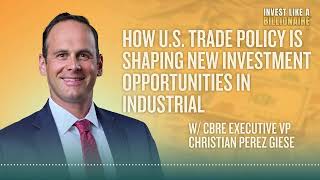
Christian Perez Giese, an industrial real-estate broker in El Paso, traces how 2018 China tariffs triggered a second wave of nearshoring to the U.S.-Mexico border. Traditional manufacturers are moving south as labor costs rise and supply chains regionalize, creating a shortage of suitable industrial real estate on both sides of the border.
Chapters
Hello, future billionaires, and welcome back to another episode of the Invest Like a Billionaire podcast. I am your co-host Ben Fraser, joined by fellow co-host Bob Fraser. Today we have a very exciting guest. I cannot wait for this conversation. We have brought on the podcast today Christian Perez Giese of CBRE. He is headquartered down in El Paso, Texas, and we actually had the great fun of getting to meet him in person and learn about this border market, El Paso, Texas, but also the broader trends going on in the industrial real estate markets. And also watched a webinar that Christian and his colleagues at CBRE put on a few weeks ago, which we will link to, talking about some of these trends. And so we said we have to get Christian on the podcast. This is so interesting as it ties into a lot of the things we talk about on this podcast of nearshoring, reshoring, the next wave of industrial boom and what's driving that. But today we're going to get into the nitty-gritty. So, Christian, thanks for coming on. Cannot wait to chat.
Awesome, Ben. Thanks so much. And it was great to meet both of you when you were down in El Paso. I think El Paso is one of those areas that you need to come down and see firsthand to really understand a lot of the larger trends that we're seeing both on the border from an industrial real estate perspective, changing logistics markets. And the relationship that is not new between the US side and the Mexican side of the border. So I look forward to discussing it with you.
It's kind of crazy to be in a border town and there's just this giant wall, you know, right there. And you drive along the wall and there's lines of cars coming and going, and one side of the wall looks completely different than the other side. And just so interesting to really get a firsthand view of what's happening. Companies are on both sides, right? You've got companies that are on the Mexican side, and then they're also on the US side, and they manufacture the products on the Mexican side and then do some final assembly and logistics on the US side. And it's kind of a finely tuned machine.
It's incredible. And it's been happening for decades. And aside from the industrial side of things, which we'll be talking about today, you just look at the relationship between the communities on both sides of the border. Retail sales is incredibly important. The family relationships people going back and forth on the weekends or every day if they're commuting. And, you know, it's one of the reasons that El Paso specifically and a lot of the border markets really punch above their weight. The demographics and the income data doesn't match what you see on the ground when you're down here because it's really a much larger community that's coming together as one on that cross-border basis.
Wow.
So there's a lot of great reasons to come down and visit and do the fun stuff. But the main thing that brings everyone down here is the industrial and, you know, the maquila industry.
We've been talking about for a long time on this podcast of just the reshoring, nearshoring trend. And you've been in this space in industrial real estate for a very long time, right? You've seen it all develop from the very beginning days with the logistics boom and the e-commerce boom to now, you know, reshoring, nearshoring. Just talk about the biggest of trends and what are we seeing, you know, in the past and what are we seeing now?
Well, I'll start off. I moved down to El Paso in April of 2002, and that was the year after China joined the World Trade Organization.
Which changed everything.
Which changed everything. And I recall that I think it was the second month that I was down here, and one of our— the CBRE for sale signs was on the COVID page of the New York Times. Business section talking about manufacturing leaving Mexico and going to China. And so the first part of my career was really dealing with the outflow and the impacts of investment and operations moving into China. There's a bunch of different examples, but one that I like to talk about is during those first years when I moved down here, I was an industrial— I am an industrial real estate broker. And I was doing a lot of cold calling. And one of my areas of focus was on the plastic injection molding operations that were on the US side, making parts to support what was happening in Juárez, Mexico. And these are not exact terms, but when I moved down here, there was, you know, 25, 27 plastic injection molding operations in El Paso. And for the most part, they've all left. They all went offshore and they went where the business was. But when you have trends that are happening globally, we feel the double effect here on the border. And so the first part of my career was relatively unexciting with manufacturing leaving Juárez and leaving northern Mexico. But you've always had the fundamentals of the border relationship. And this goes back into the '70s when the Maquiladora program started. The Maquiladora term is generally used to describe foreign manufacturing investment into northern Mexico. But you've always had companies that are coming down to take advantage of the lower labor prices in Northern Mexico and the logistical advantages of getting that product back to US consumers. So we had a rough couple years when I first started. The market had kind of started to turn around and become a little bit more positive going into the great financial crisis, and then we dealt with that. And during that same period of time, there was a, an uptick in some of the security issues happening up and down the border. And then in really 2011 and 2012, where you started to see an equalization of the Mexican wage and the Chinese wage. Yeah.
People don't realize this, that the Chinese wage has been rapidly growing and it's now cheaper. The wage in Mexico is actually cheaper than the wage in China. So it's advantageous if labor is a cost, right?
In the last couple years, we've had some exchange rate and labor events happening in Northern Mexico, but yes. Absolutely the truth. And we started to see the impact of that where our business stabilized, you know, 2012, 2013. And we had a pretty good run into 2018. And 2018 is very important for me because I believe that marks the beginning of the first wave of modern nearshoring. Nearshoring is a term that's thrown out all the time. But really nearshoring's nothing new in Northern Mexico. We've been doing it for 50, 60 years. And of course, 2018 being the year that there were the first tariffs from the United States and the Trump administration on China. And we started to see an increase in activity in 2019 and early 2020, which of course was delayed for a relatively short period of time on the border because of COVID And then we came out of COVID like much of the rest of the country on fire, but we came out with dramatically different types of manufacturing users setting up operations in Northern Mexico. And these buildings were way more sophisticated than the light industrial activity we'd seen in the past. The buildings have more being invested into them in clean rooms, in temperature control operations.
So it's kind of higher end, it kind of manufacturing. Exactly.
Just for example, we have a 4-star manufacturing building that's coming online in Juárez. There's another 2-story manufacturing building. We have a lot of land, so why are you doing that in a region like Northern Mexico? But as you're bringing back that more advanced manufacturing from Southeast Asia into North America, they're taking what they were doing there and bringing it back here. So the model has changed and the product has changed. A lot of people have equated the boom that we saw on the border, on both sides of the border in 2020, 2021, 2022 to reactions to COVID and supply chain disruptions. It's my personal opinion that that is incorrect. That boom that we saw, this first wave was actually the reaction to the 2018 tariffs and the first movers moving advanced manufacturing out of China into North America. And that's exciting for me because we then haven't seen the bigger impact, which is the impact of COVID and the final decisions for our clients to adjust their supply chains. And that's really looking at regionalization.
That's coming.
It's, I think we haven't seen the majority of it coming yet.
And so that first trend coming out of COVID was really the early adopters of the more sophisticated technology, manufacturers coming in, but it was just the first movers, right? So the vast majority still haven't done this.
That's correct.
And part of that, Christian, is likely because these are big fundamental decisions to how a company is going to have their supply chain. It doesn't happen in a vacuum, doesn't happen overnight.
And millions of capital expenditure.
Yeah.
You— what about training? What about the supply chain to the Mexican operation? So it's incredibly complicated. So the first movers have done this, but what's remaining is the vast majority of people. And as as you point out, you know, the general supply chain move because of security risks and supply chain risks has not even happened yet.
That's right. And I think the first movers were, you can understand them because they were in higher margin business that had the ability to pay for the new capital.
Right.
Being invested in their plant and operations. And so they had the incentive to adjust their supply chain and maintain those margins faster than the rest of our, air quotes, normal manufacturing. And I think that the higher value consumer electronics and some medical devices are the first wave that we've seen.
That makes sense. Yeah.
And traditionally, the vast majority of investment happening in Northern Mexico is from American firms, closely followed by Western European firms. They have been outweighed by Taiwanese investment coming in over the last few years. And then the segments have changed. We have traditionally about 35 to 40% driven by the automotive sector. That's dropped down to 12 to 15% over the last few years. The auto industry is going through a whole different set of changes, but we haven't seen the normal manufacturing coming back into our markets like we would expect. And I believe that normal investment, those normal operations, is the second wave of modern nearshoring. Followed closely by good old-fashioned parts suppliers, metal stamping, plastic injection molding, corrugated operations, the guys who are doing the nuts and bolts of industrial work in the world. And a lot of them offshored outside of North America, and I think there's going to be a huge impetus for them to come back to North America because that's where their clients are here. They're following the supply chain.
Yeah. So you had this kind of early adopters. They got, as you said, it were probably a reaction to the 2018 China tariffs and had high margin businesses. But now as comparative costs in China have continued to rise, as more existential concerns about political risks and other supply chain issues are becoming more apparent through the post-COVID world, we're seeing a bigger shift and a more diversified footprint of, you know, types of industries moving to the border. So talk about some of the changes that you've seen in the past few years even. I mean, I have your deck pulled up here and the border trade growth where Laredo is now the number one trade port surpassing Los Angeles. I mean, that feels like huge news, but that was the first time I had read that.
Wow. It's huge news. And, you know, the Laredo port of entry is picking up everything coming up what's called the NAFTA Highway from Mexico City up to through Monterrey, Mexico, crossing it, the Port of Laredo, and then heading into the Texas Triangle and up through the spine of the United States. It's the main north-south industrial corridor in North America. And the truck volume crossing in Laredo is just incredible.
Something like 20,000 a day or something like that, right?
I don't recall the statistic, but it's— if you ever go down there, I mean, it is one huge truck stop. And driving around in a car anywhere on the main arterials in town is a little frightening, but you get to see it firsthand how much is coming across there. And so that is the extension of the auto growth that's happened in the Bajío region, just north of Mexico City. Don't forget that Mexico City, Monterrey, Guadalajara, these are major metropolitan areas. They're experiencing these huge e-commerce growth, population growth.
Mm-hmm.
So there's a lot of trade going southbound through the NAFTA corridor as well, all touching at the Port of Laredo. And I think it's, it's an indication, a great indication of regionalization where you switch that, you know, number one port to the southern border from the Port of LA and Long Beach. And, you know, the easy way that I describe it is if you are putting your latest manufacturing operation with a 10, 20, 30-year horizon into Northern Mexico. As soon as you're making product, your team is going to start thinking about having a first-mile strategic distribution center on the US border. And that's what we've been seeing in Otay Mesa. That's what we've been seeing in El Paso. That's what we've been seeing in Laredo and even going down into the Rio Grande Valley in South Texas. And a lot of the real estate, the physical real estate that these companies need to operate don't exist on either side of the border. And so we're having to build it.
You know, it's so interesting. I don't think about exporting to Mexico. What do we export there? What do they buy from us?
Well, there's a bunch of, you know, consumer goods that are going back and forth. There's a bunch of food. Powdered milk is something that there's a lot moving through El Paso. We have a fair amount of powdered milk stored. So there's things that you kind of never think about.
Grain, I imagine.
Grain.
Farm products. Yeah.
All kinds of stuff. But if you look at what's really going on with— the term that's fallen out of favor is twin plant. And the twin plant refers to you having operations on both sides of the border that operate together. And you have parts that a lot of the components that are being assembled in Mexico are coming from across the world. And they're being— historically, they've come in through the Port of LA and Long Beach, or they've come in from the Port of Houston. They would be trucked to El Paso or Laredo, and then they would be sent southbound, assembled, and sent back northbound, and then distributed. If you look at auto parts, and there's a bunch of news stories talking about the crossing back and forth of a car component, you know, going back 5, 6, 7, 8 times, it absolutely happens. So a lot of the southbound stuff is components, and a tier 3 automotive component who is making seats is then, you know, bringing that back into the United States. That's going into regional distribution. A big chunk of that's probably coming back into Mexico to the auto assembly operations in addition to going to Southeast US and up to Detroit. And you've got the stuff that's just bouncing all around.
That's so interesting. Now talk to me about Mexico and the labor pool, you know, I mean, I, I, because I think most of our listeners would probably— we have some stereotype in there that these are pretty much mostly unskilled labor. But I'm guessing that's really not true, that there's a lot of engineering, design, you know, and high-end kind of expertise down there. I mean, talk about the labor pool. Has it been getting more sophisticated?
The Mexican labor pool is incredibly sophisticated and diverse because they have a deep manufacturing basis, both from a product that is being manufactured and generational experience in manufacturing, something I think that the US has lost a little bit of. But, you know, if you go into one of the trends that we're seeing, right, I look at what I can see with my eyes and my clients are doing in their buildings, and I try to always build my understanding backwards from that point. And so if I look at what my clients are investing in, in their buildings, We had gone through a 10-year period where we were moving away from large amounts of office and support areas in the production facilities, and they were getting kind of leaner and lighter. Well, that trend's reversing. A lot of the modern buildings that are being built are being built with multi-story mezzanine offices. And the reason that they're doing that is because they have their R&D happening at the production plant.
Right there.
And so you have Mexican engineers that are coming from some of the greatest universities in the world in Monterrey, Mexico City, Ciudad Juárez, across the country, that are working in industrial engineering. And they'll have hundreds of them in a modern facility working with clients and their own teams globally. The typical company that's working on a production facility in Northern Mexico has a global footprint. They're in Southeast Asia, they're in Eastern and Western Europe, they're moving into Africa, they're in South America. So a lot of times you'll have your R&D headquarters in Monterrey or in Ciudad Juárez. And the skill level there is massively impressive. The upper management skill sets in Northern Mexico are absolutely and totally world-class. This is one of my favorite parts of the jobs when I'm going in and talking to clients or, you know, going in and meeting someone for the for the first time, and you start to hear the history of a general manager or plant manager, many times these guys have worked around the world. And they're working in Juárez for a handful of years and running the facility, but they're moving all over the place. And a lot of times, it's global talent, it is global pay scale, and these guys have global perspectives. And they understand the challenges that are out there everywhere around the world. And they're bringing that expertise into northern Mexico in a major, major way.
That's incredible. Now, we're really experiencing kind of a shortage of skilled labor here in America. You know, engineers are short supply. Is it the same in Mexico, or there— is there more of an abundance? What's the supply and demand side for skilled labor?
There is an abundance. And again, I, I like to focus on skilled plant floor labor. The engineering talent is there, the management talent is there. But, you know, when you're looking at industrial manufacturing operations, that, that is a skilled labor pool that you need. And one of the trends that we have seen now is over the past 6 or 7 years, the labor cost in Mexico has increased and increased fairly dramatically. There are some government policy issues in play in Mexico that have driven some of that growth. And some exchange rate issues. And that has squeezed the margins of some of the more margin-sensitive older assembly operations. The one industry that we have picked up on is the automotive wire harness business. Incredibly margin-sensitive, incredibly volume-sensitive. They have been vacating industrial real estate space in Northern Mexico. And as they vacate industrial real estate space, they are laying off employees. So the total number of workers employed in the maquila industry in all of the border markets has actually decreased over the last years and decreased to the point of 10, 15%, fairly dramatic. That labor is now available and has 10, 20 years of training to go into a higher value manufacturing operation. So the labor is there. That's not the issue. The issue right now, and where we have stalled out of the last 2 years, is simply geopolitical and macro events that have made it more challenging for our typical clients to make decisions or to execute on decisions that have been made to put in their new factory.
Yeah, I can imagine that. And, you know, we see rising wages in Mexico, a rising kind of educated middle class and an upper middle that's a good thing, right? That means these people can afford houses. It means they're invested in their own country. You know, it means the wealth of the nation is increasing, and it just— it's only good. And it also speaks to the sophistication, increasing sophistication of Mexico.
Yeah.
And getting to this supply chain, you know, the reshoring, nearshoring trend that's happening, as you point out— I mean, really what I'm hearing from you is that we're just in the beginning stages. Most companies really have not been able to do this. You even said a lot of these companies, they have a mandate to build these plants and they just are trying to put together the plan. And I, I think it's incredibly complex. If you actually did supply chain analysis, which I'm sure these companies are doing, the average listener here on this podcast may not realize how complex these supply chains are. There may be a thousand suppliers. I mean, think of an iPhone and I'm sure there's a thousand suppliers, you know, and, and probably in 50 different countries. And I'm just guessing, but it's incredibly sophisticated. And the world globalized since World War II. If you look at trade as a percentage of GDP, it's been increasing until about 15 years ago, and then it started reversing. But the world has spent basically the last 70 years globalizing, and it's going to take a long time to deglobalize, right? To deconstruct all these massive supply chains. And so it feels to me like this is a trend that's going to continue in its measured growth for the next 20, 30 years.
I think the setup is there. And maybe an easy answer to that is the earnings announcements from Maytag earlier this week. They're starting to see the advantages of their regionalization in North America and their sales because they're not having the same impact for tariffs. And so they were a little ahead of the curve and they were able to avoid some of the mayhem that's going on from the disruptions of the changing tariff environment. And when the dust settles on that, I think people will then have clarity to go make plans. But whether you call it nearshoring, whether you call it regionalization, whether you call it supply chain optimization, all of these things seem to be pointing to let's bring more of our final product manufacturing into North America for North American consumers. And there were, as you said, there were 20 years of this, or much longer actually, of that going elsewhere. And now as that's coming back, we should have a lot of runway to see continued growth in the industrial real estate segment of that.
You know, one of the things that has completely captured my attention is the amazing move by China with rare earths. And as I've been studying this, I mean, they, through basically pretty heavy-handed mercantilism, have basically dominated the industry. They bought the major manufacturer— maker from GM, exported, shut down the plants in the United States, moved all the technology back. I personally am highly alarmed by this. I think they could dramatically hurt the entire global economy. That's got to be raising alarm bells and raising temperatures in boardrooms across America and across the world to realize we have got to put an end to this. The people that were on the fence, right, with whether they want to reshore or whatever, saying, okay, this is a done deal. I don't know how long it's going to take. I don't know how much money is it going to cost, but we're going to figure this out and we're going to do this. I don't know, give, give me your thoughts about this incredible announcement that China has made and what you're feeling and what you're seeing as you're Kevin these conversations with C-level executives and others?
I think it's part of an unfolding process. The drought in the Panama Canal, the issues with transporting through the Red Sea and the Houthi rebels, the tsunami that happened in Japan and the impact that had— there was a key automotive part that was coming out of there that had global disruptions for the automotive segment. It's a continuation of events that continue to disrupt an increasingly complex supply chain. And if you're making product for US consumers, make it locally so you take the supply chain risk off. As you're going into some of the issues right now with rare earths and Chinese companies, I think that's above my pay grade and much more of a longer-term issue.
But are you seeing the alarm? Are you seeing the increase in temperature of the—
Yes. Yeah. Yeah. And semiconductors coming out of COVID and the issue with all the cars, right? Cars that were sitting there ready to be sold, but they couldn't be sold because you're missing a microchip, right?
A little microchip, and they're sitting there, it's a giant, you know, paperweight, I guess, you know.
All of our clients are talking about this, and on the high level, it's fascinating, right? The global component of this is just fascinating. And I think when you get back to the bread and butter of what's actually being manufactured and the stuff that you never think about, You have a printer sitting behind you, right? Where's the plastic coming from that? Where's the screen control that you have? And the ribbon that goes into your ink cartridge? Where's all that stuff being manufactured? And if you start to look at your global supply chain risks, and taking the risk out of that, you're talking about the United States, North America, Northern Mexico, and A lot of times it's the headline, it's the guy who is making a computer server or a network server that's really the headline news and exciting. But think about the metal stamper who's making the nuts and bolts that go into the rack. You know, those are the types of industries where we're going to see this rebound in the coming years. One other quick example I have is if you've never done it, go stick your head under your car seat. And look at all of the components that are in your car seat. You've got wires and connectors and a steel frame and heaters and, you know, piping for your AC that goes into your seat and, you know, the lumbar massages and all these things. Think about that supply chain just in your car seat and how sophisticated that is and how important that is for auto sales and what a component that is of the US economy.
Gotta have that seat air conditioning if you're in Juárez, Mexico, that's for sure.
Or very important. El Paso, very important down here in the summer.
I enjoyed, I enjoyed your seat air conditioning.
Thank you very much. You're welcome.
Okay, Christian, one other kind of final topic I want to hit on before we kind of round out this conversation is kind of the I-35 corridor in this north to south versus, you know, east to west supply chain and distribution networks.
Yeah, another fascinating component of what's going on and coming back to this, you know, the southern border becoming your first mile distribution point and then where that product is going north and south. And we have many folks within CBRE that are way more sophisticated in addressing that question than I am. But fundamentally what you're seeing is look where the population is, look at the value of the US supply chain. And I always come back to Mexico. So we're bringing product out of Mexico, Central and Northern Mexico. It's crossing through Laredo and El Paso. It's going up the I-35 corridor into the central parts of the United States through Dallas, Kansas City, and into Chicagoland, right? And all of the consumers that you hit from there, all the regional distribution operations that you have from there, and then getting getting back into the heartland of American manufacturing. And I think those all play into an increase of the importance of north-south in North America versus east-west coming from the ports where you have product coming in from offshore and then moving that to consumers.
fun, so insightful. I know our listeners are going to get a lot of this, and honestly, it's cemented a lot of the things that we read about and hear about in the news regarding industrial and nearshoring. But I just, I love the backstory. I love from you hearing the boots on the ground, like what's actually happening. Thank you so much for sharing your wisdom with us. For those that are not subscribed to CBRE Market Insights, I would say it's best in last. You got to get subscribed.
It's the best.
And if you're in industrial, if you're, you know, interested in border things that are going on, be sure to reach out to Christian and his team. We'll put the contact info in, in the notes. Thanks so much for coming on, Christian. It's really fun.
Thanks for having me. Thanks for having the interest in what's going on down here, and always fun to have a good conversation.










