
Inside Look at Endowment Funds with Investment Director Greg Dowell, CFA
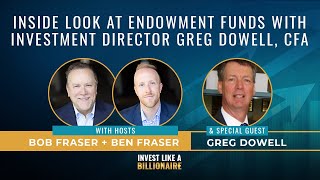
In this episode of the Invest Like a Billionaire podcast, hosts Ben and Bob Fraser interview Greg Dowell, CFA, the Director of Investments for the Texas State Endowment System. Dowell recounts his 30‑year career in institutional investing, describing how he helped grow the endowment’s allocation to alternative assets from virtually zero in 1990 to about 40% by 2013. He explains the origins of the illiquidity premium, drawing on David Swensen’s teachings about seeking under‑covered, private opportunities that command a discount to public markets. The conversation covers the evolution of alternative investments—venture capital, private equity, real‑estate, hedge funds, and mineral royalties—and how institutional consultants encouraged long‑term, illiquid allocations because endowments have perpetual horizons. Dowell then translates these professional practices to his personal portfolio, emphasizing cash‑flowing alternatives, the 4% rule, liquidity buckets, and a contrarian, long‑term holding mindset. He shares concrete examples such as early investment in Siri, multi‑family apartments, mortgage notes, and royalty streams, and discusses the role of alternatives during market volatility and the emotional discipline required to avoid panic selling. The hosts also promote their investor club at AspenFunds.us as a gateway for accredited investors to access similar private deals.
Chapters
This is the Invest Like a Billionaire podcast, where we uncover the alternative investments and strategies that billionaires use to grow wealth. The tools and tactics you'll learn from this podcast will make you a better investor and help you build legacy wealth. Join us as we dive into the world of alternative investments, uncover strategies of the ultra-wealthy, discuss economics, and interview successful investors. Hey, Invest Like a Billionaire podcast listeners, we have another great podcast episode for you today. And this interview is with Greg Dowell, who is the Chief Investment Officer of the Texas State Endowment System. So, uh, when I met Greg, um, online a few weeks ago, I was like, we got to get this guy on the podcast because this is exactly who we want to model our personal portfolios after, right? And we've talked about in prior episodes on this podcast of the ultra-wealthy are investing differently than the average high-net-worth investors. And the biggest difference is alternatives. And Greg is, you know, not new to that space. He's been investing in alternatives for over 30 years. And so in this episode, he talks about his experience taking the endowment he started working at from 0% to 40% in into alternatives. Um, talks about David Swensen, who's the pioneer in the space at the Yale Endowment, uh, breaks down the kind of illiquidity premium and what that means. And then, uh, lastly, and I think most interestingly, was how he applies the things he does in his professional career to his personal portfolio and looking for cash flow and investment. So you're going to love this episode. He's got a lot of great insights. And we want to let you guys know, if you are enjoying this podcast and you're getting intrigued by some of these, um, opportunities and ideas about alternative investments, we encourage you to head over to our website at aspenfunds.us. And we have a little, uh, part of the top of the webpage there that says opportunities, um, our offerings. Go ahead and click on that. You can join our investor club and get notified of new investment opportunities as they come available. So with that, enjoy the episode. Welcome back to the Invest Like a Billionaire podcast. I'm your co-host Ben Fraser, joined by co-host Bob Fraser. And today our guest is Greg Dowell, and we're really excited for Greg to be joining us on this podcast. Uh, Greg is the Director of Investments for the Texas State Endowment System, and Greg is a CFA charterholder and has been in the institutional investment space for pretty much his whole career, working, um, in, uh, prior family offices as well as in the endowment system. And so Greg, thanks so much for joining us. Glad to have you on.
Oh yeah, I'm excited to be here and, uh, listen and learn and, uh, speak from my experience. And hopefully some folks will take, take a grain of salt, you know, take it with a grain of salt. But hopefully you'll pick up a thing or two.
I'm sure they will. And just as a, you know, recap for our listeners, you know, a lot of what we like to do in this podcast is look at how the ultra-wealthy, you know, the most successful institutional investors are investing and apply a lot of the principles and strategies to our own personal investment portfolios. And Greg, talk a little bit about your experience learning from David Swensen, who is kind of a pioneer in this space, in the endowment space for the Yale Endowment and kind of how he—
And let's set that up for a sec. So, so really this guy, Mr. Swensen, pioneered this for the Yale Endowment, which became one of the most successful endowments. So just for people to know what endowment is, endowment is when you know, alums or whatever, you know, fund this investment vehicle that is designed to produce income and profits that will fund the growth of a university system. So it's basically an investment portfolio. And what he did is he completely shifted the entire thought about how institutions should invest and by, by really a heavy use of alternatives. And so what happened, he became so successful and so well known, it pretty much shifted the entire industry into this focus on alternatives. And today, you know, you know, generally, you know, these large institutions and high, ultra-high net worths, you know, invest around 50% of their net worth, you know, into alternative investments. So talk about, you know, you were one of those guys who ran an endowment and, you were actually kind of, you know, probably were aware of this, you know, you were aware of the shift and, you know, kind of a lot of the industry kind of saluted him and took their kind of, I guess, you know, marching orders, you know, from him. You know, not— they didn't tell you what to do, that's what I mean. But really, he kind of was leading this whole new charge. So talk about what happened that whole period, the transition and, and, you know, your experience.
Sure, sure. I met David Swensen when he was promoting his book on portfolio management, early 1990s. I started, got out of Texas A&M University, went to the Air Force, and then I had a finance degree out of A&M and switched over to the National Guard and became an investment analyst in 1990 with a private family foundation in Dallas. And We shared the same consultant, Cambridge Associates out of Dallas. So when David wrote his book, he was on this tour and I had— there was a luncheon with 10 other Dallas large foundations, you know, university endowments. And David was the beginning. And then at that time, Yale and Cambridge were kind of the— they were their pioneers, like you had said. And David was all about, you know, value. He wanted to buy a dollar for, you know, 60 cents on the dollar, like most value investors. But he was willing to do things that was kind of unheard of at the time. He was willing to— and he called it the illiquidity premium. And I reread this little chapter on the illiquidity premium. And what David mentioned in his book was how Microsoft, which was one of the largest— 1990s, you remember, that was when Microsoft, Dell, Intel.
Yeah, they were the biggie.
Yeah, those four, you know, those four were the FANGs of the 1990s, right? You had the FANGs, you know, it's just another marketing term that Wall Street uses, but at the time it was the four largest and Cisco, I think, was the other four. But Microsoft, in his book, he talked about how the analyst coverage of Microsoft, and I think there was like 50 to 60 analysts covering Microsoft. And then he mentioned that another public equity had one analyst. And he kept saying, you know, smart people can look at Microsoft and you're competing with 54 analysts, plus all the other thousands of investors that are going through the financials of Microsoft. You can compete at that level, Or you can go to the smaller, more unknown companies, and maybe you have one analyst coverage or maybe none. And so that's what he said was the illiquidity premium. And I think it's also funny is back in the day, in the '90s, the Wilshire 5000, which is a very large publicly indexed— that people index, they think of S&P 500, but the Wilshire 5000. It used to have 5,000 public companies. Today it's half of that. And it is really a lot of people, a lot of corporations have gone private because they don't want to go through the SEC or the quarterly, you know, have to beat the quarterly numbers, everything. There's more private companies now, so there's more ability to have illiquidity. So if you hire— and David Swensen, or my job was to hire and fire millionaires. That's what I said. I sat across some very successful people that were— I was willing to write a check, give it to them, and they go invest. And the most successful managers we had were the ones that were doing more out of the way, out of the index fund. You had the index funds. You can't beat that. Go get a cheap index fund. But David Swensen was, go after smart people, find smart people, and go after the illiquid or the uncovered equities or credits. And that's what David did. Now, it took us— yeah, and it took— I mean, our foundation, we went from, in 1990 when I joined, zero alternatives, to fast forward to 2013 when I left, we had 40%. But it was, it's like moving a Titanic. I mean, change is hard. And then when you throw in your own personal money, you know, people are like, oh no, I don't, you know, this is uncomfortable. You're, you're, you know, I want to see it on CNBC. We've all become CNBC watchers and we like to watch the little ticker, you know, every second. We like to see, oh, what did Microsoft do this day? What did it do?
Could you explain a little bit of what you mean by the illiquidity premium? That for some of our listeners may not know what that means.
And I'll jump been there as well because so, so it's a well-known fact that a private company, you know, doing, you know, selling cars is going to sell at a massive discount to a public company that is selling cars. If they're both doing $100 billion in revenue, the public company is going to have twice the valuation, you know, the company valuation than the private company. And so that's, that's— there's a discount for being private. And we've seen the same thing in REITs, right? We're well aware, right? Everybody says, oh, real estate's the place to be in high inflation. Well, let's go buy a REIT. And as you and I know, if you buy a REIT, you know, generally the price-to-book value ratio is like 5 for some of these large REITs. So for every, for every $1,000 you're putting into a REIT, you're buying $200 worth of real estate. Right. And that's, that's the, that's the, you know, he can call it the, the, the illiquidity or the liquidity premium, but it's also the hype premium, right? You know, it's the amount of hype and interest creates a huge premium for this stuff. Whereas a little private company that's just doing something. So, so, so it does favor alternatives, you know, and, you know, are going to be a lot of times private. And so they're going to trade at a heavy discount. And certainly for a value investor, you know, for example, if you want to buy value real estate, you're not going to buy it in a REIT, right? You're going to go buy it You know, you're gonna buy bricks somewhere, right?
And part of the idea for, for that discount is because of the lack of marketability, right? Because in a publicly traded company, you can easily transact on your shares, but in a private company, you don't know exactly—
lack of visibility.
Yeah, you, you know, tick by tick for Microsoft, whereas if you own a private company that, you know, a cousin—
there is no tick by tick.
Yeah, a cousin has to share because the cousin wants to buy a Ford F-150 and he needs to sell a share of a privately held company, it's going to take a while to get that thing traded because there is no open market. So yeah, there— that's the illiquidity premium, is in the CFA world you need to be compensated as an investor to go out and lock your money up into something that's not tradable. So That's the theory.
So talk a little bit just kind of of the evolution of the space. You're saying 1990 when you joined.
And was it really kind of a, you know, like a bomb went off? I mean, it seems like that. It seems like kind of pre-David Swensen, very light in alternatives in the institutional world. Post-David Swensen, it's kind of like best practices and what everybody is doing is paying a lot of attention to alternatives. Was it like that?
It is, but you just have to realize from 1990. What is it, 30-something years?
Yeah.
So I mean, the light goes off, but it's the Titanic. It, you know, you have investment committees that, that, you know, that a personal investment— my investment committee is me and my wife, right? I mean, that's the investment committee for an individual. For an institution, you have alumni that sit on boards, you know, they give money, then they sit on the board. And they might be a venture capitalist. Well, guess what? Everybody is going to say, we have to go venture capital. He is— if he's a big check writer, you know. But, uh, you know, it, it just evolved with the combination of the consultants out there, Cambridges and all the consultants start to say, hey, listen, you can go out and get Well, first of all, first of all, let's distinguish. Well, big distinguishing part between an institution and an individual is a time horizon. An endowment is in perpetuity. A university endowment is going to stay forever. You know, a foundation, a private foundation, unless it's got a term-specific date— there are some, you know, foundations that are term-specific, but the family foundation I work for, in perpetuity. So the consultants came to us and said, you know, you don't really need to be able to trade your entire million, multi-million dollar, a billion dollar endowment tomorrow and turn into cash because you're not giving it out. So you can take some—
take some private investments. Yeah, exactly. You don't need liquidity.
Yeah, you could buy real estate, you could tie your money up into these 3-year, 5-year, 10-year lockup plans because you don't need your fund. And that's when everybody starts saying, oh, you know, from an institutional per— yeah, we don't need our money.
Why pay for liquidity if you don't need it?
Yeah, why pay for liquidity if you don't need it? So then, then it just kind of rolled out from there, and then more investment committee members became more knowledgeable, and it wasn't so scary to be. And, you know, I'll be honest with you, we had— when I came in 1990, our family foundation still had cash on the balance sheet from the '87 crash because the investment committee was scared, went to cash in '87, still had 20-25%. Yeah, so the opportunity cost is huge. So, you know, it is an emotional thing. And, you know, and institutions have just as much emotional bound up in there and committees than an individual because they are made up of individuals.
Well, talk a little bit. I'd love to dive into what you're saying. When you started in 1990 to when you left, you took the endowment from 0% alternatives to 40%. I mean, that That's pretty impressive. And also, it's a long—
yeah. Oh, it was a long, hard process because, you know, we'd take two steps forward, one step back. You know, you had the, uh, 1990 blowup, uh, and then you had the 2001 venture capital, you know, the end of venture capital as we know it was— it was dead. And of course, the first thing that members of our committee was, well, it's all the alternatives' fault. And we're like, no, the public markets got marked down. Sure, the privates will get marked down too, but they would see that slice of the pie would go from 10% of alternative all of a sudden to 20% just because our pie got smaller because of the public markets got small. So then they would start, oh, we can't do anymore. And we're like, interesting, you know, like, like everything else when there's a crash, that's when opportunities really are there, right? I mean, when the subprime hit and subprime was trading, they were throwing out prime and subprime. And we were, you know, we were looking at some deals. We passed on some because we just couldn't get the, you know, the committees to say that's a great time.
But so what were some of the alternatives that you invested in and really kind of pioneered during that time with with that?
Typically real estate, right? Private equity and hedge funds.
Is it kind of a mix? Well, we did the— there are no pioneering here. I mean, you know, we didn't do any pioneers. There are pioneers in our vernacular is you got arrows in the back, you know, and in the Air Force, the pioneers we call the bleeding edge. We didn't do that. We got into venture capital, but venture capital started in the 1970s, you know, out in Silicon Valley. We didn't, you know, we were 30 years late, you know, we were late, 20 years late on that. But yeah, we did venture capital, which was great, you know, both just not only computers but biotech. We made a lot of money in biotech. And we did, you know, I have to admit, one of our, I remember sitting there in my office with a little letter and one of our technology was Siri. And we're like, what's that? It's like, they, uh, uh, the Apple founder Steve Jobs, this was the only thing that he personally got involved. This was a story we told, you know, we're told by our venture capitalist, sold Siri to, uh, Steve Jobs. Says Steve Jobs really wanted that voice because that was the best voice technology ever. And we made like 20 times our money on that. And it was just these tiny little companies private that weren't marked to market, but our venture capitalists seeded it, you know, nurtured it along, and it got bought out by Apple. And, you know, that was some of the great things. But we did private real estate, you know, was a big thing for us. And then the hedge funds. And the hedge funds were always, you know, sold to us as a diversifying strategy that could help mitigate some of that downside protection. Because, you know, if you own— if you own Coke and Pepsi and the market crashes, Coke and Pepsi are going to go down. But if you're in a long-short— maybe he was short Coke and long Pepsi, so when Coke went down, you actually made some money, and that kind of offset it. So, you know, we did like the long-short space too. But, you know, there's a lot of arbitrage. We did a lot of arbitrage in the hedge fund space just to dampen 'Cause you know, it's very difficult in an institutional world to go into a quarterly meeting and, you know, the market just crashed. And the old joke was, oh, our 401 is now 201. How'd y'all, how'd your, how'd our private foundation do? And if we couldn't say, you know, better, you know, if the market was down minus 20, we better be, minus 10 or positive, because it got really ugly when we'd say, well, we also lost 30%. You're like, oh, you're an idiot. Well, maybe we were, maybe we weren't.
Yeah, it's interesting you're mentioning hedge funds. So we did an earlier episode, um, we kind of went into hedge funds and what they are, how they work, where they're advantageous. Do you remember the episode number, buddy?
Number 4, somewhere around there.
But I encourage our listeners to go back and listen to that because I actually think that it's you know, we're going to see now, you know, where hedge funds have been pretty much underperforming, you know, by and large, right, since, since 2009. And that's because you simply— if the index is going one way, right, it's, it's hard to compete with a rocket ship that's going one direction. And, and hedge funds typically can get you really close to the same kind of returns as an index, but without nearly the amount of volatility. And depending, of course, on that. So it's probably a good time to start to revisit hedge funds.
Some of the data that you found is really that they perform best in periods of volatility.
Right. And so, so now that we're seeing, you know, some volatility returning to the market, you know, versus just it goes straight up, you know, hard to compete with straight up.
So it might be a real good, real good, real good thing to look at for nothing to Yeah, nothing compares to the public markets in a long bull market, right? Exactly. When you can't— you're 100% long in your passive strategy index, you know, it's going to win hands down when you've got— and let's face it, I mean, America, knock on wood, thank God, has been in a capitalist society, has been basically in expansion and growth mode Now, you know, with the demographics and all that changes, who knows what that'll, you know, foretell in the future. But you're absolutely right. If you think the hedge funds is going to outperform during extended market, I would say, boy, that you're buying a wrong product. You really need to sit down and say, what does my hedge fund— and in our hedge fund, our portfolio on the institutional side is there for one thing, make 6 to 8 You know, and if it's really crashy, make -1 to 1, you know, but just 68% returns. Yeah, but if you say yes, single digits, you know, and, and you'll be happy. I'm saying single digit during when your market is up 15 or 20, and then make 3 or something when the market is down 10 or 15, you know. So there are, there are recessions and there are market corrections That's it.
I think a lot of people aren't aware of that fact.
Yeah, right. Yeah, no, I agree. I mean, people don't— you know, there's a great quote: Armageddon only happens once. You know, at the end of the world, if it is truly the end of the world, it doesn't matter what you hold. But everybody that starts that, you know, it's the 5% down, okay, get ready. Then it's 7, then it's 10, market correction, market correction. And then if it goes to 15 or 20, sell everything. This is truly the end of the world. And, you know, if you've been around the markets enough, or a student— you don't have to be an investment professional, you just have to have some interest in the markets and take a look at it and say, we've had a depression, We've had a 1918 pandemic. Everybody thinks the pandemic's new. No, it's really not. 1918, 1919. It's just a market reaction. And it's the emotions of the market that people really have to get a hold of. And that's one thing that's different in the institutional world. The first thing I said was, you know, the time horizon. Institution is in perpetuity, but also the folks in the institution, we have an investment policy statement that tries to, real hard tries to, take the emotion out of investing. Because if I'm just a, you know, Joe guy with my own little nest egg, and I've worked hard for that nest egg, I've got 20 years of my nest egg, I've got an emotional investment in that nest egg. And when that nest egg halves, I'm not the rational investor that the CFA and the theory is, right? I'm the irrational sell. And that's usually is not a good strategy.
Yeah. Greg, talk a little bit about— this is kind of where I'd love to just dive into how you've taken your professional experience as an investor of very big numbers for these institutions and kind of translate that into your personal approach. Right.
Right.
Do you— what kind of things do you kind of bring from your professional background and what you're seeing into kind of your personal investment strategy and thesis?
Yeah, well, okay, I would say probably, you know, since I've been investing for 20 years, I started investing in college with my $100 check from the United States Air Force. We would get $100 to pay for an E-5, right? We're in there getting ready to be commissioned, so we thought we had beer money. I was like, I'm not going to spend it on beer, I'm going to invest this. Of course, I went down to my local broker not knowing anything and bought a full fund. What was it? The, the fund, the fee was 6.5%. So, you know, what an idiot, you know. But back in the— back in that, this is '80, probably '83, '84. So you just start learning, and that's the great thing, it's learn early So your mistakes aren't with commas in them, you know, you want to learn with $1, not $1,000. So when you lose the $1, it's not a big deal. But when you start losing $1,000, $10,000, you're like, oh gosh, that's the impact. So, you know, I started there, started trying to read everything I could, you know. And I think what I found out is there's just a lot of ways to skin the cat. that people make money. My parents were very frugal, and they invested their entire career through TIF-CREF, which is just public index. Well, it's not timing the market, whether I'm in and out. It's time in the market. And it was interesting. It was a very good exercise to get ready for this. I have one of my holdings— In July, it'll be held for 20 years. It's a public sector for 20 years. And that's not even— it's still a pretty good-sized portfolio, but that's not my longest hold. My longest holding was, I was in a conference with Wellington Capital Management. Wellington is a huge money manager, and we did some business with them. I was up for one of their annual meetings and come across the portfolio manager for their health healthcare fund. Well, I was like, oh wow, it sounds interesting. So I started looking because, you know, I'm always curious about things. Well, not 2 weeks later, my mother-in-law says, Greg, I've got a couple thousand dollars, what should I invest? Well, I said, well, I met this guy that's very smart and, you know, I think healthcare is great, right? And this is probably '91, '92. And She bought that. She never sold a share. She has since passed on, and now my wife has got those shares still in that same Wellington Fund. And I was like, that's got to be 30 years. So what I've really learned is, you know, just get in the market and hold on to something. Don't be a day trader. I don't understand, you know, when that phenomenon was going on, I'm just like, that just doesn't— that's gambling, that's not investing. I mean, your viewers want to know investing, and the best thing I can say is, you know, make an educated guess, get knowledgeable, and then hold on through thick and thin. If you really like an investment that, you know, intrinsic value, Warren Buffett, if you think it's worth a buck, I mean, you analyze it and you say, this is really worth a buck, whether it's a piece of land, a publicly traded company, or a note, you know, a note, a mortgage note. If y'all think it's a dollar and you can pay it for 80 cents, don't you love it at 40 cents? Because I can buy it at 40 cents, it's still worth a dollar. And I think that's what I've tried to learn is It is great to own something, but don't get, you know, unrealized gains, just, it's like water off a duck's back to me. I'm like, unrealized gain or unrealized losses don't really matter. I mean, if I'm in a position and it's down 20 or 30%, I'm more likely to add to that position because I've done my analysis. It's still worth a dollar, but now instead of buying it at 80 cents, I can buy it at 60 or 65. Uh, but, and, and then the other thing that I really try to do is I really do try— my wife and I, we, we try our best. We say when the nightly news comes on and the headline is the stock market had its worst day in a month, or worst day, you know, 1987 in the crash, I remember as a second lieutenant I was buying more mutual funds because I didn't know enough and I didn't have enough money that even if it did go to zero, I didn't lose it.
Look how to do the opposite.
Yeah, but you kind of have to be a contrarian value investor. I mean, and there aren't many, right? I mean, most people are just driven by CNBC and watching it and getting emotional. You know, if you could do nothing else, write it down on the piece of paper: why did you invest in this fund, or why did you invest in this mutual fund, why did you invest in this stock? And then if it goes down 50%, why don't you buy more?
But the value's still there, right? If that value proposition is still there. But yeah, so talk about alternatives. I mean, so how are you playing the alternatives game?
Sure, sure. So I've got this portfolio that I've grown from publics being in the market for 20, 25 years And now I'm in, unlike the university or a foundation, they don't have to deaccumulate, right? They're for perpetuity. But hey, I'm gonna die. I hope not for a long time, right? So I've got to make those assets turn into an income stream. And I don't really, you know, when I still say I have 20 years of time, right? But now it's more of a cash flow game for me. So now it's, what else can I do that's not tied to the public market? And that's where alternatives come into play. So that's where I'm, you know, I'm looking for cash flowing because I like it at this stage in my life. Not 100%, I never do anything 100%, you know, but 10 or 15 or 20% into cash flowing You know, my, my wife and I have minerals. We have royalties that come in. You know, some people say, oh, that's dirty, it's oil. It's like, well, we're from Texas. I mean, we grew up on this stuff. And, you know, you, you still drive cars and you still like heat in your homes. Until 20 years from now, maybe we'll have some, you know, renewables that'll take over. So we have—
those investments are probably doing pretty good right now, right?
Oh yeah, nobody— I mean, I couldn't— I I couldn't give them away last year. I mean, we were looking at the checks that we were getting and we're like, well, that's not enough. But all of a sudden, $100 oil, everybody wants to be in royalty. And again, you want to be selling that. And I actually sold a couple of our little public royalty plays. But, you know, it's cash flow. And, you know, I'll just throw out like gold. Everybody likes gold and crypto. And, you know, like Warren Buffett said, if I bought a bar of gold at the beginning of the year, at the end of the year, what do I have? A bar of gold. I got no cash flow coming in, and I have to pay somebody to store it. And cryptocurrency, I own one crypto coin, and at the end of the year, I own one crypto coin. What's that worth? Well, whatever somebody's willing to pay. Well, I'd rather have the cash flow coming from a high-dividend stock or a royalty or notes, you know, something that has cash flowing because it's earning something, right?
It's earnings.
Yeah, that, that cash flow that I can either reinvest that cash flow or I can go out and buy groceries with that cash flow. So, you know, I use alternatives now that I'm, you know, 3 or 5 years away from retirement is to take some of that public money that I've stored up into my IRAs to offset that so I'm less reliant on the public market. But I'm still— I mean, my lion's share of my money is going to be in the public market because people don't understand. Like Warren Buffett says, you know, our Rich Man Poor Man— my kids, I bought them that book. I was raised by the poor dad. My dad told me, go to work, get a job, invest, That's all you can do. Where the rich man go own businesses, right? Well, go own business. Or Warren Buffett says, I own businesses, but I own the greatest businesses in the United States, whether it's Coke. I mean, he made a fortune in Coke. And, you know, so you, you can own businesses by being a poor person like me. And you don't have to be the, the business owner. You get more wealthy being the business owner, and I think that's great. But, uh, you can also do quite well owning shares of businesses if you'll do this one thing: hold them for many years. Don't get out, you know, don't get out, especially when the market's down. That's, that's just the mistake you can't make.
So talk a little bit how you view kind of personally the illiquidity premium, because you mentioned before the difference between kind of professional perspective and personal is, is time horizon. And obviously You know, that is a big challenge in some of these alternatives is the illiquidity. But we talked about another episode earlier on how, you know, some of the research we found by Bain and Company and others that most investors, individual investors, overestimate their need for liquidity, right? And because of that, maybe shy away from something that has maybe a longer lockup, like a 3 to 5 year lockup. When, to your point, if you're allocating, you know, a smaller slice of the overall pie to that, it's actually not that big of a deal. It's actually not going to cause you, you know, heartburn down the road if there is a cash crunch.
Yeah, yeah. So, you know, just like, like an institution, we have asset allocation for myself and my wife, right? And that's the first thing you have to sit down and I don't know who came up with the 4% rule, right? Someone did the 4%, and you'll never— you know, you take 4% of your portfolio out of your— every year.
Yeah.
And your portfolio will last forever. I don't know if that's the right number or not, but it's easy. I'm an Aggie, so I got to keep things simple, right? If you go 4% times 5, that's 20%. So if you have 20% in your cash, That's 5 years, 5 years of cash. You have 80% of your portfolio that you can just go crazy. I'm not saying go 80% illiquid, but you don't need the money. You've already taken care of 5 years. So that's how I try to look at it personally. But I, I'm a little bit more aggressive. I say 4 times 3, 3 years for me. So about 10 to 12% in cash seems to me plenty of liquidity. And Ben, that's kind of how I say it. I'm like, so I would say if you can take, let's say it's 20% on the liquid side, I mean, and I'm talking just, you know, just straight CDs if you want to, or just straight money market, then I could, I would almost say you could barbell 20% because you don't need it. You've got 5 years, so you could have 20% in 3- and 5-year lockups, and you'd be fine because, you know, in between that 20% and that 20%, there's 60% that you can get your money if you need to. But you have to have that mindset of really sitting down with, how much do I need liquidity? I mean, you know, some people say, well, I gotta have 50%. Okay, if that's your number, you can still have 10% or 5% lockup. So I try to put it at almost into buckets and saying, how much truly, how much do you need? Do you need 5% every year? We'll multiply 5% by, you know, in most recessions, you know, recessions I think are 18 months on average or less than 12, you know, there's some stat out there. So recessions don't last. And really, the reason you have this liquidity is because the bulk of your assets, which are in some kind of a public markets, say equity, they can go down 50%. I mean, we've all lived through it, but they don't go down 50% and stay. I mean, they do recover once the economy corrects itself and, you know, interest rates go up and cut down the demand, and then interest rates start cutting, demand will keep coming back, and companies will hire, earnings will go up, and all of a sudden it starts another bull market. Well, your 50% down will come back and restore. All the while you're taking money out of your liquid pot and your illiquid, you didn't have to touch it. It's illiquid. It, you know, it keeps going for 3 or 5 years. But that's the hardest thing. I mean, that's the hardest thing on the institutional side because people get emotionally involved and, oh my God, I gotta go access my illiquid stuff. And you're like, no, no, no, you, you, you said, you know, you said at the beginning— and you know, it's always funny, the asset allocation in a bull market, 100% public equities. That asset allocation when you're in the bear market, 0% equities, 100% cash. You know, there's, there's a median that you really have to sit down and say through thick or thin, how much can you take? And you need to have some illiquidity bucket because that's where you can make more. Because people are not— just like I said at the beginning, there's not as many people chasing the little small private company or the little notes that people are buying, or the mineral owners, you know, they buy those things You know, I was talking to one of my friends in Dallas that owns a mineral fund, and he goes, when we send out bids to the landowners like me, I receive them every day— and not every day, but every week. He says we base them off of Ford F-150 because the little landowner will get a letter and it says, oh my God, hey honey, we can buy a Ford F-150 with this. And so they get it not thinking that they just let a stream of years and years and years. You know, that's the most expensive F-150 that he's ever sold. But that's what they did. You know, they did the analysis and said, this piece of illiquid rights, mineral rights, is worth X. We'll discount that. And they'll buy the F-150 where it's truly worth some big—
yeah, so kind of last question is, you know, where on the kind of personal private alternative side, where are you kind of most bullish on and kind of looking opportunity-wise right now? What are you kind of most excited about in areas you're looking at?
Sure. Well, I, I invested in some multi-family apartments here in San Antonio because I like to go kick the tires. So I was able to drive around them. I like that. I'm looking at the notes investing because I do love that idea of having collateral, you know. I, I don't get the, the gold and the, and the crypto. That collateral is based on whatever the market is. But a piece of real estate, yeah, you know, real estate does have its 2008, 2009, you know, where real estate does go underwater. But again, I'm holding things I've got my liquidity bucket already taken care of. I've got 5 years of cash. I'm not— if it goes down, that's fine. I'm not going to sell this until 5 or 7 years, so I'm okay with that. I like cash-flowing alternatives. Let's just put it that way. I like the cash flow because, you know, we've been in a low interest rate environment forever, and if something is backed by real estate You know, real estate loans, I'm looking into a couple of those, uh, mortgage notes. I'm looking at those because it gives me cash flow, and then I can take that and reinvest them in opportunities that, you know, that are out there. But that's the, that's the name of the game, is look for opportunities out there, get your, get your liquidity right, and then time in the market, hold those things. And let the market come back to you.
Yeah, I love that. I love the way you kind of break down how you quantify the level of liquidity. And in the research that we looked at on the overestimation of liquidity, that was, that was actually helpful in most cases. The lack of liquidity, um, was actually helpful because it restricted people from selling at the worst times, right, when the emotion was kicking in. And, you know, the crocodile brain takes over, you know, having the illiquidity is actually a benefit in those scenarios because to your point, most of the time it recovers. Right. And, you know, real estate came back, stock markets come back.
And if you remember nothing, Armageddon only happens once. It does come back. Exactly. When it does it right. And then it doesn't matter what you hold.
It doesn't matter. Well, Greg, this is— this is really fun. Love your perspective.
And thanks.
Thanks for sharing some of those— those nuggets. And helping us all become better investors.
I hope so.
I will say for our listeners, you know, you know, one of the challenges as a private investor is finding access to these deals and these illiquid deals. So, so we just encourage our, you know, if you're listening, head over to our website, AspenFunds.us, and get on our investor club. And because we're finding a lot of these, a lot of these deals, you take a look at them and we're making them available to you know, just accredited investors and simple credit investors find some, some of this kind of great little alternatives yourself. So. All right.
Absolutely. I've enjoyed it, too. All right. Yeah.
Thanks for— thanks for being here.
All right.
Thanks so much.










