
Investing in Turnkey Rentals feat. Ali Boone
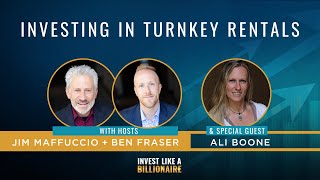
In this episode of the Invest Like a Billionaire podcast, hosts Ben Frazier and Jim Maffuccio interview Ali (Allie) Boone, founder of HipsterInvestments.com, about turnkey rental real estate. The conversation begins with Ali’s personal back‑story – growing up on food stamps, earning a master’s in aerospace engineering, leaving a corporate job, and discovering turnkey rentals as a path to financial independence. Ali defines what a “turnkey” property is (a fully rehabbed, tenant‑occupied home with property management in place) and explains how turnkey providers operate as “glorified flippers” that sell market‑value homes to investors. The hosts and Ali discuss the advantages of the strategy (passive ownership, ability to invest in remote markets, low hands‑on effort) and the drawbacks (paying market price, provider fees, the need for diligent oversight, and the myth of 100% passivity). Ali outlines three critical due‑diligence steps: verify property condition (especially major CapEx items), confirm pro‑forma numbers, and vet the property manager. They explore market selection, noting that turnkey operators enable investors to shift between markets (e.g., Atlanta, Dallas, Nashville) without rebuilding local teams, but stress the importance of market research. The dialogue shifts to the changing investment environment: higher interest rates, lower cash‑flow yields, and the need to focus on the five profit levers of rental properties—cash flow, appreciation, tax benefits, mortgage paydown equity, and inflation hedging. Ali critiques common hype (the 1% rule, overly optimistic cash‑flow promises) and emphasizes that rent increases and appreciation now play a larger role. The episode also touches on lifestyle design, with Ali citing Tim Ferriss as an inspiration and positioning real estate as a vehicle for time freedom. The interview concludes with a promotion of Ali’s free digital book, “Not Your How‑To Guide to Real Estate Investing: Life Lessons on Hacking Your Mind Before You Hack Your Wallet,” and an invitation for listeners to join her community.
Chapters
Hello, future billionaires. Welcome back to another episode of Invest Like a Billionaire. Jim and I had a really fun interview with Allie Boone of Hipster Investments, and she's talking mostly all about turnkey rentals and turnkey rental real estate. And so I'll admit this was something that I was a little bit skeptical of. Just, I share some of the interview of, of, you know, my experience just seeing this space for a while, but She's a big believer in it and has been doing this for a long time and has some great insights that I definitely learned a few things about this space. Jim, I know you've kind of had different experience with rentals and things over time. What was some of your takeaways in the interview?
Yeah, I think she did a good job and I think we pulled out of her also some of the reality that some of the things to look out for and some of the reasons to actually use a service like hers actually and connect with somebody. Because there are some pitfalls and there are some hidden traps, but you know, everything looks good on paper till you dig in. But so I think it's good actionable content.
Yeah. So it's a fun interview. Always got a lot of energy, a lot of personality. It's really fun. And as always, a little disclaimer for anyone that we bring on this podcast that is either, you know, selling something or has investment opportunities. This is not a stamp of approval that we are I have done all the due diligence and vetted them. This is on our listeners to do that. So if this is interesting to you, obviously please do due diligence and vet out every person that we bring on thoroughly if that's something that you're interested in. And finally, we recently just launched our new podcast website at thebillionairepodcast.com. So thebillionairepodcast.com. Please check it out. It's really cool. It has all the episodes there. It's really easy to listen to them all if you want to binge some great content. And we've also started a new thing called Ask Anything. And so if you've been listening to this podcast for a while, we have a series called Top of Mind Series where we will take kind of bite-sized little topics and questions and create some thoughts and content around that. And we really want this to start to become a kind of back and forth and, and, you know, community-provided content. So if you guys have questions, if you have thoughts on the market, on the economy, on different asset classes, whatever it is, please go to that website, click on that link, submit your thoughts, your questions. We'd love to see that and may even be featured on a future podcast. So with that, we really appreciate listening to this episode and enjoy Ali Abun. This is the Invest Like a Billionaire podcast, where we uncover the alternative investments and strategies that billionaires use to grow wealth. The tools and tactics you'll learn from this podcast will make you a better investor and help you build legacy wealth. Join us as we dive into the world of alternative investments, uncover strategies of the ultra-wealthy, discuss economics and interview successful investors. Welcome back to the Invest Like a Billionaire podcast. I am your co-host Ben Frazier, joined by fellow co-host Jim Maffuccio. And today we are talking with Ally Boone of HipsterInvestments.com. Ally, how's it going?
It's going. How are you guys? I'm excited to be here.
Yes.
Yes.
We're excited to talk with you. So you're, you're in California, right? You're in a beautiful part of the country. How's it going?
Uh, California is going great. My real— you guys are distracting me from a really gnarly eviction situation. I'm like, woo! I get to not think about it. I'm like, what do you guys want to talk about? Wait, no, don't stop talking. Keep asking me questions. Cause other— when I'm done with this, I get to go back to, uh, rental property dramas. It's very exciting, but California is always crazy. That's awesome.
Yeah, well, we'll get into all of it, I'm sure, but just, it's really fun little background on Allie and she's a real estate investor and she's got a pretty cool story, which I want her to share a little bit. And we'll even be giving away a little freebie at the end of the interview. So stay tuned for that. But her story is kind of crazy. She went from food stamps to becoming an entrepreneur in real estate and having a very successful career really in turnkey rentals as well as coaching. And so there's lots of cool stuff about you. I think you got a master's degree in aerospace and spiritual psychology. And so all these kind of cool things meld together to make Allie Boone. So Allie, tell us a little bit about yourself and kind of how you got to where you're at.
Sure. Well, both those degrees are two separate degrees. I can picture someone being like, master's in aerospace spiritual psychology. What?
Where can I get one of those?
I like, or A couple of ways. People are gonna think I'm a total nut. They'll be like, what in the world? Where'd you find that certificate? Yeah. So my story is that I grew up kind of with a typical old school mindset. Go to school, get good grades, get a secure job, retire when you're 65, that whole thing. And that worked out well for a while and I followed that path. But it, I think even before I really dove into that path, I knew it really wasn't the path for me. But I did it. And before I ever sat down at my first cubicle, I knew it wasn't for me. Like I had just gone to school. That was the master's in aerospace engineering. I had just gotten hired by the dream company. You know, the whole thing was like, had dream job written all over it. But I very quickly realized that it was someone's dream, just not mine. And so before I ever sat down in the cubicle, I was like, uh-oh, I gotta get outta here. If for no other reason, I've always been rebellious and I'm much better at working for myself versus reporting to other people. It's just kind of not my, not my thing. Mind me then, and here I was early in the morning. I'm at business casual clothes on. I was like, this is terrible. And so the problem was when I knew I wanted out of corporate before I even got my first paycheck, I didn't know how to get outta corporate because at the time I had just gone to school for engineering. I honestly was not really a good engineer. I can still make a mean spreadsheet, but past that, I actually wasn't a good engineer. And before that I was flying airplanes and well, I obviously could work some jobs with those skills, but as far as setting out on my own, None of that really translated to something that would get me out of corporate. So I was like, okay, I gotta figure this out. Fast forward, it took me 5 years. I was reading every book I could find. I was networking. I was just trying to find answers of how I was gonna get out. And ironically, I, some real estate investing opportunities landed in my inbox while I was trying to figure this out. I was not putting 2 and 2 together that those would be my ticket out, but I thought to myself, well, while I still have a W-2 paycheck, like a solid paycheck every Friday, I might as well do something smart with it because whenever I figure my way outta here, I may not have that money or mortgageability or anything else. So I started investing and through investing, just as a side thing, again, I was just something smart to do with my money. I started meeting all sorts of people and one thing led to another. And you know, we'll go into details of the story later, but it, it was just through who I was meeting, turnkey rental properties really came into the picture. And if you would've asked me beforehand if I ever wanted that turnkeys would get me out of corporate. I absolutely would've said no because it's just not, those two things don't really go together. But the way that it all came up, I became such a kind of go-to person for turnkeys because I was so freaking excited about 'em. I was telling anyone who would listen. So suddenly everyone was coming to me asking, who are you buying through? What are they? Wait, what are you doing? And that's what really picked up the momentum to end up having a business. And I, I still didn't know that that was gonna get me outta corporate, but eventually it did. And for the first few years I was solely focused on turkeys. I'm still very much dealing with turkeys all day, every day, if not majority of my time. But over the last few years it's graduated into turkeys attract a lot of newer investors. A lot of new investors are fearful, they're overwhelmed, they have no idea what's going on. And I know that when I was a new investor, I was lacking a lot of information and a lot of support. And in this industry it's like, what do you, for us, like Do I trust this dude in a suit who swears financial freedom? Like there's no checks and balances really. So it was intimidating. And so I've kind of graduated alongside doing turnkeys is I really loved help coaching people. And I'm saying it's not just new investors, it's people who are doing whatever strategy, they run up against an obstacle and I love being able to help out with that. So that's kind of where it's gone to now, where most of my time is spent doing turnkeys and coaching, which I love the coaching factor because I get to talk about a lot of things not involving turnkeys and Meeting people, helping people see it all along their journey, which is so fun for me. So that's kind of where I am now.
Let me, let me roll the clock back a little bit. That's awesome. But let me just ask you, when you say you've, you know, opportunity came to your inbox, was it actually to be a passive investor in a turnkey property or was it to learn how to do the business of providing turnkey investments to others? Because those are, that's, that's quite a big Yeah.
And that's a great question. So it was funny because I was so bored at my dream job for 5 years. I had subscribed to every newsletter. Now I unsubscribe to every newsletter I possibly can, but at the time I was like, bring them to me. I don't know what's getting me out of here. And what's funny is the, I think it was a Think Realty newsletter that ended up in my inbox and the advertisement for, you know, the preface to this before I tell you what it was, I had just gone down with a real estate agent. I live in LA. And I went down to Orange County looking at possible rental properties. I knew nothing about rental properties. I didn't know how to run the numbers. I didn't know anything. And all I could see were these very expensive dilapidated houses that I would have to rehab. And then the rents weren't that high. And I was like, head scratcher. I was like, I don't know how rental properties profit, but I don't see how these numbers work out.
Orange County's not a good starter market for rental.
No, it's a terrible starter market. Like the cheapest property we looked at was $271,000 and there were—
but you probably would have bought a boatload of those then, right?
No, no, I'm good. I'm good. Actually, now you say that, I wonder what those properties are worth now. And so right before this, the realty thing showed up on my inbox. One was like $270,000 for a shack. Like, ugh. So the advertisement was beachfront bungalow for $99,000 in Nicaragua. And I've always been a rebel and I love doing things that make people's heads turned. And after I giggled, I was like, where's Nicaragua? Oh, Central America, the third world country. That's kind of what I was thinking, but I wasn't sure it was actually what we were talking about. So it was a pre-construction development and island with a beach. And I was like, wait, $99,000 with seller financing. I think it was 30% down or something like that with seller financing on a beach in a third world country. I was like, done. Actually, I take that back. I didn't say done. I was like, scam, absolute scam. But I'm gonna pursue it because if for some reason it's not a scam, then it's very exciting. So I went forward on it, honestly assuming it was a scam, but the more I met the people, the more I signed contracts, more like Wyndham Hotels was in on this thing. Jack Nicklaus Golf Course Design was on this development. I was like, hey, that's kind of fun. So I went forward on it, but the people who were working on that project were also involved with turnkeys. And so the whole time this was going on, they were, they kept bringing up turnkeys and I was like, it sounds so boring compared to beachfront property in a third world country. I was like, I have no interest in this turnkey thing. So I was looking at all of these investments just as things for me to invest my money in. And one day the guy said, listen, we know you're not into turnkeys, totally fine, but just want to give you a heads up that the next big market is Atlanta because I knew I was from Atlanta and I was like, oh, well, if it's not Atlanta though, like I'd be kind of dumb to not just, I go to Atlanta all the time. Like I should at least look at these things. Like, so boring, but whatever. Real trip and out. That was literally my mindset. And so I went to Atlanta, I bought my first turnkey immediately. I was like, oh my God, how can I get however many of these? And so the answer to your question is it was solely from a, what can I invest in myself? Because the big appeal about the turnkeys to me after I put aside the rebellious adventurous side of third world country pre-construction developments, um, was first of all, they were so cheap, but the big thing, but for a good house, fully rehabbed, tenants in place. And I was like, well, this seems too good to be true. 'Cause this was 2011, right in the middle of crash. Everything was cheap. And the big thing for me, and especially compared to those Orange County houses, there was no rehab needed. Like my goal of getting out of corporate was never to go get another job. I didn't, I'm not very handy. I don't like managing contractors. I didn't like any of that. And I think that's what held me out of real estate for a while because it seemed like everything I could have done involved that kind of work. And I was like, I'm just not, that's not my strong suit. I'm not good at it. So all of a sudden turnkeys come around. I'm like, wait a minute, so I can still get a good investment and not have to do any of that? And that's what got me hooked from the get-go. So I started buying turnkeys and that's when just casually, I was telling so many people about it. Like my cousin ended up buying one, my mom's friend bought one, and I started writing about it online. And that's when BiggerPockets found me. They asked me to be a writer for them. And that's what propelled it because it was not so much me buying the turnkeys that got me out of corporate, which that helped, but it was really everyone coming to me as suddenly kind of this like turnkey guru, because turnkeys have been around for a long time, but I don't think people were really talking about them, you know, in mass quantity.
Okay. So on that though, I gotta ask you a question because there's, there's probably A small percentage of people that are listening that have heard you say turnkey now about 30 times. Just in a nutshell.
I mean, it is almost Thanksgiving, so maybe she's saying, yeah, exactly.
Turnkey everybody, not turkey.
Okay.
Yeah. Well, and I cannot write anything but Thanksgiving with, I can't type turkey. Like it's all like, I'm like, oh, you know, how was your turnkey dinner? Or like, could you bring one to me for turkey? And it's funny too, because I feel like I eat, sleep, and breathe turnkeys, and I forget sometimes that some people have no idea what that term means. So the term turnkey is a turnkey rental property. The term turnkey itself refers to the condition of a property. So the metaphor is that we stick a key in the door, you turn it, and you're making cash flow on day one.
It looks— this is typically rehabbed, if not new construction, tenant in place, property management in place.
Yep. Stick that key in the grass.
It's as passive as you could get in real estate versus investing in a real estate fund or something like that. Because you actually, the buyer, the turnkey investor actually owns the home. And that's about it, right?
Yeah. For you to personally own the home, it's about as passive as you can get. Like if you do syndications or notes or whatever, that can be more passive for sure. But for you to own real property, and it's definitely not 100% passive. And so I think a bunch of drama going on right now. And it does require your brain to be involved. And the most important thing is you doing due diligence, because what I've learned over the years is that when we call it passive and hands-off and all that kind of stuff, which I'm one of the culprits of calling them that, that it gives people this message that they just never have to do anything. It's like, ooh, that's not good. But the term turnkey itself, while it technically refers to the condition, like you said, it's rehabbed, someone else in place, property managers. When people are talking about turnkey rental properties, like you could almost use— there could be a property right next to you that is a turnkey property because it's in that condition. But when you hear people talk about turnkeys and turnkey rental properties, they're most likely talking about the properties that come from turnkey providers. So these companies go out, they buy distressed properties in bulk, they rehab them, they place tenants, they have property management set up, and you, the buyer, are buying it from this company. So they're really just glorified flippers. They're focusing on flipping to investors. But it's very rare that they, while the term technically just refers to the condition, it's very rare that I hear people talk about turkeys that are outside of coming from these turnkey companies. So the strategy as people know it is buying these properties from the turnkey providers. You get the turnkey property and then you go forward on it. Got it. And for the record, just to clarify some people too, I try and tell people this all the time, is that turnkey is only a method of buying a rental property. It's not a method of owning a rental property. Once you buy the property, you own it just like you would any other rental property. You can use any property manager you want. You can hire and fire people like you are in charge of the property. The turnkey model, the turnkey strategy is just a vehicle for people to be able to get rental properties a little bit easier, you know, if you're not willing to swing hammers and all that kind of stuff.
Yeah. So, so my perception, I've never invested in turnkey. I've, you know, not been really involved in it. So I was interested to have you on because my perception, kind of maybe your perception of the Nicaragua opportunity is it's kind of similar to turnkeys for me. 'Cause it, I think I've been on these lists where it kind of, I think is overmarketed, overhyped.
Yeah.
That it is completely passive. And we all know real estate, nothing is 100% passive. Even if you're passively investing in syndications, you're still, there's still some active involvement that you have to have, right?
Yeah.
And it's that there's, there's kind of degrees, but, and then also some of the, the returns that, you know, you see projected and, you know, 15% cash on cash and, you know, oh, that's, that's, my mind thinks this is in the States, this is in the ghetto. Like, this is, you know, you can't get that. And yeah. You know, so, so what have you kind of learned? I mean, I, I know that's not the case. You've had, you've been successful, you've done this. And so you like, help me reframe my perception of it by, You know, what are the things that maybe you've learned along the way that someone kind of get into it is, is seeing these kind of fancy ads and these emails that are saying, hey, come find the best opportunity since sliced bread. Because there are some benefits of it. But to me, it's more a determination of, you know, margins would probably be a little bit less if you are buying turnkey, I would imagine, because you're buying it from someone that's already rehabbed it. They have to make a profit. You have a property manager in place which you're paying. A percentage of the rents. And so you're giving up some profit, but you're trading your time for those costs, whereas you can be more active, do all those different parts yourself and make more money. So it's really a determination of how active do you want to be. But the original question is, what have you kind of learned along the way over the past several years that have maybe shifted your perspective on what are the things to look out for? Where are the opportunities? You know, obviously Atlanta is a great example of being in a growth market, I would imagine, is a way to really position yourself in success in this space.
Yeah. I mean, kind of what you're, what I heard that you're asking, and correct me if I'm wrong, it's basically like, yeah, you say there's an ad that comes across your inbox that's like passive income, 15% cash. I get like, what could go wrong? And one of the big questions that has come up over the years are, are turnkeys too good to be true? Because on just exactly to your point, as you get an ad about it and it all sounds perfect, it's like a walk and go around. Just like with anything else, that's absolutely not true. And I could only wish that they were too good to be true. And the reason I tell people that they're not is because there are humans in the equation. And I say that as long as humans are involved, things are going to go wrong. Period. It doesn't matter how good someone's intentions are or whatever, things go wrong. This is still real estate investing. And I think turnkeys over the years have been painted to some degree as this like picture-perfect, hands-off, passive opportunity, whatever. So the two major things that I'll say in response to that is number one, the down— there is a downside to it, which you kind of alluded to, is the typical mindset or typical investment that investors are pitched is the value-add deal. So you go buy the distressed property for $60,000, you put $20,000 into it, so you're only $80,000 in and suddenly it's worth $100,000 or $120,000. Everyone preaches that you should do that because that initial forced appreciation and that equity is a big part of your return. Yeah, that's phenomenal. That's great. But there are trade-offs with everything. And with a term fee, you're going to pay market value. So instead of paying, you know, being $80,000 in and it's worth $100,000 or $120,000, you're going to pay that $100,000 or $120,000. So you're not going to have that initial But that doesn't mean it's not gonna be profitable. That's the big argument you're gonna hear against turnkeys is most investors are trained to not buy anything at market value. But there's, in my opinion, there's a whole education with that of like, okay, yeah, don't pay market value for something distressed, but you're paying what it's worth, the market value. So that's the big complaint you'll hear about turnkeys, why they're not too good to be true. Then the second thing is where I've seen people go wrong and detrimentally so in 10 years, and I kind of alluded to this earlier, is it's not 100% hands-off. And I even have a turnkey ebook called like Turnkey Rental Properties, the Hands— something to the hands-off pro— I even call it hands-off. And I don't remember the name of my own ebook. But what I've learned is people take that too seriously. And so they buy this property, they sign on the dotted line and they're like, oh, no problem. And the two things they don't do is number one, when you're buying the property, you want to do full due diligence on this property, just like you would if you were going out on your own. And the reason people don't is because of that marketing ad you're talking about saying, oh, these people are going to do all the work for you. Here's what you're getting. Here's the picture. Here's the pro forma. Done. And people don't realize that you need to check all of that on your own. Mistakes happen on pro formas. Property can do— it just doesn't always come as advertised. So now I want people completely forget to ever do, or never think to do it in the first place, the due diligence. And that can get people in trouble because once you own that property, it's on you, whatever goes on with it. So then the other one is after you own it, not being willing to stand up to the manager because yes, the property manager should be doing everything for you, but ultimately it's up to you because the property manager's not perfect either. So if they start to suck at some point, you've gotta be willing to step in. Like right now, I just, I have an eviction situation going on where the property manager's doing one thing and I have to participate in the situation. I can't just sit back and leave it. So I think when people come into turnkeys, there's this almost inherent mindset that everything's gonna show up perfect and you don't have to do anything because that's how they're advertised. And that is 100% not accurate. This is still rental real estate investing. It's still rental properties. It's still owning properties. Things are gonna go wrong. It's not even if they're gonna go wrong, they're gonna go wrong at some point. And you've gotta be willing to put your big boy or big girl pants on. Them to do it. And I think turnkey's just come with the message for whatever reason that tell people they don't have to do that.
Right.
Well, what do you want to say? Go ahead. Oh, sorry.
Go ahead. Go ahead, Jim.
Well, I was just going to say, I think one of the big determinants, it's one of the greatest positives of turnkey that can also be one of the strongest negatives is the ability to invest in remote markets. And I'll cover the negative part first. You know, we, we, Ben is in a marketplace there, and I came from a marketplace in the Kansas City Metro where you could have really, really crummy neighborhoods within a half a mile of super, super great neighborhoods, and you can make anything look good and you could put a renter in even at a high, at great cash flow numbers. But it's, it, you know, you really have to study. This is the active part. You have to do your due diligence, know that that market's good. That being said, if you have a market that you would love to invest in and You just, how do I invest in, you know, in South Florida? How do I invest in, you know, North Carolina? Well, if there's a turnkey operator there that knows that market that you trust and you've vetted the location, it is actually a way to invest quasi-passively.
Yeah.
At least you don't have to know the contractor, line up all that. And so you're investing in the real estate. You're not trying to, you're not trying to be a flipper. You're not trying to make value-add profit. You just want decent cash flow. And really a placeholder because now you've invested in a market that you feel strongly is going to appreciate or at least hold its value. And what do you want to do? Keep your cash sitting in a bank account where it's burning up at 8% a year minimally, or have it, have it parked somewhere. So to me, that's one of the, the great strengths of it is like I have access as long as I have a turnkey operator that I can trust in that market.
Well, and to your point too, that people forget, like when people are comparing turnkeys to value-add deals, Yeah, it sucks to pay market, but just if you do the distressed realm, the value-add realm, it's not that black and white because with those returns comes risk. And so you are taking on additional risk if you don't totally know what you're doing, or even if you know what you're doing. And at the point you're talking about out-of-state, like what you're talking about is that if you're going to try to rehab a property out of state, great, but there are added risks and there is a level of involvement and effort. And in my case, sanity, I lose sanity way quicker than I lose a thing. Else. And so like people, they, there's pros and cons to every single strategy. Like there is no strategy that I will say is wrong or bad or whatever. There is a pro and con to every single one. And you want to look at those. Turnkeys have cons also, but they have pros. Value add is not all just like, oh, the rents return, so this will be great. There's a whole risk category that people forget to take into consideration. So, you know, like it all looks good on paper. But if you go do that extensive rehab deal, especially if it's out of state and something goes wrong, guess what? Your return suddenly, you know, those terms you get turned are suddenly looking real nice. So, you know, again, even if everything goes as planned with that value-add deal, how much time and energy and everything else are you putting into it? Because it's not $120,000 versus $80,000. You have to account for your time and everything and the risk you took on. It's not a one-to-one comparison type of thing. And, but again, you know, I'll have people tell me, and when I hear them talk, I'll think that they'd have the ability and the interest to do value add. And I'll say, I don't think you should buy a turnkey. They're like, isn't that what you sell? And I'm like, it doesn't matter. Like I want everyone doing what's gonna work for them. Turnkeys fit for a lot of people. And I think they get a lot of people into real estate investing who may not otherwise get into it, but they're not for everybody. Nor is now even.
Most of our audiences truly are people that, that are looking for passive investment. They're, they're not, you know, you don't learn to invest. Investing like a billionaire isn't flipping houses. Okay.
That's exactly.
Billionaires aren't rehabbing houses. So, but people that have, you know, some capital and they, they want to put that capital to work, that's where passive investment comes in.
Yeah.
And these are phenomenal. You know, I've had people, I've had some, I've had some people call me saying they have a full-time job, a family of 5, and they want wholesale. And I'm like, do you? Like, when? Like, do you like borrow a magical week, a month? Like, when, when exactly would you do that? And so that's the, you know, the passive investors, turnkeys can be so good because not everyone wants a job in real estate investing. That's my argument against the flippers and everything. Great if you want to do that, but for the passive people, why force the round peg into the square hole or whatever, because you want passive. So do something passive. It's when you start swimming upstream and suddenly you're taking on all this active stuff and you're trying to be passive. Again, that's where turnkeys come in phenomenal because it allows you to absolutely have that passivity. And I'll tell you, on normal years with my properties, I don't spend 5 minutes on them. I mean, it's, of course it's, you know, old properties go fidelio in one year, which is what has happened. I've been, I have had a very busy summer, but you know, for the most part it is, it's as passive as it's going to get. And even when things are hitting the fan, I'm managing all of it with my phone. Like I'm not, it's been very rare that I've had to travel to do anything with my property. That's still pretty daggone passive. So, you know, people can say what they want about that, but I love the passivity.
Well, I think too, back to the earlier point of being able to invest in other markets, Yeah. You know, with a pretty low, you know, barrier to entry is a really big pro to turnkeys because a lot of people don't realize, or maybe they do but haven't thought through, that investing in your local market isn't always the best strategy, right? I mean, Allie, you live in California. It's not, not a great cash flow market, right?
Yep.
So, you know, so you've gotta go find other markets and, you know, there's different strategies whether you're gonna emphasize cash flow or emphasize growth appreciation. And so, but you can kind of almost modularly put together a portfolio based on market exposure, which markets you believe in.
Well, and the big thing to piggyback off of that is, yeah, there's the initial decision. Do I want to invest locally? Do I want to invest out of state? Okay, great. And turkeys allow you to go out of state pretty easily. But the other thing that they allow you to do, which is really important, is markets change all the time. So back in those days when I started investing in Atlanta, I mean the price to rent ratios, the cash flow was Crazy. I still have all those properties. I'll, man, the lighting. But Atlanta, Nashville, if you try to invest, there's no cash flow. So if you are investing out of state and you have to have a team, you've gotta have the people to find the properties. You have to find the rehabbers or the contractors, the property managers, all of that. Markets are always changing. So not only do turnkeys allow you to invest out of state initially, but it allows you to change markets too, because If you were to change markets on your own, you have to reestablish a whole team, which is very, I mean, anyone who's been in this industry or probably any industry, it's hard to find good team members and people who you can trust, especially if you're out of state. So when Atlanta lost all its cash flow, are you gonna go put another team together in another market? How are you gonna figure out those neighborhoods? How you're gonna have to start all over? Where turnkeys, the teams are already built in. And so really, instead of finding those teams, you just have to verify that those teams are good. Just do a little due diligence, make sure they're doing their job. But the teams are already put together for you so you can bounce markets, which means you can maximize your strategy. Like if you bought Atlanta when I did, appreciation, all my properties are worth 3 or 4 times what they were before. That was again during the crash. Dallas, for example, was a big cash flow market prior to 2014 and '14, I think it was '14. Hit a huge boom and it's a completely different market now. But so it's like, so that brings up a point.
So talk to, because I'm sure there's a lot of people wondering, they're like, well, it sounds like I missed the boat. You know, you're talking about properties that have doubled, tripled, and the cash flow's not there anymore. Yet you're still in the turnkey provider and coaching business. So give some hope, give some hope to people that are just, they're just getting the email in their inbox today and they're like, oh crap, did I miss it?
I have people reach out and they'll say, well, what are the cash flows on your properties? I'm like, trust me, you don't want to hear. And you know, all of that to say, that's your motivation. If we do go, if for some reason another crash were to happen, buy real estate, it's very beneficial. But we're not there anymore. And what's happened over the last 10 years since the crash is my experience the last 10 years is that anyone could be an investor. Everything was cheap. Interest rates were low. Everything was only ever going up. Cash flow was king. The whole thing, it was so easy to be an investor. It was like a padded product. And now we're not there anymore. We're back to the pre-crash type of dynamics, whatever. And there's a lot of people out there who are essentially jaded about the last 10 years because they're like, well, but I can't get that anymore. I can't get the same cash flow. I can't get that 15% cash on cash return. And I'm here to tell everyone, I'm trying to shout from the rooftops, is that was all a bonus. From the beginning of time, people have been incredibly financially benefited by real estate. It didn't— that crash was very specific. Before that, people still made gobs of money in real estate. So it's just a different outlook of how you make money. Like, I won't go into the details unless you guys want me to, but like a rental property, for example, makes money in 5 different ways. And so it's not just the cash flow numbers. Yeah, I got great cash flow on my properties. Yeah, they appreciated. But again, that was like bonus levels of appreciation. If you buy a property now, rental properties are long-term holds, period. People have a tendency to want to think about more short-term, like flipping or whatever, or, oh, like this eviction I'm going through now. Like I can look at that and be like, oh man, I'm gonna lose so much money this year on this property. I should sell it or I should get out of it. No, anything bad that's ever happened with property, these are long-term investments. And over time, those profit centers work so hard at getting you returns. It puts this whole like last 10 years, I don't want to say to shame because it's, I was actually very nice, but it is absolutely possible and likely that you're going to profit plenty off the properties now. And with interest rates going up, people are like, well, I'm going to hold off and see if we have another crash. I hate to tell you, there's not a crash on the horizon right now. And so the longer you hold off, the interest rates are going to keep getting higher. Like it's a long-term hold. It's a big picture thing. It's not individual detail by individual detail at all. So yeah, you missed the heyday. Honestly, I feel like I missed it. If I knew everything I knew now back on Earn Buy, I would've done it totally different too. We've all, we all missed it to some degree. Don't you worry, you're not alone.
So maybe the, maybe the person who, maybe the guy who's, or gal who's the aerospace engineer right now that really wants the exit, wants to get out of that. Maybe that kind of a window where you had this incredible appreciation would've been that, you know, moment window of opportunity where if you actually picked up a portfolio of turnkey properties and the cash flow's phenomenal, maybe they refi'd out of some of that. And now they got some savings, some war chest. Hey, I'd actually facilitated you making the exit from the workplace quicker. But to your point, and I'm a believer in it because I've been full-time self-employed in the real estate world for 36 years. So I'm a believer. I've been through the ups and downs. And I, by the way, I exited an engineering career too. And I don't know why I became an engineer. I was a square peg in a round hole the whole time, but for 6 years I did that. And I jumped out and did real estate. I've been doing it ever since. So I will say, yes, it's been, it's a very good place to be. And it's a very broad topic. And rental real estate, I mean, it's probably created more wealth to the, to the, to the would've been average person. I mean, there's people that found tech companies and have patents and things. There's other ways to get extremely wealthy, maybe faster, but for the long haul, you just can't, it doesn't get better. They're not making any more of it, you know?
So, and I think really what it comes down to and what I'm really trying to teach people now, I've said it for the last 10 years, but I didn't realize how important it was until right now. It's really having people get educated on how properties really make money. I say rental properties because that's what I work with. It's, you know, flipping and all that's kind of different, but rental properties, how they make money is so key to understand how to invest in them. Because right now what I'm seeing happen is there's separation. All of those people who are kind of pretending to be investors for the last 10 years, are dropping because now you are forced to understand how properties actually make money in order to go forward because you have to understand that. 'Cause otherwise you're gonna be like, I don't see how it's making money, but they totally are. Like one of the big ones that I discounted over the last 10 years are rent increases. The rents on my properties have increased so much that my cash flow margins have gotten stupid. And that's true. That doesn't matter if we bought in a crash or not. The rents didn't crash during the crash. So my properties are rented at perfectly normal amounts. And now fast forward 10 years, the cash flow margins I'm experiencing are crazy. And I did not think about that until the 10-year mark. And so now looking back at the 10-year look back on the whole thing, never mind the appreciation because that was France-based and all that good stuff. But I mean, the tax benefits, inflation right now, if you have a fixed-rate loan on rental properties, you're beating the pants off inflation and then that rent increases. Like what, that's what's required now to be an investor is to really understand because when you're willing to get that knowledge and understand those things, you will profit. Absolutely. Hands down. No question in my mind.
I love that. So how, how has your approach kind of shifted, you know, over the past 10 years and in this current environment? I mean, let's bring it to the present because it is a different environment now. I mean, where we stand right now, the recording of this podcast, mortgage rates, you know, just high 6s and just clipped 7%. And so it is more difficult to make deals cash flow. But to your point, you know, even 7% debt over the long haul and you're paying down principal, you can create more margin over time through rental increases. You know, if you can eventually go full time into real estate investing, even passively, and get the real estate professional status, the tax benefits are incredible. Talk about how your personal strategy, but also how you're coaching your clients to what types of markets should they be looking at? Where's the opportunity right now? How are you, or where are you seeing the opportunity in turnkeys in the current environment with interest rates being where they're at and potentially going up a little bit more?
Yeah. So the two things that I'm really telling people, it's really all about cash flow because when turnkeys start getting marketed, everyone's saying cash flow is king. And I'm a little bitter towards the messaging because it's put this idea in people's head, like the 1% rule, for example, if you've heard that, or I have to have a property that meets the 1% rule. Oh, okay. Well, there's another problem with that message. Like it's, it's, um, Everything is— turnkeys were pitched as cash flow properties. And so everyone's focus was on the cash flow. Okay, cool. So now, like you said, the cash flow is not there like it used to be. So what do we do? And the two things that I say to that are, number one, like I was talking about the rent increases, the cash flow today is temporary. When you get the rent increases, and now, you know, we do, I very much acknowledge that we're starting to get into more speculation because it's like, well, I'd assume the rent will increase to this and here's the What'd be my return? But what if it doesn't? It may not. Like, what if it doesn't? That was, that's one question. But rent increases over time with inflation, appreciation, everything else. The cash flow today is not gonna be the same cash flow in 10 years. And that's where it's important to remember this long-term strategy. That cash flow is gonna continue to build because I can give you a quick example. One of my breakeven properties, this was not Turkey, it was my actual house, was my mortgage is $995, the rent is $995. So technically it was negative after maintenance and vacancy and all that. Fast forward, the mortgage on that has only gone up with escrow changing to $1,100. We just rented it out for $1,800. So that's the difference is that your fixed expenses are not gonna get as hot. They're not gonna grow at the same exponential rate as the rent increases. So the cash flow today is temporary. That's message number one. Number two, going back to the, the ways that rental property profits. It's in 5 different ways: cash flow, appreciation, tax benefits, equity build via mortgage paydown, and hedging against inflation. And I won't go into the details of all those, but appreciation, for example, 5, 10 years ago, you could invest in a sketchy street and a sketchy property because the cash flow was so high and the property price was so cheap. It didn't really matter if it appreciated later, or maybe things happened like cash flow was king and you had so much cash flow. That it kind of made up for the other things. So now if you picture like the 5, I wish I had, oh, there's 5, like a 5-thing bar graph of the different profit centers. Appreciation is now becoming more important. It was always a bonus before, but because the cash flow bar has come down, you want to buy, this is my personal philosophy. You don't have to listen to me, but it's a lot more important for me now to look at the bigger picture of a property. What neighborhood is it in? Is it in a growth area? What market is it in? Because from that speculation perspective, which is what appreciation's based off of, I want to ensure that this property has the best chance to increase in value for two reasons. Number one, property value. Number two, rent increases. Because I don't have as much cash flow as I had before, I want the other profit centers to make up for that. This year, inflation, for example, that bar for profit has gone tremendously up because of how high inflation has gone. So I'm looking now, before when I brought properties, I was like, good cash flow, done, sold. And it's cute property. That was my criteria and it worked.
Cash flow and cute.
Cash flow and cute. That's all I was like, girl, I can bring some kind of girl into this. But now it's because the cash flow is lower, it's important to look at the bigger picture. Again, certainly coming full circle back to, you've gotta be a real investor and understand those other profit centers and what things are gonna contribute to those other profit centers. To make up for that cash flow.
Now, we could probably do a whole part 2 on this topic that I'm going to ask you, but just the 5-minute version for someone that is new to turnkey rentals. What are the biggest pitfalls in the due diligence that you need to be checking when you're looking at a property?
Yeah, the biggest step in turnkey due diligence is that people do it.
Number one, do it.
Message number one. Do it. So the big thing, the two major things that you want to know, one, two, three major things. Let's go with three. Number one, the property condition. You're going to get this property amortized and should be fully rehabbed, yadda yadda yadda, but it's up to you to ensure the condition of the property and make sure that there's no looming maintenance items. So get a third-party property inspection, have the inspector go out, identify everything. You put all the recommended repairs into a list, submit it to the provider, ensure that those have been fixed. Cool. And with turnkeys in particular, you'll see in the marketing that all major items, if you are familiar with the term CapEx or capital expenditure, expenditures, that's why I call it CapEx, anything that is really expensive, roof, plumbing, hot water heaters, major appliances, HVAC systems, that's considered CapEx, which is more than a general, um, repair, it's a big ticket item. And turnkeys, all of those items should be brand new or have at least 10 to 15 years life left on them. Because what you don't wanna do is buy this property and then the entire HVAC goes out. The whole idea is to save you that money as long as, you know, at least for another lifetime of those appliances. So property condition, number one. And I've even had a property where I thought everything was checked and then it turned out the heating unit was not and it was $3,500. I was like, ouch. So property condition is number one. Number two, absolutely verify the numbers in the pro forma. I don't know any turnkey provider that intentionally— well, that's actually not true. Some people try to fluff numbers. I'm like, I was about to give way too much credit there. And none of the turnkey providers I work with would ever intentionally mislead you on a pro forma, but sometimes mistakes happen. People are moving fast. Maybe they took the wrong property tax amount, whatever. Maybe the rent estimate's not quite right. So you want to verify— there's very few numbers that you can't verify. It's really only estimates for maintenance of vacancy that you can't verify. You go to the tax assessor's website, some property tax, you can call and get an actual insurance quote. Make sure all the numbers in the pro forma are what you believe to be true and you have verified all of them. Don't take anyone's word for it. And then the third thing, I almost left this one out, but this one's critical, is property management. Because once you own that property, Property management, no pressure, is going to make or break your investment. And I don't say that lightly. Like it, they will destroy your investment if they're allowed to. Like, it's terrible. I mean, well, excuse me, it can be terrible. And so you want to be incredibly confident on which property manager that you use. And that may change over time. I've had really good managers suddenly not be very good and I've had to fire them and get a new one. But turnkeys come with property management. And it's up to you to talk to that property management company. And I recommend you talk to a couple other ones because ultimately you own this property. You should choose who you feel most comfortable with because I'm not putting guarantees on any property manager that comes with a turnkey and you shouldn't either. So you wanna make sure that that property manager who is about to manage your investment, you feel really good about. So, you know, there's other things to do due diligence on. There's, you know, details of how to do it in more depth, but if you can at least hit the property condition, the property management, and the performance numbers, you'll have greatly decreased your risk because those three things are the three things hands down that I see people get in the most trouble with.
Very cool.
Okay.
Last question. This one was in your bio and I'm a little curious. You said ultimate goal is to one day challenge Tim Ferriss at a lifestyle design duel. What, what the heck does that even mean?
Well, I will admit I wrote that a few years ago when I was a much more adventurous person. When I first read The 4-Hour Workweek, Tim Ferriss, I was like, is he my spirit animal? Like he reminds me a lot of me. Like, you know, like I said, I was like, oh, what could go wrong with my first investment, a third world? You know, I like doing rowdy stuff. I like adventurous stuff. And he has always been the exact same way. And my goal when I got into real estate and left corporate and started my company I wanted to be the female Tim Ferriss. And so over the years, you know, I did all the adventurous stuff and it was not trying to copy his life, but I was kind of doing my own version of it. And I was like, I'll challenge him. You know, he's all popular for this. I can, I can match that. No problem. I admit, and as I've gotten a little bit older, I've calmed down. I think I think Tim has too, from people I know who know him, he's kind of calmed down. So maybe we're still kind of, you know, uh, on board with each other, but Yeah, that was always kind of, cuz my big thing, real estate is great, but for me it's a vehicle and the vehicle it's for is lifestyle design. And what I mean by that is I wanna live my life how I wanna live my life, on my schedule, on my terms. Can't imagine why I couldn't work for a boss in corporate. And I wanna do the things that I wanna do. I don't wanna wait till I'm 65 and retired to do all of that. I wanna do it now. And even though I have my company and I work like a banshee, I do it on my schedule. I, if I'm gonna go do something during the day, I just go do it and I work later, or I can work where I want to. I literally am living how I want to live. And so that was my inspiration with Tim Ferriss is he was really kind of saying the same thing. And that's kind of my underlying motivation for real estate is to allow for that because, you know, people say they want financial freedom. It's not actually financial freedom they want. They want time freedom. And they just need the finances to do it. And so that's kind of the, that's where I felt like I clicked with good old Tim.
Good old Tim. That's awesome. Well, I thank you so much for, uh, for sharing your wisdom and knowledge on this space with us and super fun to have you on the podcast. Thanks so much for coming.
Yeah, thanks for having me. Oh wait, remember I have a gift for everybody.
Oh my goodness. I almost forgot the book.
I almost forgot too.
Hopefully you can remember the name of this book.
So a couple of years ago I did put out my first book. It's called Not Your How-To Guide to Real Estate Investing: Life Lessons on Hacking Your Mind Before You Hack Your Wallet. I talk about the real estate investing industry, a lot of what we talked about today, how to make it in it, but also how to, you know, bring a lifestyle design component into it. So it is for sale on Amazon, but I set up a link just for your folks. So my company's name is Hipster Investments. So if you go to hipsterinvestments.com/billionaire, so I'm checking my link here. You can get a free digital copy of the book. If you're like me and you have to hold something physical in your hand, there's an Amazon link there also if you want the paperback. But that's the best way. I love hearing from people, reach out and tell them my Clubhouse information's in there. So go get the copy of the free book and say hi.
Awesome. We'll put that link in the show notes too, to make it easy. And, uh, thanks so much for, for coming on and giving the freebie to, to our listeners.
You bet. It was a fun to be on.










