
Investing Like a Family Office feat. Josh McCallen
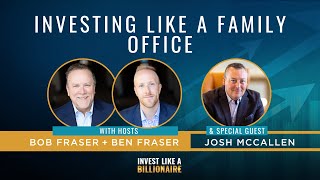
In this episode of the Invest Like a Billionaire podcast, co‑hosts Ben Frazier and Bob Fraser interview Josh McCallen, CEO of VivaMae Hospitality and founder of Accountable Equity. McCallen explains how family‑office investing differs from retail or typical real‑estate flipping: it emphasizes long‑term horizons, capital preservation, and disciplined underwriting. He describes the "capital hacking" mindset—pairing human capital with financial capital to create double‑ or triple‑win assets that generate yield, tax benefits, and strategic value. The conversation dives into his niche of resort‑turnaround investing, where properties are bought well below replacement cost, upgraded, and filled with contractual wedding and event revenue that provides recession‑resilient cash flow. McCallen outlines how his firm structures multiple investor products (equity, collateralized debt funds, and an Efficient Income Fund leasing model) to match different investor preferences for liquidity, yield, and tax efficiency. He also shares personal back‑story, the role of operating companies in family‑office portfolios, the importance of purpose‑driven culture, and macro trends such as demographic shifts and labor shortages that shape hospitality opportunities. Throughout, the hosts stress the importance of rigorous risk analysis, debt‑stack management, and the power of compound interest over multi‑decade horizons.
Chapters
Hello, future billionaires. Welcome back to another episode. We've got a great one today with our good friend Josh McCallen of Accountable Equity. And today, uh, we're talking about how to think differently in your investment philosophy and invest like a family office.
Now, what's a family office?
Well, you gotta listen to the episode to, to hear more about it and how they actually invest differently. Um, but there's a couple things that are pretty distinct than a lot of kind of retail traditional just investors. So, Be sure to check this out. We hit on family office. We also talk a little bit at the end of the episode about resort investing.
Is hospitality dead? Is it dead or is there some niches that can make you some real money?
So yes. And as always, we have to give a disclaimer for anyone that we bring on this podcast who is raising capital, has open opportunities for investment. Please do your own due diligence. This is not our way to promote them. We have no business relationship with them. So do your own due diligence. And, uh, hope you enjoy this episode. This is the Invest Like a Billionaire podcast where we uncover the alternative investments and strategies that billionaires use to grow wealth. The tools and tactics you'll learn from this podcast will make you a better investor and help you build legacy wealth. Join us as we dive into the world of alternative investments, uncover strategies of the ultra-wealthy, discuss economics, and interview successful investors. Looking for passive investments done for you? With Aspen Funds, we help accredited investors that are looking for higher yields and diversification from the stock market. As a passive investor, we do all the work for you, making sure your money is working hard for you in alternative investments. In fact, our team invests alongside you in every deal so our interests are aligned. We focus on macro-driven alternative investments so your portfolio is best positioned for this economic environment. Get started and download your free economic report today. Welcome back to another episode of Invest Like a Billionaire. I am your co-host Ben Frazier, joined by fellow co-host Bob Fraser. And today we have an awesome guest, a friend of ours that we know from afar and, and see periodically, Josh McCallen. Allen, and just super excited to have him on today. So he runs a really cool podcast called Capital Hacking, if you've not heard that or seen that, and is the CEO of VIVAMEE— make sure I say that right— Hospitality, and has really carved out a cool niche in the hospitality resort investing space. And so I wanted to bring him on, talk a little bit about that, and then also been talking recently about his kind of personal investing philosophy and strategy and really investing like a family office. A lot of these families think differently than the average investor, and it really aligns with a lot of our thoughts around Investing Like a Billionaire. So Josh, thanks so much for coming on.
I'm so glad to be here because you guys have one of the best branded shows on Apple Podcasts. The Invest Like a Billionaire show is dominant, man. Congratulations, you guys. You're doing a great job.
Hey, thanks.
And what is capital hacking? That's kind of cool. So, so what does it mean?
So, you know, there's like dissertations, I'm writing a book on it, but generally I like to think of it as a couple ways. One, human capital meets financial capital. Really, we gotta invest in the people and they're, you know, I always talk about human capital meets financial capital and that's, that's really, uh, the whole idea of capital hacking. But I also love the double wins. You know, you kill two birds with one stone. So a lot of times when we make an investment, or build a company. I, I call it capital hacking because one domino knocks over the next, which you see a lot as you get momentum in business. But if you're intentional about it, you can line up more than one domino. I can explain that some other time. And then we get alternative. It's really an alternative investment mastermind. That's what, what, that's what capital hacking is because you gotta find assets that are outside the norm. Uh, because then they come with two benefits, right? Yield and sometimes great tax strategy. That's a good capital hack, right? Or how about yield, tax strategy, and fun? That's another great triple. That's a triple bird.
Okay.
We're into that.
Well, just tell us some of your story for those that don't, don't know you, don't know your story. And how did you get into this alternative investing world and space and in the particular niche you're in?
Yeah.
Yep. And I appreciate Aspen Funds and teaching me a lot. I've watched you guys at all the conferences and we share a lot of similar values. So our journey began as a blue collar guy. My mom was handicapped and so we kind of grew up really poor. Welfare for a long time, but I love to work, right? And this is that human capital part of our show is like, uh, you want to surround yourself with people like Jim Rohn said that are, that are going to be the average of what you want to be. I always was working, so I ended up getting to the right rooms and it just was a hustle and everything from paperboy to pizza guy. But, um, journey from that to wanting to do ministry. So I ended up getting a theology degree and a history degree and I teach. And from there I realized I was supposed to go into business. I was supposed to go into business. So my wife's like, well, if you're going to go into business, you better get an MBA for free by going to work at a university. So there's another capital hack, right? You don't have to pay for that MBA. So that, that journey got us back into university. And from there, we got a crazy opportunity to live in Europe. So our journey is kind of weird, right? It goes from this heart for others to let's make sure we're making enough money to have a family to somebody offered me a chance to live in Europe for 4 years and run a property and a campus and a hotel. And Melanie and I jumped on it when we were in our 20s, and that really profoundly kind of changed our trajectory. And a passion for beauty, a passion for others, and bringing that kind of the qualities of what we lived in Europe. We lived in the Alps in a village, Hansel and Gretel style. I mean, it was awesome. It was like baskets. People carried wicker baskets to go grocery shopping. I mean, and I'm not kidding. It was just that good. A babbling brook right down our road. Uh, it's so good. As a matter of fact, a lot of the cool things we do at the resorts now are inspired by our time in outside of Munich and, and in Italy. And we would do a lot of trips. So, uh, we brought a lot of that kind of community culture to our resorts.
Man, I'm going.
You'd love it, by the way.
I can't really see you hauling that wicker basket around, but maybe.
I'll tell you, I'm not sure it's as good as it was when we were there 20 years ago, because back then it felt like idyllic. And then that, sadly, those countries became extremely authoritarian under the COVID So I'm not even sure I wanna go back, but, but when we were there, it was like hundreds of years ago. It just felt like you could walk to everything. You walk to a restaurant, you walked, and we brought that kind of walking garden-esque kind of thing to our resorts. But fast forward, end up having a lot of kids. And so from that is also necessity is the mother of invention, right? So we're always working on building things. We started working for a family office as we were just talking, you and I were talking to before the show. I ended up stumbling into an opportunity because of, you know, being hustling and working to work for a gentleman who had just had a major liquidity, you know, major liquidity, which he then turned into a family office. I had never heard these terms. This is like 15 years ago. And his idea was to build flip houses, about $5 million, $10 million flip houses. And at the time I was passionate about that idea. Had not yet built a house. And so he assigned me to be the project manager, uh, you know, to manage the family office's assets in construction. And from that became quite adept at building because back in the boom of '06, '07, the contractors who said they were coming never came. And then other contractors came and then your GC didn't show up. So if you're the project manager, you're the ones holding the plans. You end up just teaching the guys how to build because it was, it was like the Wild West back then. So I ended up building a bunch of beautiful legendary properties. And then later that same skill became how to get us out of a hole. He had bought a few hotels and they were upside down financially. And it was 2010, '11. It was still a recession. And he said, what should we do? And I said, why don't we restore 'em and become hotel flippers? And therein lies the beginning of a long journey that got us here 10, 12 years later.
Talk a little bit about your experience in the family office, because you alluded to that at the beginning of the show, of how they think differently, right? So a lot of times for those that don't know what a family office is, it's generally a family member or a family has some type of liquidity event, either usually from a sale of a business or an inheritance or something, and they have a large sum of money and they have to go and invest that and hopefully that will last for many generations. And so talk a little bit about your experience there. How did that maybe change or form your perception of investing that's different than you know, the real estate entrepreneur is just trying to make a buck doing a, doing a flip or two, you know, what, what's the difference?
Yeah, thanks for asking.
Thanks for asking. Great experience there. Spent 12 years actually ended up becoming their partner in some projects that they owned. The, the way that mindset can work for, there are, every family office is probably built a little differently. You guys probably know Richard Wilson from the Family Office Club. I'm sure he knows Aspen Funds. He just spoke at an event last week, so I got to hear his explanation of a family office. And he talked about, you're gonna put a lawyer on your team that makes sure you sign the right kind of contracts. You're gonna put a deal generator, somebody who goes out and finds assets to buy, and then you're gonna put a financial planner that makes sure— you get my point. You're gonna really be planning out through cycles, not typically flips. And so that general thought of, I guess, two things. One was that we felt that we could asset manage and direct manage some projects. I think I learned that from the family office. It, you know, that you could actually be operators of some asset managers of several. And I know you guys have that experience too. You have deep expertise in some of the businesses you own and run, and then you also asset manage other things. You guys do that really well. In a way, you're performing the functions of a family office for people that join your group at Aspen Funds.
Right.
You know, they can utilize you as, as a sense of like a plugin for a part of their needs. We do the same with our Accountable Equity Group. So, I think horizon is one of the bigger things. Horizon of yield, meaning not just pick up 50% right now, let's pick up double digits for the long term. And then the second big thing was security. Let's make sure it's capitalized, not skim, not thinly capitalized, but firmly capitalized so that there's enough working cash flow, working operating investment so that we can weather struggles. We can build out something. I think the other thing entrepreneurs forget is that early on in any business, you don't throw off cash that month. You don't throw cash that 2 months. I mean, unless you're buying something that's completely done growing. So say you jump right into a big asset that is already done, it's reached its peak, you're paying full price for it, but you are getting a check that month. That is one way to invest. Another way to invest is to buy something that needs to grow. You might buy at a reasonable price, but the growth period needs capital and it needs to be patient capital. And that's a big hallmark of family office thinking is generational wealth building.
But so long-term, long-term thinking, long-term planning, uh, not focusing on short-term cash flow and, um, for protecting capital, getting capital to sell.
And keeping capital in it for a period of time.
Yep.
Yeah.
I mean, a lot of what I think people get caught up in, especially in this kind of private equity, alternative investing world is They're just chasing the biggest return that they see, right?
Marketed.
And oh, 25% IRR projected, you know? And it's, it's okay. Well, what, what is, you know, comprising the assumptions of, of that, of that return?
Correct. Exactly.
And how much risk are you taking to generate that return?
Exactly.
Right. The, the number one rule of investing according to Warren Buffett, don't lose money.
Yeah.
The number two rule is don't forget rule number one.
Right. As guys who sponsor a lot of deals, I mean, you you realize those headline return numbers, I mean, they're just entries in a spreadsheet.
Oh yeah.
With backed by assumptions. And so it really matters who's generating that, you know, who's designing that project. And, you know, when we're putting together deals, we look at, you know, all the risk profile, which the debt stack is a huge component of that. And, you know, and there's lots of other things. We're looking at a deal, you know, development deal, not entitled. Well, huge risk around not getting entitlements for, you know, great returns. But it's like, well, you know, not entitled. You, you could, you could end up with a, you know, 200% return, or you could end up with a zero, you know, a, a white wall, you know, uh, face plant. And, you know, so yeah, underwriting is, is a big deal. And so, so, so basically taking, really doing a good job with the risk side is something that, you know, yeah, we do and we do for our clients, but it's something that few retail investors, I think, think a lot about. And family offices are going to obviously think that way.
I think another point to your comment on the horizon is you get to take advantage of the 8th wonder of the world, right? Which compound interest, according to Albert Einstein, is the 8th wonder of the world. And compound interest is actually pretty boring. Right? And it takes a long time to actually be meaningful. And so doing those maybe more boring returns with a longer time horizon, compounding, protecting capital, growing, using those points of leverage in the business or the real estate or the strategy to continue to generate more income, all those things add up and over time are very, very powerful.
So I think a lot of investors are chasing the short-term buck, right? And the truth is, okay, and here's a guy who's been around a while, right? And I think this is my like 4th cycle now. And the truth is the real money is made in when you're buying the bottom of a cycle, right?
Yeah.
And it takes a lot of courage, right?
It takes a lot of courage. So when everybody's terrified, right, as JP Morgan put it, Be greedy when there's blood in the streets. Now that's kind of visceral, but literally when people can't dump their assets fast enough, when it's, you know, everybody's terrified and literally you invest and all your friends look at you and say, you're an idiot. You know, you're going to lose it. That's when you make the money, right? When there is no good news, nothing's working, it's all going bad. And you're buying and, and, you know, and, and now we're, you, we're, we're seeing, you know, kind of clouds on the horizon. And to me, this, this is a time to start generating, you know, getting some liquidity and to, to begin looking at opportunistic buying. 'Cause that is where the real money is made, right? Yeah. And, uh, buying at the, buying at the bottoms. And it's hard to do, you know, investing is emotional whether you want to think it is or not. It's an emotional thing and prices are emotional, right? So, you know, so I, I was talking about Amazon, you know, back in 2000, you know, I can't, I can't remember. I think Amazon was like $50 a share, dropped to 30 cents a share a year later. Same company, same company, same market. You know what happened? It's pure emotion. It's pure sentiment, pure emotion. Everybody was sure that the internet was a crock, right? And well, it's not, and 30 cents a share, you know, so buying Amazon at 30 cents a share is a sure way to get, to make, to, to get money. You know, what is it now? You know, I don't even know, but, but, uh, you know, so, so having a long time horizon is really one of the keys to true wealth creation. Right. And, uh, you know, well, good stuff, man.
So, so very billionaire, very billionaire thinking on your part there.
I have a question. So Josh, how do you implement these kind of philosophies in your own business, right? Because as sponsors doing deals, there's always this inherent tension of, well, one, you want to show a good return to get people excited about a deal. And then two, it's really hard to sell people on a long time horizon, right? You know, if you see a deal with a 10-year time horizon, people can't wrap their head around that. What am I going to be doing in 10 years? We had a deal right now where we're, you know, targeting a 5 to 7 year time horizon. And you know, that's a little bit of a stretch for some of our investors. And one guy we were talking with, he was like, well, I'll be, I'll be dead by then. So I don't even, I can't invest in that deal. And it's, you know, he's being kind of tongue in cheek, but it is inherently difficult, I feel like, for people to think long term. So how do you kind of, how do you implement these strategies in your own business plans? And then how do you get investors to kind of understand the, you know, the benefits of that?
Thank God you guys are, you're asking the toughest questions. I want to share with you some thoughts we've come across over, over the last few years. So originally our philosophy was a 5-year BRRR, those BRRRR things where we're, we're gonna pull the money back out and have it back into the investor's hands. We always envisioned keeping our partner investors in for the infinite returns after that, and we always planned on making their preference payments meanwhile. So our initial business plan was, was good and it allowed for nice high annual preference payments, which we've always honored. And then if the economy hadn't switched so much, we would've done a normal cash-out refi probably next year, right? That would've been the horizon for some of our assets. We just gave a talk about legacy asset investing as a strategy. And what we're finding is when the business is still growing on a hockey stick, we love being transparent with our investors. We say, hey, if we were to execute the strategy of just pull all the cash back out, What cash and capital would be used to pick up another 20% growth the next year and the next year? We're, you know, that's a philosophy where we're encouraging all of us to go on a journey. So now we're talking to a lot of investors and we just did a presentation on this that we see that it's important to let investors be their own natural selves. And some investors want liquidity, others actually do not want their capital back as long as it's producing great yield in a great asset. That is a mind bender. So if you're listening to this show and you've never raised a dollar, The epiphany that I've had, we've had over the last 4 years is not all investors are cut from the same cloth. There is definitely the investor who sees 20+% IRR and thinks it's the truth or thinks it's doable in any market turn, right? Maybe it would've been doable in a peak, peak market, but probably not going to be doable in a downturn. But they see that and they say, that's what I want. And then there's others that say, I want cash flow annually. And then I've come to realize there's others that want peace of mind with their sponsor. Right. And that's, and we're, we have a blend of all of 'em. We have hundreds and hundreds of active investors, all accredited. We're honored and blessed to have thousands of 3,000+ people read the emails. 330 have written checks and invested. So what we've learned, we've implemented. So some of our investors, we say to 'em, would you like to join us for the long term? Buy the equity, please. We will make our annual preference payments. Of course, if there's any downturn, we'll pause, but we've always made 'em. Then we say to others, We also have a capitalization model where you can put debt on our property in a collateralized debt fund, which has liquidity calls. You can call on that liquidity similar to you guys. You do something like that. And then we have another asset class we created years ago where we build a private leasing company called an Efficient Income Fund, and it allows investors to benefit from the accelerated depreciation program. So instead of us borrowing to buy anything that makes our businesses work, remember we have golf courses, We have tractors, we have kitchen equipment, things. Instead of letting Bank of America take a lease on us and make double-digit yield, why not give that yield to our investors, but then also design it so they get full depreciation? So we do those types of models. I worked with some great CPAs to build that. So those people, what are they getting? They're getting monthly checks at very high amortized levels and they're paid out and their preference is fully paid plus their yield back. Their principal back in like 3.5 years. So they're big cash people. They want, I want a lot of money every month and I want it to tax strategy. The debt people are a nice check every month. And then the equity people are the long haul. By designing that, I think what we've done is it speaks to the different needs. I have some investors that buy a little bit of each and it's probably because of where they need their money to do some business. So then we go back. Now our core business today at the Accountable Equity Group, which is a long-term, it's kind of like an Aspen Funds. It does look at other partnerships and joint ventures eventually, but today it primarily does its core skill, which is this resort turnaround, which we're buying them well below replacement, like a third to a quarter of what we buy in the value in replacement. That's what we pay. We're spending the money on them. We're building them so that they're premium, and then we're filling them with wedding contracts. I know for us on Invest Like a Billionaire, we're talking about the bolts of what we do. That is not the fancy stuff, right? I'm not saying how pretty things— I'm just saying charge a lot, fill it up with wedding contracts, gives us an 18-month contractual revenue cash flow, and then we can weather all the ups and downs. We've weathered, of course we did it during the pandemic and now we've weathered this new inflationary period and we're weathering whatever recessionary risks we have because we've already sold into 2024. I love it because it helps people realize they're buying a generational cash flow machine, but they already can kind of see next year's budget. I want to go back to family office for a minute and then I'll answer any question you want. The other thing I saw about family office, this took a few years of working with that gentleman. So I worked with this gentleman, he had sold a massive company and he said, I'm never going to have an operating company again, right? I want to just buy flips or things that don't have staff. About 6, 7 years into building his family office, he realized I need an operating business and I need also real estate passive and I need real estate active. So he kind of ended up building a portfolio and I watched him and what I love about, I'm excited about what we're in the middle of our niche at Viva Mae Hospitality is heavy duty real estate, hundreds and hundreds of acres under management. Each property averages 200 acres. Land development rights are not in the pro forma, but they all have land development rights. So I love having those little Easter eggs for the future, but they're robust operating companies. So what is a robust operating company? Why do family offices put those in there? That's where you can design your tax strategies really well. And so what we do is we take all the generating tax strategies, annual depreciation. Anytime we buy something, build something, we rapidly depreciate it for the investors there. But we also have, like I said, the leasing company where we basically took all, we stripped out piece by piece each of the great benefits a family office wants out of an operating company that has real estate basis. And we, we parsed, parsed, portioned it off into these tools. I think I explained that okay for you guys. You probably see what I'm saying. Basically, we harvested out the best parts of everything, collateralization, depreciation, all these pieces, and the investor who needs whichever piece, we designed a way for them to have it. And then the rest of us equity people got the remaining balance of that. So really tax efficient ongoing business, and that's kind of The summary. Now you and I are talking like investors, like a billionaire. If you wanna, if you and I were on a different show, I'd tell you all about how pretty things are and how we sell really well. But here I wanted to just give you the brass tacks of how we do things.
I love that point. I think, you know, we've talked about this a little bit on the show in other episodes, but you know, operating companies, you know, especially in kind of this investing podcast world, they're not talked about a whole lot. And we've, we've tried to talk all about venture capital investing, private equity investing, which are into businesses, not just real estate, right? Because most of these family offices, most of these ultra-wealthy have become so because of operating businesses.
Correct.
And you know, you're looking at a cap rate on a multifamily property, say you're at, you know, 5% cap rate. That's a 20x, you know, net income multiplier. Well, for an operating business, if you buy a mom-and-pop, you can sometimes get a 3 or 4x. So that's, you know what, a 25 or 33% cap rate. And so, you're taking more risk. You a lot of times don't have the same collateral, but it's a way to generate value. And if you're buying these properties that, you know, have leverage where you can kind of push the top line, you can, you know, make them more efficient, that's extremely powerful.
Totally right. I mean, you know, people don't think about Warren Buffett, but Warren Buffett has made all his money by buying operating companies, right? And the returns, they are better. I mean, you know, you know, it's not, you know, most businesses are generating 15 to 20% cash flows and profits on their value. And, you know, so it's much better than just assets. You know, he doesn't own just piles of assets. And so the returns are better. Yeah, it's riskier. And yeah, you have this ugly, ugly thing called people involved, you know? But—
Ooh, that hurts.
You know, yeah, you know, people, but are they really ugly, right? I mean, that's— That's tongue-in-cheek. It's a lot of work to manage people, but if you're good at it, you can make outsized returns. And so it's definitely something that, you know, key strategy for deploying capital, especially as you're growing.
May I share something about that, Bob Fraser? You said it right on point. And you know, at the onset of this show, I guess I was extremely enthralled with the idea of how intellectual your group is, how deeply you've thought about the future of how America's going to be increasing manufacturing. Inflation has a strong foothold. I mean, I've been following your work, but I want to just go back to one other thing that's important to us people, and that's our heart, you know? And there's also something to the fact about people and jobs and purpose in life. We find it beautiful, right? And so at the end of the day, you, somebody laughs at my LinkedIn page, but it says I'm investing in real people and real assets. That's pretty much all we care about. People that want to be honest with themselves and with others. We say, so what we're doing at our company that might, might help color that word people is we're seeing them as something to someone to be invested in. And it begins for us, if I could just opine, Ben, I think you've probably heard me share my, our, our real heart of what we're doing with our operating companies is we are building them on something called Viva Mae, which is a stylized French word that means reviving the soul. And we just believe that us as people have a spiritual dimension. We, we are not just the skin. I mean, there's a little more to this baby. We all know it. It's inside of our heart and we wanna respect that and love that in our teammates. And we think the ripple effect is powerful. So what we do each week at our team, and this is why we have so many staff, thankfully, and we haven't had staff shortages. Everybody makes more, that is part of inflation, but everybody keeps coming back to our companies because we start with 3 virtues and we say, hey, if you wanna work with us as an investor even, just be aware, this is how we run our companies. We have 3 virtues. They're called the Viva Mae virtues. They think they're for the soul. We say we don't want anybody on the team. It's a, it's a way to say, please attract the right people, not the wrong people. Do you seek to serve with joy? Whatever your role is, joy of service, part of what you want to grow in. Two, do you want to grow in humility? Because humility is the identification that everyone has infinite dignity and worth, and we're going to treat people that way. We're going to demand things, right? We're not pushovers here. We're going to demand that we do our jobs, but we believe that they have that same dignity that you have and I have. Two. And then the third one's a unique one that we've been working on for years. It's called ministry. And, um, we ask everybody, do you want to grow in the virtue of ministry? And, uh, no matter where they come from, their background, have never heard the word before, we describe it in a very simple way. And we use Thanksgiving as a good example, cuz everybody kind of likes Thanksgiving. And we say ministry for us is the, the ability, and you have to work on this, to take the normal task you were gonna do anyway. Right? You were gonna get up every— this today and you were gonna make a podcast, or I, I was gonna get up today and serve someone a cup of coffee and take the same work and do it for someone's spiritual good. And the simplest spiritual good is so they know they are loved. And so can we do this delivery of a, of a delicious meal, not just because we were told to deliver the food to the table, but can we do it so when we give it to them, they know they are loved by us?
Higher purpose. Adding a dimension of higher purpose.
Adding a dimension onto your work. That's, that's so powerful.
No, it's, it's so cool. I mean, you know, going back to the operating company piece of this, it's a way to actually have impact, right? Because you're providing jobs, you know, and impact investing is something that, you know, doesn't always pencil cuz you know, if you're giving up something or doing something that maybe is not purely for the bottom line, you know, there has to be another, another, uh, reason for it. But it's, it's a cool thing to do to, if you have an operating company and it's growing, you have the ability to provide jobs and you have the ability to create a culture and to create a place where people have purpose and can come and enjoy what they're doing. And, you know, so there's, there's the pros and cons that you have to want to do that, right? That, that's, uh, it's a lot of work. It's a lot of energy, but it's a powerful thing.
So I'm going back to your family office guy who said, hey, I want to invest, but I just don't want to have people involved, right? No staff, right? But I, I get that because people are a a lot of work, right? But people also generate a lot of value, or they can. They can also generate a lot of problems, right? And it's really up to your skills. So, so for us as leaders, it's let's throw ourselves at that, right? And let's become great at managing and leading, leading people. And you do get outsized returns, you know. You know, I, I think it's especially challenging in this environment, you know, and we're seeing, you know, demographic changes across planet. You know, I've been, I've been highlighting, you know, I think in the next 30 years, you know, 45% of Chinese population will be retired, right? It's the fastest, wow, fastest retirement and fastest aging population ever in history. And, uh, so that means you got one person working for two people consuming, you know, one person working for two people, you know, going to restaurants and hotels. And so we're going to be having enhanced worker shortages over the next generation. And And it's in every industry and it's in every country. It's, it's actually not as bad in America as it is in, in virtually any other, any other country, but worker shortages are going to be a part of the equation. And, and what's more, you've got this demographic, also the demographic changes where, you know, automation is removing the lower, the lower end jobs and, and they have to be, but you've got, you know, so you've got this really weird system where there's lots of, lots of worker shortages coming, but especially knowledge workers, right? Because so, so the lower end is just not going to be, you know, people are not, there's not going to be a lot of workers and there's not going to be as many jobs either. And so, so very, very interesting to solve the people problems for a business is really the people who can do that are going to be the ones that, that make a lot of money and have outsized returns. So good, good on you for, for, we got to find something.
You even said it, even at the knowledge level, you're right. Most of our teammates get to actually work with their hands. Not everybody, of course, but even at the knowledge level, you know, Bob and Ben, it seems to me just as a very simple view of the world that one of the struggles today is people don't feel that there's a purpose. Right. And so we're, we're making a small dent in that, you know, even when, if you're a guest at one of our resorts, you know, the expression on the, on the, on the lips of everybody as you walk in is welcome home. Because so few people have connection in this world. So, so we're trying to be in each little way we can intentional about that. And I think it's kind of a, the more you can do that in your own companies, whichever company it is, uh, the more you'll stand out. And we're, we're, we're gonna fight that fight.
Awesome. You know, let's talk about hospitality space for, for, for just a minute. So you have 3 large resort properties and, and it sounds like your growth is just accelerating and And you know, I've not been necessarily bullish on hospitality, in fact, staying away from it, you know, pretty, pretty, uh, pretty clearly. So, so blow me up. Why am I wrong? You know, it looks to me like, you know, everything's been, you know, COVID definitely made hiring hard, made staffing hard. It was, it's kind of a feast or famine in the, in the, in the world. So some of these, some of the hotels are doing super poorly and some are doing super well. And, and then it's, it's staffing related, which is, which is really a problem. So, so I'm telling everybody, stay, stay, stay out of hospitality. So blow me up. Tell me, tell me why I'm, why I'm wrong.
Yeah.
I mean, there's—
and why are you guys making it so good?
There's truth in what you're saying. We always came up with this years ago. We started buying these— those beach hotels was the ones we started with 12 years ago. And beach hotels in the Northeast kick butt for 3 months out of the year, like Unbelievable amounts of money.
Yeah.
And then they suck wind for 9 months having to— so, you know, some people do all these crazy ways to try to operate that. And we came up with the philosophy that we wanted to invest in the people to stick around. So we created 9 months of active selling, 3 months of taking the gravy train, and 9 months, you know, you know, of, of working your butts off. Okay. So that discipline for 12 years now has made us a juggernaut. I think we're kind of in a, a very powerful sector of hospitality where we fill our own book. And that's different than what you might be familiar with. So most host hotels depend on Expedia or they depend on— you can't book a room at our hotel for the next 18 months. Okay. So we're sold out for '23 at a price that's double to triple the average rate of all of our neighboring hotels because we're not in a city, we're in a rural setting and we sell contractual weddings. Now you think, oh, everybody sells weddings. So we sold 300, we performed 364 weddings at one property this year. And we per— on top of that did a total of 1,000 1,000 events at this property, catered, contractual, money in advance. So there's just a different way we do it. We fill our own pipeline and we do it through great marketing, really focused on sales, and we have the best products.
Most of them are event-related.
Yep. So it's hard to grasp our sales.
So it's a really different event business. It's versus a classic hotel business.
Yeah. Yeah. And actually, that's actually a funny, uh, I find that to be a massive positive, but you're right. When people try to book put us in a box. They're like, well, you're not just a hotel. So to give you a great synopsis of the company, I just told you how strong we are at catering. This year we'll do $21 million in our first full, second full year. We budgeted to do $10 million this year. We'll do $21 million. And that was just a 2-year turnaround from what we thought we could have done this year. And the way we did it though is $12 million came in from catering. So you're like, well, where the heck did the rest of the money come from? Right? There's a waterfall effect, a capital hacking effect. Whereas once we have Uncle Louie and Aunt Sally here for the wedding, they're probably going to buy some things in our cafe. We have Parisian cafe. They're probably gonna buy some things that they're probably gonna play golf. So this waterfall effect is so powerful. And then each one of the waterfalls, hotel, restaurants, we have multiple. The scale is hard for anybody to grasp. You'd have to look it up. It's called Renault Winery. It's a resort. It's an East Coast legend. It's hard to believe how big it is. 5 ballrooms, 12 other meeting spaces, and it's been open for 158 years straight. That's another cool thing that's very legacy-esque. So Bottom line is all those waterfalls filled up because we sold out the building. And that's the difference between us and traditional hospitality. I think most hospitality is relatively transient and very vulnerable. And so we're not built on the two major problems, transient tours and business. Now we love business travel, but we don't have it in the budget. We have zero. So anytime we get a co— a corporate conference, it's all accretive profit.
So there's no recession in weddings, right?
There's no recession in weddings.
People are going to be getting, getting married and having babies regardless of what the economy is doing. And maybe I run more modest in the budgets. And so, so it's very interesting. You've, you know, I do like events and, and it seems like there is a massive shortage of event spaces.
And apparently there is. Thank the good Lord. To give you an example, we have 4,000 inquiries for next year already for weddings. So we sold 300 of them. And when I say we sold 300 of those 4,000, I'm talking about premium, very expensive contracts. And what's cool, sorry, this is for the geeks who are into business. We have the contract already for next year. We took 25% of the cash for next year and we put it, it's non-refundable. They're called contractual fees. They're not, they're not just deposits. And, uh, they're pretty premium. They're like 37 to 40. $5,000 a contract just for the food and beverage. Has nothing to do with anything else. No hotel rooms on top of that. So what we've designed here is a juggernaut model so that we can continue to build the portfolio in all, in all economies. Wow.
So why, what is the, you know, I haven't really done a lot of research, market research on events. Why are they booming so much? And is this kind of, is this going to continue?
Two answers. So I'll give you— these are very good billionaire questions. In the year 2018, we bought this big resort, and that year in our market, 47,000 weddings happened in this market that we pull from. So pretty good, right? Then in 2020, almost none because of the COVID and the lockdowns. Then there became a boom, a backlog in '21. So 55,000 happened in '21. Going forward, the average is now going to be 50,000 a year. So it's going to come down off the boom and it's going to level out a whole— at a whole new plateau. And the basic theory is weddings are different than even generations when you and I got married. For you and I, it was the formation of a household. Today it is an Instagram party. I'm sorry to say that and to be, to be rough about it, but it, it's very much unbelievably glamorous. And, uh, and for whatever it's worth, the more social media grows, the more weddings the way we do them will grow. I mean, if you look at our weddings, they look like they're on a movie. Yeah, they're beautiful.
I need to make sure my, my daughter's never hear this episode because I have 4 girls and, uh, I'm already a little nervous about it.
You should be.
It gets ridiculous. And we, we've sold $100,000 and $150,000 weddings. So we don't try to sell those. Meaning that's not what we build our model on. We build our model actually on like closer to $30,000 and then we average $37,000. Then we try to beat our models.
I, I love the event space. I do think it's, it's unique and I think resorts, you know, as people, as wealth increases, which it is, people are looking for better experiences and, uh, and, uh, people, people want to spend for the experiences.
And as you point out, you know, the Instagram fest, and we're, and we're relatively close to Manhattan, you know, 80% of our brides come from the metropolitan New York area, which, you know, I always say there's District 1 is Washington, DC. The Hunger Games told me they're always going to be rich. So we have a, we have a beautiful, like, absolute, absolutely gorgeous waterfront venue, 45 minutes from the Beltway, 45 minutes from downtown DC, I should say. So we are always gonna be able to sell that wedding venue forever. And up here in New Yorkers, as long as there's a centralized money finance center in New York, we're gonna be able to, they consider us cheap, the New Yorkers. I always crack up because, you know, I grew up very humble. Our wedding cost $4,000, I think, to do so. I'm not a consumer of this exactly at this level, but we are very good at performing.
Oh, good.
Well, Josh, what's the best way for folks to, you know, follow you? Podcast, website, if they want to book a wedding. I mean, what's the best way to—
You'll have to get— you'll have to call me personally to see if you can get in because I don't know if I have any more. But let me show— I got my jersey on. I wear my jersey, my Accountable Equity jersey. That's one great way, justaccountableequity.com. And then of course, you, Ben Frazier, was just on the world-famous Capital Hacking Podcast Episode 252.
That's right.
You did a great job, Ben. You did a great job.
That was fun.
That was fun.
And you have open investments?
We always try to keep something open. We have a debt fund. We're adding capital to the growth of these resorts, land development options, things like that are coming. So right this minute, yes. When you listen to the show, there will be options. You just hit the website. You do need to be accredited. Super.
Right.
Josh, thanks so much. Always fun to connect. Appreciate it.
You're the best. I can't wait to see you at the next conference.
All right, man.
See ya.
Perfect. Good, good stuff. You've done that a few times before, I think. Yeah.
Fantastic show.
Thank you very much, Bob. I'm glad you asked the tough questions because without a doubt, I would, I would probably stay away from hospitality as a generic as well. Um, I feel good about what we do. My personal guarantee's on everything and we're going to fight like a dog every day. Uh, you know, that's the way we do it. Yeah. God bless you guys. Have a great day.
You too.
All right. See you, Josh.










