
Lessons from 25 years of investing success with David Shaw
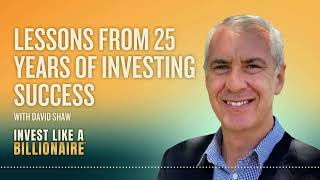
In this episode of the Invest Like a Billionaire podcast, host Ben interviews longtime investor and entrepreneur David Shaw. The conversation begins with a brief plug for the Wealth Without Wall Street podcast before diving into Shaw’s personal story: an Irish upbringing, a decade in New York construction, a return to Ireland to care for his mother, and a pivot to buying and managing real‑estate and businesses across Europe and Latin America. Shaw explains how the 2008 financial crisis created a cash‑only, distressed‑asset niche that generated 13‑14% unlevered cash flow, and how that inflection point taught him the importance of scalability. He outlines his three‑bucket portfolio approach—short‑term income, medium‑term (3‑5 year) opportunities, and a long‑term (25‑30 year) legacy focus on A‑class multifamily properties owned personally for his children. Shaw also details his private‑lending/bridge‑finance business, which now occupies roughly 30% of his capital, and describes his “wealth algorithm” (debt × time × scale) that guides his long‑term wealth creation. Throughout, he stresses nimbleness, liquidity, and the power of compounding, sharing regrets (e.g., staying in a W‑2 job too long, not building a non‑correlated, sellable business) and advice he would give his younger self. The episode closes with a reminder to listen to Shaw’s own podcast, Burn Your Boats Wealth, and a promotion for the Invest Like a Billionaire book.
Chapters
Hey, if you're a listener of the Invest Like a Billionaire podcast, I already know that you're interested in alt passive income, creating wealth outside of the public markets. So let me tell you about another podcast you might really enjoy, Wealth Without Wall Street. This is hosted by my good friends, Russ Morgan and Joey Murray. These guys are doing incredible work helping people break free from the traditional financial models and actually replace their income with cash flowing assets. They go deep on strategies like infinite banking, short-term rentals, passive syndications, and more. And I've had the privilege of being on their show a few times. In episode 421, we talked about recession resilient investing. In episode 555, we dove into oil and gas and why we're so bullish on energy right now. So if you want to get a feel for what they're all about, start there. Check out Wealth Without Wall Street wherever you listen to podcasts. I think you'll be glad you did.
I didn't know when I was in my 20s that I was a time millionaire and that you don't have to work for money. You can have money work for you. If you're generally the average person out there, if you're out there working for $200,000 a year, well, $2 million can work just as hard as you can.
David Shaw has a long track record of success as an investor, and I'm lucky enough to call him a friend. But in this conversation, I got to hear more about his journey and achieving the portfolio that he has today, how he's thinking about allocating his investments for the short and long term, and what he wishes he would have done differently when he was just starting out. Check it out. Welcome back to the Invest Like a Billionaire podcast. I've got a very awesome guest today, excited to be talking with a friend, David Shaw. He is a professional investor, actually probably about 3 different careers as I've learned his story a little bit, really cool story, and also has his own podcast. So not very often do we have folks on the Passive Investor Spotlight series we do here that also do podcasts. His podcast is Burn Your Boats Wealth. I'm very excited to bring him on because he's got a really unique perspective. I think it's going to relate to a lot of our listeners on how he built his wealth, what his story was as an entrepreneur, and really where he's landed as an investor and the businesses that he's in. So David, welcome to the show.
You know what, Ben, it's a pleasure to be on your show. I'm an avid listener. I love what you're doing over there. I'm a big fan of Aspen, and I know your mom and dad, so it is a pleasure to be here, Ben.
Well, this will be so fun. So give us a little background for those that don't know David. You know, you sound like you have an accent, maybe. So give us a little story on where you came from and just kind of part of your career arc.
Well, Ben, I do have an accent and it's the only thing I arrived in the United States with, so I decided to keep it. No, I'm Irish. I grew up in Dublin and shortly after graduating university, I came over here and I did my standard 10 years as a W-2 worker and I did very well. I was in the construction project management world in New York City throughout the '90s. And so I enjoyed that. Minimally, but I, my mom got early onset Alzheimer's and I moved back to Ireland because I wanted to spend the kind of remaining years with her. So when I arrived back in Ireland, I had quite a lot of money that I had saved. I'm just an avid saver, you know, so I started to buy businesses, grow businesses, invest in businesses and real estate. And so throughout 2001, really through 2005, I was just passively investing in real estate around Europe as the EU was expanding all of these fantastic cities in Romania and Bulgaria and Latvia and Estonia and Poland and Germany. These cities that were being rebuilt all of a sudden had like 3.5% interest rates down from, you know, 17 or 20%. So it's an amazing opportunity to acquire massively discounted real estate in the center of these stunningly beautiful cities that were largely unknown to people as well. So at that time, and we talk about alternatives, that was what we deemed at the time emerging market real estate, right? So that was what was then emerging market. So I did that on the passive side for a few years and then I like, you know what, I like this, I think I'm good at it, I understand it given my construction background. And so I went out on my own and got a business partner together and we started to invest and to acquire and market properties and build up our own database of investors. And so we were doing deals in Buenos Aires, a lot of deals in the UK in the student accommodation sector. We did quite a few deals in Panama City. And then 2008 rolled along and things got spicy.
I've heard about that.
You heard about that one? Things changed around that time, Ben.
Yeah. So how'd you shift from there?
So I'm sitting in Dublin And because of my American experience and my ability to live here, I knew I needed to figure out— there was a massive sale on. The US dollar was not doing well. Yeah. In 2007 and 2008, 2009. So it was a big currency. If you live overseas, you look at the US dollar, if it's on sale or if it's not. I'm not saying that Americans don't often look at other currencies and decide to take action or not take action based on what the position of other currencies are or their own currency. But when you're from smaller countries, people definitely do. And so we're sitting there, the dollar is massively on sale, and then the US real estate market goes on sale as well. 30, 40, 50% discounts. So I'm sitting there licking my chops. How do we do this? How do we figure this out?
And were you cashed up at that point? Or, I mean, the challenge for a lot of people that saw opportunity was they had no liquidity because it was locked up in deals or the markets that's down 40, 50%. So what was your position there? Was it just you hustled to make something happen?
I love your question because the bottom line is, is that the next 5 years, every single thing we did and every property we bought, every property we sold was in cash. I think my first finance deal that we did, I'm going to say it was in 2014. Wow. So here we are, I'm talking to you about 2008. Everything was transacting in cash. So when you say, were we cashed up? Our investors were cashed up. Our investors were all European, Scandinavians, Irish, English, Spanish, Italian, Icelandics. That's where my investor base was. A lot of Canadians, a huge amount of our buyers were Canadians, to a lesser degree, South Americans. So yeah, we're here in 2008 and I'm like, we've got to figure out how to do short sales. We find out very quickly that The realtors don't know how to do short sales. And then much to our dismay, we find out that the banks don't know how to do short sales either in 2009 and '10. They just, nobody seems to know what's going on. But a friend of ours reached out and he had 7 or 8 condos in Palm Beach, Florida that he wanted to get off his books. So we packaged them up for him, put 'em to our European database, and they sold, I'm going to say, in 7 seconds. Wow. I like bank. That's it. That's it right there. These kind of broken condominium communities, there was no funding available for them. So the developers who were building these things or kind of converting these things at the time, they had no exit strategy whatsoever except for cash buyers. And so we kind of identified that opportunity. It was Europeans were more than willing to come in and take a 30% upside on the currency, 50% upside on the price. And then we were packaging these because the developers couldn't sell 'em. They were putting tenants in them. So they were newly renovated. These were cash flowing 13, 14% at the time. And the Europeans were just eating that stuff for breakfast. So we went hunting, Ben. That's what we were doing at that time to get some traction in estates.
Wow, man, I wish we had some of those deals right now. 13, 14% cash flow on unlevered. Go back a little bit, 'cause I feel like you glossed over a big part of the story here that is really interesting. You know, life happened, and obviously your mom got sick and forced you to kind of move back. But it seemed like at that point was a critical turning point from going from W-2 to, I'm gonna go buy some businesses, I'm gonna go invest in real estate. And what was that shift for you there? Because that's, to me, a potential critical point where it really shifted from, I'm gonna go be trading my time for someone else to give me a paycheck, to I've saved up, I'm gonna go bet on myself. I've built the skills to go do this. And was there kind of a lot of foresight in that, or was it kind of just forced on you and then you never looked back?
No, no, I found it out there traveling and moving back to Europe after I really, really worked hard for, you know, a good 10 years and didn't have a lot of time off, worked really high-intensity construction projects. And so when I went back to Ireland, hung out with my mom and You know, it took about 4 months, 5 months. I went over to, you know, traveled, backpacked, just some time out from the stress. And yeah, I'm going to say I came up to 2 conclusions when I was sitting on a beach in Thailand, which was one, I was never going to work for anybody ever again. That was baked in. And I wasn't going to commute. They were my 2 lifestyle promises to myself. And so pretty much burned my resume and made sure it wasn't in my recycle bin back in Windows 95 days, but made sure I couldn't access it again. And it was just a line in the sand. It was like, I can't be happy working for somebody else and I can't be happy commuting. So then what? I wish it was a bit more mercurial than that, but it was just a lifestyle decision. And looking back, it was probably the most instrumental decisions I've ever made in my life. Because if you burn your boats and you're like, I'm not going back, I'm going to burn that bridge, take working for somebody else off the table and then see what's left.
Yeah, that's so interesting. You basically, you remove certain options and you're forced to solve for, what do I do now? When you have that mindset, you figure it out, right?
That's right.
It's scary in the sense of, I haven't been where I think I want to go, but the alternative is not an option anymore. And that is a bigger driver, I think, than the fear. And that's a big deal is understand what those non-negotiables are and you get one life, you know, you want to live on your own terms as much as you can. And so how do you go and make that happen? And I'm assuming you'd say best decision you ever made, right?
Well, you know what, it's funny you say that. Not to get too mercurial with you again, but watching somebody get diagnosed with onset Alzheimer's at 59 really puts life into perspective and the time that you have in this world and the time that you have where you're functioning. We just don't know how much time we've got. We don't have time to waste. And so I also do have that mindset. I'm not a what-if person. I don't do what-ifs. I do the thing. It works or fails. I pick up what I learned from it and I'll do again. And so, you know, I've been a fairly serial entrepreneur because of that decision. Like the idea of going backwards is just not in my lexicon.
Yeah, I love that. So looking back, that seems like a big turning point and a big inflection point for your growth.
Yeah.
What was kind of the next inflection point where you like saw an outsized return on the effort that you were putting into it or the business that was working? And you know, how do you kind of diagnose what made that recipe so successful?
Scalability. What was scalable and what was not? I think that's really the question. When I had a number of businesses after I came back and made those decisions. One of them was I started a construction project management consultancy business, and that was my time, right? And it's not super scalable. I set up at the time a bunch of internet cafes and retail stores and things like that. And again, they were somewhat scalable, but even, you know, a fool knew that we were going to have the internet on our lapel of our shirt at some point in time. But at the time, they were massively successful. They were cash monsters. But yeah, you really get honed in on what's scalable, and real estate is scalable at its core. What is the most scalable part of real estate? Well, at that point in time, going in and picking up distressed assets, a lot of people ask me at that time, it's like, how long can you do this? I said, I don't know, but I'll tell you when I know. And it took a very long time for all of that to change.
Meaning the opportunity was there for a lot longer than maybe you even expected.
And it was massively scalable.
Mm-hmm.
You know, there seemed to be fairly limitless opportunity and it was fairly easy to scale that opportunity. So I think if you're doing something and it's not scalable, stop doing it and think about what is scalable.
Yeah. It's so interesting. It seemed like from what you're saying, the '08 crash and the opportunity that was created thereafter with purchasing the condos in cash, and making money hand over fist, that that was a pretty big inflection point for you professionally. It's interesting because it feels like, you know, I've about a 20-year career so far. I was still early in my career in '08, but it seems like from my more limited experience, things aren't as linear as everyone hopes it to be. We love the idea of just simple compounding. You just do the same thing every day and you just, you know, over time has these massive payoffs, but there's these cycles and you have to consistently build your skill sets, build your resources, look for the scalability, take your lessons along the way. And then there's certain points in time where your skill sets and the opportunity match, and it's time to go all in because it's this big inflection point. And it feels like, especially right now, it feels like a little bit of a, of a down cycle in real estate, right? There's a lot more challenges. Transactions are down, lending's harder. But I'm also really excited because I know that the deals we're doing right now because they're harder and if we work a little bit more for them, when it gets easier, we're going to have some big payoffs and a little bit of hopeful foresight. But I'd be curious your perspective and your experience on if that held true for you.
Ben, I love that. I really, really love how you kind of frame that because looking back, that's exactly right. Being an investor in real estate particularly is anything but a straight line. We've just come off realistically, like we've had 13 years of a bull run.
Mm-hmm.
And that bull run is now over and things are changing and we're in a whole new capital environment. All right. But that to me would be the second time I've experienced that, 'cause obviously 2003 and '04 and '05 and '06 felt a little bit like the last few years. Right. And so you need to be pretty good and pretty adaptable. In life. So, you know, if your only thing is you've got a template and that's your only template and you're going to go all in on that template— I think one of my personal skills has been to always stay fairly nimble because you need to be nimble. I know a lot of companies who really scaled out on one business model or the other over the last number of years, and they weren't built for the change of the seasons. And so a lot of people would've come to me in 2020, '21, '22, '23 asking me to get involved with value-add syndications on the large multifamily space. And I didn't, you know, and I didn't because maybe the scar tissue of what happens when the music does stop and who's got a chair to grab or not. And so I've always stayed fairly liquid and I've always stayed fairly nimble, which means that I've lost some of the upside, but it equally means I don't really grab much of the downside. And so I've always been cautious about overscaling just when the weather's lovely, because realistically in our lives and in your, what I call your investible timeline. So for the listeners here, you're really only liquid and financeable and in good financial shape and growing, probably if you're lucky for 20 or 30 years of your life, that's the window. So if you spend any amount of that window sitting on the sidelines saying, "Oh, I'm gonna wait for the weather to change, I'm gonna wait till interest rates come down." Well, guess what? Interest rates realistically, you know, here we are in 2025, it's possible. Like nobody knows the future, you don't know the future. Jerome Powell doesn't know the future. It's possible interest rates don't come down till 2035. It's possible, right? So what do you do? You know, you get lemons, start making lemonade. Pivot, be nimble, you know, work with the environment that we do have right now. And there's amazing opportunities in the environment that are out there right now that weren't there last year and the year before and the year before. I've disliked the last number of years, Ben. When people say we're in a downturn, I think we're in an upturn. I kind of more play the wolf in the forest than I do the sheep in the field. And so I enjoy— I don't like being in the forest for too long, you know, but the sheep are a bit spooked right now. And I see there's opportunity now that hasn't been around for a number of years.
Totally agree. I'd love to kind of shift a little bit more to your investing approach. And I love what you're saying because I think it also relates to investing, right, your portfolio, and being nimble, having liquidity, right? These are things that as you're investing and building your portfolio, you need to pay attention to the economy. You don't have to be an expert, you got to pay attention. You need to understand the cycles that we're in because certain things are going to do better than others, and having your head on a swivel, so to speak, is very, very important.
That's right.
Because what worked as an investment last cycle may not work this cycle. And so always looking forward, how do you kind of take some of those concepts, you know, agility, being nimble, having cash and liquidity, even saying no to certain things, how do you bring that into your investing approach?
I block my investments and my thought process really into 3 core groups. Which is kind of what am I going to do short term, more income orientated? What am I going to do in the medium term to create a certain amount of opportunity in the environment that we're in? That's a 3-year horizon. And then I take a very, very long 25, 30-year horizon on the other portion of my portfolio. So I take a short, medium, and term, and they're completely different. They're totally different strategies. And I'm more than happy to talk about any one of those.
Yeah, let's talk about that. And just before we do, if you're comfortable, just maybe break down portfolio from a percentage standpoint, you know, of what you're invested in, just roughly.
So for me, I've evolved. I'm 53. I have 3 young kids, as you know, we talked about that quite a lot. And so, you know, everything I do long-term, I do a lot of Real estate acquisitions. I like to buy A-class type properties. They may cash flow or they may not cash flow. It's pretty irrelevant to me, but well-located A-class multifamily real estate goes up and to the right. So we're talking about A-class properties, A-class locations, highly desirable kind of— I invest in that kind of stuff and that's all for my kids. It's for my kids' futures. It's for when they're ready to become investors themselves. And so my real estate portfolio is all super long and I feel sorry for people who buy real estate at scale and think that they're gonna live off the cash flow of that real estate. They will not. Real estate doesn't really throw off all that much cash flow, but that's a sizable, sizable number, right? Of my, you know, individual portfolio.
And those are assets that you're buying as a sole owner. Are you syndicating these as a general partner?
No, no, no. This is just me and my own, just myself and my wife.
And this is that, That's kind of long-term bucket you're thinking about where it's how it does today. I'm not necessarily worried about, but I know over the long haul.
That's right.
This is going to be a valuable asset because of where it's located and it'll be a legacy piece.
Yeah. You know, in that scenario, the debt that I have on those assets is the asset. I have a wealth algorithm when it's used over the long term and it goes a little bit like this, like long-term wealth. Like, just make your kids rich. Wealth is debt by time by scale, right? So there's the algorithm, it's right there. Like, understand debt, what debt is, what good debt is, understand how to use it. And then by time, what's happening over time? Well, the debt is being paid off, inflation's eroding the value of those dollars, your rent is rising over that period of time, and your expenses are going to rise but not accordingly to the rent. And so that's your time. So debt by time. And then the big part that huge amount of people miss out on is scale. They buy a house, they buy two houses, all right. They might invest a little bit of money as an LP investor in a syndication or whatever, but they don't do it in enough scale. So you have to do it. Each one of those components, the debt, you can't have scale if you don't use debt. You can't start when you're 75, you won't have time. And so you have to do these things in scale. So just to put in perspective, I have no difficulty with having $10 or $15 million worth of debt because the according equity is growing all the time and that debt is going to evaporate and my kids are going to inherit debt-free assets. So that's how I visualize the long term.
Very cool.
But in the near term, in fact right now, it's like business, businesses help fund my day-to-day lifestyle. And I think, you know, I I'm also a very aggressive private lender myself. And so I put my money to work. I've been in the real estate fix and flip world. I've done 700, 800 flips and thousands of other types of transactions. And so, you know, that's just to create now money, today money, spending money. It helps me invest in the long-term assets. So I've evolved away from spending my time trying to dig out deals in the morning and racing around the Tampa Bay area, you know, buying deals and whatnot. I don't do that anymore. But I'll tell you what I'm very good at. I'm very good at identifying deals. I'm very good at underwriting. I'm very good at understanding what things cost and what renovations cost. And therefore, puts me in a really great position to be able to fund all the young guys who do want to do that and have got time. They're up at 6 o'clock in the morning and racing around and getting that deal. And so I fund those guys now with my personal capital. I've sat on the other side as a rehabber and You know, let's say we make $50,000 on a particular deal and you do that hundreds of times. I make 50, the lender makes 22. The lender didn't show up or repair that, you know, when we were kicking those junkies out of the house or whatever. The lender's not there, the lender's not bothered. So we talked about early on, we talked about scalability and friction. Well, funding and private lending is ultimately scalable. So that's what I do for now. That's my now money.
And what, what percent of your portfolio you say is in the kind of short-term bridge private lending?
Yeah, that's, that's a great question. I'm gonna say somewhere around 30%. Okay. Of my overall capital is at work at any given time funding deals. And that's, again, it's a, it's somewhat considerable number for me. I'm not the most sophisticated equities investor, but I have a lot of stuff, but I consider to be sort of more medium term. Now till I need it type stuff, trying to bring me up to my retirement if and when that happens. I think real estate, the life of a real estate investor, it's not a hard life. So you don't retire from it. I know no real estate investors who retire. You don't retire. You're not like a coal miner where you're coming up with black soot on your face every day and you can't wait to get out. But I'm a fairly, when it comes to the rest of my portfolio, it's things like alternates, Syndications, funds, and equities. And that's where I have the remaining 35% or 30% of my capital is just in that medium, you know, kind of 1 to 5 year horizon stuff, you know.
And on your real estate, I'm curious on the Class A, A+ location. I just, I love it because it's a little bit contrarian, right, to a lot of the short-term value add. Investors. And you know about cash flow now. Is your goal generally to basically use cash flow to pay down debt? Once it's fully paid off, then you just enjoy the cash flow? Or as it appreciates, are you taking out more debt to use for other things? Or what's— is it kind of what you will see how it plays out? Or what's your approach right now?
I know how Class A plays out. It plays out up and to the right of buy and hold real estate. And so I treat my real estate holdings as a business. They sit there on the side of my life. I've been doing this for 25 years, and I mean this when I tell you this, I don't think I've taken a single dollar out of my real estate account ever. Not one time. Every dollar of rent I've ever received goes into the real estate account, and the real estate account accumulates. I always keep reserves in there, and as soon as it accumulates, there's that capital goes into another deal, goes into another deal. Accumulates and compounds. And the money I need today, I'm able to make that in other ways than from cash flow from real estate investments, if that makes any sense.
Totally. No, I love that. What has been, would you say, the worst investment you've made in the past decade? I know you have very, very few. You're so successful, but give us some inside scoop here.
There are probably things that, like, personally, you know, just worst investment in terms of my time, how I've wasted time over the years. You know, I would— sounds controversial, but I really hate that I invested 10 years working as a W-2 job. That kind of claws away a little bit at me. And one of the other observations I look at as I look backwards is each and every business— I always told you I stayed fairly nimble, but I look back and not building a business I could sell. I think again, it's not so much it was an investment that went bad. It's more as I look back and review, because a lot of the business I've ever built, you were talking earlier on about like macro events happen, particularly in our world, like 2008 comes along, decimates whatever your business was, or 2021, you know, interest rates rise and bang, you got another big gremlin right in the middle of your business. Uh, one of the regrets I would have is not building a non-correlated business to interest rates, businesses that work outside of the interest rate environment. And that was something that was scalable but sellable.
Totally makes sense. As we kind of wrap it up here, what would you go back to tell young David? Now having all the experience you've had as an entrepreneur, as an investor, what would you go tell young David?
I'd go back and I would really, really hammer in the power of compounding. I'd say, learn this, flip this penny once, you know, watch the two pennies flip twice. Even though I knew it, it's this kind of mercurial type of existential thing, but understanding power of time. I didn't know when I was in my twenties that I was a time millionaire and that you don't have to work for money. You can have money work for you. You know, if you're generally the average person out there, if you're out there working for $200,000 a year, well, $2 million can go out and work just as hard as you can. Right. Like you could go to work, but you've gotta commute there. You gotta get sandwiches and schlep home in the evening and do your thing where $2 million can return $200,000 easily, frictionlessly. Yeah. And so I'd like to go back. If I could talk to my previous self, I would be very much, I grow businesses, really understand the power of compounding. Invest early and compound it. Reinvest every dollar you get and just compound, compound, compound. And then learn to be okay with that. Learn to be okay with that uncertainty because there's one correlation I've noticed, Ben, between everybody who has money. The destination is not really all that important to them. Turns out, Ben, it's not really the destination that makes it worthwhile. So it must obviously be the journey. But I look back at the journey, I'm like, wow, that journey was really hard. Would you want to do that again? I'm like, no, no, I don't want to be getting up at 6 o'clock in the morning or making massive bets. So if it's not the destination, it's not the journey, well, what is it? And I really firmly believe now it's who you become on that journey. I'm really happy with myself. I'm really happy with what I've turned out to be, what I've accumulated, and the people I know. People like you, Ben. I can call you a friend. You know, that's the real wealth of life. And for me, happiness comes from knowing that I can make money work harder than I can. Money's way smarter than I am.
That's so good. David, this has been really fun. I got a lot out of today, and I'm sure our listeners will as well.
Been a pleasure, Ben. Thank you so much.
Love talking to David about the big lessons that he's taking away from his 25 years of investing. After that conversation, he really got me thinking about his algorithm that wealth is debt by time by scale. And because his investing time horizon is so long, he's able to think about his investing strategy very differently than most, especially with the classic 8 properties that he owns. If you want to hear more from David, his podcast again is called Burn Your Boats Wealth. So check it out, you can hear more of his great insights. I also want to let you know that advanced sales of the book that Bob Fraser and I wrote together called Invest Like a Billionaire is now live. Check it out at thebillionairebook.org, and we'll be sure to throw that link in the show notes. Thanks again for listening. We have more terrific interviews coming down the pipeline, so be sure to throw us a rating and a review. Tell a friend, make sure to subscribe. We'll see you all next week. Thanks so much.










