
Life Settlements Demystified feat. Anne Buchanan
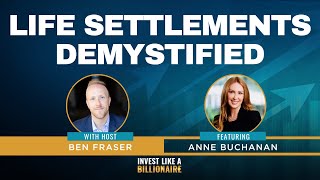
Anne Buchanan explains life settlements, an investment in discounted life insurance policies. The asset class evolved from controversial 1980s viatical settlements into an institutional market that mitigates longevity risk through large, diversified pools and medical underwriting. Demographic shifts and recent estate-tax changes are driving supply.
Chapters
Hello, future billionaires. Welcome to another episode of the Invest Like a Billionaire podcast. Had a fun interview today. This is with Anne Buchanan. She is investor relations at a company called Preston Capital, and they are in the very unique asset class of life settlements. And so this is where they actually buy life insurance policies and become the beneficiary of the death benefit on other people's policies. And it's been an asset class that's been around for a long time. There's been kind of some negative stigma around it, especially in the '80s for several reasons that she talks about, but it's kind of evolved over time into being a pretty institutional asset class, non-correlated, very, very interesting. So we kind of dive into all of it, you know, how they look at longevity risk and different things like that. So very interesting. Again, we love to highlight just unique asset classes, things that maybe other people aren't talking about, just so you can learn about what's out there and what is available to investors like us. And again, I do got to give the caveat, as I always do whenever someone comes on who is raising capital, is I have done zero due diligence. This is purely informational. I brought them onto our show because I'm interested and just love learning these things, and I hope you do too. But if you do, you know, kind of take that next step or we'll get more information, please understand we have done no due diligence. You have to do that on your own and, you know, go through the whole process to make sure it's going to be a fit for you. But we have not done any, we're not promoting them, we have no affiliation. And with that, I'll let you enjoy the show. This is the Invest Like a Billionaire podcast where we uncover the alternative investments and strategies that billionaires use to grow wealth. The tools and tactics you'll learn from this podcast will make you a better investor and help you build legacy wealth. Join us as we dive into the world of alternative investments, uncover strategies of the ultra-wealthy, discuss economics, and interview successful investors.
Looking for passive investments done for you? With Aspen Funds, we help accredited investors that are looking for higher yields and diversification from the stock market. As a passive investor, we do all the work for you, making sure your money is working hard for you in alternative investments. In fact, our team invests alongside you in every deal, so our interests are aligned. We focus on macro-driven alternative investments so your portfolio is best positioned for this economic environment. Get started and download your free economic report today.
Welcome back to another episode of the Invest Like a Billionaire podcast. I am your host, Ben Frazier, and today I'm joined with our special guest, Anne Buchanan. She is the head of capital formation and investor relations at Preston Capital, and we've brought her on today to talk about a very unique asset class. So as you know, if you've been listening to the show, Invest Like a Billionaire. We love to explore all the unique things that the ultra-wealthy are investing in, and alternative asset classes is a big core piece of what we focus on. And I was thinking about it over the past 2 years of doing the show, we actually haven't had anyone talk about life settlements. And this is something that I've not actually had any experience in, but have had just indirect exposure to, have heard about it. It's very, very interesting. Uncorrelated asset class, and we decided to go straight to the top and bring on an expert in the space. And thanks so much for coming on the show.
Thank you. I, I do not want to, to say I'm necessarily an expert, but I've now had about a decade's worth of experience in this space. It's, it's quite interesting. There's misconceptions, but really sophisticated investors gravitate for this type of asset class. So really excited to dive into it and answer any questions you might have.
Yeah, yeah. Well, thanks so much for coming on the show. I'm really excited to dive in. And just before we do, give a little bit of your background, kind of how you ended up where you're at, and tell us a little bit about kind of what you do at Preston.
Sure. So probably like many people in the investment world, I started at a very large asset manager that had a broad basket of investments in equities and fixed income, call it very traditional long only. Began my career in April of 2008, so weathered the Great Financial Crisis, and during that time realized that all of these things that people said were non-correlated or could provide weathering of a recession and different types of market environments really didn't hold true in that recession. It affected institutions, it affected everyday investors. And I was there for approximately 7 and 8 years, so really learned more of the backbone of the industry, but always wondered, is there an asset class that could actually hold up when you have pretty dire market events? And happened to be introduced to a, at the, at the time, a very small life settlement firm. Based in Austin, Texas, that was one of the pioneers in the life settlement space. Um, I came into it not knowing the asset class, not knowing that it was even investible, but I did start to understand the philosophy that the underpinning risk of this asset class is longevity. It's not the macroeconomy, it's not interest rates, it's not presidential elections. And I found that fascinating. From my traditional long-only background that this was a true nichey specialized asset class. So I spent the following 6 to 7 years, um, traveling the world and sharing the strategy of life settlements with investors from everyday ultra-high-net-worth investors to, um, some of the biggest institutional investors in the world. After that time, I took an opportunity with my current firm, Preston Capital. So they have a long track record in this space. They've been managing money in this space for quite some time, and I joined approximately a year ago. So I lead their efforts in capital formation and investor relations, and excited that we can share and educate this asset class with a broader audience. I think that's one of the biggest hurdles is just having this asset class become more well-known and adopted. So maybe in 10 to 20 years it won't seem so nascent and esoteric to the average investor. Right?
Because this is something that, you know, large institutions have been investing in for a while and it's, you know, it's the form of it has changed over time, which I'm excited to get into. But one of the things I wanted to just, I wanted to make a point of because you said, you know, non-correlated, uncorrelated assets. And I think, you know, one of the kind of knocks on public investments, publicly traded investments, you know, whether you're long only or even if you're hedged and you have, you know, diversification across different buckets of publicly traded assets, what's kind of happened over the course of time is, you know, stocks and bonds, And you know, even REITs have all started to have much higher correlations than they used to have. Meaning that if, you know, one goes down, the likelihood that the others go down, you know, is higher than it used to be. And so, you know, one of the big advantages of alternative investments, one of the reasons that we love it, you know, and kind of our, you know, neck of the woods and the real estate side and energy assets and, you know, a lot of other alternative asset classes is you get The, you know, the true uncorrelation is difficult to find in the public markets because the markets can be very emotional. It's very reactive. It's, you know, it's, it can be, you know, fear-based sometimes. And so if one asset class trends down, so might the others. But with this, I mean, there, there's really no drivers because one, it's not publicly traded, so there's not a share price that's going up and down all the time. But then, 2, it's 100% based on something that has nothing to do with the economy, right? And so, yeah, so, so kind of break down because this is where it gets a little bit unique for people. And I think some of the maybe myths or misunderstandings are kind of like, ooh, I don't know, you know, this is something I want to be invested in because of the nature of it. But talk about what it is and talk about how it's kind of evolved from maybe what it was a decade or a couple decades ago. And what kind of change to the reasons for why these are traded or sold, you know, now?
Okay, great, great question. Many people, when they hear life settlements, their mind immediately goes to viatical settlements. That was something that you would see in the 1980s. These were terminally ill people. They were approached by brokers or Individuals that really wanted to take advantage of them. So a dark cloud was overhanging this, call it industry, or just the financial exchange from someone owning a policy and selling it to another individual that would have to take over those premiums when the original insured passes away. That new owner collects the death benefit. I mean, that's the, that's the main gist of what a life settlement is. But if you go back, let me age myself 30 years in the '80s, it was really for, you know, you could call it a sad reason. It's not something that people would necessarily want to invest in. You hear things such as betting on death, death bonds. It was prevalent at that time. Fortunately, those individuals that were terminally ill, Triple Cocktail came out, people that were HIV positive. Many of them still live well until today. So that phenomenon, or we would call the first wave of life settlements, happened many decades ago. So if that's the perception, you're not wrong. You just probably haven't heard what's happened in the last 1 to 2 decades. If you fast forward—
So, so in those scenarios, just kind of break it down again. Yeah. So someone would have a life insurance policy, and obviously how life insurance works, if it's, you know, whole life, you have a named insured, you have a beneficiary. And so what they could do is they created a secondary market where they could sell the death benefit and the named insured is still the same. So the life insurance policy and the premiums being paid are still, you know, to ensure this person's life. But then once they passed, the death benefit would then be paid to the new beneficiary, which would be the, the private equity firm or the group that bought the insurance policy at that point. Is that kind of a simple way to, to under— to break it down?
That's right. In 1911, the Supreme Court ruled that a life insurance policy is property. So you can sell your car, you can sell your house, you can donate them. Many people do know about donating life insurance policies to their church or their alma mater, their college, but they don't realize it's property. And as of that ruling in 1911, you have the ability to sell it. Otherwise, you're at the whim of the insurance company and it's an illiquid asset. So you're completely right, Ben. It's, it's creating liquidity in what, in what would otherwise be an illiquid asset. The trade-off, the reason an insured would sell their policy, there's a myriad of reasons. If you fast forward to where we are at today, you have very, very wealthy seniors that are living into their 80s and 90s. They thought they were going to pass away in their 70s, and they were paying premiums along the way. They wake up at age 85, 86, 87, and they realize that they actually feel good. They feel fine. They have no terminal illness, and there's this policy hanging out there that they don't want to continue to pay premiums on. So most of them, almost 90% of the individuals that own these universal life insurance policies that are seniors, end up not holding it to a death benefit. They'll just lapse it. They'll walk away with cash surrender value. And by selling it to an institution or another investor, the exchange is you get cash upfront. So you're going to get maybe 10%, 20%, 30% of the death benefit upfront in order to release that policy and give that death benefit to the other institution who will continue to pay the premiums. And like you said, receive the death benefit in the end.
In, in general, like, if it's a whole life policy, you have a death benefit and you have a cash surrender value. So if you just, lapse the policy, stop paying it, you would get the cash value. But if you sell the policy and you transfer the death benefit and the responsibility of the premiums, you can potentially get more than the cash value, I'm assuming, or else what would, what would be the, the point, right? So you're still selling at a discount to the, to the death benefit, but more than the cash surrender value.
Exactly. So the math is actually quite simple. It's the execution and how to do this in a very diversified institutional way that can get a little bit more complex. But you're right, it would be irrational to sell this policy if you would just walk away with the normal cash surrender value. A life settlement by definition needs to be paying someone for their policy north or above the cash surrender value, less than the death benefit. So it's somewhere in between. And all you're doing is discounting those forward cash flows at a given discount rate, the rate of return that you're trying to achieve given that stream of cash flows going forward.
So the biggest risks in this, you said it's a longevity contingent asset. I like that term. And the biggest risk is people continue to live longer. So, it's because it's not a matter of when that payout happens. It's a matter— or sorry, not a matter of if, but a matter of when. Right. And so if it continues to get longer and longer and longer, that reduces the rate of return or the internal rate of return because of time. But I would also imagine because you are now having the responsibility of paying the premiums, you have to have a pretty conservative approach to assumptions to maintain paying those premiums. If you stop paying the premiums, then the policy lapses and now you're not out just the future, you know, death benefit, but all the cash that you've put up so far. So talk a little bit about, you know, what are the things you're looking for? How do you approach this? Because, you know, in my view, longevity and, you know, I'm planning on living a lot older than, you know, my grandparents lived and probably older than my parents will live too, which is older than their parents lived too. So, You know, we are seeing a trend towards some pretty big health breakthroughs. And how do you, how do you kind of quantify that? How do you kind of reduce or mitigate some of that risk?
So there's a few topics there. One are the general risks of the asset class, and then another is the precision and how does this demographic trend of living longer maybe play into it. I'll start backwards. The demographic shift of people living longer, especially with the wealth effect, the people that tend to own these large universal life insurance policies tend to be a wealthier cohort than the standard American. All of these things we believe are true. We love medical innovation. We follow it. We look at everything from the Wegovies of the world to cures for cancer, heart disease. And we think that this is going to be a good thing for mankind and also pose some challenges. The catalyst for why people sell their policies, which increases supply of life settlements, is the fact that they're living longer. The longer that people live, you're going to have this surge of baby boomers that say, this is great. I actually, you know, have lost some weight. I no longer smoke and drink. I'm on a good diet. Um, I'm feeling great. I'm going to outlive my parents. But again, when you wake up in your late 80s and early 90s, the downside of that is if you want to maintain your lifestyle again, even if you're very wealthy, how do you do that? And you're looking at different parts of liquidity. Maybe you have a second home. Um, maybe you have businesses you could sell, or if you have a financial advisor, you might have someone take a look and say, you have this unneeded life insurance policy. So the fact that people are living longer than ever, we think, is a net good for many, many reasons. But we think that in turn is going to increase the amount of policies being sold. But if you back into that—
you're saying— can I pause you right there real quick? Because you're saying it might be a net good. Is that from the idea that they're wealthier than they thought? They have other assets, other resources, so this, you don't really need it, or is it because, hey, we're living longer, our financial plan, we might not be hitting it because we planned to, you know, whatever the market didn't do as well. We didn't plan to be alive this long and now we need to find other liquidity. And, you know, with a life insurance policy, you don't get the benefit of the death benefit because it gets paid out once you pass. So now I can take some of that cash now at a discount to continue to sustain my lifestyle. Is that more what you're saying, or is it the, the former?
I'd say it's a little bit of both. So I would say the wealth effect, the fact that people are living longer than ever, we believe is, is a net good. But again, even if you're in that scenario and you are one of the, you know, top 1-2% of the population, You can invest in qualified purchaser type of assets. Even in that scenario, like you said, you might say, look, my stock portfolio is down. I want liquidity. I think XYZ, real estate, oil and gas, there are other interesting opportunities. Where can I tap into that liquidity? Well, if you have this unneeded life insurance policy and your kids are already in their 40s, they have their own policy, like they do not need this amount of money, it does create a pocket of liquidity. So I actually think that both— I would, I would agree with that— those poses as net, um, net positives to the industry as a whole. And we think it is a, it is a good thing for the insureds. Like, we're on the side of the insureds. You might as well tap into it and walk away with some liquidity if you're going to lapse it anyway.
And to that point, if they're selling it at a later stage of their life, there's probably a limited runway of, you know, it's not going to be probably another 50 years. You're not buying it early on in life. So there's probably less risk there because it's, you know, they don't need it. And so let me just generate some extra liquidity and maybe I live a little bit longer than expected, but the long-tail risk of that maybe is reduced because of the average age that you're purchasing these at? Is that— is that—
I would say that when you're looking at the very senior population, I mean, the fact that in our perspective, if you're 70 and 75, you're quite young for a life settlement. I mean, that should just show you how we really think about age. There are institutional asset managers that target, again, what we would call the younger population in their 70s. Which we believe there's more of a J curve if they live on average longer, or there is a health breakthrough. A 7-year-old could easily live to be 95 in the given environment. If you are 85, you know, can you live to 105? Like, what's a more likely scenario? Um, but we believe in the much more senior population. So you're right, on average the duration is shorter. Than many other assets. I would also say this is where diversification comes into play. We believe this is about the law of large numbers. AM Best, which studies insurance companies and gives stats on diversification, cites that you need at least 300 policies to have ample diversification because we don't know when any one person is going to necessarily pass away. Life expectancy's a midway point. It's if there are 1,000 people just like you, age, sex, smoker, nonsmoker, impairments, where you live, wealth effect. In that subset, half of the folks would pass away before the life expectancy and half after. So even though the biggest risk that we believe in this asset class is longevity risk, having precision and accuracy on what is their life expectancy at time of purchase, we also believe that you need hundreds of policies within a portfolio to lower the standard deviation and help you have more certainty around what those return expectations could look like versus having 5 policies. We think you're rolling the dice. You could have incredible returns, or very, very, um, uh, unappetizing returns. It could really go in either direction when you have that few policies in a portfolio.
Yeah, that makes sense. So if you can increase your sample size, increase the number of policies, the, uh, the bell curve kind of will hold more true to where you get more of the standard deviation, uh, of a large sample set of numbers versus taking outsized risk with smaller Well, you might not know the numbers off the top of your head, but you know, what has the life expectancy on average increased to or to and from over the past, say, 20, 30 years? And I'm thinking U.S. mostly, and I'm assuming by most of us. And then what, what is kind of the forecast like? What are you guys using internally of like, here's where we think from, you know, by 2030 5 by 2045 or '55? What are some numbers that you guys just internally benchmark to, or if you could share that, but just what are some just general assumptions of the market on how much has it— has longevity and life expectancy increased, you know, in the past and what is it kind of expected to going forward?
So I'll give you a general answer, but I would say that we would absolutely bifurcate the general US population and this population in general over the past 20, 30 years. Life expectancy increases for, again, a wealthy Western country like the United States on average about 1%. Now, there are pockets of the population that when you see suicide or opioids, that mortality has actually gone up. There are other subsets of the population where it's gotten a little bit better. So you might see a main article, Time News, in general, um, population life expectancy is increasing. You do need to dig into the numbers to see, is that men, is that women, um, demographics? All of those things do play a part. But in general, I would say most institutional investors can and should bake into some type of marginal increase a year despite anything happening, like in absentia of medical breakthroughs or pandemics. Bake in that if over the past 20 years everyone's lived about 1% longer than what they did the year prior, I would think that that's a pretty prudent estimation of the population as a whole. If you look at our cohort, one of the biggest things that has, I say, transpired over the past 10 to 20 years is the realization that you shouldn't estimate these individuals based on the valuation basic table. That's the standard table that actuaries use to look at the broad US population. It doesn't take into account, I know I've said it a few times, but the wealth effect. During COVID individuals that had better access to healthcare were able to, to have a, maybe it's a home health aide instead of being in a nursing home, they were able to get responsiveness, if they had, um, any type of symptoms of COVID versus someone that was in the middle of nowhere and was further from a hospital, your outcomes and your mortality rate looked different. So when we look at the life settlement cohort, I would just say that we're— we want to be even more conservative than what the general US population is because they typically have the ability to achieve that. And they have people around them, they have medical innovation, they have all of these tools. We don't know what 2030 looks like. It's a really good question. Is something gonna happen to a subset where all of a sudden you see no de— dementia, where all of a sudden you see one type of cancer that's eliminated? All of those things could take place. We diversify in a portfolio that has many, many different impairments. Most people have comorbidities, they have more than one. So it's not just one thing that you get at 65 and that's necessarily the reason you pass away at 95. There's usually a myriad of reasons. But I would say is we, we would never pretend that we know exactly what that looks like in 10 to 20 years. What I can say is what we care about is when we buy the policy, having precision, following that medical health over time. So when you own the policy, insureds typically sign HIPAA, so you can track changes and you can stay ahead of what is coming in case you want to sell it in advance. But it's a really interesting topic, Ben. We don't know what that will look like, but we do see that generally there's a huge demand from the US and I'd say global population to extend life. So we would not be surprised if in general we all end up having longer life expectancy over the decades to come. And we bake that into our expectations.
Right. Yeah. And I would imagine too, with the subset of the population going after, which are the wealthier individuals that, you know, maybe don't need this policy anymore because they have plenty of assets. They probably also will have the most willingness and capability to go and explore new forms of medical breakthroughs and have the, you know, the financial resources to maybe take advantage of that. So there might be a, you know, the more wealthy subset of the population might, you know, expand longevity or expand life expectancy faster than the general population, maybe earlier on until I guess more democratized. You know, it's kind of a more of an aside, more of a funny question, but it's, uh, yeah, I hear some of these, um, uh, I don't know what you would call them, but you know, long-range forecasters and, uh, people in the medical profession. One guy follows named Peter Diamandis and, um, I think Ray Kurzweil, and they're actually predicting at a certain point we kind of hit this, I forget what he calls it, but something exit velocity or velocity's in there. But the idea is you hit a threshold to where at a certain point they can figure out how to put your consciousness in the cloud and then you basically live forever, you know, but maybe your body dies. And so that, you know, triggers it to kind of a weird esoteric thought. But, you know, at a certain point I wonder if, You know, I'm not a believer that that ever happens, but, um, that's another—
I don't think those are— that's a very interesting point. I don't think those are currently baked into insurance contracts of if your mind is uploaded, but it's a fair question today, isn't it? I mean, the, the, the interesting thing is most of these policies that are going to be settled, all of these have already been sold. So you don't really see as much universal life insurance being sold today. But there is a ton of universal life insurance that is still sitting on the personal balance sheets of insureds across America. So it's a really good point that you bring up. In the next 5 to 10 years, are you going to start seeing that included in contracts? And how would that change the shape of this type of financial transaction? I follow Peter as well. I've, I've spoken at conferences alongside him. And I think what they're doing is, is fascinating. And you just wonder what is the domino effect or other repercussions that we're not looking at. I think what we would say is if life settlements are a hedge in your portfolio and we're a small portion of a portfolio, and at the end of the day, we all live for 250 years, and the biggest issue is this portion of the portfolio does not fare as well. I think there are many, many other things that you'd probably be considering before looking at the percentage, right? So, so to me, like, there's many other things. That's why we, we believe, you know, in diversification, right? Not only across the portfolio of life settlements, but across all different asset classes. But yes, if that comes to pass in the next few years, the world will look quite different for all of us. And, and it, it might not be as interesting an asset class. But until that happens, we think that there is— but there's good actuarial science and understanding, and we continue to see attractive assets.
Totally. No, and I think it's more just seeing how the industry is thinking about that, right? Because these are things that are being worked on. We've seen pretty big jumps in life expectancy over the past 100 years, you know, as a larger timeframes. But to your point, I mean, it seems as a pretty liquid market and if you have to continue to extend, pay out of the premiums, you can sell maybe other portions of the portfolio. And if you have a large enough sample of, or large enough assets in your portfolio, you can kind of manage through that. What's, I mean, This is a little bit outside of my wheelhouse, but is there any, like, I feel like when we talked before, you said there was like some changes in the tax code or things that also kind of shifted the perspective on, you know, it's not as compelling as it used to be to hold this asset, you know, until I pass versus selling it now. Maybe jog my memory if there was some kind of change in the tax code, or if not, then we can move on.
No, sure. So if you go back to the '90s, the estate tax exemption was much lower than it is today versus the past 10 years. So many, many people in the, call it the late '90s or early 2000s, they bought these policies for estate tax planning. If you had a farm, if you owned a business and you didn't want your kids to have to sell the business, sell the farm, If you bought this universal life insurance policy and overpaid early on, that policy would then invest in stocks and bonds, grow over time. So when you hit retirement, effectively that account is debited down, you pass away, and the death benefit is transferred to your kids. But if you wake up and as a married couple, the estate tax exemption is significantly higher than it was when you originally bought the policy, you don't need that because you won't have that estate tax, um, kind of gouging of your assets. Now, we don't know where regulation is going to go. It, that estate tax exemption could certainly go higher and it could go lower, but I would say broadly it has increased overall over the past 20 years, and that is another catalyst of why people are just, call it, offloading these assets. They just don't need them. So we'll see what the future holds. But as of today, I'd say that that's a meaningful driver of supply that we see out there.
Interesting. So yeah, there could be changes in supply if the estate tax rules change, you know, not in the favor of selling it, but again, having hedges in different portions of the portfolio You know, makes sense. How do you, is there like a marketplace for these or how do you go and find, you know, these individual policies to go buy? I mean, that's a whole—
Good.
Yeah.
Good, good question. So if I go take out an insurance policy myself, that's called the primary market. That's primary insurance. If I want to sell it for the first time as the insured, That is the highly regulated secondary market. So this is a state-by-state regulated transaction, which is good. This is what lacked in the 1980s. There was no one to protect the insured from, um, commissions, uh, kind of all of that, that transfer of money in the value chain that could erode value over time. It's now regulated in more than 40 states in the United States. There are institutions that buy these. So if you watch CNN or Fox News late at night, there are firms that will advertise like cash now, and you can call them up and sell it directly to them. I'd say that's one way that people will look to sell their policy. Many people that I would say that we have bought policies from, you mentioned this before, you probably have an intermediary. If you are, again, call it the top 1% of the US population, you likely have a CPA, an insurance agent, a wealth advisor. You typically have someone helping manage portions of that or the entirety of your portfolio, and that individual is a fiduciary. If they really look through everything you have, they could be the one that says, look, we should look out and see where we could sell this. And there are life settlement brokers that can represent you and say, we're going to look at your file and we're going to bid this out to 10 different firms that are looking to buy this policy so we can get you the top price possible. So that's the secondary market. Either you're calling someone directly or you have someone on your behalf help you shop your policy for the highest bid. The next market is called the tertiary market. That is when an institution has already acquired that policy from someone and now it's selling it to another institution. That is an unregulated market. So that is Apollo selling it to Berkshire Hathaway. That is, you know, back in the day, I think UBS and Credit Suisse, Deutsche Bank, You had all of these large institutions. If they sold it to another institution, that is a tertiary transaction. So I'd say those are the ways that you can source policies. As an institutional manager, you might buy from individuals, you might only buy from other institutions. So there's different markets and there are pros and cons of both markets depending on the competitive nature of the environment. At different points in time.
Interesting. So say I have a whole life policy that I took out a while ago. I'm in my late 30s, so I'm not hopefully close to dying anytime soon. Could I sell my policy or is that not even within the realm? I mean, you said Young was like 70 years old, so, you know, that's a little far from that.
The arbitrage is when your original life expectancy curve when you took out that policy and they look at blood tests, health, do you exercise, smoke, drink? They do that overall assessment to decide how much premium you have to pay. When the curve shifts from the original underwriting, that's where there's the arbitrage because the insurance company can't come back to you and say, actually, Ben, we're going to re-underwrite you. We now think that you're healthier. You're gonna pay more. They can't do that based on your health change. However, a third party at time of acquisition could see that shift or change. So the reason I bring that up is if you have a significantly different health change today from when you took out the policy, some investor out there might see value. It depends on how much duration risk do they want to take on. Maybe you have something that you have caught or you have acquired from a disease standpoint that there's some asset manager that says, look, we think if you have that, your life expectancy is probably XYZ. We would actually buy that from a 35-year-old. I would say that is not, That is not every institutional asset manager's perspective, but you'd have to have probably a very, very significant change in health from when you took it out. And the difference is once you get into like your 70s, 80s, 90s, that's where you see the biggest differences. Okay.
And a significant negative change, right? Because if it's positive change, then the value only probably goes down. That's right. I got a fitness tracker a couple weeks ago, so hopefully I'm moving, uh, on the other direction.
So hopefully we never get a phone call that you need to sell us a policy anytime soon.
Kind of the last question is, you know, what are the things to think about as someone that is investing with a sponsor manager in this space? What are the things you'd be thinking about to, you know, is this person, is this group and company experienced and what's kind of the differences in strategy and you know, how do you kind of go about, and what are the big questions that someone should be thinking about or asking if they're looking at investing in this space?
So you, you brought up one that's very important. I would ask about their experience. There are a myriad of risks, just like any asset class, whether that's litigation, regulation, insurance carrier-specific. So although we believe longevity risk is by far the most meaningful and has likely the greatest outcome in your portfolio, you need someone that's experienced in all of these risks. Have they gone through it? How long have they been investing? Have they seen the shifts over time? I would say that I would be asking about their precision in underwriting. Do they have anyone with medical capabilities looking at the policies that you acquire? I would ask, how do you source policies? Do you source from individuals and/or do you source from institutions? What's your competitive edge? I would also want to understand, are they generating returns by buying a pool of policies and holding onto them to maturity? So are their returns actually derived from the realizations of death benefits? Or do they trade, meaning they do need someone on the other side? Is it more of a trading mechanism and they're generating value that way? So again, asking, is most of your returns coming from realized or unrealized gains? I think that could give you profound answers about that type of, um, institution. The number of people that they have on staff, how much of it is outsourced? All of these things are just, I'd say, a few, a few things that I would look at. And I would finally say the structure of the portfolio. There are some firms that have this in more of an evergreen or open-ended structure, and there are some firms that manage this in more of that traditional closed-end private credit drawdown structure. There are going to be pros and cons to both. But I would want to understand the tax implications, how you value policy, specifically if it's in an open-ended structure, to make sure that I have the most comfort around the liquidity risks of those different types of entities. So those are a few things I would, I would look at.
Awesome. Well, Anne, thanks so much. This is really fun and great insights into this very unique asset class. So what's the best way for folks to get you know, learn more about what you guys are doing if they're interested?
Sure. So, um, I think you might be able to put up our information after this.
Yeah.
Um, but my firm is called Preston Capital. Um, our website is prestoncap.com. I, I would say that if you're interested in learning more, you go, you go on our website. My email address should be on there, so you could reach out. We're going to have, um, we're actually going to have a series of just purely educational webinars coming up this year, just like this, Ben, where we're just talking about what is the asset class, how does it work, what are the risks. So if anyone is interested in learning more from just an edification standpoint, we would be happy to provide that to them.
Awesome. All right, well, and thanks so much for coming on. It was really fun.
Thank you so much, Ben. Take care.










