
Multifamily: Apocalypse or Opportunity? feat. Neal Bawa
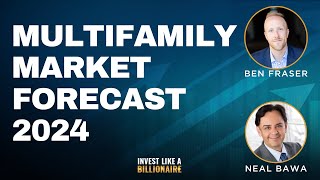
In this Invest Like a Billionaire podcast episode, host Ben Fraser interviews data‑driven multifamily investor Neal Bawa. Bawa explains that U.S. multifamily construction starts in May 2024 were only 278,000 units on an annualized basis, creating a projected supply‑demand gap of about 130,000 units by July 2026. He predicts that this shortage will push occupancy above 95% and rent growth of 5‑10% in 2026. Bawa describes three "greedy" investment buckets: (1) locking in cheap land contracts now and closing them over a long horizon, (2) buying value‑add assets at roughly 25% discount with assumable 2022‑rate loans, and (3) providing pref‑equity to distressed, near‑complete development projects whose banks have halted construction draws. He argues that the broader multifamily sector is not in distress; only development projects and a small slice of built assets (≈3% of the portfolio) face refinancing pressure. He outlines the lending environment: 4,000 U.S. banks, 282 over‑leveraged in commercial real estate, with only one systemic bank (NYCB) at risk; Fannie Mae and Freddie Mac now serve as lenders of last resort, supplying roughly $70 billion annually to multifamily at 5‑6% rates. Bawa assesses macro conditions, noting inflation has fallen from a 9.2% peak to around 1‑2% (PCE 0.1% month‑over‑month), unemployment is at 4%, and energy prices have stabilized around $75‑$80 per barrel. He expects a modest Fed rate cut (≈0.25 ppt) in September 2024 and anticipates recession‑like conditions in Q4 2024‑Q1 2025, but not a technical recession. Bawa advises investors to view the current period as a buying opportunity near the market bottom, emphasizing a Buffett‑style “be greedy when others are fearful” mindset, and promotes his free educational platform Multifamily University. The conversation also touches on regional market dynamics (e.g., Austin, Phoenix, Salt Lake City, Cleveland) and concession trends, reinforcing that multifamily remains a privileged asset class with strong demand fundamentals.
Chapters
There are certain things where you predict and certain things that you know. In the category of I know something, in May 2024, the United States only started 278,000 units of construction on an annualized basis, and it takes about 2 years to deliver those. That means that if you go out 2 years from today to July of 2026, you'll only deliver 278,000 units on an annualized basis, but there is no way your demand is less than 400,000.
So now you have this massive gap of 130,000 units, and that massive gap increases rent growth 'cause concessions come down to zero. Everyone's leasing their buildings up at high speed. All of a sudden, 2026 is that year where I'm going to say our occupancy is going to pick up above 95% and our rent growth would be somewhere between 5% and 10%.
Such a great point. I think so many people don't remember that the deliveries that we're getting today were started 2 years ago.
If you invested money into a syndication, a project, into single-family rentals in 2006, you lost your shirt.
Hello, future billionaires. Welcome back to another episode. Multifamily apartment investing, is it headed for an apocalypse or is this one of the biggest opportunities we've seen in the past decade? Well, I'm not going to give you the answer, but you need to listen to this episode in its entirety. We brought on one of our favorite people in the investing space, Neal Bawa. He is known as the mad scientist of multifamily and he is a data-driven investor entrepreneur, much what we like to do at Aspen Funds. And so it's always fun to riff off the data and we have really in this moment right now in the middle of the year, really good recent data that is providing some pretty strong indicators of where things are going to be going. So you definitely want to tune in. There's going to be a lot of great insights you're going to glean from this episode. And if you are enjoying this episode, we always appreciate you to subscribe, rate and review, share with a friend. It helps us continue to get on great guests like Neal. And with that, enjoy the show.
This is the Invest Like a Billionaire podcast where we uncover the alternative investments and strategies that billionaires use to grow wealth.
Wealth.
The tools and tactics you'll learn from this podcast will make you a better investor and help you build legacy wealth. Join us as we dive into the world of alternative investments, uncover strategies of the ultra-wealthy, discuss economics, and interview successful investors.
Welcome back to another episode of the Invest Like a Billionaire podcast. Your host today, Ben Fraser, joined by one of our favorite guests. We've had Neil on a few times, Neil Bawa. He is colloquially known as the mad scientist of multifamily. And you'll find out if you haven't heard Neil speak why he gets that name a lot, because he loves data, very data-driven, which is a lot of what we love here at the podcast in Aspen. So it's really fun to talk with Neil. Always got some fresh, hot-off-the-press insights. And today is no different because we kind of timed this really well, possibly accidentally. But hey, we'll call it as well-planned in advance with some of the fresh data coming out from the Fed, from the economy. And you just did an investor update too, Neal. So give us, give us some insights, a little bit on your background, maybe just real quickly for those that don't know much about you. And then let's, let's dive right in. This is going to be great.
Sure, computer science graduate, data science is my specialty. I've had a successful tech career, 15 years, ran a company, sold it to a private equity firm. And while I was doing that for my own taxation, you know, I live in Taxifornia and have the big fat tech salary. So I was doing real estate on my own for 10 years just for myself and my family, dozens of single-family homes, and then got into it in 2013 because when I sold my company, I had an enormous, ginormous tax bill. And the best way to, you know, bring that bill down was multifamily, right? You know, depreciation is such a, you know, I tell people depreciation is the best authorized, completely legal tax scam in America. And people have been using depreciation for 100+ years. Nobody's ever said depreciation will go away. 1031 may go away, but depreciation is completely legal. It's so deeply embedded into the way that we do accounting in America. It's always going to be there. And I've never seen depreciation on any asset class like I do with real estate, perhaps with oil, but you know, they're obviously a different level of risk.
So, you know, started doing multifamily in 2013, you know, very data-driven. We publish a lot of data, about 25,000 people use the data that we publish each year. I presented at roughly 15 conferences and actually present with Bob, co-present with Bob at many of those. And it's about 1,000 active investors right now. The portfolio used to be $1 billion, Ben, but we sold off a bunch of stuff in 2022 and so it's about $700 billion.
Good, good timing to sell.
Yeah, well, 2022, Jesus, you— I mean, I was— I wanted to sell everything, right?
Oh, man. Well, so give us a little update. So we're sitting here kind of middle of 2024. We're in an election year. We've been in one of the fastest interest rate hike periods in U.S. history, and everyone's been just holding on, hoping for some relief. And it's felt kind of doom and gloom, right? We've seen values of asset prices come down, especially in office. Multifamily has been hit pretty hard. Everyone's feeling the burn. Everyone's getting capital calls. Is that where it's going to go? Are we set for kind of a big correction, big reset, big recession, as a lot of people like to say? Or what's your perspective?
Yeah. So let's talk about that. And I think I'll start by just using a few words. So my state of mind right now is absolute and pure greed. Right now I am extremely greedy and I'm going to be very specific though. My greed is very specific in 3 bucket. Number one, I'm greedy to put land in contract because land is cheap right now because of what's happened, and I'm able to get 40% off. And instead of closing in 4 months, I'm closing in 21 months. So I'm putting massive, absolutely gigantic amounts of land in contract for future development. I'm not building anything right now because interest rates are too high. So that's my first area of absolute greed. My second area of absolute greed is value-add properties that I can buy today for 25% cheaper than they were in March 2022. Right. So 9 quarters ago, the same property was 25% more than it is today. But I'm only interested in buying properties that have assumable loans because the only reason multifamily has dropped 25% today, the only reason is high interest rates. There's no demand issue in the United States. Multifamily vacancies are at 94.2%, which is actually a little bit higher than 90, 94% historical occupancy levels. Rent growth is a little weak, but it's positive. So rent growth in the United States was a little under 1% in the last 12 months, which is phenomenal considering that over the last 12 months we've delivered more than 600,000 apartment units. So to have positive rent growth in a time frame where you have the largest delivery of apartments since Richard Nixon was president, shows just how insanely strong multifamily demand is. But demand is incredibly strong. Occupancy is incredibly strong. Rent growth is positive, but prices are down 25%.
They're down for one reason: high interest rates. And so when I can get an assumable building, I'm getting a 2022 interest rate with a 2024 price.
I'm greedy if I can get those two things together.
And the third thing that I'm very greedy in, perhaps the most greedy in, is today we have roughly 5 to between 5 and 10,000 development projects in the United States that are maybe 80% done, 90% done, 100% done. They don't have any tenants. They're not leased up or they're like about to finish. And what is happening in the United States, Ben, is that as interest rates stay high for longer, the banks that were funding these projects like Churchill are pulling back. Churchill, Corvest, a lot of these banks are pulling back. And so the banks have basically stopped funding construction draws on projects that are 70, 80, and 90% complete and are demanding more equity, right? These are beautiful buildings, are Class A, and they're 70, 80, 90% complete. And now all of a sudden the developers don't have money because the banks are not funding it and saying, hey, you need to put in another $5 million. That is the most important and biggest opportunity today because when you make an investment there, Ben, you come in as pref equity. What that means is essentially you're wiping out all of the common equity that's in there. There may be $7, $8, $10, $15, $20 million of common equity. And essentially you're saying, I'm going to come in and I'm going to take all the profit. And guess what? That common equity has to vote to let you in. And in 100% of the cases, they're voting to let you in.
You know why?
Because if you don't come in, their options— their money's gone. So at this point, they're not looking for returns. They might even be happy with, if I get $0.80 on the dollar back, I'm happy, right? So that common equity is actually pushing those developers to say, bring more money in, because if you don't and the building doesn't get completed, we're just completely wiped out. Everything goes back to the bank and the bank's going to sell it for pennies on the dollar. So while multifamily does not have any distress. There's people that say— they use the word distress. They're using it absolutely incorrectly. Multifamily value-add, multifamily industry does not have distress, but the development portion of the multifamily industry has significant distress. And then on the built multifamily side, there's roughly 3,000 properties out of a total of over 100,000. So roughly 3% that must refinance or sell this year. And when they refinance, they have to input $3, $4, $5, $6, $7 million of equity. If they sell, they're going to sell so that their equity loses all of their money. The bank will get all of their money back. This is why there's no distress. Distress by its very definition— and I want everyone to remember 2008— distress by its definition is a time when banks are afraid of taking properties back because they don't know if they can even get what their loan amount is back.
Yep.
No such distress exists in any market in the United States because the bank loan amounts are in general equivalent or higher than the value of the property. Obviously, there is distress for the 100 investors that put money into this property that are about to lose all of their money. So altogether, these 3,000 properties, if each of them has call it 50 investors, that's 150,000 investments that are in distress.
But to say that the sector in distress is completely nonsensical, and I'll give you a perfect example. In the last 13 weeks, we have made 27 offers. We've only managed to get into 3 best and finals, and we lost all 3 of them. In every single case on the— all of those 26 properties, Whoever bought them went hard on a minimum of $100,000 on day one. When you say that and you say that there's distress in multifamily, yeah, that's nearly— have no understanding of what you're saying right now. Right.
You would you bifurcate the, the traditional bank with non-bank lenders? Right. Because you could argue a lot of the loans or properties are purchased in, you know, 2021, 2022 were done with bridge debt. Those are much higher leverage points, you know, 80 to 85% plus some of those, some of those lenders I know are in distress if you, you know, extract, you know, so you're saying just the banking system as a traditional banking system in general.
Definitely. So, so I'll break it down to you. So there are 4,000 banks in the United States. Of them, 282 banks are overleveraged in commercial real estate. So there's 282 out of 4,000 banks. Now, here's the good news. Out of those 282, there is a single large systemic bank. That bank is New York Community Bank. One, one bank, New York Community Bank, that is a systemic bank. A systemic bank is a bank that has over $200 billion in total deposits. And so it's large enough so that could actually affect the system. Well, we've already had one systemic bank go down last year, and that was Signature Bank, unrelated to commercial real estate.
Right.
Obviously, there was a run on the bank. And as you saw, immediately the Fed came in and basically just guaranteed everybody's deposits because they were afraid of systemic issues. So there's a single bank at risk and the Fed is keeping a very close eye on them. So is the FDIC. I don't think that there's any possibility—
probably more office than multifamily in their, in their balance sheet.
A lot of it is office. A huge amount of it is office. And the distress level is higher in office. But here's the key thing. Out of those 282 banks, one the Fed is keeping a watch on, the FDIC is keeping a watch on. The other 281, when these banks, if and when these banks go out of business, all that happens is the next day the FDIC reopens them under a different name. There is no systemic risk because these banks are too small to create systemic risk. So what we are seeing is a pullback where these smaller banks are not lending as much to multifamily as they were. Though I have to say, in the last 6 months it's been— it's reversed. Now more banks are saying, you know what, we think multifamily is nearing a bottom, so we're going to come back into the market. So what we were seeing is people pull back. So for the moment, for the last 18 months, we have seen Fannie and Freddie as lenders of last resort have bigger and bigger chunks of the market. They're still not more than 50% of the total market, but that's a pretty big chunk for Fannie Freddie to be in. I always tell people multifamily is a privileged asset class. Every investor must understand that multifamily is different from hotels. Multifamily is different from retail, from office.
Why?
Because there's only one asset class in America that has two quasi-government agencies who receive roughly $70 billion a year from the U.S. government just to lend out. Right. Only one asset class. And it's not called hotel, retail, industrial.
Or anything else.
It's called multifamily.
And believe it or not, those two quasi-government agencies, Ben, Fannie Mae and Freddie Mac, are struggling to lend out money this year. They've got too much money.
They are not able to hit their quotas.
So they're actually creating schemes to allow people to lend, to borrow more.
All of a sudden they've gone from 2-year interest only to 5-year interest only. And for a while they had a scheme going. It stopped a couple of months ago where instead of doing 30-year amortization of the loan, they were giving you 35 years to amortize the loan.
So there's so much money that they have and so little lending that's going on because of the, you know, challenges in the marketplace.
That's actually too much money.
And that's the beauty of multifamily. That's what holds multifamily steady. The fact that there are two lenders whose job it is to lend $70 billion a year right into multifamily at pretty reasonable rates right now, 6%, 6.1%, 6.2%, 5.9%. That's what we see depending on what day the Treasuries are at. But these are not, you know, high rates. The people, as you said, Ben, in 2022 that were doing lending at 7%, 8%, 9%, 10% bridge, those loans are affected, those banks are affected, those properties are affected. But as a percentage of the U.S. banking system, It's less than 1%. And as a percentage of multifamily, it's less than 3%.
Yeah, right.
And so this is why I can't buy any buildings. I am losing every single offer that I've made.
How do you see— because there are a lot of maturing loans this year and a lot of that is bridge debt, which are generally shorter-term maturities. And a lot of these lenders are trying to work with the borrowers to extend. right, to help them get their noise up. You know, some of the data I've seen, and this is maybe a little bit older than what you're looking at, is somewhere around 25 to 35% of those loans maturing don't have the NOI to basically get refinanced out and fully pay, pay off the senior loan. How does that impact? So obviously there's no distress right now. Traditional banking sector not really under stress. How does potential more idiosyncratic issues with properties and borrowers and these bridge lenders impact the market? Is there enough demand ready to step in and scoop up for a 25% discount that that's really as far as it goes, or does it potentially create a domino effect if there's enough of these that start to hit the market at a national level?
Absolutely. There are not enough of these low NOI properties to create any kind of domino effect. In specific markets, there is an effect. So I think the markets right now that could see some price cutting are, you know, possibly Austin, Atlanta. You know, I'm also seeing Phoenix, you know, a lot of new inventory coming in. So that's putting pressure on rents. So there's 3 or 4 markets where we may see the peak discount being in the 30% range. And I think that that 30% hasn't happened yet. So I think it probably will happen in Q4 of this year and possibly even Q1 of next year. After that, it stops because every time you cut rates by a quarter, you know, percent, let's say you cut rates once by quarter percent in December and you cut once in Q1, then that half percent itself makes a significant difference on a debt coverage ratio basis. So to stabilize some of these properties, the rates, some percentage gets stabilized and that puts a little bit of a buffer into the market. But in individual markets, I'll say Atlanta, Houston, Austin, Phoenix as 4 of the areas we may see 30% from peak for multifamily. And I think that the bottom is really Q4 of this year, though. There, though, just about every data source is calling the bottom this quarter. So if you look at Marcus Millichap, if you look at CBRE, they're calling the bottom of prices, which is a top of cap rates in this quarter. Some are saying next quarter. Most people think that the market has stabilized already. And, and there's a lot of reasons for that. One is there was a huge amount of incoming supply in the first half of the year. The second year, the supply— the second part of the year, the supply is a little bit less. And so people are a little less nervous. And leasing has been very strong in many of the distressed markets. So when I look at May numbers for leasing, many markets in the United States that were boomtowns that have a lot of delivery, had pretty good months. Raleigh, for example, is a boomtown, had a huge amount of delivery. Raleigh's rents were up 0.5% in a single month in May. Well, when your rents are up 0.5% in a month, that's an annualized increase of 6%.
I'm not going to say it's 6% is going to happen, but it's certainly positive rent growth in a market that has huge incoming supply. So, you know, if you leave Austin aside, which is, you know, sort of a meltdown that's happening on the single-family side there, If you leave Austin aside, I am not seeing markets being hugely impacted.
So as a, as a national level, I think the bottom is Q3 of this year with certain markets being Q4, Q1 of next year, maybe even Q2 of next year, simply because they had a lot of delayed supply coming in.
Salt Lake City has a lot of supply coming in right now as well.
So we're, you know, one of the things that I like to see is we like to go into our software and see how many weeks of concessions is the market offering?
Because that is the best, you know, most sort of the newest data. So right now we're seeing Salt Lake City offering 6 weeks, 7 weeks. We're seeing Phoenix offer 8 weeks, and then we're seeing some markets offer 6, 5, 4 weeks. Once you— on a new asset, once concessions are at 4 weeks or 4 weeks free or less, 3 weeks free, then the market is in a very good place because you typically offer a month for free. In new construction, even in normal times. And we're seeing more markets start moving away from 8 and 7 and 6 free weeks to 5 and 4, which means that things are moving in the right direction, especially in the last 4 or 5 months.
Makes sense. Do you have the data on what the kind of 25 or 30% discount in values equates to on a cap rate basis, or is that hard to—
Absolutely. Absolutely. And I want to point out this to some, some people. You know, there's a lot of people listening to this thing He doesn't know what he's talking about. I'm not seeing a 25% decline in prices. Please understand that that can never happen. You could have a 25% decline in a strong market, right, without a change in the price per door. So let's say one of the— the Midwest is the strongest in the United States right now for rent growth. So I'll take Cleveland as an example. This is a market that nobody's built anything in for the longest time because there's no population growth. And so there basically was a lack of supply. And because of that lack of supply, the market's rent growth is very strong. So in Cleveland, you might still be selling something for $110,000 a door where the price 2 years ago was $110,000 a door. And people are saying there's no change in the price. No, because Cleveland's had incredible rent growth over the last 24 months. So if the cap rates hadn't changed, if the cap rate was the same as 2 years ago, that $110K would be $135K a door, $140K a door. So this is why it's very hard for people to wrap their head around this 25% price decline because they don't take into account the fact that we've had NOI growth, slow NOI growth over the last 2 years, and we're not factoring that in, right? So you have to look at everything from a cap rate perspective. So cap rates have declined, especially in the the high supply markets, or increased by roughly 150 basis points. So some markets are up 150 basis points, some are up 125 basis points. That's what equates to a 20 to 25% price decline. And I love it if I can buy a building today with a 2022, you know, interest rate. That's why assumptions are key. And a 25% decline, how do you How do you lose there? How do you lose? I don't know how you lose there. So that's why these 3 buckets are so important to me right now.
Yeah, it makes so much sense. Talk a little bit. Let's shift to the economy. So inflation, that's been the bugaboo for the past few years, right? And it's felt sticky. It feels kind of— is there an end in sight? We just got the most recent print. Talk about that.
Yeah. So I'm really, really happy to discuss inflation today because the last 6 months have been very painful in discussing inflation because it's— it just stuck around, right? I did not expect inflation numbers to stay stuck at that 3% level, right? So the Fed wants inflation closer to 2%. They don't have to wait to drop rates for it to get to 2%, but they want to see it in the 2s, right? And they want to see some consistency with inflation being in the 2s. So inflation peaked in July 2023 at 9.2%, and since then it's been coming down and it sort of very quickly came down to 3 and then sort of got stuck right around the 3.2, 3.3 and sort of has been bouncing around there for 9 months. But the last 3 months, inflation has now dropped into the 2s. And the last inflation print that we have for the Fed's preferred inflation method, which is called PCE, was 0.1%. And this happened at the end of June 2024. At the end of June 2024, inflation had dropped to 0.1%, which if you multiply by 12 months, that's 1.2% a year. Now it's only one print, so you can't read too much into it. But the previous print before that was also below 3%. So now you have one print that's in the twos and one print that's in the ones. And so the Fed's probably looking for one more print, which would be in the month of August, right? Before they're like, you know what, we've beaten, we've broken the back of inflation. I believe at this point we've broken the back of inflation and it's not because of the inflation number. Because think about it, Ben, what is inflation? Inflation simply occurs when demand is higher than supply. If demand and supply are in equilibrium, you usually don't get a lot of inflation, right? Well, today we are seeing the demand demand in the US slowdown. So the number one demand driver is how many people have jobs. So the unemployed claims are today, and this is in July 2024, are the highest, right? So the weekly recurring jobless claims are one of the biggest indicators of what inflation is going to be 3 months, 6 months down the line. Those weekly claims are the highest since November 2021. When the economy was booming, right? So basically at this point, people are losing jobs. We had at peak, we had 12 million open jobs, then we had 11, then we had 10, then we had 9. We are now below 8 million in terms of open jobs. Why is that important? Because the number of people looking for jobs is also 8 million. So when there were 8 million people looking and 12 million jobs open, that creates wage inflation, right?
Yep.
The two biggest factors of, or three biggest factors of inflation in the United States are energy, mostly oil, wages and rents, right?
Or rents and mortgages together. Those three, all of these numbers look fantastic right now, right?
And they didn't look fantastic 6 months ago, I can tell you that, right? So rents in the United States have only increased by less than 1% in the previous 12 months.
So that obviously has slowed a great deal. Wage inflation was over 4% about 6 months ago and now has fallen to in the 2s.
So there's just, because why? Because there's less jobs open.
We got 8 million jobs open instead of 12 and you got 8 million people looking for jobs. So there, we're very close to that equilibrium of the right number of people looking for the right number of jobs. And when there's equilibrium, wage inflation in the US tends to be 1%, 2%. It's not in the 3 or 4 because employers don't have to pay more, right? And then oil, when you're looking at energy, it's very clear that we are back to this pattern of, you know, high 70s, low 80s. That incredible shock that the world economy took from the Ukraine war is gone. It's completely dissipated at this point. When you look at natural gas prices, you look at oil prices, we're in the high 70s, low 80s. Now, this is not a low price. A low price would be in the 50s or 60 barrel. It's a good equilibrium price. The US, the US economy and the world economy functions well when the price of oil is at $75 and we're nearing that, we're, you know, around $80. So it's just a little bit higher than we would like to see it. Now, once it goes below $75, the US actually hurts. We are the largest producer of oil and gas in the world. Something that people don't get, the United States is the world's largest producer of oil and gas. We may not be the world's largest exporter because we mostly use it ourselves, but we're the largest producer. And so when it actually falls below $75, it starts to hurt our economy, right? Because we used to be in 2004, the largest importer of oil in the world. And that situation has drastically changed where Europe wouldn't have energy today if we weren't sending massive amounts of liquefied natural gas to them because of that Russia pipeline closing down. LNG is flowing from Louisiana to Europe. right? And that's what's keeping lights on in Europe, and that's what's keeping their energy prices down. And all of that liquid natural gas comes from our shale revolution as a byproduct. We're trying to extract oil, and when we extract oil, natural gas comes out of the ground, right? And we've managed to, we used to flare it, meaning we used to just burn it, right? Now we've created a pipeline which goes to the port of, you know, St. Charles in Louisiana. And from there, oil tankers, well, not oil tankers, LNG tankers come in The gas is turned into a liquid, it's chilled below, you know, freezing, and it makes its way to Europe where it's basically powering all of Europe. So the shock of the Ukraine war for energy has dissipated. There will be future shocks. I don't know when they will come, but it is inevitable that there will be future oil shocks. But for the moment, the world is in a very good place. China's economy is slowing drastically. They're below 5% growth rate. Usually they use most of the energy in the world because they're not just growing their economy, which is now one of the largest in the world, but they're also producing for our economy and they're producing for Europe and they're producing for Asia. And so they're a producer of the world. They're basically producing 40, 50% of the goods in the world and they're not seeing any inflation. They're seeing negative inflation in China. So please go look at the prices of a shipping container from China to Los Angeles or China to New York. You'll notice that the prices are negative. Not the prices are negative, but price growth is negative, right?
So prices are not negative. Still costs money to ship stuff from China to the US, but price growth is negative. That is the biggest leading indicator that demand is slowing because those shipping containers are the front end of demand in the United States and in Europe. So bottom line, we are in a very, very good place with inflation at this point. In July 2024, I have a very high level of confidence that the Fed will cut rates in September. It'll be a minor rate cut just to get things started. Quarter point. I think we get a quarter point rate cut in September. Okay.
You heard it, heard it here first on the podcast. What do you think is— well, one, do you think the election year impacts the Fed's perspective? Right. They're obviously intended to be neutral, but You know, there's a lot of things to consider making those decisions. And then two, what's your anticipation of does that rate cut continue to precipitate into future quarters? Is that kind of let's do a little bit, stabilize a little bit, stabilize? What do you feel is going to be their approach as they kind of go into a cutting environment going forward? And obviously a lot could change, but what's your gut sense as of right now?
Honestly, I am, you know, very apolitical myself. I'm an independent. I hate both parties equally. I can tell you this, that there's no evidence that I can find, not, you know, non-anecdotal, non-TikTok evidence that the Biden administration is actually interfering with the Fed. If it happens, it's impossible not to know because it becomes public news. The last president to actively interfere with the Fed was Donald Trump. Trump made public statements, which I believe had significant downward, you know, impact on rates because he was threatening the Fed chairman with his job basically and making a public threat. I have seen, there have been zero statements about interest rates from the White House in the last, in all of this year. So if they are putting downward pressure, they're doing it in an extremely quiet form that has not percolated to us at all. So they, and I don't think they can be that quiet. The Fed is an independent organization. You can force the Fed to drop rates, you can't force them to keep their mouth shut. It always gets out. I've seen no evidence that there's a, you know, push to drop rates. The Fed is fairly independent at this point. So I, you know, I don't think that there's pressure on the Fed to drop rates. The Fed, to be honest, if there was pressure, we would've seen it the last 12 months, right? Yeah. When inflation was high. When you see an inflation print of 1%, I mean, at that point there's very little pressure on the Fed. The Fed starts feeling the pressure to drop rates because if they don't drop now in the next 6 months, we will go into a recession. When inflation is at 1%, that is a warning signal for the Fed to say you have to create demand because otherwise we'll end up in negative demand. Remember, the Fed has incredibly powerful weapons to control inflation. It has not a single weapon to control deflation. Deflation is spirals. So once you go into deflation, it's extraordinarily difficult to come out of it. Where with inflation, you simply raise rates. Obviously, you know, inflation went up to 9, we raised rates, we slammed a hammer on top of that, and boom, it was down to 3 within 7 months, right? So we can fix inflation very fast in the United States. We can't fix deflation. So in the next 90 days, the Fed's conversations will focus on how do we support the economy and prevent it from going into a recession.
And so at this point, are you anticipating we avoid a quote unquote recession and have a soft landing, or do you think that we'll see how the Fed reacts if they're too late or not?
I think it's too close to call. I think that we are going to see recession-like conditions which will affect the Biden campaign because the timing, and this is obviously not deliberate, is that the, the economy will have experienced recession-like conditions in Q4 of this year and Q1 of next year. Whether it actually goes into a technical recession or not, I don't know. But so far, the likelihood of a recession are low because unemployment rate is still at 4%. So as of July, we're still at 4%. And so we've broken the back of inflation. And normally, if you look at the last 9 times that the Fed has raised rates since World War II, usually by the time they break the back of inflation, the unemployment rate is in the 5s. Right now it's at 4. So if a recession occurs, it's going to be, you know, muted. My guess is it's going to feel like a recession, but it technically won't end up being called as a recession. But bad news for Biden and the Democrats, I think the 2 quarters that will feel the most like a recession are Q4 of 2024 and Q1 of 2025. Hmm.
So let's shift to multifamily. So you've talked a little bit about what's going on. You know, I want to talk a little bit more about supply because that, that has been the biggest headwind other than interest rates, right, where we've had historic level of deliveries over the past several years, really the past 18 months. But starts are way down, right? You kind of mentioned at the beginning starts are not going to keep up with demand. And so where do you kind of see this equilibrium happening? Right. Absorption still slow. You know, rent growth on, you know, is about the same, maybe a little bit higher in most markets. But how do you see this kind of play out? You know, and the thing that's in my head, I hear a lot of people have talked about really to be end of last year, beginning of this year is, you know, survive to '25, you know, but maybe it's push it out, survive to '26 or what is kind of in your mind the timeframes that some of these things start to normalize and we get back to a more bull market in—
Sure.
Multifamily.
Yeah. So let me, let me send some groundwork numbers there so that people sort of understand what, what supply and demand means. The United States basically needs 400,000 apartment units in a year, and that number goes a little bit up or down depending upon how many single-family homes we build. But the single-family number is pretty stable right now at 1 million units a year. And it doesn't look like the single-family permits are either going up or down. They seem to be pretty flat. So, you know, so on the single-family side, we're getting 1 million units a year. The multifamily side, we need about 400,000 units a year. Now in 2023, we delivered more than 400,000. So absorption was negative in 2023, but it wasn't a lot more than 400,000. So it was like 450,000, right? So not such a big deal. You get hit on the rent growth, but you're not seeing a lot of negative, you know, rent growth or negative occupancy. So, you know, we were in a pretty decent place. 2024 is the peak. So in 2024, our absorption actually has ticked up a little bit from the historical 400,000 and we're closer to 475,000. What is that 75,000 additional units? It's immigration from the southern border. Right. So there's a lot of those immigrants are sleeping on the streets, but there are some of them that quickly get some kind of a job and they take up a Class C apartment, well, it's a Class C unit, right? It's occupied. So at that point, nobody else can live in it. So, you know, we've basically increased our absorption in 2024 to 475K, but we're delivering 600,000 units this year. So this is the peak of delivery in this cycle, right? So if you look at the last 50 years, you see very clear, you know, peaks and troughs and peaks and troughs. We're at the peak now. A lot of people said, well, 2025 is going to be great rent growth because in 2024 we'll be done with supply. So here's the first piece of bad news. No, we are not. It is clear that a lot of apartments that were supposed to deliver in 2024 got pushed out to 2025 because of financing, equity lending issues. 2025, I think that demand is strong. So I think we'll probably need more than 400,000 units, but I think we're going to deliver more like 475K or 500K. So we're still going to overdeliver in 2025, but it's all quarter by quarter. The first 2 quarters of 2025 are a lot of the delivery.
The second 2 quarters are a lot less delivery, right, in 2025.
So the rent growth will be easier to raise in the second half of 2025. So the people that are saying survive to 2025, I'll tweak it. I'll say survive to the second half of 2025. Okay, that's the way the situation— that 6 months of extra delivery is still going to push down your rent growth. If you can survive to the second half of 2025, you'll mentally feel better. The math will look better. We'll have finished the recession-like situation and the economy will start to move forward in a new direction. 2026 is where the magic happens. The— there are certain things where you predict and certain things that you know. In the category of I know something, in May 2024, the United States only started 278,000 units of construction on an annualized basis in May of this year. And it takes about 2 years to deliver those, right? That means that if you go out 2 years from today to July of 2026, you'll only deliver 278,000 units on an annualized basis.
But there is no way your demand is less than 400,000. So now you have this massive gap of 130,000 units and that massive gap increases rent growth because concessions come down to zero. Everyone's leasing their buildings up at high speed, right? Because there's just not enough units in the marketplace. So people are leasing up, everyone's leasing up at high speed. No concessions are being offered. Class A is expensive, right? So people going to Bs and Cs, all of a sudden 2026 is that year where I'm going to say our, our occupancy, which is hovering around 94% for the US, is going to tick up above 95%, and our rent growth could be somewhere between 5% and 10%, right? So 2026, especially the second half of 2026, we could see roaring rent growth. Now, obviously it seems very far into the future. I can't even get there. I can't look out 2 years. But if you can't see 2 years out, you're in the wrong business. Because the multifamily business is always about looking 2 years out, always about looking 2 years out.
Right.
And today we have a very, very good understanding of where we are going to be in the middle of 2026.
It's such a great point. I think so many people don't remember that the deliveries that we're getting today were started 2 years ago.
2 years ago, right?
Yeah, right.
We were booming conditions. Interest rates were low. Those rates got locked in or those loans got locked in. Those projects started. And so we're still accepting deliveries from 2 years ago, and that's why we have too much delivery.
And my guess is we're not going to see those starts tick up substantially over the next several quarters. So it's going to be likely a prolonged gap.
Oh my God, no. I think, I think all of this year we don't start more than 275,000 units. I think that unless we have, you know, very rapid rate declines in the second half of the year, which I don't think is going to happen, Yeah, we basically start about 275,000 units and there is no way that is sufficient for 2026. Absolutely impossible.
You know, you start out the interview saying you're greedy right now and it makes me think of the Buffett quote, you know, be fearful when others are greedy and greedy when others are fearful. And there's a lot of fear in the market right now.
Yes.
Especially from investors that are experiencing capital calls, are reading just the headlines, right, of the distress and everything that you've just dispelled. What do you say to those investors that maybe got into the private alternatives, the syndication boom for the first time 2 years ago and like, man, this is not what it, you know, you know, I thought it was going to turn out to be. What's the mentality that investors should have right now going into the rest of this year and 2025? As an investor?
Simply try and remember what happened the last time we were in these kinds of conditions. If you invested money into a syndication, a project into single-family rentals in 2006, you lost your shirt. But what happened when you invested in 2008? The difference was day and night. The point is, with every cycle there is a top and a bottom. If you invested 2 years ago, sorry for you, but you invested at the top. And if you invest now in the coming 12 months, you're investing somewhere near the bottom. I don't know where the bottom is, but it is somewhere in the next 12 months. I sense it might be actually in the coming 3 months. Investing at the bottom requires balls. It requires guts. It requires people to basically understand that what Warren Buffett does is when, when he buys into a stock and it falls 20%, He doesn't sell, he buys more. All right. That is the Warren Buffett way, and that is why he's the most successful investor of the last 50 times. He buys more. He says, my gut was right, but I wasn't quite at the bottom. Warren Buffett believes in the smile, and the smile says when something gets cheaper, right now we're 25% off, start buying. You don't know when it's going to bottom, and you shouldn't worry about that. To start buying. And then as it goes down, buy more, buy more, buy more, buy more. And then as it starts to build up, buy more for a little while and then stop because you've now bought all the way along the smile. So if you average it out, you have purchased at the bottom. And, and that's what I— all I can say at this point, investors are making a huge mistake by looking at the last 2 years. What you did in the last 2 years was peak of market. Right. It cannot be compared with what's happening to the market today.
Absolutely. Well, Neal, what's the best way for listeners to learn more from you, get into your ecosystem and hear more of these great insights?
You know, we believe in investing slowly. We tell investors, take your time. We tell people an average investor is in our ecosystem for 373 days. That's more than a year before they make an investment. And we like that. So what we'd like to do is invite investors to a website called Multifamily University. So if you type in Multifamily University, click the first link, you're there, or multifamilyu.com. We record 12 webinars a year where we take the content that I'm discussing with Ben right now and we basically package it up into a 45-minute, very colorful PowerPoint presentation. These 12 webinars are stored there. There's no subscription, there's no upsell. You don't have to be an investor to have access. It's all given away for free. We want people to have access to data because people with data make better investments. The best way to really go is to take a look at Multifamily University, look at some of the presentations there. There's a very recent one called Real Estate Trends Mid-Year Update. Grab that, you know, and get into the ecosystem. You know, as we do more webinars, we have one coming up on Airbnb, we have one coming up on industrial and one coming up on hotels. All of these will give you a good sense for what the market's doing. You may be a multifamily investor, but actually you should look at and understand other asset classes. It gives you a better sense of what you're doing. So join multifamilyu.com. The other way, if you want to be lazy, is I'm the only Neil Bawa on the World Wide Web. So right there, you know, just type in my first name and last name. Make sure you get the spelling right. Everything bad and good that's being said is about me.
Awesome. Well, Neil, this is so fun and I appreciate you coming on and love to hear Love to hear your insights. So I'm sure our listeners will agree and definitely sign up for Multifamily University. We'll put the links in the show notes. Neal, thanks so much. This is really fun.
Thanks for having me. See you later, Bob.
This is the Invest Like a Billionaire podcast where we uncover the alternative investments and strategies that billionaires use to grow wealth, the tools and The tactics you'll learn from this podcast will make you a better investor and help you build legacy wealth. Join us as we dive into the world of alternative investments, uncover strategies of the ultra-wealthy, discuss economics, and interview successful investors.










