
Origins of Crowdfunding & Accessing Distressed CRE Deals feat. Dr. Adam Gower
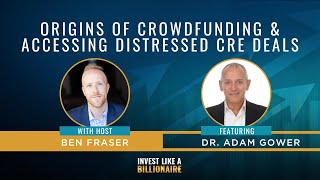
In this hour‑long Invest Like a Billionaire podcast, host Ben Frazier interviews Dr. Adam Gower, a veteran real‑estate investor and founder of Gower Crowd. Gower recounts his career—from early wiring work in the 1980s, through investor‑relations roles, a stint at EastWest Bank handling non‑performing loan workouts, to running a $200 M debt fund at Colony Capital. He explains how the 2012 JOBS Act fundamentally changed private‑real‑estate capital raising by enabling general solicitation and online syndication (Reg D 506), while noting that true crowdfunding (Reg CF) remains a tiny niche. The conversation covers the major advantages of the new model—anonymous, on‑demand research and market‑wide transparency of fees, preferred returns, and promote structures—versus the downsides of hype‑driven FOMO, aggressive marketing, and bad actors who misalign incentives or commingle funds. Gower stresses the importance of alignment of interest (co‑invest), thorough due‑diligence, and understanding sponsor character, especially in downturns. He outlines the cyclical nature of commercial real‑estate, describing the current “managed” downturn driven by Fed rate hikes, the flattening of distress versus the 2008 crash, and predicts a wave of discounted distressed assets emerging in late 2023‑early 2024. He promotes his short, practical book “The Reality of Distressed Real Estate” and invites listeners to subscribe to his newsletter for ongoing insights.
Chapters
Hello, future billionaires. Welcome back to another episode of your favorite podcast, Invest Like a Billionaire. We've got a really fun guest today. This is a guest that I've been looking forward to for a while, Dr. Adam Gower. If you're not familiar with him or haven't heard him, he is a crackup. It is really fun to talk with him. But not only that, he's been in this space of raising money for private, you know, alternative investments since the '80s. He's been around a long time. And he's seen a lot of things. And so his perspective is just so valuable. And so we talk about, you know, the origins of crowdfunding. His whole business is called Gower Crowd, where he helps other sponsors, you know, raise money through crowdfunding. We talk about, you know, just the downturns that he's seen. You know, what does it look like right now relative to other downturns? Also with crowdfunding in general, you know, we recently released an episode talking about some potential bad deals that went down on a very popular crowdfunding website and just talk about, you know, how do you avoid, you know, things like that? You know, what are the real benefits of crowdfunding? How has it changed landscape to the positive, but how has it created some obstacles that, you know, investors need to be aware of and think through? And so he has some great perspectives there I loved. And then finally, he wrote a book talking about distressed commercial real estate, and we're going to link to it here in the show notes so you can read it. It's a quick, easy read. But really talking about, you know, where he expects distress to happen across real estate, when he expects it to happen. He gives a pretty bold prediction at the end of the interview, and we're actually going to bring him back on later next year to see what happened and transpired. And it'd be kind of fun to see what happened. But with that, I think you're going to love this episode. It's a little bit longer than some of our interviews, but it's just so much good information. It's hard to cut it short. So I think you're going to love it. Be sure to listen to the whole thing because at the very end he gives some pretty bold predictions and talking points on his new book. So with that, enjoy the episode. This is the Invest Like a Billionaire podcast where we uncover the alternative investments and strategies that billionaires use to grow wealth. The tools and tactics you'll learn from this podcast will make you a better investor and help you build legacy wealth. Join us as we dive into the world of alternative investments uncover strategies of the ultra-wealthy, discuss economics, and interview successful investors. Looking for passive investments done for you? With Aspen Funds, we help accredited investors that are looking for higher yields and diversification from the stock market. As a passive investor, we do all the work for you, making sure your money is working hard for you in alternative investments. In fact, our team invests alongside you in every deal, so our interests are aligned. We focus on macro-driven alternative investments so your portfolio is best positioned for this economic environment. Get started and download your free economic report today. Welcome back to another episode of the Invest Like a Billionaire podcast. I am your host, Ben Frazier, and today we've got a really fun guest. I've been looking forward to this conversation for a little while. With Dr. Adam Gower, PhD, 30-year real estate veteran. He has transacted over $1.5 billion of commercial real estate over his career. He's seen multiple downturns and has really been on the forefront of the crowdfunding revolution for real estate. And so just really excited to have him on just to talk about the landscape, you know, how commercial real estate and investing into these types of deals has changed over time. And he also wrote a new book. So a little teaser, you know, at the tail of this conversation, we're going to talk about his new book called How to Buy Discounted Distressed Commercial Real Estate. That might be the exact title, but that's the, that's the topic. And very excited to get into this. So, Dr. Gower, welcome to the show.
Thanks so much. It's a real pleasure to be on the show. Thanks for having me, Ben.
Yeah, well, give a little bit of background, you know, for those that don't know you, aren't familiar with your story, you know, share kind of the origin story of how you've been in the space and what you've been doing.
Yeah, you know, I'll tell you what, let me expedite that because I know we've only got, we've got less than an hour and we could talk for hours. I know you and I just having chatted for a few minutes, so let me kind of accelerate really quickly. So I started in real estate pulling wires for an electrician in 1982. I then went on to doing, I did investor relations for ground-up multifamily shop in Southern California, raising about $30 million in 1980s dollars. So that was when $30 million was actually quite a lot of money in those days. Then I emigrated temporarily to Japan and ran a division of Universal Studios. I was president of Asia Pacific doing their real estate developments across the region. Based in Tokyo. And then I came back, did my own investments, sold out in 2007, and boom, here we are. Hope that only took about 30 seconds because that is the moment that really matters, especially in considering what you guys do. That was when I was actually— I sold my portfolio in '07 and was brought into actually to EastWest Bank, one of the largest regional banks headquartered in California. And they had done a lot of real estate collateralized lending or lending to real estate sponsors. A lot of those loans had gone bad. Oh my goodness. Global financial crisis. And so I was brought in to do workouts on those loans and also to sell the loans essentially. After that, I went on to, I'm going to cut a couple things out. I ran a fund after that, $200 million this debt fund and was actually brought into Colony Capital, who at the time were the third largest private equity real estate shop in the world. And they had done— by the time I got there, they'd done around $7 billion of acquisitions of non-performing loan portfolios from failed banks in partnership. Not many people know this, actually. It was a nuance. Uh, people thought that they bought these loans from the FDIC, But they didn't. They actually partnered with the FDIC and it was, it was actually a brilliant strategy to, for the government essentially to, sure, not take huge losses. So they actually bought—
so basically they didn't have to buy the loans and have a huge outlay of cash. They basically negotiated, hey, you guys got all these non-performing loans on your balance sheet. What if we can go and, you know, generate a profit? We'll split the profits. That basically everybody wins, right?
That's exactly right. So actually the way that it worked and I, you know, I, I'm pretty sure it was across all of the portfolios I worked on. I don't know, probably 6, 6, I don't know, 6, 7, 8 portfolios. There was a lot of them and it's a long time ago. But the way it worked was the FDIC went out looking for bidders for these large portfolios. So individual portfolios, and it was kind of an aggregation of failed banks, bad loans in each of these portfolios, and they each had individual names and et cetera. And the FDIC picked the winning bid and provided 50% of the purchase price at 0% interest. But they became a partner with the FDIC. That's basically what it looked like. It was very cool.
Very interesting.
Yeah, it was very cool. So I worked on a lot of those loans and what I did was re— for Colony, I, so at the bank I found investors in those days, it was strictly, strictly sponsors. You know, these were real estate professionals. There were no passive investors. Look, this was people that would, you know, like full-time. That's what they did was real estate, right? And so operators, etc. And so we at the bank, I sold individual loans typically at discounts, actually with finance as well. It's a whole long story. To sponsors at Colony. While I did that as well, the difference was I packaged a portfolio, small portfolios of loans, and in the end ended up doing a lot of dealing, selling of these portfolios to, to banks, actually reperforming portfolios of reperforming notes to banks. And then the, then the economy picked up. I'll tell you what I do now. I should get to that as well. Economy picked up and I started doing seed investing, venture investing, venture capital investing, seed and angel investing. And that's how an old fellow like me came to learn the wonders of digital marketing because all these, I wanna say teenagers, but very, very early 20-year-olds out of university who set up their these startups, put these startups together, were talking the language of digital marketing stuff that I really, Ben, absolutely had no clue about. I mean, really nothing. Google Analytics, SEOs. I mean, today these are words that are part of my lexicon, but in those days it could have been Greek or something, I don't know, foreign language. So I learned it and found it fascinating and then have over the last few years been applying it at the highest levels to real estate sponsors who are looking to raise capital online from accredited investors. So that's primarily what we do. We build essentially what are crowdfunding platforms, bespoke crowdfunding platforms for individual sponsors, and we teach and advise passive investors on what to look for when they're making investments in, I would say, commercial real estate, I know the term you like to use is alternatives, but they all kind of fall into the same bucket basically. And now I need some more coffee, so I'm going to have a little bit.
Yeah, that, that was— yeah, I need to take a deep breath after that. It's a long, very, very cool story and background. So, so talk a little bit because I think it's just so fascinating. You know, we've been talking about this a little bit over the past year and a half doing the podcast. But I think a lot of people don't realize as passive investors is the landscape for these types of you know, private investments, alternatives, whatever you want to call them, was totally revolutionized with the JOBS Act. Right. Because prior to that, you had to either know somebody who knew somebody who was doing the deal. And a lot of times it's sold through broker-dealer channels, you know, which charged high fees and you kind of had to be in the know. You had to be certain net worth usually. And it was a lot more limited access to these deals. But with you know, the idea of crowdfunding, you know, it really took off and you're kind of there at the beginning stages of it, right? When a lot of this went online versus kind of phone call to phone call or, you know, boiler room type, type approach, you know, it's, it's really good because as you and I would probably argue, we have probably strong bias, but there's a lot of really good, you know, reasons to have private alternatives in your portfolio. There's a lot of advantages, you know, lower correlation to public equities, you know, a lot of times better returns, you know, direct tax benefits, etc., etc. But it also kind of comes with the downsides of, you know, bad actors and people kind of getting into things they don't, they don't know about. So, you know, talk a little bit about just as you started so early in this space, even raising money in the '80s, you know, and compared to now, talk a little bit about just as the transition of what you've seen and witnessed and where do you kind of think it goes from here? And I'd love to kind of shift gears and talk a little bit about, you know, the thing you just mentioned of how helping people determine how do you find a good reputable sponsor with good deals, etc.
All right, fine. So you covered a lot of ground there.
Sorry, I know. I'm just going back to what you did here.
That's totally fine. I love it. And I'm happy to talk about all these topics. Actually. So I will talk about crowdfunding. We should talk about that. And that was something that I think you did an internal podcast I was just, as you know, I was just reading the transcript for, um, regarding the Nightingale issue on CrowdStreet, and, and the term you just used, uh, was bad actors. So we should talk about that as well, uh, in the context of real estate investing, period. Actually, of any kind of investing, frankly. Uh, but, um, let's back up a little bit, go to the job sites, what actually happened. And I have written a book about this. So I've written a lot of books. I've written 7 books. 3 of them have been published by major publishers, Palgrave Macmillan, one, and Routledge is the other kind of top 3 publishers in the world. And those are great and they're really interesting, but I really like writing these short books, not these 60 to 120,000-word books that are easily read in just an hour or two. And so I've written about all these topics. So crowdfunding actually is a misnomer. You're quite right. The 2012 Jobs Act, what it did, the fundamental shift embedded in the Jobs Act, and there's all kinds of reasons for it, had nothing at all to do with real estate. Again, that's a whole long story. That's in one of the leaders of the crowd. If you want to interest, have a look at that. It's a whole different story. It had nothing to do with real estate. It was a, unintended consequence in a good way that real estate benefited from the JOBS Act. But the JOBS Act, the fundamental shift that the JOBS Act caused was exactly what you said. It allowed capital raisers, let's be precise, capital raisers from company, any kind of company, startups, actually JOBS Act, JOBS stands for Jumpstart Our Business startups. It was designed for companies to allow them to access liquidity from accredited investors. And it said basically, you don't have to— if you're a business, if you're a small business or you're a startup, you don't have to do an IPO anymore, right? To raise money, you can actually just raise money directly from people. The term of art, or the legal term, is general solicitation. You can now ask anybody to invest with you. And the reason that it impacted real estate is because, as you know, every real estate sponsor, when they do a deal, what's the first thing they do? They form a company. It's called a small— an SP, a single purpose entity, SPV, single purpose vehicle, whatever. It's an LLC, some kind of company that they set up or a limited partnership, but they set up and found a company. And then what are they selling? Stock in that company. They're selling shares. They are suddenly in the securities business. And that's exactly what the JOBS Act was geared to, was allowing people to sell securities without having to do an IPO. All right. That's basically it. So what did that— okay, if you want to stop me at any point, I see you.
I was going to say, I mean, part of the good of that is for these smaller businesses, you know, which was probably the initial intention of this, this act. It's pretty cost prohibitive, right, to do an IPO. You've got a huge amount of legal to set up. You have a huge amount of ongoing reporting and things you got to send to the SEC. But you got to go do a roadshow, right? You got to go hire broker dealers. You got to go and spend an inordinate amount of capital and travel and time to raise money. And then now you have publicly traded companies.
That's why— that's exactly right. That's why the only way you could raise money before was with people that you knew. And so you were very limited. So the way that you would raise money before, and you're a young fellow, I'm hundreds of years old over here, I've been through a lot. But the way that you used to do it was that you could, or the only way that you could raise money really, practically speaking, is you'd ask your lawyer for introductions. You'd ask your financial planner for introductions, right? Or your accountant, or you'd join a country club. Seriously, you'd join a country club. And part of the process was to meet people that you could solicit, get to know first, and then when you're on the 9th hole and you're letting them win the hole, you can say, by the way, you know, I've got this deal at the corner of Walk and Cross. Look, now you're in a good mood. Why don't we talk about that? Right. So that was basically what it was. Yeah. Ended up with these kind of isolated cliques of high net worth individuals around the country that didn't communicate with each other. There was no transparency. All you knew as an investor, as a passive investor, was what the guy at the country club was telling you. And this very small network. So what, what the Jobs Act did was it, it, it took the lid off that. Suddenly now you can go online and right now you could look at 100 deals if you wanted to. Not only that, but you can look at all the offering documents for all of those deals. And what does that mean? Now you know what market is. Now you know what the market is for preferred returns. You know what kind of standards there are for fees. You know, what kind of standards there are for the promote structure, what kind of returns do you expect, et cetera, et cetera. It's all open. Before 2012, actually subsequent to 2012, 2012 was the act. The laws were promulgated in 2013, '14. So it's not really that old, but before the Jobs Act anyway, you didn't have access to that. You just didn't. So all you knew was what one person might have given you at the country club, That's all you know. You didn't know if it was market. So basically the industry became very, very transparent. Now there is a misnomer. It's not really crowdfunding. It's just the misnomer. The term crowdfunding is inaccurately applied to investing in real estate, investing in the notes that you have, for example, on your site. Again, that might be— I'm not sure if you use that term, but Crowdstreet, for example, they don't do crowdfunding. Crowdfunding is a very, very small part of the Jobs Act regulation. CF regulation, crowdfunding, SEC and FINRA regulated, extremely complicated and cumbersome to do. Very tiny, tiny part of the real estate world.
It is generally probably more for startup businesses that are doing some product or service-based business, or is it also applied to real estate?
I mean, I've not actually seen it applied to regulation. Yeah, it is applied to real estate. There are a few websites. SmallChange is one, ePickershop. They do crowdfunding, regulation crowdfunding. You have to go through a funding portal. Suffice it to say, Ben, it is a tiny, tiny, almost insignificant part of what actually ended up happening to the commercial real estate industry. The big shift was there was a regular— I don't want to get too much into the weeds because it's a little bit boring. But there was another part of the JOBS Act that was, that was Regulation D-506, and this allows a sponsor now to solicit from anybody. So the correct term really is just syndication. They're just real estate syndications. That's all they are. And what the JOBS Act did was it allowed you to syndicate a deal online. That's it. Basically, you can advertise. You can now literally advertise on Facebook and say, Buy my securities. I mean, you don't say that. You say invest in this real estate deal. But really what you're doing is, is you're inviting people to invest in securities. So you do it on Facebook, you do it on your website, you do it on LinkedIn, Twitter, wherever you want to do it. It suddenly became legal. It's real estate syndication online. And that is a synonym really, if that's the right word, for crowdfunding. Crowdfunding and syndication. And you should in real estate, commercial real estate, you should really think of these two things as being the same.
Right. And would you consider, you know, Kickstarter or some of these other— I mean, those are things that are actually— those are more crowdfunding. I mean, even Fundrise, you know, they're using Regulation A a lot of times.
Yeah, but some are also a little bit different because Fundrise is not really— it's a platform, but really they're just a spot. They're a single sponsor that does their own deals and raises money for their own deals. And you're correct, they use Regulation A, also part of the JOBS Act. Regulation A+, actually, it's called a mini IPO. So it is an IPO. It's not as onerous as a full-scale IPO, and that allows Fundrise to raise money, or anybody that uses a Reg A offering to raise money from non-accredited investors. However, again, just to make this clear, it is a tiny, tiny fraction of the overall market for real estate investments. The really by vast, a vast majority. I write again one of the books called Unleashed. It talks about this industry and we quantified it. We actually scraped the SEC database. Don't tell them that. But we scraped the SEC database and Reg A, which is what Fundrise use and Reg CF are minuscule parts of real estate investing in commercial real estate, the really big one is Regulation D, 506, syndication. That's accredited investors, unlimited number of accredited investors, unlimited raises, almost no restrictions, almost no regulated disclosures. That's the world that I inhabit, basically raising money for real estate deals.
So let's, let's take it back to investors. So how, how in your mind has this benefited passive investors, you know, and also potentially created more challenges or hurdles?
So I love that you asked that question. Of course, I don't want to like turn this whole podcast into a pitch fest for all of my books, but there is another book that I wrote. It's called Real Estate— I can forget, I've written so many. Let me just open this up. Real Estate Crowdfunding.
And we'll put the links in the show notes after the fact too.
Yeah. So the only reason I mention it, Real Estate Crowdfunding, Secret World of Real Estate and Crowdfunding. Funding. Uh, the only reason I mention it is because I can't remember everything that's in it. Uh, but there are some— I'm trying to, I'm trying to stimulate my own memory. Uh, again, I've not quite had enough coffee this morning to be, uh, super effective. All right, so there are a few major benefits for passive investors. The one that actually I talk about the most, um, and there are a lot of them, tax benefits, you know, there's kind of the benefits of investing But there's a few that are really profound that are kind of hidden benefits. You don't really think about them. People don't talk about them. And two that immediately come to mind, but I'll probably talk about more of them in the book, are one, anonymity, and two is transparency, right? So anonymity in the past, I gotta write this down, otherwise I will forget. In the past, right before the Jobs Act, what you would have to do if you wanted to invest in real estate, right? And you are a doctor or you're a businessman, or you, right, you've got a franchise chain or whatever it is, you've got a real day job and you want to invest in real estate, you'd have to know somebody. You had to know a real estate guy because you couldn't go online and suddenly find all these opportunities to invest in. It was illegal for anybody to do that. So it didn't exist. So you'd have to get to know people and do your own networking, right? So you might meet somebody at the golf club. But then what happens? For heaven's sake, Ben, the next thing that happens is, oh, for heaven's sake, what else? Maybe you don't want to invest, but you end up sitting with somebody or playing a round of golf with somebody. All they do is talk about their deals and how much money they're making and that you should invest. And you sit there thinking, oh my goodness, I gotta listen to this guy blagging on about all his deals. I've got no interest. Or if you do have an interest, but you don't, you might not want to sit down with the guy at a meeting because why? All that's gonna happen is they're gonna pitch you. You know you are going into a meeting where you are going to be pitched, right? You don't want to do that. Who wants to do that? I haven't got the time. You've got a business to run and then you've got to go through this process of, okay, that was very interesting, 2-hour lunch. You've told me everything, but can you send me this information? I need to check with my accountant. This, that, the other. It's just a very long, tiresome process. So what crowdfunding did was it— done properly, by the way, and this is what we do for our clients, just FYI, our clients being on the sponsor side, it allows a passive investor to do what? Oh my goodness, research a sponsor. Anonymously, you can actually go online, you can look them up on LinkedIn, you can look at their website, you can read news articles about them, you can listen to them on podcasts, whatever it is. Suddenly now there's this whole wealth of data that this sponsor, if they're doing their job properly, is pushing out proactively. Mm-hmm. So that you as an investor can do your research anonymously in your own time on whatever device you want. Right on your phone, on your, on your laptop, on your computer. You can, you know, screen mirror it to your TV and show the kids whatever you want to do. You could do it in your own time, however you want. So that's the, that's one of the biggest benefits is the ability to do research anonymously without being pitched. The second advantage, and this is really profound or as profound, is this idea of transparency. And I talked about this before in the generations before the Jobs Act. I lived those, at least one of those generations before the Jobs Act. If you were presenting a deal or if you were being presented a deal by a sponsor, all you knew about real estate was what that one sponsor told you, and you had to do it in person. So you had to go through this whole process. But if they were offering you a 6% preferred return or an 8% preferred and a 20%, 80/20 split, 70/30 split, 50/50 split, how did you know if those were reasonable? Right? How'd you know? The only way to know that, to know anything, like if you want to hire somebody, right? You want to bring somebody in, let's say you want an investor relations person or you want a salesperson on your team or you want a personal assistant, right? An executive assistant. What's the first thing that you do? The first thing you do is you establish what is market rate for these positions. You find out what's market. How much do I have to pay somebody? You don't guess, you pull out of your ear, you look and you figure out, okay, what's market rate? Now I know what my— I need to budget for this. It's the same with real estate. How did you know what the splits were or the preferred return? You didn't. There was no way of knowing because information was always contained in, contained in these little isolated cliques around the country that didn't communicate. Now, a local lawyer might be able to give you some insight, but for the most part, it was a black box. With crowdfunding, suddenly everything goes online. So now industry standards can be set. You can understand what are fair fees, what is a fair co-invest, what is a reasonable preferred return, what are reasonable promotes and splits at the end. Suddenly you've got transparency. So those are the, yeah, from my top of my head, the two things I can remember. And a minute on anonymity, and transparency. Those are two big advantages.
Love it. Yeah. Say that 5 times fast, you know. No, I think those are great points. And the first one I love, I love that. I mean, it's, it's so true, right? Instead of being pitched hard, you know, in a bet in the corner of an office or something and make a decision right now, you know, the scarcity or urgency tactics, you know, you can come from your own home, do a lot of research and get a pretty good sense of someone's track record, their background, do background checks, you know, have they been convicted of any kind of crimes and transparency. And I think this is so interesting because a lot of people knock alternatives in private, you know, real estate investments as not having much transparency relative to, say, publicly traded, you know, stocks or REITs. But it's funny to me because, well, how are you defining that? Because if you're looking If you're investing in REITs, you know, do you know what fees they're charging? Do you actually know what assets are in the REIT you're buying? Like, have you looked at how much your advisors are charging on top of, you know, any kind of REIT fees? And what's the structure there? What I mean, could you tell me the exact promote structure? That would get, guess, 99% of people that invest in REITs couldn't tell you that information, right? But At the same time, you know, that's pretty clear. And it's created the standard in the private, you know, commercial real estate market of here's kind of the expected standards for promotes, you know, for kind of different waterfalls and fees. And the flip side of that is, you know, sponsors like us, like we're, we're seeing what the market is. And if we veer too far outside of that, it's going to be a red flag for investors. Right. They, they, you know, to your point, creating the standardization, which is actually a benefit to investors. And the same kind of, you know, transparency that they're, they're quote unquote saying you have in public markets. You know, it's to me it's more of a blind trust of just because it's publicly traded, it's now less risky and it's a better deal, you know, than this. And it takes a little more work to maybe read through a private placement at random because, hey, they're, they're kind of boring to read and they're a little bit long sometimes if you don't know what to look for.
Yeah. Yeah. But there are ways to expedite that. And if you're looking for very specific terms, You can do searches of PPMs and you kind of get to the core things. It depends on what really drives it. But here, look, here's the point, right? I mean, your business, Ben, what do you— what's your role there at Aspen? What's your job?
Chief Investment Officer.
So you're CIO. Okay. So, you know, when somebody comes in and they want to invest with you, there has to be a process of education. Mortgage notes are not commonly understood or known. So you have to educate people. What are they, right? And that everything in the world that you and I inhabit is education. It's just education. You want to educate people and tell them what they are and allow your prospects to understand, is this something I'm interested in? And I tell you what, one of the biggest challenges we actually had, uh, was actually an investor in one of our clients' deals, funnily enough. Contacted me the other day. I won't tell you what they're working on, but it's some really interesting fintech finance solution that they put together for whatever in their industry. Again, not being too precise. And in the first 10 minutes, I hope I'm not like this, by the way. I mean, maybe I am. Maybe I've become too used to this language that I kind of just, everything I say flies over the top of people's heads. But in the first 10 minutes, he explained, I'll tell you something, Ben, I had no clue. What he was talking about. I knew he was talking about something, but he was so familiar with the language of the industry that he was engaged in. And this is true with notes as well. You can become really, really so familiar that when you talk about it, you start talking, you talk to people as though they understand.
You know the same vernacular and all that.
Yes. And what you end up doing is trying to articulate yourself in a way that is impressive to people who already know what it is that you're doing. And when you do that, people who've got no clue end up still with no clue. So you have to educate, you've got to, right? You've gotta teach. It's not like you, you're patronizing people or speaking down to people.
No.
But you've got to simplify it and understand that they really don't understand the terms of art. And so you start at a 101 level. And because your investors are highly educated for the most part, right? Either got a degree, advanced degree, or professional qualification. So they're highly educated. They might not know your asset class, but you start at a 101 level and then you dive deep, right? They have the capacity to understand, but you can't start at that deep level. You gotta start at a really simplified level and then dive deep.
Yeah.
And that's the whole process to be successful with crowdfunding or syndication of any sort?
Well, it's funny because I think human nature tends to overcomplicate things. And hey, I could seem really smart if I use big words that are, you know, common to my industry. But if somebody has written, you know, 7 books and is a great marketer, you know, some of the best way that you communicate something is try and write it to at a 5th grade reading level, right? Or a 3rd grade reading level. Where you're using smaller words, using more simple concepts. And that is proven to be some of the most powerful, you know, from a marketing standpoint, you know, way to communicate with people because you're not, you're not trying to have this big ego that you show of, you know, how smart you are. And it's not about you, right? It's trying to communicate concepts that people can understand in a, in a meaningful, impactful way. And I mean, Yeah, great, great little point on the communication side of it. Let's talk, you know, on the downsides here. I mean, this is funny we're having this conversation right now 'cause when you and I talked about a month or two ago about having this conversation, you know, we didn't have our podcast we just released this week or last week. And a little bit of a kitschy title and maybe we're misusing your term that you so well defined for us, crowdfunding. But when crowdfunding goes awry, and talking about, you know, one of the biggest platforms in our space for commercial real estate, you know, and there's, and we're not pointing blame, we're just trying to show the downsides and the things that can happen when things aren't done correctly, right? And there were some pretty big errors made and it's unsure of what exactly happened. But, you know, talk a little bit about, you know, we have this transparency, but then there's also some things that in just human nature, you know, in CrowdStreet, which is, you know, the platform we're referencing, they were really good marketers. I mean, I envied some of the, you know, the landing pages they had and, you know, they're selling out of deals in 5 minutes and it created this urgency and this like scarcity and FOMO, right? If I don't click the button and invest right now and I can make an investment decision on this brand new deal in 5 minutes, I'm going to miss out, right? But you can't do the research in 5 minutes. You can't, do the things you need to do to make a decision that quickly. And so, you know, talk a little bit about your experience with, from a passive investor standpoint, what do you kind of recommend as you're, you know, you have a lot of information, but not to get caught up in the human emotion of, you know, maybe a really good, you know, marketer or platform or these kind of things.
Yeah. All right. So the power of FOMO is something that is impossible to resist. At the end of the day, I mean, it's what we all fall for. It's fear of missing out, right? For that one person in your audience who doesn't know what FOMO is, fear of missing out. And so that fear of missing out is triggered. And by the way, these are, it's actually fascinating. I'm a historian. I love history. And so I've looked into this. These are tactics and techniques. I won't dwell on this now. So we'll talk about real estate and bad acts.
This will be your 8th book that we'll read next year.
No, it's actually my first book.
Oh, it is? Okay. You already wrote the book on it.
Okay. But the, oh no, it isn't. I should write about this. But anyway, these ideas, the idea of missing out and sales and marketing tactics, they've been around since time immemorial. And some of my, the best books are things like, looking at my bookshelf here, let's see, Scientific Advertising, John Hopkins, the Robert Collier Letter Book. They talk about FOMO. They don't use this term, But they talk about, they talk about this, these books were written 100 years ago, Ben, and they're talking about, you know, marketing, direct mail marketing campaigns that they ran in the early 1900s. Nothing has changed. Why? Because human psychology is always the same. So, right. From an investor perspective, the best way to beat FOMO, that fear of missing out, not to, especially in investing, you know, on these sites. Start your homework early. Don't wait for that webinar to make your decision. It's like going to an auction. I used to go to auctions when I was first, first in, not first in California, when I bought my first home and I furnished the whole thing. I had no furniture. I'd just come back from Japan and I used to go to auctions to buy all the furniture. It was really cool. And I walked around and I decided in my mind, how much am I going to bid on each one of these items as it comes through. Hard stop. I'm not going to get caught up in the damn thing and end up overpaying for something I don't want. In other words, do your homework first. And when you go into that moment where they are pitching, they are launching a deal, be ready to make your investment or not. Don't go to the webinar. Yeah. Already decided you're going to invest. All right. So this is like the final step, not the first step. But let's talk more about your primary question, which is this idea of how to avoid making mistakes. You talked about bad actors and what was it when crowdfunding goes awry. It is, it's a, that was, I think that was an article in the Wall Street Journal actually, wasn't it? Or correct?
Yeah.
Yeah. A title or headline. Okay. So, If this is how real estate works, real estate, there's a cycle. There is always a downturn. It is absolutely inevitable, right?
Period.
Things that, what goes up must come down and always does.
Period.
The golden rule. End of story. And what that means is that when the market is going up, there's usually a slow build for the market to go up and then there's, Often it kind of appears to be a fast downturn, right? Comes off the cliff quickly. When things are going well, it's very difficult to make a mistake. All you need is a down payment and a heartbeat to make money in commercial real estate during an upcycle, right? Because you buy, you sit on— I mean, this is it. You see it happening all the time. You buy a house. Let's just say, think about how— think about your own house. You buy a house, you live in it, before you know it, it's gone up. I mean, I'm in California, so values have gone up stupid fast, but you don't do anything. Just the market momentum carries it up. So when that's happening, sponsors— there are two types of sponsor. Well, there are three, basically. There are those who have been through it before, have either made mistakes themselves or have seen people making mistakes. And who have erred on the side of caution going in, those are the ones most likely to survive. Now, they're also the ones most likely to offer the lowest returns. And that's what gives you this— unfortunately, that's this other mentality you got to be careful of. Don't chase the shiniest object.
That's the biggest—
yeah, we could talk for hours about that. That's also probably something you have to deal with with your kinds of projected returns as well, right? But conservative investment, basically you've got the seasoned sponsor, the seasoned pro. So I'm going to just disconnect that. The seasoned pro, they know what they're doing and they're going to survive the downturn. Then you've got the amateur, the person that's just come into the, or the novice who's just come into the industry and things start going bad. Right? Things start going wrong and what they do is they start panicking. And what they might end up doing is they might try to shore up their portfolio and end up making bad mistakes that could ultimately be seen to be illegal. One example might be, let's say you've got two deals just to make it really easy, Deal A and Deal B. Deal A starts to run outta money, but you got somebody that says, yes, I'm gonna put the money in, but that person is taking too long. So you go to Deal B and Deal B's got all kinds of cash. So you take money from Deal B, you put it into Deal A just to shore Deal up until you get this investor to come in. The investor doesn't show up. And what happens? Deal B's money has now been sucked up by Deal A. And you just broke the law, you just commingled funds. That is a criminal offense. You cannot do that. But if the market is going down and you get caught, this is Warren Buffett's idea. When the tide goes out, you see who's swimming naked. Now suddenly people who with good intent made bad decisions end up losing everything and losing all their investors' money. So that's the second type. Of failure or bad failure, right? The third is the criminal, the person who steals money and fakes returns and lies in their updates and, you know, uses Photoshop to fake bank accounts and who knows what. That is the hardened criminal. And those people, you simply cannot protect yourself from those. And all of these characters, and there's, you know, there's variances within this range as well, right? As, but they all become exposed when the market goes down. That's exactly what happens, right? When the market collapses, this is what exposes. So it's not crowdfunding that's gone awry. It is the inevitability of losses being incurred when real estate market goes down. It is the nature of the business. That's all. It's the nature of the business. You just got to accept it.
Yeah. And to your point, I mean, it's really who's behind the deals that, you know, and managing through the challenges because it's, you know, character is revealed in times of difficulty. Right. And sometimes it's difficult to ascertain character when things are going well. Right. And I've made the point many times on our podcast Anyone that could fog a mirror and sold a commercial real estate deal in 2020 or 2021 made an outsized IRR, right? And so there's almost this like we always say, you got to look at the track record, right? But if they've only been operating a couple of years and they sold all their deals full cycle in these couple of years, it's not that indicative of how good they are, right? It's just indicative that the market was going up and they, you know, had enough you know, intelligence to sell then, right? Which counts for something, but it shouldn't be the end-all be-all. And so not to belabor this part of the topic, and we actually go on that podcast, if you haven't listened to it, on, you know, kind of 3 or 4 things that you should be looking at, you know, to kind of ascertain character. I don't know if you'd add anything to that on kind of some quick proxies or things that you would say to just, you know, as an investor that you're looking for.
Thanks for asking that actually. And I apologize, I was, as you know, I was scanning the transcript. It looked like a very interesting, well worth listening to podcast. So I didn't get through all of it, but I would say probably there are all kinds of things to look for. There are some technicalities that you should look for, but probably the most important is the co-invest, the alignment of interest.
Yeah.
You want to be sure that whoever you are investing with stands to lose money if you lose money. If you lose money and your sponsor is still making money, there's a misalignment of interest and they're not as motivated as somebody who stands to lose money alongside you. So I'll give you an example. We've had, you know, because what we do is we, we build crowdfunding platforms for sponsors. We have a lot of people coming through the door. Sometimes we've done promotional programs for sponsors and we had a guy come through, highly reputable, very visible guy in the industry, but, you know, big assets under management, whatever. And he was looking at a $50 million raise, equity raise. And I asked him, how much co-invest are you putting in? He said, oh, we're putting in $4 million. All right, well, that's Big number, right? It's a lot of money. That's very interesting. What he didn't tell me, what I didn't figure out until afterwards, 'cause there was a couple of other things that he, there was a couple things that he said that just made me think, I don't, you are not being straightforward. And I didn't trust him. It was something I didn't like. And so I looked at his offering documents and it turned out that his going-in fees were, came to like 5 million. So in fact, he was putting no money in and making $1 million putting the deal together.
Taking $1 million out. Yeah.
Due diligence fee, marketing fee, had all these fees. So on day one, he was making $1 million, but what he was putting out there was, we have a $4 million co-invest. It was a full-faced lie. I'm not saying names, so it's okay that I say that. But if you didn't dig deep enough or know what to look for, You would miss that. And so I actually canceled the, I canceled the, the, I was, I can't, sorry, I can't, I didn't tell him why. I didn't want to be, whatever. I didn't want to get into a discussion, but I just canceled it and I said no, refunded his money to him. Like we got, can't do it. Sorry.
Yeah.
But that's what you gotta look for is an alignment of interest. Make sure that whoever you're investing with loses money if you lose money, that they're not motivated by fees or bonuses or whatever else. Just they have to be aligned with your interest. And then you know that even if things go bad, which they will do, the inevitability of a down cycle, you know they will do their very best because they're protecting their own capital as well.
Love it. Yep. You basically hit the nail on the head exactly what we said.
So, I love it.
Okay, so, so last little section here. So apparently it sounds like you've written a book or two and you've got another one coming. And so tell us a little bit about, you know, what this, this new book. And we kind of, you know, teased it at the beginning of the episode of the topic. But I think it's a very fascinating topic and what a lot of people are looking for and obviously kind of hails back to kind of your time, you know, post-GFC. Working in some of the distressed assets there. So talk about that and what's kind of your perspective and are we going to see discounted real estate and when are we going to see it and where are we going to see it? So give some kind of context for that.
Sure. Thank you again for asking that. All right. So I'm actually not writing, I just finished writing another book. It's called Reality. It's the reality of real estate, reality of distressed real estate. It's again, one of these short, kind of read it in an hour, hour and a half summaries. But it's based on my experience of having gone through the savings and loan crisis of the early '80s and the global financial crisis and dealt with billions, literally billions of dollars of non-performing commercial real estate collateralized loans. And yeah, I just kind of break it down. What is distressed real estate? How it's not— you get discounts, right? You can buy discounted real estate if it's distressed. But it's distressed for a reason, and you've got to know what you're doing. It's very complicated. There can be a lot of litigation. If you buy notes, again, your shop, this is how your shop started, right? Buying distressed non-performing loans. You've got to do workouts, and some of them work and some of them don't. And it's just a complicated task. And understanding what is distressed and what makes something distressed is worth Understanding. That's what the reality, the book, The Reality of Distressed Real Estate is all about. All right. So that's number one. What's going to happen? So I'm going to date stamp your podcast. Everything we've talked about so far is evergreen, but I'm going to like for the hundreds of people that are still here listening now, this is August 2023. And this is where we're going to go. So during the Global Financial Crisis, try and make this quick. Global Financial Crisis, banks, regulators insisted that banks mark to market. The effect of that was a lot of banks, so suddenly a lot of banks had huge losses on their books and failed, right? Just super simple story. And so the economy and commercial real estate basically went off a cliff. And a lot of banks went off a cliff. This time, this whole downturn is a managed downturn. It's very different from the Global Financial Crisis that was— it was out of control. Nobody had control over it. This downturn is managed by the Fed increasing interest rates. And so what regulators have been saying to banks is work with your borrowers. And the term that is used loosely is extend and pretend. But they're not pretending anything. What the regulators are doing, in my humble opinion, is they are flattening the downturn curve. So instead of going off a cliff like we did in 2008, 2009 with marking to market, the Feds are saying, or the regulators are saying, extend these loans. They know that interest rates are not going to come back to zero rates.
Right.
So by extending, instead of having everything collapse all at once by marking to market suddenly, by having everything kind of drop through the floor, they're flattening the curve. So you will continue to see distress. There will be more distress. It will be metered out over the next few months towards the end of this year into the first half of next year. As soon as the regulator, as soon as the Fed reduces rates, which they may well do early next year, there will be a flood of capital to the markets, but it will not stem distress. You'll just have to move even faster than you normally would because the end will be in sight. The bottom will— people will know when interest rates come down, Investors sitting on the sidelines know that we've hit bottom. Now it's time to start buying because it's now it's just going to start bumping along the bottom before it picks up again. So that's what you're going to see August '23, say for the next 9 months or so, middle of next year ahead of the election, we'll start seeing distressed opportunities. Get ready to invest, man.
Oh man. Okay. We got to have you back on early next year and see how this plays out.
And play that little bit back to me and see where we are. Throw my own words back at me. Let's do that. I'd be up for that. Sure.
That'd be fun. I mean, I have to tend to agree with you. It's, it's, you know, I was still kind of fresh out of school and, uh, tail end of school in the last, you know, uh, great financial crisis. So was a little bit less, uh, involved in it. But it is so interesting how the Fed has really, you know, been at the, the core of what's been happening over the past really, really 12 months and trying to manage through this and the managed downturn. I mean, that's a, that's a great way to encapsulate what we're doing because everyone, you know, if you're looking at past cycles, it's generally this very big boom, big bust, right? It's this kind of big up, big down. And we're not seeing that right now. I mean, as we stand today, August 2023, a lot of these big investment banks are actually changing the probabilities of recession to, and we actually might hit a soft landing, right? And it's bumpy, it's uncomfortable. There's a lot of turbulence. There's a lot of things that are blowing up here and there, you know, sporadically within different asset classes. But those are probably the most highly leveraged aggressive deals that were purchased at very low cap rates with inexperienced managers, to your point. And so, you know, our sense, what we've been saying is there's going to be some distress, there, there may be a recession, there may not be. If there is one, it's probably not going to be that severe or that long because of the amount of capital that's sitting on the sidelines waiting to pounce on these opportunities. And so, you know, it's, you know, we're, we're, we're still buying assets. I mean, we're looking at different strategies, changing strategies, looking for, you know, best yield for best risk-adjusted returns. But I think a year from now, people are going to be, you know, wishing they they had not sat on the sidelines because they're the imaginary, oh, it's going to be the best time to go and buy things for half off and the world's going to be in shambles. I don't know if that's going to be a reality, you know, from an investor standpoint. Would you tend to agree with that or am I—
Yeah, I mean, the thought that comes to my mind right now, Ben, is the same thing that we were talking about before. Don't rush in. Start doing your homework now. Start learning.
Yes.
What is distressed real estate? What does it look like? Who are the sponsors? Who are the players out there? Really know what they're doing. Tap into those, keep an eye on what they're doing, listening to what they're saying, learn what's going on, and when they move, be ready to move with them, right? Don't wait until the last minute for somebody to say, hey, we got this great discounted distress deal, invest now. Don't become a FOMO sucker and jump right in. Do your homework now. So you know when you see something what you're looking at, and you need patience. Now is not the time to be jumping into the market, but that time will come. It will, and it will suddenly be upon us. So now is a good time to patiently start doing research and understand as an investor what this— that's why I wrote Reality, Reality of Distressed Real Estate. So yeah, this is a good starting point to understand what distressed real estate looks like, how it's managed and how you make money from it. But doesn't mean you need to invest now. Just wait, right? Keep an eye on the market.
Well, I think a great way people can do some education is get the book. So we'll put that in the show notes you just wrote. And what's, what's another good way for people to kind of get in your sphere, get in the mailing list, hear more about what you're doing?
All right. So the best thing to do is to go to my website, which is gowercrowd.com. It's my last name, G-O-W-E-R Crowd. Gowercrowd.com and subscribe to my newsletter. It goes out every Wednesday. It should have gone out exactly now at 10:00 AM. But I was slacking off doing other stuff this morning. I could go out in about an hour, but it goes out every Wednesday. We have a list of all the latest headlines with links to all the articles and commentary, and it comes from me. And as soon as you get one of those, just reply and you'll get me. So that's, that's the subscription button. It's a big red button on the website, gowercrowd.com. That's the best way to get a hold of me.
Awesome. Well, Dr. Gower, thanks so much for coming on. It's been really, really fun. And I would— I'm going to hold you to it. We're going to have you back on early half of next year and have your team seriously take that little clip.
Let's play it back and see where we are. I might abandon the podcast immediately. It's that embarrassing.
Exactly.
It is like, like spot on accurate, in which case I'll take all the accolades I can take.
Oh, as, as you should. As you should. Awesome. Well, thanks so much. It's been really fun and look forward to having you back in the future.
Ben, it's really been a pleasure. You're an excellent host. It's been a pleasure being here today. Thank you.










