
Passive Investor Spotlight #4 – High Tech Career to Mobile Home Parks w/ Todd Sulzinger
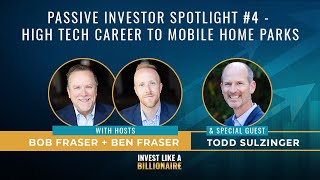
Todd Sulzinger, a former Silicon Valley finance executive, left tech to invest in mobile-home parks. He targets mid-teens returns and 1.5-2% cap-rate spreads versus multifamily, betting on recession-resistance and a fragmented industry ripe for value-add. His portfolio runs 75-80% real estate, with a quarter in mobile-home parks.
Chapters
This is the Invest Like a Billionaire podcast, where we uncover the alternative investments and strategies that billionaires use to grow wealth. The tools and tactics you'll learn from this podcast will make you a better investor and help you build legacy wealth. Join us as we dive into the world of alternative investments, uncover strategies of the ultra-wealthy, discuss economics, and interview successful investors. Welcome to the Invest Like a Billionaire podcast. I am your co-host Ben Frazier, joined by fellow co-host Bob Fraser. Today we've got a really fun guest. It is Todd Solzinger. Todd is kind of an expert passive investor, but he also used to be a Silicon Valley finance executive and kind of made the shift a while back into real estate with a focus on mobile home parks. So we're going to kind of hear the story of Todd's journey, kind of coming from the corporate world to real estate investing actively, and then kind of over the last several years going more passively. And so, Todd, welcome to the show.
Great. Yeah, thanks, man. Thanks, Bob. Happy to be here.
You know, it's kind of an unusual journey going from the high-tech high flyers, you know, super sexy, to the, to the, to the unsexy. So what happened there?
Well, yeah, I had a great career in Silicon Silicon Valley, and through that, you know, through working for Silicon Valley companies, actually had the opportunity to spend a few years living in the UK and getting to travel around Europe for a couple years. So I had a great career doing that, but just, you know, kind of got tired of the lack of control around, you know, I had examples where I'd be working for a great company and they'd say, okay, like, we're relocating the entire finance group, you know, 500 miles away. And it's like, okay, you know, I just don't want to get up and like move my family, move to a new place to live. Or, you know, often in the technology companies there's acquisitions. And so, you know, I'd work for companies that would get purchased and the larger acquiring company doesn't need two finance groups. So then, you know, kind of you're left looking for your next opportunity. So that happened multiple times. And I also kind of got into that pattern of trying to chase the next IPO or chase the next great startup. It's really just luck in terms of the company that you get into, where you might have the chance to hit it rich. I've been through a couple IPOs, I've done okay, but none that I thought that I was going to hit when I was in my early to mid-30s, working for these can't-miss startups that ran right into the dot-com bust. And ended up getting sold for pennies on the dollar. So that got me looking more towards something where I could have a little more control and just kind of over a multi-year process kind of discovered real estate and decided I wanted to build a business around that.
So yeah, of all places to go from kind of the high-tech sexy to mobile home parks, which maybe some investors haven't looked into what that looks like as an investment, what made you choose that over multifamily or another asset classes maybe more well-known, especially probably several years ago when it was even less on the radar.
When I decided I wanted to start a syndication business, I looked at a lot of different asset classes, looked at mobile home parks and apartments, self-storage, maybe putting together acquiring groups of single-family homes. And I liked mobile home parks, one, because they were a little bit more of a niche asset. So if I was going to start my business, I decided I didn't want to be another apartment syndicator. And some of the things that I really like about the mobile home park business is that it's historically really recession-resistant, especially in the affordable housing space. There's hardly any new parks being built. So there's probably a handful, there might be 5 or 10 new parks being built across the country every year, but they often get redeveloped for greater use. So it's the only real estate asset class where there's a decreasing supply every year. So that made it attractive. And there was also just, you know, less competition. You know, I'd talk to some of my apartment syndicator friends and, you know, they'd go into these, you know, $100,000, you know, hard earnest money deposits and best and finals, multiple offers, and just this frenzy, especially in some of the hot markets, to buy apartments. Whereas in the mobile home park space, because while it's growing and more people are interested in it, there wasn't kind of that frenzy around trying to acquire those. So I find you can get better deals, you know, kind of more upside on the back end. And because a lot of them are run by older mom-and-pop operators, they're not as run as efficiently, so there's opportunity to add value that way.
Well, one of the things we've been tracking for a while, kind of the macroeconomic trend, is just there's a lack of affordable housing.
Oh yeah.
And there's a huge affordable housing crisis in the U.S. And, you know, we've shared a lot a lot of data on this in prior podcasts and things. But as the cost and the structural cost and overhead to develop new homes has gone up, it's forced a lot of the developers to go to the higher end of the market. So they have to build where there's more margin, right, to keep their businesses afloat. And what's left a huge gap on, you know, in single-family especially, but even within that on the lower end. Of the entry-level homes. There's just no new homes at that price point being built. I would imagine that that is a very strong demand driver for mobile home parks.
Yeah, it is. There's a huge need for affordable housing. A lot of the job growth is a lot of times in lower-income, service-level type jobs. Those people need places to live. Part of the population's growing a lot, but whereas in the '50s, '60s, '70s, even '80s, there might have been newer B-class, C-class type of apartments being built, but now they're all the higher-end A-class apartments. So there's a huge need in mobile home parks because, again, they often haven't been run well by older family operators. A lot of parks you might get into, and some of the ones that I've purchased, have a lot of vacant homes that are owned by the park that can be rehabbed for people to live in, or just vacant spaces. I mean, there's literally, you know, probably millions of combination of vacant homes and vacant lots in mobile home parks that could be, you know, put to good use for affordable housing that wouldn't take the kind of capital that you'd need to build a maybe a new B or C class apartment.
I mean, it seems like with the, as you said, shrinking supply kind of increasing demand because, you know, the homes are really affordable. Um, seems like it's like the— a perfect investment opportunity, you know. I mean, my impression— I'm not super familiar with it— but that it's just scarce, right? Just very, very difficult to buy because there's so few, uh, of them around, that kind of thing. And, you know, so it sounds like a perfect opportunity though.
Yeah, I think so. And there's, um, I think there's Nobody knows exactly how many mobile home parks there are, but the estimates are in the 40,000+ range. Maybe about 5% or 10% of those are owned by some bigger operators, including some publicly traded companies. Really? That's all? But the rest of them, in terms of number of mobile home parks—
So, it's still not consolidated, the industry?
No, it hasn't. It's still very fragmented. Again, there's some large publicly traded companies, and a lot of those companies really focus on nicer 5-star parks in Florida, for example, where there might be 200 or 300 spaces with clubhouse and pool and really nice parks. But as I see deals come across my desk or in my mobile home park consulting side of my business, new clients I talk to that we're helping consult on parks that they're buying, there's still a lot of parks out there owned by mom-and-pop operators or operators that might own half a dozen parks in a local area.
Yeah, so a value-add strategy seems like it'd be great. Is that really the optimal strategy that you guys have looked at deploying?
Yes. A lot of it is, you can find parks, again, because they've been run by a family that's— maybe they've owned the park for 20 or 30 years and might be paid off. They might live in the park. They are making a decent enough income from it. But maybe some houses became vacant and they just haven't decided to fix the houses up, or somebody, you know, maybe a house fell into disrepair and they took it out and you have a vacant lot there. So as a syndicator, you might look at that and think, hey, if you came into this park and put in half a million, a million dollars, you could really, uh, you know, boost the NOI for the property. You know, you know, husband and wife in their 70s or 80s, they're not thinking they want to take out, right, you know, raise money from somebody or take out another million dollars in debt. So what happens, those parks just kind of stay like they are. But as a syndicator, you can come in and invest in those and really improve the parks.
What is the selling price of a mobile home? I just don't even have a sense of that. They're way cheaper than a new construction build or even a used home, a previously owned home. They're quite a bit cheaper, right? And smaller square footage.
They are. The prices have gone up a lot in the last couple of years, a combination of increase in raw materials. When the lumber prices went up, mobile home, new mobile home purchase prices went up quite a bit. And because there's been increased demand, as more people have gotten into the space, either bigger hedge funds or larger operators that want to fill vacant lots, they put in orders for new homes. Now, the backlog, depending on the manufacturer and where you're located in the country, you might be looking between 6 and 12 months if you place an order today to get a new home. Wow. At the lower end, it might be $40,000, $45,000. At the upper end, for maybe a double-wide that's a couple thousand square feet, you might get over $100,000.
That's really still very affordable. Once you buy that, you install it, and then you basically lease the plot from a mobile home park. That's right?
Yeah, it's a combination. I read some statistics recently that said about 2/3 of new mobile homes being built are actually placed on private land. So if you drive around a lot of parts of the country, you'll just see, you know, somebody's quarter-acre, half-acre lot with a mobile home on it. So a lot of people in those situations as well, they're deciding, hey, do I hire a contractor and put a stick-built house on my property, or can I just buy a manufactured home? It's cheaper. Yeah, so it's, it's, yeah, quite a bit cheaper.
So if you just go to a mobile home park, well, presumably, you know, what does it typically cost? And presumably then you get amenities. I mean, there might be swimming pools, and I mean, you know, that kind of— you get amenities that might be comparable to an apartment complex or something like that. Is that right?
Um, depending on the type of park. So in the, um, uh, apartment complex world, it's kind of like A-class, B-class, C-class. And mobile home parks usually rated like 1 to 5. So if you've got 5-star parks, typically on the coast, uh, sometimes 55 and over communities, then yeah, you'll have a lot of those nice amenities similar to what you might have in an A-class apartment. The parks that I, uh, that I acquire typically don't have any amenities. They're really affordable housing.
So place to put your, put your, uh, property there, your, your—
exactly, exactly. And then there's that combination of, uh, a situation where you might own the home and just rent the lot from the park, or the park can own the house and the park rents it out similar to the way they would an apartment or single-family home. But there's kind of—
if you were just renting the space, what are the price ranges? How much does it cost you to rent the space from the 1 to 2, 3, 4, 5?
Um, you know, some nicer 5-star parks or in more expensive areas like here in Silicon Valley, I think they— the lots might go for between $1,200 and $1,500, $1,600 a month.
Wow.
To rent the lot when you own the house.
Gotcha.
So a lot of other parts of the country, you could get— you could rent an entire house for that, or, um, you know, or, or a nice apartment, uh, in some of the markets, uh, less expensive markets more rural or in the South, um, you might be between $150 and $250 per month. And so in those situations, it's really affordable.
And that doesn't include utilities generally?
Um, it typically does not. Um, and you know, every park's different too. That's one of the things I think that makes people sometimes shy away from mobile home parks versus looking at apartments is that sometimes you might find a park that's on city utilities. Other parks might have septic systems, might have a well, so might not have city utilities. That can make the parks a little bit more complex. And it depends. Sometimes you've got direct metering where people individually sign up for their own electricity service with the utility company. Other times it might be billed to the park and the park bills out to the tenants.
You've done super well in this market in the past. Is this still a place to be? Is this still a really good opportunity? In this mobile home space?
I think there is, you know, cap rates have compressed everywhere, um, and it's happened in the mobile home park space as well. But you're still typically seeing between maybe a 1.5% to 2% cap rate difference between multifamily apartments in a market and mobile home parks. Um, and there's also the, the upside that you can find in mobile home parks, uh, where it's not uncommon to maybe find a 100-space mobile home park that's half occupied. Whereas, wow, you know, it seems like it'd be hard to find a 100-unit apartment building that'd be half occupied, right? Those are typically more professionally run. Um, but like I said, sometimes parks, just due to the ownership structure, might become vacant over time. So, um, there's often parks that we see that somebody might buy that might just be breaking even, or maybe, you know, maybe selling for 1 or 2 cap But because they might have quite a few vacant homes in the park that could be rehabbed and rented, or vacant lots that can be filled in with the additional investment, then you can get them into the double-digit cap rate area, you know, with the rent investment.
That's amazing. What, what kind of returns? I mean, you're seeing, uh, you know, we're seeing in the multi-family space, value-add strategies are generally, you know, you can get in the 15% IRR range. What kind of returns are we seeing? What have you experienced, number one? Number two, do you think is going forward, what do you think kind of returns can be generated, investor returns?
Yeah, I would say investor returns are probably kind of in that 15% to 17% range from what I've seen. And again, there's so much variability park to park in terms of stabilized parks versus ones that are kind of in a 1- to 2-year turnaround situation. So I'd say the— The IRRs that I've seen on deals I've been involved in or people I've helped consult on are in that kind of mid to, I'm going to say, 15% to 17% range.
Seems like you do better if you can find a park that's half occupied. As you said, it seems like you could really hit some incredible IRRs.
Yeah. And especially, it depends on the kind of park operator you want to be. So there's a situation where it could be 100% one way or 100% the other way, or some mix where the tenants own the home and you rent the lot, or the park owns the home and you rent it out like a— again, like you'd rent a single-family house out. And, you know, the pros are when the tenants own the home is that they take care of all the maintenance, right? Their house, you just need to take care of the—
you know, that would seem to be preferable to me, right, as an investor. Yeah, yeah.
I mean, there's less, uh, less maintenance, less headache for sure. Um, the returns aren't as pie just because of the spread that you can get by renting the house out. Like some of the, you know, markets that I've had parks in Georgia and Tennessee and Arkansas, and in those markets you might get to charge maybe say $200 to $250 to rent out the lot. In those same markets, you can rent the house out for $600 to $650. So you got that maybe $400 spread every month. So let's say it's, you know, $4,500, $4,800 a year. Typically doesn't take that cost that much to maintain one of those houses, uh, you know, you know, even including turnover. So, uh, there is more work to do. You gotta have a, you know, better on-site manager. You probably gotta have an on-site maintenance person to, uh, to take care of the homes and to be able to do, uh, you know, rehabs and to be able to turn them, uh, for the next tenant. So there's more work for sure, uh, but in the long run, uh, your returns can be higher when you own the homes.
Yeah, that's interesting because we've done a little bit— I'm familiar with lower income investing in homes. And, uh, you know, the— on paper, the returns look amazing because these are, these are less expensive homes, and yeah, you rent these things out and looks amazing. But in reality, it's just they're harder to manage, and, you know, higher turn rates, and, and, yes, you know, property damage and other things, crime, etc., just makes it very difficult as an investor to actually realize any of those.
Yeah.
Returns.
Right, right. Yeah, you have to know to run them. I mean, there's people that love investing in A-class apartments and people that are comfortable investing in C-class. So there's that risk-return and/or brain damage versus ease of maintenance.
Right, gotcha.
So that's the kind of range that you deal with.
So with some of the demand in this space, why aren't more parks being built? Is there a structural constraint where different counties or cities don't want more of these parks being built? Or what's kind of constraining the supply?
Yeah, what's kind of interesting, a lot of cities or counties will say, "Oh, we've got a huge need for affordable housing." And then somebody says, "Oh, let's build a mobile home park in this vacant piece of property in town." And all the neighbors are like, "Nope," up in arms, fight to the city council to say, "You're not putting a trailer park in our neighborhood." Whereas if they're built nice and run well, they could be nice communities. So there's that kind of not in my backyard attitude. The other thing is because the mobile homes themselves are personal property, kind of treated more like a car, even they usually have registration tags in them like you get at the DMV, the property taxes are structured differently. So a lot of times cities look at these and think, okay, well, if we let that 100-unit mobile home park get built and there's, I don't know, 100 kids or 200 kids living there and they're all going to go to the local schools, We're not even generating the income to cover the cost of this park here. So sometimes from an economic sense, it doesn't make sense and they don't get approved. Um, so that's kind of, you know, a couple things that, that holds, that holds people back from doing those. Um, I got a friend of mine, well, I know you may have met, uh, uh, Ryan Gibson from Spartan Investment Group. They're in the process of developing a new park in Washington, uh, 55 and over park, and it's going to be beautiful. And, um, you know, it's probably going to be all tenant-owned homes, but like a really nice Park, but they really had to fight with the city to get approval for that. And it only works because in that market, the average price of a house is over $400,000, whereas people are going to be able to move into this community for maybe $150,000 to $200,000 with a nice house. So in that, in that kind of market, it makes sense. But if it's a market where the medium, uh, single-family house price is, you know, $125,000, $150,000, $200,000, uh Sometimes it doesn't make sense for an investor to go in and build out all that infrastructure for a park.
Do you think that sentiment's going to change ever? It seems like it's just seems like it's not that bad. Why, why would cities really open their doors? Affordable housing, it's only getting worse. And, and, uh, you know, what's the— there's no answer. Um, the best answer to my mind is that's why I—
right, right. I mean, I, again, I just look at all the, you know, vacant homes and vacant lots across the country. And if there was some government incentive to even help park operators buy homes and fill those lots, it would make a huge dent, I think, in the need for affordable housing. And also, in certain markets, they need more density. I know there's a mobile home park here in San Jose that recently was torn down, and they're going to put a 10-story condo in its place. So in those situations, you can get a lot more density in a, you know, per square yard.
Sure.
Um, so, so in dense markets, it sometimes doesn't make sense to be, um, you know, horizontal rather than vertical. But, um, other markets where there's, again, lots of land, lots of room to grow, it would— to me, it makes a lot of sense.
So as an investor yourself, where do you kind of see specifically in this mobile home park space, you know, where's the opportunity going forward? I mean, we've, you know, one of our partners, Dan, he's done very well in a mobile home park investment and they've recapitalized, I think, 2 or 3 times and they bought it at, you know, double-digit cap rates and now it's trading for, I think it's, you know, 5 or under and it's in a great area of the country. And so he just hit the jackpot on that. But, you know, he's thinking the run— the running room in the space is done, right? Because he's like, it can't just keep going up based upon his experience. At a broader level, you know, what are you seeing? And do you still see some—
are you still investing in it?
Yeah, yeah, yeah. I bought a park in Arkansas in October last year, um, so there, there's still deals out there. They're just harder to find, uh, you know. There's been some bigger operators that have gotten into the space, and, um, you know, they're all— you know, sometimes they'll contact, uh, me through this consulting company I work for and say, hey, we're looking for 100 pads or more, city utilities, all tenant-owned homes, like It'd be great to find something like 8, 9 cap rate. It's like, okay, you know, 5 years ago those existed, you know, those aren't around anymore. So, um, so there's still opportunities out there, but if somebody's used to kind of like buying in at a double-digit cap rate, that's— those, those are hard to find. Yeah, it's usually situations to get to that level you've got to find something that's underperforming that you've got to make additional investment in and then potentially get out and, you know, refinance later.
Yeah, so kind of shifting the conversation a little bit because one of the things that I love kind of that you can speak to is just passive investing, right? So our podcast is really focused on more the passive investor, you know, and those that have made money and are deploying wealth specifically into alternative investments. And so love your thoughts in the mobile home park space, but what, what other asset classes are you investing in and kind of how do you, from your personal portfolio standpoint, create a good allocation strategy? How do you think about that?
Well, because I felt I was really burned by the stock market and I just kind of— a lot of it's the timing of when you started to invest, when you were born, when you got into it. But I remember specifically, my daughter was born in 1998. So I opened up an Education IRA and a 529 plan, did all the calculations. Okay, it's going to grow 8% per year and here's the way college costs are going to grow. And then 2000 to 2010, the dark years, no return. So I'm like, wow, all this planning, continuing to invest and get to the end of the road, or into this time period, and it wasn't where I expected. So it's like, oh, we got to invest more to try to catch up. So I didn't like that. And then I started to educate myself more and learn more about real estate and hard assets and started to reallocate a lot of my investments into real estate. And I'm probably probably at this point are probably 75% to 80% allocated towards real estate related, a combination of mobile home parks, single-family homes, mortgage note funds, thank you, and a few other types of investments. So I like real assets just because I just don't trust the stock market.
Yeah. So how much of your net worth percentage-wise is in mobile home parks? Are you heavily allocated there? Have you started pulling some away in other areas?
Probably like within mobile home parks is probably 25% or 30%.
Okay.
Because I bought my first parks in 2019. So as the GP putting those deals together, so that's probably about where it sits right now. Yeah.
Okay. And when you're looking for investments personally, are you kind of more focused on income, on growth, kind of a combination, or what's kind of your personal barometer for determining if a deal's a good fit for you?
Yeah, I would say mostly income. I'd probably say if I had to do a ratio, probably 75% income, 25% growth. I'm 55 years old, so I've started to shift in terms of how I want to allocate my investments in terms of risk-return and what I'm expecting from a growth perspective. The mobile home park deals that I'm involved in, either from— I said I mentioned I did a couple syndications and one joint venture with another partner. Those have kind of a maybe more 50/50 mix of income versus growth. But yeah, but it's really looking for kind of tangible real estate investments, which is why I invested with Aspen and then prior to that with a company called American Homeowner Preservation. And I just love the idea of a real estate-based investment that that doesn't have the, you know, tenants toilets aspect to it. At least from a passive standpoint.
Exactly. Where else do you find income? I mean, especially with cap rates compressing so much in the past couple years, it's driving a lot of the cash-on-cash returns down on, you know, more traditional asset classes. Anywhere else that you like for income?
Let me see. Well, yeah, I mean, some other syndications, self-storage syndication. I was in a commercial syndication, so I looked for other operators I could invest passively just as an LP in syndications that those typically had that probably more of that 50/50 combination of current income, but then potential upside at the back end when they sell the properties.
Very cool. A lot of folks when they start getting into these passive real estate opportunities, one of the biggest challenges initially is is, you know, where do you find them? How do you find the right deals, find the right sponsors to work with? And you maybe had a unique advantage kind of being an operator and a GP in this one particular market in mobile homes, but how did you kind of start to expand beyond that? And how did you find opportunities? What was your process for doing that?
You know, I think it really comes down to networking and, you know, whether it's local meetups, real estate conferences. I think some of my first— when I first started investing in single-family homes, I started in Dallas-Fort Worth market because Silicon Valley is so expensive and it's a very tenant-friendly state and the cap rates are so low. And that was, you know, a combination of meeting somebody at a meetup and then traveling out to Dallas and doing a field trip and then meeting property managers and brokers and insurance agents. So it's kind of usually kind of a combination of whether it may be potentially listening to podcasts and hearing people talking to other people that may have invested with a particular operator, and then meeting people face to face before investing.
Yeah, awesome. Who do you kind of consider, you know, your inner circle? You know, a lot of folks kind of focus on, you know, traditionally working with financial advisors, but they're generally going to only have a one-size-fits-all investing in the public markets, but who do you kind of have as your inner circle to help you find the best opportunities, to vet them and source deal flow?
Yeah. Probably just through the, I guess, maybe the network I built through a lot of the real estate conferences that I've gone to, some relationships I built there. I belong to a couple of real estate masterminds. That have just a great group of smart people that are investing in a lot of different areas. While it's, in a lot of ways, the real estate community is very small and a lot of people, it seems like everybody knows each other and knows all the operators and deals out there, but the more relationships you build, the more you find out that there's a lot of people doing a lot of different things in the market. So I think that's probably one of the biggest areas I would say, is just through some of the Masterminds are kind of tighter groups that I belong to of other people that are investing as passive LPs.
Yeah. So for you, what's more important, the horse or the jockey? The classic question.
Um, I think it's the jockey because, um, you know, I've been involved in syndications that, uh, the, uh, you know, the people managing it, uh, you know, whether it was, you know didn't perform that well from, I think, from a management standpoint, or weren't that great from a communication standpoint, that made it really difficult. So I think you could take a good asset, you know, good product, and have somebody that's not managing it well and/or not communicating about it well to their investors that can, um, yeah, that can make the deal not feel good. I was involved in a commercial syndication, uh, that, that was that way. And while the syndication overall, you know, didn't meet its all its expectations but pretty close, But because the communication was so bad during the life of the investment, it just made it continually painful to say, like, what's going on? Why is this happening? And you want to be, as a passive investor, you want to be as passive as possible and feel like somebody's handling your money in the best way and communicating about it. So I think finding a good operator from that standpoint is critical, with the assumption that somebody that's smart and trustworthy, they're going to manage the asset well.
Absolutely. What has been the best investment you've made in the past decade, would you say? Give us a win story here.
I'm actually just about to close on an RV park motel, actually in California, that I'm part of a small group where we did a lease option, which is a great strategy. To buy real estate, but also a lot of times in mobile home parks. We had agreed with this buyer, or this park owner rather, that we would buy the park at a fixed price in the future, but we would maintain it. We'd operate it, we'd run it, we'd take the profit from it, we'd just pay him a lease option fee. And we're at the point now where we have the park under contract, and that's probably going to be maybe a 3.5 to 4x return over a 3 or 4-year timeframe. And it's because we invested so little because the guy who owned the park didn't want to run it anymore, knew he wanted to sell it, didn't necessarily want to take the capital gains hit at that time to actually sell the park. So he told us, hey, you guys can run it, just pay me my lease option fee so I'm getting income from it, almost like carrying back a note. So he was happy, we were able to run it and add some value, cap rates compressed, the value of the park's gone up, and me and the few people I'm in the deal with should do pretty well. Awesome.
Sounds like it. That's awesome.
Yeah.
Talk about, this is sometimes painful to think about the worst investment, but a lot of times we can learn from others' mistakes to hopefully avoid them ourselves. But talk about a deal that maybe didn't go as planned and maybe why that happened.
Yeah. Well, one of the first, this was back in, I know one that probably my worst investment was one of the first ones I did with a self-directed IRA. So, you know, I'm like, okay, I'm going to take the money out of the stock market. I'm going to open the self-directed IRA and find find a good investment. So I found out about this guy who was doing, kind of after the financial crisis, like 2008, 2009, this guy was developing 4-unit kind of townhomes outside of San Antonio. And he would just like build the townhomes, sell them to an investor and rent them out. And he couldn't get financing anymore after the crash. So he was looking for private investors. So I took my self-directed IRA, put money in his deal, and then like, you know, one thing after the other. One, you know, he paid, made a big advance to one of his suppliers. That supplier went bankrupt and he ran out of money, and, and the project just totally stopped.
Oh no.
So, um, and afterwards, you know, I found out that like the money that I invested, you know, some of it went to pay down other debt and pay some attorney's fees. So not all of it actually went, you know, to the, uh, you know, to the investment itself to build these units. And if it would've been a single-family home, then I maybe could've just said, "Hey, I'll just like kind of take over this house. Maybe it's half constructed and finish it up." But I was 1/4 of a townhome.
Oh, wow. Yeah.
So then it's like me and 3 other people trying to figure out, "Okay, like what do you want to do? What do you want to settle for?" You know, each of us is contacting our attorneys and the builder. And it was just, it was a mess. So I got out of it probably I know, half or two-thirds of my investment. But again, the initial story was, hey, I'm just going to need this, you know, this money for passive 6 months, right? 14% interest, um, you know, good return but short, short, uh, sure timeframe. So from a dollar standpoint, it kind of made sense for this guy to borrow that way. Um, so I thought it was going to be like a safe short-term investment until I figured out kind of what else I want to do with my self-directed IRA. And it did not turn out as planned.
What'd you learn from that experience?
Um, like, I think do a better job of really understanding, hey, like, I'm giving you this money, like, where is it going? Like, is my full investment going right into, like, you know, paying suppliers to keep building? Um, and then also, I, I wouldn't do kind of a partial type investment like that where, um, it was—
you don't have control—
part of a unit where I just, uh wouldn't be able to kind of take over one piece of it if it went sideways.
Yeah. One of the questions we like to ask in the kind of past investor spotlight here is, are there any investments that you'll never invest in? And it sounds like maybe townhomes would be one on that list. Yeah.
Like a group investment. And I know there's been some like private mortgages that I've been— opportunities I've been introduced to where you might be able to kind of go in with 2 or 3 people and invest in a mortgage. Private mortgage with somebody. And I've stayed away from those because I, you know, in the event that the person didn't pay, they had to foreclose, then it would be maybe 3 or 4 of us that would be involved in figuring out, okay, how do we rehab it, sell it, rent it out? And I just kind of wouldn't want to be in that situation. You know, other ones that I've been introduced to, some good opportunities in the cannabis space over the last few years, and that just feels a little bit risky to me from a from a regulatory standpoint in terms of what might happen over time, whether it's— I guess a state might change the rules one way or the other in terms of distribution, manufacturing. So I've seen a few of those that look really enticing from a return standpoint, but felt too risky for me.
Yeah, absolutely. Where are you most bullish in the next few years, and where are you placing your capital, especially in this high inflation environment that we're experiencing right now and with maybe some risk on the horizon with increases in interest rates and other things? Where are you seeing as the opportunity that you're positioning yourself for?
I'm still looking into mobile home park opportunities, for sure. I also have been looking at apartments as well. I mean, I still feel like this is We've seen inflation rate, it's here, we're seeing it, and it's going to be with us for a while. So I still think we're in that sweet spot right now where you can still get low interest rate, long-term debt with the future rent growth through inflation. So I'm looking seriously at apartment investments, probably in secondary or tertiary markets because the The top-tier markets are just so expensive right now and there's so much competition. So I've been looking at that. I've also been looking at triple net opportunities because those cap rates have seemed to kind of almost come in line more with other multifamily. I think with those, you don't have the— with built-in rent growth in a triple net lease, you don't have that ability to take advantage of inflation. Right.
What kind of cap rates are you seeing on triple net?
Um, you know, I've seen, um, you know, uh, I was trying to think, um, and I've looked at— it was— looked at properties in kind of like Michigan, Ohio area, and sometimes you'll see those in the 7-8% cap range.
Really?
Yeah.
And that would probably not be with the national—
that's for a retail or hospitality or, um, yeah, it's like CVS or Advanced Auto Parts or, uh, retail, you know, Dollar General, Dollar Tree, places like that.
Yeah.
But that would be a national credit tenant?
Right, right.
Wow, okay, interesting. Very cool.
Um, but yeah, but again, those might only have, uh, you know, 2 or 3% rent bumps over a—
sure—
5 or 10 year period. So, you know, one investment like that, like, okay, that's good, it's a solid, uh—
it doesn't scale with inflation, right?
Yeah.
Yes, yeah, exactly right.
Awesome. Well, Todd, it's been great to have you on the podcast here, and love hearing your thoughts on mobile home space and just passive investing in general. For anyone that wants to get a hold of Todd, learn more about mobile home parks or other asset classes, his website is blueelminvestments.com, and we'll link to that here in the show notes. And then he also wrote a book called The Success Habits of Super Achievers, which is a number one Amazon bestseller, and tips and inspiring stories to accelerate your success. So go check that out. Todd, thanks so much. Always a pleasure to connect, and thanks again for coming on.
Yeah, love your guys' show. Thanks, Ben. Thanks, Bob. Uh, yeah, I had a good time.
All right, thanks.










