
Passive Investor Spotlight #5: Buying Your Time Back W/ Justin Donald
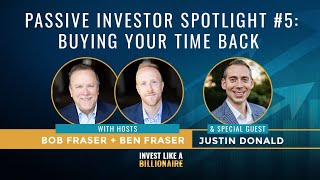
Justin Donald, author of The Lifestyle Investor, explains how he replaced his wife's teaching income and then his own through mobile-home parks and other cash-flowing businesses. He scaled to a top-75 mobile-home-park owner, sold a dog-training studio for an 11× return, and emphasizes buying back time over accumulating wealth.
Chapters
Welcome to the Invest Like a Billionaire podcast. We've got a really fun episode for you today. We have Justin Donald as our guest. You may have seen his name around. He seems to be everywhere. He is the author of The Lifestyle Investor, which is a Wall Street Journal bestseller, and the host of The Lifestyle Investor podcast. This is really cool because Justin is not just one of those talking head financial gurus who talks a big game and has never done anything. He is actually the real deal. He has done this himself. He has built a pretty great net worth and has done a lot of deals and has been in the space for about 15 years doing alternative investment deals. So we dive into his story, his background, what he likes.
And the whole point is not just— it's not just to, to build another hamster wheel, but actually how do you buy time?
Yeah.
And how do you buy freedom and to do the things you really want to do?
Yes.
And as a super cool thing, so we've talked quite quite a bit about Tiger 21, and this is the group of ultra-high net worths and, and how they invest in alternatives. Well, he is actually a member of Tiger 21, so we get to hear what he likes and what he's investing in in these days.
So yes, so stay tuned, stay tuned. And we just wanted to mention to those listeners that have been joining the podcast, if you are interested in seeing the potential deals that we have coming down the pike, be sure to go to aspenfunds.us. And at the top, we have an Offerings tab, and you join our investor club to be notified, to get first access to future deals we have coming down the pike. So enjoy this episode. Thanks for listening. This is the Invest Like a Billionaire podcast, where we uncover the alternative investments and strategies that billionaires use to grow wealth. The tools and tactics you'll learn from this podcast will make you a better investor and help you build legacy wealth. Join us as we dive into the world of alternative investments, uncover strategies of the ultra-wealthy, discuss economics, and interview successful investors. Welcome back to the Invest Like a Billionaire podcast. I am your co-host Ben Fraser, joined by fellow co-host Bob Fraser, and today we are joined by Justin Donald. Justin, thanks so much for jumping on.
Hey, so happy to be here.
Yeah, this is going to be a fun one. So it's kind of funny because, um, I saw your name pop up. This is probably, I don't know, 6 months or a year ago even on Facebook and all these ads. And I kept getting followed by your, by your ad crawler. And I'm like, this guy is super cool. I want to get him on our podcast. And then we come to find out we have a mutual connection. Uh, that was really awesome. And so here we are, we're super excited. And so for those of you that don't know Justin, he is the author of The Lifestyle Investor, which is the number one Wall Street Journal bestseller. It's a book and he also has The Lifestyle Investor podcast. So he's all about investing and he's got a really cool story. So Justin, for those who may not be familiar with you, give a little bit of your background and kind of your whole journey into what you call The Lifestyle Investor.
Sure. Yeah. So, you know, I've got kind of a fun story. Like many people, I started out kind of bound by a job or a business that kind of became my job. And I worked really hard to, you know, kind of create this lifestyle, this business that was gonna basically provide for me freedom and autonomy And it really didn't. At first it was fun and it was exciting, but it actually was more work. And it was, I feel like all the answers had to flow through me. So it just became much bigger and bigger. And so I just wanted to get to the point where I could work because I wanted to, not because I had to. And that was it. I don't want to sit around and do nothing. That doesn't sound interesting to me. I think it's important to recharge and take time off, Um, but what I experienced and what a lot of people that I work with and meet experience is, you know, really just this, this idea of being a slave to something, a slave to the business you own, a slave to the job that you have, a slave to the money that you make or the material possessions that you own, or the security of maybe a routine and You know, for me, I just really value freedom and value being able to spend time as I would like to spend it. And I see that others feel the same way. And so my goal is to help people buy their time back. And so I spent time doing this. I learned how to buy my time back. I started buying assets that produced income, and that income, you know, covered different parts of my cost of living. And for me, I had kind of a wake-up call where, you know, I had always heard and learned from my mentors that you should be investing in the stock market and, you know, that's where savvy investors put their money and through qualified plans where you're going to have no access to them until you're, you know, retirement age and, you know, all these things. And I learned this unfortunate truth, which is the way that the returns are advertised where it makes you think you're getting a good return if you actually do the math, your return is nowhere close to what you may think that it is. And that was my case. It was like I got punched in the gut. I got all these statements saying that I had these positive returns, but when I ran the numbers, I had lost money. And that, it didn't make any sense to me. I'm like, how is this possible? Like, it says 7% return, but like, when I do the money and I know how much I put in, I had less than what I put in. And that just opened my eyes to the manipulative nature of the financial industry and the things that can be done to make sure that they get more of your money with frequency, that you take less out. And I just wanted to learn how to be in alignment with kind of what I wanted to be in alignment. You know, if someone's going to make money off of me, that's fine, but they shouldn't make money when I'm losing money. I would rather it be You know, kind of a win-win scenario. So, I got into my very first investment outside of the stock market. This is where alternative investing began for me about 15 years ago. And it was in mobile home parks. That's how I got started. So, yeah, real interesting story. I just, I had a friend that was doing it. It made sense to me. I mean, at first it didn't. At first, he said, hey, I'm I'm going to sell all my single-family homes and buy mobile home parks. Do you want to go to boot camp to learn how to do it? I said no. So that doesn't sound interesting to me.
I think this is super interesting to our listeners. I mean, I think a lot of folks, you know, may— they just have jobs and they've got some passive investments on the side, but they're looking for, hey, how can I grow this? And others that are high net worth and maybe really trying to figure out, wait a minute, how do I How do I get some freedom? And I think it's interesting too. I love the way you talk about buying your time back because I do know a lot of times, you know, you start your own business for freedom, but you end up building your own hamster wheel, right? And that's right. And so, so tell us, kind of take us on the journey of how you, how you broke out of this and, you know, how you, how do you solve this problem and some of the hacks you did?
Yeah. The interesting thing is I built the business to get out of the rat race. You know, I was on the hamster wheel, but What ended up happening is I just built a much nicer hamster wheel. I didn't even realize that's what it was because, you know, had really nice TVs on this hamster wheel and I had the finest wheel with the best axle. And, you know, basically I had distracted myself into believing that I had achieved what I wanted to achieve. And so I just realized, you know, my wife and I need to be in alignment. She was working a lot when I was off. I was working when she was off. And so we needed to kind of pair up our schedules. We were at this time, this is years ago, we were about to have our daughter and I just thought it'd be great if we could, you know, kind of be— she could have the flexibility. She was a high school teacher, so not very flexible, but great flexibility in the summer. And then I had a pretty heavy lift for the work that I was doing at that time. And so, the first mobile home park when I was running the numbers, I realized that if we buy this park, it totally replaces my wife's income after taxes. And so, you know, it didn't equal, you know, on paper, it's not like, oh, my wife is, you know, earning $36,000 a year and the park was producing $36,000. I mean, after taxes, you would see that the numbers were basically identical. And so, I bought that park. She was able to retire from teaching. She ended up helping me in the mobile home park business because we decided to buy more. The next one kind of covered our survival income, which was just what it cost us to survive without any, you know, trips or fine dining or anything like that. Just basic income, groceries, utilities, car payments.
But you're running these, right? So, you're busy now.
So, in the early days, I was running them. But with mobile home parks, it's a lot different than most other, you know, multifamily. It's a lot less of a lift. There's not a lot to do. I mean, it really was 5, maybe 10 hours a week max. It's just not the same animal as some of the other, you know, it's like an apartment complex. Most of the residents own their own property own their own homes, you don't have to maintain the home. You just have to maintain the utilities to the home. So, in time though, you know, we bought that second park and it covered our survival income. We bought our third park and it covered our lifestyle income. So, at that point, I knew I didn't have to work. I mean, it was a true choice. Like, I get to work, I don't have to work. So, what is it I want to do? What is the hour, you know, kind of breakdown that I might want to work inside? You know, what am I passionate about? And at that point in time, we also had enough profit to be able to bring in a manager to run everything. So my wife was able to step aside. And so today, that same person that stepped in who's worked with me in every business I've ever done, she runs our entire portfolio of real estate. And I think we're, you know, probably close to a top 75 owner of mobile home parks in the US.
Wow. What if she wants to become a lifestyle investor and then you lose your employee? You know, that's the problem with this. This model, right? Somebody has to do the work.
Well, someone's got to put in the time, but I actually hope that in time she does, uh, right, uh, really, you know, graduate to this and that she can find someone to replace herself that she can train and teach to bring in. So my goal, like, I'm not afraid to lose anyone. I would be bummed to lose her, but I would be overjoyed to see her kind of following the 10 commandments that, uh, you know, I kind of outline in my book, The Lifestyle Investor, um, where she can create true freedom and autonomy and agency in her life.
Wow.
Yeah. One of the things that I want to go back to what you said earlier, and I think it's a really important point, especially where the stock market is at right now, you know, we're early May and there's, you know, year to date, it's been a pretty rough ride, right. In the public markets. And, You know, kind of going back to your kind of light bulb moment back when you're like realizing, hey, I'm not actually taking home much more than I'm putting in. And, um, you know, the way that the whole system is set up is, you know, you build this big nest egg and then when you're ready to retire and you need cash flow, you need distributions. Well, you have kind of a set amount that you hope you can earn, but then you're actually eating into your principal, right? Every month and you're taking distributions and then Well, a lot of people don't realize, and where the system kind of starts to break down, is something that people call sequencing risk, right? Where if the market is down like it is right now, about 25%, well, you're actually taking— you're, you're taking those, uh, you're selling those positions, you're actually taking realized gains or losses and reducing your principal. So the pie that you're using to generate those returns are actually decreasing over time. And so it has a dramatically negative effect, but in these mobile home parks, as an example, like you were saying, you actually aren't eating into your principal. In fact, your equity is likely growing over time as you're paying down your mortgage, as the market's appreciating, and you can generate— you can live off the cash flow purely, not on any principal or equity. Talk a little bit about that.
That's totally right, Ben. Um, so the way, you know, it's so interesting, you know, I have a lot of friends that are in the market and I think the market is great when it works for you, but to have all your eggs in that basket is a pretty risky, uh, endeavor in my opinion. And I think if you look across the wealthiest people in the world, and even more notably here in the US because we have access a little bit more to those numbers, uh, you'll see that it really is a smaller percentage than what, uh, the financial services industry wants you to believe that it is. And a lot of people that are in a big position in the stock market are at the point in their life where they've made their wealth and now they want to maintain it, not necessarily grow it at a crazy clip. And so, you know, it's interesting, anytime you sell something, there's going to be a tax consequence. And then as you do that, you're, you know, kind of dipping into that principal. I really like on the private side of things, there's so many ways to access capital where you can borrow against it, where you can refinance it, and all of that is debt. So you're not paying taxes on that. So you've got the cash flow to cover it, you have access to capital if you need that capital via refinance or just via, you know, a collateralized loan. At a certain point, you can get an unsecured loan, you can get balance sheet lending. There's just so many ways that you can do it down the road, but it's a great place to start. And the cash flow that it kicks off is really nice because as you keep acquiring, it gets to a point where you have to repurpose that money. And so, I remember, you know, soon on in my journey of mobile home parks, this realization of, "Whoa! I've got a new problem." And some people are gonna probably scoff at this, but it's that I had to repurpose some funds. I had enough coming in every month that there's surplus and I don't want to just sit on it. And so, that's really What got me to the point that I started opening up my view and my kind of analysis of anything and everything alternative is that I had capital, I had to place, and I had it every month. And I needed to figure out the best way if I wasn't going to continue to scale the mobile home parks. And I didn't want to do that. I really enjoy learning new things and getting, you know, kind of Creating better hedges with my portfolio. My goal is to be in everything. I want a little slice of everything. So no matter what happens in the economy, I can still do well.
Yeah.
How long did it take you to make this transition to being a lifestyle investor?
Well, the very first property I bought, so I mean, I went to this boot camp and I learned how to do it. It was a great session. So I found a park within months of graduating from that boot camp, my wife basically in one fell swoop, you know, I guess it was less than 6 months later, was able to retire from teaching. And then we had our basic bare minimum, uh, survival income inside of that 6 months as well. And then probably another 6 months later after that, so a year total, I had covered what it cost us to live. So, not necessarily my lifestyle income, but at least what it cost us to live. That was about $10,000 a month.
So, it might be a little bit harder today just because valuations are so high and cash flows are so low generally after, you know, at this time of the market. But the principle remains, right? And there are always good deals out there. We were just looking today at cash-flowing real estate investments with great upside potential that are cash-flowing at 10%, you know, unlevered and, you know, kind of nuts, right?
Not too bad.
Really good deals. And there's always something that's working, right? No matter what, there's always something that's working. You just gotta, you gotta, you know, have enough, you know, view to see where it is working.
Yeah. Talk a little bit about, you know, you started the mobile home parks and got a couple of those, and then where did you kind of go from there? 'Cause you've done a lot of investing since then. And what year was that when you bought your first mobile home park?
So I did some lending in the beginning, but I think my very first park was in '09 or in 2010.
Oh, wow.
That I owned the deed to the property myself.
Well, dude, yeah. There's nothing like good timing as an investment strategy. You know, luck is the best investment strategy possible. So, you know, yeah, that's incredible.
You know, yeah. I guess, you know, during the time where it was, you know, prices were a lot higher, I was more of the debt, so it was a really good situation. And then when I own my own, the timing really worked out. I mean, this is one where, you know, if you're going to dollar cost average over, you know, peak and, you know, bust type of markets, you're going to be just fine because mobile home parks don't really decrease in value. It's not like a a single-family home that is based on the neighboring home's comp. Uh, this is based on net operating income, as I know you guys know. And so you're, you're making an offer based on a multiple of the profit or the operating income that already is coming in. So I like that. Um, and one of the other things I like is to find businesses that I can buy from your baby boomers that are starting to retire right now. You can find some great prices, great opportunities. In some of these cases, these people maybe weren't even going to sell their business. They were just going to close up shop and retire. And so it's neat to be able to buy a business. And really today, I think with inflation the way that it is, with monetary supply expanding the way that it is, I think you just want to be in assets. You want, you know, an asset's going to appreciate at the same level of the monetary supply. Over the last 2, 2 and a half years, we've pumped in about 40% of the money in circulation through, you know, stimulus, quantitative easing practices. And so you've got all this money, the dollar is being devalued. So you just want to be in some sort of an asset that can hold its value. And I love real estate. I think real estate's great. I think it's a great starting point. But my goal is to be on the cutting edge of whatever I think the trend is in the future. So mobile home parks, I was much earlier and it took a lot longer for Wall Street to kind of pick up on this. I had done single-family homes a little bit as well in there, and those really picked up steam. And, you know, other areas that I think I was very early on the curve would be e-commerce and even cannabis, which we're seeing a lot of positivity in each of those industries right now. So part of it, one of the things I write about and talk about in my book is this whole idea of invisible deals. You can do that in real estate where you find deals that are off market, you try to buy something without all the competition, but that same thing exists outside of real estate where you can find a company that maybe isn't looking for money or doesn't need money, but maybe you make a case that you're a strategic investor, you've got a good network, you have the opportunity to give them a war chest that they're going to be able to use later if and when they need it. And if not, you know, it's just a good protection and you can help them grow their business. Um, I mean, it's endless. But if you study where millennials, for example, are spending money, then you'll see a lot of trends of likely opportunities and businesses for the future because you know that that type of spending is going to continue on for a period of time. And so I've been able to make some pretty good investments around that.
Very cool. Yeah, that's something we've talked a little bit about on the podcast before. I used to be a commercial lender and actually did a lot of SBA loans and did a lot of acquisition loans where you can go and buy these businesses and you can lever them up with the SBA program is extremely generous terms.
And I mean, you can buy a franchise, right, that doesn't even exist, buy and go build a franchise. For, you know, name it and, and using SBA funding.
A lot of times, I mean, depending on how you structure the equity contribution, you can put in as little as 10% down. Right. Which you can't even do in real estate. And you're getting a lot of times unlevered cash flows in the double digits. And now you add a little bit of debt on there and, you know, obviously you're taking on more risk because this is an active business you have to run and it is a job.
So you're sinning against his Ten Commandments here to do that.
But yeah, so, so talk about what are some of the businesses that you've purchased purchased? And I mean, obviously you've had this framework. So even as you're buying these businesses, you still, you don't want to create a job like, like you were saying, right? You want to create more, um, time purchasing power. So what, what are the businesses that you kind of, you know, early on started seeing some opportunities in? Like you said, baby boomer businesses, but what types of verticals?
Sure. Yeah. And, and by the way, I love franchises as well. I think those can be incredible, but you got to be careful because in most, you're buying a job, right? There are very few where it's truly a passive endeavor, but you can create a system where you plug people in. So, you know, I own an Orange Theory Fitness franchise where one of my partners operates and runs that business. So, my, you know, my big sticking point is I'm going to be the capital partner. That's it. I don't want any operations. I'm happy to help periodically, but that's really it. And so, We did that. I had another partner that ended up— so I bought a dog training studio during COVID By the way, I don't own a dog. I've never owned a dog. I know nothing about dogs. But during COVID I noticed everyone was buying a dog and everyone who told me they would never buy a dog bought one and everyone who—
I bought two. I bought two dogs during COVID Yes.
Yes. Totally. And so I just, I saw like the—
The dog training.
What these dogs were doing and just the frantic nature of people that were going crazy, you know, with these new puppies that were destroying their homes. So anyway, I bought a dog training company which coincidentally Patrick Mahomes trained his dog at, which is cool, in Kansas City.
Oh, nice.
And that business was one that we were able to get a loan. It didn't cost much to put down. So, you know, small down payment. And what I did, there was a salary that the previous owner was paying himself of $75,000 a year. And one of the guys that I had worked with in the past, I worked in Cutco, that's kind of how I funded my college and early career. That's how I kind of learned how to work with people. And one of my managers from there, I brought over to run the dog training company. He was making $65,000 a year. So He got a $10,000 pay raise, plus I gave him a ton of equity and just, you know, said, hey, uh, you run it. I'll be the money. I'll help periodically on, you know, strategy stuff, but I want you to own it and you've got a lot of upside. And so, uh, we ended up scaling this company, doing a great job. At one point we had profit between $10,000 and $12,000 a day for a stretch of a couple of months. Until we fully booked our, you know, all the meeting appointment space that we could for the year. And then, we decided, you know what? Let's just flip this thing. Let's just ramp it up. We'll sell it, which we did at a year and a day, and we made an 11x on our investment. And then, we're able to repurpose that into another business.
What kind of business did you repurpose it into?
So, we are opening, and when I say we, again, actually, this is an interesting transition into another way of investing. And so my partners now who have run some of these different businesses or franchises have cash. We've done well. They don't need my money anymore. So they can go out and they can do their own business. But what ended up happening is the banks still think they're too young or don't have enough experience. And so they want a personal guarantee, uh, or they want some sort of a credit line that they know is there. And so What I've been able to do is negotiate equity in many different new products. And so the newest one is KidStrong. We've got several KidStrong franchises that we own, and I didn't have to put any cash into this. I'm literally leveraging my balance sheet for an opportunity to have equity where it's going to be no money out of pocket. And it's just a unique way of structuring a deal to create a win-win where all parties can feel great.
That's really cool.
That's really cool.
So talk a little bit about for someone that's listening to this and says, oh, that's really cool, but I, you know, how do I do this as a passive investor? And you have some ideas there where maybe you find an operating partner or you leverage your balance sheet. But, you know, maybe for someone that is thinking, hey, this, this could be something I can go actively do. What are, what are some of the pitfalls that you find or for investors that are maybe, you know, ready to take the leap out of the public markets and kind of get started? What are some of the scars that you carry from early experiences that you advise people to look out for?
Yeah, my goal is for people to learn from my mistakes. I've made plenty of them, and, uh, you know, luckily not all of them have cost me money, but certainly some have. And I think early on, you know, I've got a really funny chapter in, in my book where I talk about, uh, basically what not to do when you invest. Like, here are all the poor decisions that I made. Avoid all these decisions because this one costs me a lot of money. And, uh, one of them is just like thinking that a deal is a good deal because a buddy did it, or thinking that because you are a successful entrepreneur that you actually can be a successful investor without putting in the time. I mean, it's amazing to me the confidence, this utter like ignorant confidence that some people have where they invest maybe a whole bunch of money, not in a well-thought-out plan, not in a bunch of different industries, like all this money, same spot, one deal, horrible terms, industry that maybe not growing. So I just think that there's a lot to learn. And if you want to become a good investor, number one, you've got to be willing to educate yourself. And number two, you've got to be willing to spend time with people that are good at it, that can teach you. Your peer group matters, your mentorship matters. And, and so that, that's really what I encourage people to do is learn from everyone else's mistakes so that you don't have to lose money or you don't have to lose as much money.
Yeah, it's so, so true. You know, people invest, you know, they go to school, they go to college and maybe a master's degree, and then you go build your career and you're, you're developing your career and people spend enormous amounts of time and energy to develop a career. But the same, same person would spend 0% of their time, not even an hour a week thinking about my investments and how do I actually maximize more investments or think about how do I invest? How would they're not educating themselves to make their make money work for them. They make their, they make their time work for them. And people maximize that, but they're not maximizing their balance sheet. And it's not that hard to do. This is not rocket science compared to the stuff that, you know, a banker has to know, or a retailer, or whatever. It's nothing compared to that. It's just, you just got to go do the research, take the time to actually make your balance sheet work for you. And, and but people don't spend the effort. And that's, you know, that's one of our missions, right, in this show. And, you know, sounds like yours as well, which is, which is great.
Yeah. I remember there was a deal that when I was a banker and this was very illuminating and also to the points you made of a lot of skills that maybe you learn in corporate America or whatever don't always translate to business ownership. And there is an individual that took out a massive loan, maxed out the SBA program at $5 million. And he put all of his cash for his equity contribution and all of his life savings to purchase his business. And it was a rock quarry. And he was a C-suite executive of a large company, you know, and hey, how hard is it to run a small rock quarry? Well, fast forward a few years later. I mean, it's kind of a sad story because he lost everything. He literally walked into the bank and handed the keys back and said, I can't do it anymore. And I lost everything. And wow, you know, that's, that's the worst horror story, right? But it is true. Like, you have to know what you're good at, what your skill sets are. Can they translate to, you know, this endeavor? And then you're like, you're saying surrounding yourself with the right people that have done it before, with mentorship, with people that you can learn from, you know, mistakes and, and not making the same ones.
Yeah. And I think diversification is really important. You know, you hear about this a lot in the public equities— have stocks, have bonds, have fixed income, right? You got to be, you know, you got to have a good portfolio allocation, but you want to do that same thing on the private side as well.
But let me just jump in there and say all that's a little bit of a crock, too, because we saw in the great financial crisis, the correlations of everything went to 1. Right. It didn't matter how diversified you were in the public markets. It all went to crap, right, at the same time.
And, and so, yeah, so we're seeing it right now with equities and with bonds, all going down in lockstep.
It's the same thing. And so really, true diversification is getting into alternatives and not just real estate alternatives. Everybody loves real estate, and real estate's a great play, no question, but You know, there's a lot of other ways to play businesses, you know, ATMs. We're looking at, you know, lots of different deals, venture debt deal we're putting together right now. And there's so many other ways that are completely different from everything else. And that's true diversification, right? So anyhow, sorry to interrupt, but keep, keep rolling there.
Yeah, no, I think that's great. I mean, when I say diversification as well, like, I even mean diversification of income streams. Like, where are you dependent on all of your money from one business, one opportunity, one real estate play? Like, I want as many as I can get. And then I want to not swing for the fences. I want to hit just singles and doubles. I don't need any home runs. Home runs kind of create, in my opinion, really bad due diligence. There's this emotional component of like cashing the check before it actually arrives. I don't need that. I'm just— my mission is don't lose money, right? Like, can I get a good return and not lose money and protect against losing? I don't need a 20%, 30%, 40% IRR. If I get it, great, but I just want to make sure if things go wrong, I'm at least getting my money back, because that right there is where you lose the most. If you lose money, you got to work twice as hard to get it back. You have forever lost that, you know, opportunity cost of what it could have produced. But sometimes you still need to learn that lesson as well. Like, some people don't learn the lesson until they've lost money. It was very valuable for me. It was hard in the moment, but losing money has made me such a better investor. And so the big picture, you know, some people are afraid to do it because maybe they'll lose money, but you might lose money in the public side or in whatever else you might be doing. But the reality is, if you do, you should learn lessons that are going to equip you to not make that same mistake again and make you smarter, better, willing to hang out with, with others that are smarter and better at whatever the thing is that you're doing.
Yeah, I saw in your bio here you're a member of Tiger 21, and those that have listened to the podcast since the very beginning, that was one of the key data sources we used in in researching, you know, Invest Like a Billionaire, how are the ultra-wealthy investing in Tiger 21. You can talk more about it, but it's basically, you know, an organization that has these high net worths and looking at—
they're focused on alternatives and where their portfolios—
and one of the cool data pieces there that we've pointed to a lot is 50% or more on average of all their investors are invested in private alternative deals. And that's either real estate or private equity or venture capital. And 50%, you know, the average retail investor is, you know, between 0 and 5% maybe in a true private alternative. Right. And so it's this very big discrepancy. And that's really why we're doing this whole podcast is to kind of educate that. But talk about your experience, you know, being in Tiger 21 and kind of rubbing shoulders with a lot of these successful investors and just maybe the different mindset that they have in approaching deals. Right. It's not just throw it in an 80/20 portfolio and forget about it for 30 years.
Yeah. You know, it's an interesting group and you're right. I mean, I, I've tracked these stats for a long time. I share these all the time on, on my podcast, which is, you know, where, where do the wealthiest people have their money invested? And there's been a long, uh, run of, of studies, data points, uh, a lot of different groups, you know, publishing this data, but your wealthiest people most certainly have over half of their net worth in real estate and private equity. That's, that's a slam dunk. In many cases, it's very high into it. You know, I think overall as a group, um, it's broken out into about 25— 25% in public equities, 25% in real estate, 25% in private equity, uh, and then 25% is kind of all over in a bunch of different things. Um, and so Tiger 21, I think, was kind of founded on the basis of this whole real estate play. So you've got a lot of people that are in real estate, but you also have a lot of business owners. If someone exits a business, a lot of people look at this as the place to maybe move on to, you know, once maybe you're done with an EO or a YPO. But you also have a lot of other people that are there with investments where they're looking to raise capital and they have unique deals. And so you're going to see a lot of interesting investments. And that doesn't mean they're all good deals, But there's a lot of opportunity to dig in and learn. And I think it's very chapter-specific as well, where you've got— I mean, there's over 1,000 members, I think it's over 1,100 now, and each chapter is kind of its own animal. And so I'm here in Austin and I just love my chapter. You know, some of my closest friends are in this group and it's been a lot of fun.
So what about, what about the mindset is different, would you say, from the Tiger 21 crowd from the non-Tiger 21 crowd?
Well, in Tiger 21, it's not a, it's not weird to be on alternative investments, uh, even if someone is not heavily in it. Normal, right? Like, it's just, it's just the way that it is. You certainly have some people that what they do is heavy in the public equities, but it's, it's a small percentage. And if you look at the breakdown overall, one of the biggest things that you'll see is that a lot of people built their wealth in private equity and, and in real estate, and then they've transitioned often a lot of that wealth into the stock market. So the, the thing that I see a lot of people think is, oh well, wealthy people have a lot of money in the stock market. Yeah, but they didn't typically make their money there. That's, that's kind of where they're going to maybe maintain a portion of their wealth. And long term, I think there's probably some truth to that. If you can find a smart way to do it, if you're distributing it out over 10 different hedge funds so that you're— you've, you've got, um, you know, a nice allocation, or if you're just doing, uh, you know, a low-fee, uh, index fund or something, but this is a long-term play. To have some exposure I think is good. But overall, I think the mindset is that you really want to, number one, be around other people that are smart, smarter than you, right? Smarter than me. And then two, that you want to get as much opportunity to learn and get involved in extra deals or extra education And so, you know, it's a fun group of people.
Probably a lot of Lifestyle Investors there.
Yeah, you know, we've got a good number of Lifestyle Investors, you know, even from my organization that are part of that group, and a lot from Tiger 21 that are part of the Lifestyle Investor Mastermind. So yeah, a nice, uh, you know, a nice kind of, uh, group each way and, and kind of transfer of people. But, uh, there are a lot of people that are still kind of building their business in But I think that the majority of people are people that have a substantial net worth and are looking for what they can do with it.
So what are your— as we sit here, you know, markets are melting down and, you know, you know, multifamily is at an all-time high, you know, super low cap rates, very difficult to find, you know, deals that pencil in certain, certain categories of real estate. You know, inflation is ripping higher, you know. So what do you like? Where are you sticking your new money right now? And because there's always something good, right? So what's good right now?
Yeah, I mean, I think you can still find some deals in real estate that are good. I think there's a lot that's overpriced. I mean, I'm still able to find some good industrial warehouse distribution center type of assets, and I like that. Yep. I've done some self-storage conversion. So, you know, if you buy self-storage straight up, that's going to be pretty expensive, low cap rate. But if you do a conversion, you could, you know, there's definitely some opportunities there. You know, I would say in the world of multifamily, I still like mobile home parks a lot. Cannabis has been a huge winner for me, especially structuring the deals the right way with very highly profitable companies there. There are definitely some banks. There are about 600 regional banks that will work with cannabis companies. And so you can get access to financials, see bank statements, and know if a company is a good company to invest in. But that's, you know, we're still the Wild West here. And if you think about the money that people made during Prohibition, I think there's just going to be ample opportunity for something similar like that as cannabis becomes more and more legalized, at some point federally legalized. I think e-commerce is going to continue to boom. I think there are some, some technology plays that are really exciting. And there's ways also that you can de-risk the tech play where, you know, most of these VC funds are 10-year funds with, uh, where sometimes they'll extend it 1 or 2 years. But there are unique ways where you can get in and out in a shorter period of time, you know, in between a Series A and a Series B And, um, you know, maybe get in on a Series A extension, get out on a Series B secondary. So you get the majority of the growth, like that's the largest growth jump from, from Series A to Series B, but it's only a 2 or 3 year wait as opposed to 10+. So that's kind of a unique strategy. Um, I've got into a lot of other secondaries that, uh, where these companies have exited, you know, last year, 3 of the deals that we did in my mastermind, uh, went public. And so there was some good opportunity there. So yeah, I mean, finding the right deals for me, I want to get the money back quickly. I'm not trying to sit in an investment for 10 years. I would like to know shorter than that if it did well or didn't do well, right? I'd like to get some cash flow on it. Ideally, I'd like to get that principal back so I can reinvest it quickly into something else. I mean, I, I'm like the The thing that I love is taking the same dollars, getting them back, and putting them to work somewhere else. So, you know, in the example, one of the things I write about is the whole velocity of money. So if I take $100,000 and I invest it in a multifamily deal, which, you know, this is a, you know, one example of many where I got that back in a year, year and a half, took that, put it into, you know, maybe a senior secured debt vehicle with warrants or equity kickers. And then I get that back in a year, maybe it's the 1-year note, and then I put it to work over in, you know, the dog trade.
Meanwhile, keeping your equity kickers and letting it ride, you know, that's right.
That's right. That's right. It's house money, right? So I've got, I've got no risk in the deal, total house money, and the same dollars are creating equity across the board in 3, 4, 5 different deals over the course of 5 years.
Justin, you sound like you're having fun.
Oh, I love it. It's a blast. I mean, so it was, it was really interesting. I took, uh, so in 2018, I just took the year off and my family traveled. We, we went all across the globe. I think we hit up 13 different countries and just had so much fun. And during that time, what I did when I didn't have to do anything was I figured out how I spent my time. I did a lot of journaling and I recognized the things that I did the most were read, learn and educate myself, teach my friends how to have financial freedom, and do investment deals. Like, those are the 4 things that I did outside of hanging with my family. And so I decided, you know what, it would kind of be fun to just take my hobby and make it, you know, the main thing to like a passion project. And so that's really where Lifestyle Investor came from.
That is so cool. Well, our listeners are about to have some fun too, because Justin said that he is going to give our listeners a special link, which we are going to link to in the show notes here. So check those out. And, uh, Justin, what are you gonna— what are you gonna do for our listeners here?
So I'm so excited, you know, just to really spend time with both of you guys, Bob and Ben. You guys are just a blast, and I love your thesis and your strategy and your energy and your desire to educate. And I am just excited to be on this journey with you. So, for any of your audience that wants a free copy of the book, you just pay for shipping. You can go to lifestyleinvestorbook.com and you can get yourself a copy there. And so, one of the things that— you can, of course, get it on Amazon if you want to pay for it. But one of the cool things that I'm excited about and inspired to do is partner with a company called Love Justice International. And they stop human trafficking in 24 countries around the world. And so all the proceeds of Lifestyle Investor go to that organization and, you know, helping what it is typically predominantly children and women that are, you know, being enslaved in some way, shape, or form. So, uh, however you do it, if you get it on Amazon, if you, you know, get a free copy and, and do the shipping, anything, any of the proceeds that we have in any of our products, a portion of it goes— all the book, 100% of the book goes to Love Justice, and then a portion of all the other sales for everything else we do goes there.
That's sweet.
Awesome. Well, listeners, go get the— go get the free book, and it's definitely going to give you some great nuggets. Justin, thank you so much for joining us on the podcast, and I'd love to bring you back on down the road and hear what other deals you're doing. Exciting stuff.
Yes, awesome time.










