
Real Estate in Limbo: 2026 Outlook with CBRE’s Spencer Levy
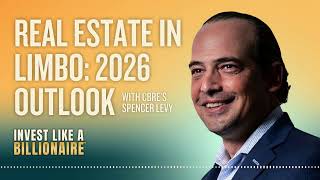
In this December 2025 podcast episode, Bob Fraser and host SPEAKER A interview Spencer Levy, CBRE’s global client strategist and host of The Weekly Take, to dissect the 2025 real‑estate market and forecast the 2026 outlook. Levy describes 2025 as a “barbell” year – a strong start, a mid‑year trough caused by a tariff‑induced spike in the 10‑year Treasury and a dip in foreign capital, followed by a robust finish as capital returned and debt spreads narrowed. He notes that the 10‑year Treasury has stabilized around 4‑4.25 %, providing a clearer pricing floor. While the traditional “big four” (office, industrial, multifamily, retail) remain core, investors are increasingly allocating 30 %+ of core capital to alternatives such as data centers, senior housing, and student housing. Levy highlights durable demand drivers (population inflows to the Southeast, Southwest Texas, Austin, Portland) and warns of over‑building in some sub‑markets. He stresses that sticky inflation, driven by a mismatched, aging labor pool, will keep rates higher for longer, and that the 10‑year Treasury functions as the global risk‑free rate and a bond‑alternative to equities. Capital is deep, but the real bottleneck is getting assets priced at fair market value; cap rates have expanded, especially in multifamily and industrial, making positive leverage harder. He discusses sector‑specific outlooks: office opportunities in premium sub‑markets, multifamily pricing challenges, industrial sub‑segments (logistics, flex, last‑mile) with modest rent slow‑downs, and the growing but still nascent reshoring/near‑shoring trend tied to US‑Mexico trade and Chinese investment restrictions. Data centers are seen as a high‑value, liquid asset class with strong rent growth, though the market could be vulnerable to tech‑company ownership shifts. Throughout, Levy balances optimism about durable demand with caution about structural headwinds such as labor shortages, construction cost pressures, and the need for skilled‑labor immigration.
Chapters
Spencer Levy joins the podcast today to help us reflect on what's been a pretty dynamic year, especially in real estate. Spencer is the global client strategist and a senior economic advisor at CBRE, where he focuses a lot of attention on real estate, and he's the host of CBRE's podcast, The Weekly Take, We're big fans of Spencer and are really grateful to hear his hot takes on where the market has been this year and where he's expecting 2026 will take us. Tune in, you're not going to want to miss this one. All right, Spencer, so excited to have you on the show today. So let's maybe rewind the clock a little bit, you know, maybe a year ago, thinking about 2025. What were some of the big things on your radar that you were processing as you're trying to figure out What does '25 hold for real estate?
I think there's the big things that are obvious, and then there are the things behind the curtain that are not quite as obvious that I'm going to try to touch upon. I think the obvious ones are interest rates and how they're going to impact capital flows. And then the political changes, because we had a presidential election last year, and how those might impact other things related to our industry. They both had impact. Interest rates had impact because they came down, but not nearly as slowly, which is the bad news. The good news is that the 10-year kind of stabilized. Stabilized in this 4 to 4.25 range, which I think is good. I don't think people, or very few people, expected to get much lower than that, but I think the stability of it is really helpful to the market. I will say that the year started off very strong, and then we had a real trough in April, May, June after the tariff announcement, uh, for two reasons. Number one, it caused a spike in the 10-year Treasury. There was a moment there where the 10-year got close to 4.8. And the second, it really damaged foreign capital flows into the US. That's the bad news. The good news is both of those turned tail. 10-year came down, foreign capital came back, and we had a very good end to the year because capital is now deep, abundant, debt spreads are narrow, and the base rate came down even today with the Fed dropping rates another 25 bps. So it was sort of a barbell year, as one person put it on a panel I was on last week. Beginning of the year was great, middle of the year was, eh, and then the end of the year ended up strong. So I think we're in a very good place entering into 2024. 26. But I think the things that I guess surprised me a little bit in '26, uh, the hottest asset classes are now not the big four. The big four: office, industrial, multifamily, and retail. Look, when I got into this business a long time ago, that was basically the game. But now we've had several investors that I've spoken with, met with, had on the Weekly Take telling us that core investing— and core is defined as the least risky investing is now 30% or more in alternatives, things like data centers, senior housing, student housing. That surprised me. I thought that you would see actually a bigger shift into not only retail, which we did see, but also people seeing the opportunity in office. Now, some people do see that opportunity in office, and I think they're dead right. I think the pendulum swung way too far on that, and I think if you can get the best office in the best submarket, you're in a great place. And/or if you can get a reset basis, you're also in a great place. So what surprised me is that more people didn't jump into the office trade, but I think more people will. That's my synopsis of '25. Goodyear, Barbell, and then the rise of alternatives as a real alternative. Maybe that's the wrong word to use to the four basic food groups.
I love it. Let's kind of take a step back again and even talk about some of these big things that are driving a lot of the capital flows, interest rates, et cetera. What do you see from just a, economic standpoint as far as, you know, strengths, weaknesses?
Sure. So I'm going to mention two concepts. One is durable demand drivers, and the second concept is good old-fashioned supply and demand. Let's start with good old-fashioned supply and demand. Anybody you talk to when they talk about the flow of people to places are talking about the Southeast, Southwestern Texas. That's the good news. The better news is that they're cheaper places to live. You're seeing a reshoring of manufacturing. Great story in these parts of the country. The bad news is there was a little bit of overbuilding in the Southeast, Southwest, and Texas, including in some of our most popular markets like Austin, Texas, which has a glut at the moment of multifamily. And so they're still working through that supply. We also saw an overbuilding in some submarkets of industrial. And so there's a little bit of bloom off that rose as well. Why? Because when you go to the best places and the best submarkets, people will build until, well, there's oversupply. So I think that's part of the story. But that brings me back to my other thing I want to talk about, which is durable demand drivers. I'm just being straight up here, folks. If you're down on Austin multifamily, sell your building to me because Over the long term, Austin is a fantastic place to be. I remember 15 years ago when I was looking at Nashville, maybe it was 12 years ago, any event, same dynamic, overbuilding, you know, 5 years of supply, never gonna absorb it. They did it a lot faster than you thought. Why? Durable demand drivers. Austin is the second fastest growing city in the country behind Boise, which is, well, small but faster growing. It has unbelievable inflows of people, high-quality talent, and I'm biased because I just taught at University of Texas. And it also has great tech, it has a great music scene, it has a great food scene. It's just a city that everybody should aspire to be. I— where was I the other day? I know where I was the other day. I was in Portland, Oregon last week. Heck, you know what, Mr. Fraser's, I was everywhere last week. And when I was in Portland, the phrase in Portland is "Keep Portland weird." You know what the phrase in Austin is? Keep Austin Weird.
Keep Austin Weird.
Right. And I said Portland should look at Austin, do what they did because Portland's had its challenges, but Portland's a terrific place. It's got durable demand drivers. It's got the ocean's 80 miles in one direction. The ski mountains are 80 miles in another direction. It's got a lot of wealth. It's got highly educated people. And yeah, it's had some challenges recently, but you know what? So did San Francisco. And who called San Francisco as my number one investment idea 3 years ago? This guy. And who was right? This guy. And this guy was also right when I called retail as my number one investment idea a few years ago too. So how you like me now?
Well, hearing your talk on the retail, actually, I think 3 or 4 years ago at that conference was one of the first times it was, wow, this is a crazy time to get into. I remember that.
And we did. We jumped into retail at that time, which we did well in, by the way.
You guys owe me a commission.
Yeah, exactly.
Coming.
So inflation, right? I think you've been a proponent that it's going to be stickier, going to be higher for longer. And obviously we've seen the headline numbers come down a little bit, but seems to still remain somewhat stubborn. And obviously that's a big driver of the Fed's decision on interest rates, on the demand side of growth for a lot of different types of real estate. What's kind of your synopsis of inflation and where we go from here?
Well, I think you've already given a good synopsis of my point of view about being higher for longer, stickier. But I think what you really need to dig into are the two factors that are going to impact it, I believe, the most. Factor number one is the depth and quality and availability of the labor pool. And the second one being what is the actions of the Fed as a result of what looks like sticky inflation. And so the challenge, of course, is I think everybody would like lower interest rates. Even, even the people on the Fed who don't want lower interest rates want lower interest rates because they want the economy to boom faster, because we need to grow faster. And the only way we're going to grow faster is with lower interest rates. The problem is that inflation is sticky. And so the challenge is, if we drop the short end of the curve too quickly, we could make inflation worse. And you know what, that will put upward pressure on the long end of the curve, which to me, the 10-year Treasury is the single most important number in finance. And I'm pretty sure that is the consensus opinion of the Trump administration as well. And so they're really in a balancing act here. Of course we want lower interest rates, but the administra— or rather the Fed controls the short end of the curve. They do not control the long end of the curve. The long end of the curve is controlled by the global bond market. And the global bond market will revolt if they don't do a good enough job on handling inflation. So I think that I'm very mixed on next year's opinion. I'm not going to say interest rates are going to be lower, inflation is going to— I'm not saying that because I don't see that in the numbers. I don't see that in CBRE's projections. And there is the risk factor that we drop rates too quickly. Now, do I want rates to drop more quickly? You darn tootin' I do. But the bottom line is I'm very conscious of what its impact might be on the long end of the curve.
I think it's a great balance to say that, right?
To say what? To say darn tootin'? Has darn tootin' ever been said on this show before?
I don't think so. We have to have an award for that one. Let's take a real quick step back. Let's break down for us why the 10-year Treasury is, as you said, the single most important number in finance, or what you said, but—
It's the single most important number in finance in the world, period. And the reason why it is considered to be has been and will for the indefinite future considered to be the quote-unquote the risk-free rate. It is the base rate for most securities in the world, and it impacts the cost of your car, the cost of your house, the cost of new construction, the cost of just about everything. And here's where it really comes in and why this show is so important, is that it comes in— if the 10-year stays high, it is an alternative to equities. And that's really why it matters. It matters not just because everything in your life gets more expensive. It is, if I can get my mom a 7% muni, why would I have her invest in equities? Why would I have her do it? And I mentioned my mom because my mom just sold her house. I helped her sell her house. What do we do? We invested in munis. Why? 'Cause I'd never seen rates like that before. Because if you can get high bond rates, real estate, we like to say that it's, you know, alpha creator special. It is all those things. But it's also a bond alternative. And if the bond rates are too high, you're not going to get the risk capital going into real estate because it doesn't have to.
You know, just double-clicking on the, uh, your comment about the labor pool, and you said both the quality and the match of skills is off. And, you know, if you look at the numbers, the growth of the wage growth is beating inflation every quarter, and you continue to see just wage growth outstripping other areas. And of course, wages underlie everything. It really is a structural issue, right? It has to do with, you know, boomers retiring, the younger set coming up to speed. And, you know, there's a great article in the Wall Street Journal about Ford needing 10,000 mechanics and not being able to hire them, and a million mechanics in the United States that are needed. We've got a very educated populace, but they're not educated in the right things, right, that the people that we need. And so you've got both kind of a smaller labor pool and a labor pool that doesn't have the skills that are needed. And I don't see any of those things changing. In fact, I probably see those things continuing to get worse. And so to me, it just says inflation is going to continue to be troublesome simply for that reason alone.
Well, look, there are solutions to this. They take time and they're highly political. And that's the challenge. The challenge is that we need more skilled labor immigration. And now I know that's a controversial thing for some people to say, but I think most people in the business world would agree with me. Yeah, because there, there is this skills mismatch. And very often we saw in the tech field that because the immigration rules are so much looser in Canada than they are in the U.S., we'll see many of our tech companies recruit people to go to Canada and hope they could bring them down to the United States eventually. But we need skilled labor here however we can get it. I would like to upskill the existing population, but it has to be supplemented by significant skilled labor immigration because the shortage is as dire as you've suggested, Bob.
And it's not going to ease. It's not, you know, you look at the boomers just continue to exit and there's really not— there's no one stepping in behind that. And, you know, as we see, as people age, right, they're pulling money out of the markets, they're pulling their labor out of the labor pool, but they're continuing to consume, which again just means higher inflation. So I think it's going to be here with us. So going to rates, I mean, obviously you alluded to it. We saw rates, you know, drop a little bit. And this is, I think, the third decline. A year ago, everyone was expecting the rates to come back to normal, right? But to me, I've been around the block a few times. This is more closer to historical norm than the 2% 10-year, say. And so I don't think rates are going to come down for that reason. And to me, here's the thing I can't get past. It's if you look at the size of the Treasury market, it's roughly sixfold higher than it was prior to the Great Financial Crisis. 6x. More Treasuries. And it's because of these just massive deficits that have been run since the great financial crisis. It's like, you know, we've gone deficit crazy and there hasn't been a price to pay. Where are the bond vigilantes? You know, they're gone. And so I think the governments have felt very comfortable with these massive deficits. But what happens, it just increases the size of the Treasury market. Now you have supply and demand in the Treasury market. Who's going to buy all these Treasuries? It just means higher rates have to exist. You know, am I missing something or are we in for just higher stickier rates?
I think there's a lot to unpack there, but let me simplify it and just answer your first thing and then I'll get to your second thing. Your first thing was rates are getting back to normal. Okay. I think you're looking at rates the wrong way. Not that you're looking at them incorrectly on a historic basis. I think you're looking at them incorrectly on the basis of how they impact the capital markets. Because what matters isn't whether the 10-year is 4, or that the short end of the curve or SOFR, the short end of the curve is went down by 25 bps today to 3.5 to 3.75, whatever. That doesn't matter. You know what matters? It matters that in 2021 they were both zero. And that means that the relative difference between zero and 3 or 4% is infinity. But what really matters is that people who bought their homes in 2021 and have a home mortgage under 3%, which is a lot of people, they're not selling their houses. Anytime soon. Same thing with commercial real estate. So what matters isn't whether we've normalized it, whether historically the 10-year on average is 5%, which it is. What matters is where it was and what it— it distorted the market. And that market distortion will not go away unless we have a shock. And now I'm not looking forward to, nor do I hope that we have a shock, but a shock is the only thing that I could see that could really drop interest rates significantly. I certainly hope it's not a stock market correction, but that certainly looks like it would be the most likely shock. But nevertheless, it is the relative value of treasuries in the last 5 years and the short end that matters. It is not the absolute value that matters. And then to your question about stickier, higher for longer, I think I've answered that earlier. I do expect that, and I think that there's going to be this battle. By the way, I disagree with you. I think the Biden vigilantes are alive and well. And I think that, and I think they showed up in force in April. In fact, you know, the bond vigilantes get a bad rap, but I'm not saying all they do is pure as the driven snow. What I am saying is that they really helped the market in April by pushing the 10-year up, by forcing it, and it really forced changes in policy, which helped the market.
Let's shift a little bit to kind of capital markets, right? So we've hit on interest rates, inflation, capital markets, you know, especially in commercial real estate. Been pretty sleepy the past few years. I don't have the numbers in front of me, but transaction volumes have been down 70-plus percent in several core asset classes. What are you seeing from your perspective at CBRE? Are you seeing a pickup from— and I'm talking about lenders as well as equity— what's the sentiment? What's the feeling right now, and where do you see that going? In the next year?
Well, debt is deep and available. Equity is deep and available. What is not deep and available is we are not bringing enough transactions to market at market value, right? But like I said, back in 2021 when the cost of debt was zero, people could lend it a song. I hate to say it, cap rates have expanded since then, and a lot of people don't want to take those marks. In particular in multifamily and industrial. Okay? That is factually what is going on here. And so, the challenge really isn't the availability and capital. The challenge here is deals that are being priced at fair market value. We're seeing more of it. We saw more clearing in office in the last 12 months than we probably saw in the last 4 years combined, maybe more. But the point is that people need to sell at fair market value. And that's more of the issue than is the availability of capital. The other thing is, it goes back to something I said before. If you have a high cost of debt, you're going to have a bond alternative to equities that look attractive. I'm not saying anything positive or negative about my mom, though I should call you more. Mom, the reason why we put you into bonds and munis is because it was a good deal, right? You're taking basically no risk in exchange for these rates that I've never seen before. On municipal bonds instead of buying real estate or other equities that have the volatility risk factor associated with them. And as long as interest rates are high, it's going to cause less capital to be shifted into higher-risk equities.
And you're saying, you know, there's still a lot of appetite both from lenders and equity, but it feels like the types of assets that they're wanting have shifted quite a bit, right? It feels like a flight to quality, more core, and whether that's a return to normalcy or just a, a reaction to some of the pain that's happened the past few years. I mean, what is the appetite truly for, and at what point does maybe more of a risk-on approach kind of come back in the market? Is that when that spread between, you know, debt and potential equity growth widens?
When you can get it, the magic yield on cost on construction, because right now construction has been significantly slowed by the high cost of interest, the high cost of labor, the high cost of goods, and you can't get to that magic number. The magic number for construction used to be a 6% yield on cost. Now you can't get there, or it's hard to get there.
And this is for multifamily or kind of cross—
that's for multifamily. That's for multifamily. And then the other thing you can't really get is if you're— notwithstanding the challenges I just laid out for you about we're not seeing enough assets traded at fair market value in multifamily and industrial, you're also having a challenge of getting what's known as positive leverage, which means that when you buy it, getting debt that's accretive to your returns is actually— you have a negative interest reserve because you're paying more in interest than you're actually paying in the cap rate. So we have these structural issues right now that we need to work through. Unfortunately, with interest rates coming down, It'll help us work through some of those issues, but some of these issues are structural, as pointed out by Bob Fraser, about the labor force aging and not having enough supply of labor. And that's not going everywhere. There's a concept in economics known as sticky prices downward, and you're going to see sticky prices downward within the labor markets. And that's going to be our primary challenge.
Looking at the asset classes, right? You mentioned the Big Four and then, you know, kind of the others. Can you give us kind of a survey of what you're seeing in each of these asset classes going into 2026? What's the sentiment? What are the challenges? What are the maybe silver linings or bright spots that you're starting to see?
Sure. So a couple of things. Number one, durable demand drivers. I'm a very simple guy. Durable demand drivers, supply and demand, the opportunities. So right now there's some asset types that have been challenged because of people not selling their homes. One of them was self-storage, and it was challenged because if somebody doesn't sell their house, they're not going to get the self-storage unit to put their stuff in it. And another asset class that hasn't grown as quickly is senior housing. Why? People aren't selling their houses because they got these low interest rates. You see what I'm saying? It's sort of like a logjam here. Yeah, right. And then the other challenges, you have cities that have what people perceive as excessive political risk. San Francisco was one of them, but it became the number one market. I'm bullish on New York. There's some people who aren't as bullish, even in multifamily, because of durable demand drivers. And I simply don't see any new supply of note coming on the line anytime soon. So the opportunities are those places that are down today but have great durable demand. Drivers over the long term, number one. And number two, have supply constraints. And the supply constraints in multifamily and in San Francisco are acute. They are not building new supply anytime soon, or certainly not at any type of scale that will impact the market rate segment. So I love that. The other places I love are places that have echoes of self-storage. Who has echoes of self-storage? Industrial outdoor storage. And it stores things like oil derricks, buses, and the 20-foot equivalent units that come off of ships. And the beauty of that space is the local communities hate it. And why is that beautiful? Because you ain't making any more of it. No more supply, lots more demand. Good place to be. And a lot of this stuff is grandfathered. They do not have as-of-right use. So a lot of it— I'm not gonna say it's illegal, but they are non-complying uses. So the space is hard to get into. It's gritty. It's small, it's beautiful. It's exactly where you want to find those types of niches in real estate to find opportunity. Places that are down today because they have this structural issue like senior housing, self-storage, and places that are disliked by the locals so you can't have a supply coming in right on top of you.
Let's hit on multifamily for a minute, if you would. Just, I know it's talked about a lot and a lot of people have some scars and as you said, probably to bring a lot more to the market and kind of mark to market, right?
But we're starting to see that. It feels like it's starting to see transactions happening and realistic pricing and really good pricing, whether that yields cash flows day one. Some of these properties, it seems like it's a good buying opportunity coming up here.
Well, look, if things were sold at fair market value, then there would be great opportunities everywhere. The challenge is that people pay dearly for a lot of these things. 4 or 5 years ago and, you know, they're not going to clear it at 200 basis points higher than they bought it, right? Hard to make the math work when you have bought something sub-4. The difference between a 4-cap and a 6-cap, for you math people out there, a 4-cap is the equivalent of like a 24x multiple on your earnings. A 6-cap is the equivalent of like an 18x multiple, maybe a 17x, winging it. But think about the difference. You know, when you talk about buying businesses, you talk about EBITDA multiples and the difference between a 5 multiple and an 8 multiple and a 10 multiple is a big deal. The difference between a 4 cap and a 6 cap is night and day. And so that's the challenge you have with clearing some of these assets. Now you are still seeing the expansion in cap rates was not nearly that severe in multifamily, but it was significant enough to in many places freeze the market. But when you look at housing, I like to say, look, housing is a big place. We need a lot more of it. So it has a durable demand driver. We need more of it no matter how you slice it. But when you go down from market rate to workforce to capital A affordable, which is LIHTC, then you have SFR/BTR, which I think has been unfairly besmirched. I use that word besmirched 'cause it came out of The Godfather Part II. Do you remember the scene with the senators? You've besmirched my clients. Any of them. The reason why it's gotten besmirched is 'cause people think it raises the price of single-family homes. And you know what? At the margins it might. Okay, so look, I'm admitting it. Well, what I'm also saying is we need more BTR like we need oxygen as much as we could get. And we should not be turning institutions off to any segment of the housing market.
You know, just a little side note here. I don't know if you saw the analyst report that came out about a population, more people dying in America than being born by 2032. And he was making inferences to the housing demand and saying that there was much less likely going to see continued demand for, you know, suburban housing and more people wanting to rent and a few other things. I don't know, are you— how much do you buy into this kind of demand destruction going forward because of demographics?
Let's rewind the tape, shall we? Let's go back to 1978 when Jimmy Carter got on TV, said we are at peak oil. Wrong answer. And then there was a book. I forget exactly when it came out, somewhere in that same period that the population was going to double.
It's called The Population Bomb, 1971.
Thank you.
Thank you. Didn't happen.
It didn't happen.
And so when you look at housing, The aggregate numbers mask the real challenge, right? And I say this not to diminish small towns in America where that have been depopulated, but a house in Rochester, New York has nothing to do with an apartment in Austin, Texas in terms of the supply of— oh look, there's all these free houses in, in Rochester. There's all these free houses in half of Italy too. There's free houses in half of Japan. But there's a shortage where they're needed. And that's the challenge is that here's the thing. This is why some people in the Chambers of Commerce don't like me, cuz I tell them the truth. Your city is immobile, but capital and labor will go to where they have the best opportunity. And those are the places that need the housing. So yes, that population may be shrinking overall, but it's still getting concentrated in the places that need it the most. And no, we're not getting out of this housing crisis anytime soon. Boom.
You heard it here. Well said.
Industrial. So, you know, this is an asset class we've been investing in for a while, and at least from our perspective here in the Midwest, cap rates didn't expand as much as maybe say multifamily. You know, as interest rates are going up, it seemed to remain resilient. It seems like it's poised for some more growth. Obviously construction is As you mentioned earlier, a challenge, it's hard to make deals pencil still, but from the demand side, it feels like there's some real strong drivers. What's your sentiment on industrial and where different pockets are performing better than others?
So industrial is much like housing, a very deep and diverse space. And you have the industrial that is the bread and butter of all the large industrial owners, which is logistics. Industrial, which are the big bombers that are in logistic patterns by the ports, by the rail, by inland ports with the airports, and by the major roadways. Okay, that's one category. Then there are these other subcategories of industrial, which are small bay, used to be known as flex industrial, but we're not allowed to say that word anymore, but that's actually performing quite well. There's last mile industrial, there's iOS, which we mentioned a moment ago as well. But here's the thing with industrial: we overbuilt certain segments of industrial, and rents were hockey sticking in places like the Inland Empire for a long time. Sometimes the new rent comps for some of these buildings are negative rent comps. Now, doesn't mean your rents aren't 50% higher than they were 6 years ago. It just means you're not going to get, you know, 25% year-over-year rent growth in some of these areas. So from my point of view, it's a great time to get into these great areas with durable demand drivers, even with declining rents in the short term, because they're going to come back as they're not building any new industrial. You know who had declining rents until about 4 years ago? You're not going to believe this. Well, if you believe the Jimmy Carter peak oil story, you'll believe this one. Data centers had negative rents until about 4 years ago, and then they turned the corner, and now they're hockey sticking, right?
Everything has its day in the sun.
Everything has its day. And people say, oh, we rents are going down. Look what happened, right? Durable demand drivers, AI, crypto, other things that are driving demand, whammo.
Okay, so we flew to spend time with the CBRE guys in El Paso and kind of looking at the reshoring trend. And what was clear is that it's only just beginning. As you pointed out, I mean, logistics has really driven big box industrial demand more than manufacturing or any kind of real reshoring, anything related to reshoring. And the point they were making to us was that it's only the early adopters have started really thinking about US-based manufacturing or even nearshoring. What's your view of that? When are we going to see the deglobalization or de-risking of supply chains and the reshoring, nearshoring? What's your view of the timing on all that? And then the demand drivers, is it coming anytime soon?
Well, I'm glad you mentioned El Paso, and we just had a large call talking about Mexican-US trade. And what's going to happen because of an increased demand into the United States. But there's been one little wrinkle here, and it ain't so little, which is Texas put a restriction on Chinese ownership of manufacturing in Texas. You can only lease to Chinese owners for one year. It's like, oh, big deal, right? It's a big deal. China was the number one investor in new manufacturing in Mexico. I forget the exact number, but two years ago, I think it was $25 billion. It was a big number. And there is a symbiotic relationship between US and Mexican manufacturing. And a lot of those manufacturers are foreign. They could be the BMW plant in South Carolina. Enormous, by the way. You should check it out. It's a thing of beauty from a real estate perspective. But a lot of it is going US to Mexico. And why, why is Mexico so important? Because the average Mexican laborer makes 10% of what they make here in the United States. And that's a cost advantage that's going to be very difficult to overcome. Now they have some great new rail systems from Mexico that drive up through the mid-United States. And dare I say it, Mexican-U.S. trade has been doubling every 7 years or so for the last, I don't know, 40 years, maybe longer. It's going to continue to do that even with these Chinese capital restrictions, though it is going to put a challenge in place in the near term with respect to certain types of manufacturers. The law may change. We hope that it does, but at the moment it hasn't. But I think that when you're talking about the reshoring of manufacturing, you're really talking about the reshoring of high-skilled manufacturing. Folks, no matter how much you like your Grateful Dead t-shirt, they're not making it here in America anytime soon. They may throw the tie-dye on in America, but the shirt itself is going to be made in a much lower value-add place, much cheaper place to do it. You're going to be making high-value-add goods here in the U.S., high robotic centers that unfortunately don't create a whole lot of jobs except for the people building it. Because if you go to a data center, there might be 5 people working in the whole place. When you go to some of these automated places, you have more workers, but certainly not as many as you would hope. So my goal isn't necessarily more manufacturing in the United States. Would I like to see more? Of course I would. I'd like to see more jobs. I want more good jobs. I want more knowledge workers. That's what we're good at. Do we do more in manufacturing? I certainly hope that we can, but it's just not creating enough jobs. Now, a lot of people are afraid about AI and its disruption to the labor force, and I get that. But I was a young lawyer right here in New York City where I'm sitting right now. And you know what I did for the first several years of my career? I did a lot of lease abstracting. I was at a presentation the other day by a public company CEO. He said he just reduced his legal costs from $1.8 million to $200,000. Why? He sticks the lease into the machine, comes out with a perfect lease abstract in 30 seconds. That used to take me 3 days. The bottom line is, am I worried? I was jumping for joy. There's few things that are less joyful than doing a lease abstract. You know what's joyful? Thinking about release, thinking about value, thinking about what is a— how do I create more demand? Value, value, value. That should be the first and last word that everybody thinks about every day. And that's between your two ears. How do I create value? And AI is going to free you up to do it. It's not going to take it away.
I love it. On that note, just real quick on data centers. So obviously you said huge rush into it. It does feel a little frothy, right? I mean, I think OpenAI just signed a $1 trillion commitment to invest in data centers, just them. I mean, it just seems absurd. And, you know, we've been to a couple of conferences. This is the hot topic everyone's talking about. Well, what's your perspective on this? How does this play out?
Well, we're out of time. It was nice talking to you today. Just kidding. Look, there's definitely two schools of thought on data centers. There's a lot of people that are going all in on them, and there's a good reason to go all in on them. As I mentioned, the rents are going up materially while they were going down 4 years ago. It's very hard to build them. So once you have powered land, you have one of the most valuable pieces of real estate out there. You have a highly liquid market. There's foreign banks that are willing to write $500 million and up checks. Those are big checks still, even in today's world. And the bottom line is that technologies are going to require more and more of them for AI, for crypto, and for other things. That's the yin case. The yang case is what if there's a technological disruption? Why don't tech companies buy these facilities directly rather than lease them? So there's the negative side to the data center story, but the positive side is much stronger than the negative side at the moment.
I loved having Spencer Levy on the show. I hope to have him back again. If you want to continue the conversation with other listeners and investors, join our free online community by visiting investlikeabillionaire.org.










