
The 60:40 Portfolio is Dead… Here’s How to Invest like the Top 1%
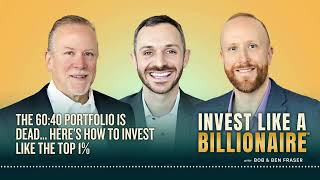
Ben and Bob Fraser argue the traditional 60/40 portfolio is obsolete. They present the Yale Model, which uses private alternatives like venture capital and private equity, delivering 13.1% returns versus 8.8% for 60/40 over 35 years. A 2012 regulatory change opened these investments to accredited retail investors.
Chapters
How many ultra-wealthy have a 60/40 portfolio? None. Not, not one. They don't do that. They're giving advice that no one who is wealthy is following.
Hello, future billionaires! Welcome back to another episode of the Invest Like a Billionaire podcast. I am going to be your host for today. My name is Ellis Hamm, and I serve as the Vice President of Capital here at Aspen Funds. And the reason that I am your host is because I have with me today the co-authors of what we believe is going to be a bestseller of Invest Like a Billionaire. That is the official title of the book. We have with us Ben and Bob Fraser today. Welcome, guys.
Hey, hey, hey. Turning the tables on us. I like it.
It's gonna be fun.
Yeah, I'm really excited about this. In fact, all of August, so today and the next 3 episodes, we are going to be diving deep, taking you behind the scenes of this book and so you can actually hear from the author. So guys, let's jump in. And Bob, I'll start with you. I want to just ask you the question, you know, what is the story behind the story, right, that caused you to want to actually sit down with all that you have going on to actually write this book and deliver this book to our audience?
Well, you got to know a little bit of my history. And so started a dot-com in the late '90s and lost everything. I mean, it blew up into a big company, you know, some 300 employees and venture capitalized, etc., then lost everything in the .com crash. And then again happened in 2008. And that's really what led to Aspen was just the desire for something that was controllable. You know, I loved investment, I loved investing, but I want to do something outside of the public markets and realizing that, you know, hey, with real estate, you know, you've got a lot of control, right? You, you buy a multifamily property and people pay your rent and, and you just have a lot more control than the public markets. You wake up, you turn your screen on and everything's red and you have no idea what happened. And nothing makes sense. So that was really the idea. The book is really just kind of, it's like everything came together when I started understanding the power of private alts, you know, kind of the limitations of the public markets and started studying David Swensen and the way billionaires invest. And then looking at the difficulties in the current financial advisory system where it's very much kind of stacked against alts. And realizing that this book needed to be written.
Ben, who did you have in mind when you were writing this? I know you interface with a lot of our investors here at Aspen. Who do you have in mind and what do you hope the lesson is as they go through this book when they get access to it?
Yeah.
As we've had a lot of conversations with investors, accredited investors, high net worth investors, it became pretty apparent that there's this huge knowledge gap for how to really do alternative investments well, what even are alternative investments. So we felt that this book had to be written in a lot of ways because this is where the trend is going. Alternative investments are becoming mainstream. You're seeing this over and over and over again. These big financial firms are now making this a core part of their investment philosophy, but there's still a lot of gaps out there. And so that's really who I had in mind when Bob Fraser and I were talking about this book and as we put this together.
So guys, let's start with what is the 60/40 portfolio and why was it traditionally the gold standard of investing?
60/40 portfolio is basically 60% stocks, 40% bonds, and, um, it's traditionally had a very good mix of returns and risk-adjusted returns. So, you know, the bonds tend to stabilize your returns out because they're not very volatile, and the stocks capture a lot of the upside. But over the years, a lot of analysts have started to note that it's not performing as well as it has in the past. First, the returns aren't what they used to be, and the volatility is higher. I mean, during the Great Financial Crisis, bonds fell as well as the stocks, and the, you know, was the opposite of what people thought. And so everything has just become correlated to everything, and it's been a trend that was in place before the great financial crisis that's become way worse after. And I have a number of charts in the book that show how correlations have just been increasing, meaning everything is zigging and zagging together, including stocks and bonds. And yet it still is the cornerstone of what financial advisors are advising. You know, they're telling people get into some version of a 60/40 portfolio and not realizing, you know, you know how many ultra-wealthy have a 60/40 portfolio? None. Not one. They don't do that. They're giving advice that no one who is wealthy is following. It's just, it's very flawed.
So if the data's there and we know the 60/40 portfolio is broken, why is that continuing to be pushed? And why aren't there other models that are more mainstream?
Yeah. Well, you know, and Ben made the point that alts are becoming mainstream. Well, they kind of are and they kind of aren't, right? You are seeing a dramatic demand push. So people, investors are demanding access to alts. Retail investors. The financial advisory system is still resisting it. It makes firms uncomfortable, and basically the system is just not set up to do it.
I think it's really interesting. I don't know if you guys saw some— I saw some big headlines over the last really week, which is kind of interesting, the timing of this whole book launch, where, you know, Blackstone is in negotiations with Vanguard, for example, to try and bring 401 kind of larger retail capital into their system. So it seems like there's to your point, Bob, a demand for this and definitely an appetite for this. And maybe it's just the big alligator Blackstone needs more capital to place as well. But there's definitely— I don't know if you call it momentum or—
oh, there's not a question of demand. I mean, investors are demanding it like crazy, but the advisors are basically holding the gate, right? And just saying, oh, this is super risky, right? You don't want to do this. But I fail to see how an apartment complex that's well-capitalized and stabilized, how is that as risky as an operating company that's maybe have negative cash flow? To say it's more risky is ridiculous. Someone is not doing their homework.
Well, so the book, you introduce us to a, a wealth manager, David Swensen, who created a new model called the Yale Model. Can you explain why you chose this model as the framework for the book? And more importantly, kind of what, you know, you're calling the billionaire model?
Yeah, well, it's what David pioneered in 1985. And what happened in 1985, pretty much the ultra-wealthy were doing more or less what the retail guys were doing, right? They're just kind of a mix of public stocks and bonds and, you know, maybe a little bit of real estate and this kind of thing. And David came in and said, no, he said, there's a way to get a free lunch. There's a saying, right? There's no such thing as a free lunch. He said, but in investing there is. A free lunch. And that's if you have uncorrelated assets. And he looked at this and realized that the only way to get uncorrelated assets is to go private. And so he started investing in venture capital, private equity, private real estate, natural resources, infrastructure plays, hedge funds, and started kicking the tail of the markets and experiencing way less volatility and earning way higher returns. And bottom line, over his 35-year career, he earned 13.1% compounded at a time when the 60/40 portfolio earned 8.8. And you think, oh, that's a nice little bump. But because it's compounded, the difference is something like 5x in the results over that time period. So he pioneered this model that blew everybody's corks. It completely redefined the way institutional investors look at investing. And so it's been adopted by all the institutions today. Anybody who's got a full-time money manager that's deploying these assets, they are doing some version of David Swensen's model, let's call it the Yale model, and with far superior results.
Would you say this kind of brought on a wave? Like—
Oh, massively.
Definitely changed the industry.
Oh, 100%. I can show you a chart. I think it starts in 2000. You know how little total investments in alts are, and it's just like a sliver.
Yeah.
And how today $20 trillion is deployed in alts. And so what happened, he created a massive groundswell. It was a tsunami. And a complete redefining of how the ultra-wealthy invested. And the retail market has not followed suit. It's still playing the old school game, but it's happening. And what happened in 2012 when they changed the rules, it used to be a private alt placement. So if I bought a multifamily apartment complex and I went to raise capital, I was not allowed to advertise. I could not buy a billboard. I couldn't send an email to somebody I didn't know. I couldn't place an ad in Google. I couldn't do this. That was illegal. It had to be people that I had a relationship with. 2012, they changed all that. They added a Reg D 506 exemption. And what it said is this, as long as you verify that this investor is accredited, meaning a million-dollar net worth or $200,000 in income for the last 2 years and with expectation doing the same this year. If as long as you verify that with third-party verification or take reasonable steps to verify, You can advertise all day long. Well, that was a game changer. It blew the lid off availability. And all of a sudden, a normal Joe can get an email about deals that we're doing, that smart guys are doing, of putting together incredible investment opportunities. And it's a game changer. What's happened is now you're seeing the retail demand just skyrocketing. At the same time, the millennials, you know, your generation is starting to trust financial advisors a lot less, right? People want to do, you know, Google reviews and they want to find a YouTube video media on how to invest, right?
Yes. You know, nobody.
Yeah.
If they don't have a million subscribers, we don't trust them. Okay. I mean, that's just the reality.
That whole trust system is eroding as well as the rules have changed to allow this. So it is the future. There is no question. This is where the world is going. But as Ben said, there's still a knowledge gap, which is really why this book is so, so, so important in this time to make alt investing approachable and where you can be successful. As a little guy.
I think one of the important things you said too, for our listeners to understand, even to be reminded of it ourselves, is 2012 was only 12 years ago, 13 years ago. I mean, yeah, yes, people have been investing in alternatives for decades, but the access to market this, I mean, this is a fairly young industry, right? I mean, we're in the early innings of this.
Oh, very definitely. And you're seeing a rise of younger syndicators who went out and bought Dallas multifamily places and paid too much money. You know, we won't name anybody, you know, in particular, and that used the new rules, but really did deals that shouldn't have been done. And so we're seeing a shakeout right now, but it's no different. It's a little bit of the Wild West and that's what you get.
Yeah, I think that's such a good point. It feels like still the Wild West, right?
There's a lot of ways to lose money out there. And this is where the financial advisors are right. You know, I'm not against financial advisors. I have one. And they're very helpful and they're good people. So while I think the system needs to be updated, we're not throwing all the financial advisory world under the bus here.
I'm curious, just for personally, guys, as our listeners are listening to this and we're talking about stocks and bonds and alts, I mean, would you say this has shaped and is shaping how you guys are currently investing? I mean, is your portfolio beginning to reflect more of this? Talk personally how this has kind of redefined you guys in your investing strategy over the years.
Yeah, I'll jump in there, but I want Ben to answer this too. But you know, when I did the research for this book all through 2024, it was definitely eye-opening to me. And I knew a lot of the things, but not in this level of detail. And I realized the importance of managing a portfolio correctly. And in the book, I actually give a lot of my mistakes. I mean, the mistakes I made of overallocating in certain things and also not doing sponsor due diligence very well. And I hope those really help people to, you know, don't step in the same pot I stepped in. But oh yeah, it's definitely changed. I am 100% building my portfolio now, filling the gaps where here's the slots that need to be filled and realizing my investment map is hodgepodge. And so I'm now aggressively going towards doing the model, the allocation model that is the mathematically proven model and even sponsor selection too, as well as taxes. I have a whole tax section in there. You know, the billionaires pay less taxes, but Yeah, Ben, how about you?
Yeah, I think I'd probably say very much the same. You know, I think we have the benefit of probably being a little over-indexed towards alternatives than most people just because of the industry we're in.
Right.
And we know real estate, but we're also really good at a few things, right? In a portfolio perspective is really a very broad perspective and a very diversified perspective. And so I think I've definitely taken a step back and looked at a more holistic approach. And I think the framework here is so helpful. You start to see these charts from Tiger 21, from all these endowments and how they're allocating these portfolios, it creates this really nice guidepost of, here's kind of what these guys are doing. This makes sense for me. And investing in things outside of just what we're doing is really, really helpful. And I think that's, again, really a big part of the benefit of this book is it's, we're not selling anything. We're not telling you here's the deals you should do. It's very much a framework. It's a process to go through and create a really robust portfolio that looks like the billionaires. And yeah, I mean, we, we share those hard-won lessons, you know, from making mistakes along the way. And I think like a lot of people, I think this book is coming out at such a critical time because we have come out of, you know, not a recession, but definitely a reversion to the mean, a correction in the market. And a lot of people have been a little burned because of all these young syndicators and this kind of mini bubble that happened in private alternatives. That I think is creating some scars, some actually really fresh wounds that I think people are a little bit— they're having a hard time figuring out, what do I do from here? And so I think this is a helpful way to zoom out and see, here's the path. The path works, but you have to know the right things to do. And that's what we really try to provide in this book. It's not only the vision, but the benchmarks and the guideposts of here's what not to do and here's what to do. It's very much a how-to guide as well.
Yeah. So for me, I knew a lot of the information, but I had never really put it together until I started writing the book.
Yeah.
And what I had is information, but that doesn't mean you have a framework. And now I have a framework. It's like I put it all together and I am aggressively building this framework. And for me, what it has done is the writing of this book is I am now going to be a disciplined investor. And I think a lot of our listeners are going to relate to that. You've been more of an opportunistic investor, right? This thing popped up, that one popped up, and you're opportunistic. And then you made a mistake here and there. And so you got this kind of very ugly mix, nonsensical mix. I'm exiting that whole thing and I am going aggressively to a disciplined approach on the framework, building according to the framework. And let me just, because I think it may make sense at this point to fill a gap or two here. So when we say 60/40 portfolio versus private alts, so the average institutional investor is between 50 and 60% private alts, 50 to 60. The individual investor is 2%. And in the public market, so the big boys invest 20 to 30% in the public markets. So just to put some numbers to it. And then just to give an idea of what I'm talking about with the framework, this whole framework idea, we have this, we've been talking for a while about what we call the alts continuum, right? And it's this, as your net worth grows, it's how you grow into alts. And so the first thing you're doing is probably have no alts, right? You're all public markets. And the first step into alts is probably real estate for most people. You know, it's doing— maybe it's DIY real estate, but then it's really passive real estate. And it's really a good place to start because real estate is a fantastic investment and actually is today because it superpowers inflation performance. And it's easy to understand, right? You buy a building, you rent it out, you collect rents, you pay your investors. Not that hard to understand, right? So next is private credit. So as you start to go up the net worth curve, and then you're doing private credit, then you're doing private equity, then you're doing, you know, natural resources and infrastructure. Then maybe as you're really getting up there in the net worth side, you're investing in venture capital, hedge funds, and some of these more exotics. So that's the idea as a framework. And we have allocation, kind of target allocations to each of these, and then add the discipline of sponsor selection where you're simply saying no to deals that aren't checking every box in the sponsor section, and you're not making mistakes. Takes, right? Because losses are way more important than gains in portfolio management. So that's kind of the big picture of the framework.
Yeah, I love what you said there too. And only because I want to make sure people are clear, like, this book is yes for those who are getting started, but it's also for those who have capital or are looking to deploy. Because I think of a lot of our clients might be high net worth individuals or people who are post-exit founders. And what we see a lot is typically they make the worst investors because they've been very successful. They are very smart. They come into a sum of money.
Right.
But they're novices when it comes to investing. And so they actually start on your spectrum. They invest with their buddy or their brother or their best friend in some private, crazy risky venture capital deal.
And I've done it. I've done it.
Right. And so I think it's cool though. Like what you're saying is your framework is not for people who are at the beginning of their wealth building journey. Like this is actually a book and a framework for—
The book is targeted to accredited investors. And so, you know, maybe you've read Rich Dad Poor Dad, which is really how you get started. I think this is the next part of the journey. This is a a data-driven book about how to manage a million-dollar-plus portfolio and how to be very, very successful at it and how to make more money that you can make in the public markets and take less risk by taking a disciplined approach to investing.
Yeah, the kid grew up and this is his next book. I love that. Guys, two more questions to wrap up this episode. Bob, this is first for you, and then Ben, I got a question for you. You said that you believe this to be an industry-changing book. What do you hope changes as an investment industry as a result of this book?
Well, I hope that it sells millions and millions and millions because everyone that reads this is going to get their cork popped and they're going to start to get very smart in alts and they're going to want to start to form clubs and investor circles and whatever, and they're going to start to share information. And how the industry changes is then one, sponsors are going to be forced to execute and be honest about their performance. If people are all talking together, And the advisory industry is going to start to adapt to become alt-centric and really do a better job for investors where you can get, again, higher returns and less volatility than the public markets.
And not so much industry, but more for individual investors who read this, what do you hope they will take away and do differently as a result of reading this book?
Yeah, I think for me, the biggest win that would happen from this book would be getting investors confident to take control over their investing and their financial future. And I think that's a really big hindrance for a lot of people is they feel like they have to rely on the financial advisors.
Because they're not qualified, right?
They're not qualified, but it's not rocket science. And we lay it out in this book exactly the things you need to do and the things you need to learn. And taking this disciplined approach will help you avoid a lot of the mistakes along the way. But the outcome potential is so powerful for people if they actually apply these, these principles and these, these actual guide steps. We have several examples in the book to really have the idea of making your money work harder than you do for the returns. Right. And that really creates this, you know, called the wealth escape velocity, kind of your net worth and your wealth starts to grow so fast that it starts out-earning you. Right. And that's, The goal is to create that financial future, financial freedom for people, and really the confidence to, you know, take it into their own hands and not rely on someone that ultimately does not have their best interests in mind and take control of their financial future.
Yeah, really cool.
So I know this book is available for preorder. Can you talk about the importance of our audience, especially going and preordering this book and what we've created for anyone who is going to preorder? Where do they go and what can they expect when they do that?
Yeah, you can jump over to thebillionairebook.org. So the book is actually available for presale in a bunch of bookstores, including Amazon. But what I would encourage you to do is go to thebillionairebook.org and we'll point you to Amazon on those sites. And as soon as you make your purchase, you can just give us the number of the receipt and then you get a whole bunch of free stuff. So you're going to get my top picks for 2025 economic picks. You're gonna get access to the masterclass, which is we go through the book in a 9-video series, and you're gonna get a download before anybody else of the first 6 chapters of the book. So you can get started on getting excited about this book, the full first third of the book you get for free. So those are all free as soon as you go there. So don't just go to Amazon and order it. And it also helps us if you preorder it, it helps us get this book out. Awesome, guys.
Guys, that's it for this week. Check out the show notes to this episode for a link to preorder the book, and we will be back next week with another lesson from the book on the secret killer of wealth. So stay tuned. Thanks, guys.










