
The Hard-Won Lessons Behind Aspen Funds with Jim Maffuccio
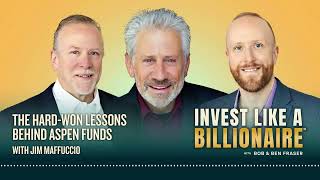
Jim Maffuccio lost everything twice—once in the mid-1990s, again in 2008—before pivoting to non-performing mortgages and founding Aspen Funds with Bob Fraser in 2013. The fund grew from $1.5 million to over $100 million by focusing on cash-flow-positive deals and vetting operators like a crime scene investigation, including family interviews and background checks.
Chapters
People talk about, "But do you get the job out there because it's the security?" Well, there's really not security in a job out there because you could get downsized, upsized, wrong-sized, merged and acquisitioned out of your position. But when you know you can identify a need and then the marketplace will pay you a profit for doing that, you have this confidence that I'm not going to let a couple wipeouts keep me out of the game.
Jim Maffuccio has lost everything twice. Once in the '90s, and again, you guessed it, in 2008. But those experiences have made him a better, wiser investor. He brings those skills to Aspen Funds, which is the company he founded alongside Bob Fraser in 2013. This conversation was my chance to dig into Jim's story more, learn about some of those battle scars and how they've taught him to filter out the good deals from the bad deals today. I hope you enjoy. So, Jim.
Yes, sir.
This is going to be fun.
All right. Good to be here with you, Ben. Yeah.
So give us the backstory. You come out of college. What was kind of your story? Eventually made your way into real estate.
Yeah. So came out of college with a civil engineering degree. That was 1979. And I went to work for a large oil company, did that for about 5 years before the entrepreneurial itch was just becoming too much to bear. Just working in the corporate world just really wasn't for me. So, uh, I got my real estate license in late '85 while I was still working as an engineer, got about 3 deals under contract, and calculated what the commissions were going to be and said, man, this is like what I make in half a year with a pretty good salaried position at the time. And I thought, I'm out of here. So I turned in my resignation letter and Within 2 weeks, 2 out of 3 of those deals fell out, and it was welcome to the world of, uh, you know, eating what you kill and, and sometimes having it fly away. And so I've been self-employed since then. So I know the, the world of alternative investments because that's really what I got involved in as an active participant, you know, doing small residential development projects in Southern California. I also did some transactional business with my license, but, uh, I've always kind I've kind of been a swing for the fences kind of guy, or at least that's where I started, 100% swing for the fences. And so I wanted to do projects and, you know, make millions of dollars and that's great. But in Southern California, well, in any of the coastal communities and higher end markets, especially where there's a lot of regulation, it takes a long time to get a project done. So you really don't know what the market's gonna look like by the time you have a finished product ready to offer. So long story short, I got it handed to me really twice, but the first time in the mid-'90s, uh, actually had a lot of projects going and a decent net worth at that point. And really, if I liquidated everything, I could have not worked another day in my life. Not that I would do that because I enjoy working and producing stuff. But, uh, anyway, lost everything pretty much in the first go-around. That was in the mid-'90s. And so retooled everything and focused more on affordable housing, thinking that, okay, worst-case scenario, can't sell these things, we can turn them into rentals. And so, um, started the process again and built up a pretty good portfolio of projects and didn't know 2008 was coming. So the mortgage crisis really wiped out everything that I had. And the projects were great. In fact, in the first wipeout, actually had a Golden Nugget Award-winning project that people loved the homes, the city loved our development concept. But long story short is we ended up losing the last handful of houses and lots to foreclosure. Because of the debt structure that I had against those projects. And I just couldn't outrun the alligator. And the market prices tanked so much that we just got upside down. So it was the most successful failure I've ever had. So anyway, so I found myself in my mid-50s, moved out to Kansas City to finish the second half of raising our kids. We had 5 teenagers at that point in time, including 2 adopted girls that were just learning the language. So it was an interesting time to go completely broke, and that was, you know, 2007. And by 2009, I was done. I mean, I'd fought and fought to try to save the projects I had going in California, but to no avail. It just, like I said, the alligator outran me. And so I was trying to refigure out life in 2010, and I saw opportunity everywhere, and yet I had zero capital to do anything about it. But I was led to this opportunity in distressed debt, you know, buying defaulted mortgages. Got a handful of friends together that I'd made in Kansas City to invest with me and went out and bought, you know, a handful of these non-performing second mortgages and realized, wow, this is a little gold mine here. It was a very high margin business and it was kind of cool because I could help people stay in their homes by executing a workout plan with them because I was buying these mortgages at 10 cents on the dollar. So there was a lot of room to work with people and make it happen. So I was, you know, basically gonna rent some good clothes and go fly out to California and raise money for my investors and actually bumped into a guy that you and I both know, Bob Fraser.
I've met him before.
Yeah, you've met him, you've known him. You've known him a long time. But yeah, so Bob kind of out of the blue texted me and said, "Hey, let's get coffee. I wanna find out what it is that you do." And I knew Bob from a distance and never really sat down and had a one-on-one with him. But we did have that one-on-one. And it's kind of funny because he asked me, well, tell me what you do. And I said, well, I buy non-performing second mortgages on residential properties. And he said, you're basically said you're an idiot. That won't work, you know, in Bob Fraser's straightforward way of addressing things. So I said, well, you know, I don't, I don't feel like I have to, you know, convince you, but I probably could change your mind in 5 minutes. And so he said, okay, show me, kind of proverbially puts a napkin in front of me and started walking through the business plan. He goes, oh man, that's brilliant. Well, I'll invest a little with you. And I want to see how this goes. So he bought a handful of loans with his capital. And we both pretty quickly saw, wow, this really is a great opportunity. So we partnered up, we formed a fund, just kind of a one-off fund. And that was in 2013. Bob Fraser raised some, about $1.5 million from family and friends fund. And I went out on the hunt for, you know, more of these mortgages to buy. And it worked out great. So we formed a what is now Aspen Funds back in that timeframe. Right on that one little business model of buying these non-performing second mortgages, we added another business model to it. That fund is actually still growing today. I think it's over $100 million in assets. So we had really those two things going. And Ben, you came on board with us in what year was that?
2018, I think.
2018. So you were with us when it was just the mortgage funds. And then Aspen Funds really came into its current form in about 2021, and you were really instrumental in helping set that up and build it out. So we really built this company around serving passive investors and helping them get some of their money into alternative investments as we put our own money in these alternative investments. So it's kind of a perfect world for us. We're having a great time, aren't we?
Yeah, it's been super fun. Very cool to see the evolution of the company and the opportunities that keep unfolding. I wanna go back a little bit 'cause That's really helpful to get the survey of your career. And, you know, there's so many things that we could dive into. I'd love to, but let's talk a little bit about some of the ups and downs. And I think this is, you know, I love how transparent you are because a lot of people when they're reviewing their careers, they sometimes edit out, you know, the hard parts, right? But if you're an entrepreneur, if you've done anything where you're betting on yourself, there's going to be ups, there's going to be downs. And shared already, you've had two significant times that were pretty challenging. And I'd be curious, looking back, maybe in that first one in the mid-'90s when you got wiped out, what was the takeaway there? And then do the 2008 one.
Yeah, that's, man, that's my life story is really about the failures and learning from those in so many ways and so many levels. But looking back at it and doing the forensics, there was the SNL crisis that happened. Interest rates were high, and large developers were slashing their prices. We had this beautiful little project of these boutique craftsman-style homes that people loved, the city loved, but the finances didn't love. And, and so I had— we were using largely private debt. Private debt's expensive, but the numbers looked so good. There was so much pro forma, on-paper profit in this project that we needed to move fast. We were just a couple of young guys. And me and my partner, and, you know, we weren't really bankable, I would say, at that point in time. So writing the big checks every month for the interest was, you know, going in, it was like, compared to what we're going to make on this project, this is nothing. But when you suck 30% of the value of the finished product out of the pro forma immediately, now you're fighting to get these homes built, get them sold, and pay off the debt. So two things there. One, getting into a business model that requires an unknown amount of time from when you start to when you actually have a saleable product. That's something to really consider. I know, Ben, when we look at deals and we're underwriting deals for a credit fund, for instance, or for our hard money loans on our income fund, that's a big deal. You know, you've heard me plenty of times, but the execution risk and then the market timing risk of a project, you know, there's no cash flow on a development project. All the cash is flowing away from you until you have a product, and then you can sell it, and you hope to get it all back in big chunks. So there's the timing aspect of it. And my timing was just— it stunk. It was the worst possible timing. You know, back then we were saying, this is the biggest crash in real estate prices we've ever seen. Of course, until 2008. And so, you know, I love investing in projects now where there's either cash flow on a walk-in basis or a very close horizon to cash flow. You know, you got to make a couple minor improvements, and then you cash flow, that's okay. But a development project for a small guy, small fish in a very large pond with a very well-capitalized competition, it's just a recipe for disaster. And so really, honestly, I really kind of went through that twice. It's just that, you know, like I said, I focused on affordable housing the second time climbing up the hill, thinking again that if the market does come down, then we can hold these properties and rent them. But it came down so fast and so far that even holding the properties as rentals wasn't an option because of the debt structure against the projects. So really the big word here, that's the big D word. And, you know, we've had a lot of conversations and we've watched a lot of, we're watching even right now, some slow motion train wrecks happening with a lot of younger folks that have gone out and bought a lot of apartment complexes with these short-term bridge loans. And again, thinking that they can get these projects performing well and stabilized in X number of years, but if it takes X plus 5 years, then these interest rates go up and it's the debt that wipes out the business model, not the business model. You know, there's nothing wrong with building homes and selling them, right? You know, but when it's dependent upon financing that's pretty aggressive, that's when you can get burned.
So yeah, no, that's so interesting because you're thinking, hey, in the back of my mind I've got a contingency plan, but the market kind of sucked the air out of the contingency. And when you have the high-interest debt and you got no cash flow, there's a limited amount of time that you can keep it going, right? And the challenge I think a lot of people, you know, including myself that hasn't been through, I, you know, I just come out of school right as the great financial crisis was really having a heyday. But in talking with you and others that have gone through cycles, so many times you think, oh, there's a way we can manage through this, but the cycle can be so disruptive so quickly. It can really catch you by surprise, right? Is that something that you would say was maybe after the first time, maybe did some things smarter, but you thought maybe I'm a little smarter this time too. I've seen it happen again, so I can be able to have a contingency. And then it was just, you know, caught by surprise again.
Exactly. Exactly. You make adjustments. So, you know, it'd be like saying instead of going at a 75% debt structure, we'll go to a 65% and have all that safe. Well, that 10% difference, It's like you said, Ben, when the cycle hits you wrong, especially as abrupt of a change as that was through the financial crisis, I mean, that 10% cushion is nothing. Yeah, that disappeared in a month. So part of that is you're never going to be able to 100% avoid— we don't know the future, so there's always going to be an element of risk. But honestly, probably what I would do different today, I would have found mentors, right, and education and people to help. Now I know there's a lot of scammers that go along with that, but I You know, work your network, work with people you trust and get referrals. But like even what we're doing on this podcast, if the 30-year-old Jim would have had access to this information and humbled myself and gotten some coaching and mentoring and say, hey, am I doing a good thing here trying to get back into residential development in California with private money without deep pockets? And probably somebody like myself today would have said, no, don't do that. There's better models, there's better things that are less speculative. Yeah, you won't make the millions of dollars overnight, right? But you can do a slower, steadier, more secure climb up the mountain. So that's probably one of the big lessons for me is collaborate with people and find somebody who's a lot smarter than you are, which in my case was, I could have looked around and that would've been almost anybody.
Well, another thing I wanted to talk about too, I think this is such a, I love this part of your story and how open you're about it. So you have the second wipeout after 2008 and You're in your 50s, you got 5 kids, most of them are teenagers.
All of them.
All of them are teenagers. You have no income, no prospects for making income. And I think so much of the time, like, the narrative of the American dream is it's just this consistent thing. Everything is going up into the right all the time. By the time you're 50 and 60, you have this huge nest egg that you can rely on, and now you can sail off into the sunset and drink your mojitos. You're sitting there in your 50s with a couple pennies to rub together. What was that point where you decided to go back and bet on yourself again? Right? Because I think that's got to be an interesting moment of, do I go back and go work at Starbucks? Right? Do I just give up? And I've done the entrepreneur thing now for 30 years and look where it got me. But then looking back now, obviously you made the right decision, but that wasn't guaranteed. And that also wasn't an easy thing to do, I'm sure, at that stage. Talk us through some of the wrestle you had there and like what really got you to go and take that real third swing for those that might be in a similar position, right? Or feeling that way.
Well, you know, I would have to say 100%, it was my faith. It was my relationship with God through that adversity and really came to have a trust in God that he had my back. He was leading me and he would show me. And I remember talking to my wife, Joy, and I remember talking to the Lord, you know, and saying, hey, if I need to go— and it's funny you said Starbucks because, you know, 4 out of 5 of my kids worked at Starbucks and worked their way through school. And I literally said, I will go put on the green apron and be a barista if that's what I'm supposed to do. And I just did not have peace. I just strongly felt, nope, you're an entrepreneur and I'm going to show you how to do this thing. And So I started like working on little flipping houses in Kansas City and just barely making it, really not making it. So I think you go through— when you go through times, when you go through real high-pressure times, you find out what's really in you and the good, the bad, and the ugly. It really kind of got squeezed down to what I've got is I've got this hope inside of me and I've got this clarity on who I am and who I am as an entrepreneur. I'm a business starter and That got refined, but it got clarified to a greater degree. So, you know, once you've been through it, especially a couple times, and you realize, you know, people talk about, but do you get the job out there because it's the security? Well, there's really not security in a job out there because you could get downsized, upsized, wrong-sized, merger and acquisitioned out of your position. But when you know you can identify a need and then put together the pieces to fill that need and that the marketplace will pay you a profit for doing that, you have this confidence that, you know, I'm not going to let a couple wipeouts keep me out of the game. So jump back into the game. And, you know, it was small at first. It was like I was literally mowing lawns at one point in time. Get this, I was mowing the lawn of a duplex that I bought with a partner. And, you know, when the bottom fell out for me, the partner had invested money in other deals. And all I really had to give him was like, whatever I had, you know, interest in property. So I deeded my half of the property to this gentleman and Ended up mowing the lawn for him and being happy about the shekels I was getting for it. This is in mid-'50s. It's pretty humbling. But anyway, yeah, long story short there. Short story long, maybe.
I think it's so cool and I think very helpful for people that may find themselves in a similar position. We've had conversations over the years where it's like you've built all this knowledge and you knew you could go create value. You just had an innate knowing just from who you were and what you'd learned. It's just a matter of finding the right opportunity, the right timing, right? And I think that's what then lined up with the start of Aspen. I'd love to focus on Jim as the passive investor, right? And you can also pull in some of Jim as the general partner investor because there's a lot of overlap. But what are the lessons that you've learned along the way, you know, through some of these wipeouts, through all these years of being in real estate, being on the wrong side of the debt a few times, and now on the right side of the debt, as you like to say, debt up to your eyeballs? Loving it with buying the debt, owning the debt, being the bank. And then as you've kind of shifted to also passive investing where you're investing your own capital into our deals and deals outside of, of Aspen, what are the things that you look for that other investors can glean from in their own investing?
Yeah, well, one of the big things is I touched on it already, and that is I want to see what the financing structure looks like and how much runway a project actually has. As I said, I love investing in things that have current cash flow because even if it's not super high yielding on the front end and there's really a pathway to make some improvements to increase the net operating income as well as market dynamics, you know, if you're, you know, for instance, if it's apartments and you're in a growing area, if you're in a job creation center, there's always a demand for that kind of housing. And I mean, They're not necessarily home runs, but I love investments where there's some cash flow coming in. So the reason isn't because I need the income from it. It doesn't have to really be making a lot of cash flow if there's an upside down the road, but that's what solves the debt problem. I mean, that's why banks, when they're lending on a, say, an apartment complex, they're looking at a debt service coverage ratio. They want to see that right now income coming in covers what the servicing of the debt would be, plus a margin. So there's a financing structure, and then the model itself. Was it a speculative model? Is it a development project where you're swinging for the fence and you don't get any cash flow until the project sells? And I'll still do some of those, but I want to do those with well-capitalized sponsors or operators of those deals. If they're like I was both times that I lost it— had I as a passive investor looked at Jim Maffuccio's deals back in the day, you look at just the deal and it's like, ah, this deal looks great. But what happens if it takes you a year longer than you're planning And the answer to that would have been, you're going to go south, dude, because you don't have capital. You don't have any cushion time-wise there. So that's one thing I like to look at. What's the financial strength of the operator? And what's their financial plan? You know, there's been a lot of folks that are like, you know, they're rocket ships because they're great promoters and they're able to raise a lot of money and they're able to find and acquire deals. But you look at their personal financial statements or even their corporate financials, and it's like, you really don't have a lot of— capacity to withstand some extensions in time for your business model to work out. So that, to me, that's hugely important to look at. Then you move into character issues and can't always tell what's going on behind closed doors with people. But I think you and myself and our two other partners, between the four of us, we have pretty good sniffers as far as sniffing out bad actors or people that just— your spidey sense, you know, just don't feel quite right to us.
What about looking at deals? So you have an approach, CSI approach, for vetting deals. Break that down for us when you're crime scene investigating a deal.
Yeah, well, it really goes into a background check, literally looking for crime, but thorough background check is really important. It doesn't mean that if somebody had some train wrecks in their early years, it doesn't mean don't invest with them. In fact, I mean, sometimes those are your best people because of people that walk with a limp and a level of humility and maybe a level of conservatism that they've learned from their past mistakes, that's a person I'd invest in. A person who covers it up or isn't out front about it, or as you said earlier, even just based on, on your age, Ben, you haven't been through one of those cycles yourself personally yet with your own capital at stake. So it's hard for people that haven't been through it to imagine what it looks like and feels like when it happens. But I mean, it's like It feels like in one day things went from everything's going up and the market will cover me to I can't give this project away. It literally, it can change that fast. So yeah, the experience— has this person been through some, some challenges and what did they do? How did they weather it when it happened? So, and what have they adjusted to not make the same mistakes? So yeah, I mean, I mentioned to somebody just the other day that, you know, in a perfect world, One of the things to invest with somebody, to trust somebody with your capital, in our case as Aspen, not only our own capital, but to entrust somebody with our people that trust us with placing their capital. The ideal thing would be like, "Okay, you sound great, you look good, your projects, everything checks out, but what I'd really love to do is I'd love to spend a couple hours with your wife and your kids without you there." Exactly. And talk to them. Now, you don't get the opportunity to really do that too much, but you and I both know You can find out a heck of a lot from somebody's family. And I think other things similar to that, maybe a little less intimate, is what is the corporate structure? What's the partnership structure? Like, who is this person? What are your team members like and how do they feel about you? And is there a lot of turnover in your organization? And, and I mean, this gets pretty deep, but I mean, all of these things play in. If a person has trouble either in his home or with his leadership team, there's no way that's not going to affect their performance on the project that we're putting our money into. So, I mean, I'll just say I've personally learned, you know, where I placed a pretty good-sized loan with a group that, uh, you know, the partner that was the strongest part of the group wasn't really tied into the corporate structure strongly enough. And then there was a parting of ways, and we were left with the inexperienced partner That's actually the one that was responsible to us. And all of a sudden it's like, wow, this is not what we underwrote going in. So the operating agreement or partnership agreement, whatever the corporate structure and agreements are, is hugely important. And if you smell any kind of friction or any kind of these people are going in two different directions, say it's a partnership, it's like a divorce or a potential divorce, and nobody wins, including the people who have invested into that entity. So that's the CSI part, I guess, is kind of the intangibles, because A heck of a lot of deals look good on paper. Great pitch, great graphics, great plan. But it's the intangibles that can get you. Yeah, that's the people issues can get you.
Thank you so much to Jim Maffuccio for a terrific and really transparent conversation. He's been through a lot of challenges in his life and investing career. And I'm so grateful to have the wisdom that he brings to our team today. I'm always learning from Jim, but today I really heard what he said about the financing structure. When he vets deals, he's looking to avoid the same mistakes he made in the '90s and 2000s. And he's asking, what's the timeline of this project before it cash flows? What's the contingency plan if things change in the market? And the big lesson really is, who are the sponsors? What's their track record? Who are they as employers, as team members, as people? And can you really tell a lot about the project might go if they hit speed bumps? A reminder that the Invest Like a Billionaire book that I co-wrote with Bob Fraser is available for preorder now. Check it out at thebillionairebook.org. That's all for Invest Like a Billionaire this week. If you've got something out of today's episode, please drop us a 5-star rating to let other listeners know that you're enjoying it. Share with a friend. We'll see y'all next week.










