
The Rise of Co Living Redefining Rental Real Estate feat Johnny Wolff
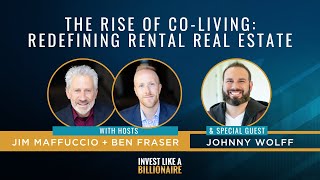
In this episode of the Invest Like a Billionaire podcast, hosts Ben Frazier and Jim Maffuccio interview Johnny Wolff, founder of Homeroom, a Y‑Combinator‑backed company that converts single‑family homes into rent‑by‑room co‑living properties. Wolff explains his personal journey from finance and early real‑estate investing to creating a vertically integrated platform that sources, underwrites, purchases, and manages homes for investors while simultaneously matching roommates and building community for tenants. The conversation covers the economics of the model—typically 30‑50% higher net operating income (NOI) for investors, sometimes up to 100%—and the fee structure (15% of collected rent, with a reduced 5% fee in the first year). Homeroom relies heavily on data science, using latitude/longitude‑level analytics, a proprietary “HIP” desirability score, and custom pricing models to determine optimal room rents. The hosts discuss operational complexities, including dual‑side marketplace dynamics, tenant screening, roommate matching, partial furnishing of common areas, and lease terms ranging from three months to 18‑month averages with high renewal rates. Regulatory hurdles around occupancy codes are addressed through a legal playbook and city‑relations team. Wolff highlights macro trends—rising roommate prevalence among 22‑35‑year‑olds and a $25‑75 billion U.S. market opportunity—while noting that demand exists beyond traditional tech hubs. The episode concludes with practical steps for investors and homeowners to engage with Homeroom via their website or direct contact.
Chapters
Hello, future billionaires. Welcome back to another episode of Invest Like a Billionaire. We've got a fun episode for you today. We interviewed Johnny Wolfe with Homeroom, and in this episode we talk about how Johnny has created and is part of this kind of pioneering movement in co-living and how they use this movement to generate anywhere from a 50 to 100% better net operating income on single-family rentals. By having more occupancy per property. And so it's kind of a fun conversation learning about this movement to co-living and why tenants are choosing to do that right now with affordability. And a great episode. You'll learn about what that all entails. And as with any episode where we bring on a guest who is also possibly raising capital, we do have to give the disclaimer that We have not done any due diligence. This is not us promoting Homeroom or Johnny, and you have to do your own due diligence. If you're interested in learning more about them, be sure to do that. And lastly, we are so close right now to 100 reviews on Apple Podcasts. We're just a few shy. So if you don't mind leaving that 5-star review, helping us spread the word on this podcast, we really appreciate that. Thanks so much for listening. Hope you enjoyed this episode. This is the Invest Like a Billionaire podcast, where we uncover the alternative investments and strategies that billionaires use to grow wealth. The tools and tactics you'll learn from this podcast will make you a better investor and help you build legacy wealth. Join us as we dive into the world of alternative investments, uncover strategies of the ultra-wealthy, discuss economics, and interview successful investors. Looking for passive investments done for you? With Aspen Funds, we help accredited investors that are looking for higher yields and diversification from the stock market. As a passive investor, we do all the work for you, making sure your money is working hard for you in alternative investments. In fact, our team invests alongside you in every deal, so our interests are aligned. We focus on macro-driven alternative investments so your portfolio is best positioned for this economic environment. Get started and download your free economic report today. Hello and welcome back to the Invest Like a Billionaire podcast. I am your co-host Ben Frazier, joined by fellow co-host Jim Maffuccio. And today we've got a really cool guest, Johnny Wolfe with Homeroom. Johnny, how's it going, man?
Good, man. I don't get introduced as a really cool anything, so it's, that's pretty exciting for me. So it's a good start to the, to the show for me.
Well, you've definitely improved your, uh, your beard game since I last saw you, so that, you know, kind of, kind of adding to that luster.
Um, I actually, a friend of mine, uh, he was part of the Austin Beard Club, and like, it's just a bunch of guys that like compete They like compete in beard competitions. Wow. And apparently like the Austin Beard Club had like the national champ. So it was, I'm not there yet, but someday I hope to be.
Tell us about your background, Johnny, and this Homeroom, which is really focused on the co-living trend, which is something investors may have heard of, right? And it's becoming more popular, especially on the, you know, bigger cities, coastal markets. But it's a trend that we, you know, could become a much more common thing. And then also it's a really cool way to, um, kind of benefit as an investor. And so talk a little bit about kind of your background, your journey into this. And, uh, you know, so that's a pretty cool tool, which we'll hit on, but your, your company was in YC or the Y Combinator, which is, uh, uh, one of the most well-known business, uh, incubators. And, uh, so tell us a little bit about kind of your journey in this. It's really cool.
Yeah, so I started my career in the Bay Area in finance. I worked at larger companies like SanDisk and Electronic Arts as well as some startups, and I realized that startups were where I, what I really enjoyed. In addition to that, while I was work, you know, the first 10 years in the Bay, I was investing real estate remotely. I bought my first home one year outta college in Midland, Texas. Back in the day when you could do 10% down loans, and that, which so meant you put very little down. That was in 2008. And then I bought a couple other properties remotely and I got really into real estate, watching my properties perform, figuring out ways how can I buy more properties. So in 2015, I decided after I analyzed the entire United States for the best, you know, I was looking for the highest appreciation. Market. So I moved to Austin, Texas in 2015, bought a number of properties, and I had lived with roommates in the Bay Area, in San Francisco and San Jose for the previous 8 years. And so I thought, well, why don't I rent out by the room and get more rent? And that ended up doing really well. It was a little bit more headache, but the properties that I was buying were higher quality and still cash flowing. Which ended up being the model that I deployed in the way that we invest at Homeroom is if you do roommate, if you rent your properties by the room, you can get cash flow with higher, higher-end properties and better areas. So it, it ended up being really good for me. The properties appreciated substantially between 2015 and 2018. I ended up selling one of those properties, taking some of the winnings and deploying it into starting Homeroom in 2018. At which point I was in Kansas City, moved there to invest in more real estate and to see if the roommate model would work in even kind of a less busy ecosystem than Austin or San Francisco. And it did. So we had, you know, 30 homes in the first couple years and we've been growing steadily since then across, we're currently in 10 metro areas and have a team of about 50. And you know, for investors, you can make 50% more rent buying a home with us. You don't really have to do anything except for pay some money to get started. And for tenants, they're going to save 30 to 50% on rent compared to a studio apartment. So a pretty good combination, right?
So we've talked a little bit about long-term rentals on the podcast before, and you know, one of the knocks they've gotten recently is homes have appreciated so much is, you know, cash flow definitely goes down as asset prices go up, right? So. One of the ways you're kind of solving that is looking at maximizing the rent by renting out individual rooms and having roommates. So you've created kind of a platform and you're kind of doing kind of both sides of this, right? So you're marketing not only just to, you know, buy the assets and, you know, manage those, but you're also marketing to the tenants and trying to create community and a platform that can be really easy for tenants to kind of find good roommates, right? Because that's one of the challenges in this model, right?
Yeah, it's definitely, you know, we're to make it way easier on investors. We decided to go full vertical, vertically integrated, right? We'll help investors find the home at the front end. We'll underwrite the deal. We'll do the kind— we have an analyst, an analytics team that will do that, and our data science team has contributions. And then we'll connect you with an agent to help you buy, and we'll You know, manage it, get all the tenants in there, and then we have to obviously market to the tenants. So yeah, it's a marketplace, which means you're selling on both sides all the time and there's operational work on both sides. So it's a, it's an interesting dynamic. It's, I wouldn't say it's easy, but it's, it's quite a bit more complicated than a standard single-family rental. But we've, we've got a really good team and process in place that make it very manageable. Okay.
So you got, So you built a team in the middle of this equation. On the one side you got, you're serving the tenant base and that makes total sense there. And you're curating or they're finding each other, dating, dating type of thing. They're finding, so they're going to be able to see who they're going to, who they're going to be sharing a house with. They can rent for cheaper than if they went and got a studio. And typically those are going to be not as nice of areas of town also, probably. And then on the other side, you've got investors that you're— they're, they're, they're who actually own the homes. Is that correct?
Yeah, we, we actually, we're kind of a full— we'll actually help the investor source and buy the property just for this model.
Right. So when you help them source and buy, are you, are you pretty picky about down to the like particular neighborhoods that you advise them to buy it or that you'll accept into your program or just pretty much if it's in the zip code, it works. How do you? How do you decide like, yeah, that's one we want in our portfolio or not?
Housing is for rent by the room is really data. It's really data based on lat, long, right? Like latitude, longitude is important. At the zip code, it's not quite granular enough because when you're renting by the room, the desirability factors are different. And also the databases for houses, you can like kind of go to Zillow and all these other places and say, how much does this home run for? And most of them are going to be relatively right, but there's no centralized data set for how much a room should run for. So we have our own data science team, we do analytics, but we, it has to be really at the latitude longitude basis because there's all these different factors that flow into it. So, but yeah, we're doing all of that stuff in-house and to kind of like underwrite the investment and provide a pretty good indication of the returns for the investor.
So, so if an investor comes to you and say that they're in one of your markets, I'll just say Kansas City, because You're all familiar with that. And I say, hey, I've got 10 rental houses in Kansas City. I'm tired of being the landlord and I want to, I'm kicking all my long-term renters out or they're vacant or whatever. Here, I want you to take over my portfolio. You probably wouldn't do that. You'd probably look at each house and say, this one's really not in the area where it makes sense to our business model on a room-by-room basis. Is that roughly accurate?
Or what we would do is we'd say, you know, we think that real estate is becoming more flexible, right? And its usage and also in like how you maximize the asset's returns can, can be different form factors, right? So you could say if you have a 10-house portfolio, we could say these 3 would be better rent-by-the-room rentals by a wide margin and that these 2 would be at parity, maybe worth it. And then these 5, we think a single-family rental for 3 of them, but the other 2 should be short-term rentals because you can maximize— if you use, there's more flexibility around how you use homes today in terms of like a revenue-generating machine than there was, you know, 10 years ago. And Airbnb's gotten a little bit tougher, but it still works for some homes. And so, but our model is like kind of another one. So I think that's how we look at it. We most likely wouldn't say all 10 should be roommate houses. You have it because you would not, you always want to exceed a single-family rental's returns.
Right.
And so I don't want to, I won't keep hogging the questions here, but I'm a 30, You know, going on 40-year real estate veteran, so I have to ask. So come on, Joe. You touched on like Airbnb and so now let's move into like the entitlement regulatory zoning issues. Do you run into, you know, like, no, there's, that's, you know, I know in some markets it's like you can only have two different family groups in a house and that could be an individual, but then if another individual has a different last name, that's it. You're tapped out. Is that the case around the country pretty much, or is it, you know, is room by room pretty accepted in most areas?
That's a good, it's a good question. And you know, I would say like it's a real estate veteran question that we, you know, not everyone knows about that, but yeah. So occupancy laws is kind of like the definition of, so the way that a city would look at what a family is, is either unlimited children and a parent and parents. It could be like 1,000 kids if you get, you know, or whatever. Or it could be unrelated people, right? And so it goes between 2 and 8 is the highest we've seen. So, you know, Austin, Texas is 6. Fort Worth is 5. Now, one of the things about those, they're not laws, they're codes, right? So it's not the same. Enforceability is really difficult. And in addition to that, we think there's legal arguments that are to be had around those. And so both us and our competitors, what we do is we just make it hard to find the homes, right? And in addition to that, we have like a legal playbook for litigating with cities. We also have a city relations team that goes out and makes, and outreaches the cities. We actually had conversations with cities where they say our occupancy law is for We're going to send you this email. It seems like it's working and providing affordable housing for our cities. Got it. Right. So that's happened at some scale too. So it's—
so you do have to be involved in that part of the equation. That's part of your model. Yeah.
I mean, it for certainly, I mean, like if a home has its code issue, like we're going to, we got to jump in. We have a playbook for talking to the cities, working through those issues, you know, and typically almost always we get through it and it doesn't. Affect the returns of the home. There are some crazy outliers. We had one home in particular where we had a mentally ill tenant and the police were called into the home and the city council found out like it was a disaster. But that's, we think that's like a 1 in 100, 1 in 200 type situation. Very unusual. Yeah. Thanks.
Take a step back a little bit and talk about why is this matter? Why is this a trend? One of the things you just mentioned now is housing affordability, which You know, is a big issue across the US, especially in the bigger metro areas. And so talk about some of the trends that, you know, you think this is a long-term thing or, you know, I haven't— I've been married for a long time and have kids. I haven't lived with roommates for a long time, so I feel, you know, disconnected. But talk about some of what you're seeing. Is this becoming more common? Is this, you know, something you see as being a desirable thing over the long haul? From a tenant standpoint?
Yeah, the, you know, the macro trends are that it's the percentage of young people between, you know, 22 and 35 has increased dramatically, right? So 11% of people in that age range live with roommates in the '80s. Today it's 23% and it continues to grow like a percent a year. And so as the population grows and the percentage grows, the demand grows, right? And so that's sort of what You know, when I moved to Kansas City to prove out that the model could work in, I would say like a market that doesn't have a lot of net migration to it, you know, really showed me how dense the demand was in that demographic. We had hundreds of roommates that have lived in Kansas City, like Olathe, Kansas. You know, most people would think it, this is a San Francisco thing, but it's everywhere, right? Because people want to spend $500, you know, they want to spend $500, $600 all in on where they live. And they don't, some of them would prefer to live with other people, but there's just not a great way to do that, right? Craigslist is super spotty in all, in almost all ways. And so like trusting how you lived at Craigslist, it's dicey. So yeah, this, the demand here is big. We see it as a, you know, $25 to $75 billion market in the United States. It's likely internationally, half a trillion. So it's a pretty substantial opportunity at scale.
So what are the tenants really looking for? Right? Obviously price point matters and that's going to drive a lot of this from affordability, but what about like, what are you doing from the community aspect? Right? How are you, are you doing kind of tenant vetting or roommate vetting and what kind of goes into that to kind of get tenants comfortable with living with people that they may have never met before?
When we started the company, we were very like, you gotta do a living room meetup with your future roommates and like everyone's gotta be like, everyone's gotta vote on it. And like you, everyone can say no for any reason. One of our competitors actually does something similar. They actually do that digitally and we emulated it digitally for a while and we still kind of offer it as an option, but we found that people that are looking to live in a roommate situation, way more often than not get along with, with basically general intro, with like a good framework for how to live together. We also screen everyone, like, you know, industry standard, you know, credit score, eviction score, criminal record. We'll do a text message combo and we'll do a video call with them. So we do everything by the book, but a lot of it is that people that are living with finding some random person on Craigslist is probably going to be happier in this situation because it's managed. Even if the person isn't like their dream roommate. Right. You know, and we allow transfers as well. It's part of the membership with Homer.
Yeah. You know, I'm just thinking through this and I'm thinking, you know, I mean, you're, it's not an easy model. So obviously building your team and your operation and especially your, you know, I guess customer service and if it's, you know, tenant service or tenant management, but you know, you've got a multiple now, number of potential bad reviews that could happen simply because one roommate that moves into a house causes a problem and really could be a jerk. And notice I'm using language that couldn't get involved in any fair housing issues. Like, I don't think there's a category called jerk yet, but you know, I mean, all they gotta do is say, hey, these people treated me like blah, blah, blah. And I think it's because I'm a blah, blah, blah. And all of a sudden it's on your, you know, it's a bad review on your website. Wait a second, we didn't do it. You know, I mean, I imagine that's a, that's a, that's probably a challenge and, and, you know, takes, takes some, some savvy in managing that process.
I mean, the interim issue is actually much easier and better than you'd think. We've done everything we can to kind of like make it simpler. Like utilities are split by us. We have maids once a month. We have support if needed. You know, we're pretty, we're pretty intense about, you know, paying your rent on time and being a good actor in the house. We also will— we're working on like a roommate score, like an Uber passenger rating. So we have all these things that are checks and balances so that the roommate interaction— we— that's almost never the case. Some people are mad at us because we've been, we've been modifying policies as we work to find the right business model. But generally people are pretty happy with each other and with Homeroom. So our Better Business Bureau rating is like real high. Like it's an A or it's an A or B+. But like it's, yeah, that's actually much less of an issue than you'd think.
Yeah.
Very, very cool.
So give us some, like from, I think Jim asked earlier, you know, if someone has a portfolio of rentals, and they want to kind of shift to this model where, you know, hey, maybe I can try and maximize, you know, the NOI on this. Is that something that you guys do? Is this kind of management as a service part of your business, or is it kind of you have to be— you have to buy the assets that you guys choose?
Yeah, we'll take— if you have a house and it's in one of our markets, we'll take it. We get a lot of emails from people in Seattle. They're like, hey, are you in Seattle? It's like, no. I mean, it's honestly like pretty Easy to see that we're not Seattle, you know, like it's listed everywhere, but you know, we're not in Seattle. But yeah, I mean, like if you're in a market that we're in, we'll take it and you have a house and you want to look at this model, we'll look at it, we'll underwrite it. We can do that in like 2 minutes, right? We, we've considered doing a tool that you can actually get your number in real time, but we prefer to kind of look at it and talk to you at this stage. And that will be down the road. So yeah, we would be happy to take properties that you already have. If you're going to get a new property for this model, we generally, we highly recommend you work through our process because we have an agent that's trained in it. We underwrite the full thing. We're watching the construction report, all that stuff. So it just, it would be, if you're going to, yeah.
So let's say I come to you and say, hey, I got, I just had an exit or whatever. I have some capital laying around and I really like, I like single families for the appreciation and the ease of getting rid of it down the road. The exit's easy.
Yeah.
I don't want to be a long-term, but I really don't want to do the short-term thing and hire a short-term rental manager. I like your model. How does that work? You know, and what kind of con— what's the contractual situation like between me as the investor property owner and you, and then between you and the tenants?
What does that look like? That looks like we have a master agreement with the owner. We're the master tenant legally, right? And so our master tenant agreement with the owner has an addendum which talks about kind of these nuances around roommate housing. We will pay you 85% of the rent we collect. So it ends up being a 15% fee. Typically, if you buy a house with us, we'll, the first year will be 5% because it's like a stabilization period. And so we want you to have a chance to make, you know, get your house stabilized, recover some of the cost of, the setup and get to a good spot, right? And then we're both making money, you know, after the first year.
So my net number, would my net number be equivalent, slightly less or slightly more than if I would've did market rent with just one long-term tenant?
Yeah, we're targeting 30 to 50% more. We've had albums that will make 100% more.
Less headache, like really, theoretically no headache because you're the master tenant. And you're going to pay your lease and whatever's downstream of you, barring cataclysmic type stuff, I'm pretty, I'm pretty shielded from, and I don't have to, I don't have a turnover rate because you're signing a, what is it, a 3-year lease?
Yeah, exactly. We don't really say no to renewal of leases. We've yet to do that. Right. We want more inventory. We want more locations. So it's sort of. Ideally in a perpetuity, you're going to make 85% of this, the rent being 30 to 50% higher, right? And you pay a little bit more to us because our job is quite a bit harder than a standard single-family property manager. But you're going to get, we're going to pay for ourselves typically with the upside.
So are these rooms generally furnished or is it like an Airbnb where you have to also, you know, kind of spend money to furnish and get these ready? Or is these Generally not furnished.
So we do partial furnishing. So we furnish the common areas. We do not furnish the bedrooms. The kind of the rationale there is if someone's going to move into a room long-term, they want to have their own furniture. And so we have an option. You can actually check in the website somewhere and be like, I want my room furnished. No one ever checks it. You have to pay an extra $100 a month or $200 a month to rent it. But Nobody does it. So yeah, the common areas are good because we found that, you know, you, what I found back in Austin, like I would rent the rooms and like I wouldn't furnish the common areas and then they'd go find like a couch on the side of the road. Oh, and like one of the houses had like a TV that was like this big. And I was like, this is such a sad way to live. And I can't imagine they're going to stay longer because they have like a 3-inch TV. We asked the investors to invest a few thousand. It's ends up being 3 to 5 to just set up the common areas. It's not full Airbnb treatment, which ends up costing much more.
So what's the length of, what's the length of stay or length of tenancy for the roommates?
What kind of, yeah, we go down to, we'll allow it down to 3 months. We usually will charge a premium on the shorter stays. It also depends on the season. We don't, we kind of like a multifamily, our team is from multifamily property operations, so they're going to think, they're trying think like that in terms of asset management and revenue maximization. So that means like we would do a 3-month lease in January so that we, but opens up in April, right? Because that's the strong leasing season. So we're going to try to do that. But the average, you know, most people sign a year lease. That's the standard. It's a little bit, it's cheaper. Then they'll just, you know, 60, 70% renewal rate, which is like crazy high. An average stay is, you know, 18 months, give or take.
But it's good that you offer the, the shorter term. 'Cause you know, like my, I was just with my daughter today. She's a traveling surgical tech. And so she's, you know, she goes on these 13-week gigs. Like right now she's on a gig in Knoxville, Tennessee. And so she's typically having to jump on Airbnb. And I imagine, are you, are you seeing a lot of that kind of tenant come into your, come into your orbit and like marketing to them direct? 'Cause I would think that would be a, you know, a really sweet fishing hole for, for tenants.
Yeah. The traveling nurses and like the traveling surgical techs, jump pads for pilots. Those are all things that we've been like kind of looked at. One of the challenges with that is that those folks really want their room furnished, which they can like pull the lever and do. But that, that creates kind of a little bit of a challenge because we are more, we're really a long-term rental platform, not a short-term one. And so if we have a short-term person like that and they're like, I want to do it, can you furnish the room, I'll pay the extra $200. Then we'll definitely do it. But it's, we really want those 18-month tenants. We really want to create a community because in the house it doesn't have feel like it's movement, move as much movement.
So talk a little bit about what, what are some of the, you know, the secret sauce, so to speak, of what makes a good property? Like you said, some of these can do up to 100% over what a long-term rental kind of cash flow would look like. Is that, Are these like student housing type properties or as close to a university? Is it kind of in the city? Talk a little bit about what kind of makes a really good type of property for this.
That's in its infancy today, right? And is that just like, you know, now Airbnb has kind of matured and so you can get things like AirDNA. They'll tell you like, this is what you're going to make like on this day and like 2 years, right? That doesn't exist in the rent roommate rental space. So our data science team is working on that pretty actively. And so we've gotten quite a bit better. And so the main things that we're, we've seen or still improving is density within the micro neighborhood is a big selling point. Desirability also can be driven by age. So we find that young, like we have a HIP score, I guess we call it. Which is desirability for like the target population of 22 to 35. And so we have that score based on a number of different factors. Income as well is important. These are all pieces of the kind of the puzzle and the data science team has done some pretty advanced stuff. We're still not like, we're not hitting with the accuracy that you would hit with any of those other two platforms. We can get you 30 to 50% on average. And so some of the time it'll be 20, some of the time it'll be 100. But if you listen to the team and you do the underwriting with the data science team, you're gonna have a really good shot at it.
So I imagine you have a pretty, especially in the early stages, probably like your first handful of deals. I mean, you have a chicken-egg problem and so you've got a challenge. So, you know, whatever you're doing to market and attract tenants, it's like you got 100 calls. Yeah, but we only have 3 bedrooms and they're all full and there's a waitlist. You know, I'm being, we need to buy more houses. I mean, does Is that kind of dynamic happening where, you know, are you house rich or tenant rich at this point? And how do you, how do you manage that equation?
That's really a latitude longitude question, right? Because are we house rich or tenant rich is like, well, in one area of Austin, we're certainly in many areas of Austin where we're house poor, we could probably deploy 500 homes throughout the city of Austin tomorrow. And we'd probably lease them up by midsummer. And then there's areas of Kansas City that we're like, well, you know, this, this, we find that net migration, which is a really hard dataset to track because the census data is so spotty and like you start to like run out of datasets that really are tracking net migration at a micro level. But we have a proxy for it. If it's really, really low, like let's say Blue Springs, Missouri, like you have some challenges. Maybe, maybe you can support a few homes. Right? So it's really about, we're house rich in some areas. We are extremely poor in most though.
Very interesting. Well, this has been really, really cool, Johnny, and thanks for coming on. And it really seems like you're saying is as this platform grows, and what's pretty cool is that this, the data is going to become so valuable over time, right? Where you're like with their DNA and you can really start to price these things out. That's pretty exciting to to see what those, you know, sweeteners are. But what's the best way for folks to kind of, you know, hey, I got some rentals and this sounds pretty cool to check out and see if my portfolio may, you know, fit, or I want to learn more about Homeroom. What's the best way to hear more about what you're doing?
Livehomeroom.com/homeowners. You can go in there, you can put your address in, and it will provide, it will kind of ping our team. They'll run the numbers and they'll reach out to you. We should have like a basic estimate of what your property will get pretty soon as well. You can also reach me at johnny@livehomeroom.com. If you do room rentals, we always find those conversations interesting. It's sort of like we, like a shared, a shared, shared pain, shared pain. And so like, I'm happy to talk to kind of like my brother and sister and sisters and, and in this, in this ecosystem anytime.
Awesome. Well, thanks so much. We'll put those links in the Transcript and appreciate you coming on, Johnny.
Thanks for having me, Ben. Really appreciate it. Yeah, you too, Jim.
Awesome.
Thanks, man.










