
Transitioning from Private Equity to Private Debt with Jeremy Goff
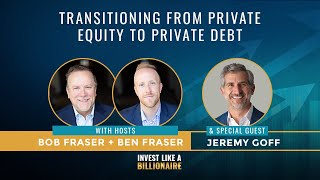
Jeremy Goff, a former Blackstone executive, founded Hiram Capital to offer private credit as an alternative to banks. Private credit lends directly to real estate and industrial deals, pricing off equity returns rather than LIBOR, and delivers high-yield returns with less volatility than public markets.
Chapters
This is the Invest Like a Billionaire podcast, where we uncover the alternative investments and strategies that billionaires use to grow wealth. The tools and tactics you'll learn from this podcast will make you a better investor and help you build legacy wealth. Join us as we dive into the world of alternative investments, uncover strategies of the ultra-wealthy, discuss economics, and and interview successful investors. Welcome back, Invest Like a Billionaire podcast listeners. We've got a really fun show for you today. We're joined by Jeremy Goff, and Jeremy is, uh, formerly working at Blackstone, which was the largest alternative asset management company in the world at one point, and still probably is, and has been in the alternative space for for over a decade and has recently started his own shop in private credit. So we're going to talk a lot about what that is, also dive into conversations around energy markets, which he has a background in, and where that's going.
And so juicy, where is oil going? So it's a great deep background in the, in the energy sector as well as private credit, which is this amazing kind of mix between income and safety and, uh, and upside opportunity. So, so you definitely want to hear about this.
Enjoy. Welcome back to the Invest Like a Billionaire podcast. I am your co-host Ben Fraser, joined by fellow co-host Bob Fraser. And today we have an in-person guest that we're really excited is here.
Jeremy Goff.
Jeremy Goff with you guys. Yes, thanks for coming. We don't get to do in-person very often, so this is really fun where you kind of have a little more personal interaction here. So it'd be great. And Jeremy and I actually used to work together at a company called Tortoise Capital Advisors, and, uh, Jeremy's here because he has started his own firm called Hiram Capital, uh, doing private credit or lending to real estate, uh, bigger real estate. And so we want to bring him on just kind of what's going on in the market. Interest rates are increasing, just kind of understand a little bit what's happening in the private credit world. and you work with a lot of institutional investors. And again, our podcast is trying to educate about what are the big, big boys doing and how are they investing. So Jeremy, talk a little bit about your background. Sure.
So I've got a little bit of a non-traditional background, I think, you know, prior to my time with Ben over at Tortoise. So I started my career in the military and then as I left, I was sort of trying to figure out whether or not I was going to do an MBA. At that time, it was, you know, just after the financial crisis. So as you can imagine, the MBA programs were very full of other Wall Streeters trying to figure out what they're going to do and decided not to. And so was lucky enough to meet some folks from Blackstone at the time, and I was a very nontraditional hire for them, but ended up sort of making it through that process and working for Blackstone for a number of years.
Um, for those who don't know what Blackstone is, I mean, they're kind of 800-pound gorilla in the alternative space.
Yeah, they're a very large alternative asset manager, uh, focused—
aren't they the largest?
I would say they're probably the largest, and they span the alternative spectrum. So everything from hedge fund to fund investing, private real estate, private credit, and I mean, what they're known best for—
yeah, they are humongous. They are humongous. All the largest institutional investors, you know, go to them and You know, so I think they, they, I think Sean, close to a trillion in assets.
They are. In fact, I think they have a, um, they have an infrastructure fund that has close to a trillion dollars in commitments.
That's with the T, not just—
yeah, so, uh, forget Invest Like a Billionaire.
I mean, it's great, you know, it's, it's— and I'm sure they would tell you the same thing, it's always great to have that kind of capital at your disposal, I would say. But it also creates issues, honestly, for value investing.
I mean, yeah, yeah, how— where do you put that much money? That's the problem, is how do create, you know, 10, 15% returns when you're dealing with, you know, 10 figures, you know.
Yeah, it's— I think it's finding these little avenues. And we were talking a little bit about this before, um, before we started the podcast. And I think on the energy side, for example, they owned a company called Cheniere. And for folks who don't know what Cheniere is, it's a publicly traded company today. It's an LNG export company.
Um, and so that wasn't even cool.
It wasn't even known, right? It was like sort of like I hope this works out at the time. And that's— it's like the number one LNG exporter in the world.
And what is LNG exactly?
Liquified natural gas.
So, so it's where they take the natural gas, which the problem with natural gas is it's all local, right? It has to be piped through pipes. And so you can't ship natural gas from here to Norway or wherever it's needed to be compressed. It has to be compressed and liquefied and then put on special tankers and then it can be shipped. So that— but that's a fairly new technology.
It really is. And I think at the time, you know, they were looking at that trend and saying like, hey, you know, there's one— they were already looking at the shale plays and they knew that oil and gas production was going to get very strong in the United States. And, and they also knew that the United States would have to become an exporter of hydrocarbons. And so who do you start investing in to capture that value 10 years from now? Well, a company like Cheniere is a good one.
Yeah. So they figured that out and you helped put together their, their, their equity strategies. Is that what you did?
So I worked primarily on the private equity strategies. I would say probably the thing that I learned, I guess the most knowledge I gained was I worked for someone, his name's Tony James, and he was the president there for a long time, just recently retired in January. And I worked on a lot of his special projects and investor presentations. And I would say sitting with him and working on those presentations and how he looked at the world and how he took what seemed to me to be completely disparate data sets and built them into a story to convince institutional investors, who by the way are some of the most sophisticated investors in the world, that what Blackstone was doing was the right place to be. It just really, uh, I think that's what really got me.
And they've been right over and over and over.
They have been. And it just, it's what really sort of, I was like, there's a way to figure this out. And again, it's not rocket science. It's just work. And, uh, it's exciting, right? It's, it's kind of fun.
So So, so before we go too much further, you know, let's just take a break and talk about the public markets. So we had, we had a fun little conversation, you know, while we're waiting here a minute ago. But, but, you know, as we sit here, the markets are, you know, crashing and then rallying and crashing more. And so, you know, what do you think about what's your opinion of the public markets?
They scare me. I think they scare me to death. And, you know, we still, we still monitor, Even though we're not involved in the public markets, we still monitor Bloomberg. And there are days where I just don't even turn it on because I just don't want to see the flashing red. Or if it's flashing green, you know, it's like, I don't know, how long is that going to last?
But I was telling you, you know, in our studies, you know, we're in the real estate business quite a bit and looking at public REITs, real estate investment trusts, which are real estate packaged into a public stock that all of a sudden trade because they're public they trade at an average of, let's say, 7 times the book value, meaning that $7 investment gets— buys you a dollar worth of real estate.
Why?
Why is that? I mean, you know, it's not— well, it's more than liquidity premium. It's, it's hype factor, you know, or fear factor. It's, you know, it's all priced based on nothing. It's priced— you know, fundamentals no longer really matter, do they?
I don't think they do. And quite frankly, I don't know that a lot of REIT investors that are involved investing on the public side even know what's in their REIT, right? They're buying it, but do they really know what's sitting inside of there? You could possibly be overexposed to retail, right? And if you're overexposed to retail, well, COVID was a very bad time for you on your REIT, right? Or you could be in a hospitality REIT, right? And, and that was bad. So I think, you know, you still have to look at what's in there because it's not wrapped in a nice package and you can trade it. Via the equity markets doesn't necessarily mean that you shouldn't pay attention to what's sitting inside of it.
Yeah. And so if you pay $7 for a dollar worth of real estate and that real estate does super well, now it's not worth a dollar anymore, it's worth $1.10 or $1.20. Does the stock go up or down? I mean, you have no idea because it's not based on that. It's based on a random, you know, kind of emotion. Attached to this, right? And the celebrity factor and/or marketing factor and/or information disinformation factors.
Well, we were laughing about the names, right? We were laughing about the names of these securities. But the fact of the matter is, is that sometimes it works. And closed-end funds are a great example next to REITs. If you look at some of the closed-end funds today, like folks buy these at the IPO, right? And, and, and they sit there and they immediately go to a discount right? So their nav is trading at one place and the price of the security is trading at another.
So explain that real quick.
So a closed-end fund is essentially— it's a portfolio like a mutual fund, but, uh, it's in a closed-end wrapper. So it trades like a stock. You can buy it via a ticker.
So they don't issue more shares, or they can draw shares?
A point. But I would say that like most of them trade at a significant discount.
So they can either trade at a premium to what they own or a discount to what they own.
So they very rarely do they trade on NAV, right?
Net asset value, which is, which is par, what it's actually worth on the underlying assets.
That's right. I— it's very rare that you would see one actually trade that way, and it's very rare that you see one actually move to a premium. Um, I would say in most cases they trade at a discount.
Yeah, they do. So, so, so just, you know, this whole— this, this podcast is focused on really opening up the door of alternatives to everyday investors and to high net worth investors. So, so, you know, you're in that camp. I mean, you love alternatives, right? I mean, there is so much you can do with alternatives in terms of income, in terms of capital preservation, in terms of growth. You know, you know, you know, what are your favorite strategies today and how are you playing your own, your own, you know, placing your own capital? Are you in the public markets?
I'm actually not. And I would say that in— and I do put a lot of my own capital into my own products. So like that's important for our investors. And also that, you know, we have skin in the game, which I think if you're looking at alternatives, you should always find a manager who does have skin in the game.
Yeah, for sure.
It's a meaningful way to show support. But, you know, it's funny, I think that alternatives are misunderstood. I've heard you guys talk about Swensen before. When he built the Yale portfolio. And he was really the godfather of alternatives for institutional investors and how to understand them, which is why Yale, the Yale endowment has done so amazingly well from a return perspective. I think, you know, I grew up in this industry sort of looking at private equity and I think trying to understand why, why it's valuable as opposed to a public stock. And I, and I think, um, it's very different, right? So in private equity, and, and please stop me if I'm, I'm, I'm moving too fast, but, um, in private equity, it's essentially a pool of, of, of capital that has been committed to a manager and they are out looking for companies that are either private to begin with or are, are public today, but would, they would like to take private in order to create more value within that company. And. And that value is created by cleaning up the balance sheet. And whether that's adding leverage or taking away leverage, depending on the market, that could help. I think in a lot of cases, you know, and private equity gets beat up for the way jobs work within those companies, but I would say that their biggest goal is to create efficiencies within the company. So I think over the long run, if you were to look at private equity portfolios, you do see job creation within those portfolios. Through efficiency, but they're bringing in operational experts from other companies in the industry and really just trying to build a better company. And so one example I'll give you, and this is kind of a funny example, so Blackstone bought Hilton at the top of the hotel business, the hotel business at the top of the market. And I think at the time, and that transaction was done, I believe, by, by a gentleman by the name of Michael Che. But I could be wrong. Um, but anyway, so they bought the company, was at the top of the market, was like, oh my gosh, this is— there's no way that this thing's going to turn out okay, right? And so, um, but ultimately what they did was allow— they made Hilton more efficient, allowed them to grow it internationally, and ultimately exited a hugely valuable company that was operating way better.
Did they take it private or—
um, they did take it private.
Yes, they took it private to get rid of the scrutiny, basically let them operate, put it on the operating table without, without criticism and scrutiny and public regulation, etc. They put it on the operating table and, you know, turn it into the Six Million Dollar Man and then turn it public again, right?
That's right. And that is the strategy. That's, that's ultimately— I mean, that was a great way of putting it into a nutshell. I mean, it's, it's literally take a private company or take something private, make it better, and take it public again, or sell it to a strategic buyer who will continue to add more value to a business.
Of course, nobody probably knows what the Six Million Dollar Man was.
It's like something from the '70s, right?
I think it was the '70s or '80s. This is the Bionic Man.
It's like, well, with inflation today, he'd be like the $6 billion. There you go. There you go.
So talk about— so you were at Blackstone doing the private equity transition into the kind of energy base and you took, you know, some of these—
yeah, well, energy became really interesting to me because that's what I was working on, right? And so, um, Blackstone decided to separate their energy business from their, uh, core fund, which was— has always been Blackstone Capital Partners, which is a multi-sector fund and they can focus on anything. And when shale and US production became very strong, and there were— there was even a lot of production going on off the west coast of Africa, um, they decided to take that team and create— now, this didn't mean that the the core fund couldn't participate, but they did want to have a concentrated strategy within energy. And so that really interested me. And I was born and raised in Kansas City. I never planned on staying in New York long term, and my boss knew that. And so I got to know the folks at Tortoise as I was looking to come back to Kansas City and just coming off of the energy fund at Blackstone. It was a good fit. I, I had no experience in public markets.
So, and Taurus, for anybody who doesn't know, was— became one of the largest kind of ETF, uh, businesses in, uh, in energy. So they were the first—
at one point they were the MLPs largest MLP holder probably in the world.
Yeah.
Yeah.
And so an ETF is an exchange-traded fund. So it's basically you take these pools and you, you— it's like a mutual fund, you go public and it trades. So like like the S&P.
Yeah, in many cases it's passive, so it's based on an index that—
Right, so interesting. I mean, you know, we want to talk about private credit strategies, which hopefully we'll get there, but the energy space is super interesting right now too. So now you are primarily the equity strategist. You're the guy with the Lego set trying to figure out how to construct, you know, the ultimate investment vehicle, but You know, uh, energy is interesting. I mean, you see oil is hovering around $100 a barrel. It's insane. And, and all of a sudden, people may not realize the US has become the world's largest producer of oil and gas.
I think JP Morgan had a 185 number out there at one point.
So, so nuts. So I, I personally have been predicting for years, uh, deflation in the oil space because of technology. What happens— I mean, we saw in the '90s the fracking revolution that basically eliminated a massive amount of risk in drilling and unlocked, you know, you know, you know, billions and trillions in, in hydrocarbon production for previously uneconomic kind of deposits. What happens when that goes to the Guar field in Saudi Arabia? What happens when that technology is deployed in, in Russia? You know, and so we're— there's no shortage of hydrocarbons and in the planet. And so my view was that technology was going to, was going to suppress prices.
Yeah. So when I saw—
what's your view?
Yeah, I think we saw that happening, right? I think at the peak of the shale boom, when U.S. producers arguably were sort of at their peak production, not, not peak production, but were producing more than they ever had before, we saw oil prices come down. I think, you know, I, at one point, I believe we were down close to $28 a barrel or something like that. And I think everybody was shocked. Like, what are we going to do now? Right. And it's great for some, it's terrible for others. Yeah.
These guys, I mean, this technology allows them to ramp up production incredibly rapidly. And so, but then they got smacked down and punished by Wall Street. Well, so now everybody's like, prices are high and they're saying we're not going to increase production because we don't want to get, you know, OPEC's losing control, right?
They're like, you know, darn the US, like OPEC no longer has pricing power and they're meeting for days on end. Right. And it was interesting. I mean, I thought that the days of $100 oil were completely gone. Yeah, but then there's always an event that proves us all wrong.
Always. Always. So, so where do you—
are you, are you, you know, bullish on oil, you know, or, you know, I think, I think what it does show is that I think what it shows is that we were all— so the market got very excited around renewables and clean energy, too. Right. And I think the price of oil coming down and producers laying off production and everybody buying Teslas. Everybody got really excited about green energy. COVID happened and then everybody was like, oh yeah, like nobody's going to drive cars anymore.
We're all just going to—
and what we realized is like that we were a little quick to the punch on that. And I think that what we realized is that we still need oil and gas, right?
Because we're figuring that out.
I mean, you know, and I think all the people driving Teslas still don't realize that it takes all those hydrocarbons to fuel those gas-powered power plants.
Where does the electricity come from? Hello.
You know, so now that oil goes back above $100 a barrel and the gas prices are going up, everybody's like, well, you know, like, I don't understand, but we're all still very dependent on it and we're going to be. Yeah. This idea that we can, we can wean ourselves off of oil over the next 20 years is, is I think it's a little short-sighted, but that's just my opinion.
So yeah, we are seeing it, you know, we are seeing renewables, you know, continuing to take greater and greater market share, which I'm super happy about. But, uh, and we are seeing, you know, we, we saw actually in the Western world, we saw consumption at least flattening during, during the recession. I think it's picking up now, but, you know, conservation is working. And, you know, these guys—
well, and interestingly, I think nuclear power was ultimately, you know, there were obviously some horrific accidents that occurred there, but I think Europe was a little quick to, to sort of say like shut down all the nuclear power power plants. And honestly, I think that was probably also a little short-sighted.
I know it's, it's, it's easy for me to say now, but new clean energy.
Yeah, yeah. I mean, it's easy for me to say now because we're sitting here going like, oh, you should have kept those open. But, uh, yeah, yeah, it's a tough decision to make.
So, so where's the best play in the energy space right now?
Oh, that's a great question. I mean, I think, um, honestly, I believe that there are still, like, it, and I'm speaking to within the United States, if I'm, if I'm someone who has capital to work in the United States, and I, I put some to work myself in this area. There are still producers within the United States who have interesting acreage that are producing steadily oil and gas every day. And these guys aren't traded on the public markets. They do raise funds to support what they're doing. And, you know, we can always introduce folks to those people, but I think it's on the private, private companies. They are. And I totally agree. And the way to do it today is just privately. Like, you cannot find value in energy value in the public markets, in my opinion. I think you have to find private players.
You can't find value in the, in energy in the public markets, which I agree. So it's so funny because I just did my first private oil and gas investment.
And great to hear.
And, and unfortunately, I don't know anything about oil and gas, you know. So, so it's, you know, it's part of me doing my due diligence on operators, right? And go figuring it out, you know. So place a little bit of capital and go, you know, let's see, see how it works. But but the numbers are insane with these guys, especially with $100 oil.
Well, and there is a way to—
returns are incredible.
There's ways to invest with guys that really, it almost looks like a fixed income play because really once these guys are up and running, they're just paying you cash flow off of the sale of their oil. And like, it's honestly like, it's a pretty steady, steady play, right?
A lot of these smaller operators have much lower overhead operating costs.
So their breakeven price of oil is much And there are structurally ways to do it so that they don't— you don't have to worry about that.
And there's— people don't realize how fragmented the market is. You think about the Exxons of the world, but there's, there's, you know, I mean, thousands and thousands of small operators who have 32 wells in western Kansas, you know, on 1,000 acres, and they're just cranking out the cash.
Yeah. You know, and they're looking at even more so now. And I think, you know, it's I think the toughest part I had with everything that occurred as we started to go back to $100 oil was, you know, the idea that, you know, that these big oil behemoths, the Exxons, the Chevrons of the world, could ultimately just turn the spigot back on overnight and reduce gas prices, that everything would go back to normal. And the structural ability for them to do that is just impossible, right? Because this is still a very large operation that's in place. And so even to see the value catch back up is going to take a while. Yeah.
The funny thing to me is the political infrastructure, too. And we don't want to be a political show, but you look at, you know, the White House is calling for, you know, greater production out of Venezuela, for crying out loud. But, you know, we're the largest oil producer in the world. You know, do we not want to increase production? You know, so it's kind of nuts, right?
It is.
It is kind of hypocritical.
You know, BS, which is why I can understand that someone looking at the markets and saying like, I still believe in energy, but how do I capitalize on this? The messaging is very confusing.
Yeah, it is. So, so the small energy player is such a good opportunity. But boy, you know, who has it that said, you know, the definition of oil well is, you know, a hole in the ground with a liar on top, you know. So you never heard that. That's good. You got to you know, figure, find the great operators is absolutely critical. And that's true of any, all the private space. That's the hardest thing about, you know, private investments, right? And alternative investments is finding the right operators.
Well, you know, in our business, in private credit, obviously, and especially on the real estate side where we do some work with development and construction, I think it's all about who the developer is, right? I mean, ultimately for us, it's about their track record, their ability to execute, their ability get it done.
Um, so you started private equity, went, worked in kind of public equities on the energy side, and now you've transitioned back to the private debt side.
Yeah, so we like that.
We like that. Yeah, we know that space. So talk a little bit about, you know, what, what drew you to that. Um, what are the attractive dynamics, especially in this environment? How does it kind of, you know, compare contrast with public equity— or private equity, I should say.
Um, you know, and maybe first define private I mean, everybody thinks about debt and people think debt is bad, right? But that is great. And we're not talking about banks here, right?
No, no, no.
Okay.
So we're not— and I like to think of it too, it's, you know, just to sort of bring it back to kind of what you guys have spoken about before. It's a lot like saying like, well, I invest in a hedge fund. A lot of different hedge funds out there. So yeah, there's a lot of different private credit, right? And the way I got into it was ultimately while we were working at Tortoise, we started really looking at alternatives just to diversify the asset base that Tortoise had. And private credit, I would— got really interesting to me because I saw that there were a way to find opportunities that where you're, you're, you're acting as a bank essentially, but you're able to structure things in a way that take you away from public market exposure, right? Meaning that like I'm not pricing something on a spread to— we don't use LIBOR anymore, at least we're We say we don't, um, whatever the benchmark rate is you want to use for today, I guess. Um, but we were really looking at, okay, we're really pricing credit. And I think most private credit investors do this. We're pricing credit based on risk and not based on what the public markets are telling us that should be, right? So we go in and we look at our counterparty, we look at their experience, we look at, you know, really the dynamics within that submarket or whatever that market is and try to determine what the best way to do that. And generally speaking, we're using probably the equity cost of capital as more of a benchmark than we are a benchmark rate, if that makes sense.
Okay.
So bank, everybody knows what a bank is, right? You go stick your money in it. You do it for free. Basically, they don't pay you anything and they go make loans sometimes, but mostly not. Right. And they hold the money. And so that's really boring. So what, how is what you're doing different than that? Right.
And I think it goes to a bigger trend.
So you're a bank.
I mean, for all— well, I don't want to say that because I'm sure there's a lot of regulation. You're an unregulated lender, right?
So is there a gap in banking? Is there?
Yeah. And I think it really, you know, the financial crisis changed obviously a lot of things. But I also— the bank's ability to take on too much exposure was one of the things that really created— was really the genesis for private credit markets really coming to life, I think.
And right.
And what it— and you're seeing it take place. It's a larger trend just in what we're doing. So if you look today and you were to go look at an LBO, a leveraged buyout transaction, which is ultimately how private equity firms buy their companies, they use a good deal of debt alongside their equity to get—
to go buy a public company. You go borrow money to do that.
So you're basically cleansing the balance sheet and recreating a new balance sheet. and traditionally before the financial crisis, it was always the large bulge bracket banks that were the, the large financiers of that. Gotcha. The Citi's, the JP Morgan's, the Goldman Sachs. Um, well, what they realized was that, well, if the banks can do that, well, why can't I lend on an LBO too? So now if you go and you look at the cap table of an LBO, a leveraged buyout, and let's say you look at KKR's cap table, well, you might see Blackstone Credit in the debt side of that port— of that capital stack, because now these guys are like, well, we can just do the debt between each other. And so you have this huge direct lending movement taking place, uh, within the private equity markets, um, creating BDCs, and which is a business development company focused on small businesses. And so it's interesting, you know, I don't think the banks are getting pushed out, but it's definitely released some of the pressure on the lending side. And I think now you also have guys who— and it's not that banks don't have all this experience within the transactional space. I do think you have guys who have transactional experience that are able to also price it effectively.
So maybe break down just a sample deal of when you guys come in, where you're at in the capital stack, and just kind of all the players.
Sure. So the way we generally look at it, and I'll just use a development deal as an example. So we work with a number of different developers and construction companies and who do— they develop assets all across the country. And really what we're looking for is guys that are doing deals in areas that we feel like have appropriate density, meaning like the population makes sense. You like the project, we like the project. And so we start talking about what their typical cap table look like and one of the ways that we've really, you know, sold ourselves to them is that, okay, today a bank may lend 60% loan to cost, meaning the cost of the project, they will loan them 60% of that cost.
Is $1 million, they'll loan you $600,000, and the rest is equity.
So 40% equity in a deal is a lot for an equity holder, right? For, for a developer. So he, maybe he's doing 2 projects, but like his ability to do multiple projects becomes very slim, right?
He's doing one deal instead of two deals, right?
And oh, by the way, if he's using a regional bank, there's only so much they can lend out to a guy at one time, right? And so you need other people in that ecosystem to be able to do financing.
And so, so they'll come to you, they'll come to us, and but the rates may be significantly higher.
They are, right? Because ultimately, like, we're looking at, well, if the bank— the, the bank's, um, loan-to-cost ultimately is our sort of metric on risk, right? We're like, well, if the bank's looking at this now, a lot of that's based on just what they're able to do. But they're not looking at really the developer's track record and they're not looking at the demographics of the— maybe they are, but like, I think we're probably looking at it more granularly. Right. And so, but we also like the bank being there and we don't want to do anything that's going to disturb or disrupt sort of their piece of the pie. And so we'll work with the developer to make sure that we can come in and do sort of a junior slice.
So you'll do a second lien basically. So yeah, it is higher cost, but it's also a smaller slab. And so the cost is not that high, the net-net cost.
And the way we're modeling this, right, the way we're having it make sense is that ultimately, if you're able to reduce their equity exposure, their return on investment is actually— our position is actually accretive to their return, right?
Yeah, that's right.
Even at double the bank rate.
So instead of, you know, a million-dollar build, you got to come up with $400,000 in equity. Maybe it's $200,000.
Correct.
You know, so all of a sudden I can go do 2 deals. That's right. And so this— the opportunity cost is there.
So, and if they have to go raise 40% equity, that cost of equity from, you know, a private investor—
so you're filling a niche that the banks won't do, and, and, and possibly offering, you know, you know, in investors, you know, maybe, you know, high single-digit returns, right, which you can't get anywhere else, right? Certainly not in your bank. That's right. And pretty safe, right? 'Cause you guys, again, are more sophisticated. We do find, I mean, you know, that you can have sophisticated underwriters and underwrite to things that banks do not do, but they make a lot of sense to underwrite properly. I mean, our debt fund is now 10 years in the running, soared through COVID, and we have very, very, very smart, very clever underwriting, but it's very different than how a bank would underwrite.
Agreed.
And it's more mathematical-based, and, and that kind of thing. And, and literally it's been proven out through, through good times and bad.
Yeah, listen, I don't think anybody— nobody— like, it's like the guy standing on the hole, you know, you know, say, making promises. I mean, I think there, there is, um, there's always something that's going to come up that you don't see, right? And every portfolio, like, it's— is not going to be perfect. But what you're trying to do is create a portfolio that has enough diversity, um, between developers, geographies, and all of that to reduce —your loss.
So from an investor's perspective, if they put money into a deal like this, a private deal, if the market goes up or down or whatever, there, it doesn't affect that. It doesn't matter. It's— that's pretty cool. And potentially income, which is the, the hardest to get piece, right, of— and your portfolio is how do you get current income, right? So that's no problem in a debt piece. And then, you know, what's possible— I don't know if you guys do it, but it's possible in private debt space, you also get an equity kicker. You can— you get warrants. So explain what a warrant is, or an equity kicker.
It's, you know, I look at it like an option, right? It's like an in-the-money option that you can exercise, um, to add a little juice to the return at the end of the day. And I think it's—
you get a piece of the deal. Not only do they owe you money, but you also get a little slice of the upside. That's right. In addition, so there's a— you get to play. That's right, you get to play, but you have no risk pretty much, or very little risk of downside loss. You get current income and you get to play a little bit. That's right, man. I love that.
It's fun. It's fun.
I love those deals, right? Yeah. You know, because the first, the first rule of making money is what? Don't lose money.
You know, it's, it's funny too, because I think when we, when we talk to a lot of prospective investors, the one thing that always comes up is liquidity, which I'm sure you guys discuss quite a bit. And I you know, it's this idea that going into a private fund is a lockup, right? And everybody's like, well, my money's going to be locked up for 6 years. And, you know, what if I need liquidity within that time? Right. And my explanation to them is like, one, I think people have an irrational need for liquidity that they don't actually need.
Right. It's more of an emotional need than an actual—
I think it is. And I guess my thing is like, well, if I'm paying you, if you gave me $1 million and I pay you 8.5% every year on that million dollars, over a 6-year period. Is that enough liquidity in your mind? You know, like ultimately those deals are going to roll out as well. So it's not like your money's locked up for the full time, right? As a deal matures and is harvested, you're getting your principal back. And so I think one thing for investors who haven't done a lot of private fund investing is understanding that like one, like that is not truly like a lockup of your capital forever. There are distributions and, and everything that take place within the life cycle of a fund. Um, but I also think that low volatility, you get to see like where your principal is all the time, it's staying there, right? Um, the ability to reduce volatility and correlation in the markets is, is really valuable for anybody, I think.
So, and liquidity. So let's say you've got a $5 million portfolio, what's your— what is your real liquidity need? I mean, let's say worst case scenario, I need a half a million Well, then take $500,000 and make sure it's liquid and roll the other $4.5 million into something that is, you know, you don't need that liquidity because liquidity is expensive. It is really expensive.
Super expensive. Especially with inflation. Well, I mean, the opportunity cost alone of cash, right?
Yeah. There you go. Yeah. And then, but then add the public markets. Yeah, the public markets are liquid, but at what cost? You know, when you watch, you know, overnight values crash, you know, where it's a 6-month period by, you know, we look at Netflix, right, as a great example. You have liquidity, guys, you know.
Of course, and arguably one of the best hedge fund managers in the world took a bath on that, right? So it's like, it's, it's like no matter how much work you do, how much you pay attention to fundamentals like we were talking about, yeah, like you can take a huge loss based on somebody's emotion, right? Exactly. Um, so it's, it's interesting. I think ultimately, I think Netflix just came back back down to a valuation that's more attractive and actually makes more sense.
But, but aren't they still negative cash flow? I mean, I, I can't remember. I mean, how much is a company worth when it's just a bonfire of cash, you know? So how do you value a company that is literally throw your cash in thing and light it, light a match, you know? So it's hard for me to say. It's hard.
But I think that's the problem, right, is, is, um, that's a hard decision for anyone to make, right? And, and I think even the best guys in the world have a hard time determining at what point that's going to happen because I ultimately don't—
yeah, every quarter let's throw $1.2 billion.
I mean, everybody, you know, everybody sold off on One News and then within the same earnings report they said that they were literally going to do 10 times worse on the next quarter and everybody's like, oh well, you know. So like, what does that mean? I know, I know.
I honestly just— the private markets are so much more predictable and you, you can really solve the unknowns and make good, good decisions that are not based on emotion and not based on— it's control over outcomes.
It is, it is control over outcomes. Um, and that's how we always explain it, is that we don't have control over everything, right? I mean, the environment that we live in is unpredictable, but at the same time, we have the time and patience to make sure that our outcome is better than what it might have been if we were forced a forced seller in a market. And, and that's the difference, I think.
So, so what are you kind of seeing right now in this kind of current environment where maybe there's some turbulence, obviously, in the public markets, interest rates are, you know, going up, and you know that—
I mean, 75 basis point hike is coming whether we like it or not.
So yeah, so how are you— I mean, at this point, economic cycle, you know, where you're at is actually probably a pretty good place to be because you've got equity usually covering your position. You're second behind a lender. Yeah. But what are the kind of things you're looking at? You're in a lot of industrial, um, it's kind of the primary asset class.
Yeah, we really love industrial right now. And I think everybody— I mean, it's— I think it's, it's hard not to— it's hard not to love it. And I think, um, ultimately between everything that's taken place, uh, across the world from a conflict standpoint has really— has made everyone realize that we need to bring a lot of the logistical supply chain back onshore. Um, and listen, this is a cycle. Like, if you look back, I mean, this cycle takes place— we've done this 2 or 3 times, right? Where we offshore, then we onshore, we offshore. And, um, and I think, you know, I'm like this huge student of Howard Marks because, I mean, he looks at everything within cycles, right? And in, in every market you have a main cycle and all these multiple cycles. And I think for us, industrial right now as a, as a, is a large cycle, is in a very good place. Um, and I think that you're going to continue to see build out onshore of logistical supply chains. And I think not just because of last-mile overnight Amazon-type shipping. But generally speaking, we're going to need more warehouses everywhere, right? And we like that. And I think for us, the hardest part is in capturing this opportunity is finding the, the smaller markets where this cycle is early, right? Where we're in the early innings of that cycle. Because not every— Kansas City, my mind is, is probably a little bit, probably a little, little later inning than like a Boise, right? And so we're trying to find where those later inning assets are or early-earning assets are. And that's, that's tricky, right? Because like, where are they going to build and where is it going to go? But and I think that's all about finding the right partners from a development standpoint for us.
So, yeah, industrial space. But what about the debt space? I mean, so you're watching the bond market, right? You know, you know, well, we're jumping off.
I don't want to say we're laughing our way to the bank on that, but I think it's for us, it's the ability to create. Now, listen, we have to adjust our own pricing based on that. Right. And ultimately what we end up having is we price a little lower than we should have based on how quickly interest rates move up. That doesn't bother me, right? Because I'm still not—
I'm not losing money on that deal necessarily.
And I think the ability to create income without volatility is also really important. I mean, like, you know, the ability to know that, like, you're going to get that coupon payment every quarter. I mean, that's what it's about.
And so you're not like a bond, like buying a bond, because when the rates are a lot higher, so there's a lot more margin, right? More spread. And, and because, you know, so it's just a very different animal.
Yeah. And I mean, like I said, I think we like— I look at what we do as more of a spread to equity than I do a spread to LIBOR or SOFR or anything like that, because we're looking at what the cost of capital on the equity is and what they can survive with and still be accretive to the whole project.
So from an investor's perspective, it's like a high yield bond but without volatility.
Yeah, and that's right, because our duration is also short, right? So like, if you look, I mean, we may—
so much your loans are a year or two or—
well, I would say like we may write a 5-year note. Interesting. Like, so the other— you're kind of— I'm trying not to change topics, but the interesting thing about private credit is our ability to be really, really flexible and creative in structure, right? Which banks are not great at. And I think we all know that. And so what we're able to do is like take something and say like, okay, well, we're going to do a 5-year note. I think the duration on that is probably around 36 months max. Right. And then, then we will give ourselves call protection for 18 months, meaning like whether or not you sell this thing, you're still paying us 18 months worth of interest on it. Right. So that's how we create stability and consistency within the debt. That is right.
So good. Very cool. All right. Well, thanks so much for coming out.
It's been great. Great conversation with you guys.
I really enjoyed it. What's the best way if people want to learn more about Hiram?
Sure. So we have a website, www.hiramcap.com. You can reach out to us on there or find us on LinkedIn or any of the other social media outlets that I personally don't have a lot of experience with, but I'm sure someone that we work with does.
Awesome. Well, thanks so much, Jeremy.
It's been an awesome conversation. Thank you, guys.










