
UHNW Survey on Portfolio Allocation & Strategy feat. Tad Fallows
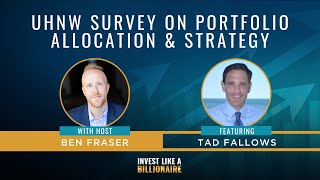
In this Invest Like a Billionaire podcast episode, host Ben Frazier interviews Tad Fallows, founder of the Long Angle community for high‑net‑worth individuals. The conversation traces Tad’s journey from bootstrapping and selling a SaaS company to creating a peer‑driven network that offers unbiased advice, live events, and syndicated deal flow for members with $5‑30 million investable assets. Tad explains the community’s structure, the motivations behind its formation, and shares findings from a 2022 benchmarking survey of 1,200 members. The survey reveals that members allocate roughly 50 % to equity (public and private), ~25 % to real‑estate equity, and ~20 % to cash, bonds, and other alternatives, with low leverage and modest mortgage exposure. Trends show a shift from public stocks toward private equity and real estate, growing interest in private credit, secondary‑market fund shares, and early‑stage venture despite recession concerns. Tad also discusses asset‑protection strategies, emphasizing umbrella insurance over complex trust structures. The episode concludes with details on how listeners can join the free‑membership community and the fee‑based deal‑flow model that sustains it.
Chapters
Hello, future billionaires. Welcome back to another episode of the podcast. This is a really fun conversation. This is with a gentleman named Tad. He started a community for investors, ultra high net worth as well as high net worth, called Long Angle. And he did this because he sold a business. He came into a lot of money himself. And how do I deploy this? How do I protect this? How do I grow this? Those were, you know, the questions he was asking. And he didn't have any community around him at that point. So he created one. Um, and, uh, he shares a lot of just detail of how his community is allocating into different asset classes. He talks about his background a little bit, and then we also get into the current environment. Where's the opportunities right now? What are some of the things that his community are looking at and seeing, not just in real estate but also in private equity and venture and hedge funds and other alternatives? So be sure to listen to the whole thing. It's a really great, interesting conversation, and I appreciate you listening to the podcast. Enjoy. This is the Invest Like a Billionaire podcast where we uncover the alternative investments and strategies that billionaires use to grow wealth. The tools and tactics you'll learn from this podcast will make you a better investor and help you build legacy wealth. Join us as we dive into the world of alternative investments, uncover strategies of the ultra-wealthy, discuss economics, and interview successful investors. Looking for passive investments done for you? With Aspen Funds, we help accredited investors that are looking for higher yields and diversification from the stock market. As a passive investor, we do all the work for you, making sure your money is working hard for you in alternative investments. In fact, our team invests alongside you in every deal, so our interests are aligned. We focus on macro-driven alternative investments so your portfolio is best positioned for this economic environment. Get started and download your free economic report today. Welcome back to the Invest Like a Billionaire podcast. I'm your host, Ben Frazier, and today we've got a really exciting guest, Tad Fallows of Long Angle And I've been looking forward to this interview, Tad, so this is going to be a fun one. And a little bit of background on Tad. So he, I'm going to share his story here in a minute, but he was an entrepreneur, bootstrapped a company, software as a service company, and sold it and had a great problem, which was a big pile of cash. How do I diversify this? How do I create a great portfolio? And long story short, created this really cool community called Long Angle that is focused on high net worths and ultra high net worths and creating really an ecosystem to help people diversify outside of just the stocks and bonds portfolio that most, you know, average high net worths are in. And so obviously there's a huge alignment here. If you've been listening to the show for a while, you know, at Invest Like a Billionaire, our whole goal with this show is to educate around alternative investments that, you know, the billionaire, the billionaires, the, you know, ultra high net worth and wealthy have been using for decades to deploy into, you know, private equity, real estate, venture capital, and many other asset classes. So with that long intro, Tad, thanks so much for coming on the show. I'm looking forward to this conversation.
Well, thank you so much for having me. I'm very excited to be, uh, be on the show.
Yeah, well, let's start kind of at the very beginning— not very, very beginning, but kind of this whole journey it unfolded for you is, you know, starting a company. And, uh, talk— walk us through that process. What was that like? And then selling a company, um, and then really kind of the next step from there.
Yeah. Well, it was a fantastic experience, you know, certainly the formative experience of my professional life. So in my early 20s, I was a couple years out of college and decided that I'd always had an interest in being an entrepreneur. It seemed like a good time to take a shot on that. You know, wasn't yet married, didn't yet have a mortgage and kids and those sort of obligations. And so I thought, you know, if I was ever going to take a crack at it, it was a good time. So along with two close friends of mine, one from high school and one from college, we decided to start a software company. We were focused on universities and hospitals. It was a pretty niche industry, but we helped them manage their high-end research equipment, you know, your million-dollar microscope or DNA sequencer or that sort of thing. As you, I think, mentioned, we bootstrapped that. So we ran it for about 10 years. And, you know, it's certainly bootstrapping has its challenges, especially early on. You know, if you're growing 50% a year, going from $20,000 a year of revenue to $30,000 a year of revenue, doesn't feel that satisfying and doesn't leave a lot to pay the bills. But we were fortunate to be able to do that successfully. So by the end, we got it to about 75 employees. We had customers in maybe 20 countries. And so really great experience. At that point, we sold it to a strategic acquirer and, you know, great company, has good ethics, good values, was a good fit. Almost all of our employees are, you know, still a number of years later, still employed there. So ended up being a good fit. But on a personal level, as you mentioned, what that meant for kind of my financial life is that we went, and the same with my partner Suram, we went for a long time paying ourselves almost nothing as we rolled every dollar back into the business. And then on one day, we got our deferred compensation effectively for the last 10 years of effort, and we're introduced quite abruptly to all these questions of, you know, high net worth questions like, okay, you know, estate taxes, alternative assets, umbrella insurance, these things that we hadn't kind of been, been eased into, but said, okay, you know, you need to figure this out and you kind of have one chance to get this right. You may not be fortunate to have another major liquidity event like this. So I want to be careful with it. We spent a while, you know, talking with various wealth management firms, you know, life insurance salespeople, different people to try and figure out, get advice on this. And at least for us personally, we found there was a bit of a gap. There's a lot of good free advice out there that's targeting probably more of the, um, you know, more common problems of, okay, you know, setting up 529s and 401s and that sort of thing. But when you get into questions like estate taxes, the general advice was, look, the exemption is so high, nobody's ever going to hit it, so don't worry about it. So that was not super useful advice. Um, and then, you know, there's a number of, uh, sources of information that are targeted specifically at the very high or ultra-high net worth crowd. But those are often, you know, coming from somebody with an agenda of some product they want to sell, whether that's a wealth manager or whether that's a trust and estate attorney who thinks you need a complex trust structure, whether it's a life insurance salesman who thinks life insurance is, you know, the solution to the problems. And what we really wanted to do was set up a community of friends of ours who were in a similar situation and where nobody was trying to sell each other anything. And that was really the genesis for how my partner Suram and I ended up starting this. Initially, it was just going to be a couple dozen of our friends. That was about 2 years ago. Over the last 2 years, that's grown from maybe 20 of our friends to about 1,200, 1,300 members, just all kind of word of mouth of one member saying, "Hey, my co-founder, my director, my brother would make a good member here." And that need of looking for advice that was unbiased advice targeted toward the high net worth or ultra high net worth crowd was pretty commonly felt.
Yeah. So what year did you sell your company?
What year did we start Long Angle or the software company?
The software company. When did you sell it?
Started that in 2006. So ran it from 2006 until 2016. And then I spent a few years working at our acquirer after the company was purchased and then started Long Angle about 2 years ago.
Got it.
Yeah.
So what you said there is, I think, so important for a lot of people listening because we have people that talk to us many times in a similar situation, right? They've been working for so long for their company and building this company. And that one day, you know, I love you said that you basically got all your deferred compensation in one day and it can be a significant number. But then it's what do you do from there, right? There's not a retail store you go walk to and say, hey, I have $20 million or whatever the number is. You know, how do I, how do I manage this? Well, I deploy it well, right? And generally, you know, those wealth managers and, you know, other, uh, service providers that you mentioned, they all have an angle. They're all selling something, right? Which isn't necessarily bad, but it puts them in a biased position. And, um, and it's difficult as you're trying to explore what do I truly need, you know, is this what I need, right? And it's not all one size fits all. And what we found is a very similar thing where there's kind of the you know, people that live and work in corporate world and work there for 20, 30, 40 years, and they have their 401s and the 529s. And the wealth management system is built well for those types of people because it's pretty cookie cutter, it's pretty simple. And then you have the ultra-high net worth, like the family offices that can afford to pay their own staff to do, you know, deal flow and underwriting and asset management and all that. But you kind of have this gap in the middle where it's, what do I do? I don't— it doesn't really fit one way or the other. And so you went and created your own community, which I love. So talk a little bit about kind of what your community looks like and kind of— you did this study I'd love to get into here in a minute that shows just a survey that you did with your, with your participants.
Yeah, sure. So to share a little bit about who's in the community, it is primarily people in that gap that you're talking about of where they have more money than sort of a traditional kind of wealth management target to, but less than the family office range. So I'd say The bulk of our membership is between about $5 and $30 million of investable assets, so assets outside of their primary residence. In our particular case, I think that skews a bit younger than your average very high net worth group. So the large majority, call it 85% of our members, are in their 30s and 40s. That's not a rule or necessarily intentional on our part. I think just more of a selection thing. And in terms of, you know, their sources of wealth, I would say a number of different areas. A whole lot of entrepreneurs, whether that is tech or non-tech, a lot of people from financial backgrounds, you know, private equity, venture capital, hedge funds, a lot of people who work in technology, and then everything from real estate to crypto to corporate executives, professional services, etc. And in terms of, you know, how those people interact within the group, it's basically 3 parts to that. The first is a private online community, so sort of like a private version of Reddit or a private version of Facebook. And that is gated in the sense of either Sreeram or I interview every potential member and we validate people are in the qualified client cohort, but it's not monetized in any way. You know, we don't sell data, we don't have ads, you know, we don't charge membership fees. It's just a private discussion community there. And the second thing is live events. That's a combination of in-person live events for sort of, you know, networking and building camaraderie. So any of probably your top 30 metro areas, about once a quarter, we organize a member dinner there. Then we also have a lot of Zoom-based live events, whether that is member-led, say, introduction to an asset class. Well, maybe you have 3 people who've started hedge funds take an hour to talk about here's what a hedge fund is, here's the role in your portfolio, here's how to underwrite deals. We've done similar for crypto, for clean tech, for qualified opportunity zones, for fine art. Then sometimes we'll bring in external speakers, whether that's trust and estates attorneys, people who specialize in raising children with wealth, insurance experts, philanthropy experts, etc. And again, that's totally non-monetized. We don't charge those outside speakers. We don't charge members. It's just sort of talks we think would be valuable. And then the third thing that we do there, as you mentioned, is syndicated deal flow, which is sort of 1 to 2 deals a month. In these areas of alternative assets. And I'd say, I know a little later in the conversation we can get into, you know, what we both mean by alternative assets and what they are. But that's sort of the third piece to it. This benchmarking survey, though, that you mentioned, I think this one could be interesting in the community so we can take a few minutes to talk about it.
You know, we get there. I'd love to hear just from your perspective as someone who is an entrepreneur building this business, you're not really thinking about my 401 portfolio. You're thinking about how do I grow, how do I make payroll this month, how do I keep building my net worth? And then all of a sudden you have all this cash. What was your perspective then? Were you already kind of turned on or open to alternative assets? You know, and what we mean by that is basically real estate, private equity, venture capital, hedge funds, right? Those are kind of the big ones. Or was that kind of a journey for you that unfolded and you became more open to it as you were having conversations? Like, just start there. I'd love to hear that before you decided to launch this.
Yeah, that's a great question. Um, you know, the, the honest answer there is a little bit funny. It might sound a little bit, uh, you know, contrived in retrospect, but really what happened is, uh, after we sold the company, I had a whole bunch of stuff that I ought to have been doing for my family, but I was too busy, you know, running a company and selling a company. So there's a long honey-do list there, whether that was things, you know, in terms of being a more full, uh, parental partner to my wife, or whether that was things with the house that need to be fixed, or with our portfolio, etc. And for the, you know, the financial ones, I basically, you know, sat down and just made a list of here's everything that needs to happen. What's the— I know I'm not doing any of these things right today. What's the impact of not doing it right? And when I tried to put dollars against them, the impact of not having my portfolio, having put thought into it, dwarfed everything else. I said, okay, if I can get 1% more per year return here, it doesn't matter if I'm paying too much for insurance. It doesn't matter if we're paying too much for, you know, a house cleaner, for our travel, etc. If we can actually get the portfolio right, that is where all the money is financially. So let me just kind of set a process of educating myself there. So it had not really historically been a major interest of mine in terms of personal finance as an area. Not that I disliked it, but it just wasn't, you know, something I did a lot of free time reading about or put a lot of my thought into. You know, as you said, my thought was all just into how do we win another customer, how do we improve the software, how do we meet payroll, hiring people, etc. And so then, you know, really did a lot of intentional looking there. I started with, you know, a lot of the resources that probably come up a lot, whether it's things like, um, you know, A Random Walk Down Wall Street or various, you know, websites that, um, kind of talk about basic portfolio allocation. And, uh, certainly started with, you know, what I still have a whole lot of my portfolio in and would advocate anyone in terms of basic index funds. So, you know, low-cost Vanguard index funds certainly, uh, form a critical component of my portfolio. Alternative assets only really came on, and also I'd say real estate. For me, for real estate, I've gone mostly just with properties that I directly own, single-family real estate, much more of that than shares in LP shares. But in terms of the other alternative assets elements of the portfolio, like private equity, venture capital, private credit, trading strategies, arbitrage strategies, et cetera. That has been, I would say over the last couple of years through the Long Angle community is really where I've learned much more about that. And I would say, you know, they're all very interesting. So there's some level of intellectual interest there, but I would say in general, if I were defining the difference between alternative assets and core assets, which for me would probably be stocks, bonds, and real estate as sort of maybe more traditional assets. I think alternative tends to be much less liquid, much less accessible, and there's much less information. And so if you look at your public markets like stocks, if you pick 50 random stocks and buy them, you are going to almost exactly perform the same as an index fund. It really doesn't matter. You can, you know, I enjoy looking at stocks so I can spend a lot of time nerding out on them and deciding if I think Apple or Microsoft are better, but I'm not really going to beat the market by doing that. I'm just going to kind of entertain myself. But if you're looking at, you know, private equity funds or hedge funds, if you buy 50 random hedge funds, you're going to lose your shirt. They are a place where there really is a difference between knowing what you're doing and not knowing what you're doing. So that was probably also part of the reason that I didn't get into it until I had this community, is I felt like on my own there's a couple asset classes, the alternatives, that I probably have enough knowledge to do well in. You know, if I look at, say, angel investing and B2B SaaS companies, since I worked in that industry for 10 years, I can do a decent job of picking which ones are going to be successful or not and probably get good returns. But if I look at, you know, private cannabis lending, I know nothing about it and I'm going to just do terribly if I do that. Again, if I look at private equity, if I look at, you know, whiskey aging, I have no idea what distilleries I should be buying from and whether I want Kentucky or Tennessee bourbon and that sort of thing. And so I really shouldn't be playing there unless I have a way to learn about it. That was really only for me more recently.
Yeah, I love how you describe that. So obviously we've talked a lot on our show about one of the big disadvantages of alternatives is generally lack of liquidity. Right. And so, but that can be a positive in some, some instances, right, where, you know, emotional selling is a thing, right? If you sell at the bottom, you're going to lose automatically. And sometimes that forced illiquidity can help you ride out downturns. But also the lack of information that you have through the public companies, right? That's a disadvantage, but can also be an advantage too, right? You have the ability to drive more alpha to your portfolio or outperformance is a lot higher in alternatives because of that information gap. And—
Yeah, I would completely agree. There's one other one I'd add to that. It's honestly, they are much less regulated. If you are buying a stock in a public company, you can have 99.5% confidence that those financials are accurate. And if somebody misstates those financials, you know, a CEO or a CFO is probably going to go to jail, or they're going to lose millions of dollars. And almost nobody is do— especially in the US markets. Maybe if you go to China, there's a lot more question marks around it. If you're buying an NYSE-listed company, you pretty much know what you're getting. Um, whereas You know, we have looked at, you know, some things, for example, forex trading funds. We've been digging into them and I just ultimately don't have confidence in some cases. Hey, I'm not 100% sure this is not a fraud. You know, there is too much risk here. And of course, you know, I don't personally put any money into those ones where I think there's a fraud risk, but it's basically that lack of the regulation. It's not that there's zero regulation, but the SEC has much less of a hands-on model in this world of hedge funds and private equity funds than they do in public securities, and probably for good reasons. So, I think that's one other important element, but I 100% agree. I think that's the reason why you can get excess return in the private markets is because they're less efficient. You know, if Apple comes out with a new announcement or new earnings report, it's going to be half a second before that's completely baked into the price. There's no way that you can say, oh, it looks like sales are going to be up next quarter. They gave good guidance. I'm going to buy ahead of that. You know, you're way behind by the time you finish that sentence. But if you look at these private ones where there is less information and less liquidity, as you said, the alpha can persist for much longer periods of time because it doesn't just get arbitraged away by some Fidelity manager putting a billion dollars toward it.
Right. No, I love that. Okay, let's jump into the study here. So you did a study, this was for 2022, and we're actually going to put a link in the show notes because this is stuff that I love. I mean, this is my favorite type of reading here. But you did a survey of a lot of your participants or members of your community, and just ask questions about portfolio, about sources of wealth, and, you know, how they're investing and changes over time. So let's dig into that a little bit. I think one thing that was— we talked about before we hit the record button here, I think it's really interesting with your community, it definitely skews toward, you know, what we call maybe first-generation wealth. This is kind of the self-made entrepreneurs, business owners, or even corporate executives that have done very well in their careers. And so this is a lot of people that are, you know, first-time, you know, money, so to speak. And so they're all trying to deal with the same problems of, you know, how do you, you know, not have entitled kids? How do you avoid estate tax or, you know, have a good portfolio? So I just want to make that point. I think it's really valuable, and I think will relate a lot to our audience that I know is a lot of first-generation wealth as well. So let's, let's dig in here. Give us some kind of really high, high points. And then for those that want the full study, you know, we will be linking to that.
Yeah, sure. So, and one other thing I would say in terms of that background of who's participating, I think given the fact that they are mostly people, say in their 30s and 40s, who have created substantial wealth on their own, in most cases, they're going to be more risk accepting and optimizing for long-term returns than maybe if somebody had $20 million they inherited. I think on average, that person might be a little bit more risk averse and a little bit more concerned with wealth preservation. I think the person who made that $20 million the first time probably has a little bit more willingness to roll the dice and think, if I really have to, I can make some money again, and I don't want my money just sitting there in bonds for the next 30 years. I want it to be working as hard as I did. So I will say that I wouldn't purport for any of this to be universally applicable portfolio allocation. It's just, you know, it is what makes sense for this particular subgroup here, but it may not apply to each person's particular situation. And in terms of what we've seen, we've actually run this study 2 times. The second time was with a much bigger sample set since our community had grown quite a bit in 2022 versus 2021. And just to give a high-level breakdown to what we asked people to do is we gave about 60 different asset classes and say, hey, in percentage terms, not the absolute dollars don't matter, but as a percentage of your overall net worth, can you break it down to a variety of these categories? And we'd cluster them together of, here's a few categories that'll represent equity, whether that's private equity, whether that's US stocks, international stocks, et cetera. Then here's a set that represent real estate. You know, there is directly held real estate, limited partner positions and real estate funds, and so on. And then we also asked them, how much debt do you have? So that you'd say, okay, if my net worth is $1 million, maybe I have $1.5 million in assets and $500,000 in debt, that sort of thing. The way it broke down is basically about 50% of people's total holdings were in equity of some sort, whether that was public equity or privately held companies. And because we have a lot of entrepreneurs in the group, a bit of that is coming from some people holding a lot of stock in the company that they founded. About a quarter of that was in real estate equity, so not the gross value of their real estate, but net of any debt they had about it. And about 25% of it was in real estate. And then the remaining—
that would be directly owned real estate, not REIT holdings generally.
The combination of both, whether that's public REITs, private real estate funds, or direct real estate. I'd say most of it was in direct real estate, but across all of those categories, you get a little bit more than a quarter. And then about 20% was in everything else— cash, bonds, alternatives, et cetera. If we look at the direction of how that changed since 2021, I'd say the big shifts were probably away from public stocks toward real estate and toward private equity or holdings in private companies. I think some of that was probably driven by market performance that you had real estate having a great run, a number of private companies doing well. But the overall stock market, you know, not going up as much. And then some of that was intentional rebalancing, I would say, especially historically. You know, if you look at literally today with interest rates having gone up quite a bit, I think there is— our members, we're seeing them be less bullish on real estate. But if you looked at the situation 12 or 18 months ago when you had inflation that was picking up and people had high confidence was going to continue to pick up, but interest rates still record low, it became, all right, this is sort of a no-brainer. I'm going into something where I can get 30-year debt fixed at 2.5%, and I think inflation's going to be, you know, 5% plus, I kind of can't lose here. And so rebalancing toward real estate and private equity. You know, a couple of other just interesting things from it, and happy to dig into details. One is that even up to about $50 million in net worth, people's primary residence continued to be a pretty appreciable amount of their portfolio. I think with those with maybe, you know, on the lower end of the spectrum, like $2 to $5 million, their primary residence, their equity in it represent about a quarter of their portfolio. But even up to those in the $25 to $50 million range, it was still about 13% of their portfolio was in equity in their primary residence. So I wouldn't necessarily have expected people to continue to invest more in their primary residence as their net worth went up, but that was certainly something we saw. Also interesting, but kind of in the opposite direction, is only about half of people owed a mortgage. And in that half that didn't, a quarter of them is because they didn't own a home. You know, so these were people certainly could afford it. They had maybe $10 or $20 million, but they just chose not to. You know, we did some qualitative follow-up to understand why. I think it was a combination of some people saying, hey, look, I can just get better returns. You know, I have access to, you know, great deals in these different markets, and I think those are going to grow better. And so, you know, I can just rent a house and not tie up a bunch of my equity in a house. And then other people honestly didn't want the hassle. You know, they felt like, hey, I like being able to just call landlord and tell them there's a leak in the roof and I don't have to, you know, figure out how to fix the leak in the roof. And I can certainly, as someone who owns multiple properties, identify with that and think there's a lot of value in that. So a quarter of people didn't own a home at all.
Another quarter just own their own home outright with no mortgage. And going back to kind of your core audience of, you know, the survey here being a little bit younger, I think that is also part of the lifestyle you know, changes over time to kind of an older audience, you know, that maybe is, you know, more 50s, 60s, 70s. That may— homeownership was a bigger deal, right? That was part of the American dream. This is how you show you've arrived. But I think that's becoming less of a thing, right? And so I think it's interesting to see if that continues over time, right? If, you know, the lifestyle— yeah, and freedom continues to be a big part of driving that.
And we certainly by no means majority, but have some members who identify as nomads. You know, ask them, where do you live? And they kind of say, well, nowhere in particular. You know, I'm in, I'm in Berlin this month. I'm maybe in London next month. But you know, I sold my company and you know, those of course tend to be the people without kids. I think, you know, speaking as someone with two little kids, it would be a lot harder for me to be a nomad. But a lot of the single people just enjoy the fact that they can follow the cherry blossoms as they're blooming up Japan or things like that. And you know, not be tied down to real estate obligations in any one place. Yeah. And then I guess, you know, last two points I'd make that I thought were interesting in this benchmarking study. One is that the group was quite light on cash and bonds. And I think that's probably somewhat a factor of what I mentioned before, that these people generated their own wealth to a significant amount relatively young. And so maybe don't need the, feel the same need to keep a bunch in bonds for sort of risk mitigation. I think some of it is probably also the fact that at least until recently, the yields have been terrible on cash and bonds. So You say, okay, if a 30-year bond's going to earn me 3%, why the heck would I put my money into that? It just seems like a very foolish thing to do. I think, you know, today over the last 6 months as those rates have gone up, I would suspect that when we run this again next year, we're going to see people putting more money into bonds because there's just much more upside there. And then the other thing was, which also surprised me and kind of goes the opposite of what I was saying about people willing to take risk. Is that in general, the group is quite light on leverage. 80% of our members had debt that was less than 25% of their net worth. So if we take the person with, say, you know, $10 million in net worth, 80% of them would have less than $2.5 million in debt and $12.5 million in assets. You know, most people are willing to take a lot of risk with what they put their money into, but we're not willing to take a lot of risk by levering that bet up. You know, I will say that I personally actually am very much on the side of having leverage given the fact that I own a lot of direct real estate. I was in that position of saying a couple of years ago, hey, I'm going to load up on 30-year fixed non-callable debt because it seems like a good bet, and that's worked out okay. But I would say I represent an outlier there. The large majority of people are saying, hey, I've been successful once. The last thing I want to do is take 100%, go from $10 million to $20 million of assets, but risk being wiped out. And I think that's probably a good call. But it's interesting if you look compared to maybe conventional financial advice, there's a lot less leverage going on.
Yeah, that makes, that makes sense. And do you think that's also potentially a function of— I mean, I would imagine that can the REIT holdings, a lot, most of those, uh, either US direct or, you know, through REITs, those have leverage underlying, you know, would they be counting that leverage against the assets that they're owning, you think, as an LP, or is that just—
No, that is fair. I am just talking about direct debt. So I, I, it probably is a factor of One can take on a lot of debt, for example, with borrowing against your stock portfolio. Sure. But I think very few people would recommend going to the limit. If you've got, let's call it $10 million in stock, you could probably find a bank that's willing to lend you $6 or $7 million on that. But I think it would be pretty irresponsible to do so because if the market then drops 30%, you're going to get a capital call. You're going to have to sell the downturn. It's going to be a downward spiral. So I think most people are really only taking debt against their real estate. And as you said, if I'm a holder in a REIT, I'm not going to count the embedded leverage that's happening there, at least for the purposes of our study. So I'm sure there is a fair amount of embedded leverage.
Yeah, but that makes sense. I mean, conceptually, take a step back. As you increase your net worth, right, obviously you want to keep growing that and you want to generate higher yields. But there's also the trade-off of wealth preservation, how much I'm putting at risk. And not only that, but you also bring in the asset protection side of this thing, right? There's, there's also a lot of other extraneous things that can happen to your wealth, not just investment loss, but other things you want to be thinking about. And so you become more risk-averse potentially as that goes up. But to your point earlier, it's a high concentration of entrepreneurs or business owners in this group. Maybe that's not as representative in this study, but definitely interesting point. Yeah.
And actually, you know, a bit of a tangent, but just your listeners might find this interesting. There is a lot of discussion within the group around that asset protection. Because there's a sense of, hey, again, if I made $10 or $20 million, I'm probably not going to make such bad investments that goes down to zero. But I think a lot of people have this sense of what are the unknown unknowns? What if I accidentally get in a car accident and hit a school bus full of kids and now I could be wiped out by that? And of course, the moral and ethical problems of that are much bigger than the financial outcome, but still people are worried about that. Or let's say I own a rental property and somebody has a slip and fall there and they sue me over that. And I'd say, you know, one thing that's— there's basically two tracks you could take to mitigate that risk. One is through a complex ownership structure where, okay, I'm going to put this property into LLC and I'll put the land into a land trust, and then I'm going to have this other LLC over here and all my assets I'm putting into irrevocable trust. So I don't technically own anything and I kind of can't be sued that way. And then the other general way is through insurance. And I would say, you know, I have looked at both, our community has looked at both. On average, most people really are going toward that second one of insurance. Um, and we have, you know, a few people in our community who are personal injury lawyers, so they've kind of seen the other side on this of, hey, if the person who got in a terrible car accident now wants to go suing, you know, what does it actually look like in a lawsuit when I'm trying to recover assets? And if you— you can get $5 to $10 million of umbrella insurance for really not very much money. For a few thousand dollars a year premium, you can get $10 million of coverage. And there is virtually no lawsuit out there that's not going to be covered. I mean, maybe if you are doing something truly fraudulent, truly intentional and unethical, you're not going to be covered. But if you're talking about pure bad luck accidents, you weren't trying to hurt people and just something went wrong, that $10 million of coverage is going to provide you a whole lot of protection. And somebody's going to be just much less expensive and simpler than trying to have this really convoluted trust structure that when tax laws change or if it turns out your kids have a problem and shouldn't be getting access to money, you give up that control. So I would encourage any of your listeners who don't have umbrella insurance and are sort of in that kind of asset bracket to take a look at it because it's really much less expensive than you might expect.
No, I love that little nugget. Thanks. Thanks for sharing that. Just to be clear what you're saying, so there's, you know, to get the whole route with all that of asset protection, but a lot of people use trust structures, irrevocable trusts which cannot be revoked, right? And, uh, and they're using insurance as a supplement to that. And you're seeing A lot of people in the group are using insurance. There are— I will say, you know, we are on the personal side looking at different trust structures. There's some really great benefits on the estate side of things from an estate tax standpoint, but that's another whole separate issue and you got to go down the rabbit hole in your own situation. But again, this is the whole point of creating this community, right? You're around like-minded people in a similar position. And instead of, you know, going knock on the door of the insurance agent, the trust attorney, and all these people that make a lot of money off of their clients— nothing that's wrong, but it's always biased, right? And so you're going to hear, this is what you need from this person, generally, versus, hey, you know, buddy, that's the most position I'm in. What did you do and how did that work? And are you happy with that? And, you know, you can have a lot of really beneficial information being transacted through this community. I love that. So let's keep going on a few more points here. And then I would love to get into kind of how to bring this down to now, right? We, you know, understand allocation is important and diversifying into alternatives is great, including real estate. But, you know, where are the opportunities now? What is your group seeing and where are, you know, some, some things to be thinking about given the current environment?
Yeah, I think it's a fantastic question. Well, I'll share two things that I'm seeing people have a lot of interest in, and then another one that I particularly or personally think may be interesting, although I will admit that I'm probably in the minority on that. So in terms of the things that are popular right now, one is I've seen a lot more interest in private credit than I had previously. And basically private credit just means making direct loans. So the same way a bank will loan somebody to buy a mortgage on their house or a car loan, It can be me lending either to an individual or more commonly to a company. And I think the reason that's become more popular lately is a couple of reasons. One, as general interest rates and the Fed has raised interest rates, private credit gets a premium to that. So if the risk-free rate is 0% and you get a 6% premium private credit, then you're still only getting 6%. But if the risk-free rate goes up to 5% and then you're getting a 6% premium on that, now you can be earning 11% on your private credit. And I think that tends to be, you know, a lot more interesting as those rates go up. And I think what we have seen is that, you know, a lot of 10 to 12% kind of interest rates for things that are quite well secured. So they may be so-called hard money lending on real estate where you're backed by a solid piece of real estate with a pretty good buffer, maybe a 50% loan to value. You might also be getting a personal guarantee from the borrower. That might be a cash flow positive business, things like that. But you can still get double-digit interest rate. So I think people are getting better interest rates. And then also with the general feeling that there could well be a recession. I mean, none of us have a crystal ball, so I can't tell whether the Fed has engineered a soft landing or not, but I think the odds of a recession in the next 18 months are certainly non-zero. And so people want to be a little bit higher up the capital stack. And so when you're making private credit lending, there is risk, but you have that buffer there. You're not the first loss risk the way you are in an equity position. So that's one that's been popular that we've seen a number of interesting deals around lately.
Yeah.
And then a second one is secondary shares. Sorry, go ahead.
I was going to say, I definitely agree with that. So we've, you know, I come from a banking background and I think another driver of what's also creating opportunities in the private credit space is, you know, traditional lenders are pulling back, right? So they're already generally in the first position on the capital stack, but they're reducing leverage ratios. They're, you know, we're done in this bucket. We're not going to do any more multifamily. We're not going to do any more X, right? And so it's being pulled back. So it's great opportunity, right? And obviously, if you go into recession, there's potentially more risk and different types of assets. But if you have good underlying fundamentals and if you're lower position on the capital stack, risk of capital loss is much lower. And then I even think to another area I like that I think you're going to be on in a second, but You know, obviously there's loans, hard money loans to real estate, which is a very well-developed asset class, but then also venture debt. So this is a— I'm not personally invested in this, but I've talked with other operators and sponsors that do this. And I think especially right now as we sit, you know, the SVB, which was the biggest funder of venture-backed companies for many decades, has now evaporated, right? And there's this huge vacuum that I think is going to create a lot of opportunity for backing venture and the debt position, right? So you're actually, you're taking debt risks. So your first position, you should get a UCC filing and you're covered by a lot of times the assets of the company, but you also can negotiate upside through equity options and other types of call options. And get some equity upside through that. So I definitely agree. I think there's some opportunity here. We're actually looking at things in that opportunity set as well and finding some pretty cool things.
Yeah, no, I couldn't agree more. And you know, we're not— there's sort of a limitless number of these private credit ones, so we won't go into all of them. But to build on what you said, a couple of examples, you know, I've seen a number of things lately where they are lending to software as a service businesses that have this, you know, highly predictable recurring revenue. So I know, okay, if they're getting $1 million a month, I can lend them a few million dollars and they're pretty much guaranteed to get that money in over the next few months based on their recurring contracts. There's other examples, you know, like maybe cannabis lending, something like that, where banks have various federal regulations that mean that traditional lenders can't lend to cannabis, but these companies can be highly profitable and stable businesses. But something where you as a private lender can take advantage of the fact that you are not regulated by, you know, federal regulators and dealing with those cannabis issues. And so you can get either, as you said, you know, better interest rates. And I agree with you, those equity warrants, we're seeing a lot more of them. I think part of that is with rising interest rates, there's only so high an interest rate can go that company can still afford. They're not going to borrow at 30%, and you might run into usury law issues and that sort of thing. But if they were previously paying 12%, maybe they'll still pay 12%, plus you're getting options or equity warrants or some sort of, uh, upside on top of it. It makes it effectively a 15% or a, you know, 18% return. You know what, one other, what I was saying, you know, one is private credit. A second area that we've seen a lot of interest in and done a few deals around lately is so-called secondary shares. And this basically, that can be across a variety of asset classes, but it's something where you have a fund, call it a real estate fund or maybe a venture capital fund or a private equity fund where I am a limited partner. So I invested in this 5 years ago, maybe I've gotten 30% of my capital back and it's been performing well. So I put in a million, it's now worth 2 million. but I can't actually get that $2 million. Now I could go to you and say, okay, I'm going to sell you my position that has a net asset value of $2 million, but I'll sell it to you for $1.5 million because I need the liquidity. You know, maybe I had a setback, maybe I want to retire, maybe I want to diversify, whatever it is. So we are seeing across a number of different asset classes, you know, like real estate or like venture, uh, the ability to buy these things at, you know, 60 or 70 cents on the dollar. Um, now of course you have to be clear what the dollar is. If it's venture capital, And they marked up, you know, every 3D printing and, you know, robotics and, you know, electric bike company up to be a unicorn, then you don't really believe that. But there's ones, you know, like very legitimate real estate operators. I don't think there's any world where real estate has lost 30 or 40% of its value over the last few months. But if somebody will sell to me at 70 cents on the dollar, then it's a great investment. And the other interesting thing about buying those secondary positions is you actually get your money back faster. If you look at, for example, a venture capital fund, if I put my money in today, it could be 10 or 15 years until that fund is fully returned, just because I'm investing in a brand new startup and I'm waiting for it to go public, you know, in long in the future. But if I buy into a fund from, you know, 2014, that fund's already got 9 years of lifestyle. So the so-called J-curve, that means things are flat for a long time and then spike up. I'm actually buying right before that spike up. So I might expect to get my money back in 5 years rather than 15 years. Plus I'm buying at a discount. And again, that could go for venture capital or real estate or private equity. So I think that combination of buying at a discount plus getting— being toward the tail end and getting a faster return of capital can make those secondary shares a pretty interesting asset class right now.
Yeah, I love that. I think those are both really, really good points. If you think about from an IRR perspective, you know, internal rate of return, it's time weighted. So when you're buying into the share, you're buying into a fund or syndication or whatever it is. At the initial value that when it was initially offered, but you may be coming in several years later. Not only that, you're buying at a discount to what it's actually, you know, was the initial capital contribution because this shareholder needs the liquidity for whatever reason. So you have this kind of double factor that can drive IRRs much higher. You know, I will put a little word of caution. I'm sure you would agree that, you know, in the real estate world, I'm kind of in more than the other kind of, you know, private equity world. You know, I'm starting to see some secondary share sales, but they're on deals that are going really bad, right? So it's, you know, they had fully underwritten debt and they didn't buy an interest rate cap, and maybe they were going into a hot market, but they were way too aggressive on the rent growth, not hitting those. So, you know, not every secondary offering, you know, is going to be a good offering. You really have to dig in. Your point, what is that dollar what's the value that you're actually buying, right? So you're buying it at a discount, but has the value of what you're buying gone down greater than the discount? Is an interesting exercise to think about because we are seeing, you know, obviously as a whole, real estate, we're probably seeing 5 or 10% pullback in price values. And depending on which market you're in, what asset class, nothing significant. But on a deal-by-deal basis, I know there's some deals that are going to be full equity wipes. And, you know, I'm in different communities where I'm starting to see some of these things pop up.
Right.
That's not a deal I want to be in, even if it's at an 80% discount.
Right.
So just to make a point there, but I agree with you, I think that's going to create some huge opportunities as we kind of go into this, you know, maybe a little bit of a slog or potential recession where people do need liquidity. They are selling for legitimate reasons, really good assets or businesses. So I love that idea.
Yeah, I would completely agree with what you're saying about you need to know what you're doing. And that was my point in general with alternative assets. They are not like public stocks where you can blind buy blindly. Now, that also doesn't mean though that I have to be an expert in real estate to invest. You know, I can go to somebody— there are funds, and the only purpose of that fund is to buy secondary shares. Again, whether that's venture or real estate, another asset class, or I could go to someone like you who's a sponsor, you know, and, and I'm trusting your expertise to help me separate the good from the bad. You know, I can look within my community there and take advantage of that community knowledge, or if I personally have expertise, I can do it. But I, I agree with you, I think that would go universally for an alternative asset. Don't buy it if you don't either understand it yourself or have access to someone you trust who truly does understand it. I was going to say, you know, one other asset class that I have seen limited appetite in our community for so far, but I will just say I personally think could be interesting right now, is that venture and especially early-stage venture. You know, you've seen, as probably everybody knows, angel and venture investing, the price of these companies got way marked up over the past several years as public growth markets were going crazy. But that has ratcheted back pretty significantly. And I think if you look historically, the famous buying when there's blood on the streets, you know, if you buy at the time when everybody is turned off by an asset class and think it's riskier, there's a good chance you're buying into a good vintage. So I certainly can't guarantee it, but I think, you know, now is a much better time to invest in venture than a year ago or 2 years ago was. And I think there is a good chance that some of those investments, again, done in moderation, could turn out well.
And coming from someone who ran a software company for 10 years, you know, so you probably have some insight that maybe the community doesn't based on, you know, personal experience. And the natural thought, me personally not being, you know, a venture— having a venture background, there's a recession, right? These startup companies, they're going to be, you know, hit harder than a more established later-stage company. So that makes sense. But there's probably certain business models that are very scalable and you know, you can ratchet down and if you have to, you know, cut expenses, you can kind of have a recurring revenue and just ride that through. But yeah, I think you're right. The contrarian, you know, investment can, can be turned out very well.
Yeah. And I mean, I think if you look historically, some of the best companies were started in downturns, and that's probably a variety of things. In some cases, you know, talented people just got fired. You know, if you look at Amazon and Google and Facebook and others, you know, they're firing people left and right. Those engineers are going to find something to do, and a lot of them are going to go start companies. I think some of it is you're just buying in at a better price. You know, every investment is a great deal at one price and a terrible deal another. So if you can get a $2 million valuation on angel company versus a $20 million valuation, you're going to get far better returns on that first scenario. Then I think also just sometimes companies get that DNA of, if I'm started, you know, my software company started in 2006, so really our formative years were in '07-'08, and we just— part of the reason we bootstrapped it is there was no venture funding to be had in 2008. So we had no choice but to build a cash flow positive business model. You know, we couldn't be throwing big parties and having growth with no revenue. And so, you know, you kind of get that embedded in the DNA of these companies of, hey, we have to solve a problem that a customer is willing to pay for, even when that customer is hemorrhaging money. And even when it's tough times, we need to still grow through that and we need to be personally profitable. So I think that can be another thing that kind of works to your favor in some of that recessionary investing.
Awesome. Well, that has been super, super interesting. Just for the benefit of our listeners that we want to get plugged into your community and just kind of get in the mix, what's— just clarify too, is this a paid membership? Is it not paid? And what does it take to kind of be part of this community?
Yeah, sure. No, it is not paid. There's basically 3 parts, as I mentioned, to what we do. There's the private online community and the live events. Neither of those are monetized in any way. You know, no selling data, no advertising, no membership fees, anything like that. The third piece is syndicated deal flow in these alternative asset worlds, and there's a small management fee and carry on those, and that is how we cover the cost of the community. There's certainly no requirement or expectation to participate. You can be in the discussion groups and come to live events, etc., and never do the deals, and that's perfectly fine. But that is sort of how we run the community financially. And we are— we're about 1,200 members now. It is something I would've expected when we started that a few hundred people would've been the ideal size and we'd kind of capped the membership there. We have found that the community keeps getting richer as we grow. So we're not looking to recreate LinkedIn here. There will be some limit. I don't want a million members, but as of right now, found 1,000 people is much better than 500, and I think 2,000 would be better than 1,000. So we are, you know, very interested in, if any of your listeners think that it might be a good fit for them, we'll be more than happy to speak with them. And the process would just be to go to our website, longangle.com, and you can submit the form there that just asks you to, you know, give a couple facts about yourself. And then we will— every potential member has a discussion with either me or my partner Sriram, but we can turn around those discussions pretty quickly if somebody— if your listeners are interested in getting involved.
Cool. So your partner in Long Angles was your part— business partner in the software company?
That's right. We, you know, we watched cartoons together growing up. You know, I remember watching a lot of The Smurfs on his couch there. We tried to start a few companies, you know, during high school and college. So yeah, we go way back, which is pretty neat to have somebody who, you know, you've known for the last 25 or 30 years and still working with closely.
That's awesome. That's so cool. Well, thank you so much for coming on. This has been super, super informative. And I do hope, you know, some of our listeners will reach out and jump in the community. And thanks so much for coming on, Ted.










