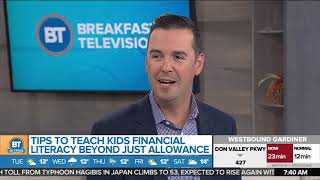
TV interview with CPA Bob (Robert) Gauvreau about teaching children financial literacy. Gauvreau recommends starting age-appropriate money lessons as early as 9–11 (per Junior Achievement), practical habits like saving a portion of allowance (example: 10%), small regular investments, and early paid work/chore-based earning. He demonstrates tools (piggy bank toy) and provides contact info (GOVROCPA / www.govrocpa.ca).
Questions this video answers
9–11 years old (per Junior Achievement in Canada).
53%.
Jack (11) and Sophia (9).
GOVROCPA; www.govrocpa.ca.
Around 12 or 13 (shooting hockey pucks at a hockey school).
Chapters
Financial literacy courses have recently begun to be taught in 10th grade. But is that enough?
Our next guest doesn't think so. CPA Robert or Bob Gauvreau joins us with tips to teach kids about financial literacy that goes beyond an allowance.
Good morning.
And you're a proud pop of two.
Good morning. Yes. Jack and Sophia, 11 and nine. Proud.
Dad, are you ruthless with them?
I am fairly ruthless. They would tell me that. Yeah, absolutely.
Okay, where do we begin? We see a lot of us are in debt here in Canada. We adults should know better and we can't afford homes. So what do we impart and teach our kids so they don't make the same mistakes?
Absolutely. So the interesting part is different age groups have different introductions to financial literacy. And we work with an organization called Junior Achievement in Canada. And they would suggest that the earliest you can start introducing these topics to kids where they can comprehend them, we should start doing it. So at the 9 to 11 years old, we should start talking about how money comes in because of jobs or businesses and money goes out related to rent and mortgages, but basic concepts to start out early and then advance that later once they get into high school. Talking about what your career choices are, how education might influence how much money you make and future obligations you have, like student debt, mortgages and rent and all that stuff.
Alright, critique. I tell my son when he gets some money for a gift or whatever, 10%. Put 10% in the bank and keep the rest. You can spend the rest if you want, but put that 10% in the bank. Just try and get into the habit of saving 10% of your income.
Is it good? Bad?
Am I doing all right?
It's amazing. It's a Great tip because 53% of Canadians live paycheck to paycheck, so. Meaning they don't do that. So it's so important for not only us, for us to teach our kids, but that we actually start implementing that in our own lives. And one tip that we offer our clients that we work with is small. Start taking a small amount on a weekly basis. Get it out of your individual account and into some sort of investment.
So you were mentioning jobs. We talked about this because we were saying, like, now everything's so much more expensive. Like we needed a couple of bucks to kill some time when we were young, or we just wanted some jelly shoes for like a buck. Now it's everything's designer and they want cell phones. It's hundreds and hundreds of dollars for parents. So when should young ones start working? Like, aside from Home, Home allowance stuff. Actually have a job. Do you think it's a good thing?
Absolutely. So we were just talking and I think I had my first job at 12 or 13 shooting hockey pucks at a hockey school. But great responsibility to understand how money comes in and money goes back out. And we were just talking backstage there a few minutes ago that anything in the house, there's jobs that can be done in the house. You can, you know, whether it's chores, whether it's doing deliveries, there's always responsibilities in the house that you can learn how to earn money and understand and appreciate the value of what that means.
But I've had some people say that kids shouldn't be paid for chores. What's your thought on that? You say yes.
You know what, it's interesting. I agree. I think there's basic chores like make your bed, brush your teeth. You know, those certain things that I don't think they should be compensated for because I think that should be an expectation. But if it's, you know, delivering something down the street or if it's maybe cutting the grass or something that's, you know, a little bit outside of the norm, then absolutely, if we can create some knowledge around money coming in and an appreciation for hard work and creating that income, I think it's a great learning point for kids.
Well, and you hear kids are like over scheduled. They have all these extracurriculars. They've got more homework than ever. They need the downtime. Where does the job fit into that? Is it maybe just a few hours on a weekend? Like, how do you put yet another thing on their plate?
Absolutely. So. Well, I feel like job is one element of it. But I brought Monopoly, for example, I think is a great opportunity, even in a fun moment with your kids, to go and have a game and just have an understanding of how you work and money comes in when you're going around the board. And there's obligations like utilities come up and rent, but there's those obligations in life that money has to go out as well. So they just have to start learning the basic skills of how money comes in. What sort of obligations like student debt and mortgages come along with being a responsible adult?
That is a great representation. There's some other games that come to mind that are good to teach kids about financial responsibility.
This little guy, the little doggy.
Oh, yeah, this is my daughter's and she made me promise I wouldn't take any of her money out of it. But this goes to your point of the 10% a week. If you give your kids $5 a week for an allowance and you make them put a dollar away and they can spend four on something they want, at least they're getting an appreciation for what it looks like to save money. Then at the end of the day when they open up a little piggy bank and they see that they've put $20, $30 in there, after a few months, they can really have an appreciation. Wow, look at how much we've saved and accomplished. And it feels good, right? Really great lesson for the future. And I think so many adults could take that same lesson as well.
Speaking of, let's save some cash right now. Does he actually eat the food?
How does this work? We gotta turn this on. Okay.
How cute is this thing?
This is so great. I know.
I gotta see how this works.
Rush, you're take this home and put this in. That's the allowance money right here. Yeah.
Saving all this cash, kids, for the future. Now what do I do?
So you put it right in the dish.
Okay. Eat it up, doggy. Save it up. You know what's going on? Oh, my gosh, that's adorable. Everyone's gonna ask where you got that? For more information, where do we get tips?
You can reach out to us at GOVROCPA, or you can reach out to our website, www.govrocpa.ca.