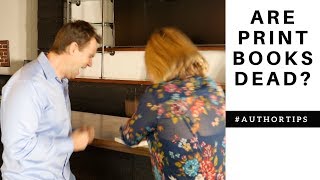
A short YouTube video by Julie Broad arguing that print books—especially in nonfiction—are still valuable. She lists seven reasons authors should offer three formats (print, ebook, audiobook): marketing value, longevity, perceived tangible value, usefulness as gifts/sales items, continued reader preference for print (citing a 76% print share), the ability to sign physical copies, and photo/visibility benefits. She also endorses ebooks for linkability/Whispersync and highlights audiobook growth; closes with a CTA and a mention that her book The New Brand U is on Audible.
Questions this video answers
January 12, 2018.
76% (print) vs. 24% (audio and ebook).
Seven reasons.
Print, digital (ebook), and audio (audiobook).
The New Brand U.
Chapters
Help. Help.
My printed book.
It's dying. Book launchers can help.
Come on, breathe, dammit, breathe.
Why? I turned my back to the camera again. If you're writing a nonfiction book and you're wondering, are print books dead? And you're thinking, maybe I should just be creating an ebook. Well, stick around. I've got some ideas for you around whether print books are dead or not. Hey there. I'm Julie Broad, award winning author and founder of Book Launchers, a company that helps entrepreneurs and professionals write, publish and sell a fantastic nonfiction book. I've had a lot of conversations with potential authors who are thinking that maybe they'll just publish their book in an ebook version only. Why bother with print? Print books are dying. Bring out your dead now fiction authors. If you're writing adult fiction, your digital books are crushing it. Does that mean you don't need print? Well, I'd still argue otherwise. I mean, Santa can't put a digital book under the tree for you. Signing digital books is lame.
Oh, I'd love you to autograph my book.
Oh yeah, I'd love to.
It's on Kindle.
Um, how? Word. And seriously, it's just awesome to hold your book in your hands. You feel like a real author when you can hold your book. But let's talk about nonfiction, because there are actually seven reasons why I think you need three versions. Yes. One, two, three versions of your book. That means print, digital, and even audio. Number one, marketing. Your book is the best marketing material you'll ever create. Whether you're selling your services as a speaker, you're selling a product, or some other service. When done right, this is the most polished version of your message and it should look amazing. So amazing that number two, it lives for a really long time. People don't throw good books out. They'll toss out your business cards before you leave the room. Or at least I do. That's true. Your brochure hits the bin before it's read. Your book sits on someone's desk, shelf or coffee table for months. It will rarely be thrown out. It'll be given away. But that's kind of amazing because now somebody is going to learn about you or your product or your service that didn't know about it before. Number three, a physical book has value. If you speak, you can sell copies to the event manager to give to everyone in the room, or you can sell them at the back of the room. They they may even promote your book as a value add. Number four, you can use it for thank you gifts and client gifts. PDFs get forgotten and they get lost. A book is a tangible item and again, it has value. Even if it only cost you $6 to print, it still has more value than a digital version. Number five, readers still want print books. This is a year old study, but check this out. 76% of nonfiction book sales are in print, 24% to audio and ebook. Nonfiction book buyers want that printed version.
Come on, breathe dammit, breathe.
Number six, you can't sign a digital book. Or at least it's kind of weird. Number seven, try taking pictures with your Kindle only version of a book. That's going to be awkward. Digital is still important. Links are alive. You can send people to view your YouTube video, link to your website, add resources that aren't suitable for the print version. So there's a lot of great reasons to do a digital version of your book. And those digital readers, if they're reading your book, they may engage with you in a way that you can never do with print version. It's also pretty cool what you can do from a marketing perspective with an ebook. Especially with Whisper sync which will connect your audiobook to your ebook, allowing someone to seamlessly switch from your ebook to your audiobook. Pretty cool feature. Can't do that with print. And audio is where the real growth is. Audiobooks are blowing up. And if you're a nonfiction author, creating credibility, trying to build that know like and trust kind of feeling with your readers so they seek you out. There's nothing better than getting your voice, your voice, not someone else's, your voice in someone's head through audio. As a self published author, I think adding audio and even a hardcover book is the new frontier. To stand out amongst all the other books out there. But bottom line, print books are still alive and well, especially in nonfiction. Good news sir. Book Launchers was able to save your printed book. It's alive and well.
Thank you.
In another video, I'll give you some tips to record your own audiobook because I did it for my second book, this the new Brand U and it's available on audible.com if you want to check it out. All right, if you like this video, give it a thumbs up. If you don't like this video, just move on. And of course subscribe to the channel while you're here and I will see you again on the next video.