April Deep Dive: Author Showcase
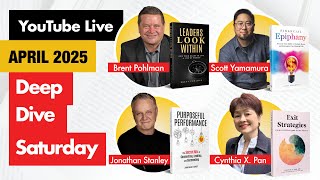
Scott Yamamura, Brent Pullman, Cynthia Pan, and Jonathan Stanley talk through their books, launch strategies, and what worked after publication. They cover podcasts, bookstore signings, audiobooks, and how to choose a cover that sells.
Chapters
Foreign.
Hello. Happy Saturday. Oh, there's Cynthia. She's just arrived. Here we go.
Hello.
Hey, Cynthia. Welcome. All right. Hello, everybody. Welcome. This is our April deep dive training. If you're new to our deep dive trainings, it's two hours of fun and content. So I hope you've got your notebook and your coffee and your water and your pen. You've got a backup pen. But this, this month we have a special session. Like last month, I think we talked about, Gosh, I don't even remember if last month was our cover and layout session. And we've talked about editing and writing and all of those things. And this month, you guys get to meet four of our book launchers authors. And you're going, julie, your math is terrible. There's only three on the screen. But that's because Jonathan is going to show up at 11 Pacific Standard. @ that time, I think Brent is probably going to part ways. So there will always be four of us here. It's, you know, my math is good, but there will be four total authors that will be participating today. So lots of you have already done what I was about to tell you to do. So we've got Brian's here, Bill's guide, Amy, Kevin, David, Rose, Ta, Wendy. I don't know how to say it. Drnd, maybe Dr. Nd, I don't know. Not sure. And then Bill Miller's here. So great to see all of you. And if you're just arriving, do say hello. And I'm just going to turn it over to each of our authors to introduce themselves. I'm going to. I prepped them so they knew they were going to be doing this, so I'm not putting them on the spot. But I'm going to start with Scott because he's in my right hand corner here. And then I'll go down to Brent and then over to Cynthia. So you guys know the order of actions. And I am going to have them introduce themselves and share what their book is about. And, and then we'll just go back around. So you guys ask any questions you want. Angela's also here. You can't see her, but I can. And she will be keeping track of your questions and we'll bring her on to bring your questions on shortly. So, Scott, take it.
Away. All.
Right. Hey, everybody. Scott Yamamura here, author of Financial Epiphany. And I've worked with book launchers over the past several months, and my book just launched about three months ago, early July. And Financial Epiphany is about solving A problem. And I really feel that a book can solve a problem if we as authors identify it. Money can be confusing, intimidating, and most of us don't really have an exact direction plan or even adequate financial literacy. So I set out to help solve that and put one more idea out there and the universe. And what I come up with was that money could be solved very simply. Many of us are overwhelmed by money. There's just so many messages out there, we don't know who to trust. But I figured that if we came up with just a simple set of rules of thumb, that that's all we needed to know. So instead of failing by trying to understand all of money, we can succeed through understanding some of it. And so these three rules of thumb that I had been living for a decade and were really, really working for me, and for those I was talking to, I realized I need to put this into a book. And so financial epiphany is those three rules of thumb. Lots of examples, stories, application. It's 200 some pages, it's a four hour read. And I'm trying to, in the, in the very simplest way to help empower people to get out of debt, learn how to multiply their money and use it towards their life's purpose. And so for me, it's like the rudder on a ship. You shift that rudder just a little bit, those four hours can really, I hope, change a financial life and bring financial health to.
People. Fabulous. And one thing, I'll plant the seed now that I'll come back so you don't have to answer it now. But I didn't warn you about this, but one thing Sarah on my team said that you have dialed in is your messaging. And so she really wanted you to kind of touch on your messaging. And also I think another thing that we'll bring back for everybody watching, kind of wondering what topics we'll cover is you've, you've had to kind of decide or choose when to hop on a plane and go for interviews. And I think you went for.
What was it anything in New York was when I had to fly.
For. Yeah.
Yeah. So I think that's always a good, I think that's a good discussion topic too. Like, why was that worth it for you? You know, because it's not, you're not getting paid to go for an interview. So I think that's a great discussion topic that will come back to you. Of course, lots of other things, but just giving you a fair.
Warning. All right, all right, consider myself.
Warned. Thank you all Right, Brent, take it away. And I'm going to move my logo off of you so that, I mean, I know that you're proud to wear it.
But.
That'S. All right, Julie. Can everyone hear me? Okay, good. Well, my name is Brent Pullman. I'm author and CEO, author of Leaders look within and CEO of Midwest Laboratories. I wrote my book right as Covid was hitting us, and I really wanted to look at my leadership journey because I think a lot of us are trying to understand where leadership comes from, and it really does come inside of each and every one of us. Leadership is very personal, and I wanted to tell that message in such a way because I've learned so much through this. And I think writing the book for me, again, it started out almost like a personal journey. Personal journey or personal journal. And what I didn't see is the impact it was going to have not only on myself, but the lives of others. My employees, my family. The book was a way for me to connect with my five adult children. They said, dad, we don't know what you do. Can you tell us a little bit? So it was really a good way to reconnect with my kids. And I would also say even my employees, there's something about taking the time, investing and writing a book. They just saw that the leader and then sharing that with all of them, that he's. He values something. He's. There's. There's a reason for his madness or the way he talks or the way he operates the company. And the company has flourished, I will say, since I wrote the book, too, which is, again, I didn't see that coming. I guess my advice for you, too, and what. Why I really like this team at Book Launchers is they are there to assist you along the whole path. And I think the biggest thing, I think, as an author that I had to really deal with myself, was that getting down. Maybe I don't have the right words or I couldn't come up with the right thoughts or organizing the content. If you take a pause or take a breath and even give one of these team members a call, they can help you through that process. And as you do it more and more, you'll get better. I wrote my book, and then I released it in May. And that summer, I had two daughters get married. So I had to put a pause on everything. I thought, oh, gosh, have I just ruined the whole release of this? Don't I need to be out there doing something? I will tell you, once you release that book, you have the Next couple of years. I am finding more now than when I released it in 2023. More exposure, more opportunities to speak. The book is coming alive. It's not the. Yes, those first two months are very important, but it's continuing. And that's what this team has really taught me. The marketing just doesn't. It's. It's a year two process. I'm actually writing my second book. I really like this journey so much. I'm starting another book and I'm in the editing part of that again. And by the way, the second book is much easier to write and get collect your thoughts, I think, than the first book. So that's really my summary or my take on this whole.
Process. You stole my thunder, I was going to say, and now you're writing a second book. That's okay. And also, I mean, the other thing I was going to go to you with was about the speaking, because it's been really fun to see the speaking build. And so many authors, they launch their book and they think, you know, I've launched my book. I'm going to be speaking everywhere. And it almost never happens, like, instantaneously. Speaking is such a long journey because especially you're probably, you know, you book stuff six months in advance before, you know, before the event. You actually get on stage. And then you get on stage and people see you talk and then they're like, I've got an event in seven months. Will you speak at that? But I'm going to come back to you on that because that is. I want to talk about some of these speaking engagements and how they've led to other speaking engagements because I think that's inspiring for other authors to kind of know how that, how that happens. So thanks, Brent. It's great to have you here. And he is a returning. And that's. And I wanted to have somebody who had launched their book a while ago because, you know, so often I think people think six months after the book is out, well, that's it. Like, my book's dead. And I love what Brent's been doing because he's still talking about his book and it's still doing things for him. So. So if you've seen him before, you're like, he's familiar. Yes, he's been on one of these before and he was kind enough to come back. So. So thanks, Brent. All right, Cynthia, over to.
You. Hi, how are you? I feel like I need to go and get both of Brent and Scott's books. They're in my Amazon cart. My name is Cynthia Pan. I'm in New York. I'm a hospice and palliative care physician. I see a lot of patients who are seriously ill and a good number who are terminally ill. I wrote my book, Exit Strategies Living Lessons From Dying People, because I feel like we all exit this world at some point. We kind of all know that, but nobody has a strategy. Nobody wants to talk about it. Everybody's full of fear. And also, I learned a lot of lessons along the way through all of my patients. And at some point, kind of like Brent was saying, this idea of journaling came up because it was very heavy duty. It was very emotional, and I had to start journaling to process my own emotions. And as the stories built up, I really saw a lot of themes and trends. So if you get my book, you'll see different themes. Advanced directives is a huge one, which this month, next week is actually National Healthcare Decisions Day. So I encourage everyone to look at their advanced directives. I do a lot of talks on that. But also, like, basic things in life that we take for granted every day, like food, music, sex. There's actually a book chapter called Sex and the City at the End of Life, because these topics come up, too. And I couldn't believe it when it came up for me. I was like, what's this all about? And then it made it into my book. And the trends that I saw are that, you know, just like in life, people have a lot of fears. And that my patients, the people who were able to face reality and look fear in the eye rather than being paralyzed by it, did a lot better. Less suffering, less missed opportunities, more healing in their family. And that the people who are able to validate, name, acknowledge your emotions and process them did better than the patients who shut down. And the people who were willing to ask for help and accept help did better and got more help than the people who didn't. So really just mirroring those things in life, by the end of life, that's the last chapter of our lives. If we don't do what we want to do or need to do, that's it. Your time is up. So it's more important than ever. And I wrote my book with an approach of courage and dignity and cultural sensitivity, and also kind of a lighter approach, sense of humor, because there are a lot of funny things that happen along the.
Way. Wonderful, thanks. And Nafaria said, I just dealt with my own advanced healthcare directives this week. So there we go. Yeah. And, Cynthia, I think one of the things I'm going to come back to you and chat about it was. And I hope you don't mind me saying this, but you, when you were launching your book, you're like, I don't know very many people. My network's small, you know, I don't know who's going to buy my book. And you had an awesome launch. So, you know, I think whatever you did to leverage this small network that you have worked really, really well. So we'll come back. So I'm giving you a little heads up about something I want to hone in on for you. All right? So, yeah, and Joy says, what relevant, meaningful topics, all three. And Kevin said last breaths are important, as are as important as first breaths. Yes, absolutely. I love that. All right, so what we're going to do first is we want prizes. We're giving away copies of everybody's books. So, Angela, can you drop everybody's website links in the chat again, so they're handy? Because I'm going to go in and give away. I'm going to use the Streamyard giveaway and I'm just going to mute you guys until you come back on because there's some. A little bit of feedback coming in. It's not that I don't want to hear from you, though. All right, so the links are going in. So everybody who said hello, you have been entered in. And again, if this is new to you, if you haven't been on one of our live streams, we give away lots of prizes. But we're going to have two rounds of giving away books from the authors that are here. And so just give me one second to bring up this screen. And sometimes this doesn't work. And then Angela comes in and rescues me. So, you know, that could happen because sometimes it just doesn't want to work for me. Okay, so let's see. Start collecting the comments. It's working. And I will share this with you guys. So there are. Maybe I'll share it. We'll see. We'll see if it works for me. Streamyard giveaway. There it is. I think it's going to work today. All right, we see it.
Excellent. I love the.
Giveaways. Me too. Me too. All right, so here we go. So when your name is drawn, you can choose which of the author's books a book I should say you would like. So, T.A. thompson, I don't know if you've won before, so congratulations. Thank you for being here. And let us know which of the four books you would like. You need to email Angela@teamoklaunchers.com and let her know your mailing address as well as the book that you would like. And I'm going to do one more and then we'll do more later. All right, here we go. Who is it? I was going to say book launchers can't win. So, Zaya, I think that's how I say your name. Isaiah. Congratulations. Thank you for being here. So, same thing. Email Angelaeen T E A M book launchers.com and let her know which of the four books. And I say four. I know for those of you who weren't here at the beginning, you're going, I don't understand. There's three authors here plus you, Julie. And it's because Jonathan Stanley will be joining us at 11. And Jonathan, for those of you who don't know, is another really cool example of an author who just kept going with his book marketing. And then a little bit of luck struck. You know, I think it was a lot of preparation, being ready, and then luck hit as somebody filmed his book signing at Barnes and Noble and it went viral on TikTok. And, and it is a wild, wild story of publishing deals and, you know, every media outlet in the United States covering this story. So it's going to be really fun to hear from him and what's been going on since that happened, you know, three weeks ago or so. All right, so Scott, I want to turn it over to you and I kind of alluded to where I want you to cover as well as I also want to hear what's been the big surprise since you wrote your book or even while you wrote your book. Oh, you're muted. Sorry I muted you. Hang on. There, now that'll work.
Better. Oh, I appreciate that, Julie. Surprises. I was not a book reader. If anybody would ask me, when's the last book that you read? I would say it was in college when there was no choice. And so I have become just an avid book reader now. And the book I've read the most, of course, is my own. I've never read the same book so many times over. I want to say it's been 50 plus times. I read it after each edit and in between everything. And so that to me was a big surprise was just my love for books that came along with trying to get an idea out. I was just trying to get an idea out to help people get healthy with their finances. And a absolute passion for books came. I used to be the lowest on the book reading ladder in my household. My wife and son were the book readers. And I became the number one book reader. I love going to the bookstore. I love even just looking at the covers. And usually I leave with a book or two. And so my wife even says, maybe we need to go somewhere else because you're going to end up spending money if we step foot in a bookstore. So that was a big surprise. As far as lessons learned and about the messaging, writing a book, it forces you to refine your message. Each one of us is a subject matter expert at what we want to teach. We've been practicing it for years. It's all in our head. We are wired to understand this. But a book forces us to refine that message so that others outside of our head can, can get what we've been doing. And so I love that because my beta readers had to read this, the editors had to read this, and they helped me get the message that made sense in my head. Makes sense for everybody else to simplify and distill that message down so others can comprehend it. So I think of it as an organized archive for your ideas. That is a book. It really took all those separate ideas which I had in the margins of books I was reading. I had them on my phone, I was emailing them to myself, I had Google Docs, everything, all these notes all over the place. And writing a book forced me to compile all of this, to force it into 11 chapters that made sense and really be able to clearly communicate. So I love that a book forces you to do that because all my conversations were very scattered before the book. And now there's a brand, there are certain terms that are used, there's certain statements that I repeat that I wrote in there. And having conversation now so really refines your message. So I love that a book takes that big mess that made sense to only us before and gets it into something that can be repeatable, make sense to others and really change others lives. Not just my own and not just my small circle, not just my family. So the, the message of the book and figuring that out is money is an ability. In fact, I've got the book right here with the, with the subtitle. So yeah, money is an ability. And I want to help people discover your ability to multiply money so you can reimagine your financial life. That's. That's the subtitle. So money is very much like physical sports. Early in life we have an amazing ability to multiply money based on our age. And like physical sports, it diminishes over time. And most people don't understand that. They're thinking the big myth, which is, oh, when I make more money later when I get promoted, oh, then I'll worry about money. But really, it's when we're young that it's the most powerful. Many of us believe that save early statement or take advantage of compound interest. We believe those, but. But we act timidly with money and we don't take action. So I needed to get a message out there that was so simple and people understood so easily that they could do this simple calculation in their head, that they actually could apply this any day of the week and make huge money decisions to really multiply their impact on this earth, finances being that way. And so what I did was just made money sit still by creating these three rules of thumb. First rule of thumb is that money can double every 10 years under common circumstances. So an input of $1,000 can become $2,000 after 10 years. So money can double every 10 years. The second one is that we start our careers with a multiplying power of 16, and so. And that diminishes by half every 10 years. So now we know we have to act early when we start our careers. This power of 16, and it's halving every. Oh, my goodness, I need to take action. Writing the book forced me to figure this out, this very simple message. Three rules of thumb. I use them all the time in big money decisions. It's so amazing to hear from readers and to get with together with people and discuss how they're applying the three rules of thumb to their life and really understanding money. That was this huge, huge mystery before. So by creating three rules of thumb, it cuts through all the noise. The messaging is simple. It's repeatable. The book forced me to refine, define, distill that idea and communicate it over and over and over again. So that's what I'm doing now is the book is now out there. People can read it without me even being around, which I love. There's an economy of scale there. And I'm meeting one on one with people and doing podcasts where sometimes it's hundreds or sometimes it's thousands of listeners getting this message. And I just love that multiplying factor as well. That can help way more people than I ever was before. This book. It's really like a bullhorn for the.
Message. That's awesome. Thanks, Scott. And I got to tell you, so I have three bunch of things on my brain. First, Cynthia, great mug. Love your mug. Second, there was so that you can't. The, the people watching and listening, they couldn't see all the nodding. But when you were talking about reading your book 50 times or however many times it was, Brent and Cynthia were nodding. And I mean, somebody, somebody was writing. I know I saw somebody else commenting, like, I read my book over and over and over again. So, you know, that's something that I think everybody was relating to. Also, there was a couple questions about your cover. So do you want to show your cover and just take a moment to chat about the COVID art and kind of the vision behind this.
Cover? Yeah, absolutely. So to me, finances is misunderstood. I call it a wolf in sheep's clothing. I myself, when I started to study finance as a normal corporate employee, so I'm not a finance major. I'm not, I'm not a stockbroker or anything like that. I'm a normal person with a normal corporate job who started to realize money kind of has a bad rap. How do we redefine, rebrand money? Because it's empowering. Once I got over that hurdle of learning the basics, I was like, this is not so bad. And so when I was asking questions and looking around and hearing all the stories of what's really under the hood, I mean, you know, financial literacy is, is actually at a low where most of us don't understand financial basics. We spend 18 years learning how to make money in school, we spend 40 years making the money, and we spend 18 years spending the money in retirement money we are immersed in our whole life. But boy, a few of us can say we spent even a handful of hours learning how to steward this, this massive thing that, that we acquire our whole life, about $2 million the average person is going to earn. And so I wanted to. To show that money can be empowering, it can be colorful, it can be exciting. The word epiphany is the most wonderful way to learn. Yes, we can learn something out of a textbook, but what if it's this realization, this aha moment, and I realized myself, I used I love this word because it was simply when I was sitting with my feet up at the dining room table alone one evening and I thought, okay, we're now minded people. Most people want instant gratification. You were ordering something and it's showing up the next day on our doorstep. How do we, how do we take this now minded thinking and turn it. And there's later minded, which is how many actually grow. So I was like, how do we flip that? And it, it was at that moment that I Had this epiphany. And I realized it's not about putting in money. Waiting forever. In 40 years, something happens and we don't know what that something is. But by flipping our thinking and having my own personal epiphany, I realized we have a multiplying power now. This is an ability. It's not about an object that grows. This is about us, our ability, my chance. I need to steward this. I don't want to squander this. It's like being an athlete with athletic ability that's going to diminish over time. Let's take action now. That's what causes this action. So this. This cover, the dollar sign, the light bulb is the ha moment. The. The. The cloud dust and the rainbow colors behind it represents just this amazing reimagining. I use the word reimagining of your own financial life, that it can be empowering that you can have this. This confidence over money that you never thought you could. And those words like discover and redefine and epiphany are just so beautiful. I really think it's the way that we should be looking at money. And not that it's this cold, hard thing. I call it, like, as comfortable as hugging a cash register. That's what most people think about money. It can be so much more warm than that and purposeful, really. The last chapter of this book is called From From Products and Prices to People and Purpose and Money can help us live out our purpose and fulfill relationships and just help change the world. And I want to help people get there, but you got to read the other 10 chapters.
First. Nice work. Way to see the book. That was great. Thanks, Scott. All right, so, Brent, I'm going to come back on over to you. And again, so it's been two years since your last or your first book launched, so when I ask you kind of what surprised you, I'd love you to kind of focus in on kind of the journey after the book launched. And, you know, I think you sounded a little surprised that you were enjoying writing the second book, but besides that part. Yeah, I'd love for everybody to kind of hear about that. You know, two years post launch, you know what surprised you the most in those two years? And then again, because I already kind of gave you the heads up. Let's talk about the speaking journey, too.
Please. Oh, yeah, I. I would say the speaking journey just took off so much last year. I think the Last count was 78. Podcast interviews, something like that. And each one of those, again, we're just different topics, they take the same, they can go a different route every single time. There's no really template for, for having to do a podcast. It depends on the host and what they're going to ask. But that whole speaking engagement took off. Then there's a particular conference I did, I brought the book a year ago and this year they asked me to give two different topics on presenting. So I started to talk more about the second book in the, in that topic and I think what it's also led to with myself going to these and again I'm just relating how the impact of this. Our leadership team at the company came to me and said can we now have quarterly lunches with the CEO where the employees can ask you questions? So I think people are seeing myself online, they want to know more. And I would say another thing that's really been eye opening to me, if you're hesitant about maybe you've got a small group, maybe it's five people. I did that, I've tried this and it's worked phenomenally, is just give your book out to those five people because they will tell not only five, but about 10 more people that you gave, that you gave a presentation and that you actually gave them a copy of your book. So I think through all that it's just showed me that this, this effect, this roller coaster effect is still going on. I, I, I don't see it ending anytime soon. So it just keeps building and building. There was one day I think I did that the book Launchers marketing team set me up. I was on the radio or TV or podcast. I think we started at 7am and we finished at 5pm I think it was 13 times. I was on different stations. I don't know how they do that again. You don't have to worry about the how on how they get those interviews lined up. But every hour I was talking to somebody different and that was huge. So again the, the marketing and working with your team, it's just been phenomenal to see this take.
Off. That's awesome. I forgot about that. That you did that whole day. Yeah. So we call that we actually we're now offering that externally. So if somebody really wants a full day media blitz, kind of like Brent said, it sometimes ends up being a day and a half because we can't get everything booked on a single day. But yeah, we now have a package offering where we will help get you that. But you have to give us eight weeks. Like it takes a long time to line everything up to make a big, big Full day of it like that that Brent got to do. But that's great. I forgot to ask you about that, so I'm glad you brought it up now I do. There was one question here that I think I'll ask you now and then we'll come back to some of the other questions after we give hear from Cynthia. But Joy was asking because few people were like 78, like, what? You've been on that many podcasts. And so then the conversation in the comments started going on about your podcast. So Joy was curious if you turned down any invitations for podcasts and if so, why or why not. Why did you not turn any.
Down? Some of you have initial interviews and you have to. You can. I've probably turned down a couple just because it just did the, the topic of my book didn't quite fit with what they were trying to. To go through. I mean, it's just like anything. You're going to have some good interviews, some not so good. Again, don't beat yourself up. You're just trying to get. You're just trying to tell your story and you'll get. You'll get better at it as you go as far as format. And in the beginning, every. I mean, every presenter is really different, but just come prepared. I. My simple rule of thumb is you'll write that sheet out with book launchers that they'll give to the companies, but have your own sheet. Just say, I think in this one, I really want to touch on these three key themes and keep it really simple. If you just say somewhere I want to bring these three themes out or three examples from the book, if there's an opportunity, I really want to bring these out. Those are my three, I call them goals, my three goals of the podcast. If there's an opportunity, I want to tell that a particular story because I think depending on the audience or I've listened to the. And always listen to whoever you're talking to. Listen to to the podcasts some previous times that they've interviewed other people just so that you get a feel for the conversation and the dialogue. But keep it really simple. Have a little sheet next to you or even on your screen so you're not looking down. And you'll get, you'll. You'll come up with your own little routine as you do these more and more. It's good. It is. It's really good to do.
It. Yeah, that's great. Thanks, Brent. I actually have a video as well, Angela, if you can find it. It's from a few Years ago, but it was like preparing for podcast interviews and talk about having a cue card. Exactly what Brent just talked about. The other thing is after you, because you've listened to the podcast, because I, in that one, I confess how I got. I've been caught a few times because I haven't listened to every podcast and they have like a signature question. And sometimes those signature questions, they're really oddball things like. And it. There's no hiding the absolute shock and surprise on some of those questions. So it is important to listen to an episode before, beforehand, or if you cannot, ask the host if they have a signature question or if there's anything that you should expect. But some hosts will get really offended if you haven't listened to their podcast as well, which doesn't make for a great, you know, good rapport during your podcast. So. So don't do what I have done. You know, learn from my lessons on that and listen like, like Brent said and. And have a cue card that'll note and write the host's name down and the name of the podcast. Because, my goodness, when you're in the middle of that podcast, it is so easy to forget who you are talking to and what podcast you are on. And because you get nervous or you get focused on your message or if you're like me and I did. I don't even know. I've done at least 200 podcasts and so I have. I don't remember. That's just the honest truth is I don't remember who I'm talking to. So, you know, having that handy, I think makes a big difference along with those key points. So that was fantastic. Thanks, Brent. There's lots more questions for you, but we're going to go to Cynthia and then we'll open it up. So if you, if you're watching and you have questions for anyone, we'll do open Q and A in after Cynthia gets a chance to talk about what's been her biggest surprise, along with also her launch, which may have been her biggest surprise because she did not think she had anybody to sell books to when she was working on her.
Book. Yeah, I'm also busy trying to take notes from, like, Scott. So I have several surprises. And so I would say encourage anyone who wants to be an author. And you like surprises, write a book, because you'll get many surprises. So I think my first surprise was that, yes, I could do it. I kind of manifested I was going to do it and I wanted it to be done in 2024. And then 2024 was a very rough year for me. My dad passed away in a different country. I had to go, you know, help him. I had a lot of stuff and deadlines to do at work, which I also had to manage. But I said to myself, I'm just going to get it done. I'm not going to wait anymore. Because one mistake I made was I'm going to wait for the right time. And I was waiting for the right time. And then Covid hit and as a palliative care doctor, I was getting murdered. I was like a shit show. Sorry, I shouldn't have said, okay, so don't wait. And another surprise is that how fast I was able to do it within that year, really with Book Launcher's help and with Julie's process. So I learned that. So, so big plug for Book Launchers. And then my big surprise was the pre launch, like what Julie said Book Launchers warned me a lot about really trying to engage people, people on my social network. And I don't want to write a book and kind of just sell to like 20 of my closest family members or something, which is embarrassing. So I really was trying to plug, like really encourage all my social media and my connections and everyone, which I didn't think I had a lot of connections. But once I started doing this process, I discovered that I did and I was aiming for at least 20. And at some point, I guess the week before my actual launch, I was talking to Todd at Book Launchers and he was giving me like a number and I was like, oh, you know, and the number was like. And I was aiming for 20 to 50, something like that, just so I don't embarrass myself. And he emailed me and he said, right now you have Pre orders for 642. I was like, what? And I emailed him back and I was like, please, please don't mess up the numbers. Maybe you meant 42 or like 64 or something, because I don't think my heart can take this kind of joke. And so he called me up, he goes, no, for real, 642. I was like, what? And I was like, really in shock. So that was a great, huge, wonderful surprise. And then another one was when I got my plaque in the mail from Book Launchers. So sweet. It just made it very real and just wonderful. And then when I actually saw my book in Amazon, which was always my dream, I love buying things on Amazon, especially books and stuff. So a lot of really wonderful surprises and also that I aimed for A smaller group. I was aiming for about 10 chapters, but I. As I was writing and organizing the themes and with book launchers, editors and stuff, it ended up being 20 chapters, so really filled out, and everyone has been very, very supportive. And even though end of life is a taboo topic, what I found out was once I start talking about it, everybody has some experience. Everybody chimes in and says, oh, yeah, that happened to me. That happened to me. So it is out there. We're all human. We have these experiences, but we don't have permission to speak. And that's the goal of my book, is I want to use this book to give permission to speak about this topic because it's so.
Important. Fantastic. Thank you. And I am curious about your cover. You know, was there some meaning behind the imagery for you? And kind of. How did you. How did you come to this.
Cover? Yeah, so I wanted to do well, being Chinese American and being, you know, kind of. This topic has a lot of different sides to it. It started out with an yin and yang type thing, but I didn't want the straight yin yang. I wanted some variation of it, which the Book launchers team really helped me kind of fill out. I also wanted some vibrant colors. So when this came out, you know, a lot of people ask me, yeah, what is this supposed to mean? And I think it's kind of like art is very. It's a little abstract, so people can make it mean whatever they want it to mean. And people have come up with a lot of wonderful interpretations, so it's up to each.
Person. That's great. Thank you. And, you know, people watching the book launchers, TV videos, you'll have seen Brent's cover, too. I don't have your new cover yet. I have to get the new book, Brent. I don't have the. I still have been showing your old coverage, and that's the great thing. After a couple years, if you feel like you want to give your book a refresh, you just put a new cover on it, and it's almost like a new book. But, yeah, Scott. Scott's cover and your cover look really good in the background of my videos. I really like seeing them there. They give it a pop of color. All right, so I know we have some questions, Angela, So. And if you do have a question for the folks here, I am going to. We're going to open up for questions. And while you take a moment and I see Kate's in the house. Yay. Hi, Kate. And she's on vacation all next week, so she's she's showing up to say hello in. In her pre vacation, pre vacation mode. Or maybe her vacation has started. So thanks for being here, Kate. Kate's on our team, in case you didn't know. And there's Angela. So Angela has come from hiding in the backstage into the front. Okay, so do we have a question? You want to turn it over and I'll do, I'll do a draw after the first.
Question. Yeah. So I've got three because we've already answered a couple. I've got three starred. Two are for the whole panel. But Brent, since you unlimited time, there was one directed toward you that I thought we should answer first. So I'll put it on the screen. This is from Bill and it says how did you begin the podcast?
Interviews? Yeah, typically you have to come up with. I, I think Scott said it best. Come up with that short message about yourself while you wrote the book. Just be really succinct. Talk about, talk about your. Talk a little bit about yourself and the book and just keep it really short. What. And with the purpose of writing the book. So that's how I typically start out if, if I'm not given a, a question right away. Most of the time you get a question right.
Away. Sorry, Brent, I was trying to give you solo layout and I took you off the thing for a minute. Oh, dear. I appreciate that. All right, so thanks. Thanks, Angela. Sorry, everyone. So here's the next one and.
You guys could just unmute if you already have an answer, but says I'd love to hear the author's process to go from a draft of scattered topics and thoughts to an organized structure and order that takes the reader on a journey and gives concise takeaways. And perhaps all of you mentioned that as part of the very, very beginning processes. So that was Dance into Colleges question. Does anyone already know exactly how you started to put everything together in this process? Yeah.
Cynthia. Yeah. So I was journaling and I had random chapters and I took advantage of one of book launchers offers nine week process where if you commit a certain, you know, amount of time with a writing group that by the end of those weeks you would have a final draft. So I signed up for that and I diligently just follow the process. I really believe that when I'm doing something foreign that I'm not an expert at, to go find the experts and follow their advice. And that really got me to a final draft. So it was very.
Useful. I would, I would just add.
Say, yeah, I saw that. Go.
Ahead. My Second book, I use a spreadsheet with columns. I list all the. The different chapters or themes. And even through the editing, I just got my first round of edits and I went back to that again. And it's helped me organize my thoughts, all the comments that are put into those editing scripts. So I use a spreadsheet format and I just list out those because I think that's the hardest thing for me is putting the topics together and making sure you create that journey that you want to take the reader through. So I've really found that really helpful this second time.
Around. That's cool. I don't think I've heard very many people use a spreadsheet. Yeah, that's a neat, neat idea. Scott, do you have something to.
Add? Oh, yeah, sure. So like I had mentioned before, I had notes in the margins of books. I had them on the phone, emailed to myself all over the place. So I started writing one long Google Doc. And I realized that was so overwhelming when I heard that, hey, why don't you break this thing up into chapters? Okay? That was the first step that really helped. But then I did get stuck being a designer in the past. Graphic designer, web designer. My brain kept on running into a hurdle, and it was, how long is this chapter? What's it look like? And I couldn't break away from visualizing the book as it was happening. So I actually. Understanding design, I actually started writing the book in a design program. So I saw exactly what it was like on the page. I wanted to see the page number. I wanted to see the little subtitle up top. I wanted to see the column and the paragraphs that helped me actually get through because I had really gotten stuck before, and that was just the way my mind works. So the other thing I want to mention to any authors out there is book launchers will help you with any of that. But if you have a custom way of thinking and developing a book, maybe there's a way you can lean into that's right for you. Because my. My way was definitely, I would say most people are not designing the book as they're writing it. They're going to be in a document. But for me, it's what I needed. So you can ask yourself, what is it that. Where's your background? Where's your experience? What's that roadblock for you? And most likely book launchers can help you get over that hurdle. But certainly there's so many different ways to get a better book written. And so I'd want to have you ask yourself, what's the right way for you.
Now? Thank you for that. Now, before everybody goes off and designs their book while they're writing it, I want you to tell them what happened when you went to editing. Did it stay in that beautiful.
Design? No, it needs to go back to a document again. So, and so that was a good learning experience. I realized that. Absolutely. So it helped me get the book written, the content out, because I was stuck. So it helped me get the content out because I kept asking myself, what's it going to look like? What's it going to look like? How long is this? How short is this? But it does go back to a document, and that absolutely has to keep going back and forth. I learned how many editing stages there are, and each and every one is so utterly important. I realize the importance of every single editor that's specialized in what they do. You're looking at the content, you're looking just at the spelling and the grammar. You're looking at, should you say this or should you not? You're looking at, is this properly attributed to the person that actually said this? And you know, we're dotting all the I's, crossing all the T's, making sure that we're covering our basis and giving credit where credit is due. If you're, you're pulling sections from what other people set and that, you're just being accurate. The fact checking part was huge. And that's, that's actually one of the major reasons why I went to Book Launchers is I wanted someone to fact check me. I was like, I have this idea with personal finance. It is working wonders for me and the people around me, but I got, I, I don't want to just go from that small circle to many, many people. All the podcasts that, that Brent is doing, there's got to be a middle step where people have to be checking me on this. And that helped me with my confidence going through Book Launchers and them just getting my back and taking so much time and effort to really check me, including the fact checking step, which I really, really love. That's once again one of the big reasons why I wanted to partner with Book Launchers. So. Yep. And then it went from that document back into beautiful layout and the physical.
Book. Thank you. I just wanted to bring that up for everybody because so often, I shouldn't say so often. Often it doesn't happen that often, but sometimes people bring me beautifully designed books and they're like, my book's ready to go to publishing and I'm like, great. Have you had any editors? Well, I've put it through Grammarly or. Well, I've read it. My. My spouse, who is really good with grammars, read it. And I'm like, I'm sorry, but this is. This needs to go back to a document because editors are not going to function in a design file. But you do what you need to do. Like, I love what you shared because I think that, you know, everybody. Every brain works a little differently, and to be able to go to editing, you have to do whatever it takes to get the manuscript out of your head onto the page. And so, you know, I think it's great. I just wanted everybody to kind of know that that is. That's not how it's going to end up. It has to go. I always tell people, you're. We have to make your book naked before we can dress it up again. So, Angela, I know you have more questions. If there's anything.
For. Can I. Can I add something also, please? Because I. What I learned through this process was that there are different types of editing, that there's content editing and line editing. I didn't really know that, like, very specifically. And my. My draft. My manuscript. My manuscript draft was ready. Book Launchers helped me get an editor to read through it. And then there were a lot of comments that came back, and I was really exhausted by then. I was like, I don't think I can go through these comments and, like, one more round. But I had a lot of pride. I didn't want to use a ghostwriter, which was available also. So that took, like, quite a bit of time. And I was behind schedule. And finally I swallowed my pride and I said, all right, I'm going to work with the ghostwriter. It was Dan Good, and he was so great, and he really helped me push forward to the final draft that was then ready for the line edits. And then there was another process after that. So it's like, you know, it's quite a.
Journey.
Yeah. Can I add.
Something?
Yeah. Oh, just. I need to call out Ina Davis, who was just an amazing editor for me, and, oh, my goodness, I didn't know someone could be so good at what they do. So everybody out there, when you have an expert in your corner and you don't know what you don't know, and that expert editor, like Ina show shows you what they know. Oh, my goodness. She uncovered so many awesome changes, and I just really leaned on her and felt so confident about the book after. So I needed to make sure I. I called her workout.
Awesome. Thank you. We'll be. We'll be sure to let her know. And our little. My little secret is we. We work with a lot of contractors. I think we have like 65 contractors. But time and time again, when the same. When the work comes back, it exceptional repeatedly, we bring those people in house. So our cover designer, she, you know, it was one of those things where I kept seeing these covers. I'm like, whose cover was that? Oh, that's Cassie. Whose cover? That's Cassie. Who's. Okay, that's it. She's coming in house and we're keeping her. She's ours. So that's the same with Ina. She was always, you know, she did copy editing for us, but she was also doing fact checking and it, you know, she just really, really stood out from all of the other people. So I love, I love that you shared that because, you know, we love, we love everyone in our book launchers family, our contractors too. But whenever we find somebody who's extraordinary, that's when we, you know, say, okay, we don't want them as contractors. We want them all to ourselves. So we got that. I forgot where we were going now, but. Oh, Brent, right? Was Brent. We were going to give Brent the last one more question and then, then we don't. Because we don't. We want to respect your time, Brent. I know you need to leave.
At the top of the hour. Real quick, though, Scott, what was the name of that design program someone was.
Asking? InDesign. Adobe.
InDesign. The design program you use.
Okay. Which is. Which is where the book ends up, you know, working with us. Not Everybody Designs in InDesign. I do recommend, if you're paying a designer to design your book, that they do end up designing it in InDesign. So. Yeah. So Scott's book started in InDesign and ended in InDesign, but had a journey in.
Between. Me personally, because I had that capability, it was right for me because I was like, oh, why am I not doing this? But, yeah, for most people, I would not recommend InDesign and doing it yourself. I would start with the doc and then lean into book launchers when it's time. That's going to be your more common.
Approach. Awesome. Brent, we had a question from David that's directed toward you and your speaking engagement. So, Brent, how did your speaking process? Process takes.
Shape. Yeah, I think when I released the book, I, I thought maybe I'd, you know, that you'd get a lot of calls right away. I think One thing that helped me, and I would encourage you to do this, but I took the book, I used LinkedIn, the newsletter on LinkedIn, and I went through every single chapter. I started once, one chapter a month, and I talked out the theme and then some examples about it and how it applied right now. And I did all 13 chapters. And now it's just a monthly newsletter. But I think it got people, again, interested in the book. The more you can get your book out there in some format or some way, whether it's your side, whether it's social media and all that, it's very powerful. And once people have it, they may not comment right away. But there are so many people who know that I've written a book and I've never seen them comment on social media again. You don't know what that number is, but I think that's where I got a lot of these speaking engagements. The other thing are articles I've asked, been asked to write. I never thought of myself as a writer until this book, but I've been asked to write articles for about four or five different magazines. So again, when you speak at a group or you even send your information to a group, somebody's looking at your content, someone's looking at your book. And don't be afraid to send your book with some of your information. And then you'll get into other articles and you can find other ways to bring people in on your book. So I think that's really how that whole speaker piece really lined up. But Book Launchers does a phenomenal job about that with the marketing piece. They'll, they'll, they'll get you in front of a lot of people. Just be ready because it's a lot, I'll tell you.
That. Yeah. Thank you, Brent. And there is some, some prep work that needs to be done. I'm going to drop a link to some of the YouTube videos that Julie has about that prep work, because Brent alluded to some of that. You don't want to go in there blind. There are things you can do and then there are other things that will build on your marketing ecosphere that that is created. Brent, we do want to be cognizant of your time. Thank you so much for joining in today. It's always, always lovely to have you on here. Hope you have a great.
Rest. Some great com. I've been reading the comments. Some great people on here and great comments. So thank you so much for. Let me be part of.
This. Absolutely, absolutely. Well, thank you so much.
Cynthia. I'm going to buy your books too. So thank.
You. Hey, same.
Here. Awesome. Scott, I wanted to direct that question over to you as well. Since you've also done some speaking engagements. How did that process take shape for.
You? Yeah, absolutely. So that's one of the offerings of Book Launchers. And so I received right away. Surprisingly, it was before my book launch that we had this podcast in New York that needed to be in person that came up. The podcast is called Afford Anything and the host is Paula Pant. And the year before I had seen Paula Pant as a keynote speaker down in New Orleans. And so I was like, oh my goodness, here's someone that I really respect and that is a big name in the personal finance sphere. And so I was just so, just amazed that that came right away. That was the first one. And so of course I was going to say yes, this has been, you know, a, a real mission of mine to get out there and, and get the word out whatever it takes to help people with their finances. And I knew that was going to take writing a book, it was going to take having a website and it was going to take individual conversations. It was going to take podcasts and videos and I'm open to any and all of it. All these things that I may have been uncomfortable with before, I am willing to do now because this is for the, the good of, of other people and their financial health. And after I'd realized what a common hurdle this is for most people. So Book Launchers has been continuing to send me opportunities with podcasts regularly. And so my next one is next Saturday. I love it when it's on a Saturday because I do have a full time job. And so, and that one's going to be really awesome. It's going to be speaking to parents and youth and finances for kids. And I just love that topic. I love the idea of, hey, let's, let's customize this message to this audience to parents and, and what's right for their children. I have a 16 year old now. I've been teaching them finances since the single digits. And I love seeing how empowered and how normal, healthy finances is for him because he's never known any different. He didn't have to be traumatized by money first to get on board. He knows it from the beginning. And so I love that audience. And, and there's just other audiences I've really enjoyed. There's the faith based audience. How do you steward money with faith as a consideration? And then there's the professional career people and there's the older generation or the, the if you're in your 40s, middle, middle aged. And I love thinking about all those different audiences and who these podcasters message and audience is for and, and customizing it. There's always going to be that core message. But then the fun challenge every week or two is how do I kind of lean this way for them or how do I lean that way? I also love having repeatable messages and seeing how people respond to them. And so it's fun. Some of these things I'll say every single time, and other times there's just something I'll try new. It's kind of like what I hear from comedians on a stage. You're testing that new message. So I find myself not having done public speaking to now loving it because it's the message. I want to change people's lives. And so my, you know, comfort with being in front of people comes secondary to that. And I love that idea. For anybody out there, you all have a story to tell and it's so worthwhile to get out there and you're the subject matter expert. And all those other fears wash away when you're up there helping others people have a better life. So thanks for asking.
That. Yeah. And that's so great. Thank you. Thank you, Scott. We do, we realize the time we do want to give another prize away. So, Julie, you already have the, the random name picker pulled up. You want to go.
Ahead? Yeah. So when you see your name, you can choose which of the four authors because we have Brent. Brent has just left and Jonathan's just coming in. David, congratulations. So email Angela@teamoklaunchers.com and let her know which of the author's books you would like. She will put the their website addresses in the comments again so you can see. And I'm going to draw one more. And if you're sitting there wondering, am I in the draw? Well, you are are if you have made a comment. So if you have not yet said hello, you'll want to make sure you do that because we're going to do one more round of prizes before we end the day. And so let's see who our next prize winner is. And K.J. oh, no, it was. It paused for a second. Joy, congratulations and thank you for being here. All right, so email Angela at team T book launchers.com and all of the author's websites are showing up in the comments, so you can go and check them out. And then let Angela know when you email her which book you Would like her to send you as well as of course, the mailing address. Because sometimes people just say, oh, I'm so excited I won and I want this prize. And she's like, great, where do I send it? So please do let her know where to send it as well. Okay, so I think we still have more questions. Do you want to pick another.
Question? Yeah, yeah, we absolutely do. So this is from Linda Magoon. Question. Yes. It's so nice to have. I hope you're still here, Linda. Has anyone conducted their own book talk online? Yeah, go for.
It. Yeah, yeah. So before I forget, Scott, I have to invite you to come and talk to our doctors in training at my hospital because doctors are so focused on their training and they make whatever money, but they don't really know how to like, you know, invest it or do whatever with.
It. So I do hear that. Great.
Wonderful. So in terms of doing my own book talk online, I've done a lot of. One regret that I have is actually, actually I haven't been making as much use of the book Launchers marketing team. I get emails from Angela Bell and, you know, and then I get overwhelmed. So I don't follow up on them because I also have like a very full time job. So I want to make a commitment to follow up on that. But in the meantime, I've done like my own talks from my own network. So for example, I'm a graduate of Harvard University and I belong to the Harvard Club, Long Long island, and I'm in touch with them. So they actually invited me to do an online talk for alumni and I was allowed to invite other people too. And that went really, really well to the point that people were asking. It was done online virtually and people are asking, oh, when is your next presentation? So that was like really reaffirming. And I've also done in person things. I'm going to do one in my local public library here. And I had watched Julie's video, or I think it was in your book about how to approach libraries, my first approach, and didn't want to do anything with me. And when I changed my approach to Julie's approach, that's when I landed the.
Talk. Thank you. Jonathan's trying to get in, so Angela is trying to help him get in. So let me just see. I think I can invite him right from here. Let me just try one more time. Let me.
See. I can say a little bit something about my own approach to the library, which did not work. And then Julie's.
Approach. Yeah, let's Do. Let's do that while we get Jonathan on. And. And that'd be great because I think libraries is a great topic as well. So, yeah, I'll. I'll put you back in solo so you can keep.
Going. Okay. So I had approached my library because I really felt that I should do one for my local library. And if my local town library doesn't support me, who would support me? So I had written to the person who's in charge of adult programming and things like that, and I just never heard from them. I called and I left messages. Nothing. I got ghosted. I emailed them. Nothing. And then I listened to Julie's book about getting that. Libraries don't, you know, they're not in the business of helping individual people. So I had said, can you please help me get the word out? And, you know, they don't. And then I changed. My approach was that I got some of my local friends who use the library or who had connections with the library to go and say, hey, one of our local residents just published a book. We want the library to have a copy. So asking other people to advocate for you to say, we request copies of this book. And then they did get it. And then I emailed them and said, I'm a doctor and I published this book. I think that the content can really help your audience and your readers and of the library. So at that point between those two things, I did get a call back, an email back, and I'm scheduled for May. So it seems like a little thing, but, you know, it made a big.
Difference. Yeah. Libraries in particular, it works with bookstores, too. You know, if you get people going into the bookstore store and requesting, like, they have to physically be in the bookstore requesting it. But then it works well if you've also had sales. So Barnes and Noble, as an example, if you've been selling a decent amount of books and then you have a couple of people go into a location and they request your book while they're there, then they happen, they'll pull it up and they'll look at it. They'll order it in for the person, and then they'll see the sales history. And that's a simple way. Then the bookstore will go, oh, okay. I guess people are asking for this. But libraries are even more receptive to, you know, the community because they're. They exist to serve the community. And so when the community starts asking for a particular book, it's a very quick, usually a very quick window for. For the book to then be carried in in the library. So thank you for sharing that. That's great. I think we have some other questions as well. Let me just go back. And Angela's still trying to help Jonathan get in. I'm not sure.
So. And.
Then. Oh, yeah, you got something to add? Yeah, no, go.
Ahead. Yeah, yeah, yeah. Just on the topic. So not online, but I can definitely talk about trying to have a. An audience and throw some sort of event. Not online event, but there was my book launch, and I want to say that I was wondering, should I do a book launch? Should I not? That's scary. Are people going to show up? This is worth putting some money into and renting a facility. There's all this preparation, a slide deck or a talk or whatever, decor, food, beverages. Is this worth doing? And so. But I will tell you that when I had the book and I saw that thing, it gave me the confidence to lean into that and to take a chance. Because fear of failure is a huge thing as an author if you're going from zero to an audience. And that was me. But having a great book gave me the confidence to say, let me do this and try this event. So I rented out a public space and we decorated it all day and had food and drinks and slide deck and many speakers too. That was actually helpful. I didn't make it just about my book. It was about financial empowerment and confidence, hearing from many people, from getting out of debt to I want to get this and 401k plans. The retiring chief financial officer of Costco Wholesale, who's in my area, came to talk at my book launch. And he talked about 401k plans and he talked about giving. And that was so amazing. Richard Galanti showed up and closed out the whole talk. It was just so incredible. It was a dream come.
True.
True. I couldn't believe it. That was my book launch. I was thinking maybe 30 people would be there. Then my stretch goal was 60, and then over 100 people showed up in person. And that was so incredible. And there's no way I would have ever stepped into that if I didn't have a great book to start with and just be proud of and have that confidence. So I recommend having a book launch party if possible. It's not for everybody, but in my case, it's just. It was like having a second book wedding. I tell people and it was the work of having a second wedding. It took that much work. But it was just it. They say a wedding is one of the greatest days of your life. I would say my book Launch was one of the greatest days of my life as well. It was just so incredible. So thank you book launchers for helping me get.
There. Oh, thanks, Scott. And I love that you had other people at because it takes the pressure off you but it also can attract other people to the event. So I think that's great. We've got Jonathan here and he has a very short window of time. Thank you for joining us, Jonathan. It's a pleasure to see.
You. It's great to be here. How is.
Everyone? We're good. We're having fun. We had Brett here and he left and now you're here. And so I teased a little bit earlier about some of the wild ride that you have been on. And so I'm going to just turn it over to you to first give people a quick, you know, the, the 62nd what your book is about. And then I would love for you to then tell them a short version because I know it's been a wild ride. So you probably have a long version and a short version. So we'll go with the short version of what has transpired in the last month in particular. And then I kind of want to go back and talk a little bit more about, you know, because luck was involved in what has happened. But if you weren't ready for this moment, you know, it probably would have been a very different scenario. So I've given everybody a heads up of where I'm going to take the conversation. So I'm just doing the same for you. But yeah, can I just turn it over to you to tell them about your book and kind of what's happened.
Recently? Yeah, absolutely. So my book is about bringing humanity back to the workforce. It's really about leading with people, purpose and values that are aligned with that purpose and moving forward towards the aspirational change you want to make in the world with intention. The second part of the book is a strategic framework to help people achieve those goals and fulfill their purpose. And you know, it was, it was a lot of fun writing the book. And so I had this sort of moment in the universe where I was doing a Barnes and Noble signing and this little four year old girl, she bravely walked up to my table and told me that she wanted to be an author when she grew up. And in that moment it was just really special. She told me she'd created her first book and she touched my heart. At the same time, I didn't know that her mom, Taylor May, had recorded a 10 second video of me sitting alone at the table with no one stopping by when, when Taylor was there. So she posted this TikTok video that went hyperviral, a 10 second video that went hyperviral and touched every corner of the globe. Overnight, I became an instant bestseller. Within a few days, I was on Amazon charts for the most sold and read book of all books, placing at number nine. So. And of course with all of this came, you know, all of the media requests from People magazine to the Wall Street Journal to cnn, NBC News, getting national attention in Canada. It's been a wild ride and, you know, incredibly grateful. And it's opened up, you know, new opportunities I couldn't have.
Imagine. That's great. Thank you. Of those, I mean, yeah, my team was dancing for days because we love our authors, but it's like something special for you because we all have loved, loved, loved working with you. And it's just been one of those things where we're all like, it couldn't have happened to a nicer person. And so we were so, so happy that this is what happened for you. And so I know I want to kind of highlight some of some of the things that have happened, but I also want to take a step back and talk about how you were ready for this moment, which I think is something people miss, you know, when, when they see, oh, that was lucky. And I even saw some crazy comments like that this was all a contrived PR play. And, you know, some people just, they're just mean. But, you know, and it definitely was not a contrived media play. It was, you know, you were out there promoting your book. You didn't stop. You were still doing book signings, which I always tell people, they look so cool in the photos, but they really are quite, I don't know what the word is. Humbling, I think is a good word as an author, because people come by and they're like, do you know where the Starbucks is? Where's the cookbook section? Have you seen the bathrooms? And you're like, I got this really cool book. Do you want to talk about it? And they're like, oh, yeah, yeah, maybe.
Later.
Exactly. So, yeah, so talk about kind of the preparation and how, you know, when this lucky lightning bolt struck, you were ready for it and kind of what you think was important, you know, what was some of the preparation that led to you being able to make the most of this.
Moment? Yeah, I first want to see that, you know, the media sort of took this angle that, you know, I was a lonely author, you know, sitting at a Barnes and noble. And I want to say that that's. That's not the case. I was incredibly grateful to have the opportunity to be at Barnes and Noble that day. And I think it's a privilege as an author to be able to have the opportunity to share your message with the world. And so, you know, I came back from that book signing having sold 12 books, and I shared with my wife that it was a great day. I mean, I was really lucky to have the opportunity to speak with people. And, you know, showing up is so important. And so, you know, from the moment the book was published, you know, I really focused on the message. I started going and attending podcast interviews and having a LinkedIn strategy in terms of the message I wanted to share. So every sort of piece of this was about reinforcing the message I wanted to share with audience. But my entire goal through this process was to touch one person, to make a difference in one person's life and sort of the. But the amazing thing about this is I write in my book about the power of kindness and how it can, you know, a small act of kindness can have a ripple effect that reaches every corner of the globe. And that moment was reflected back at me. I mean, I've had thousands upon thousands of messages from every corner of the earth. And the love and support, encouragement has been absolutely incredible. So I think there's a few lessons learned here. And number one is believe in you. Number two, believe in your message. Number three, have a strategy behind that message. And show up. Continue to show up, even when it's hard, even when no one's watching. You know, don't seek the approval from others. You know, fulfill that purpose even when no one's clapping. Just get out.
There. Yeah, that's great. And that's something I always tell people, is it is a privilege to have an audience. And so, you know, when. When you have three people in the room and you hoped for 300, those three people could be three of the most important people you will ever, ever impact in your entire life.
So.
Right. It's. It's so important. And that's why I love your story so much, because you. You touched that little girl's heart and vice versa. And now everybody around the world has. Has seen it, and thousands and thousands of more people have read your book. Even watching the Amazon reviews climb in the week after it was incredible. And people weren't just buying your book, they were immediately devouring the book. So it's good. You had a good book when this.
Happened. I would say, Julie that this would have been sort of a flash in the pan, that 15 minutes of pain fame, if the book didn't stand on its own. And, and so, you know, I've been very blessed, of course, and, and to hear back from readers that they're motivated and inspired and it's changing their perspective on leadership. I mean, that's, that's deeply moving. And, you know, sort of through all of this and, and I've shared this with you, Julie. I mean, the most important part of this process for me was, was editing and working with your team and having those tough discussions. You know, more than 60 pages of my book ended up on the cutting room floor. And you've got to be open to that. You can't be so in love with your story that you're not willing to give up pieces of it. And so you've got to strive to be the best version of yourself and be thoughtful about the tough discussions you need to have about what's working and, and what's not working and, and why it's not working. And so, you know, elevating that book was so important to the process. It really sort of took it from, you know, a possibly three and a half star review to five star reviews. And, you know, the outcome of this is, you know, I've got publishers reaching out to me from every corner of the globe looking for foreign translation rights. I mean, it's just been an incredible privilege to be in a position to help others.
Succeed. Yeah. Thank you. I'm sure there's questions and we have other questions that we can bring up that you might answer as well. But I would say what's kind of your. What are you most excited about right now? Now that all of this has, I wouldn't say settled down because I know there's still lots of things happening. But what is happening right now from all of this that you are most excited.
About? You know, for me, it's the opportunity to touch so many more lives. I can't speak in terms of confidentiality, but there'll be a press release in a couple of weeks and it's really exciting. So the book is going to go to much wider distribution. I'm going to touch a lot more people and I'm really excited about that. So, you know, in my future there, there, everyone asked the question, yes, there's going to be an audiobook, yes, there's going to be a tour. All of those things that you would expect. And I'm just super excited about the road ahead. And obviously, you know, through all of this. I've received hundreds of speaking engagement or requests. I'm being very selective in terms of who I talk to because. Because I want to make sure my message aligns with audience. But in my future, I see sort of touching a lot more people and getting in front of audiences and really focusing on the message, which is we've got to bring humanity back into the workplace. As leaders, we have a responsibility to help people become the best versions of.
Themselves. Wonderful. Thank you. And thank you for sharing some of your time today with us. I think we still get you for 10 more minutes, so I'm going to hold.
It. Yeah, yeah, I'm happy to answer questions. And we can go 15 minutes because I was late, so let's add another five.
Minutes. Thank you, Scott. Cynthia, do you have any questions, anything you want to ask? Jonathan, before we open it up to the.
Audience? I just want to say I've seen some of those media pieces. I've heard your story, Jonathan. I am so inspired. So myself as an author, I know a lot of people on here are as well. So thank you for just your response, your humility, and riding this wave. And it's great to see that it's possible. I love that you just pushed forward and. And the right thing just hit for you. So. And I've read some of your reviews on. On Amazon as well. I just. I just love that people are so happy that you're doing what you're doing. So thanks for putting yourself out there. Thanks for doing that book signing at Barnes and.
Noble. Thank you so much. Thank you so much. That means the world to me. And as authors, we've got to keep lifting each other.
Up. Yeah, I totally agree. I want to say congratulations and thank you for all the great work that you're doing. I have a couple questions for you. One is, how did you arrange the Barnes and Noble book signing? And two is, what are your plans for the.
Audiobook? Great questions. So Barnes and Noble in my local community, you know, they're 20 minutes away. And I reached out to Barnes and Noble in December and I said, you know, I'd love to do, you know, an author signing inside of your store. And they got back to me and said, we're not supporting local authors right now and, you know, come back to us. So I waited until the new year. I went into the store, I met with the store manager, and I said, listen, you know, I've had some success with my book. I shared the resources that Julie's team had put together, and I said, I'd be excited to be here and do an author signing. And they got back to me a month later and said, you know, Barnes is no Barnes and Noble is back to helping local authors succeed, and we'd love to have you. So we scheduled the date and the. Funny. You know what, you don't know about this story. As I said to my wife, I don't know if I'm going to do this Barnes and Noble. And she said, yes, you.
Are. That's fantastic. I did not know that. So I bet you were giving your wife a big hug and a kiss after this, maybe.
Flowers. And to answer your second question, I produced an audiobook. I wasn't completely happy with it, so it's in the can. And for me, I really want to take a thoughtful approach to this. I want to do it right. I want to make sure that it's done in a way that supports the message and the brand. And so, you know, as I move forward, I'll certainly be working with a partner to make that happen. And like I said, you know, within the next couple of weeks, you're going to see a really exciting press.
Release. And there was some questions about foreign translation rights. And I'll, I'll come back to you in a second on this, but I'll tell you that we've actually had a, you know, a decent number of our authors land foreign rights translation. And one of the secrets is not a secret. You just got to sell books. If you're selling books, they're watching. And then if there's demand for that subject, you know, the foreign, the foreign publishers will contact you. But, and I'm going to ask you this part in a second, but we always refer our authors to work with Drop cap. And if you're interested in this, you know, we'll, I'll put the link in, or Angela can put our link in. So you, you can kind of go through our pathway into Drop Cap. But you want to have somebody negotiating this on your behalf, because it is a tangled web of things when you start working with foreign rights translations. So whether you're working with Drop Cap or someone else, you know, that's a web. And I don't know if this is tied up in the announcement or if you're able to allude to how you're handling foreign rights. But I know you've had lots of, lots of people asking you about.
It. Yes. So, you know, I am having an agency represent my foreign rights. And, you know, the best, the best path forward for me is obviously not trying to navigate this alone, there are people who are really successful at obtaining foreign rights and negotiating those contracts. And every contract is different. So you want to make sure that you're working with a partner like Book Launchers, who can help you facilitate and negotiate those best deals. Right. So from a foreign rights perspective, it's really important that you've got the right representation at the.
Table. Yeah, absolutely. And one of the things why we work with Drop Cap in particular is they're one of the few rights agencies that specialize in self published indie authors. And so, you know, for all of our clients, the vast majority are self published. And so we want somebody who's going to work with them directly versus a lot of other companies they're working with publishers. And so you don't quite get the same treatment and attention. But the other thing is, once you get a deal, you still have to get paid. And if you do this on your own, it's going to be up to you to chase them down and get paid. However, if you work with a company like Drop Cap, they're going to chase you, chase the money down and get you paid. That's part of what they do in that agreement. Which is why I think it's so important, because, you know, besides going to Frankfurt Book Fair and all the book fairs and having your book represented by somebody else, you know, having somebody that's going to make sure once this deal is done, you're actually getting what is owed to you, I think is really, really important.
So. Really important. Really.
Important. Yeah. Great. Angela, are there any questions that we want to put up there? You know, that we can have all three answer? Kind of maybe lightning.
Round. Yeah, let's see. Sorry, I was looking at the Drop Cap stuff. You answered the foreign rights one. I think there was a lot. Oh, some people are curious, like how everyone chose their.
Titles. Oh, that's a good. That's a really good one. All right, so we'll do somewhat of a lightning round on, on the title piece. Let's go. We'll start with.
Cynthia. Yeah. So for my title, I had conceived of it, Exit Strategies, Living Lessons From Dying People that really captured what I wanted to talk about. And it kind of had a business, you know, bend like Exit Strategies. So I thought it was a little clever. People maybe get a little curious about what it's all about. And then I did work with the Book Launchers team as well as a lot of friends and family about changing it. But ultimately, I think everybody, including the Book Launchers team, really liked my title So I kind of stuck with it. So that one wasn't really too hard for me. It just, like, came to.
Me. Great. Thank you, Jonathan. We'll go to you.
Next. Yeah. So I'm going to let the secret out of the bag. I completely relied on Julie and her team to come up with some concepts around Tidal, and I let them fly with it. And they gave me 10 variations. And I fell in love with purposeful performance, which, by the way, I was on this sort of wild phone call yesterday with the publicist for bands like U2 and David Bowie and Depeche Mode and New Order, and he said to me, I love the title of your book, man. So thank you.
Team. Hold on. You guys couldn't see me, but I was doing this. I love to hear it. I love to hear it. Thank you for sharing that. That might have just made my day. All right, Scott, your.
Dirt. Yeah, I started out with a spreadsheet, and so I actually did some research and looked at where the most common words used in the personal finance space. So I looked online to see what common titles were out there. I just did my own research and I looked at how I tallied how many times money was mentioned or finance was mentioned or investing was mentioned. And then I looked up other words that were being paired with it. Something that comes to mind is how the names of some companies that we're very familiar with got formed, like Microsoft. This combination of a couple words. How did other big companies or books come up with their name? And so I tested all the different matches and I came up with financial epiphany. And that just came just sounding so good. I loved how it sound. I ran it by a bunch of people and when I ran it by Book Launchers, so I came into the process. I would have involved myself a lot earlier, but I hadn't heard about Book Launchers until I was so far along with. With the book already. But when we did run the. The title by Book Launchers, they certainly gave me other things to consider. And we kept coming back to the original financial epiphany name. So I like that it was. Experts were really looking at it too. But I will say the. The big help I got was on the subtitle. I think it took me something less than two months to figure it out. It took a time, long, long time. And Book Launchers helped me through that one. The subtitle might have been harder than the title itself, so. And it's so important to communicate in such a short amount of words too. So thank you for. For that.
Help. Yeah. Thank you for sharing. And it's funny, your. Your process is a lot like ours as far as we do our keyword research. We do your competition research. Like, we kind of look at the space when we're talking, when we're looking at titles, and then we brainstorm a lot of things. But the subtitle has such an important role because, you know, the title is the thing that everybody has to remember and say, and, you know, they're, you know, they have to be able to spell it, like, all of those kind of things. But the subtitles job is the SEO and the reader identification. Like, when a reader sees your subtitle, like with one of the conversations we had with Cynthia about her title was we're like, okay, Exit.
Strategies. This really.
Cool. But our subtitle and your book cover have to really make it clear to the reader we're not talking about how to exit your business. Right. Because Exit Strategies could very well be a book about business exits. So that's where, you know, that's where the subtitle plays such an important role because it has to help the reader go, oh, okay, that's what this for. And then the COVID has to speak to that reader as well, because you have to be very careful with those kind of things. But that subtitle, in Amazon in particular, the title subtitle combination is 80% of your search engine optimization. So that's where we really want to make sure we're identifying that reader and making sure you've got keywords and all of those things. And the title subtitle is one of the pieces that isn't very easy to change. Right. We can change the COVID We can update your description. You know, you can, you know, make updates to the inside of your book. But as soon as you change your title, you're looking at, you can do it. But there's a whole bunch of pieces that have to be changed and a whole lot of work that has to go into even trying to keep your reviews and all those things. So cool. What else do we have? All right. Says one thing that really helped me finish my book was reading it out loud. Did any of you read your book out loud to help edit? I'll just open it up. You guys go free for all.
Anyone? Yeah, I will say. I will say I did not. However, I did read a number of lines in a studio to do the acknowledgments, and it's a very different experience, and I would recommend it if you've got the.
Time. Yeah, it sounds different when you read. I, I always recommend people do their audiobook in layout and read your book out then because you'll catch last, you know, you'll catch last minute things that you might want to change before it goes, it gets published. And then, you know, to me, reading it out loud is sort of painful. So reading it out loud for a purpose makes it easier for me. That's why I like to read it out loud for the purpose of my audiobook. But did Scott or Cynthia, did you guys read your book out.
Loud? Go ahead.
Cynthia. Not the whole thing, maybe just here and there, little pieces of it in kind of mental prepar. Preparation for going to do an audiobook, which I would like to do eventually, but not the whole thing. And it is.
Painful. And my answer to it is not having read the book out loud. But I, I had 14 beta readers, so they're reading the manuscript and they told me their input out loud. And some of it was painful. Just like Jonathan said. I think I lost about 25% of the book in the beginning. It had to go. And I got that from a couple beta readers and they verbalized that and they said, you're taking too long to get to the point. And they said, you're telling too many stories. They're like, get to your point sooner. And that was extremely good.
Feedback. I had the same.
Feedback. Yeah, it all makes sense up here, but when someone else is approaching this for the first time, they're like, wait a second. It don't take so.
Long. Take so long to get to the point. All right, let's do one last question and then we will, we'll do a prize and we'll say goodbye to Jonathan. So Angela, is there one, one more question that we can throw to the group? Oh, this is always a good.
One. I don't know. Answered this one earlier. I think you were going.
To. We were about to. Yeah, that's.
Right.
So. Yes. How many edits on average? I'll start with Cynthia and then go Scott and then Jonathan and then we can, you know, bid you adieu and thank you for, for your time today, but let's go.
Stop. Yeah. So for me it was a content edit and then it was. Okay, it was a content edit, it was a line edits. And I think for me, each one was about, about probably 10 times. So it was tedious. And I had to really like discipline myself and going back to the editor to create a timeline for myself. I would write these appointments into my calendar to make sure they Were.
Happening. That's great, Scott. Yes.
Sorry.
Yeah. Yeah. I wonder if all that is. Together were under a dozen rounds and it just kept refining and getting better each time. But, yeah, between content and line edit and fact checking and just checking spelling and grammar, all those things, I read it in between every single time it came back to me and I was pleased for all the changes. But it's well worth it to. To feel confident, get it refined, to get every little word, every little letter looked at. It's worth.
It. Yeah. For me, I went through the content edit, line edit, and of course, proofreading, and it was incredibly valuable. There's, you know, if. If you omit editing from the process, then, you know, I believe you will fail. And it's not because, I mean, even Stephen King has a great editor. And so it was such an incredibly valuable process for me, and it pushed me to do better and be.
Better. I want to add.
Something. Go.
Ahead. That. In a previous author showcase that Book Launchers did, I learned a trick from one of the other authors. I think it was Nick. But he said somewhere in the middle of the book, maybe like 30, 40, 50 pages in, to say, like, break for a favor. If you're enjoying this book, please write a brief positive review. So I actually put that in my book as a direct.
Ask. That's great. Thank you. Yeah, that was another author showcase. Angela can probably grab the link for anybody who wants to watch that one that had Nick Rise of the Reader in there. One of the things I was going to mention, and I'm sorry, my brain. My brain went over there. Was I going to say, oh, I know. So I don't know if you guys have had this experience, but I. I hate my book. About the second round of copy edits. I am tired of reading it. I don't. I don't want anything else to do with it. I think it's a terrible book. And this is. I've written four books now, and I've had this experience four times where I think it's a terrible book at that phase. And then I. By the time the book launches and I've given myself a couple months space and then I go back, I'm usually like, wow, this is actually really good. And I'm working on a second edition of Self Publish and Succeed, and I was reading through it for the first time in probably two years. I probably haven't read through the book in a couple of years because that one came out, I think, four years ago. And I wrote Alyssa on our team and I was like, this book's actually really quite good because I'd forgotten. But in the middle of that book, let me tell you, I did not think it was any good at all. So you don't have to have had that experience. But I'm curious if any of you.
Did. That's such a great question. You know, for me, I just felt like it was an opportunity to just do better and be better. And so I was, you know, I was really encouraged through the whole process and, and I, you know, I haven't gone back to read my book, Julie, and I probably should now, but I can tell you that through the whole process, working with your team, it was just, I just love the fact that I was challenged and, and it was inspiring for.
Me. That's great. Thank you, Scott or Cynthia. Did you. I'm not the only one that hated their.
Book. No, I can, I can speak to this. Absolutely. Because my career is, is communication. It's in video communication. And the very. I was wondering if, if there was a psychological path to creating that paralleled video. And absolutely it does. So when your idea is all up in your head, it is perfect. It is just makes sense to you. Everything's just perfect. And then you start putting pen to paper and then you're like, oh. And there's a huge psychological drop where you're like, you got to start at ground zero where there's nothing on the page. And that's a, that's a hard phase to get over. In fact, as I forced myself to run this race, halfway through, I stopped for months and a friend came up to me, a colleague, and says, how's your book going? And I'm glad that I had an accountability partner like that because I said, well, I took a pause, but I am going to jump back on. And I did. And it's good to have accountability partners. But there is a psychological drop when, when everything goes from in your head perfect to nothing's on the page. And this isn't coming out right, but that running, that turtles race and that step by step and that steadiness and that consistency and sticking to it is so well worth it. It took me three years to a three year journey to write that book. It's done. It's done forever now. And you know, hey, is there going to be a book too? I sure hope so. There's some chapters, actually, I pulled out to simplify this first book, so I'm starting with something for the next.
One.
Awesome.
Awesome.
Cynthia? Yeah, I think that I never really hated my Book. I like my book. I so believe in that. It's a real message that needs to get out there. I was getting tired of the process and I think accountability partners are really, really important. Before book launchers, I had gotten my own coach, like a well being coach, and had gotten other accountability, but it never really worked until I got to book launchers. So I really just want to say how important it is to really work with experts. Yeah. So important. Oh, and the other thing that people told me was nowadays if you really want to get your message out, a book is a must. You know, the book is like the new business card but like times 10. So having a book is so.
Important. Fabulous. Thank you. Well, Jonathan, I know you need to go. Thank you so much for being here today and thank you you for sharing your journey with us. And again, we're just so excited. So keep in touch. I can't wait to hear what the announcement is. I have some guesses, but I can't wait to see what it actually.
Is. Julie, anytime. I'd love to chat about where I am at and where this is going, but just super excited to be here and thank you so much for helping me with my.
Journey. My pleasure. Thank you so much. All right, we're going to do another prize and then we'll have a little bit of time left for a few more questions. So let me just pop on into the prize, the prize portal one more time. Oh, wait. Whoops. Wrong. Wrong portal. Wrong portal. Okay. Share screen. I was inviting people, not giving prizes. Here we go. Now we'll do it. There we go. Okay, here we go. So everybody who has commented you are in there and let me hit the draw again button and let's see who's going to win a prize. So we're giving away the books from the guests today. So Alvin Dawkins, congratulations. Angela's going to drop the links for the authors that have been here today in the chat so you can take a look and then email her@teamoklaunchers.com and let her know which book you would like her to send you as well as your mailing address so that she can get that off to you. And then we'll do one more here and then we will do questions until the top of the hour and then we will shut it down. Okay, next up. Oh, Jason's here. Hey, Jason, glad to see you here. All right, drnda42, congratulations and thank you for being here. So same thing for you. Email Angelaembookcontros.com and let her Know what book you would like her to send you. All right, Angela, what other questions do we have for the.
Day? Sorry, I am multitasking clean over here. I am putting in their everyone's websites. So I'm just putting in the last one now for.
Jonathan. And those are the question about how long from initial editing phase to.
Publication. All right, let's do that alter. And since you're talking, we'll start with you.
Cynthia. Yeah, I would say it really depends on, like, how avoidant I was. So if I did everything and then I didn't avoid it, I didn't take, like any unnecessary breaks. It would just be line editing. I'm talking line editing now, probably maybe three months. So as long as I was doing everything and keeping myself on schedule, it didn't really have to take that long. I think when it got delayed was because I got fearful. I got avoidant. I was like, oh, my God, can I really do this? I started doubting myself, using excuses, but otherwise it doesn't have to take.
Long. All right. And for me, from the first edit to launching the book, it was about eight months. And each step was valuable. Like I said, even the subtitle, I think I took two months to probably do that. So as parts came up that needed more attention, we took it as other parts were quicker. As a designer myself, I was able to help out with some of the process, like the website, for instance. Then those parts went quicker. And I do want to call out Shane the web designer. Oh, my goodness, my website. I love, I adore. He took off of my plate what would have been extremely painful for me. So that was happening during the book. You know, there's these other things that are being developed as well. There's copyright that's happening. There's the website potentially. There's all these other messaging and marketing tools that are being created as well. So it's not just the editing of the book itself. There's. There's a lot going on.
Concurrently. That's great. Thank you. All right, next question. And also, we haven't mentioned our group. A lot of people have been asking, when's your next deep dive? And how can I make sure I don't miss these? The best thing to do is join. We have a free group and we have a calendar in there, and you'll get notified when there's. I mean, the newsletter, of course, is one thing. So if you're not getting our newsletter, that's the first thing to do. But then the group is the next thing. So, Angela, you can bring up the questions and I'll put the websites in. Unless you're already. She's so fast. All right, so that, that first link, that school link, that is our free group that you can join and meet our other authors. Some of them are here. Kevin hall, you know, they're. They're hanging out in there. And it has a calendar so you can see when our next live streams are. So you can see. I don't know if we've posted the May schedule yet in there, but we'll be posting that really soon. So you can see when the May deep dive is and all of those things. But then also our newsletter, of course, because we will send an email when we're doing these sort of things so that you don't miss out on them. All.
Right. Yes. And, yeah, someone just asked, will this be available later? Like, yes, obviously this is live, but it will stay on our YouTube channel so you can go back and watch it later. You will need to go to the live tab in YouTube to watch this again. It's not an upload, it's a live stream. But yes, this will absolutely be available later. Okay. So someone had asked, asked if anyone here had recorded their audiobook. And I know we. We heard about from Jonathan, but have either of you made that decision, already gotten started on it? What's your plans, if you're willing to.
Share?
Cynthia? Yeah, I really want an audiobook. People have been asking me, when are you gonna. Are you gonna have an audiobook? And I think Book Launchers has a resource to help with that also. So I would like to do that. Sometimes I dream about that. I'm going to book myself a studio in Nashville and just stay there for a few days and just, like, do it, but I haven't gotten the time. I do want to do it, but I don't know what the process is, so I have to explore.
That. Scott, what about.
You? Yeah, it is a common request once the book is out. You know, in my case, there's a paperback and then there's the ebook. But then there's this whole audiobook category, and there's a demand for. I do get asked frequently. I've even had voiceover artists come up and say, hey, are you looking to do this? So I do intend to do it. Once again, this book is done. It's reached an excellent place, Perfection, almost. Whatever. It's locked and loaded and ready to go. And so an audiobook version over time would make sense. Right now, I'm focusing on what's at hand. Right now already. And so just getting podcasts, going marketing and speaking engagements and just moving what I have on my plate right now. But getting around to audiobook is definitely on my.
Plate. Yeah. So I think the audiobook process. I'll just touch on this briefly. There's a lot of paths now, and I know some of you are going to absolutely hate on me because I get hate every time I say it, but there's now a lot of AI options to do it cheaper. And also, you can clone your voice and still get some decent distribution. Now, for people who are still actively promoting their book and they do have time, energy, resources to invest, I still recommend you be the one to narrate the book, because at the end of the day, it's your voice in their head and nobody's going to read, even a professional. In nonfiction, a professional narrator is. Is not going to read the book like you would because this is your material. So I still. I still prefer All Day Long, a book narrated by the author themselves. Now, for me, this is. This is an interesting thing, but I came to the realization recently that that's my number one. So if that's the choice, like, I want that book All Day Long, the book narrated by the author after that, if it's a professional narrator or even a robot voice, I don't really. It doesn't really phase me which one it is. Now, I'm good with robots, so that's one thing. I'm fine with them. And I don't have this aversion to, you know, the. The devices and their voices and the voices that are there are much better. So there's paths. Right. You can narrate the book yourself. You can hire a narrator to narrate the book for you. You can clone your voice and produce the book. Not able to distribute it on Audible yet, but you can distribute it to Spotify and to a lot of places. Now with your voice clone version of your book, it's pretty good. It's still lacking the emotion of a human, thank goodness. Like, the day the robots have our emotions is the day that, like, I'm gonna be glad I've made friends with them. And then there's also Audible, which I. Or, yeah, Amazon, which I just did a video on, where they have a really good repertoire of voices that you can just basically hit a button and your book gets converted and it doesn't cost you anything. And somebody's asked me the question recently, can you still distribute it other places? Yes, you can only use that particular version on Amazon. But you can distribute a different version on other platforms. If you say, like me, have a voice cloned version. So there's not one single path. Again, my preference and recommendation for the majority of our authors is to do that narration yourself. It's actually really fun. So, like, your dream of going to Nashville and getting a studio and doing it there, you'll probably have a blast. Like, it is really cool experience to narrate your audiobook. I would do it sooner than later. Because the thing with your book is when the audiobook comes out, all those people that have asked for it, they're not going to go back. Like, they're not checking every month to see if you've released an audiobook. So the sooner you have it, the more sales you're going to get. Because it is tricky to sell an audiobook only, right? Like, people come to us and they're like, I just launched my audiobook. Let's do a marketing push. And I'm like, it's really, we're going to do a push for you and your book. Like, that's where that media blitz package followed by some podcast pitching might make a lot of sense to kind of give you some momentum and push. Because it's not easy to sell just an audiobook. It's something that people will buy if you've bought it, but they're not, you know, there's no notification feature, like, notify me when this comes out in audiobook, which would be great, but it's not there. So. All right, what other questions do we.
Have? So someone made a comment about. About websites. It wasn't particularly a question, but the interesting thing is all of our authors, pretty much every time we do one of these, they always have author websites. And that might not have been something Scott and Cynthia, that you might have realized we would be as necessary as it is when you first started this process. So what. How did that transpire for you to perhaps not even realizing that you might need a website to having one that you can direct anyone to it, whether you're at events, podcasts, anything like.
That. So before they answer. Yeah, I was just gonna say, before they answer that, I'll tell you that we learned that one the hard way. So we make. We make it a requirement of every one of our office authors. Whether we make it or they get somebody else to do it, we make them get an author website. And the reason is because we had a book many years ago, we got a really great magazine feature for them. And then when they asked for the author website, and they didn't have one. We lost that feature. And that was the moment where we realized that every author has to have a website or they don't look credible enough to the media outlets. So it, it's a requirement. It's one of those things where we don't give you the choice. It's like it's not, do you have a website? It's how are you going to get this website? Sorry, Cynthia, go.
Ahead. Yeah, so I also use Shane and I'm very proud of my website. I really love it. I think Shane did a great job. One of the things that I struggle with because I'm not so techy. So I give a lot of input into the website and Shane really helped me. But then once it's done, it gets handed over back to the author. So in that case, it's me. So I'm responsible for updating it and putting new material in it. And I know that Shane had given me like a job aid to do that, but I really, I'm not good at it. So I haven't really done it. So that's something that right now I'm struggling with and I'm trying to find maybe a webmaster who can help me do.
That.
Yeah. And as far as a website goes, it's that net to capture people 24 hours a day, seven days a week. It's always there. It's the neon sign that's always lit and so you could be sleeping and someone could be looking at your book and buying it right there. Having a digital download is very helpful. People will give you their email address for future communications and if you're presenting them with something that of value upfront that they would want to download, maybe it's a little stepping stone to getting your book. I certainly refer to that download in my book as well. So there's this talk happening back and forth between the book and the website, but having it is absolutely necessary. Shane did a wonderful job. Took the pain out of my life by assembling that together and taking the sort of work that I didn't want to do off my plate even though I was involved in the design of it. Oh, and I did want to add one thing about the audiobook is that many of the people asking me for an audiobook are commuters. So 45 minute commute, hour and a half, sometimes in traffic. I'm in the Seattle area and so yes, I plan to do an audiobook and if I can make your commute any easier, plus change your financial life at the Same time. I'm going to do.
It. I love it. Thank you. Yeah, it's. And so I always tell people, we have some clients that 40%, 30%, 40% of their book sales are coming in audiobook. And that is because if you are talking to moms, entrepreneurs or people that kind of live in an area where there is a big commute and that can be on the subway too, like, I know a lot of people in Toronto and some of those other cities, New York, they have subway rides where they listen to audiobooks every day on, on the way in and the way out. Those are, those are people who are. They would probably love to read your book, but they're not going to buy it because they'll just know they're never going to read it. But they would listen to it. So, yeah, it's great. All right, so I know we have a few more questions popping in here and I see Christina George's question. Do they teach you how to collect emails and autoresponder stuff? Yeah, we're, we're kind of obsessed with author platform building. So we do some. Spend time helping you get reader magnet or a lead magnet going and make sure that you've got emails set up. We also have a community. So if you're not working with us in our full service, we have a paid community called Author Business Accelerator. And I think, I think I saw Beth here. I know Beth's in it. I don't know if Laura was here. I thought Laura was watching. I thought I saw, I thought I saw Laura's name as well. They're both in our. Oh, and David is here too. They're all in our Author Business Accelerator Community. We help you with reader magnets and talk about, you know, book descriptions and all things marketing as well. And it's a low fee paid membership site as well. We also have some software that's coming out really, really soon. We're going to be making the official announcement sometime late May and then it'll be available for sale in June. That will help you all with that. So we have some exciting stuff that we're building on for, for the book marketing world. All right, questions. Oh, I like this question. Kevin. Sorry, go.
Ahead. Julie, what were you gonna.
Say? Oh, I just say. I was just saying I like this question. So Scott kind of alluded to the fact that he's already starting on his second book with the leftover chapters from his first book. But. But yeah.
Cynthia. Yeah. So now that I know this book process, I have a couple of books that I really want to write. They're not in the same vein in terms of themes, but one book I want to write is everything I learned, I learned from YouTube because it really, like, documents my struggles with public speaking, how I can do that, my actual writing, because I used to have writer's block, and I wanted to write my book. I also wanted to write for academic purposes, as a doctor in an academic community, and I just couldn't write. I would freeze every single time. And I even hired, like, on my own ghostwriter, and I was paying the guy, and he wasn't writing better than I knew I could. And then one day I went to YouTube and I said, how to overcome writer's block. And then I got, like, 10 different videos, and I chose the shortest one because I had no time, and it actually really helped me overcome it. So that was really great. And then I started going to YouTube and for, like, styling advice, because I'm petite. Okay. I'm short, and I need to, like, know how to style myself, being short and being Asian and stuff like that. And eventually I found that YouTube had a lot of answers. So that's the book I want to.
Write. That's great. I love that. Scott, anything you want to.
Add? Yeah, you said it. With the. The chapters that I pulled out to keep my first book succinct and to the point. The second book would be potentially just more advanced reading. The first book would probably help with. With the second one. But I'm trying to think about how if someone just picked up the second one, it could stand on its own. But certainly I want to keep teaching. There's folks that want an easy, simple entry point into understanding their money, which is the first book. But then there are those that want to become savvy and move on to that next point and simply, there's great ways to teach finances at any level, simply. And that's what I want to continue to do and help people become savvy once they graduate from the first.
Book. That's.
Great.
Yeah. Thank you. And maybe one for.
Teenagers. Yeah, you said.
It.
Yep. All right, we've got five minutes left. We're gonna do rapid fire to try to get through the remaining questions. But also, we have one last prize we want to give. It's almost like a secret shopper prize. So, Angela, who's monitoring all the comments, we like to award somebody who has been participating, you know, cheering other authors on, all of that sort of thing. So, Angela, who is our prize winner for.
That? It.
Is. And we've had several so please don't. Please don't take this personally, but Wendy Mangeant. Mangent. Wendy, please email me at team tam booklaunchers.com you can choose from any of the four authors books and I will get that sent your way. And I think at some point you had mentioned that this was actually your first live stream, which is pretty incredible. So, Wendy, again, I hope I'm pronouncing your last name correctly. Please email me because you are our.
Winner. Fantastic. Thank you. All right, let's do rapid fire. See if we can finish off a lot. Last few questions before the top of the hour. And thanks, Cynthia and Scott. You guys are champions for doing the headlining the headline act today for two.
Hours. Yeah, absolutely. Some of the questions are more basic. I'm trying to stick to some there specifically for them. David had asked anyone using books buy for sales understand seller obtains buyer email.
Address. I'm not familiar with.
It. I'm not.
Either.
Okay. So I just wanted to ask next question. That was actually it as far as. As questions directed toward the authors. Unless some have come in within the last.
Month. That's.
Okay. I can follow.
Up.
Oh. Oh, yeah, go.
Ahead. Yeah, I was. Oh, I was just gonna say any final words. Anything last that you want to share advice for authors and. And that'll be a great. A great place for us to wrap.
Up. Yeah, just a continuation of the last one of writing a second book. Also, all the feedback they're getting about your first book is perfect for the second book. Or if there's something that you didn't answer in the first book and it's coming across as you're getting it out there, it's the perfect net to capture the new ideas for a second book. So certainly after you read that first book and start getting feedback, it's like, all right, let's put that one on the list for material for the second book. So I just had that for now. It's not a closing statement, but. Cynthia, did you have anything.
Else? Yeah, I also wanted to follow up on a previous topic that was mentioned about COVID design. That when I was having trouble deciding between several cover designs that Book Launcher's design team had sent me, I actually put my favorite ones, maybe my three or four favorite ones, on my social media, whether it's LinkedIn or Facebook or whatever it is, and just ask people to vote. And that was really, really helpful process for me. So that was a good tip for me to choose.
It. Great. Thank you. I just sneezed behind the scenes, so that was perfect timing that I was not talking. All right, do you guys have any final parting words that you want to share with anyone? Scott's nodding, so we'll go to you.
Scott. Well, it's like running a marathon, writing a book. It's hard work. There's effort, there's fear of failure that you gotta get past. And Book Launchers helps guide the way. And so it's helped me gotten to this place where the book now launched three months ago. Financial epiphany launched three months ago. It's like climbing a mountain for a while and you're wondering, like, how tall is this mountain? How long is it going to take? I'm sweating. This is hard work. But then there's like a slide on the other side of this mountain. You and you go down this thing. You don't know what you're going to get. But it's, it's an exciting adventure where now the book is done. I'm no longer. This is out there. Before, this was only in my head. And now there's, I would say there's conversations every day. There's either an email, there's either an in person conversation. I'm hearing from Book Launchers on new opportunities. And there's something that I'm always prepared, preparing for, you know, whether it's a podcast or a talk or this other thing. So the adventure that comes after you climb that mountain is so worth it because that slide that goes down is, is an amazing ride. And I love hearing the other stories, like Jonathan's story earlier where he just ran into this amazing opportunity. And I've, I've enjoyed every single opportunity I have had. And I spoke at a school school with 200 grade schoolers just the other week. And that was, that was a blast. But yeah, you never know what's going to happen. And, and the book is done. It's just so amazing to have a completed book. It says just by handing that to that book to somebody or having them buy it, that's 10 years of research, three years of writing, and a certification in finance that I got all in the meantime. And it's, it's all right there. And it's so nice to have a product, an item that encompasses all of that. So thanks to Book Launchers for helping me get here. It's done, it's circulating, it's creating conversations and helping people with their financial lives. So I really do appreciate it and I hope all of you on your journey get to that point where you have a completed book. You can be Proud of and keep getting your message and story out.
There. Thank you. That was fantastic. Cynthia, parting words and then we'll wrap.
Up. Yeah. I want to also say Book Launchers is a huge accountability partner. Really? From like soup to NAS A to Z to get everything done. And I used to think, like, knowledge is power. Everybody knows that saying. But now my thinking has changed. You know, knowledge is potential. Action is power. So actually doing it and get that book done and have it in your hand. I have people coming to me and say, hey, my father's in the IC or I'm encountering this situation, and I can really refer them to the book in addition to talking things out with them. And just like Scott was talking about maybe audiences that you may not expect. I went to a catering hall for a party, and the person who was managing was saying, you know, everybody thinks that we do celebrations, which we do birthdays and weddings and everything, but also people come in, like, after the funeral, and our staff don't know what to do with that because, you know, they're into celebrations. So nobody knows how to even talk to them or acknowledge them. So I offered to do a talk based on my book. So I'm in conversation with them about.
That. Yay. Oh, that's great. I didn't know that. Wonderful. Well, thank you. I mean, thank you to everybody who has been here for all your lively comments and chat. That's been great. And thank you, Angela, for giving us time on your Saturday to help me manage the livestream. I'm always so grateful for. For you to take your time for us on the weekend. And Cynthia and Scott, thank you. Thank you. Thank you for sharing your experiences and being here for the full two hours. I'm very grateful to you and it's been a pleasure working with you and continuing to work with you. I'm just so excited to see where this fun adventure takes you guys next. So, yeah, you guys have been.
Watching for a long time and now you're in the spotlight, which is so excited. Thank.
You.
Right. Yeah. I saw this author's Spotlight last year and that inspired.
Me.
Hey. And here you.
Are. That's awesome. Well, thank you everybody for being here and look forward to seeing you guys on the live stream. We're doing Book launchers TV. Our regular Tuesday live streams happening at 2pm so look forward to seeing some of you back there then.
Bye. Love you guys.
Bye.
More from Julie







Should You Skip Amazon When You Publish Your Book? #digitalmarketing #amazonauthor



