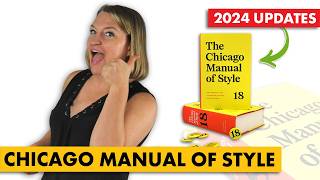
YouTube video by Julie Broad (founder of Book Launchers) summarizing key changes in the Chicago Manual of Style 18th edition and explaining what nonfiction authors should know. Highlights include new title-case rules for longer prepositions, capitalizing words for racial/ethnic identity (e.g., Black, Indigenous), capitalizing first word after a colon when a full sentence follows, dropping place of publication in citations for post-1900 works, recommended placement of acknowledgments in back matter, and guidance for modern items (AI citations, emojis, text messages). The presenter emphasizes that authors need editors who are up to date and promotes Book Launchers’ editorial services.
Chapters
Big news for every editor out there. The updated Chicago Manual of Style has finally dropped after seven years. Well, how much has changed? And as an author, what do you need to know? And, well, should you care about this? If you're wondering any of those things, Well, I have fabulous news because this video is for you. Hey there. I'm Julie the Book Broad, founder of Book Launchers, a self publishing services company helping nonfiction authors build a business around the book. We will help you write, publish, and promote. Now, we take books pretty seriously, and quality is one of our core values. We hire experienced editors and have people on our team who absolutely nerd out with joy when things like the 18th edition of the Chicago Manual Style get released. If you're an author, you don't need to know all the rules. That's what editors are for. But you do need to know if your editor knows. Here's the thing so many people tell me. Oh, yeah, my aunt is a great editor and she edited my book. And then I'll ask what style book she followed. Was it Chicago Manual of Style? And the author just stares at me. No, she just has a good eye for typos. Well, that's fine, but I would call that person a beta reader, not an editor. Because my friends, real editors like Ena Davis on our team, who announced with glee that her weekly win was the 18th edition was out. I'm not even kidding. True story. She was happier than my son when he pulls a great Pokemon card from a new package. Conforming to Chicago standards makes your book look more polished and professional and ensures that it conforms to current best practices. As an author, you don't need to read 1000 pages of this information, but your editor needs to be up to date so they can take care of that polishing for you. When new editions are released, most of the core rules stay the same. But the manual adds new rules to reflect evolving standards and suggestions, and it clarifies existing rules to address common questions. In this new edition, many of the updates relate to accessibility, inclusivity, and technological changes that have taken place since the last edition. So what has changed? Well, according to Ina, because believe me, I did not read it and I will not read it. But some of the most notable rule updates include prepositions that are five letters long or longer, such as about, beyond, throughout, or without. That was like a cruel joke to, like, hear my Canadian accent. Let's unlock that Canadian accent again, shall we? All right. Prepositions that are five letters long or longer, such as about, beyond, throughout or without, are now capitalized in titles. Previously they were lowercased. This means that Much Ado about nothing becomes Much ado about nothing, Chicago's example and A year without a Santa Claus becomes A year without a Santa Claus. The W is now capitalized, so this form of capitalization is now officially called title case. Instead of headline style. Prepositions that are four letters or shorter are still lowercase, so the capitalization of a room with a view, Chicago's example, and Water for Elephants remains the same. When a full sentence follows a colon, the word directly after the colon should now be capitalized. Previously, the word directly after a colon was only capitalized if two or more full sentences followed the colon. I don't know, I think I was doing that one already. That one really confused me. But I never worry about these things because I know my editors will catch it. However, in my newsletters, I sometimes get people who point out my errors and I let them know that my editors are busy working on books and I'm the only editor on the newsletters. Speaking of the newsletter, do you want to make sure you're up to date on all the latest changes in the publishing industry and you're invited to our Deep Dive training sessions that happen every month? Go to book launchers.com newsletter okay, here's a few more updates for you. The word black is capitalized now when it's used as a racial and ethnic identity. Chicago actually introduced this change between editions, which is something they do very rarely, but but it's now being formalized with the inclusion in the 18th edition. The words indigenous and native are also now capitalized when referring to people. And one of the things that excited Ina the most because it will save her so much work when she's fact checking books for books published after 1900, Chicago no longer requires place of publication to be listed in citations. Chicago also now recommends that the acknowledgments pages go in the back. Book matter. Previously, Chicago allowed authors to choose between placing them in the front or the back. I've been saying this for quite some time, and I've told people to disregard anyone saying that front was okay. It belongs in the back. So now Chicago agrees with me. All right, just for fun, Swiss in Swiss cheese and French in French dressing are now capitalized. So is talk in ted talk. The 18th edition also includes helpful updates for the modern day, such as rules for citing AI text and images, punctuating emojis and formatting text messages and styling text message abbreviations, and even writing out the names of memes. Well now you're up to date. And again, as an author, I think the most important thing for you to know is that you should be checking in with your editor to see if they are up to date on the latest changes. And if you want to work with Ina and our amazing editorial team, you know, you know people who live for things like Chicago manual style updates as much as Cassie, our lead designer, lives for font packages. Seriously, do you know how awesome it is to be surrounded by people who aren't just experts, but they love what they do so much they're giddy over these things? Well, that's the kind of team we have at Book Launchers. And you can work with us in a variety of ways. We have our author business accelerator for us to guide you, or you can hire us to do the work with you on your book. So reach out to booklaunchers.com apply and let's see how we can help you. Now, what are the different kinds of editors you need? Because it's not just copy editors that you should get on your team. This video covers that important topic. And this is the video YouTube recommends you watch next. Click on over. I'm waiting.