Copy Editing vs Content Editing - A Case Study to Show the Difference
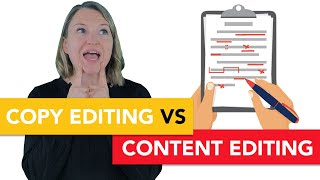
Julie Broad walks through her book's editing journey, showing the difference between content editing (which prompted her to add chapters and rewrite structure) and copy editing (which tightened sentences and prose). She covers fact-checking, proofreading, and how to work with editors without losing your voice.
Chapters
When you write a book, you don't just need an editor. You need different kinds of editing to make your book the best it can be. To illustrate the difference between a content edit, which is also called a developmental edit, and a copy edit, I'm going to do a compare and contrast between the edits on my latest manuscript. If you're trying to understand the different kinds of editing your book needs, or you want to know what to expect when you work with the different editors, well, then this video is for you. Hey there. I'm Julie, the book broad of book launchers. We're a full service self publishing company helping you write, publish and promote a nonfiction book that is set up to sell and grow your brand and your business. As part of our service, we have a lot of different editors on our team to help you polish your book to almost perfection. I say almost because of course, perfection is not achievable. And if you seek it as your standard, you're going to spend a ton of money and time that you do not need to spend. There is no return on seeking perfection. But what you do need to spend time and money on is editors. If you care about writing something that a reader wants to read and that you can be proud of for the rest of your life. And yes, editors are an expensive part of the process. But what's your reputation worth? Well, I would say it's worth a heck of a lot more than the cost of editing. Now, my latest book on book marketing is back from its first round of copy edits and I thought it was a good opportunity to give you a little, you know, look back behind the scenes on the editing process. First, a quick reminder of the difference between a content editor and a copy editor. Content editing is like the 30,000 foot high view of your book. Like an airplane. This is where your book needs to be reviewed for its hook. Will it be well positioned to achieve your goals? Is it an enjoyable read? Are there opportunities to make it better? Do you know who the reader is and is it obvious throughout? Does it need more or less content in certain places? This is the edit that makes your book back better. As a book, the copy edit is the line edit where the editor reviews your word choice, sentence structure, grammar and punctuation. This is where it gets polished so every sentence is easy to read, makes sense, and is grammatically correct and consistent. Now, with my latest book, I essentially had two content edits. Some might call the first a beta reader, but what she ended up doing was really more of a content editor. It was by the book marketing manager at my company. I asked her to read it and see what was missing, make sure I wasn't stating something that wasn't accurate. And I also wanted her help to add more client examples. What she did that a normal editor wouldn't do was add some content because she was adding in some client examples and expanding on a few pieces that I didn't give enough detail on because it's something that she deals with and knows more intimately than I do. An editor would not normally do that. Now, one of the things Sarah flagged for me is that the book talked about layering marketing into the process, but I didn't do a good enough job of actually identifying the layers. I also missed the mark on matching strategy to the appropriate tactic for many of those strategies. These were very important points because those are fundamental to the book. But I'd gotten lost in the material and had lost sight of these higher level points. You can see that here that she's flagging the need for context as well as where the layers need stronger clarification. So what can you expect from a content edit? Is feedback like this? Expand on this, make this more clear. Can you explain why you say this? And it's why I always like to tell authors that the writing isn't done just because you finished your first draft. There is still more work to do. After I worked through Sarah's suggestions, I sent it to one of our content editors. Now I actually think our content editor was a little light and gentle on me. The challenge is that it's my book and sometimes I think there's hesitation to be too heavy handed with me not to counter what I've said in any way. We found this in the past as well, so I felt like this edit could have been more intense. But there was some really valuable feedback here too. I've added chapter summaries as a result of this feedback. I broke up some of the concepts and into steps and bullets and I added another chapter and expanded on one piece while removing another. Based on the suggestions, you can take a look at the summary sheet that came in for our content edits. Our summary sheet usually focuses on the hook of the book, the reader clarity, suggestions for improvements for the summary. But again, being my book, there was a slightly different approach to this book summary than normal. Now your edit may come back with a lot more suggestions and revisions and that is a good thing. Those suggestions and revisions are an opportunity to improve your work. You don't have to agree with everything or do everything suggested, but consider it and if you feel yourself reacting emotionally to something, take a step back. What I found when I felt offended or challenged is after I took a step back and worked on something else or went for a walk, I came back and I could see how to make that area better. What you don't want to do is rush through a content edit trying to get the book done because you'll be missing out on the big opportunity that content editing gives you to make your book really great. If it hurts a bit to do this edit, you're probably doing it right. Many of our clients actually get paired with a writing coach to work through the edits. It takes support and guidance to make a book better. In many cases, don't expect your content edit to be done in one single review and sitting. If you do rush through your content edits, you'll likely find yourself with a book in print that you're not feeling as good about as you could and should. If there's something you want to make sure the editor spends time on or doesn't do, make sure you let them know. For example, if you want it to be funny, let them know that. If you're worried that something is too heavy or too long, ask for support to improve around that. One suggestion I have is that you prompt your editor to help you make sure every chapter starts in an engaging way. It's not always something editors are in tune with, and asking for a little attention to help the start of the chapter can help you have five chapters or help you avoid having five chapters that start in the same way. When it comes to content editing, you will need to let them read the whole book because it's the higher level view of your book. They can't really give you feedback without reading the whole thing and then going back over and diving in so you won't get a sample edit like you will with copy editing. You also really shouldn't ask them to break up their editing into pieces. Sometimes a second content edit can be warranted, depending on how deep your changes went. We do have books that come to us, we content edit them and the author realizes that there's a lot of work to be done to make the book the quality level they want, and they revise a lot of the book after it's gone through major surgery. A second content edit makes sense. You can also send sections back to a coach or to your editor if want to. You if you need to make sure you address the major issue that was uncovered. Copy editing is a crucial step in the publishing process and it comes after that content edit. It's when the editor goes through your manuscript line by line to fix any errors, improve the clarity of your writing, and ensure consistency throughout the book. This is a different person than the one that does the content edit because it is a very different skill. The person who helps create, craft a great story and make sure the book has reader engagement from a structural level has a different talent than the talent of a great copy editor who can see how changing one word improves a sentence 10 times over and how removing a sentence changes the flow of a paragraph, and so on. Copy editing is usually an easier edit to go through as an author because it's more of a yes no decision versus write this, change this, explanation this and add this, type work. That said, it can still be intense. Take my book as an example. After the lighter content edit, I asked for a heavy handed copy edit. I wanted to make sure every sentence got close scrutiny and boy did I get it. Now this is a heavy copy edit. You may not want this level of intensity because it might change your voice or the tone of your book and it can feel daunting to open up your manuscript to see so so many changes. But it was exactly what I wanted to feel a little less insecure about my book. At Book Launchers, we get our copy editors to send a sample edit back for the author to approve or comment on. If they are changing words you don't want changed, or if it's too much or too little, that sample edit is your time to let us know. And sometimes authors go, I don't like that editor. I want someone who is X or Y. Sometimes they want a sensitivity read or they want someone who's not in their audience to read it, or someone who is in their audience, or someone who knows the lingo of a country or an era. There's a lot of possibilities. Remember, the copy edit is about polishing your work and making it the best it can be. While your content editor is looking at the overall picture, the editor, the copy editor is in the weeds. Here's a look at my sample again so when you send it off, be prepared for feedback. You might have to make changes that you're not initially comfortable with, but keep an open mind and consider the editor's suggestions carefully. They have a fresh perspective and can often spot areas where your writing can be improved. Now I want to tell you that the sample edit made me feel overwhelmed and a little discouraged when I saw it. I was like, oh dang, she slaughtered my introduction. I can't wait until we really get into it emotionally. I reacted negatively to this edit, but intellectually I knew it was exactly what my book needed to be. Great. So at first I had to grit my teeth. Well, actually, I went in my cold plunge to get a dopamine hit. And then I said, okay, great, keep going. So here's what it looked like when the full edit came back. Are you sitting down? I know I needed to be when I got this back. Yeah, it's a bit ugly, but the work was awesome. She highlighted things I said that didn't come across the way I thought they did. She reworded sentences, cut words, and just made this book easier to read. The good news is that I find it fairly straightforward to review a copy edit. Take a look at how I'm reviewing it here rather than cry any tears over what hit the cutting room floor, or even look at what was taken out or changed my approach. This may or may not work for you, but this is how I do it. I accept the changes to a section and read it. Does it work? Does it say what I wanted it to say? How can I make it read even better? Is there more I can cut? It's easy to be attached to the words and look at what they changed word by word. But really what matters is what it says and whether it says what it's supposed to say. It sounds like you and is the best it can be. So that's what I focus on. What I've learned is to pay attention when I react emotionally to something. If it makes me feel defensive or reactive in some way or I feel annoyed or something else, I note that feeling. I don't push through when that happens. I take a beat, I get up, I walk around, I get a drink. I think about something else. I usually need to let that sit for a minute, or even more if it's a bigger reaction, to see what the opportunity is to make it better. It's been flagged for a reason. Even if I don't agree with the change or the suggestion, it usually means that I can make it better. So I really try to do that. Well, I can't help but take some comments personally. I know they aren't meant to be personal. It's meant to help me help the reader and make the best book possible. After I went through the edit, which took me about three weeks of working on it, a few hours every other day, it's finally off to the fact checker. I actually knocked a lot off while getting on a plane, which was great. I'll review the fact check, then it goes back for another round of copyedit. After that, the manuscript is more or less locked to bigger changes, so I don't introduce a bunch of mistakes, then a proofread and a layout, and then I'll probably do another proofread after the layout and I'll read it out loud for the audiobook. And then, whew, it's done. Making a book takes a lot of work if you want it to be great. And while the editing is happening, my team is doing metadata research, brainstorming titles, thinking about how this book will be launched and who's going to be ready and waiting to review and read the book. The process is much more fun with a team cheering you on and carrying you through all the things you need to do. And if it's a good fit, we would love to be your team. So let's chat about your book and how we can help@booklaunchers.com apply if your book is heading to an editor, it is a great time to start with us because we can still help you position the book for marketing and make it the best book it can be. So let's chat. And after you do that, here's a video on how to write great chapter titles. This is something worth spending some time on, probably more time than you likely have today. And this video on 5 tips to improve your writing technique is also pretty great. Pretty sure you'll like them both, so click on over. I'll see you there.
More from Julie







Should You Skip Amazon When You Publish Your Book? #digitalmarketing #amazonauthor



