How to Become a Recognized Thought Leader (Not Just Another Author)
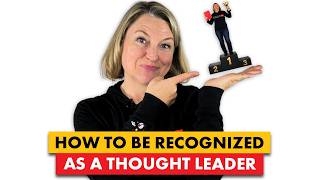
Julie Broad explains how authors build thought leadership beyond book sales by owning a distinct, repeatable point of view like Malcolm Gladwell's "tipping point" or Brené Brown's "vulnerability." The five principles: develop a unique idea, be predictably reliable, use signature language, welcome disagreement, and let others echo your advice in your own words. Consistency builds intellectual property that unlocks consulting, speaking, and product deals.
Chapters
What do Malcolm Gladwell, Brené Brown, Benjamin Hardy, and Robert Kiyosaki all have in common? Well, besides being authors, you likely associate a concept or point of view with each of them as soon as you hear their name. They have built a thought leadership position around an idea. If you're an author and you want to build a sustainable career and be known as a thought leader in your space, this video is for you. For you. Hey there, I'm Julie the Book Broad. I'm the founder of Book Launchers, hashtag no boring books champion, and of course your host here at BookLaunchers.tv. Here's a hard truth some authors will resist hearing. Your leadership book, your inspirational story, your big success in life and business, none of those things are going to get you known. Teaching someone the 5 steps to get wealthy or the process to work through trauma, It's nice and there's value in it, but it's not a thought leadership path. You need something with a little bit of an edge that you can repeat and that you can own. I mean, if I say vulnerability or I want to hire someone to talk on vulnerability, you probably immediately think of Brené Brown. Tipping point, of course, Malcolm Gladwell. Scaling a company, well, this one might not be as widespread and known, but in the entrepreneurial community, Benjamin Hardy is going to be the name that comes up. And by the way, he owns the domain scaling.com. A point of view becomes recognizable before it becomes popular and it becomes recognizable not just because it's a book, but that always helps, but because an author is sharing that idea and their perspective, their unique lens on the idea over and over and over again. It's in a book, It's in a TED Talk. It's on a stage. They share it on media. When people can recognize your thinking, even if your name is removed, if they can associate your name with an idea like habits, right? Who owns habits? We all have habits. We all need habits. That's not luck. It's intellectual property. And there are authors who have done this so well that you can spot their thinking instantly. We're talking about how authors become recognizable thinkers. Most authors think the goal is to sell books. Selling books is hard. It takes a lot of time and effort to sell books, and the reward is a couple of bucks per book sold. So for most authors, that's not the real game. The real game is becoming recognizable, to be compensated for being the person who owns their topic. When that happens, the book sales also happen, but they don't matter as much as the high impact and even high income things that your book is leading to. Think about the consulting gigs, the investment capital, the product or service sales, the keynote talks. Because when your thinking is recognizable, your book sells longer, your content compounds, and your ideas travel without you. Books are kind of like vehicles, and your point of view is the asset that they're driving around. Again and again, I say this, but just in case this is the first video of mine you've seen, I'm I'm gonna repeat it also. May I invite you to subscribe and tell a friend who also needs to know this? AI has made it mandatory that you don't just write a book on the how-to or the process of something. You need to have something unique to say. That's partly from your story, but it's also gonna be the ideas you have. AI can give us a great financial plan. It can help me understand how to navigate a tough conversation. It can help me revise an email. But what you're going for as an author is when you tell your story, your perspective, your point of view, and someone lights up and leans in and says, tell me more. Now that is something AI can't do because you're tapping into something that is uniquely human and not something we can pull out of a machine. So share those things. Or when someone goes, oh my gosh, I thought that was just me. Right? When somebody says that, that's gold. Pay attention. So what do you do to create a recognizable point of view? Or another way of saying this is how do you become a branded entity associated with something? Well, again, we're going for a point of view that's recognizable when people can identify your thinking, even if your name is removed. Like if someone says hashtag no boring books or they talk about building an empire from your book, well, I sure do hope you think of me. Now, this doesn't mean you've established something that's correct, and you don't want to lean into anything that's already popular. What you're looking for is distinct, uniquely you, that you can repeat consistently. Because what you're going for is, number one, people can finish your sentences. Because if somebody can say, well, Brené always talks about, or, you know, James Clear is going to say, you're building recognition. For example, if you hear focus on systems, not goals, Most people don't necessarily need the attribution. They know that's James Clear. Don't work in your business, work on your business. Well, of course, that's Michael Gerber. Belonging is being accepted for who you are. Fitting in is changing who you are. Brené Brown. You know the idea and the thinking without the name. So if your content doesn't create that reaction yet, it doesn't mean you've failed. This takes time. All it means is you haven't committed long enough and you haven't repeated it enough times. You won't publish your book and instantly be recognizable. You have to say the same thing over and over and over in a variety of platforms, which leads me to point number 2. You are creating something that makes you predictable, but in a good way. A lot of people associate predictable with being a negative thing. Like it means you're boring or you're stuck. I think it's the opposite. Predictable thinkers are trusted thinkers, and trust, well, that is the entire game. When someone follows your work long enough, they should be able to predict what you're going to say next. Not the words necessarily, although that is possible too, but they know your values. Predictable doesn't mean repetitive. It really means reliable. One of my core values is simple. I do what I say I'm going to do. If I say I'll be there, I'm there. That's not exciting, but it is trustworthy. So if you've followed me for any length of time, you already know what I believe about books. I don't believe everyone should publish a book. It is a ton of work to do it well, and I believe books should be done at a professional level. So if tomorrow I start telling you how to publish a book in 30 days and that everyone needs to do this, would you trust me? Of course not, because I'm violating my own pattern and my own values. Seth Godin, he's been saying the same things for decades, not 'cause he's run out of ideas, he blogs every day with new ideas, but because they're the ideas he believes in the most. You already know Seth goes permission matters, small audiences matter, trust beats scale. We trust him because he's predictable. He has new ideas, but they usually fit a pattern. If people can't predict what you stand for, they will lose trust in you. And if they lose trust in you, they won't follow you, buy from you, or recommend you. Consistency, it's not boring. It's how trust compounds and builds. So plan to say the same thing over and over again. Number 3, use the same language over and over. Don't just say the same thing in 20 different ways. Recognizable points of view have a language. You know that friend who starts every story like, okay, so basically, well, not basically, I mean, kind of, okay, wait. That's what it sounds like when someone hasn't named their idea. Let's imagine you are someone talking about energy and the power of good energy in any situation. Now you might think saying the same thing over and over again is boring. You don't wanna say the same line about energy. So you change it up and sometimes you talk about energy, sometimes you talk about vibe, sometimes you talk about aura, or maybe the vibes are off or it's not giving. It's all the same idea, maybe some different slang, maybe we're just rotating the buzzwords, but recognizable thinkers, they don't rephrase, they repeat. Think about it again, going back to the Seth Godin example. He didn't just talk about marketing, he named things and then repeated it. Permission marking, tribes, purple cow, the smallest viable audience. James Clear didn't just talk about habits. He gave people phrases, Atomic Habits, systems over goals, identity-based habits. Brené Brown didn't just talk about emotions. She talked about shame versus guilt, vulnerability, and one of my favorite lines that she always says is, "Clear is kind." If your words could belong to anyone, your view is generic. Language is how ideas stick. Number 4, people disagree with you. All right, this is when you are going to celebrate. This matters more than authors realize. If everyone nods politely, your view is probably vague. Seth Godin excludes people constantly. He openly says not everyone is your audience. So do I. Brené Brown gets pushback when she says vulnerability belongs in leadership. People disagree, and that's the point. A recognizable point of view draws lines. It makes trade-offs visible, gives people something to react to. Polite disagreement is a sign of clarity, not failure. When I was in real estate and I used to say, "Real estate investing is not passive income," and I would push back at anyone counting the doors they owned, people argued and challenged me. But when you get that, you know you're hitting the right messages and you're getting an identifiable point of view. Number 5, your advice sounds like you when others repeat it. If someone says, "I learned this from you," you're close. If they repeat the advice in your language, using your framing, and others recognize the source without being told, well, cheer loud because you've built IP. People don't say, "I read this somewhere." They say, "This is very James Clear. That sounds like Seth Godin. That's classic Brené Brown." And that is the goal. And remember this goal, it is going to take time, but when you do it, you will build a recognizable point of view, which is the pathway to much higher impact and a whole lot more income. All right, so let's create a little bit of a checklist because we have covered a lot. So let's test it. Is your point of view recognizable? Just answer yes or no and make your goals based on this. Someone could summarize my core belief in one sentence. Yes or no? I repeat the same ideas across different content. I use phrases people associate with me. My audience knows where I stand on key issues. I say some things other authors avoid saying. If you answered no to most of these, not a problem. It just means you've got some work to do. Here's the mistake a lot of people make. They think a recognizable point of view is something you're going to magically discover. It's not. It's something you're going to commit to, and repeat. Consistency creates recognition. Recognition creates IP. And IP creates leverage. If you're worried you're not distinctive enough yet, good. That means you get to build it on purpose. And if you want to do that alongside authors who are playing the long game, join us in our free community over at school at booklaunchers.com/school, S-K-O-O-L. After you've subscribed here, of course. I'm going for the coolest mom in my son's grade 3 class award this year. That's the YouTube Play Button for hitting 100,000 subscribers. So every subscribe helps. And of course, we're gonna throw a big party here on YouTube when we hit it, and you'll be invited.
More from Julie







Should You Skip Amazon When You Publish Your Book? #digitalmarketing #amazonauthor



