How to Get Paid to Speak as an Author
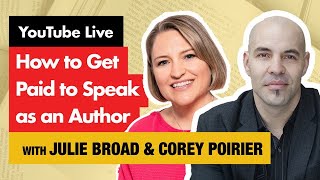
A live-streamed conversation (host Julie Broad; guest Corey Poirier) about practical strategies authors and speakers can use to secure paid speaking engagements. Corey explains two primary tactics: (1) research other paid speakers on directories (e.g., Espeakers) to find who hires them, then use LinkedIn/RocketReach to contact meeting planners; (2) book no-fee/local talks (e.g., chamber of commerce), distribute an evaluation form to collect testimonials, referrals, emails and filming permission to build video and leads. He also covers required assets (speaking video—preferably live audience footage—testimonials, book or press mentions), breakout vs keynote roles, using VAs to scale outreach, and rehearsal options like Toastmasters.
Chapters
Foreign.
Hello and welcome to today's live stream. I see we've already got people saying hello. Hi Gary, Kevin, Darla, Efren, great to have you guys here. You clearly know the drill. So when you are watching, do say hello. And if you have questions, you can see we have a special guest today. If you have questions as we're going through things, go ahead and put them in the chat. I am manning the show. Angela is busy working behind the scenes. So I said I've got this. Corey's going to be talking so I can handle questions. Fingers crossed. I'll do my best. But yeah, so with, oh, and also I owe you guys some prizes so I will not forget. But I'm going to save them till the end. But I know I owe you prizes from our last live stream. So I've got everybody queued up who has commented on the day a video was released. So you are in the draw. So that will be happening at the end. But I don't want to make you wait. And I see Antoine's here in Bible Story tv. I don't want to make you guys wait any longer. We have Corey Poirier in the house and he's a multiple time TEDx and keynote speaker. He has shared stages with thought leaders like John Maxwell, Deepak Chopra, Stephen Covey, I mean senior, maybe junior too, probably, who knows. And he's interviewed thousands and thousands of people. He's also been a columnist for Entrepreneur and Forbes. I think you guys are going to like what he's talking about. And if you don't know what we're talking about today, he's going to share how to get paid as a speaker. And as you know, we're talking about that all the time around here because speaking and authoring go hand in hand. So Corey, welcome. Thanks for being here.
Well, thank you ever so much, Julie, for having me. And yeah, I'm super stoked to dive into Getting Paid to Speak. And what I'm planning to do tonight is, I just want to say it this way, very actionable. This is stuff your community and those watching can apply literally as soon as we finish. And that's important to me because, and I think we covered this whenever I came in and spoke to your group in the past is a lot of us get invited to webinars where there's not a lot of content and it's like, here's some case studies. You should work with us and we'll help you. But I want to do for your audience, what I want to do is I want to make sure we deliver massive value. So I just want to share with people. Expect to take a few notes and. Or watch a replay.
Awesome. Before you take over, there's like some rattling sounds. I don't know if there's something you can do with your mic, but it's. Yeah, there's something. Now I don't hear it.
I think I hit the pen on the side of my desk.
Okay. That's probably what it was. I don't hear it now. So this is much better.
It might be that sensitive that it picked that up. But, yeah, I just hit a pen a couple times with my hand that was beside my desk. So I bet you that was it.
That's probably what it was because it sounds great now. So we're good to go. So I know you have slides. Do you want to just dive right in?
Yeah, I'll dive right in. It's actually not slides. So what I'm going to do is I'm going to share screen and I'm actually going to show people exactly what I recommend around getting paid to speak and just to kind of dive in. Just before I open up the slides and share screen or should say share screen on. What I want to do is like a URL that I want to show people. I will say the reason this is so important is because I've been getting paid to speak for 20 some years, Julie. And you may talk about this with the group at times. I can honestly tell you it's one of the hardest things in the world to do is to find clients that will not only pay you for speaking, the bigger challenge is pay you instead of somebody else. Because of the fact that there's so much competition, like when the OGs are the legend speakers like the Lisa Nichols, Les Brown, Zig Ziglar, Jim Rohns. When they started, there was much less competition. So what I want to show you is how to actually get real paid speaking gigs. And I'm going to use three or, sorry, two strategies tonight. One of them is the share screen I'm about to do. It's the thing that took me three years to learn. And when people say, if I dropped you in the middle of nowhere and you had to start building your speaking business over again, what would you do? This is the thing, and it's honestly, and this is going to sound boastful, it's not meant to be. I'm from P.E.I. in Canada. We're not, you know, it's not a mean world down here, but I will say this One thing I'm going to share with people is responsible for over seven figures in speaking gigs. So, you know, keep, what do you call it? Notes or watch the replay. But I want to make this super powerful for you. So having said all of that to kind of gear things up, I'll share screen now and show people exactly what I'm talking about. So hopefully, Julie, we can see the screen now.
You should be good to go.
Awesome. So the reason I'm sharing the screen, I got to give some backstory so people. I don't just dive in and people like, well, what's he showing me? Is whenever I first started speaking, I was talking to different mentors, and I'd ask people how to get paid to speak. And I was told things like, if you build it, they will come. And I jokingly said, now I built it, and nobody even heard the hammer of me building it. But I found that I couldn't find how to get paid no matter where I went, what direction I went. So I finally. It took me two or three years. I finally realized I needed to find out who hired Julie to speak on AI and what they paid her. And I figured if I could figure out who hired. And I just used you as the example, but if I could figure out who hired a speaker to speak on customer service that charges 5,000. That's what I charge. The people that hired them is my target market. So what I was told when I started was go, just go to Google and type in conferences. The problem with that, as you, I'm sure, well know, Julie, is those conferences typically don't pay. And. And more so than that, they often want you to buy a ticket for the event. So at the end of the day, it's not really the quickest or shortest path. So I figured I needed to reach the people that are paying the speakers. So I'm going to show everyone. And Julie, when I do this, I can't see the share screen over on streamyard. So hopefully you can let me know if everything I'm doing is showing. That's great, but let me know if I'm doing something and nobody sees it. I'm getting.
Oh, you get to fly blind. You got it. I'll be your eyes.
All right. So hopefully you just saw me switch to another screen.
Yep. Espeakers.
Okay, perfect. So I'm on E speakers, and this is what I would do. So ultimately, what I figured is I had, as I mentioned, find out who hired that other speaker and paid them and if I could find that person and knew how to reach out to them and what to say. That becomes my very, very, very target client. So you go to a site like Espeakers where there's lots of speakers listed. That's why I'm choosing E speakers. And then you type in whatever you speak on. So let's just use like for example, let's say I speak on customer service. I want to find out who else speaks on customer service. And you'll understand shortly. It won't take me long to show this, but you'll understand shortly why I want to know who else speaks under customer service. Now, you can see here I can actually, like change the numbers so I can target. But just for argument's sake, let's say I charge $15,000 to speak on customer service and. Or I want to. So you'll see that I found 1904 matching speakers. That means 1904 speakers on E speakers that speak on customer service. And you'll notice I found. I'm going to use him as the example, but James Feldman, AI Concierge Transformation keynote speaker, and he charges $15,000. So let's say for argument's sake that James speaks on the same thing I do. Let's just say that for argument's sake, what we're trying to do here is find other speakers that speak on what I do. Now, Julie, I'm not sure if I am going to go to another Google screen. I might have to stop and start sharing again. I'm not sure how that'll work. I think if I jump to the other screen, it won't share for me, but let me know if I'm wrong. Are you seeing Google now or are you seeing still the E speakers?
No, it's still on E speakers. So, yeah, we'll have to remove that one and you can bring up a new one.
Yeah, I'm only going to use a few screens, so it won't take effort.
So it keeps people awake. We're changing the screens. They got to pay attention.
That works for me. So what I did, and you'll see it when it opens up here, is I opened up, I searched James to see if we could find him online, and we found James's website here. So you can see him clicking into his website. Now. What I'm going to say, for the sake of what we're doing here, I don't know how old different speakers are, if they're retired or what have you. So I don't know how new or old what we're. The data is, but let's just pretend for argument's sake, this is a speaker that's still speaking, and all the data is accurate and current. So what we're going to do is, and I think it'll take a second to come in here. There we go. Okay. I'm just waiting for his website to load. So you'll notice here. And this is what we're looking for. So, Julie, you can see me clicking, I think, on praises here and then client testimonials.
Yep, we can.
Okay, so that should. So that's going to open client testimonials. So now what I want everyone to see here is, can you see here it says client testimonials? You can start seeing all the names. And let's go back to our original point is James speaks on what we want to speak on. The people that hire him pay him what we want to be paid. And we know the people that hire James are our target clients. Well, look how many. Just what we did, which, if I wasn't talking, takes like less than one minute. And look how many targeted clients we now have. And you'll see in a second when I say target clients, how easy it is to reach the person as well. But look at this. I mean, I don't know how many of the number is, but let's say it's. I don't. I'm not going to keep scrolling, but let's say it was 200. That means you now immediately, within a couple of minutes, have 200 clients that probably pay James what you charge to speak on, what you speak on. And chances are James is a professional speaker. These are people that hire speakers every year for their conference. And the other cool thing is if they hired James last year, they probably won't hire him again this year because most people only hire. They never hire the same speaker, usually two years in a row. So I'm going one step further now, and I'm gonna have to come back for a sec and share screen once more. I think I only have one more share screen after this one, but let me share this one again. It'll all be worth it once you see what I'm doing here. So you'll see what I did is I searched. I basically grabbed the name. That was, if you guys remember, that was at the top of the website. This was the first person that provided a testimonial for James. So now when I click here, I have one of two options. One, if I wanted to, I could send an InMail message. Like, if you hear, look here, I Could go message Terry and I could send them an InMail. If you have Sales Navigator, if you can send in mail. That's one option. And that will get me directly to Terry. The other option, which to do it I have to show you one more share screen and then I'm done with the share screens. But the other option is. Let me just stop on that one. The other option is to go to a website, for example. I'm going to give an example. But Rocket Reach is one example. That's one that I've used. And so let me share on Rocket Reach. And this is the last screen, I think, if I remember correctly. But let's say we go next, we go over to Rocket Reach and yeah, okay. I want to make sure that we're sharing. So what we can do in Rocket Region, we can put. Oh, can you see it?
Yeah, we're good.
Okay. If you go to Rocket Reach, what's really cool is you can put in LinkedIn profiles and it'll grab every email it can find associated with that person. So right here we see Gmail, which is really great because that means that's probably his personal email, really easy to reach him. But you see it says four emails total. I won't bother going into all that. But that means there's probably the company email as well. Again, we're assuming all the stuff is still accurate and he's still at the same company. But what I hope that you just saw, and I'm just gonna shop, stop the share screen. What I hope you just saw within four screens and whatever that was, I mean, even with me yapping and talking, that took five minutes, I think. But what you hopefully saw is I was able to find clients who pay speakers what you want to charge to speak on, what you want to speak on. I was able to find that in minutes. I was able to go to that one speaker's website. Now, there were 1900 results at one speaker's website we went to has probably 2 to 300 leads right there on that one page. So what you have to do is go to the speaker's website and hope they have client testimonials. Client names will work. Like if it says client list, the problem with that is you won't have the contact name. So you have to do more digging. So in a perfect world, I always go for client testimonials that list their name, where they work, and then you just copy and paste that into Google. And in most cases it's going to give you their LinkedIn profile. Now the Caveat, I didn't share. So let's say we did all that. You could spend literally less than an hour and find 30 to 40 clients who pay what you want and hire you to speak on what you want to speak on. The other part is you need to get them to reply to you.
That's what I was gonna say.
Yeah. I mean, I will say, Julie, that the best case scenario, but most people on here and most people in this world today aren't going to do it. The best case scenario is to pick up the phone and call. If you do that, your. Your results are going to be higher because. And the catch is, you've got to get them on the phone. And I don't even. I haven't done it in three or four years. So I don't even know today what it'd be like. You try to reach somebody on the phone because everything goes to voicemail. But when I used to do it, I would reach about 20% and. But the big part is, is I would have a higher number of people that I could get in a real conversation with because I picked up the phone. However, having said that, what you can do to hit those same odds, in my opinion, is you can send the first email. And the first email, here's what I would do, which goes against everything we're taught. What you want to do is because you're reaching out to meeting planners, do a tiny bit of research on this. So don't, you know, put your foot in your mouth. But for the most part, it's going to be event organizers. So what you would do is you would say, hey, Terry, just wanted to reach out. I'm curious, are you the person in charge of events with the organization now? If you know the organization, customize it, right? So, hey, Terry, wonder if you're in charge of events with AT&T or whatever it is, question mark? What I'm getting at, Julie, is full stop. That's it. Nothing else that goes against everything we're taught. Everything we're taught says, you know, you should pitch like, here's what I'm looking to do, or try to convince them to reply by some sexy thing. The reason this works really well is because most of the people that run events, they are also involved in getting more members. They're also involved in membership. And so they don't know when you ask, are you the person involved in events if you're wanting to sign up for the event, sign up to become a member. So they feel obligated that I at least need to reply to see what Julie's inquiring about. And what that does is it gets you in a conversation. So now, worst case scenario, they're just going to say it's not a fit or not reply. But the odds are much better because now it's human to human if you just send out a message and say, hey, I'm wondering if you're charging events. The reason I ask is because I also speak and I speak on customer service and dot, dot, dot. Then if they don't have a need right now, even if they like what you said, it's going to be, I'm not going to reply to that. I'll reach out to Julie when I need her and they never will. So what I'm getting at is the first message, make it the simplest thing and make it something that's in it for them, which is you want to know about the event for some reason, let them reply and then you can go into that same thing. But now you're probably going to get 4 out of 10 replies instead of 1 out of 10. So that's what I would do. Now there's a nuance to exactly every aspect of this. Like what exactly do I say in that second message after they reply? That's hard to go to now. I'd have to almost have a template and show it. But I hope people get the general idea. Is that what we just did? And again, I'm talking and explaining it, even in the talking, explaining it, everything's been 10 minutes now. But if you were doing that on your own, you could probably, like I say in an hour, get 25 meeting planners, names and contact info. If you want to go one step further to finish this all off. Because I'm going to show another strategy as well. But if you want to finish this all up, if you want to go one step further, what I would do is I would actually hire a va. So this is what I did after I, I did it myself for a couple of years because I needed to be the guy doing it. And what I found, Julie, is when I reached out, my, my actual numbers of replies and percentages were lower. And it sounds counterintuitive, but the reason was, is because they said, well, if you're that busy, incredible as a speaker, why are you reaching out to me? Tony Robbins wouldn't reach out to me. So it's actually better to have a VA or a virtual assistant do it. But here's the other cool part. If you hire a VA to do this, and let's say you paid them for two hours a day. Let's say you pay them $10. Now that means you're spending $20 a day. Let's say you do it five days a week, a business week. You're paying the $400 a month. So 20 a day times five days times four weeks. So you're paying them 400amonth. And the great part is, is that they could probably reach out to 4 to 500 of those meeting planners in that same time. So here's what I want you to think about. If you charge $5,000 for a talk and you got that meeting planner or sorry, that VA to reach out to 4 or 500 and you land at one booking, you would pay for the virtual assistant for an entire year. So what I'm getting at is you can put it on autopilot. And the only time you have to get become involved is if somebody said, oh, I'm so glad you mentioned Julie. We do have an event coming up. She'd be a great fit for it. Can we talk to her about it? So you're only getting involved when it's an actual active lead. So that's the first strategy that changed everything for me. And you know, Julie, I'm happy as I know you. You're probably thinking for the way the listeners might think. So is there questions you think that. And I mean, of course people can ask questions in the chat, but is there questions you think that may have come up from what I just shared?
Yeah. I mean, if somebody has questions, you can go ahead. I mean, I can share my own personal experience because I get pitched because I'm in. I'm on the board for entrepreneur organization. Well, now I'm in a regional role, but I used to be on the board and I held the role where we booked speakers and book the events. And so once people realize that know the association pays speakers, you get a constant flood of pitches. And you're right. As soon as somebody like actually pitches me in the email, I filed it because I'm getting so many. And this is a volunteer role that I hold. Right. This is not my business. It's a volunteer role that I hold where I book the speakers. And so I would file it. But I did get, and I use the word suckered, but, you know, I. It felt like I got suckered into some conversations with people because they would just say, hey, are you the learning chair? And I would feel like I had to reply not knowing what this was in regards to because there was an array of Things that it could have been in regards to. So you're right about the simple thing. I never thought about it though, until you just said it. And then I smiled to myself and I thought, geez, yeah, those are the ones I did reply to, the ones with the pitches, because I knew exactly what was going on. I filed them, and if I happen to be looking for a speaker on that subject, I. I would then look for a speaker reel. So I know my next question to you is what? You know, in that next email, for me, I needed to see video. I had to see what they were going to look like in front of an audience. But what, what is the next. You know, regardless of what they say. But what are the assets that somebody absolutely must have in place?
Yeah, so this is a very, I mean, it's a great question. And you know, and you know, I can, I can mention it later if we have time, sort of why we did it. But we launched this thing called Blue Talks for exactly what you said, which is that when I started. So I go back 25 years, and when I started, I'll be honest, Julie, I didn't realize how many bookings I was losing without having to sizzle reel until one good friend who was also on a board said, corey, I just want to tell you, like when we were in the board, they basically said, well, we're going to go with this other guy because your friend doesn't have a video. And he said, I don't know if anybody else would tell you that. And he's right, they wouldn't have. So I went for quite a while where I couldn't figure out why. So then what I did was I circled back to some of those clients that didn't hire me and they said, oh yeah, well, we couldn't see video, so we just couldn't hire you. And so to your point, one of the most important things you'll ever get, however you get it, is, and I don't want to say a sizzle reel. In fact, I'll tell you why. I think a Blue Talk or a TED Talk works better than a sizzle reel. But I don't necessarily mean a sizzle reel. I just mean a video of you speaking, showing that you can deliver. And I always say a bad quality video can't make a brilliant speaker look bad. And a great speaker can't make a bad video look good, a bad talk look good. So what I mean is that you can have the most brilliant video ever, but if you're a terrible speaker, it's going to show and vice versa. So I don't necessarily just say you have to have the crispest, best video ever. But I think you need to have some video no matter what. And obviously if it's a higher production value, it's going to be viewed more creditable and it's going to make you look like a better speaker. And also like you would, you would charge more. As far as the reason I say I don't necessarily think a sizzle reel works better is we tested this. So years ago I had a $8,000 sizzle reel I got made. It was three minutes and it worked for quite a while. I was getting probably quite honestly 60, maybe to 70% of my people that saw the video that were considering me booked me. What's interesting though is once I started using my TED test talk at the time, which was like a five minute talk. Well my. I did five and one of them was five minutes. That's the one we used. It was a five minute talk and it was doing 85% conversion instead of 70 or lower than 70. And I asked people, I started saying like, why do you think that is? And they said, well, I don't know if this is the answer, but I loved the fact that I could see your whole talk in less than 20 minutes because then I knew this was you front to back. And one person said to me, they said, have you like a sizzle reel, like a testimonial, you're never going to give us your worst. You're going to pick all the high spots. And they buyers know that now. So I found that actually having a short video of a whole talk works better than having five or six clips of highlights. So but going back to your question, Julie, because I just wanted to share that insight, what you typically would need after let's say in that next message, first and foremost is going to be the video of some sort. I always tell people we've done surveys and we show that people, people hire you first. The first reason they hire you is because they see you themselves speak live. That's the first. The second and third, which can go back and forth, they're pretty close, is either they have a video of you or a referral from somebody they trust. And the reason they go back and forth is if it's somebody they trust, like let's say a spouse who co runs the business with them, then they'll probably even trust them more than a video. But if it's somebody they know somewhat, they might go, well, you know, Julie might Not like the same type of speakers as me. I need to see a video and I see it with referrals. Often they'll say this sounds awesome, but is there any way, you know, if they have a video we can watch? So the, the video I still think is right up there with referral. And the only thing higher than that is if they see you live in person, which is less common because they have to be at the event you're speaking at. So going back to the your question, you need a video for sure in the reply and not that you need this, but I think it helps if you have some, I'll call it achievements that are notable to people. So for example, it could be that you wrote a book. That could be an example and it could be a link to hey, check out my book here, not necessarily to buy it, but just check out the book and you give the credibility of a sought after author or what have you. It also helps if you have things like you had an article on Forbes or you're featured in Forbes or you were on an interview. An interview which could be a podcast or a big show. I think all of those things, not mandatory, but really help a lot. Because when I'm looking at it, if we just did what we call meet the meeting planners last night. So on our bureau we actually had people last night that are speakers on and they were actually pitching real live meeting planners who hire speakers. And we did this last night and it was great. It went over huge. And it was fascinating to watch the things that the meeting planners mentioned that they need and they're looking for. And when we heard speakers, so when the meeting planners gave feedback when they heard speakers say, and I've also spoken 600 times, I've written an article for Entrepreneur. I've done this, I've done that, I've been featured on. What they said is they they trusted that that speaker is going to deliver more than the speaker that didn't say any of those things. And we don't like to hear that because if you're brand new, you don't have those things. But it is true that if you know yourself, if somebody has a book, let's say somebody has a book that was on the New York Times list, again, whether right or wrong, versus somebody who doesn't have a book at all immediately. That's the only two things and everything else is identical between the people who are people going to trust more and who are people going to look to as more credible. It's just the world we're in. So I think the more of those things you can have, the better. But I would say the only quote, unquote, mandatory in my opinion would be a speaking video.
Yep, I agree. And Gary just asked if a YouTube video will work as well. And I can speak from personal experience with a thousand videos on YouTube. No want to see you speaking in front of an audience. And I've had that. I've had that. Come back with, we saw your videos on your YouTube, but can you send us one of you speaking in front of an audience? So. So I can tell you without even asking Corey what the answer to that one is, but do you have anything to add to that? Corey?
I just said I agree with you. And we had a person in our bureau who could have got a booking. They literally went through everything of his and said, we love him. And. But by mandate, the company mandate is we need to show why we hired him, so we need a speaking video. And he said, well, the only thing I have is the Blue Talks amplify thing I did, which would be like a YouTube video or like what we're doing here. He said, that's the only thing I have. And I said, I don't think that's going to cut it, but let me ask. And I went back and he said, no, Corey has to be a speaking video in front of an audience. Now, they said, we don't have to see the audience in the video. Often you don't, but we need to know it was on a stage or some way that we could see them standing up in front of an audience. And so, yeah, the other thing with that is a $5,000 booking. They were ready to hire him and he couldn't get a video obviously, that quick, and they went with somebody else. So to answer your question, Julia, and also, Gary, it really does need to be a speaking video with whether it's engagement or at least has to be an actual speaking video.
Yeah, the ideal is showing the audience engagement while you're speaking. But, you know, the minimum requirement is you standing in front of an audience or a room. You can fake it. We've had clients fake it. You know, they just. They just rent a stage space and get it filmed. And, you know, if you're not showing audience reactions, at least that checks the box. But it's better to have an audience, if that's an option. Yeah.
And what we do, because we do have a lot of scenarios, as you know, Julie, with our Blue Talks, where there's the side of. First of all, if you watch TED Talks, you never see the audience either. It's kind of the norm. But you can tell, I believe, by watching a video that there's an audience there. And then also when we can, we'll maybe show the backs of heads. Because the other challenge is we're filming and we get one shot at it. And if we film and there's somebody like doing this while you're talking or falling asleep. Yeah. Or whatever that is. I mean, we also, we have multiple angles, but that's always the fear. And so, yes, I, I think always have it in front of an audience for the feel. And I think we can breathe that energy. But also if you can show backs of heads or something that shows people there is really an audience there, even better. And I see, I think Antoine has another question. Am I okay to tackle the question?
Yeah, let's do it.
Okay. What are your thoughts on speaking of breakout sessions to build up to a keynote? My answer is yes. Yes to that. So, Anton, some people get lucky and their first talk ever is a keynote. That's rare. And also subjected to what keynote is too, because you could be a keynote for your cousin's event that they put on. That'd be a different thing than being a keynote for, let's say, Vcon with Gary Vaynerchuk. Right. So it's keynote is subjective. But yes, usually the keynote means it's the main note that either starts the event or closes the event. One thing a lot of people, and I'm glad Antoine asked this question, don't necessarily know what a keynote is versus a breakout or versus a guest speaking role and so on. I always say that a keynote is we're going to show you or tell you why you want to change. So in other words, I might have 20 minutes. I'm going to show you you should change. I'm going to try to motivate you to make a change. But I'm not going to be able to show you how to change. The breakout is where you learn how to change. And I mean, and even goes further than that, because coaching one on one is where you learn more of how to change. But at the end of the day, breakouts usually means that there's like four rooms going on. Usually there's concurrent break at events, four rooms going on, and there's four different events, and people at the event choose which one they want to go to. And so if you're a breakout speaker, you're one of four speakers, where usually the keynote is the one speaker at the end of the event or the beginning of the event. That kind of is the name. Whether they draw the crowd or not, they're usually the last speaker or the beginning one. And so my question would be anti. Or my answer would be yes, do any talks you can to build up to a keynote? And I mean, ultimately people have different goals. I know some people that never want to be a keynote. Now for me as a speaker, right from day one when I started, the goal was to be keynote because I want to be one to many and some people would not like this, but I don't want to get in the weeds. Like, I want to help motivate somebody to change, show them why they should change, make them go, wow, I never thought of it that way. But if there's going to be a change, I would rather refer them to a coach who can then work with them one on one and help them make the change. Part of it might be that I like the flexibility of my schedule by being one to many. Because when you're a coach one on one, I have friends of mine that are coaches and they're literally one to one with with clients six hours a day. And I chose not to do that. And I think if you're going to be a speaker, when you choose not to do a lot of the in the weed stuff, your, your option eventually becomes keynote because breakout, you're still in the weeds more. I do breakout stuff, I do guest speaking, but keynote was what was my goal. And yes, I used to break breakout and stuff to get to keynote and yet I still did break it.
Yeah.
So hopefully.
Yeah, no, I think that's the case. And I think there's also different business models for different approaches. So, you know, and that's all kind of going back to what's the ecosystem, you know, what are you building around your book? Because for some people, if your goal is really to be a paid speaker, then a keynote probably is your objective. For me, my goal isn't to be a keynote speaker. My goal is to speak, to drive business to book launchers. And so for me, a breakout session is fantastic. And also I often have a little bit more room to invite people to come and work with us. Whereas at a keynote, you know, that would never be an option.
Right.
Like you're up there to offer some sort of transformation in that moment and then see ya. Right. Like so. And that's generally speaking because every conference is also different in that regard. But you know, not that I would ever say no to a keynote, but it's not my. Not Where I really fit, I fit much better in a breakout or a workshop.
Yeah, I think I do believe and agree with you that I believe it comes down to what's your business model and what do you want it to be. I was, I spoke at Lisa Nichols event two weeks ago. Some people here watching might know who Lisa is. And Lisa, she, what she covers, which I love is she covers what she considers to be the four different types of speakers. So like in for informational or informative, inspirational, motivational and transformational. And when you hear that almost every person goes oh, I want to be transformational. They just think that sounds like it's the best one and it's the fourth, so it must be the best. And Lisa is a transformational one. So if you're at her event you're like, oh, I want to be like Lisa. But I think it's important to know which one serves you best. So for me, transformational doesn't serve me best. It goes right back to what I know, which is I don't want to be in the weeds that long. Now having said that, and by the way, transformational speaker might do like stuff like where they'll get a breakout and get everybody to be like touching each other's shoulders and motivate each other and, and do it try get past limiting beliefs like they do a lot of hands on stuff where I want to be in between inspirational, motivational. And it's not that I like being a motivational person, I try to edutain but meaning like I try to educate with humor but I fit really well within those two. And if you're a teacher, like an actual teacher or you teach business, you're probably going to want to be the informative. And actually I would say Julie, you're probably, you probably sit more around the informative where you're given lessons and teaching how they can launch the book and what have you. I think all four of them are great, great to be. And some people are a bit of all four. But I think again to your point, it's important to know which one you want to be and which one you are.
Exactly. Yeah, I agree.
Because that also ties into whether you break out or not too. If you're an informative speaker, you're probably going to enjoy breakouts more than you're going to enjoy keynotes.
A hundred percent. Yeah. And it's a, it's an interesting, you know, kind of going back to the question of what are your thoughts on breakout sessions to build up to keynotes when I Was in the real estate space. I went straight to keynote and I'm on this big stage in front of 800 people and as a brand new speaker. That is a crazy, intense thing to do when you haven't done much. I had spoken, I think two small little meetup groups before that. And then there I was in front of almost 800 people. You know, the lights are bright, you're mic'd up, it's. It's quite a jump. So I really do think there's something to be said for going in the smaller groups to begin with and honing your message and understanding what you say, what reactions it gets, what people are connecting with. Because the dream of being on a stage when it happens too fast, it's quite shocking.
Yeah, well, I mean, a prime example that. And I experienced the same thing. I jumped too quick. The keynote as well. But a prime example of that is when I started doing stand up comedy, which is what I get tricked into, stand up, which is what got me into speaking. But the first time I ever did comedy, we were, we were told five minutes before that we were going to be the comics for that night. We were tricked into doing it and eight people left at a 15. And I stayed and I performed while the first two jokes I told got no laughs. Found out why later is that the mic wasn't turned on. So to your point, leading, like if I would have done other, like if I would let somebody else go first and all that the mic would have been on and, and if they had a screw up and I saw that, I would learn from them. But I foolishly went on upstage on stage first because I learned from Toastmasters go first to get over the fear. But I didn't know that. I didn't know I was even supposed to turn the mic on. So I jumped too quick from nothing to being on a stand up stage and we got the mic turned on. By the way, the joke still bombed horribly. So it wasn't the mic, but I jumped too quick. And to your point, if I would have jumped in the same way as that to like a keynote, let's say my second talk was a keynote with 800 people. I would think I'm ready and I might even be ready in the message side, but I wouldn't even understand how the mic works. Or what if I'm scratching the mic, I wouldn't know how to stop doing that. Like there's so many things you learn as you're building up that if you jump right ahead, you could have all Those screw ups in front of an audience of 800 and might not recover from that. So I again goes back to really supporting the idea of building up to keynotes. Yeah. All right.
Anybody else have questions? I've seen comments coming in, but nothing else. Antoine said getting clear on your purpose for speaking will help drive the business around your speaking, which is absolutely a good summary of what we were just saying. Yeah. So what else, what else do you want to cover today, Corey? Anything else?
Yeah, I want to show everyone one more thing. Just make sure I can share this. Okay. I got to figure. I think I have to share this one differently because it's image. So. Okay, see if I can share. Okay. I got it on my screen, but now I'm trying to figure out how to actually my computer. Let's try that. Gotta love technology.
I know, right? While he's doing that, if you haven't said hello yet, make sure you do, because I will pop over after this part and do all the prizes for the day. So everybody that's here, you're entered to win. Everybody that's commented on the Tuesdays and Fridays when the videos have come out, you're entered to win. So we have. Angela's not here, but I'm still doing the prizes. So. Yeah, so once, once he shares this, I will pop. I will take over the screen and share that with you guys. Oh, here we go.
I think. Yeah, I think you might have to share. Okay. So I don't know if people can see it because it is pretty small, but I'll explain at least what it is. And so the second, if I had one more strategy that I would share it as the thing that I would do if I was starting over. It's how you do this. So it's. It's simply looks simple, it's evaluation form, but it's the science behind how you do the whole thing. So first and foremost, if you want to speak on more stages, you've got to get on stages. And so what. Here's how I tell people. If I were starting over, I would use this to get a lot of bookings really quickly, actually. So what I would do is I would reach out to some local association that. That does no fee talks. So again, I don't like the word free that much in speaking. So I'll say no feet talk. But what that means is I might reach out, let's say, to make it easy, a chamber of commerce. So I'd reach out to a local chamber of commerce and see that, oh well, they hire they bring in speakers every month and it's probably going to be like local MLAs or local politicians or local educators. And so I would see that and I would say, hey, I notice you bring in speakers. I happen to be a keynote speaker or a speaker or a professional speaker, whatever you want to say. I happen to be a speaker and normally I like to charge my talks. So if I'm already charging, then I can say that with all sincerity. If you've never charged for talk, just to be authentic, you might want to say, normally I like to charge for my talks, which doesn't mean you actually are. But normally I like to charge my talks, but I want to do a no fee one for the chamber because I want to support the local community. But also, so you got to explain to them why you want to do it. Also because it's a new talk and I want to test it. And then what you're going to say is, all I want in return is to be able to hand out my evaluation form. If you love my talk, I'd love to get a testimonial and I'd like to set up some phones and get some video footage. So the great news is what we talked about earlier, then you're going to get some footage. Even if it's not great footage, it's still better than no footage. And then also you're going to get the, hopefully the testimonial from the chamber. But this form is what's going to be the money. So essentially now you book this, let's say you book the talk with that chamber. So you pick up the phone or you email them, you get the booking. They say, yeah, we'd love to have you come in. And they promote it to the chamber. They have 200 attendees in the room, let's say. So what you're gonna do is you're gonna find it from them. How many people you're gonna go hand, you're gonna put those forms in a perfect world under their chairs or under the table, or in the middle of the table, whatever the structure is, so that when they come in, they don't see the forms yet. You're gonna deliver a killer, knock it out of the park, 45 minute keynote or whatever amount of time or hour long talk, doesn't matter. You're gonna deliver a killer talk and then you're gonna say, thank you so much for listening today. I hope I shared some value. I'm going to ask for only one favor today. The only favor I want to ask is I Have some evaluation forms. They usually take about five minutes to fill out. And I want to ask you if you could fill those out for me. You know, I'll wait up at the front so I can answer questions after you fill them out. And as a thank you for filling them out, I'm going to send you a free copy of my digital book or whatever you have to give. So. And then I'll say to them, I'll say, just write books on the side and put your email address and I'll make sure you get a free copy of the book. And I find. So it's going to blow people's minds. Perhaps. But in the printed form, when I do that, I get about 90 to 95% filled. It. It's kind of funny you think 100 of people would do it because you're asking them to do it and you're in front of them. People will sit there until the thing's over and still not fill it out. And so. But again, I've gave about 95%. I've had people tell me they're only getting 60. And I think it's because of the saying, would you do me this one favor after I've just done this great favor for you. You're not saying it that way, but also, oh, and I also say this will also help the next group we speak to. So you'll actually be helping the next group. And people love helping other people. But then I think the biggest one is then getting a free book out of it, too. And so that's what I do. And the form itself is the important piece, which I'll go through in a minute. But the handing out of the form, that's how I get as many as possible back. Now people will say, well, I'll just get. I'll get them to fill it an app or send it in later. My experience is if you ask people to send it in when they have time, they'll never have time. You'll get five.
It never comes in. Yeah, I agree. Never, ever. Same with the QR code. Don't do a QR code. They don't do the QR code.
Yeah. And you know what, Julie? I mean, I'll. I'll have people meeting planners over the years would say to me, oh, Corey, we don't need your form. We have a great app this time, and the app works really well for a whole bunch of things, but not that. And so I'll say to them, I'll say, well, how about this? What if you let me Hand out mine in one room and then you try the app and all the other rooms and let's talk later. And if they're honest, I'll have conversation like, dude, I only got like 10%. I only got 5%. And yours, how many do you get? And I'll show them that. I'll send them the summary. I don't send them the names, but I'll send them like the first question. I'll give them all 100 answers to that question. It doesn't identify who anybody is, but they then can add follow up and they get some data. But anyway, they're like, holy crap, you got 100 out of 110, they got five. So that's one thing. The one thing I've heard works and I haven't tried it, so I can't speak to it other than to say I heard it works. Is talk a dot, which is a platform where you can literally put the same thing on, but you get them to fill it in real time while you're sitting there, they just fill it out online. That apparently works really well. I haven't tried it. They go back to the last piece of this though. Why this form is so important is the questions that are on the form. So getting them to fill it out is just you want to do. That's the byproduct of the good part, which is actually what you get from the form. So you'll notice the first two questions and I'll read them to you because it is small. What basic message did you hear that you could use tomorrow? And the second one is, how will you use what you heard to increase your profits and or productivity? Now you can change that. It doesn't have to be products. Like if you don't have that, if you're speaking to a group that is like Subway employees, you're probably not going to say how you're going to increase your profits, but so customize it. But those first two questions are about the audience. You want the audience to know you're not just trying to get stuff out of them. So those two questions remind them of what they learn. But here's what's also cool, Julie, is they actually. You find out how much they listen, you find out what they took. You also can learn their language because they'll say, oh, well, I like how he said this. And if you notice common language, you can use that for marketing to similar groups. But either way, oh, and it's also good for that organization that hired you because if you can send back all this, and it's 100 answers. They're all like, holy crap, they all learned something from him. They were able to remember that E + R equals O. Clearly they learned that. So that's why the first two questions. The third question starts getting into the. For what's in it for you? So it's. Is there something about the topic that you would like to know that Corey did not have time to touch upon in his presentation or training session? And what will happen is, let's say you're covering customer service. People might. And you mentioned personality types. People might say, oh, I'd like to learn more about personality types. And so that would be an example. But what it does is now gives you a second reason to go back to that client. Because now you're like, well, 80% wanted to know about this, and I didn't have time to cover it. But if it's, let's say, a real estate group, and you get that answer five or six times, then you also know you can approach real estate associations saying, hey, seems like realtors want to know about personality types. So that's a powerful question. But the fourth question is the biggest, which is, do you know of others who would. And you could reword this however you want, but do you know of others that would benefit from the material presented today? Who might that be? And may we contact you to follow up? This is the one where if I deliver, like, if I did a talk today and I deliver, If I had 200 people in the audience, it wouldn't be abnormal for me to have 30 plus answers to this. Now, when I say answers, it could be one person has, like five events they want to refer me to. So it might not all be like 30 separate people, but I usually would get 30 to 40 opportunities, let's say. And now it's. It's my. In my hands because I have the form so I can follow up the reason, by the way, you get more answers on this form than, like, years ago. It used to be like, Zig Zigliter would deliver a knockout talk and people would approach him and say, zig, we have to hire you. Here's my card. It's a different world now. And if somebody's at a chamber event and they got to get back for lunch, or they're busy, or they're scared to approach a speaker, one to one, there's a lot of reasons they won't go up, but they'll write it on this form. And what's funny, too, Julie, is name is optional for a reason, because it gives them more incentive to fill it out. But I find it funny when people don't put their name, but then they put their email addresses. Julie Broad like, okay, you don't have to give me your name if you don't want to. But the point is, is that they usually they'll say, here's my email address. You'd be a great fit for the event that I'm a part of. I'm on the committee. Reach out and we might, we can talk about how we can get you on to speak at the event. But what's happened is you, let's say you went and did this talk at a chamber. The reason I chose chamber or business association is because they'll have separate business owners in the audience who could all potentially hire you. So it's not just one. If you go and speak for a corporate like Subway or McDonald's, chances are most of those employees aren't going to hire you to speak in their living room. But if you go speaking association, like a home builders association or AI association chant, let's say home builders there could be conservatively in a room of 200, there could be 75 of the home builders there that have employees like 50 employees who all run events or quit running event. So if you can go to that room with hand at this form, you now have people at separate companies that are saying we need to talk. The next question is, what is your opinion of today's presentation? Well, that becomes good for marketing and you'll notice it says can we use your comments in association with our services? That's basically saying, if you said this is the best presentation I ever seen, can we use that in our on our website? And the next piece is what would you like us to add you to our free newsletter? If I do a talk for 100 people, it's not abnormal for me to add 60 or 70 to my newsletter after I leave. But what's really cool is you get them to opt in there like. So in other words, you got proof, they opted in and then additional comments. What's fascinating, the reason that was left there is we noticed that we got better feedback for testimonials on the additional comments than what's your opinion? But we wanted to what's your opinion? So when I say that, it could be like, what's your opinion? Awesome. But if you have 50 people that say awesome, that's not really great. But. But if you have additional comments, best HR presenter since 1997. That. And that's where they put something like that. That becomes the testimonial. And then finally, last piece of why this works really well is let's say you do a chamber event, and it's your first event you've ever done, and you have a hundred business owners in the room, and 75 fill up this application or evaluation form and say we loved your talk and say you can use our comments and they put their company name in their name. You now have 70 testimonials for your website on your first talk ever. If you had to do that with corporate, you'd have to do 70 talks and knock it in the park with all of them. So what I'm getting at is this one, what we just shared, what I shared here, this one process that you could follow, you could walk away with video. You can use forever. Many testimonials for your website that look like they were at separate events, by the way, people on your newsletter and prospects you can hire and knowledge of what people want to hear more of, all with one evaluation form and literally one top. So that's the second piece, Julie, that I wish somebody would have told me when I started. And also that changed the game for me in every way possible.
Love it. Yeah, everybody was loving that. Although Antoine said you needed to slow down. But you know what, Antoine? You can watch the replay over and over. You can put them on 0.5, so. So it's fine. And fun fact for you. Corey Takadot is a Canadian founder who lives in Las Vegas like me. And it's just the crazy world that we live in that I actually know her.
That's so amazing. And I've heard only good things, like I said that it works well. And Antoine, I agree. I'm an East Coast Canadian, and Julie knows that from being from Canada. We speak really fast. You should get a new flavor up here. You'll never be able to.
Just so long as they haven't been drinking, we'll be okay. They've been drinking. We will not understand anything.
And I think I saw some more questions, too.
Yeah, Efren had a question, so. And if anybody else has questions, what we'll do is we'll answer Efren's, and then I'm gonna do the prizes so that we get that done. And then we'll come back and answer any other questions. And then if you want to share with everyone how they can connect with you, what you're working on, because I know there's lots of blue talks and things going on too, so. Okay, Efren. Says ideas for getting started without having to pay to speak. Spoke many times. Oh, Efren, were you here at the beginning? You were. Because we. He basically laid out a few ideas, but spoke many times and did not have the rights to record myself. Ah, interesting. All right, what have you got for that, Corey?
Yeah, I mean, there's a couple of questions there because one is the rights to recordings. And usually in my experience, I know there's times like there are times where they say you can't film and or you can't get the recordings, but for the most part I find like I don't know the percentage, but let's say over 75% of the time if I say, hey, can I bring a camera in? Or is there a way I can get some of the footage? I find most people are very agreeable. So Efron, it might be just picking the right location or the right place and I would just use what I said, go in, do a no feed talk and get that footage anyway. That's one part as far as getting started without having to pay to speak. As Julie said, those two strategies I just shared, both would do that. Meaning if you go in and do a no feed talk where you're not paying to speak and then you get the evaluation form that'll help you get potential bookings. And then the other thing I showed, which is going on E speakers and finding clients that actually pay speakers, that's a secondary piece. But the other side is because there's another piece to that is without paying to speak. Because in my opinion there's multiple things, but there's three sort of main categories, which is paying to play, which we'll call paying to speak. There's no fee speaking, which is you're not getting paid, but you're not paying. And then there's you getting paid. Now, as you know, Julie, there's also selling from the stage and other things as well. But as far as you're at the first year, let's say paying to speak. The great news is if you're just talking how do I do talks about getting paid to speak, you will, if you will actually be bombarded with the amount of places you could go to speak for no fee. There's summits that are looking for speakers every day. There's also, there's even websites where you can go and. And look up where they're offering and they're sharing that there's Here's a talk that we're looking for speakers. In fact, what's the name of that group, speaker connection, I don't know if you know they are, Julie, but they're a group that they do a weekly meeting and it's free. Everything's free that they do. I think their Facebook group is the place to find them under speaker connection or speaker connections. But they actually have a website, Event Raptor. And on Event Raptor they list free, like no fee booking opportunities every day. Efron. So there's an example where you can go and find lots. So it depends if you're talking, get paid. If you're talking paid. The two things I shared today I think will help with that. If you're talking simply not paying, you'll never run out. It's just you have to probably lean into it and move away from the people that are trying to charge.
Yeah, yeah, that's great advice. And I think, you know, local associations and like you said, the chamber of commerce, those are easy places for almost anybody to start with. And then it kind of builds from there. And it is one of those things where the more you speak, the more opportunities come to you. So just get, you know, just cracking the egg and getting there. The first few out there will. Will help. I'm gonna go ahead and. Oh, it looks like my. I have a tab crash reporter. Great. So my random name picker. Let's just see if I can revive it here where I have all the prizes queued up. It crashed while we were talking. See if we can get it back up. We're both having technical fun today. Let's see if it kept the names. No, all the names are gone. It crashed. We broke it. All right, we'll do the prizes for the people who are here today. That's what we'll do. I still owe you guys. I won't forget we didn't have the names last week.
Oh, and Antoine did ask another question. I don't know if you want to do that. And then I can tackle this question or is it easier for me to buy you some time while I'm answering that question? What works better for you?
I've got the it up right there. I think we're seeing it. Yep, we are. So I'm going to do this and then we'll do the question and any other questions that folks, come in. We have seven minutes. So you have seven minutes to ask Corey questions. Okay, so let's do this draw. So everybody that has said hello so far, you are entered to win. So there's 17 of you. So let's see who our first prize winner is. And of course, you're winning a journal or self publish and succeed, or self promote and succeed or potentially one of our mugs. So, T.A. thompson, congratulations. I think you're a new winner. So what you need to do is email Angela at Team T E A M book launchers.com and let her know what prize you want. And if you need her to send you the prize list again, she can do that. And then you need to tell her where to mail it, because a lot of people just say, I'll take the mug. And then she says, that's great, great, but I don't know where you live, so you have to tell her your address. And our second winner of the day is Scotland Scorpion. Now, I know you've won, and you know the drill. We can't ship. We can't ship mugs to you, but we can send you books. So if you would like another book, email angelaeamooklaunchers.com and she will hook you up with that. So thank you. All right, where's this question from Anton? We'll put it on the screen.
So I don't know if you can find it. It says, how does one speak on stages? Okay, you found it. And I saw another question down below, so I know there's at least two last questions. So, Antoine, the good news is, is that. So the question being, how does one speak on stage without selling their book on stage? The two strategies I offer, both of them, you don't need a book. And in fact, the two strategies I offer, which is not necessarily the only way to go, are both more built around getting paid when you show up to speak. Meaning they're not built around selling from stages. So the good news is the two. Actually, the two strategies I offered more talks than not, they probably won't let you sell your book from the stage. So those are the answers to that. Having said that, there's a lot of great stages for. We didn't even talk about that and don't have enough time to go into it. But selling from a stage, and there's times, whenever selling your book from a stage makes sense, I will say, julie, you may or may not be the same, but there's plenty of times where, if you could. If you could get me an audience live in person with 300 speakers who get paid to speak. And you said, corey, I want you to pay $5,000 to get access to this group, but I guarantee you there'll be 300 that get paid to speak. And I'll prove it, and I guarantee it or your money back. I would sign up for that one. I do that every day of the week, literally. Because. Why do I say that? It's because we help speakers, and if one person or two people signed up, we'd recover our investment. So I would do that every day of the week. So I don't want to make it seem like there's not times you should. There is times to pay to speak, and it makes sense. But I think the key thing is it doesn't make sense if the only reason you're doing it is to get in front of that specific audience, like getting in front of an audience in general. And I see a lot of people like, you know what we do, Julie, with Blue Talks, it's a bit different because we offer a service, we're trying to get you the footage and all that other stuff, but there are times when people charge $15,000 just for you to be in front of an audience. And you get there and there's four people and that. And you pay just to be in front of that audience. And so again, there's always cases to pay to speak. But I think me, I would be looking a lot closer at it. If I'm paying, I would really analyze the opportunity. So hopefully that helps. But, yeah, I think at the end of the day, there's a lot. Most paid speaking, you're either not going to sell your book or you can, but you can do it without it. And in fact, I always recommend everybody has a book. I know Julie obviously does, but, I mean, there are. There are speakers out there that built a lucrative career with. On a LinkedIn profile, like it happens. But I'm going to say you'd have to be the anomaly. It's not as common, so you're going to work a lot harder to do that. The other question I saw was from Rich, which was about feedback on Toastmasters for extra practice. And my answer is, which is not really the way the question is posed is yes. So for me, one of the things that I did was when I first started out, I had a lot of ums and odds, especially with new talks. I. There's still. I still have crutch words when I deliver a new talk for the first time, it's like people. My wife does it, she'll say anyway. If she's doing something she's nervous about, she'll say anyway, anyway. And I did that with comedy, which is the worst place to do that because I would deliver a joke and before I give the audience a chance to laugh, I go, anyway, so I literally stepped on their laugh. And. But we do that with crutch. I'm going to say new tops and I call them crutch words. And so. And what have you. Are those Crunchworths? The reason I bring that up with Toastmasters is I've been paid to speak for four years. And somebody said, corey, you need to get rid of those ums and ahs. Go to Toastmasters. And I did my icebreaker and the guy next to me said, you get paid to speak, right? I said, yeah. And he goes, he said, you had like 12 ums and ahs in two minutes. Like he had timed it even though he wasn't a grammarian. And, and it instantly. The next week I did another introduction and I had three. The week after that, it was zero. In two weeks to get rid of my ums and O. Toastmasters cost me the equivalent of about five bucks a month. And it was for. For the. What I spent versus what I got was one of the best investments I ever made. So going back to the question, yes, Toastmasters, I absolutely agree, you should go to Toastmasters if you can. And Toastmasters can really up level you. The one thing to be careful of is with Toastmasters, it teaches you to become a certain type of speaker, almost like a. I don't say robotic, but a certain style of speaker where it's like you can tell this person's a professional speaker. And for me, I never wanted to be like that. I want it to be very in the moment, fluid, authentic. So the one thing I know some Toastmaster champions who are very like. And so I loved, like, they're so dramatic. So I, I just would make sure you don't pick that up. That's all I'm going to say.
Fantastic. Well, thank you, Corey. So, so just for everybody, I. What URL should we share? I want you, I mean, you can tell them whatever you want, but I would love for you to share a little bit about Blue Talks. I've been in the community for, I don't know, almost two years, probably since the early beginning anyways, where. And I'll be going to another one to get another talk filmed. But you also create a great database of opportunities for people to pitch themselves for speakers. Like you have this banner event last night where people got to pitch themselves for that. So, you know, I think it's a great way for people to enter this whole speaking world if they're relatively new to it or they want to really up their professional game. So. So tell them about Glutox and then if there's anything else you want them to know about, we still have, we still have one minute. You got one whole minute, Corey.
I'll jump right in then. So Blue Tox in a nutshell is I built it to be what I wish I had when I started. And it's like an accelerator or incubator for speakers. But essentially how I usually describe it is if TedX and chicken soup for the Soul had a love child, we'd be the love child. Blue stands for Business Life Universe. But essentially what we do with Blue Talks is we get you that video that we talked about and usually speaking at an iconic place or an iconic location. Julie's joining us actually this month to speak and we do talk events at Columbia, Oxford, Cambridge, mit, ucla. So you get to speak at that iconic place but get that powerful video. We have a lot of platforms where we share the person's video. We, we also get them on a podcast, a virtual stage. On top of that, we also have the Expert bureau, which is where we have that database, as you mentioned, a Kajabi site on the back end. There's thousands of leads sitting there. Well, at least a thousand right now. We also pitch you through our VAs for different opportunities. But the newest thing we added, which I believe is the biggest thing we've ever done, it's the game changer is as you said, Julie, we're doing it three times this week. We have one tomorrow where basically we brought in meeting planners, people asking how do I get paid to speak? We brought in actual meeting planners. These are people from like payroll.com, cGI, the Association of Electrical Engineers, Professional Management Association. These are actually meeting planners who pay speakers. We have brought them in and the speakers get to pitch them their ideas and what they speak on. And we had five last night we did it. We had five situations where people said we need to talk, you'd be a great fit for my event. So we've tried and we're doing it every second month. And the idea is speed dating for speakers lets you in front of meeting planners and save all the steps of you reaching out to them. So that's a part of our expert spear as well. So I was a minute over Julie, but that's kind of the Blue Talks thing is we try to basically what I feel it is, it's your one stop shop for us to build your expert space and your speaking career all at once.
Fantastic.
Well, thank you. Want me to tell you people can reach out?
Yeah. I was going to say I put bluetalks.com there, but I don't know if that's the right URL. So yeah, that's, that's, that's an important piece.
It is. But I think a better route is one of two options. Email me if you want. If you just want to go the easy path, email me. Which is coreylutox.com and blue is Blu without the E. I don't know if people can see what I just put in the comments. No, it says failed to post for some reason.
It might block you. So I think I put it in. I think I got it. Is this right?
You got it right? Yes, that's it. So you can either email me there, just say, hey, I'd like more info about Blue talks. The other option is if you want to jump on with our team, we have a website set up called Speak on Blue. So it's blu speakonblue.com it literally sends you to a calendar link and you can schedule a time to chat with our team. That's usually our team there. If you email me directly I can reply and we can try to line something up.
Is that the right, is that right, that URL.com?
Yep, that's it.
Okay, perfect. Thank you so much. It was fantastic to have you on and I know lots of people were asking part two and more. So I know where to find you. So we can definitely do this again and I'll be more organized with getting you on the calendar. We had a few blips, you guys, but. But Corey was with me. Thank you. Take care, everybody.
Thank you so much, everybody. To be continued.
More from Julie








Should You Skip Amazon When You Publish Your Book? #digitalmarketing #amazonauthor

