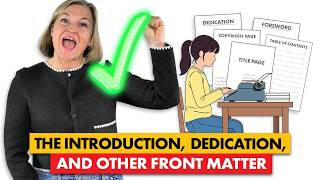
In this instructional video, Julie Broad, founder of Book Launchers, challenges the one‑size‑fits‑all approach to book front matter and outlines a strategic, authority‑building framework for nonfiction authors. She walks through each common front‑matter element—title page, copyright page, a post‑copyright connection page, table of contents, dedication, endorsements/blurbs, acknowledgments, foreword, preface, and introduction—explaining which are mandatory, which are optional, and how to position them to maximize reader engagement, email capture, and credibility. Key recommendations include: keep the title page strictly structural; use the copyright page to add permission/contact info and immediately follow it with a value‑add page that captures emails; craft a table of contents with curiosity‑driving chapter titles that act as salespeople; make the dedication a personality showcase; avoid front‑loading endorsements and acknowledgments; reserve forewords for high‑profile contributors; limit or skip prefaces and keep introductions short, value‑focused. Throughout, Julie emphasizes that every front‑matter page must serve one of three purposes—selling the book, connecting with the reader, or building the author’s authority—or else it should be removed. She concludes with a call to join her free Author Lab community for further support.
Chapters
Most book advice is one size fits all, and that's exactly why so many books don't sell, don't get read, and don't build your empire. So let me ask you something. When has one size fits all ever actually fit you? If you're writing a book or thinking about writing a book and you're looking at the list of front matter and thinking, what is all this stuff and how does it help me build my authority or write a book that sells? Well, good news, this video is for you. Hi, I'm Julie Broad. I'm the founder of Book Launchers and your host here at BookLaunchers.tv. Book Launchers is your first choice for all things related to writing, publishing, and promoting nonfiction books that build empires. All right, here's the problem. Most authors are building their book based on what they've seen in other books. Okay, cool. Let me look at this book. It's got a copyright page, a table of contents, a prologue, a dedication, a foreword, introduction, and then they start with chapter 1. So I guess I need all those things too. Okay, most books do have those things, but are you most people? No, you're not. And that means your book is not gonna be like everybody else's book. So let's not build a book to look like everyone else's book just because that's how it is always done. Let's make intentional decisions to set you and your book up to build your brand and your authority. Most books include things because tradition says they should, but smart authors like you ask a different question: Does this actually help me sell the book, connect with the reader, and build my authority? Or is it filler? Your book is not just a book, it's a tool. You want it to be read You want it to get results, a transformation for that reader, and absolutely you want it to open doors for you. And if something in your book isn't helping to do that, it does not belong there. So in this video, I'm going to walk you through the common parts of the front matter of a nonfiction book, and more importantly, I'll help you decide what actually deserves a place in your book and what you can rethink or remove entirely. Besides the title page, which is first, This one is simple. You do need it. The title page is the page with your book title, subtitle, and author name. The title and subtitle should match the COVID There's nothing sexy about this page, and it is not where you try to get cute or creative. It is a core structural page. It belongs there and needs to be exactly as described. So this is not the page to reinvent publishing. The next page is your copyright page, and also you need it. It's legal, it's standard. Now I do have other videos on this channel on what to put on your copyright page. That's like an OG video from 2018. Still the same. And there's a video on copyright FAQs, which you can also check out too. Bottom line, you need the copyright page. Now, I do recommend including information on this page on how to contact you for permissions and for orders. That's it. Here's the opportunity though. What comes immediately after the copyright page? This is when your reader is engaged. They've just opened the book. They're curious. Most authors waste that moment. Instead of going straight to your table of contents or your dedication, Add a page between your copyright page and your content that connects with your reader and pulls them into your world. Give them something valuable. Say, "Thank you for reading this book. Thank you for picking it up. And to enhance your experience, here, download the workbook, the PDF guide, the audio version, the app to go along with this book," whatever it is. In the first version of Self-Publish and Succeed, I gave away the audiobook for free. Listen while you read, I said. There was a link to sign up, and I used BookFunnel to distribute the audiobook. They got the audiobook, I got their email. Now instead of a reader who disappears, I have a reader I can follow up with and build a relationship with. Most authors put this kind of thing at the back of the book, and that is a mistake. A lot of readers never get to the back of the book. And frankly, sometimes this page is all someone sees. They don't even buy the book, but they sign up, and now I have them in my ecosystem. And I would much rather connect with someone that might purchase my software or hire us for a full service, then make $5 from the sale of the book. So here's the rule. Put this connection point early when attention is highest. I like doing it right after that copyright page. And ultimately, make sure you're doing this a few times in your book because if your book is not capturing emails, you are leaving your best readers behind. And this is where your book becomes an asset that helps you scale and grow even when you're not selling books. Your book needs to lead somewhere, your email list, your offer, your next step. If your book doesn't create a next step, you've built something that looks good, but it's really not going to work in the long term. Back to the front matter. Next is that table of contents. For nonfiction, you need it. Absolutely. It's essential. And it's optional for fiction. But this is a golden opportunity. Please lean in. Pay close attention. A lot of authors think the table of contents is navigation. Uh-uh. Compelling and curiosity-creating chapter titles help sell the book. Lead to speaking engagements, and trigger media interest. These chapter titles are little salespeople selling your book. And if your book sounds like every other book someone has read, because be real, you are not the first book in this category that they are reading, guess what? If it sounds like every other book, you've lost that reader. They want new and novelty. So yes, you need a table of contents, but not a lazy one, no. Your chapter title should not sound like every other boring book in your category. Your table of contents must help you connect to your reader by having compelling chapter titles that make them go, "Oh my gosh, I need this book right now." And by the way, they lead to speaking gigs and media too. All right, dedication. It's commonplace advice that the dedication is optional, and you know what, it is. But I recommend that you spend a little time and use the dedication because it's one of the most read pages in the book, and it's the first taste a reader gets of you and your personality. It kind of sets the tone. So don't fall into the trap that authors fall into and treat this like a throwaway personal moment where you thank your spouse and your dog and tell them how much you love them. Start thinking about your reader. What can you say to give them a taste of your personality while still dedicating the book to someone important? For me, to every author brave enough to not be boring. Or to one of our clients dedicated their book to the family who tasted every bad recipe to get us to the good ones that you'll find inside of this book. Do you need a dedication? No. But if you use one, make it count. If it's there, have it be so inviting that it sets the tone and creates connection and makes the reader feel something so they're excited to spend hours with you consuming your book. Oh, and I should mention this. Many books start with a page or 10 pages on praise for the book. You can do that. We have authors that do it. They get some incredible endorsements or blurbs from great folks and they want to feature them, and so they put them at the start of the book. And there are folks in the publishing industry who say this helps sell a book. I am not convinced. I think it clogs up the early pages where I want to hook my reader, not just to buy my book, but to read it. I'm not right about everything, so if you love those quotes at the start, you do you. But I wanted to mention it because I personally don't recommend putting them in the start of your book. Now, acknowledgments historically have been placed next, but in 2026, the rest of the publishing world joined me in saying Put it at the back. Acknowledgments are usually boring. Most readers only read them after they have read and loved the book, and there is no good marketing reason to put them at the front. So put them at the back. Do you need acknowledgments at all? No. Can you include them? Absolutely. Should they be at the front? Absolutely not. Have you ever watched Oscars or another award show and you didn't see the movie and you don't know who that actor is that's accepting the award? So do you care what they're saying as they thank the long list of directors and agents and People? No. No, you don't. But if you've seen the movie and you like the actor, you'll listen. So put 'em at the back where they belong. Foreword. A foreword is written by someone other than the author. Some people say you must have a good foreword. I tend to veer away from this advice as well. A foreword only earns its place if the person writing it has real credibility with your target reader, and that credibility transfers immediately. Now here's the bonus and where I do get excited about them is if they are a successful author writing to your reader. Why? 'Cause if someone searches their name on Amazon, your book will come up too if they've written the foreword. Otherwise it's just another thing slowing the reader down before they get to the value. And here's the thing to consider because I've seen this happen more times than you would think. When you ask somebody you've admired all your life or somebody that's well known in the space and you're grateful for their support and you ask them to write a foreword, and the foreword sucks, it's a snooze fest, what do you do? Do you not use it? Do you edit the heck out of it so it's unrecognizable? It's a horrible predicament and it happens. So do you need a foreword? Well, for most nonfiction authors, I'd say skip it. But if you're writing a leadership book and John Maxwell will write the foreword, I mean, let's go. That's going to have big rewards for credibility and discoverability. This is front of book real estate. Do not hand it to someone unless that person is genuinely going to help sell trust, and sell books faster. Next up can be preface or introduction. A preface is author-written front matter that orients the reader and talks about context or process. An introduction, especially in nonfiction, is usually treated as part of the main text. And the distinction matters, and most authors definitely do not need both. I don't even generally recommend a preface. But a preface is almost always where the authors kind of indulge themselves. They start explaining why they wrote the book, how hard it was, what happened on their journey, what inspired them. And suddenly the reader is 5 pages in and still has not gotten a real reason to keep going. Now, if your book is really technical or needs an explanation on how to read it, then definitely do that. More than half the readers will skip book introductions, which should make authors think hard about how they use those early pages. Clean guidance: do you need a preface? No. Do you need an introduction? Generally, I recommend one, but sell the journey ahead and make the value obvious. Do not write a long, self-important, throat-clearing intro that warms you up for the book. Make your introduction sell the book. Reread what you have. Is it all about you, or are you connecting to the reader and selling them value immediately? My introduction on Self-Promote and Succeed starts off, "Many good books don't sell. This is not said to discourage you, it's to inform you and motivate you." That is all about the reader. Your introduction has to earn the read, and if someone even looks at it, they need to be brought immediately into why they will and should keep reading. When you look at the front matter of your book, some pieces are structural, you need them. Most are optional, and some are optional but powerful opportunities if you use them strategically. Remember, online with read sample and browsing features, those early pages really, really have an important job. Get someone to buy your book. Once someone has the book in their hands, now those pages have the job to sell them on reading. Those are both big jobs, so those early pages are so important and can make or break the success of your book. Your book. I can't tell you how many times I've not meant to read a book because I am surrounded by books all day long, and I pick up a book and browse the dedication and introduction, and the next thing you know, I am absolutely hooked. And one of the books that did this was our client's book, Neil Gordon's book, The Most Powerful Sentence of All Time. I picked it up to look at something, the next thing you know, I read almost the entire thing in one sitting. It hooked me. If your book can do that, you You've not just got a reader, but you're having such an impact that it will extend your reach. Title page, yes. Table of contents for nonfiction, absolutely. The dedication, optional, but make it meaningful, and I think it is really, really valuable. Acknowledgments, boot 'em to the back. Foreword, in my opinion, generally no. A preface, generally no. If your book is technical, not meant to be read start to finish, okay. Introduction, probably, but keep it sharp. Short, sell the reader, and then open it up with a fantastic first chapter. Don't warm up to the good stuff, get right to it. And the big idea running through all this is simple: these pages are not there because tradition says they need to be there. They have to be there to help the reader, help sell the book, or help build your authority. And if they're not doing one of those things, question it. Wanna connect with me and other authors? Come on over and join our free Author Lab community over at booklaunchers.com/school. Of course, after you subscribe to the channel and say hello down below. Of course. See you in the community.