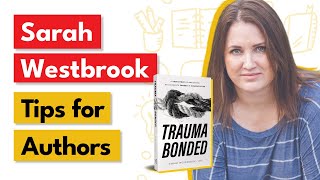
This is a recorded interview in which Sarah Westbrook (licensed professional counselor, private-practice owner, Army spouse, adoptive parent) discusses launching her memoir Trauma Bonded. She explains why she wrote the book (to show how trauma bonds shape relationships and to offer hope), practical launch tactics she used (competitor analysis, following Book Launchers' marketing advice, brand visibility via a podcast and merchandise), lessons from content editing (don’t take edits personally; clarify connections for readers), and live-event sales experience (sold 180 copies across two events, importance of promotion, offering giveaways, accepting card payments via Square).
Questions this video answers
Trauma Bonded
180 copies (total across two events)
About 15 months
Eight children
Licensed professional counselor in the United States
Chapters
I'm Sarah Westbrook. I am a licensed professional counselor in the United States. I've got a license in a couple of states, and I own my own private practice. So I'm an Army wife. My husband retired from the United States military a little over a year ago, and I'm the mother of now eight children. My husband and I are adoptive parents. My book, Trauma Bonded, is my memoir, and I wrote it because over my lifetime, I've learned both in my professional practice and then as a parent, a foster parent, and adoptive parent, that the attachments that we have forged in trauma really affect the way that we interact with people, how we show up for people. And so I wanted to write my story and my memoir in order to demonstrate that trauma bonds change the way that we interact with people and also to be a voice for those that are stuck in that toxic relationship, to help them overcome those challenges from their own trauma and then show up differently in their own lives and to let them know that they're not alone and to write about the really ugly parts of me, because most people will look at me and say, wow, she's got it all together. And so I wanted to write a book where I was able to say, hey, look, I didn't always have it all together, and that's a normal part of your healing journey. So I really wanted my readers to know they're not alone, things can get better, and how to do that. So the two things that I did to have a successful launch, I definitely had a much more successful launch than I was expecting. It was a phenomenal launch week. And I think the two things that I did really well that I would want to share with people is, number one, I identified the competition. So when I looked at my book, I said, okay, whose book is the most similar to mine that I have ever read? And so I went in and I did a ton of research, and then I mimicked the things that really worked for my brand. I also listened to Book Launchers because, frankly, their marketing team has a whole lot more experience in marketing books than I do. And so a lot of the things that they were recommending I would never have thought about, or I would have been like, yeah, no, I'm not doing that. But I listened to what they said. I followed those recommendations as best as I could, and I. And I asked questions. The other thing that I did really well, I think that that really helped is the exposure of your brand. And so I wanted to make sure that my brand was visible. And so for me, I've Got a podcast, I advertised it, I did merchandise that has nothing to do with my book. I've got like a duffel bag and all kinds of little things. And then I also use my own merchandise. So. So that way, everywhere I go, I travel a lot. Everywhere I go, my brand is visible. My focus was be honest, be real, be raw for your audience. Because that's in my field, people really value the genuine, raw truth. And so when my book hit content editing, I remember comments from the content editor and I loved my content editor, but we had a love hate relationship. I'm going to say that's probably normal we with your content editor, but there were times where she would say things like this isn't believable or how could this, you know, why are you being so hard on this character? It hurt. I'm gonna be honest, there were some really raw emotions during the content editing. Mostly because I poured my entire soul into writing this book. And what I would do is, number one, I would lick my wounds. I think it's very important for us to feel our feelings and work through some of those difficulties for sure. So I took some time away. I licked my wounds. When I needed a little bit of support from book launchers, I reached out to book launchers. I was like, hey, I'm not sure how I'm feeling about this, so that way I can get some of that feedback. But over the course of content edits, what I learned was that it's not personal. In no way was my content editor telling me that my story was a lie. Rather, what she was saying was the way that it's written does not make sense to the reader. You need to connect these dots, you need to fix these things. You know, if you're saying, hey, I don't understand why you're being so hard on this character, what does that mean? That, and for me, that meant I needed to go back in and clarify why the way that I was interacting with that character didn't fit the situation or what was going on. And so I would say the biggest lesson I learned is do not take the editing process personal. You've got to be able to step back after you lick your wounds and look at it from the what can I do to make this believable? What can I do to make these connections make sense so that it is the best finished product out there? I've had two incredibly successful book events. I sold 180 copies. The challenge with live events is marketing. People have to know that you're there. They have to Know that you're coming. And for me, both of my successful live events people knew I was coming. And so my social media word of mouth and then the signs around the event were the best. I actually pulled this up. I had this, that book launchers put together for me. And then on the back I have, Here we go. The author signing with my logo for the publishing, my publishing company there at the bottom. And so what I did is I sent these to the places that I was doing my book signing and I put all of the information on the back. The other thing is I had free giveaways at my events and then I spent time. So the first live event I did, I was there for like nine hours doing nothing but signing books and talking to people. And so I would ask them questions. You know, what was your favorite part of the book? Where are you at in reading it? What are you hoping to gain from this? Do you have any questions for me? You know, I gave out my professional email address and I've had several people, you know, email me. I said, hey, if you've got a question and you don't want to talk about it here, feel free to email me. And so there was a lot of personal interaction and I think that that really helped. And I think it's important to keep in mind every contact you have with somebody about your book or about your brand is a potential future audience. Also, set your expectations. You don't need a 6,000 person audience for from the get go. Books are around for a really long time. And so as long as you are actively working to build that audience, it will baby steps continue to grow. So my podcast has been around for about 15 months and we've seen exponential growth in that 15 months. I'd also like to add I have square for my book that's attached to that business account. So when I was there, not only could I accept cash, but I could also work with square. And I just played with the settings to price my books so that they would come out with the tax to get that round number. So that way also I knew when I had to go to pay the taxes, I knew how much was mine to keep and how much I needed to pay in taxes. So I had the majority of the people who bought my book used a debit or credit card to pay for it. So make sure when you're at these live events you have those multiple options. The reason I ended up choosing Book Launchers was because the team was positive. They were very helpful and inspiring. They when they gave me criticism it wasn't, you know, this sucks, and you can't do it this way. It was delivered in a way of, hey, I love your goal. Let's look at some of these statistics and facts now. How can we grow your goal and make this fit and work for you? The other thing that I absolutely love about Book Launchers is that there were a couple of things where I was like, no, this is how I want it. And they would give me the, you know, these are the pros and cons. These are some of the risks that you're going to take. And then they respected my decision. And, you know, I. I'm a boss of my own company. I'm used to being in charge, and it. It's my life story in that book. And so there were some things that I was like, no, this is what I really want. And because they were able to honor my choice without shaming me, that made a huge difference. And so, honestly, for me, Book Launchers, not only were they looking at me to make sure that what I was writing was a good fit for their company, I was looking at them to determine if they were a good fit for me based on how I value boundaries and healthy communication and relationships and whatnot. And I can absolutely say 100% book launchers fit that bill for what I was doing and for my project. So thank you so much to Book Launchers.