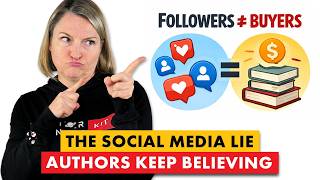
In this video, Julie Broad, founder of Book Launchers, argues that relying on social‑media follower counts as a book‑marketing strategy is a misconception. She explains that follower numbers are a vanity metric that rarely translates into sales because social platforms are discovery engines, not purchase closers, and algorithms control visibility. Instead, real revenue growth comes from authors who focus on owned assets (email lists, websites, intellectual property), authority positioning (speaking, PR, podcasts), and wide distribution (international markets, multiple formats, library platforms like Hoopla). Broad introduces the "Empire Framework," which layers owned assets, authority, and visibility (social media as an amplifier) to build a sustainable author empire. She recommends alternative audience‑building channels such as podcasts, livestreams, in‑person groups, and library distribution, emphasizing consistency, long‑term planning, and independence from algorithm changes. The video also promotes the Author Launch Kit software and Book Launchers community as resources for authors to implement these strategies without obsessing over follower counts.
Chapters
If your book marketing strategy is sell my book on social media, I need to tell you something. You don't have a strategy. You have a wish. And wishes are not business plans. So if you want to make sure your book is building something like book sales, platform income, well, this video is for you. Hi, I'm Julie Broad, founder of Book Launchers and your host here at BookLaunchers.tv. Book Launchers is your first choice for all things related to writing, publishing, and promoting nonfiction books. Today we're talking about the social media lie. I'm gonna show you why a million followers is an unreliable predictor of sales and where the real revenue growth is actually hiding. First, social media is massive, but it's a discovery engine, not always a great sales closer. Some authors are obsessing over TikTok and they are seeing some results, Many of them are missing the fact that library demand through platforms like Hoopla just surged 501%. That's not driven by a viral dance. It's driven by structural distribution. Follower counts are a vanity metric. The industry is seeing sales growth by 33% while unit volume is only growing by 22%. That means the money is being made by authors who focus on value capture and wide distribution, maybe even direct sales. Not just hunting for eyeballs on a feed. The surge in book sales isn't happening because every author got a TikTok account. It's happening because authors are moving into a distributed ecosystem and they're getting into things like international markets, regional store alliances, and they're doing multiple formats. In other words, they're creating great assets, pieces of high-value intellectual property, when they create their book, and they're finding ways to sell their content across platforms, formats, and countries. It is an exciting time to be an author. And if you hate social media, I have some great news for you. All those followers, well, they are not guaranteed to convert. The uncomfortable truth of social media is that it trains people to scroll and books require people to commit. Those are different behaviors. A follower can like you, by the way, always a good time to like a video, They can enjoy your content and even comment on it. Hint, hint. And they can be entertained by you and then they never buy your book. Why? Well, the platform has the relationship, not you. And the algorithms decide who sees what. And attention spans are more fragmented than ever. It's a distraction-first kind of environment. And if you use social media and you're consistent and you do a good job of creating content, Well, you can build an audience that likes you, but that doesn't always mean they're going to buy your books. And that's the key. Audience-book fit matters more than audience size. And publishers are starting to realize this too and are no longer looking strictly at social media size. If you hate social media, it's totally fine. Find where your readers are hanging out and get yourself in front of them in a way that works for you. What does that mean? Well, podcast interviews, livestreams, in-person associations and groups. I've had wonderful success selling books and meeting potential authors to work with Book Launchers by being active in groups and associations. The in-person factor might take a little more time and effort, but it can be a very high value and high conversion, and you can meet some really cool people that way. Basically, I'm saying there's no rule that you have to do except to say you have to consistently be putting some message out there into the world in front of your audience. Whether that audience is on Facebook, Instagram, a podcast, or at an event. There's still value in social media. Social media is not useless. It's powerful, in fact, when used correctly. I had someone come on my channel the other day and say, uh, 4 days, 259 views, 26 thumbs up, and only a few comments. You might want to concentrate a tiny bit more on the algorithm. Just saying. Well, at first this comment stung and I felt a little hurt and then I actually felt annoyed because I clicked on his profile and he doesn't even have any videos. But this guy is armchair criticizing me while not building anything of his own. In the end, I settled on the fact that this person was right in the fact that my latest video had not performed spectacularly well. And guess what? Some of my videos don't get thousands of views, But there were still 259 people who did see that video, and that is not nobody. So when you're starting out on social media, it can be easy to pay attention to those numbers, but don't let the fact that only 2 people liked your post stop you because another 30 or 300 saw it. And that is 300 people you reached without having to be dressed up or out of the house. You reach those people while doing whatever it is that you were doing that day, and that is something to celebrate, not feel bad about. Feel bad about. And that is the key. You have to have a plan when it comes to social media. And when you do, you will also understand that it is not an overnight solution. It's long-term and requires you to be consistent. It does support a larger strategy and it does drive to owned assets if you do it right. And it can build authority, not just visibility, but it needs to align with your genre and your message. Generally, where social media really works is when there is a quality connection with an audience. So it's not about the numbers because if you have, what was it, 349 or 249 people who are engaged and connected and 20% of them take action when you say, you know, buy this, click this, that is phenomenal. And a lot of people have 100,000 followers that don't do anything. I mean, a lot of those are bots. If you really start digging into it, they're fake accounts. They're not real. Things like BookTok work more because of communities that get excited together. Not because a certain person had 300,000 followers. Now, YouTube can work really effectively for nonfiction when it builds thought leadership and trust over time, just like Instagram can support a brand and it keeps you in front of your audience. LinkedIn is great for building credibility and discoverability. Now, the thing with social media is that none of those things are assets you own. You're on rented land, and empires, they're not built on rented land. So go ahead, use them, but also build something you own. And that is where the Empire Framework really comes into play. So if you want real authority and thought leadership, here's what you need to have. Owned assets, which are things like an email list and a website and your intellectual property, which for most authors, of course, starts with your book. Your middle layer is your authority positioning. This is where you are doing speaking partnerships, PR, like media, podcasts, written publications. Then on top you have your visibility. This is your social media, and that is the amplifier. You can post about the things that you did in the foundational, right? About the speaking, the partnerships, the PR, of course, your intellectual property, your ideas, your concepts. And that is where this is really, really powerful. Nick Hutchinson of Book Thinkers, also the author of Rise of the Reader, one of our fabulous clients, he spoke at our live event. Author's Empire workshop and said, "The best approach is to document your day-to-day." So if you're creating on social media, don't put the pressure on yourself of thinking of it, "I have to create this amazing content." Just document what you're doing. And when you do that, now you have content to share and it's reinforcing the other layers. It's not the foundation, it's the amplifier. And that kind of content also creates connection because your audience gets to view into you and what's going on in your day-to-day life. But again, it's not the foundation, it's the amplifier. The question to ask yourself is if the algorithm changes tomorrow, does your strategy collapse? And if the answer is yes, you've built on rented land or even sand, and that is a challenge. So build your own assets that you own first. Now, I wanna share one other thing with social media that doesn't work that I see authors doing all the time. Your book is 2, 3, 4 weeks away from launching. So now you frantically start posting everywhere about all the things trying to get momentum for your launch. It's not gonna work. And you're competing with full-time creators. You're also competing with a whole lot of AI-generated content, and there's algorithmic saturation. Organic growth is slow and requires consistency. And that's why I say, if you enjoy social media, do it. If it energizes you, lean in, but it is not a last-minute lever that you get to pull. It is not a guaranteed sales engine. It is a strategy to implement with care and consistency. And if you don't have it, don't panic. Build it slowly and look to other strategies to build attention and momentum for your launch. Speaking of that, our software, Author Launch Kit, has a guided path to help you truly build big momentum pre-launch and post-launch with or without social media. You can get a 7-day free trial over at authorlaunchkit.com. Instead of chasing followers, ask yourself, what authority am I building? And what transformation does my book deliver, and where are the readers that need that transformation hanging out? When you start to think about that, you can think then, how am I moving people from awareness to now ownership and capturing their emails and deepening trust? Remember, 1,000 aligned email subscribers that trust you are far more valuable than 100,000 passive followers scrolling past you on social media. It's not just me that believes this. Publishers have stopped caring as much as they used to about social media. Agents will still ask and marketing teams will still reference it, but they have been burned by authors with big social media followings who don't buy books. Engaged and into what you're talking about matters more than numbers. So it's okay if you only have 249 viewers, if those 249 viewers are liking and commenting and engaging with you. Discoverability does matter, but the math is messy and follower counts alone are not going to be a reliable predictor of success. So if you're building your entire plan around grow followers and hope, you're outsourcing your future to an algorithm, and that is not empire thinking. It's kind of gambling. If this video helped recalibrate your thinking around social media and strategy, I do hope you subscribe. But more importantly, come on over to our free community over at booklaunchers.com/school and hang out with us so we can help build empires together.