Tips and Ideas for Authors from the Author of Better Listening - Stan Slovin
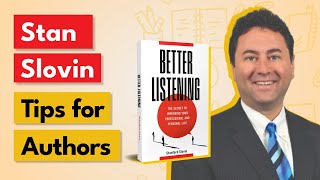
Stan Slovin wrote Better Listening because he noticed people's attention spans and conversations were declining. He learned patience and compromise while writing, then used podcasts, book signings, and targeted keywords to market it. His main advice: treat publishing as a team effort and understand that getting published is just the start.
Chapters
My name is Stan Sloven. As Julie mentioned, I am in Chicago, Illinois, and I am a new author. My book, which is called Better Listening. So this is what it looks like. The secret to improving your professional and personal life. So came out in September of last year, and with the amazing help of Book Launchers, we were able to bring out the book. One day about 10 years ago, I realized that, you know, the world was kind of busy and everyone's multitasking and, you know, our attentions were, you know, short, and we're constantly distracted. The world is just full of distractions. And I realized that conversations were starting to really get lost in terms of that. We were just cutting each other off all the time. We were constantly thinking about what we wanted to say while other people were talking. We were hijacking conversations, and we were really not letting people really empty their buckets. We were like, listening to respond versus versus listening to understand. I thought, you know what, boy, we need a book on better listening so that we can create just more impactful conversations, just have more meaningful dialogues and actually deeper discussions. And I thought that would be a great way to help not only people in the professional world, which is I'm in the professional world for 31 years, but also personal relationships that really just, you know, the cry for being heard more and just helping people just have a better human communication with each other. I would say that I learned a lot about myself. I really did. This was a new process. You know, all of us, obviously today we've had our successes in areas, and then we wanted to put it down on paper. We wanted to become that author. And I would say that I probably really needed to hone in on understanding that it was a new process. So I had to learn to compromise a little bit more. I had to learn and relearn about patience and understanding. And because that was not my world. Writing a book, you know, when you put it in hands, especially, you know, with a company like Book Launchers and Julie's team, which was, again, it was phenomenal. You have to learn that that's not your life. That's not what you're used to, it's not your profession, and how you handle things. Like, you know, Max, you know, how he did it with his business. And so big thing was the patience, the compromising understanding that it was a new world. And also the last thing was trust. You know, I really had to learn a new area. I'm very trusting, and sometimes that's a good and a challenge. But you have to trust those that were taking you through this process. And the key thing was for them to be able to communicate those steps. I think those are the three big things. Trust, communication, patience, and a little bit of just understanding, compromise. I would definitely be thinking about the world after the publishing of the next book. So I will tell you that I think that life begins not really on getting your book published. I view it, I'm very sports oriented and I kind of think about football all the time, you know, in terms of like the red zone, you know, getting it over that goal line. And I think that that's one of the things that sometimes new authors are focusing on. You know, they're so close, they have the draft, they're in the process, you know, like that, but they're just not getting it over the goal line. It's taking time and you need help. And this is where again, our friends from book Launchers, I think that's how I viewed it is like they got me over the goal line. They literally got me published. But that really was just the beginning of my journey. That was not my goal only was to just get published. It was to really figure out how to get that message out. And I think that if I did book number two, I would realize that you have to have a partnership with your publisher. You can't rely on your publisher only to do your marketing. And you definitely cannot rely on yourself because you don't have necessarily the expertise. Even if you have 80, 85% of expertise in marketing your own book, there's always that 15 or even 20% that you don't even think about. So, for example, podcasts, I don't do a podcast, but I've been on already seven to nine podcasts and I would have never been able to do that unless I would have had avenues getting your book on Amazon and different distribution lines. Yeah, you could figure it out. You could do research, but you want to. And if I did my second book, or when I do my second book, I think that the process is going to be quicker in terms of after the writing. In fact, that's what I would take away from if your audience took something away from publishing. That's just part one. Life begins after that book. And I think that I would do differently is I want to work on how do I get that book out, Whether it's podcasts, speaking engagement. Here, I'll give you another one book in the box where book launcher says, hey, do a video of opening your box on the day your book arrives. I thought, oh, God, that's so Stupid. That's so hokey. That's so corny. That's like probably my most viewed thing on my website. Okay. Is everybody seeing the excitement of stream opening up? Better listening? Okay. Because you get to tell this excitement because people want, they really do. People love to share in your excitement. They want to share in your journey. The other thing is think about also your network of friends and your marketing of friends and family who you want to that book army. I would go over that video over and over and listen to Julie's video and this team's video because it gets you out on Facebook and social media, all the different avenues that you're not used to. Necessarily because you're a first time author, you've never really promoted. So that's what I would do differently. I would be thinking about marketing your book army, how to get it out so that when it does get published, that's the beginning of the fun journey, not the end of the task. I think that what worked really well from the marketing standpoint was that we were working together again. Like I said, this was a book that was trying to get into the industry, into the professional and the personal. So Angela and Roy and everybody on the team really came together and kind of helped me script what I was going to kind of promote what I was going to communicate. And really, I think we took a three prong approach. One, we were trying to see how we can get in front of live and in person. So book signings. So from a marketing getting in front of some chambers of commerce and audiences. The second one, which book launchers does again, they're amazing at it. I don't have that professional experience or the skill set, but reaching out to the medias that could read your book, review your book, invite you to be on podcasts. And that's really, I think what we really learned a lot together in the beginning part was that one patience, compromise and being understanding that you're in a new world. It doesn't happen overnight, but over the time, over the last four or five months that I've been doing this with book launchers, every month I'm getting signed up for three or four new podcasts. I'm going in front of new speaking engagements. I'm getting ideas, the ideas that came from book launchers because of their experience or their skill set or what they have seen work and not really helped me open up my eyes of like what we should be spending our time doing. Shane who's working on the marketing, he's like, listen, let's try to get this out by creating some keywords or focus words that people will see. And I forgot if it's called imprints or algorithms, but, you know, 100 to 200,000, okay. Hits or. Or touches. And all of a sudden every month we were getting another like 20, 30, 40, 50 books being sold because of things being caught up. So areas that I took advantage of that I never had exposure to was one letting book launchers utilize their experience. This is the key if you are an author and you are looking to do signings or speaking or you want to be on a podcast or you want to coach or you want to do meetings in your industry or you want. Or you want to reach out, like Trent was saying, to different communities that may be affected. Their ability to identify, their ability to target market, and their ability to campaign your book through the right search engines and the right search words, the modes of receiving was incredibly, very strong. So, you know, that was kind of like from a marketing and branding standpoint. And just as a note, moving on, even today, I'm only six months in, or five and a half, six months in. And I will tell you that I'm getting now calls and I'm getting emails asking me, hey, I saw you on this podcast. Would you like to be on our podcast? Or hey, I have a buddy that runs a podcast on leadership, and I just did one last week in London. And leadership, okay, I don't know about you, but I've never been on an international podcast before in my life, before writing this book. And now I've been on two internationals because I guess listening is important also in Europe. I just realized that. And listening is also important in South, South America. I just realized that. My point is that, you know, don't limit yourself on just little your little niche. Allow book launchers to expand the potential of reaching markets and audiences that you didn't even think about. And work with them, collaborate, give your input, give your feed, let them share. And I think you'll see very quickly some great venues to use your marketing and branding. This cover is all because of book launchers. I had, like, in my mind, I was like, better listening, you know, like big red letters, you know, big black. And they're like, you know, Stan, maybe we could come up with something different, like. No, no, no. I want, like, better listening, you know, and I was so stubborn and really working with the team, you know, not just with like Sarah and Nicole and Angela, but even a call from Julie, and Julie says, you may want to listen and you should take your own advice about better listening. You should maybe let us look at a cover. They came back and I am telling you this cover is because of them. It has been so well received and the positive comments. So sometimes even when you get really entrenched in that writing process, you got to step back and give them a chance to share some of their wisdom and their best practices. That's what I would call it, their best practices. It was a year, a one year process. I would clearly set expectations. Set expectations of what you are trying to accomplish in the timeframe that you're trying to accomplish it. Have big picture expectations and have also your short term. Number two, be clear. Be clear on what you want so that you can communicate that to book launchers. And also be clear to understand what they want to do to help you and listen. You know, my book is all about active, reflective listening. But my one little plug for my book is the difference is that it adds empathy. It adds empathy into the art of listening, which means you have to find out what's most important to them to help you, but you have to share with them what is most important to you with regards to a relationship with working with a publisher and let them hear what's important and go through that and dig deeper so that not only are you optimistic, but then you're realistic. So optimistic is that you're writing the book. Realistic is the process of actually writing, writing that book. Number four, be patient. Be patient, but be proactive. Be patient because you don't know that it takes time and it takes research and it takes a collaboration on book launchers part to sit and to look what you're trying to achieve. They have to go over that and it doesn't always come back right away. But you also have to be proactive to make sure that if there's an issue or you have a concern, they need to know that. Because if you don't, they won't know. And that's a really good back and forth. And then finally when you're checking in, remember it's your book, it's your name, it's your, your reputation. But it's not all about you. It's about a team effort. And I would say those are my four or five areas.
More from Julie







Should You Skip Amazon When You Publish Your Book? #digitalmarketing #amazonauthor



