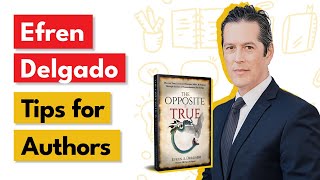
Efren Delgado, a former FBI agent and author of Opposite is True, discusses his book and offers practical advice on writing and promoting a book. He frames his thesis around vulnerability as strength (good guys vs. bad guys metaphor), and structures advice using "bones/meat/spice" (foundation, illustrations, surprises). He recounts the humility of the first content edit, gives tactics for gathering reviews and subscribers (pen-and-paper signups, calling contacts), and describes his publishing timeline (ebook in August, paperback in September). He emphasizes authenticity, daily small actions, persistence, networking, and using podcasts/events to reach audiences. Book Launchers is cited as his publishing partner.
Questions this video answers
Ebook in August; paperback in September.
Chapters
Efren Delgado. My book is the opposite is true. I've been with book launchers for a while. My background is I'm a former FBI agent, but I've always been interested in psychology and human behavior. Noticed patterns since I was like 6 or 7 years old that just continued to get corroborated throughout my life and particularly in my career and chasing around bad guys. And essentially I compare the bad guys to Chihuahuas barking at the doorbell. They're weaker than the good guys, even though we, the good guys, are intimidated or scared of the loud danger and violence and aggression of the bad guys. But my book is meant to encourage the reader just for the sake of you. Being not one of the bad guys means you're stronger than they are. And I point out several examples why they're weaker. And essentially they don't want to expose their vulnerability because most truths are counterintuitive. So when you make yourself vulnerable, you're actually making yourself stronger. And the good guys make themselves vulnerable all the time. And the bad guys, that's the last thing they would want to do. So their aggression and their attacks are always hardening their turtle shell. So that should encourage the reader to know when you're in danger or you see somebody, you're actually stronger than they are. I guess in a nutshell, yeah. Adversity is the catalyst to purpose, action, and success. And I convey that in different biographies and my own FBI stories to try to get the message across. Reader first. Every chapter, every paragraph, every sentence benefited the reader in some way. Book launcher slogan is no boring books. So it's no part, no chapter, no paragraph, no sentence could be boring. And just keeping that in mind, as I was writing the book and illustrating my points with stories and different anecdotes, I just kept those two things in mind for the goal of just making the overall book useful or entertaining, either educational or entertaining throughout. So it wouldn't be boring. Know who your audience is, who you're interested in reaching out to, and the big why I would really emphasize in the bones of your manuscript or what you want to say, what does your audience need? And the emotional part is the why, which is the entertaining part of the book. So just kind of keeping in mind what your goal is, definitely knowing what you want to get out of it. And book launchers will ask you all those questions, so you might as well be ready for it. The bones are the foundation. The meat is like the illustrations, and the spice are the unexpected things the that you will read and go, oh, wow, I've never heard that before. So I kind of break it up in those. In those kinds of that. I love metaphors, so I use that metaphor for a lot of things, and I think it'll make your book not boring with those elements. Your book cover, you wanted to catch the eye from across the room or in a thumbnail of the Amazon when you see all the thumbnails. So that helped me at the table. And so a lot of people came by with that. And then once I started giving my take on, like, what the book's about and how it could benefit the reader, that's when they were more interested. And a couple fresh people bought books that way, you know, joined my subscriber list, and I put name, email, and left a pen there. I didn't ask anybody to put their name and email there, but they just did, naturally. So that was a quick pen and paper way to do it. I've heard from several people, Julie, too, that that works better than a QR code to get subscribers. When you have a book, you have to promote it. So it's a great, valuable question. And so what I'm doing is pushing for book reviews, because anybody who does read your book will recommend it to somebody else because you probably have a good book. So I'll literally pick up the phone and call people that I might know that would be interested in the book and see if they could leave a review since they've already purchased the book. I'm trying to do networking, so I. I joined Nick with his event with Book Thinkers, which was valuable. I met a lot of great people, and I did this recent event that Julie was also there at, and I met a lot of people. So once you start talking about your book, your idea is going to get out there and they'll. They'll promote it to wherever they go back home after these events. And then you could collaborate on people's podcasts or business ventures or whatever applies to you. And then the last thing I already alluded to it is trying to get on a podcast just to get your book in front of other people's audiences who would appreciate what you have to say. I learned something at this conference yesterday that I wanted to share with everybody. One of the speakers gave the metaphor of a traffic light. Like, you have green days where everything's going great, you're in a zone, and no problem, you're plowing through everything you have to do. That's. That's a great no problem day. Then they had yellow days where things are going okay, but it's not the best. So just kind of push through and make progress there. But it's essentially a good day focused on the positive. Then people have red days with family issues, things going on in the world, or just curveballs that come at us and humble us. And the speaker was saying, just do something that day, every day, and you'll. You'll keep moving forward. So that's my main takeaway, is just do something every day. And at the end of the day, like, authenticity is huge. So instead of selling them, I just was authentic. And I think that resonated with people because people appreciate that, especially nowadays. The heaviest part and the biggest lesson I got was the content edit. The first content edit. I've got this ongoing theme where humility is the only path to wisdom. And I quote Greg Laurie, he's a pastor out here, and his metaphor, he says, fruit grows in valleys and not on mountaintops. Just telling everybody that when you're in the valley, when you're humbled, pick up all that fruit of wisdom, stuff your pockets, nourish yourself, and resume your climb. And I just love that metaphor because it's so useful. And I was definitely humbled from my first content edit, too. I'm like, who is this person? So I felt all that same angst. But I had. Chad Sanborn was helping me as a book coach, and he said, use the devil's advocate approach. And that's often what they do, just so that you're ahead of it. So when your book does come out, anybody who would have an issue with whatever aspect of the book that's being criticized or giving you the devil's advocate approach, you could already get ahead of it, address it, even, like, give a. Like a preamble to. In the interest of intellectual honesty, I'm saying xyz and then go on with your point. And I really got a lot out of that. And another main theme in my book is assess, adapt, overcome. And this was a way to personally challenge me to assess the criticism or the lack of clarity issue and just be authentic, intellectually honest and move forward from it and grow from it. And I think it made my book better. I had the bones completely written and I had most of the meat written. I was just kind of refining and doing some spice and needed more meat in there. Essentially. I was about a month, maybe a month and a half away from my first content edit. So that. That's how I did it. And then I got humbled quickly. August was the ebook, and September was the paper. It's good to have it out. And now I'm switching to marketing phase and doing podcasts, trying to get out there, trying to explore the whole social media thing, which I'm not too good at. You know, obviously it took a lot of time to do, but it's nice instead of having to search for all the different people like editors, content editors, copy editors, and learning the whole process, Book launchers had it all together and there's other companies who I researched and they just weren't as effective. So it's been great being with book launchers. I think all of us aspiring entrepreneurs would, would love to be authors full time, but the reality is we all have to earn an income with our day jobs while we're trying the second career, so that's tough for everybody. And then our third career is our personal lives, our families that need us and everything. So I just encourage everybody to just persist, persist, persist and do something every day and we'll get there where we're supposed to be. So it's fine.