Why Most Authors Are Blind to Their Data (And Losing Sales Because of It)
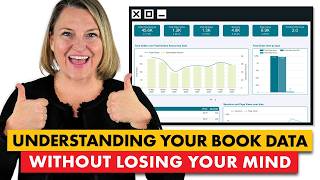
Julie Broad (founder of Book Launchers) argues that authors must be data-driven to market books effectively. She outlines five key analytics categories—sales & format breakdown, reader engagement, discoverability, marketing performance, and audience/platform metrics—and gives practical benchmarks and testing advice to help authors track what moves the needle and allocate marketing budget efficiently.
Questions this video answers
21.5%
$2.88 billion
Anything over 0.2%
Between 1% and 5% (over 3% is strong)
Lower than 2%
Chapters
If you've ever opened up your Amazon dashboard and instantly felt like you were looking at the matrix numbers flying at you, graphs blinking, and your brain quietly going, nope, Nope, nope. Well, good news. This video is for you. Hey there. I'm Julie the book Broad, founder of Book Launchers and your host here at Book Launchers tv. Book Launchers is your first stop for everything. Writing, publishing, and promoting nonfiction books. All right? In 2026 and beyond, data is not optional for authors. It's your advantage. So if you want to win in book marketing now and in the future, let's get into understanding the data you need to know about. All right, so first you're probably thinking, what do you mean, data decision making? And I know it probably sounds as exciting as reading your user manual on your blender, but hear me out, because authors who understand their data are winning. In fact, I'd argue that indie authors, yeah, us scrappy self publishers, we're doing better than many hybrid and traditionally published authors precisely because we have our data. They can't see what's selling and what isn't, and what keywords attract readers and what ads are wasting money. We have visibility into all of that with a lot of hybrid authors. They get a report and ultimately they're paying someone else to handle it. But they might not know what is going on. And sometimes it sounds like month one, they have hope, and month they have disappointment, and month three, they have crickets. And I know you don't want that to happen to you, so if you want to make smart marketing decisions, you have to know what the numbers are telling you. I had a call yesterday with an author who wanted me to break down everything she was going to spend between our services and book marketing and book marketing, things she might do outside of our services. And I said, well, I appreciate the question and that you want to budget, but. But here's the reality. You really won't know what you're going to spend on marketing until you get into it. What I mean is that smart authors test things. They see what's working, and then they lean in and even double down on the things that are moving the needle. And then they might tweak a few that show potential and drop the ones that don't. That means it's good to set a budget and have a preliminary plan. For example, in presale, you want to submit to editorial reviews, possibly book awards, maybe get some PR or podcast bookings, and those things have a cost, but you want to try and forecast your marketing costs for the next year. If you've never done any book marketing, you probably won't know what is going to move the needle for your audience. So this isn't about turning you into an accountant, but it is about understanding the numbers that will matter so that you know what the things are that are moving the needle for you and your audience and your goals. All right, so author analytics we're talking about not just how many books you sold. That is definitely one metric. It's a good number, but it's not one that I think I need to talk to because almost all the authors are paying attention to that. It gives you a bit of data. But for most authors, I always ask, is sales your most important metric? Because if you only look at sales, it's like trying to understand a movie by only watching the credits. You know the ending but not the plot twist. That got you there. So let's break this down and I'll put it into five categories of data to help you start to understand. So number one, sales and format breakdown. Yep, sales. Sales matter. But dig deeper. How much of your revenue comes from eBooks versus print books versus audiobooks? If 90% of your income is from print, that's great, but maybe you're missing out on one of the other platforms or formats. Based on data from the association of American publishers AAP, their StatShot reports, the US market for adult nonfiction books in 2024 showed a strong dominance of print formats, with digital formats ebook and audiobook collectively accounting for 21.5 of total sales revenue. So print matters a lot. And by the way, this is not a small category. It's 2.88 billion in sales. Now. When you dive into a more granular breakdown from the first nine months, it shows that audiobooks held a larger share within digital than ebooks, reflecting trends where nonfiction genres like self help, business and history perform really well in audio. So the book's format split tells you where your readers prefer to read or consume your book. And that is important. And it also tell you if you see something different from the norm, is that an opportunity or an issue facing, for example, in the real estate space? With some of our authors, especially those who are podcasters, we see as much as 40% of their sales in audiobook format. In general, though, the split is very reflective of what most of the authors with the formats are seeing. From the AAP report number two, reader engagement data. This is where I think things get kind of juicy. Look at how people interact with your book and brand. Your reviews are a significant indicator of this. How many what they say the different platforms you're getting reviews on. Now, it's not as easy to understand because a lot of the platforms keep their data to themselves, but this is developing Spotify for Authors as an example. The data potential about your readers is fairly significant. Now, unfortunately, my Spotify for Authors account doesn't have enough sales for it to produce a report at this stage. I only set the account up about a month ago and I have the distinct disadvantage of that I've created for myself, mind you, by giving my audiobooks away all the time in all the places. So I don't have a ton of audiobook sales and I don't have an example report to show you. But the Spotify for Authors audience report will give you a clear snapshot of who's actually listening to your audiobooks, with their age range, gender breakdown, the other content, especially podcasts they love the most. It also shows which authors share the biggest overlap with your listeners. That data is aggregated so it's privacy safe and updated daily. For an author, this is marketing goals. Instead of guessing, you instantly know if your core audience is 25 to 34 women who binge romance and true crime or a 35 to 44 year old man who's into history and business shows. Because when you know that you can target promotions really precisely, you also will start to find out, well, they like Mel Robbins or they like Benjamin Hardy. And you can target your ads to those book readers as well. It turns blind promotional data into data driven strategy, which is pretty cool. Now that kind of data isn't available From Amazon or IngramSpark, maybe never will be, but I'm still hopeful. Amazon gives you sales data and if you're in Kindle Unlimited, you'll get page reads. In ingramspark you get the extra layer of where your buyers are from. Now this is not super useful to me, but if you did see a dark green in a surprising country, you may want to put your book in the drop Cap marketplace. We do have them as partners so you can connect and put it in the marketplace through our link book launchers.com dropcap but also when you see a country, you might want to check to make sure you have ebook distribution in that country. So just checking and seeing if there's any other strategy you can do to leverage if there is another country beyond the ones you expected. All right, the third category is discoverability. This is all about how easily readers find your book. When you type your book title or book subject onto Amazon's platform, ideally do this in A window where you're not logged in. What shows up? What if you search for your name, do you show up? You want you and your book to show up, so make sure you test this when you're not logged into Amazon. Now here's a quick test I did. I want to find a nonfiction book marketing book. Well, hooray. I'm not showing up organically, but my team's running Amazon ads and as a result I am top of the list. I'll take it. In a perfect world, your reader finds you with organic search results. But we're not in a perfect world, so sponsored ads will work. Now, I decided to head over to Grok because we're not just interested in showing up on Amazon or in Google. I also want to be recommended by the LLMs so Grok chatgpt Claude now this was interesting because my book didn't show up when I asked for book marketing book recommendations. And I asked it why and it gave a very detailed answer as to why it was not on the six books it recommended. And and it specifically said Self Publish and Succeed. Or actually rather Self Promote and Succeed focuses on broader brand leverage over pure sales tactics, while it dives into practical stuff like optimizing your book description for conversions, creating content flywheels from chapters, and scripting podcast pitches. A lot of it emphasizes using your book as a business accelerator rather than the raw launch sales machinery you're after. Interesting. It's tactical, but with a heavier tilt towards long term authority than immediate unit moving. So that was an interesting assessment. It also then went on to say that while it's popular, it wasn't recommended in various author communities like Kindlepreneur's Roundup. So Dave Chesson's hurting me here. It also praised the no fluff vibe. Interesting because it said folks often pair it with her earlier more than a book launch for a full system, making it feel like a complete companion rather than standalone. Hammer I mean that's really inaccurate. My first book was not more than a book launch. It's like a bad combination of More than Cash Flow, which was my first book, and Self publish and Succeed, which was that one. But it's interesting to know that one of the reasons I wasn't recommended is that it put a lot of value in Dave Chessen's Roundup and some of the other lists. So getting yourself on some of these industry lists is so important. Okay, so after I'm going to call Dave and tell him his snub is hurting me. But besides that, back to you and the data you need to be paying attention to. So is your book getting recommended by the LLMs? Does Google show your book when someone searches for it? Then you want to look at your website traffic. Where are people coming to your website from? When you change keywords, categories or cover design on your Amazon page as well, what happens now? That's your data giving you some information. If you see a bump in traffic, I mean that's your data giving you a high five now. So getting your books recommended on some recent roundups is vital to discoverability. Prominent book awards, basically media write ups, all of that will help you too. All right, number four, marketing performance. Running Amazon ads helps me with discoverability. But the data you can get from ads also is useful. If your Amazon click through rate, the CTR is low. It tells me that your title, subtitle or cover isn't doing its job. Since the title isn't easy to change, I would start with COVID adjustments. But let me break down all these pieces. So CTR is click through rate. What you're looking for is anything over 0.2%. If it's lower than 0.2 or lower than 0.1, you definitely have a cover title or price issue. People are seeing it, but not clicking. Now your conversion rate is your sales clicks that turn into sales. If you're between 1 and 5%, you're in pretty good shape. I mean anything over 3% is kicking butt. If your conversion rate is lower than 2% though, I would start to make a few changes. Like maybe change the first line of your description, get some more reviews, look closely at what is appearing in that read sample section. ACOS is the number that people focus on the most because it's ad cost of sales. This is your spend as a percentage of ad attributed sales. Anything below 30% is profitable and fantastic. When you first launch 50% or even 80%. ACOS is totally normal. We don't even kill ones that are 80% because it still helps with visibility. Like you saw with my book. Showing up with the sponsored ad and ultimately a lot of the game isn't just about straight conversions. CPC is cost per click and it varies by keyword competition. And it's not something that I'm going to focus on today. Today because it's not as useful. But that's just Amazon ads. But it helps you understand a lot more about your book and where it's performing and where it has opportunities. But how do your ads, newsletters, social posts work? What's your engagement? Speaking of engagement, are you with Me if you are comment with you in the comments below or even just still awake. Because data I know isn't the most exciting. But if you start using data, your decisions will be better and your spend and effort will will be maximized for efficiency. And that's pretty fun. So I mean like this video. If you want to make more money with less effort and cost, yeah, you do. Okay, looking at engagement, where do you get the most traction? What is the topic? What are people saying in the comments? Where do they like or comment the most? That's all important Data number five Audience and platform metrics. This one's about your author business, not just your book. Are your email subscribers growing? Is your web traffic growing? And to what pages are people going? When someone hits your website, are you getting leads or sales to start with, you don't have to track all of it. Start by tracking two or three measurable items and set goals. And then watch over six to 12 months. For example, maybe your goal is to increase AudioBook sales from 10% to 20%. Or improve your CTR on your Amazon ads by 0.1. Or get 200 more email subscribers. Build a spreadsheet. Yeah, I know that might be scary, but just keep it simple. And if you're not a spreadsheet person, fine. Write it on a whiteboard or a notebook. The thing is, you just need to track the data to see what's happening. And as you track the trends over time, you don't have to obsess over every single number. You can start to make small adjustments. The goal of analytics is not to make you feel bad about a slow week. It's to give you insight so you can adjust intelligently. And if you notice a sales spike every time you send an email, great, let's do more emails. Going back to that author that wanted to know all the costs before she left the starting gate, I explained to her that you might be budgeting for this big PR push, but you might not need it for your goals. Or you might be planning to hire a company to do a huge social media video campaign. But what if you don't like doing videos? Or your audience doesn't respond to videos of you? Start with a few things, measure, and then decide what to add on with the things that work, and then try a few new things and see if they work. If your ad spend goes up but conversions, don't pause and play with that a bit before deciding if it's time to axe that or try a new tactic. And please, when you're making adjustments change one thing at a time. If you overhaul your cover, your subtitle, your description, your price all at once, you won't know which piece actually worked. Analytics and data should empower you, not confuse you. Think of it like a gps. You still have to drive unless you have a Tesla full self drive. Oh my gosh, that's the greatest thing. But you still have to pay attention to it. You are still behind the wheel. The publishing world is shifting fast and AI is writing faster than humans and attention spans continue to shrink. But data is your anchor. Authors who understand their numbers are tracking them and are moving as the data tells them a story. They can pivot faster, market smarter and build sustainable author careers. Being data driven isn't nerdy. I think it's necessary. You can't make smart marketing moves without knowing what's actually moving. Sales alone don't tell you the story. Engagement, visibility and connection is what you need to be watching. That is how you stop guessing and start growing. And you don't have to figure it all out alone. Come on over. Join our community@book launchers.com school. It's free and we help nonfiction authors make smart, data driven decisions. Write better books and market them like the pro that you are. All without losing your mind in the process. Because being an author today isn't about luck. It's about learning, testing and building a business around your book that lasts.
More from Julie








Should You Skip Amazon When You Publish Your Book? #digitalmarketing #amazonauthor

