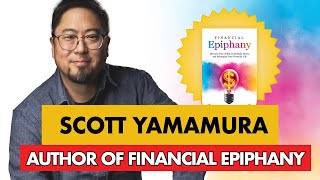
This is a transcript of a YouTube interview (Julie Broad with Scott Yamamura) about Scott's book Financial Epiphany. Scott describes becoming an avid reader during the writing process (reading his manuscript "50 plus times"), how the book forced him to refine and distill his message, and the core thesis: "money is an ability" (subtitle: "money is an ability. And I want to help people discover your ability to multiply money so you can reimagine your financial life"). He introduces three rules of thumb: money can double every 10 years; early-career "multiplying power" starts at 16 and halves every 10 years; and acting early is critical. He also explains the cover art symbolism (dollar sign-lightbulb, colorful "reimagining") and recounts speaking and podcast opportunities (including an appearance on the "Afford Anything" podcast hosted by Paula Pant).
Questions this video answers
"50 plus times" (Scott's estimate).
"money is an ability. And I want to help people discover your ability to multiply money so you can reimagine your financial life."
Money can double every 10 years under common circumstances.
Start with a multiplying power of 16, which diminishes by half every 10 years.
The podcast "Afford Anything" hosted by Paula Pant.
What's been the biggest surprise since you wrote your book or even while you wrote your book?
I was not a book reader. If anybody would ask me, when's the last book that you read? I would say it was in college when there was no choice. And so I have become just an avid book reader now. And the book I've read the most, of course, is my own. I've never read the same book so many times over. I want to say it's been 50 plus times. I read it after each edit and in between everything. And so that to me was a big surprise, was just my love for books that came along with trying to get an idea out. I was just trying to get an idea out to help people get healthy with their finances. And a absolute passion for books came. I used to be the lowest on the book reading ladder in my household. My wife and son were the book readers and I became the number one book reader. I love going to the bookstore. I love even just looking at the covers. And usually I leave with a book or two. And so my wife even says, maybe we need to go somewhere else because you're going to end up spending money if we step foot in a bookstore. So that was a big surprise. As far as lessons learned and about the messaging, writing a book, it forces you to refine your message. Each one of us is a subject matter expert at what we want to teach. We've been practicing it for years. It's all in our head. We are wired to understand this. But a book forces us to refine that message so that others outside of our head can get what we've been doing. And so I love that because my beta readers had to read this, the editors had to read this, and they helped me get the message that made sense in my head. Makes sense for everybody else to simplify and distill that message down so others can comprehend it. So I think of it as an organized archive for your ideas. That is a book. It really took all those separate ideas which I had in the margins of books I was reading. I had them on my phone, I was emailing them to myself. I had Google Docs, everything, all these notes all over the place. And writing a book forced me to compile all of this, to force it into 11 chapters that made sense and really be able to clearly communicate. So I love that a book forces you to do that because all my conversations were very scattered before the book. And now there's a brand. There are certain terms that that are used, there's certain statements that I repeat that I, that I wrote in there and having conversation now, so really, really refines your message. So I love that a book takes that big mess that made sense to only us before and gets it into something that can be repeatable, make sense to others and really change others lives. Not, not just my own and not just my small circle, not just my family. The message of the book and figuring that out is money is an ability. In fact, I've got the book right here with the, with the subtitle. So money is an ability. And I want to help people discover your ability to multiply money so you can reimagine your financial life. That's. That's the subtitle. So money is very much like physical sports. Early in life we have an amazing ability to multiply money based on our age. And like physical sports, it diminishes over time. And most people don't understand that. They're thinking the big myth, which is, oh, when I make more money later when I get promoted, oh, then I'll worry about money. But really, it's when we're young that it's the most powerful. Many of us believe that save early statement or take advantage of compound interest. We believe those, but we act timidly with money and we don't take action. So I needed to get a message out there that was so simple and people understood so easily that they could do this simple calculation in their head that they actually could apply this any day of the week and make huge money decisions to really multiply their impact on this earth, finances being that way. And so what I did was just made money sit still by creating these three rules of thumb. First rule of thumb is that money can double every 10 years under common circumstances. So an input of $1,000 can become $2,000 after 10 years, can double every 10 years. The second one is that we start our careers with a multiplying power of 16. And so. And that diminishes by half every 10 years. So now we know we have to act early when we start our careers. This power of 16 and it's halving every 10 years. Oh my goodness, I need to take action. Writing the book forced me to figure this out, this very simple message. Three rules of thumb. I use them all the time in big money decisions. It's so amazing to hear from readers together with people and discuss how they're applying the three rules of thumb to their life and really understanding money. That was this huge, huge mystery before. So by creating three rules of thumb, it cuts through all the noise, the messaging is simple, it's repeatable. The book forced me to refine, define, distill that idea and communicate it over and over and over again.
There was a couple questions about your coverage. So do you want to show your cover and just take a moment to chat about the COVID art and kind of the vision behind this cover as.
A normal corporate employee. So I'm not a finance major. I'm not, I'm not a stockbroker or anything like that. I'm a normal person with a normal corporate job who started to realize money kind of has a bad rap. How do we redefine, rebrand money? Because it's empowering. Once I got over that hurdle of learning the basics, I was like, this is not so bad. And so when I was asking questions and looking around and hearing all the stories of what's really under the hood, I mean, financial literacy is actually at a low where most of us don't understand financial basics. We spend 18 years learning how to make money in school, we spend 40 years making the money, and we spend 18 years spending the money in retirement money we are immersed in our whole life. But boy, a few of us can say we spent even a handful of hours learning how to steward this massive thing that, that we acquire our whole life. About $2 million the average person is going to earn. And so I wanted to. To show that money can be empowering, it can be colorful, it can be exciting. The word epiphany is the most wonderful way to learn. Yes, we can learn something out of a textbook, but what if it's this realization, this aha moment, and I realized myself, I used I love this word because it was simply when I was sitting with my feet up at the dining room table alone one evening and I thought, okay, we're now minded people. Most people want instant gratification. You were ordering something and it's showing up the next day on our doorstep. Doorstep. How do we. How do we take this now minded thinking and turn it. And there's later minded, which is how money actually grows. I was like, how do we flip that? It was at that moment that I had this epiphany. And I realized it's not about putting in money. Waiting forever and 40 years, something happens and we don't know what that something is. But by flipping our thinking and having my own personal epiphany, I realized we have a multiplying power now. This is an ability. It's not about an object that grows. This is about us, our ability. My chance I need to steward this. I don't want to squander this. It's like being an athlete with athletic ability that's going to diminish over time. Let's take action now. That's what causes this action. So this cover, the dollar sign, the light bulb is the aha moment. The, the cloud dust and the rainbow colors behind it represents just this amazing reimagining. I use the word reimagining of your own financial life, that it can be empowering, that you can have this confidence over money that you never thought you could.
Awesome. Since you've also done some speaking engagements, how did that process take shape for you?
Yeah, absolutely. So that's one of the offerings of Book Launchers. And so I received right away. Surprisingly, it was before my book launch that we had this podcast in New York that needed to be in person. That came up. The podcast is called Afford Anything and the host is Paula Pant. And the year before I had seen Paula Pant as a keynote speaker down in New Orleans. And so I was like, oh my goodness, here's someone that I really respect and that is a big name in the personal finance sphere. And so I was just so, just amazed that that came right away. That was the first one. And so of course I was going to say yes, this has been, you know, a, a real mission of mine to get out there and, and get the word out whatever it takes to help people with their finances. And I knew that was going to take writing a book, it was going to take having a website, it was going to take individual conversations, it was going to take podcasts and videos, and I'm open to any and all of it all may have been uncomfortable with before. I am willing to do now because this is for the good of other people and their financial health. And after I'd realized what a common hurdle this is for most people. So Book Launchers has been continuing to send me opportunities with podcasts regularly. And so my next one is next Saturday. I love it when it's on a Saturday because I do have a full time job and that one's going to be really awesome. It's going to be speaking to parents and youth and finances for kids. And I just love that topic. I love the idea of, hey, let's, let's customize this message to this audience, to parents and what's right for their children. I have a 16 year old now. I've been teaching them finances since the single digits. And I love seeing how empowered and how normal, healthy finances is for him because he's never known any different. He didn't have to be traumatized by money first to get on board. He knows it from the beginning. And so I love that audience and, and there's just other audiences I' really enjoyed. There's the faith based audience. How do you steward money with faith as a consideration. And then there's the professional career people and there's the older generation or the if you're in your 40s, middle, middle aged. And I love thinking about all those different audiences who these podcasters message and audience is for and, and customizing it. There's always going to be that core message. But then the, the fun challenge every week or two is how do I kind of this way for them or how do I lean that way. I also love having repeatable messages and seeing how people, people respond to them. And so it's fun. Some of these things I'll say every single time and then, and other times there's, there's just something I'll try new. It's kind of like what I hear from comedians on a stage. You're testing that, that new message. So I find myself not having done public speaking to now loving it because it's the message. I want to change people's lives.
Some people are curious like how everyone chose their titles.
I actually did some research and looked at where the most common words used in the personal finance space. So I looked online to see what common titles were out there. I just did my own research and I looked at how I tallied how many times money was mentioned or finance was mentioned or investing was mentioned. And then I looked up other words that were being paired with it. Something that comes to mind is how the names of some companies that we're very familiar with got formed. Like Microsoft. Combination of a couple words. How did other big companies or books come up with their name? And so I tested all the different matches and I came up with financial epiphany. And that just came just sounding so good. I loved how it sound. I ran it by a bunch of people and when I ran it by book launchers. So I came into the process. I would have involved myself a lot earlier but I hadn't heard about book launchers until I was so far along with the book already. But when we did run the title by book launchers, they certainly gave me other things to consider and we kept coming back to the original financial epiphany name. So I like that it was experts were really looking at it too. But I will say the big help I got was on the subtitle. I think it took me something less than two months to figure it out. It took a long time, and book Launchers helped me through that one. The subtitle might have been harder than the title itself, and it's so important to communicate in such a short amount of words, too. So thank you for. For that help.