10-minute Full Body Workout Using 2 Chairs
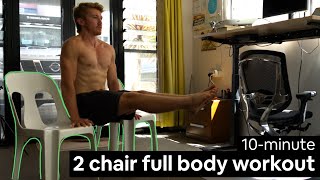
Daniel Bourke leads a 10-minute full-body workout using two chairs, cycling through five exercises twice with 30-second intervals. He weaves in Alan Watts' swim-or-float philosophy: active effort like swimming, passive acceptance like floating, applied to each rep and hold.
Chapters
Full body workout with a couple of chairs. You ready? It is day 16 of the Restorona, so pause the video now, go grab 2 chairs. If you only have 1 chair, there'll be some variations that you can do, but go grab 2 chairs. As I said, we've got Larry and Harry. Best to give your inanimate objects names so you feel some sort of relationship to them so we can all make gains together. But let's get started. The theme for today is swimming or floating, and you'll see how that works in with the, the workout that we're going to do today. So let's get 10 minutes on the clock. We're going to do 30 seconds on and 30 seconds off. The first exercise we're going to go through: L-sit, push-ups, lunge, step up, and feet taps. Get the whole body covered. 5 exercises, we're going to go through them twice. So let's do this. I'm ready. Did a whole bunch of stretching before and I'm feeling loosey-goosey. So now we're doing— starting off L-sit/raise. So this is where you just hold your body up and come in like that. Now if you can't really hold yourself here or you can't move your legs up, just stay static and hold yourself as best you can. So this one we're just letting our legs sink and then bringing them up. That's it, kick out, kick out. Very nice. Rest. Beautiful. Nice and simple. So the next one we have push-ups. Now if you do only have one chair, you can do push-ups like this into there, but since we have two chairs, We're gonna take advantage of that. Larry and Harry, we've got 2 chairs, kinda like 2 chains but without the, what's the different letter? With an R instead of an N. Had to think about that. So 2 hands, let's go. Push-ups, right down in deep, back up. That's it, keep going. Push-ups are our staple, 'cause it's so good. You can literally do it anywhere. If you've got room to stand or flop on the ground, you can do push-ups. And if you're stuck in a hotel like a lot of people are in Australia, might be the same. I don't know. Rest. At this time, I mean, if you're watching this video in the future, just a little reminder that we are doing Restorona. And so a lot of people, a lot of Australians now, if you come back from overseas, As of whatever date it is, I think it's April 1st, April Fools. Just had to check what we have next. So we're doing lunge next, so I only need one chair for this. We use Harry for this in this case. So a lot of Australians are in hotels. If you come back from overseas, you have to spend 2 weeks inside a hotel room. So this is perfect for a hotel room. So lunge, one foot on the chair, one foot forward. I'm going left foot forward this time. Down, up. Arms out in front of you to keep balanced. Squeeze those glutes as you come up. Very nice. Come up. You might be wondering, where did this swim or float thing come from, Daniel? Well, I figured— that's it. Rest. Actually got triggered from reading this amazing book, which is Tao: The Watercourse Way by Alan Watts. You may have seen some of Alan Watts' videos on YouTube, and if you haven't, do yourself a favor and spend a day just listening to the man talk because he is like a modern-day— let's just say we're lucky to have his recordings online. So now we're going to do step-ups. So grab one of your chairs. In this case, I've got Harry again. I'm going left leg again. Step up, watch your head on the roof. I probably should have checked that before I looked up, before I started stepping up. So come up, that's it, left leg, boom, kick forward, up, kick, very nice, kick. We're not counting, we're just going for time. We just want to focus on moving. That's it, beautiful, beautiful. You might have seen one of my first memories of Alan Watts is the video, What If Money Was No Option? What would you do? The person, he's a student, he's a lecturer at a university and he said, a lot of students come up to me, what should I do with my life? And he goes, well, replies back rather than giving an answer because that's the best, the best mentors don't give answers, they give questions. We'll get back to that in a second. We've got feet taps. So one chair, Harry's getting all the attention here now. So, come up on your chair, left foot to the ground in a plank position, right foot to the ground. Left foot, right foot, nice and slow, control it, tap, back up. Control it, tap, back up. We want to suck our belly buttons into our spines. That's it. Nice. Oh yes! I'm feeling good. Now, for this next one, we're going to need Larry and Harry back again. We're right back to the start now. We've got L-sits. And so, the question he poses, "What if money was no option? Do that." And I remember watching it when I was young, maybe 18 to 20 or something like that. And I was like, "Wow, that's such a profound thing. What would I do?" if money was no option. So let's go. We've got L-sit. This time we're going to do a hold, so see how long you can hold it for. Legs out. Oh, they're trying, they're falling. Had to give up there. That's right, back to it. Hold. Give it up, love it yourself. So on this section we're doing, on the second half of these exercises, we're doing holding. So we're floating, not swimming, and we'll get to that analogy in a second. But I remember reading it as 18 to 20, or hearing it, and going, what if money was no option? And I thought, wow, how can I set my life up like that? Because At the time, I didn't really know what to do. I was 18 to 20 years old. I wasn't very good at anything. And I was like, how can I spend the rest of my life? Exercise. So, we got push-ups, but this time we're doing a hold. Turn Larry and Harry around. I'm coming in, down. We're just gonna hold it nice and deep there. And that way we can just have a conversation. So this is the floating part. And it comes from the book that I'm reading. The Watercourse Way. And so it talks about, it's Alan Watts' interpretation of the Tao. And if you're not sure of what the Tao is, I can't really explain it because the Tao that can be talked about is not the true Tao. Rest. And that's a bit of a mind bender for anyone who's from Western civilization like myself. It's an Eastern philosophy, Taoism. And of course I can't explain it in words because you can't explain the Tao, but as best I can describe it, it's like, The feeling of nature, you being a part of nature and nature being a part of you. You can't exist without everything else existing and everything else can't exist without you existing. So now we have the step up. We're not going to do the hold for the step up because it's a step up, but this time we're going— oh, actually no, lunge, right leg. Time is ticking, but we can adjust. So right leg forward. Let's do the lunge. See, a lot of Western philosophy, everything, uh, or Western way of thinking, is everything needs an explanation. Like, for example, the fact that we're moving right now needs an explanation, such as the one I've been offering, that we're doing Retserona, keeping our bodies moving for an immune system boost. But Eastern philosophy is that Everything, everything is a circle. And again, I might be— I'm still an amateur at this, I'm still learning about it, so it might be, might be my interpretation is different. But things— a lot of the Eastern way of seeing things is that things, things on their own is enough of an explanation. So we just went through the rest time there. We're going to do step-ups with the right leg. Let's go. Kick forward to the roof. How fun is it kicking, by the way? I just love throwing my legs everywhere. Keep it up. And so in life, there's going to be times— if you imagine your life as a watercourse way, which is the title of the book. You know, water on its own— Rest. You put your hand in water, you can't pick it up. And it just disperses everywhere. But at the same time, so you could think, what have we got next? We got feet taps. So, might use Larry for this time. So grab Larry, give Larry a turn. You pick water up and it falls out of your hand. You can't pick it up. So you might think that water's weak, but at the same time, water over time is able to erode the biggest mountains. You see those rivers going through different mountains. Let's go. Feet taps. So we could hold this one, but I like the feet taps. There we go. And so if your life is a watercourse way, there'll be times where you have to swim. You could think of it as water having to erode a mountain to get through to where it needs to go. And there'll be times where you'll need to float, such as holding, holding the position here. And not moving. So we're just floating through, we're just letting it happen. Then we might go for a little bit more. 5 more taps, we'll do a little bit of swimming. 4, 5, one more for good luck, 'cause that, it just feels good to move. So we're gonna pause that. Workout pause. That's 10 sets done. Thank you, Larry and Harry. The chair workout, that's a full body chair workout. In 10 minutes, I'm getting a little bit of a sweat. This is the time where you keep going through another 2 rounds, and I encourage you to. I'm going to probably do another session similar to this later this afternoon, because why not? So the takeaway from this, aside from the movement, I hope you're enjoying it, hope you're following along, is that in times in life, there are times when you need to swim, times when you need to float. You think of that as water making its way through a mountain. Eventually, the water might come up against the wall, but over time, it's able to erode that wall and keep on flowing. And then, once it's made its path, it might spend some time just enjoying the path that it's made. Swimming, eroding the mountain. Floating, enjoying the path that it's made. So don't forget, swim and float, keep moving, stay safe, and we'll see you tomorrow.
More from Daniel

Small Language Models (SLMs) Are the Future: Fine-Tuning AI That Runs on Your iPhone

Introducing Sunny - A MedGemma-Powered Skin Health Tracking App (Kaggle Competition Entry)


Benchmarking: NVIDIA DGX Spark & NVIDIA RTX 4090 | Part 4 - Comparing the results

Benchmarking: NVIDIA DGX Spark & NVIDIA RTX 4090 | Part 3 - Running LLMs on the RTX 4090

Benchmarking: NVIDIA DGX Spark & NVIDIA RTX 4090 | Part 2 - Formalizing the tests

Benchmarking: NVIDIA DGX Spark & NVIDIA RTX 4090 | Part 1 - Creating a series of tests


Local Multimodal RAG on the NVIDIA DGX Spark | Part 4 - Publishing our demo to Hugging Face


Local Multimodal RAG on the NVIDIA DGX Spark | Part 3 - Putting it all together