A balance you need to fix: Creation vs. Consumption
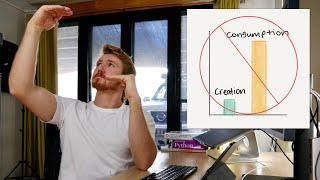
Daniel Bourke started creating instead of consuming on May 21, 2016, and argues modern life has tipped too far toward Netflix, TikTok, and YouTube. He offers six frameworks: pick creator role models, use the Three You's to guide what to build, find pleasure in hard work, recognize creation's unlimited upside, treat it as responsibility, and track screen time to reset your balance.
Chapters
May 21, 2016. That's when my balance started to change, you know, the balance between creating and consuming, because I wrote my first blog post. I actually got— I've got that here. "Today I created my blog," and that's the title. "Dear Daniel, you finally did it. Aren't you glad you started today? Yours truly, your past self." Well, thank you, past self. I am thankful for that, and we'll see where that ties in in a second. But I'll just read out the, the rest pretty quickly. This is the first post I've ever made on my own website. It's hard to describe how I'm feeling at this stage. Clicking the subscribe button on the Squarespace page, because I made my first blog with Squarespace, filled me with exciting, excitement. Creating a blog is something I've been thinking about doing for a while. Maybe you're the same. I've never written much for myself, mostly for university projects and other miscellaneous bits and pieces. I'm looking forward to what this new adventure holds. I don't know what I want to come of it. All I know is that it's something I've wanted to do for a while. Well, that shows how great my writing was back then. I said the same thing twice in two sentences. You can find quotes and stories from multiple successful— successful is in italics— I use this term loosely. People that say— oh, there's a typo. People that say that the journey is the most enjoyable part of any project. I guess that's exactly what this is, something new for me to explore. And that, that was my first blog post about 4 years ago, almost to the day today of what I'm recording this video. So today is the 9th of May 2020, and that was on May 21st, 2016. And the reason the topic of this video is a balance, a balance that, that you need to fix, and that is the consumption versus creation. So, I've got a few points here that I've, I've written down here. So, they're not really in any order. So, we'll probably just go through them in, in some strange way. But the reason I think it's a timely manner, because I saw the other day that services like Netflix and TikTok and all this sort of stuff, even my own YouTube statistics are going through the roof. And you might think, well, Daniel, that's a great thing with people watching your videos more and you're getting more watch time and all that sort of stuff. And yes, well, yeah, part of me does think that that's a good thing, but seeing things like the amount of time being spent on Netflix and all these other services and whatever— look, I'm not saying that they're inherently bad. What I'm saying is I'd imagine the change or imagine the world The world I want to live in is if the balance went the other way. And right now, it's a timely matter, okay, fair enough. A lot of people are spending a lot more time indoors because of the current circumstances. It's pretty easy to figure out what's going on. But imagine a world instead of, let's just say all consumption metrics have doubled. Viewing time has doubled. Everything's gone up twice. So, consumption has gone up by a factor of 2x. Imagine a world where every individual and spender, instead of doubling their consumption time, doubled their creative time. Seriously, imagine that world. I want to live in that world. So, that's kind of the reason I was thinking about this for all of this week, and I'm in deep learning— deep learning— I'm in deep study mode at the moment. I've got a whole bunch of books that I'm trying to read through. So, I'm in learning mode, not really in creating mode, but there was something inside of me ever since I made that change on May 21st, 2016. I said to myself, I said to myself, you know what, I'm going to start creating more than I consume. That, since that time, I've had this, even before that time, you might be the same, I'm not sure, but if you're watching this channel, it's likely you are. I had this little poke in my side that always wanted to make things and that's what I've been wanting to make for this whole week. This is a sort of a, just a little bit of a rant, not really structured, but a rant on fixing the balance between creating and consuming. Now, I'm not going to say that consumption or in any form is inherently bad. The problem comes is when the balance is too out of proportion. So, a lot of people, including me, I can use myself as an example for this. That's what the beautiful thing is. Before I switched, right, my consumption levels were up here, my creation levels were down here, and I wasn't, that wasn't a fun place to be. And so, when I switched, I was always looking for the next thing, always scrolling further on my phone, scrolling through Instagram, lying in bed at night, scrolling through Instagram, scrolling through Facebook, switching back between the two apps, scrolling through whatever was the Flipboard or Snapchat or something like that, always looking for the thing that would cure this poke in my side. And you know what? I never found it despite switching back and forth, going through the endless scroll, Never found it. It wasn't until I started to shift that balance, started to push the consumption down, you know what, started to listen again, ah, I've got all this energy inside me, how can I use that to create the things I want to see in the world? And so ever since that blog post, a lot has changed, it's really helped me out, it moved to my life shifted fundamentally, I started to become, I started to look at the world in a different way, I started to think instead of 'How can I get more?' I thought, 'How can I make more?' And it wasn't just making money, it was making things. And so, I've got a few points here. We'll start to go through them. But the reason why I did that blog post is I thought of the role model. Now, this is a really great one because I think it's a story everyone can relate to. It's the role model versus the anti-role model. Now, I wrote in here a lot of successful people, and of course I use the term successful loosely. I actually wrote that back then because if there's anything you take away from this is that success is, is based on whatever your definition of it is. But I knew a lot of the people who I viewed as successful had something in common, and that was that they were creators. They made things. Now, it's unlikely that you look up to anyone who consumes in excess. In fact, they might even be an anti-role model for you. Now, that comes to the second one. So, that's the first one is the— think about the role model versus the anti-role model. Now, if you don't have anyone that you really look up to, someone— you might not, you might not have anyone that you go, "Oh, wow, I'd really like to be like that person." You might take— and of course, if you're like me, you take little bits and pieces from people. You might look at someone and go, "Yes, That person is amazing. They're doing some incredible work, but I don't really think I'd be interested in that part, but that's okay. It's like religion. You might not have one doctrine that you fully adhere to, but you can take the best of both and remix it and create it. Create— there you go. There's a point for you. A way for you to be a creator is take the best from all different role models. Take the best from all different religions. Take the best from all different types of ways of living life. And create your own. That's, that's your true path there. That's your true path. And so, when you do that, or a concept that helps me think of how to do something like that, is to think of myself as 3 different people. This is the 3 yous. And it works whether you look at time in the concept of how the West looks at time. The West looks at time as a as a line in philosophy, really simplified version. So things have a start and things have an end, whereas Eastern philosophy is more so that time is a circle. So it just— whatever happens just keeps looping over and over and over again. But the Three You's philosophy can be related to either of those. And so the way I look at myself is three different versions of of myself. The past me, so the younger version of myself. The present me, so the me that's sitting here right now talking to you. And the future me, so maybe myself tomorrow, a year's time, 3 to 5 years' time, even longer, a decade's time, 2 decades' time. Now, the 3 yous, the past you or the past me What I try to do with my creations if I get stuck is how can I, what could I make to inspire or educate my past self? And that's where a lot of my work has been for the past couple of years or so, ever since I created my blog. This is a really, and that, the reason why I keep referring back to the blog, the YouTube channel, a lot of the blog was really the inception of the switch, the switch between consuming and creating. And so, a lot of my work has been to either inspire my past self, and again, this is going to come down to individuality, or educate my past self. It's like, hey, you know what, I'm 26 now, I'm able to grow a beard now. So, this is also another reason of why you should listen to me, is because everyone knows that a beard adds 200 IQ points. Even though it's red. But I've learned all these things, and of course, I'm not a joker, right? I know that there's a lot more that I don't know than what I do know. But if I think about the last, let's say, 5 years or so, ever since I started to create my blog, I've learned a lot since then. And so, a lot of my work is going, hey, if I was my past self, my 21-year-old self, my 17-year-old self, what are the things I would have liked to have known then. So, there's, that's sort of a way to bring down one of the roadblocks when people say, I don't know what to create. The trick is that you kind of really do, but it's hard. We'll get to that in a second. The next one is for your present self. You want to make things that make you happy or proud. You see, human beings, like, we're pleasure-seeking machines, like it or not. Like, we have, we basically have a switch in our heads that's going, Yes, I like this, do more of this. I don't like this, I'm not— I'm gonna avoid. Put it this way, if you knew where you were going to die, the place you were going to die or was harmful to you, you would avoid that place. So, that's what we are. We're sort of pleasure-seeking machines and the device— smartphones, they have exploited that something fierce. We'll get to that one in a second. But what you want to do during your— for your present self is to find something that makes you happy or makes you proud. Because in the short term, that's what you want to— that's what's going to push you forward. That's what's going to keep you going. It's actually quite hard. Like, I mean, I know for myself, my perspective, um, I do want to build things for the longer term. We'll get to the future self and that's something that my future self will be thankful for. But it's very hard for me to imagine something like 10 years in, in the future from now. Because if you look at anyone who, who has done anything worthwhile, um, and of course this is going to depend on what your definition of worthwhile is, and it's taken a very long time to do that. We're talking We're not talking a year, although a lot can change in a year. We're not talking even 4 years, although a lot can change in 4 years. We're talking a decade of time. I'm still getting used to that, that concept. I mean, 10 years ago I was 16. Alright, so I did— when I was 16, my primary goal was creating the best Call of Duty team possible and succeeded at that. Funny thing is that if you focus on one thing maniacally, you're almost likely to succeed. But for some reason, we've decided to just take on all of these small little tasks and try to optimize for things that aren't really going to matter next January. Anyway, so in the short term, what you want to do is make your current self happy or proud. That's going to start to— and what I mean by that is work on the things that excite you and don't necessarily always chase pleasure. Another switch that you can make, right, from the increasing the balance from, or improving the balance between your creation and consumption, another switch that you can make is finding pleasure in hard things. And so then, a hard task becomes a pleasurable task. For example, working out. I now find it more pleasurable. I've built the habit of working out, so I now find it more pleasurable to put my body through some kind of stress. Now, there's a word for this, it's called eustress, which is good stress, which makes me short-term uncomfortable, but also short-term happy. If you can find that space, whatever it is, like for example, reading a book short-term, like this is a book on machine learning, it's a greatly written book. So, it's actually a pleasure to read. If I had tried to read this book 2, 3 years ago when I started learning machine learning, it probably would have been far too uncomfortable for me to, uh, because you don't want the space to be too far between where your current capability is, because that's when it'll be too uncomfortable for you. For example, remember the first time you ever went to the gym and did— trained your legs? This is what a lot of people talk about. They usually go far beyond their, their, their capabilities and then the next day they're incredibly sore, they can't walk, and so they associate a negative connotation with training, with, with practicing, with doing leg day. And so that sticks with them for— that stigma sticks with them for however long it takes. And so in the short term, you want to, instead of stretching yourself too far, you want to work on something that's pleasurable, not too far from your current capabilities, break it down. But in the long term, you really want to be stretching yourself. This is where your future self is going to be thankful for what you did in the short term. What you must remember is, if you're thinking of yourself in 3 yous, is that progress disappoints in the short term but surprises in the long term. And I, I still haven't fully, even though I know the concept, I still haven't fully It still hasn't fully sunken into my brain, that little saying that progress disappoints in the short term, but surprises in the long term. When's the last time you worked on something for 6 months at one time without any reward? Any reward for 6 months, then at the end of the 6 months you get— it just piles on. And now 6 months isn't even a very long time. I mean, we've been in lockdown for almost 2 months with, with what's going on, the health crisis around the world. That's the concept of the 3 U's. Inspire and educate your past self. Make your current self happy or proud. Don't stretch your boundaries too far in the day-to-day, but make sure your longer term is something that almost scares you. Well, in fact, I think life would be pretty boring if what you were trying to attain didn't scare you in some way. And think of your future self as what could you do today that your future self will go, "Wow, thank you past self." Like, I wrote myself a note as my first ever blog post. I'm actually very thankful that I started my blog on that day. Like, it feels like a different person did that for me. So, that's your future self. Now, the next one is non-linearity. So, if I had a whiteboard here, I could get mathematical for you, but I can just explain it and it's really, you can explain it in a language quite easy. I know you're smart enough to understand this. I've just realized this video is kind of— we're past the 15-minute mark, so I might leave off. We'll wrap this up. We'll talk about these points. I could talk for a bit longer, but I'm conscious of your time. You shouldn't be consuming all of this video when you should be creating, but hopefully this has given you a little idea. Nonlinearities. So creations work for you. If you make something, if I write a blog post, if I make this YouTube video, the beautiful thing is, is that it works for me. It goes out there, it replicates itself infinitesimally, and people like yourself can watch it, can read it, and potentially gain value from it. So that's the beauty of— and if you were drawing this on a graph, you'd have a y-axis and an x-axis, and you'd have a line that starts just below the— in a negative y-value, and it goes up like that, just like that. And because when you create, your downside is limited, but your upside— now, this is, you can use this for investment, you can use this for whatever you want to live, but it's how I think about how I want to live my life is like this kind of, it's capped downside, unlimited upside. When you create something your downside is capped. So, as in, the only downside that you have is the time that it takes to create. And that's the way you look at it. If, if improving at something, if building a skill, um, because that's creation, right? Building a skill. If that is your only downside, which takes time, that's not really a downside. That becomes pleasure. And so, if your upside is uncapped, I mean, you would always take that as an investment opportunity. So if you're investing in yourself, the smartest thing to do would be to fix your balance between consumption and creation. Because why? If someone said to you, you know what, you can invest, I'll give you an investment. You got— if you give me $10 and your upside is potentially $10 million, you take that bet. But if someone said to you, give me $10, you probably wouldn't give them $10. See, that's the difference between creating and consuming. Simple, just simple math. Now the next one is opportunity equals responsibility. So one of the most noble things that you can do in life is to suffer for others. And what I mean by that is creating is hard. Improving at a skill is difficult. But what makes it worth it is that you are able to bring not only value to yourself, but value to others. And see, a lot of people think, and I got caught in this, right? I wanted the, especially with the internet, I wanted the opportunity to create a life for myself, but I didn't have the courage inside me to take on the responsibility to do such a thing. And so that's what I want you to remember, is that don't take this switching of balance lightly. Of course you could, because it's fun, really. It's fun once you start creating. It's all play. Life becomes play. You look at the world, as I said, you look at the world in a different lens. You start to think, what can I, what can I make? What can I build? Now, I know you're probably already thinking like this, but just remember, when you take on such an opportunity to build something, to bring something into the world, to create, to connect heaven and earth, you have to take on that responsibility. And I, I'm still realizing this. This is why I make sort of these videos so I can both help myself to to think about this in spoken word and to potentially help you think about it as well is that if you do take on the opportunity to create, you choose to go, you know what, I am going to make that change. I am going to reduce the time I spend on TikTok and I will get to that in a second, that slot machine of a smartphone. I'm going to take on the responsibility of building skill. Building skill is a responsibility. Supporting yourself and putting yourself out there is a responsibility. That's— people say, I used to think, you know what, I can't, I can't be a creative if I don't earn money from my creations. And the thing is, you don't necessarily have to, right? You can have a job some crappy— this is what I say to my little brothers, I— this is what I did. Have a crappy part-time job that pays the bills, or maybe a full-time job. One might not even be crappy, it might actually be great, but it pays the bills. But then on the side, maybe, but maybe your, your role, um, it doesn't set your soul on fire, but creating your artwork does. Maybe you're secretly— you, you're a writer, or you secretly like to make videos or animations or something like that. But of course, if your skill level isn't there, society hasn't decided, you know what, this person has a skill, so we're going to exchange capital in— we'll give this person capital to keep working on that skill because they're bringing us so much value. Maybe your skill level isn't there yet, but what you can do is just have some kind of job where it takes care of the bills, and then on the side you have this creative outlet, that you don't have to worry about it putting food on the table or paying bills, but you can still make things that bring value to you, that potentially bring value to others. But again, that takes responsibility. The final one is, is imagine if you're your own boss. And a really good way to check this out, uh, is to— it'd be quite draconic, a draconic measure if your boss actually did this at your workplace, but— is to check your screen time usage on your phone. Now, I would do this on my own phone, but it's in another room. It's in a drawer. I keep my phone in my drawer because— or in another room because that way if it's out of sight, I'm not looking at it because I know that that thing is a slot machine. I don't have any social media apps on my phone because I know that's not where I want my time to go. If I'm paying myself $1,000 an hour, you can use that metaphorically, you can set your rate to whatever you want. It's like, would I pay $1,000 an hour to scroll through TikTok videos for 4 hours a day? Probably friggin' not, right? Like, and if your boss, imagine if your boss saw that you went to work, your job, and you were looking through TikTok, Instagram, and Facebook, the mobile equivalent of a slot machine, for 4 to 5 hours a day. And don't— like, if you think that number's outlandish, it's not, because we have a ritual at our dinner table on Sundays. And when— well, we used to when we were allowed phones at the dinner table. I've banned them. And where we check each other's screen times and kind of hold ourselves accountable, it's like How long you've been spending on your phone? And I've seen teenagers, and this would have been me if the screen time feature was available. I've seen teenagers my brother's age, about 19, 20, have 6 to 8 hours average of screen time per day on their phone. And now, to me, that saddens me. That really saddens me. And it's probably, it's probably more now, right? Because of the current situations. But what I'm— the rant I'm getting on, the point I'm getting on is imagine if that time was switched. And the only reason I say this with such emotion is because if I look back, I wish— the only thing that I wish is that I started sooner. The only thing that I wish is that I fixed the balance sooner. That's how life works. Maybe it's a time in your life where you're on the fence, you're starting to think, you know what, I've really got this poke in my side, I should start listening to it, I should start creating, I should start doing things that set my soul on fire, I should stop consuming, I should stop— of course, not completely, right? We are human, but at least fix that balance between creating and consumption. So we're going to wrap it up there. But think about it like this: the role model versus the anti-role model. Who are the people you look up to? What do they have in common? Is it the fact that they are all creators or are they all consumers? The 3 U's: inspire and educate the past you, make the present you happy and proud, and make the future you thankful of the past you. Non-linearities. Look into this topic. Very valuable for you. Don't optimize for the wrong metric. Creations work for you. Numbers going up on a page don't necessarily mean that the, the change you want to make in the world is happening. So be careful of that one. Opportunity equals responsibility. If you take on the opportunity of being a creator, if you want to start making things, remember— I have to remind me myself of this when I start to think You know what? I really don't feel like writing that thing today. I have to go slap myself into— back into the world and go, Daniel, you've got a responsibility. If you want to build skill, that takes responsibility. If you want to improve yourself at machine learning, you need to read this book. That is your responsibility. And I'm just using this book. It could be whatever topic you want to improve on. I'm just using this because it's close to me. And finally, if you were your own boss, giving yourself an aspirational rate of $1,000 an hour— could be whatever you want, could be $10,000 an hour if you're really generous— how would you spend your time? Use the screen time on your devices as a little bit of a trigger to go, wow, I've quantified this now and I realize I don't have to spend 4 hours a day on TikTok, the mobile equivalent of a slot machine. So, hope you enjoyed this video. I hope, I hope and hope, and I know you will because that's the kind of people that watch this channel, you'll think about the balance between creating and consumption. Of course, I say these things as if I've mastered this and I haven't. So, we're all on this journey together to keep learning, to keep creating, and that's where I'll sign off. So, have a great day. If you'd like to see another video of this sort of style where I just talk about a sort of topic for probably too long, leave a comment below. If you have any other questions, leave them, leave them in the comments. I'll get to them all. I'll probably host a livestream Q&A at some point this month, but as I said, I'm in deep learning mode. Study, study, study, learning to build up the foundation to create next. So, I'll see you next time.
More from Daniel

Small Language Models (SLMs) Are the Future: Fine-Tuning AI That Runs on Your iPhone

Introducing Sunny - A MedGemma-Powered Skin Health Tracking App (Kaggle Competition Entry)


Benchmarking: NVIDIA DGX Spark & NVIDIA RTX 4090 | Part 4 - Comparing the results

Benchmarking: NVIDIA DGX Spark & NVIDIA RTX 4090 | Part 3 - Running LLMs on the RTX 4090

Benchmarking: NVIDIA DGX Spark & NVIDIA RTX 4090 | Part 2 - Formalizing the tests

Benchmarking: NVIDIA DGX Spark & NVIDIA RTX 4090 | Part 1 - Creating a series of tests


Local Multimodal RAG on the NVIDIA DGX Spark | Part 4 - Publishing our demo to Hugging Face


Local Multimodal RAG on the NVIDIA DGX Spark | Part 3 - Putting it all together