A simple study break meal for optimizing mental performance
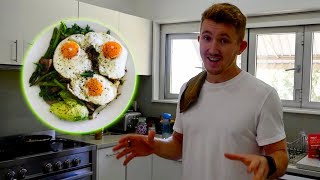
Daniel Bourke makes a nutrient-dense study break meal with eggs, nuts, kale, beans, and avocado while explaining his approach to eating for mental focus. He practices intermittent fasting from 12 pm to 8 pm, avoids refined carbs to control insulin spikes, and learned nutrition through YouTube and a degree after transforming from an overweight teen to a bodybuilder.
Chapters
Hello everyone and welcome to my cooking show. You can tell I'm a professional because I have a tea towel over my shoulder. And I noticed before that my white shirt's a little bit dirty, but never trust a chef that doesn't have dirty shirts. In today's video, we're going to cook a meal that I like to eat during like a study or work break. We've got a little pal. Hey! This is the co-host of the show, Seven. She'll be smelling the meals and making sure they taste amazing. I mean, smell amazing. Oh my goodness. Oh my goodness. We should do this in cuts. Nah, I'm kidding. Alright. So as I said, this is one of the meals I like to eat the most during a study break or a work break. The idea is to maximize mental health and optimize physical recovery. So let's do it. I like to keep the food that I eat. We got about 6 animals. 6 animals going off. Is this a cooking show or a zoo? You tell me. I like to keep the food that I eat nice and simple, so that's what this meal will be. It's basically just eggs, oil, nuts, greens. We'll get the pans heating up. We'll check what's in here. Shallots, tick. Mushrooms, tick. Asparagus, avocado. Oh no, avocado's over there. Kale, beans, tick. Keep the fridge closed. Make sure your tea towel doesn't fall off. We've got onions. So lots of vegetables. You want to try at least get a big pile of green vegetables in your meals at least once per day. At least that's what I try to do. Now we need a cutting utensil. Knife. Tick. Chopping board. Tick. Right, first things first, we prep the vegetables. Now someone asked me the other day at jiu-jitsu what my— how did I get so lean? Because I am pretty shredded, but it's taken a lot of work to get there. I wasn't always shredded. I was an overweight teenager. And so, out of high school, I kind of got into— well, I did get into health and fitness. I got into bodybuilding. I did a nutrition degree. Kind of taught myself about health and fitness by watching YouTube, by looking at people's blogs, all different kinds of online resources. And so that was what, 2011 I started getting into health and fitness, and now it's 2019, and I've kind of been refining the process over the last 8 years or so. And the way— what you'll see with like food and nutrition and health is that everyone— there's like different dogmas of like different ways to do things. And so the preface to everything that I say in this video is take the best you hear from everyone, including me, and create your own style, which is what I've done, right? So you'll have some people that preach a certain type of eating, other people that say, "Oh, that's bad for you. You should do this, you should do that." And so what I kind of realized is that although a lot of the advice is well-meaning and has some good aspects to it, a lot of it as well really comes down to the individual. And so that is what I figured out, is that, you know what, sometimes I don't want to eat like that person's telling me to do. You know what, sometimes I want to go against my own rules and eat whatever I want. Majority of the time, I figured out, if you take care of— it's like the 80/20 rule, right? If you take care of eating well and working out majority of the time, then every so often you can eat whatever the hell you want and it won't really matter. The important thing is to make sure the trend line follows a few simple principles. For example, eating simple foods. So all of these foods here are simple. Got kale, got greens, all of them are out of the ground. I was talking to my little brother last night. He's actually behind the camera. How are you, Wynn? And he was saying that he was telling his friends, because I've been kind of If you hang around me, you start to eat a little bit better and you start to get fitter because that's just the vibe I give off, you know. And so he was talking to his friends and one of his friends wanted to lose weight. And since Sam has been doing the same, he's been getting into jiu-jitsu with me and eating better, Sam's tips for his friend was to eat less often and to to reduce the— eat foods that have a less number of steps, what it takes to get to you. So basically unrefined, unprocessed food. Let's get this on. Revisit both of those in a second. So what I'm going to do, take the pan off the heat because we don't want it too hot. Big drizzle of olive oil in here because that's where all the flavor is. Again, Simple food, olive oil. This is just pure olive oil. Avoid, you want to avoid plant oils at all costs, like sunflower oil, seed oils, that sort of stuff. Olive oil, avocado oil, both good options. Coconut oil, grass-fed butter if you want. We're going to put all this in here. So again, nice and simple. We only got, we got 2 pans happening and about 4 ingredients so far. We're going to get some eggs on as well. We'll have 4 eggs today. Bit more olive oil in there. So as I said, I've been kind of refining my own process of how I like to eat, of how, what works best for me, and I encourage you to do the same. But what, after all these years, The main 2 things that I've come across, or the simple tips that basically anyone can incorporate, you don't need a nutrition degree or years of study to think about this, is 2, or maybe 3 things. Number 1, learn to cook. Alright, learn to cook your own food because that way I know exactly what's going into what I'm eating. Number 2, eat less often. So it's about, it's 1:30 PM right now, and this is my first meal of the day. You'll, there's a big stigma going around over the last few decades of breakfast being the most important meal of the day. And growing up as a kid, I used to think that too. I'm not saying again, remember, Just because I do it, it doesn't mean you have to. This is just what I found through trial and error. I'm going to get some seasoning on this. So the process of me, why I haven't eaten between dinner last night and 1:30 PM, because I practice intermittent fasting. And what, what does that mean? Well, it's kind of simple really, because And that's, that's my whole philosophy. The Simple Shredded Chef. Maybe that's the idea for the cooking show. Maybe we could call it that. There we go. We've got some nice spice on there. I'm gonna leave that running. Intermittent fasting. So the whole premise of that is that you eat between a certain window of a day. So my window is typically 12 PM till 8 PM, which means I don't eat anything in the morning. So I wake up, I I might have some water, might have some black coffee. I might go for a little bike ride or a little walk or something like that. And then once 12 PM hits, I'll cook a meal like this. Like, this is a meal I basically eat almost every day. It's absolutely delicious. Wait till you see the finished product. And then once 8 PM hits at night, I don't eat anything else. So a typical day for me might be wake up, 7:30 AM, something around then. Water, black coffee, little bit of salt in water, 'cause water, that helps with the hydration. Then I'll do some work and study in the morning because that's when I'm most productive. At about 12 PM, I'll have a meal. Usually it's something like this. So this kind of meal is plenty of greens. We got eggs, so it's low carbohydrate. Low refined carbohydrates, which is the most important thing. I find if I eat refined carbohydrates, they slow me down. But if I eat a meal that's high in fat and protein, I don't get that bursting full feeling of eating a carbohydrate-heavy meal, but I do get that satiated feeling. And satiated is just another word for feeling not hungry. And then I find that kind of meal, if I eat this now, 1:30 PM, I could go till, till dinner. Like, I don't have to eat until dinner, and then in between that, I'm, I'm doing more work. I'm doing other things that have to get done during the day. Remember what my goal is, right? It's to optimize mental health, like mental capability. So when I'm working on projects, that to the best of my ability, and physical recovery, which is why we've got things like the eggs and the yolk and the greens, because I do a lot of I do a lot of hard training, so I want to make sure my body is recovered well for the next training session. So that's number 2, eating less often. You could practice intermittent fasting. That's what I do. Or like reduce the number of meals you eat per day. So things like, you don't actually need to snack. What I'm trying to do with that is minimize my insulin spikes. And so, give me a second, I'll come over here. I've been tracking my blood glucose. You might have seen it in a previous video. I did a fast of 4 days and I used this glucose meter to track my blood glucose. So part of the reason I do intermittent fasting alongside eating like this is to minimize my blood glucose spikes. What happens when blood glucose spikes is that insulin in the body, which is a hormone, goes up, and insulin is a growth hormone. So essentially, it's going to start triggering your body to store energy in the form of new cells, in the form of fat cells, which is what I don't want. So my whole, I would say, way of eating now is about controlling insulin, controlling hormones. If you can control your hormones through things like getting better sleep, eating well, etc., you'll control your, your weight loss or your, your concentration levels. So that's my whole premise now, is to try and control my hormones because there's no point trying to battle against hormones that are working against you. I'm actually reading an amazing book somewhere over here. Conveniently placed book called Genius Foods by Max Lugavere. Lugavere. And so if you're like me and you want to eat, eat foods that help out with cognitive function, which is probably what you should do, right? Because a lot of us, we have to use our brains. Actually, some of you might not have to very much. But that's an amazing book. And I'm kind of stoked, actually. I've You might be able to see the front cover. I've kind of worked these foods out for myself on trial and error by going, okay, I ate this food today and I felt like this, and I ate this type of meal and I felt amazing. So then I just noticed the trends and started eating more of the food that made me feel amazing. And don't get me wrong, there are foods like 10-minute foods like fried chicken, wings, fries. I had some of them yesterday. I'm saying this, I'm doing a cooking video on eating healthy, and yesterday I had fried wings and fries, but I caught up with one of my friends, right? And we had, we had lunch and I knew I could eat whatever I wanted because remember, my average is eating stuff like this. Now I'm going to get an avocado ready. You want to treat yourself like an experiment. Avocado. And so some of the foods that Max talks about really, as genius foods, really just adhere to the same sort of principles as what we've talked about. They're simple, right? They're what you could go out in the wild and find. And now, what I'm eating now is based on what I have available to me. I can go to the supermarket, I can buy these ingredients myself. Very easily. So it's not like I'm having to source these from some special place. This is just at my local supermarket. I'm going to plate this up. Look at that. Look at that volume. See, this is how I'm able to only eat 1 to 3 meals a day, or sometimes— actually, for the last couple of weeks it's been 2 meals a day— is because there's such a volume here. Like, this is going to fill me up. And it won't give me that, as I said before, that, you know, when you eat a carbohydrate-heavy meal, like something like bread or sandwiches or burgers or something like that, you feel full to the point of expansion. I don't like that feeling because first of all, it hinders my ability to perform mentally and hinders my ability to perform physically, which is what I'm optimizing for. We go here, a little bit of, we're gonna get half an avocado on this bad boy. Boom, put that right there, right in the middle. Oh, I'm getting excited. Mmm, delicious. We'll save this other half for later. Put that in there. Now I need a spatula. Boom! There we go. Now, if you had the base, the greens are a great base to have with almost anything. So you could cook up this greens. We've got some kale, we've got some beans, we've got mushrooms, asparagus, onion, a little bit of spice on top. You can add whatever spice you want. Salt and pepper works fine. And then you could sub out the eggs for something like salmon or some grass-fed meat or whatever you have access to. And remember, depending on where you from, where you're from will depend on what kind of meal you're going to eat. So for example, I was chatting to my friend Shaikh and he's from India and he asked me, like what sort of stuff do I eat? And I told him this, but he told me what he regularly eats, which is like curry and roti for breakfast. And that's, that's, that's his culture. And this is my culture. Whereas actually my culture is more like just eat crap, like refined crap. So the important thing is to remember is to treat yourself like an experiment and use the confines of the food that's available to you to figure out what best works for you. Why? Because if you're eating multiple times per day, that's something you should care about because that influences your health. Nutrition and sleep are the force multipliers of life. Now, your goals might be different to mine. You might want to only optimize mentally, but this— the beautiful thing about eating like this right, learning to cook, eating less often, and eating less refined foods, is that it actually works both for mental and physical performance. So my goal, mental, physical performance, yours may be different. A lot, a lot of people I know want to, want to lose weight, want to stay lean. Eating like this is a way to do it. And so I think this is almost it. We're going to salt and pepper this up. I want to make more of these videos, right, where I'm just doing simple, simple cooking videos. This one was more of a just give you some of my philosophies on food. And now I can talk all I want and you can listen all you want to this sort of stuff, but at the end of the day, none of it is going to work unless you give it a try, unless you start to actually follow the principles yourself. That's what— that's the biggest thing that I noticed. You can have all the information in the world, all the knowledge about how to eat healthy, or whatever you want, but none of it will work unless you try it out, unless you give it a shot, treat yourself like an experiment, see what works, see what doesn't, create your own style, which is what I've done over the past few years. And now look at this. It is a beautiful style, isn't it? We're going to cut this egg. We're going to spread it through here. We've got salt and pepper, a nice little glass of water. Boom! What was that? How long did that take, Sam? 28 minutes. 28 minutes. About 30 minutes, a little bit of chitchat in between. So realistically, this thing would probably take you 20 minutes if you had it down pat. Simple, nice and quick, good way to spend a study break optimizing for mental and physical performance. But that's it. Happy eating. Keep moving. Keep learning.
More from Daniel

Small Language Models (SLMs) Are the Future: Fine-Tuning AI That Runs on Your iPhone

Introducing Sunny - A MedGemma-Powered Skin Health Tracking App (Kaggle Competition Entry)


Benchmarking: NVIDIA DGX Spark & NVIDIA RTX 4090 | Part 4 - Comparing the results

Benchmarking: NVIDIA DGX Spark & NVIDIA RTX 4090 | Part 3 - Running LLMs on the RTX 4090

Benchmarking: NVIDIA DGX Spark & NVIDIA RTX 4090 | Part 2 - Formalizing the tests

Benchmarking: NVIDIA DGX Spark & NVIDIA RTX 4090 | Part 1 - Creating a series of tests


Local Multimodal RAG on the NVIDIA DGX Spark | Part 4 - Publishing our demo to Hugging Face


Local Multimodal RAG on the NVIDIA DGX Spark | Part 3 - Putting it all together