Are courses enough for a job? | Machine learning engineer livestream Q&A
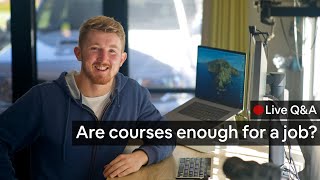
Machine learning engineer Daniel Bourke answers audience questions about careers and learning. He argues courses alone won't get you hired: build projects instead, skip expensive certifications, and use free tools like Google Colab. Writing and blogging matter more than credentials for standing out.
Chapters
Whoa, always the little moment between clicking the go live button and actually going live. We ready? Are we going live? Are we live? Excellent connection. Boom, fish on! I think we're live. Let me know in the chat, can you, uh, if you're there, let me know if we're live because that would be amazing. I always have this little, uh, And if you can hear me, that would be even more incredible. But hello everyone, welcome to the stream. I'll just wait. We're live. Ashik, hello brother. Can you hear me? Can you hear me loud and clear? Leave a thumb up in the chat if you can hear me. I'll just sit patiently, make sure we're connected. We're live. We are live. Yes. Welcome, Satwik. Welcome, Lona. We're here. To celebrate just being here, you know, just dancing. If you're new to the channel, welcome, welcome, welcome. We've had a fair few new subscribers over the past month or so, which is kind of crazy. It's— I never really— you can't help, like YouTube kind of puts these analytics in front of you all the time, so you can't help but check them out. So I don't really like pay attention to— put it this way, I don't really have a goal of like what number of subscribers I want to get to. I just like making videos. And so, if you're new to the channel, welcome, welcome, welcome, thank you so much. If you've been here before, you know how this works. We have a little party, we dance around, I do a Q&A for like an hour or so. I've got a whole bunch of questions banked, ready to go, but if you have any questions relating to anything, anything at all, that's what this is about. Machine learning, health, business, whatever you want, leave it in the chat. I'm kind of going to go back and forth between bouncing the questions that I have banked and questions in the live chat. So, and if I don't get to your question in the chat because there's too many things, don't be afraid to post it twice. I'm pretty sure you can mention my name and that'll highlight it or whatever. So, let's get, let's get started. Oh, and by the way, I lost all my powers. I lost my mullet. I got it shaved off. It was getting in the way. Like, I do a lot of jiu-jitsu and whatever, and so it was just getting sweaty and yuck and whatever. And one of the perks about having long hair is that you have long hair. Long hair is pretty cool. But the downsides are basically everything else because there's so much maintenance. It just gets in the way, yada yada ya. Anyway, we're not here to talk about hair. Let's get— so what I'm going to do, I need to set up my Notion of questions. Look at this. I wonder if this is going to work. Boom. Oh, look at that. Let's dive right into here. Can you still hear me if I keep this here? Like if I keep this like there. And I got the chat over this side. And let's go. I'm going to start just from the top. I'm going to probably work through these, maybe go one for one. I got some questions. Oh, this was supposed to be July livestream. We're a few days late. August livestream QA. And I think today is the 6th. But hello everyone. Hey Drizz, how are you? Hey Armando, Carlos, Landon, Satwik. So good. Thank you everyone for saying that you can hear me. I really appreciate it. Let's pump it into here. So we've got some questions from Satwik. I might turn these into a little to-do because I like checking things off. Don't be afraid if you're new to this sort of session, leave a question in the chat. I'll get to as many as I can. You know, I'm, uh, I have a little bit of a tendency to waffle on about things, so please let me know if my answers aren't as good as you— Oh! There's a big preface to all of this, by the way. You must know that anything that I say, and this goes for advice that you take from anyone, any answer that I give is going to be biased by my own experiences. So, that's what you have to tell yourself, is that even though that I'm saying something, you have to ask yourself, "Does what Daniel says relate to me in my current situation?" So although what I might do might sound good, it might not be for you. That goes for anyone else, like including someone that you see as like a rock star or someone who's doing really good. You gotta, you gotta take their advice and apply it to your own situation. So, grain of salt with all of these answers, right? Satwik, let's go. He's read some answers on Quora telling me that careers in AI aren't as exciting as learning it. And now AI is mostly overhyped and that most of the people learning AI will never actually get a job in it. Oh, that's very, very interesting question. Well, there's a 3-part question here actually. I'm preparing for the TensorFlow certification exam, hoping it would get me some sort of edge in the interviews, but that made me kind of demotivated. I'm desperate to know what you think. Don't sugarcoat anything. A harsh truth will always be better than a sweet lie. Ew, you know me well. I like, I much prefer the harsh truths as well. So let's go into this. You said AI is mostly overhyped. I would agree with that. The reason being is because a lot of people who typically work in AI, like directly on it, are like hardcore engineers or they're like mathematicians and whatnot. Whereas a lot of the people who talk about AI are journalists, including like myself. I'm not gonna lie, like I hype it up in some of my videos and whatnot. And so what you get is a discrepancy between like the engineers who are actually working on these things and like journalists who report on these things. And so if you were to read an article within like the last 3 years of like what AI is capable of, is you'll probably think that, wow, it's gonna take my job, it's gonna automate everything, it's gonna— we're gonna be— it's gonna be Rise of the Terminator robots. That's what— like, have you seen those classic articles that just have like the the Terminator face and it's like AI is going to take your job and all that sort of stuff. Whereas if you're an engineer actually working on these sort of things, you probably know that that scenario is like pretty unlikely. And who knows? I'm not, I'm not going to pretend that I can predict what the outcome of the future of AI is going to be. But once you start to realize, okay, all this like machine learning stuff is actually just a combination of linear algebra and a bit more math and finding patterns in data, then you go kind of like, ooh, that rise of the robots thing, that's pretty hard to imagine. Again, that might actually happen, who knows? And so you get this discrepancy, right? You get what's been reported on actually happening because those sort of stories sell. Whereas if you're an engineer working on it, your article that you write that's beautifully decadent in LaTeX math and all this code and whatnot, not many people are gonna read that. Aside from the people who are like you and like that sort of stuff. So, that's where you get this overhyped thing. And now, of course, one part of it has to be that it kind of has to be overhyped for anything. The reason being is for someone to get excited about something, it has to, there has to be a narrative around it. There has to be a story that someone can latch onto and go, "You know what? I want to work for that." And if you had told someone like 100 years ago, "You know what? We're going to fly a rocket to another planet." How do you think they would have reacted to that? They would have been like, wow, that's, that's, I can't, no, that's not going to happen. So you have to create that narrative about why it's, why we need to do the things that we're working on. And so one way to look at this is to buy into that, like that, those Quora answers that you've been reading saying that AI is overhyped. It's more fun to learn it than it is to actually work it on. You can pay attention to that. You can pay attention to the naysayers all you want, but is that going to help you go where you want to go. See, this is how I always look at things, right? Is, is what someone's saying okay? There might be truth in saying that it's overhyped, but does that help me in what I want to work on? So in my case, right, I want to work on these, these new technologies. I want to build things with, with AI and machine learning. And so if I listen to people that say, oh, it's overhyped, it's overhyped, it's, it's not going to do anything, rather than actually building the thing I want to build or trying to build the thing I want to build, Well, then you see, you see where that's not very helpful. So, that's my aspect is whatever you do, no matter what it is, you're always going to have some group of people saying, "Oh, it's overhyped. You can't do this. You can't do that." And then you have people like Elon Musk and SpaceX who are sending reusable rockets into the atmosphere and bringing them down. And of course, that's an extreme case scenario, but that's just, that's just an example, right? What's, what's the point of like killing a dream before you even try it, you know? So you could listen to all this sort of stuff about AI being overhyped and it's more fun to learn it than it is to work on it, or you could just work on it. That's my take. And now he says, uh, what do we got here? I'm preparing for the TensorFlow certification exam, hoping it would get me some sort of edge in interviews, but that's kind of got me demotivated. Look, put it this way. I posted a video the other day of me doing the TensorFlow certification exam. Truth be told, I've had thoughts of like taking it down and not posting it. The reason being is because certificates also just create this illusion, right? This illusion of like, if I just do this certificate, like I'm ready for a job. So certificates are just one way of showcasing skill. They're a nice to have. The reason I kind of went for it and wanted to get it was because I just wanted to spend a month studying, and then if I had like this one, like, very specific goal at the end of the month that I wanted to do, then I would like work towards that. What is more important than certificates is actual skill, right? Show me someone— like, I've got course certificates coming out my ass because I just, I got, I got stuck in that narrative of just, if I complete more courses and then I get these certificates, well, then I can share this beautiful little thing, and then I can show, and an employer, "Oh, look at all these certificates that I have." Now, okay, sure, some employers might value the fact that you have a certificate, but if I think about myself and I think about if I was hiring someone for the machine learning team that I'm working on, the startup that I'm building, what would I be more impressed by? Would I be impressed by someone who's got a rack of certificates? And the reason being is because I know, you know deep down, I know deep down that it is actually easier to get a certificate than it was to, for example, for example, build out my own project and post that project to GitHub. And so if I've, if someone, like if I've got someone here, Person A, who's got like this beautiful project that they've worked on, you can clearly tell that they've put a lot of effort into this project. It's fully built up through GitHub, like all the code's on GitHub, et cetera. And they've got like, maybe they've even got like a little bit of a deployed version of a prototype. The prototype could be work 70% as well. Maybe it doesn't work all the time. Or I've got person B who's got like a collection of certificates that you can basically game them. You can't really game working on your own projects. Sure, you can take template code from someone else, but if you really want to make it your own, you have to put in some self-guided effort. And so that's, if that was the only two things, differentiating between the two people, I would probably choose the person who's worked on their own projects 9 times out of 10. This is, this is like, if you, if I ever put out a job ad that, that's in the future, if I'm hiring someone like as an engineer to work on, um, take note, right? I probably won't even, maybe I'll look at certificates or courses or whatever, but if you've got your own like deep learning projects or machine learning projects, I'll favor that. So, yeah, take the exam if you want, but no certificate is a guarantee of a job. No project is a guarantee of a job. These are— it's impossible to answer the questions as like how— like things like how much math do I need to know? Or when am I ready for a job? Or how much should I do for this? Like those things are— you can't measure those. If you could, I mean, probably there's Someone would gamify it by now. So, when you're interacting with people or going for a job or something like that, it's not an exact science. So, there's no real way to go, "Oh, you're ready right now." The better way to look at it is to go to just always be— apply for something or apply for some sort of role or take on a challenge when you think you're almost ready. Because if you wait to take on a challenge or apply for a job or something when you're 100% ready, you're never going to be there. So, you're always just going to keep holding yourself back. So, 70% ready is enough for anything. Alright, we've got on a little bit of a rant for that, but yeah, value skills over certificates. Don't be like me and have certificates coming out your ass but an empty GitHub repo. Work on your own projects because they're the really— so, build foundation. I'm not knocking courses. Build foundational skills from courses, but then build specific skills through working on your own projects. So, that's it. Now, let's go to the chat. What do we got here? Holy crap! Good to see you all here. So amazing you're all here. And there was a question right up the top. I'm going back in the chat. Let me just, uh, boom. So I'm going to tick these off here. And so now we're going in the chat. Someone asked, there's a question on biased here. There was one on BJJ. Here we go. A human called Tenner. What's going on? Oh, we got 81 viewers. What's up? What's up, people? How you doing? Hello from Australia. We got Tanner. Don't worry, I'm gonna get to— I've got these questions here, so I'm gonna get to those soon. So Tanner, I just wanted to talk about this, uh, jiu-jitsu question. And I am a white belt in jiu-jitsu. Where is my belt? I had jiu-jitsu training this morning, actually. Where is my belt? There it is. Boom! This is my belt. I'm a white belt, 4 stripes. Um, what that means is I'm kind of close to, to a blue belt. And so I've been doing jiu-jitsu since November 2018, and it's really good fun. Like, it's just fighting. The other two most pleasurable activities I actually have, by the way, is fighting and writing. Fighting, just because that's just being an animal. I love doing that. Um, and writing is like writing code or writing words, so creating things. Um, but yeah, jiu-jitsu is a whole bunch of fun. Been doing it for about 2 years, take away like 4 months, uh, for COVID, or maybe 18 months. Because you minus 4 months for COVID, everything was locked down. But I'm really excited. I was going to do a competition and then COVID hit. I'm going to keep doing that for a while. So if, yeah, if you've got a jiu-jitsu gym near you, get into it. It helps, um, just helps. It's a whole bunch of fun, great community, good challenge, and plus you get to fight people. And anyway, let's go to Santiago. From email. Oh, actually, we've got a couple of questions here. I tried to group them, uh, so they're similar. These two are about like computers for machine learning. I get a lot of questions about this actually, um, and I'm afraid I'm probably not the best person to answer, but I'll give you my take on it anyway. So Santiago says that I use a MacBook Pro 16-inch. Yes, I do. And is basically asking, I used to train my models in the cloud anyways, I do all of that too. Um, is the MacBook Pro 16-inch the ideal computer for machine learning? Put it this way, there is no ideal computer for machine learning. What it becomes is I get a lot of these questions like, which computer should I use? And that's the equivalent of asking, um, which pen should I use to write the amazing book I'm going to write? Now the real answer there is use whatever tools that you have access to. In Santiago's case, he was going to spend most of his savings on a MacBook Pro 16-inch. Do you need that? 100% no. I only bought this because it's good for editing videos. That's it. If I wanted to do machine learning, this is not a great computer because Apple computers don't really— you can't access CUDA libraries on the GPU, which kind of just throws out all of, all of the, the deep learning libraries like PyTorch, Intensify, flow. So my advice there is always for the computer, for whatever you're doing, is buy the one that you can afford. Almost doesn't matter what it is. If you need like more compute power, say a GPU, use Google Colab. You can use Google Colab for, for the first 2 years because you'll probably be working on some foundational skills by the time you need a bigger, a bigger system than Google Colab can offer. It's going to take you a while to get to that stage, right? You can also use Kaggle kernels. So yeah, buy the computer that you can afford. If you do need more compute power, use Google Colab. If you do need even more compute power, then you're probably going to look into paid cloud providers. And then from there, Jithrendra asks, should I build my deep learning rig and use a low to mid-range laptop? And rely on cloud GPU storage providers? The same, same answer goes for there. Should I— it's basically, should I build my own deep learning rig or rely on GPU cloud storage? Same answer goes for there. Unless you're racking up a whole bunch of, um, like cloud storage GPU bills. There's a great article actually I want you to search. If we go here, boom, Build deep learning. There we go. So just search build deep learning PC. You should come up with some article like this. So how to build the perfect deep learning computer and save thousands of dollars. The caveat here is yes, you do save thousands of dollars, but it costs you upfront like 3 grand to build. And I think that's okay. That's with the 1080 Ti. How much do you save? Anyway, there's a series of articles here. Just search this one by Jeff Chen, and there's a few in here. Just read those and they'll tell you how much you save. But it's only— you only start saving if you're spending a lot of money on cloud servers already. Yeah, here you go. AWS. Look, so unless you're spending like $2,000 a month, and I, like, I'm not going to break this down, maybe what I'm quoting just, just off first glance isn't the correct figures. Unless you're spending like around that much, well then you're not gonna, you're not gonna be saving in the long run. So until you're doing large-scale experiments on the cloud, don't What I'm trying to get at is don't let your equipment hold you back from working on the projects that you want to work on. There's ways to do these things. I'd actually advise, like, it's too easy these days just to go, "Oh, just throw more compute power out of it." That's also like the bitter lesson. If we go have a look here, the bitter lesson. It's kind of— this is a great article, read this, "The Bitter Lesson." The biggest lesson that can be read from 70 years of AI research is that general methods that leverage computation are ultimately the most effective, and by a large margin. So back when— this story here is back when AI was starting, there'd be like a lot of handcrafted algorithms. And so this is basically just saying that now neural networks and plus a whole bunch of compute power are kind of the best method to do things. If you also want to keep building your Deep learning PC. Read Tim Detmers' article. So a full hardware guide to deep learning. So I'm actually in the process of building my, my own deep learning PC. But if you're just getting started out, don't even worry about the equipment. Just write more code. And then until you get to a point where you start to actually— like, you'll get to a point where, you know, you just have to start worrying about like, maybe I should have my my own hardware. And so let's go to the chat. What do we got here? I'm gonna mark that question off. Boom, boom. And let's go to the chat. Holy gosh. Now I'm not gonna be able to reply properly to all of these questions, but I'll just, I'll just pick them. So if I miss you, that's my bad. And Where were we? Oh, Aditya says, how can a 15-year-old get a data science internship? This is a good one, and I think it actually doesn't matter what age you are, not to me. How can a 15-year-old get a data science internship? What I'm going to say is the advice, this is kind of general advice, that's the kind of advice that I like too, is advice that experience, boom. Is advice that kind of being applied anywhere. Look at that, dude. See, look how awesome my mullet was. Don't worry, I shed enough tears myself. Yeah, so this is my best advice for that. Start the job before you have it. So don't let anyone hold you back when, in terms of any kind of internship or any kind of job that you want, it's just start the job that you'd like to have. And now if you want a specific internship, what you're going to have to do is do your research and apply directly. Now what I mean by directly is A lot of companies will post like job postings and whatnot, but I like to treat those as being dead. So the way, put it this way, I posted a job the other day for someone to do some work for me and I got an influx of like 110 emails, right? And so you can imagine if a company posted like say an internship position, how many offers they would have. There's just going to be a lot, right? So, the way I like to think of these things is first of all, start the job before you have it and then go directly to the source. So, what that means is find the person you should be talking to. Don't just go through like some sort of apply now button, but really search and find the person you want to talk to. That may be through an email, that may be through LinkedIn, that may be through Twitter. Something along those lines, right? And talk to them directly because the issue that I had when I posted that job was having too many offers and all of them were, were probably valid, like valid candidates. But when I just went through it, I just, it was just like I wanted to give everyone a fair chance, but it was literally just too much for me to comprehend. And so, which one did I latch onto? I latched onto the one that kind of just stuck out in my mind, and maybe this person wasn't as good as another person. I could have probably found, maybe found a better person, who knows, but I just latched onto the one that stuck out. That was just, that's just human bias. We have to simplify everything. There's no way we can take in all of the things that are going on around us. And so, first of all, start the job before you have it. If you have some sort of internship that you want, look up some places that you enjoy, those some companies that spark your curiosity, and maybe you figure out what kind of projects that they work on. And if you can't figure that out, or maybe you, you reach out and you talk to some people at that company, and then you start to build that relationship. Because at the end of the day, who do people like working with? That's a quiz. Who do you like to work with? People you like to spend time with. So if you start to build that relationship, first of all, of course, you need the skills, right? So if you have the skills, then your next step is to, to build a relationship with working, working with someone. And you can do that by showcasing your skills, to start the job before you have it, and then reaching out to the people or the companies that you would like to work for directly and going, hey, is there any internships that you, you you'd like to offer me? Oh, that's another thing, just ask sometimes. But yeah, age doesn't really matter. If you have skills and you showcase your work, that's what people are after. We go here. Where are we at? We're back to, we're back to the Notion document. So Aditya, great question. And now let's go to Richard. Richard sent me this one in an email. Actually, these two are, these two are kind of related, so my head is in the wrong place here, but you kind of get the point. It's, um, I've read your articles a lot, and in fact, your writings have inspired me to start writing on my own. I have written a couple of articles on data science and ML on Medium. That's amazing, so good to hear. I love when people start writing. My questions are, can you experience Can you share your experience when you first started writing? What keeps you motivated in writing? Do you have any tips, tips, suggestions for a new writer? And then Aditya has— I mean, sorry, Aravind has very similar questions. Starting my blog, advice for starting my blog, I'm an introvert, always kept my thoughts to myself. Can you tell me how you felt when you started your blog? When do people start reading your post? How is your blog useful while you're learning? Do you have good writing skills before starting your blog and/or you developed it after starting to write? Okay, so basically it's, um, what's it like when you first start writing? When do people start reading your shit? Any tips or suggestions? And did you have skills when you began? Okay, let's put it this way. When I first started, I actually have my first blog post I have a photo of it somewhere, but it's in— I wonder if I can look it up. Photos. Here we go. Boom. I can actually show you this. There. So that's my first blog post. Dear Daniel Bourke, you finally did it. Aren't you glad you started today? Yours truly, your past self. Yada yada yada yada yada. My first blog post. Thank you. So that was May 21, 2016. So about 4 years ago, just over 4 years. And before that, so Aravind said, did I have any writing experience? And I mean, of course, I'd written things before. I'd had a lot of ideas, I'd had a lot of thoughts. I'd actually wanted to think, I thought for a while like I did want to start a blog and all that sort of stuff. Or just to create things. That was the real catalyst. Not even like writing, whatever, like anything, just to create something rather than just sitting and scrolling all day. I wanted to contribute back. And so, when my writing skills— I would say that my writing skills have improved dramatically since when I first started. But that— this again, another roadblock, right? People will always— you will always try and hold yourself back because you think you aren't ready. And if you think you're 100% ready, well, You've waited too long. And so, the best way to build writing skills is to what? Is to write, right? Is to read, read articles that you enjoy and then write your own. Is to read books and then— books that you enjoy and then write your own. And now, it's just like coding. Remember when you first started to learn to code? You're probably pretty bad at it. You had to look up documentation, all that sort of stuff. The same thing with writing. What writing is, is it's connecting, connecting your thoughts in your head to putting something on the paper. Because at the end of the day, I was like Aravind. I had a lot of thoughts, but a lot of them were just going to waste because they were just my own. And now, that might not be to waste, but if you do want to create something, create value for others, while having these thoughts on your own, Well, they just go to waste when they just stay in your own head. So, one way to get them out there is through written word. And now, Richard says, "Can you share your own experience when you first started writing?" I was really nervous when I was putting out my first post. In fact, I actually want to feel that way every time I put out a post. So, when I wrote it and then I clicked publish, I was like, "Wow, who am I to be putting these thoughts out into the world?" But I'm sure that's how everyone feels. That's how you listen to any artist or any creator, they think, Yeah, you might hear there's some confidence like, "Yeah, just put it out there and create whatever you want to create." Sure, I have that too, but it's also, I kind of, it's a self-fulfilling prophecy. I tell myself that story so that I put that, the work out there, but I also have a small portion of me that still goes, "You know what, whenever I hit publish, whoo, I'm biting my fingernails. How's this going to go? Am I actually putting my own thoughts out there?" Right, but that's the exciting part about it. In fact, I don't want to read any writing that someone didn't actually feel like that when they, when they click publish. And so, what keeps me motivated in writing? It's probably the one activity I wouldn't, wouldn't stop doing. So, this is a real good way to sort of tell like what you would want to do in life or what you kind of, rather than adding things, what you're interested in, rather than adding new things that what you're interested in, one of the best ways to to like figure out what you are actually interested in is what would you miss? Say you had a day where you just did nothing at all. What activity do you think you would miss the most? So, for me, it would be writing or working out or just moving in general. So, fighting and writing, the two things I like. But in other words, I want to give you a little tip of how I got started. I built the habit of started writing, starting writing. We go here. 750 words. Boom. This is actually really simple. So there, there's today. This is just— if I go here, hello world, today I'm doing a live stream, say hello everyone, right? So I'd go to this website and I would just write 750 words Every day, then you can build up a little streak. I've like lost my streak. I was on a bit of a streak a while ago, but yeah, there we go. Training is coming back, baby. Boom. But yeah, a lot of this stuff is just me thinking through thoughts and then, because that's what writing will do. It'll show you how poor your thinking is. Once you try to put something in words and you try to understand, it's like how, What you got to think about as well is, well, this is what I'm thinking about, is how is that message, like if you're writing and it's sounding confusing to you, how do you expect someone else to interpret what you're saying? So, that's what I spend a lot of time on is going, okay, if I was to read this from a fresh mind, it's a very hard thing to do. If I was to read this from a fresh mind, how would, and I didn't know the things that I knew, how would that interpolate, how would I interpolate that in my head? Same with code. Like, if you're writing code and it's very hard to, to interpolate, how do you think you're going to come back to that code in 6 months and go, wow, I'm not even sure what I did here, right? And so there's another part to this question. It's, uh, do you have any tips or suggestions for a new writer like me to write better and more impactful art audience? So write the things— this is always my advice— is write the things that you would like to read. That's it. And then this kind of leads into the point. Aravind said, when people start reading your post? As I said, I don't really track. I used to. I used to track like how many people read my articles and how many people watch my videos. I mean, you— it's kind of impossible not to these days because like the numbers are just there whenever you log in and you see all these notifications and you get emails from like, oh, your article got 100 fans or whatever. Yeah, cool, that's nice. It's like a stroke to the ego, but those things don't impress me. They may— sure, they may impress someone, but those things don't— I don't— what I go for is nothing excites me other than the things that I can create. So as soon as I post another article, the next thing that's going to excite me the most is creating the next one. Same with any project. It's building the thing itself that excites me most. Of course, there might be someone who gets motivated by numbers and sales and views and all that sort of stuff, but I've just worked out over time, trial and error, that that doesn't get me going. So, when do people start reading your posts? Well, I always had people reading my posts because I would be the one to read them. But no, more and more people started reading my posts after my writing got better, and that was only after, let's say, 100 articles. So that's your goal. Race to your first 100, and then each time improve, improve your writing skills from there. It's just a— there's no secret trick to it. It's just, just write the things you'd like to read, and as, as you start to go through, improve your skill of writing, read back through it, and The art is really in the edit. So when you write out a rough draft, it might be just full of absolute gibberish, but then you go back and you rewrite it, you rewrite it again, and then you make it legible for someone else to read. Um, how is your blog useful to you while you're learning? It's probably the best thing I've done in the last 5 years is creating a blog. Um, again, it's that switching from just consuming too much to creating. Um, Writing, again, is nature's form of showing you how poor your thinking is. And how did you decide on what you're going to write is the same thing. I just write things that— now it's to the point. It's only now after writing for about 4 years that I have people asking me questions. And so, usually an article will either be just something I've had on my mind and I just wanted like to get it out of my head and just put it into written form and something I would like to read. Or it's something that a fair few people have asked me over and over again, and I thought it's probably just better to put this in a blog article, and that way people can kind of find that, and then I can just link that article if they want. So, if someone asks me a question, I'll just send them the article. Alright! So, back to the chat. How we going here? We rocking and rolling? Is the pace alright? And let me know. So if we got here, Aravind, we're going to tick all these off. Now we're going to go to the chat. Maybe we do like, how about we do a quickfire round? I've been doing boxing as well lately, so again, fighting and riding, two, uh, two of my favorite activities. So here we go. Whoa, we got a lot here. Does Khan Academy calculus enough for understanding machine learning algorithms? Yeah, so, so maybe Khan Academy is not the one perfect resource for you, but if you go through that calculus, I mean, that's the beautiful thing about math, right? Is like my math is the same for your math. What, what's— rather than the resource itself, find a teacher that you understand. So that's a lot of what I had this realization like the other day is a lot of education is actually just getting a teacher who's going to excite you about a problem. Because at the end of the day, most of learning is self-teaching. So the teacher has to spark your— that's probably one of the main goals of a teacher is to spark your curiosity in something. And then it's up to you to fill that gap of learning the new things. So to do— does Khan Academy calculus enough for understanding machine learning algorithms? So machine learning algorithms have a fair few more parts than just calculus. Well, actually, it's really just like calculus and linear algebra. But yeah, so I go, go through the calculus on Khan Academy and linear algebra and then just start applying it to where, where you are, where you need it. Because at the end of the day, going through course material is kind of again that foundational knowledge, but it won't become cemented in your brain until you actually use it. Someone can't hear anything. Can you all hear me? Um, there's some good courses for ML engineering or data engineering. What would you recommend? So I'd probably, probably start with— oh, we just answered that. This is a quickfire round, by the way. So, Jiao, can my keyboard do— it can't do that little fancy A. So Jiao says, there's some good courses for MLE or data engineering that you'd recommend. So I would go course.fullstackdeeplearning. This is probably, um, boom, training and debugging. There we go. I'll probably check out this one, full stack deep learning. Uh, the data engineering and machine learning engineering will kind of be different depending on what platform you go to. So I'd check out this. Google, I think— Google machine learning engineering certification. Google, I think, just, just actually released this one certification. Again, we had a rant about certifications before, but the thing you can do is just reverse engineer the criteria for what the certification requires and and then just go and learn that without actually doing their certification. But again, it's kind of hard to— here, real-world experience. What's, what's in it? They're professional machine learning engineer. ML problem framing. It's kind of hard to learn like ML engineering without having something to work on because otherwise you're just setting up like just dummy pipelines and all that sort of stuff. So the best way is to, I would say, go through something like this, Full Stack Deep Learning, um, and then integrate it into your own project. Because then you're going to— this will set the foundations, and then you'll, you'll build up your own knowledge through working on your own project. But yeah, this is This is kind of the things that like a machine learning engineer will do. Pipeline automation and orchestration. Yeah, but again, this is, this is pretty full-on, like the, like this kind of criteria. So better off to, to not just go through this, right, and just learn each of these on their own, is to see how they piece together. In some sort of project. So maybe you look up something like this to see what an ML engineer actually does, um, and then, uh, build your own knowledge through self-teaching. So that's kind of my approach to things. Let me come back to the chat. Jiao, thank you, thank you, thank you. Anar says, can you please explain how ML models are connected with website or how backend is connected with ML models? Okay, beautiful. So there's a fair few ways to do this. One is you can— so this is deploying machine learning models. So one is— where's the whiteboard? Here we go. Right, how do I draw on this? Draw. So one is This is deploying ML models. We have a model that can be model. Now this is option 1, okay, 1. So you can put your model into— this is a cloud— into a cloud. We'll put that for C, and then you can have your application over here. Application. Right now, there's a lot of tools that you can do this, but let's say this is Google Cloud. This is your machine learning model. This is your application. And so one way is to have all of your application stuff in here. So like the website itself, like it could be this, this could be your website, right? And then every time I write something here, so I'm going to write a story. Hey, I went to BJJ this morning and felt very happy afterwards. Okay, so the machine learning part of this could be that every time this application— every time I type into that, this application sends my text to this machine learning model which is hosted in the cloud, Google Cloud, and and then it's going to pass in all of my text to my machine learning model and it's going to send back something like, um, the sentiment score of this, which sentiment is a measure of like, uh, how good a feeling the writing is. So the sentiment score is 97, right? So if I spent— if I kept writing on here, maybe it goes— there's a little box that appears here and says sentiment score 97. And then if I, I go maybe here, um, I got stuck on a code bug yesterday and felt sad. So then it could do the same thing again, send that text up to the cloud, then the machine learning model will return a value. Maybe the sentiment score now is not 97, it goes down to— wow, trying to draw with a trackpad— it goes down to 90, right? So that's one way. This is an API, ML API. Now you could do that with something like Google Cloud AI Platform. Now you don't have to do it with Google Cloud, I just have experience with Google Cloud, so that's why I'm using it. So there you go, take your machine learning Models to production, prepare, build and run, manage Kubeflow pipelines, etc., etc., AI Hub. Boom, there you go. So this is it. Deployment end-to-end cycle. Ingest data, prepare. So this is what we basically drew out, a very simple version of this. Google should hire me to draw their, their, um, Wow, I can't even scroll. There. Okay, so ingest data. So this is where our app comes in. Our app sends text data to the cloud and our machine learning model, maybe in here there's a few more steps to prepare it, process it, um, don't worry about discover, test, and analyze. So that's what this— we've done the deployment part here. So ingest data, which is here, sucks up data, and then a machine learning model works on it. So it tests and analyzes it, and it's already deployed. So then it sends something back. So check out something like this, Google's AI platform. AWS have an offering, Azure have an offering. Then option 2 for deploying a machine learning model. So let's come over here. So that's option 1. So this is 2. Again, there's probably many more ways, but these are just the 2 main ones, is to have your app here, app, and include the ML model here. ML inside the app. Now what is the benefit of this? I want you to think about this. Why, why wouldn't you just host it on Google Cloud and have, have your app query, query the cloud every time some text went in? I mean, I'm already on the internet here, so why wouldn't I just just put it, the machine learning model, in the cloud? Well, it's because what if your device doesn't have that much internet connection? So if I've got, I've got my phone here, don't worry, it's on airplane mode. So if I've got my phone here and I'm say driving along and what's an app that uses machine learning? I'm say— I'm sayin' in the grocery store and I'm trying to scan different foods. I'd like to see, to see what new, what foods are in there. So let's put it here. Let's draw an apple. So this is an apple and I want my phone to scan that, right? If I'm in the grocery store and I don't have a very good internet connection, how can I send the data from this to the cloud? It's just going to be, it's not going to be a very good experience. But if my machine learning model is on the app, right, then it can just go, you know what, I'm going to find the patterns here, send that, send the photo of the apple to that machine learning model, runs on the device, and then it shoots it back. Well, it'll display some information on the app. And so again, that's a very high-level overview of how you can deploy. But the two, the things here to remember is you can either bundle it with the application itself, or you can run a machine learning model as an API on some sort of cloud server. So they're the two main ways. And you gotta, the one for you, it'll be you thinking about how you want your users to use whatever you're building. So in Tesla's case, like they're building a self-driving car, all their models probably run on the car. I don't actually know exactly how they run, But I'm assuming, uh, for inference you need it to be as fast as possible. So it's got no time to go to the cloud. I'm sure there's probably some component that they send to the cloud, but for like the self-driving car itself, it probably has to be as fast as possible. So it has to be bundled with the app itself. And so again, there's many different ways that you can do these things. Um, for example, the last way that I did it for one of my Airbnb projects is I used Docker, put my— let's actually get that graph up. GitHub, where we got Mr. D. Burke. I'll show you Keynote. This is just one example, right? Um, this is what I worked on for this project. There we go. So to serve the model, I built an application on my computer and then can you see that? Right. Wrapped it all in Docker. So made sure the machine learning model worked on my computer so I could access it in the browser, wrapped it in Docker. So Docker is like this, um, I don't actually know how you would describe it, but it just, the way I think of Docker is it just say you have some code here. That runs on your machine, Docker builds a little container around that code, and then you can put that code somewhere else. And the guarantee, or the, the kind of selling point of Docker, is that if I wrap that up in a Docker container and then give it to your computer, it will run. And so that's what I did. I wrapped up my working code on my local machine, put it onto Google Cloud, um, through App Engine, and then whenever someone accessed that, that browser through App Engine, it was just running the exact same code that I had working on my local machine. That's just one way to do it. One way to do it. In that case, the model was part of the application itself. Okay, so look how good those drawings are. And where are we at? We got a lot of questions in the chat, I'm guessing. So we go here. And our ML models are connected with website, or how backend is connected with ML models. We'll go Robert here, and then we'll go back to the chat. So Robert says, how did you hook up with Andre? So if you don't know who Andre is, we teach a machine learning course, Zero to Mastery, mlcourse deburke.link/mlcourse. This is, this is where I teach machine learning. Andre teaches the Python parts. So Andre teaches that and then I teach this. Anyway, that's just who Andre is. Amazing dude. Well, actually never met him. So shout out to Andre. I was going to travel. He lives in Canada, I live in Australia. I was going to travel, but of course COVID happened. Um, how did you hook up with Andrej? What was the process of like working with him? What have you learned with him? I've assumed he has a lot of input to the structure and teaching methods of the course. I did the intro to Python section and I think he taught it really well. Oh, there you go, that's awesome. I have a master's in mechanical engineering, currently doing a business master's, so I have some experience with learning methods and I think the ability to self-learn is the most important skill. I I agree with that. Boom. Um, how did I meet up with Andre? So I wrote an article, 12 Things I Learned. 12 things. There we go. I have to search my own articles. So this is the article I wrote when I left my job. So I left my job just over a year ago as a machine learning engineer, like my employed job. So that's the article. Look, it's in that room, but the same room and same hoodie. Haha, that's how you tell a true hacker, if he's got an old raggy hoodie. This is not really raggy, it's probably only a few years old, but still same hoodie, repping it. So I wrote that article and then Andrei read it, it kind of went like viral. But again, I didn't write it to think, like I just wanted to accumulate, accumulate the things that I'd learned. I didn't know that it would go viral. Like, these are things you can't pick. So I just wanted to accumulate the things that I learned actually working on the job. And so, um, Andrei read that and said, hey, I'm building a machine learning course. I just see you left your job. Do you want to help me out, um, do the machine learning part? And I'm like, well, sure. I now no longer have a job anymore. I need to 'First of all, build some kind of way to get an income so that I can fund my next projects.' And so that's a beautiful idea. I'll build this machine learning course with you. And then I spent— we spent the next few months working together, and it turned out that we created a pretty damn good course. So that's how I met Andrej. He just read that article, sent me an email, and that's it. Um, you also had another question, Robert, that says And I go back to here. Boom. I've been looking at machine learning jobs. Oh no, anyway, been looking at machine learning jobs. I'm not sure if I want to do this as a career path, but certainly it sounds interesting. Can you see that? Maybe this whole time I've, uh, just been hiding things from you. Um, do you think the best way to get a machine learning data science job at an established company or startup is to create your own portfolio of successful work? Yes. I'm just going to say yes. Like, that's it, really. What's someone doing when they hire you for like some sort of role? They want to know, do you have the skill to be able to work on the problems that they're working on? And so if you can showcase— the key point here is, um, your own portfolio. Boom. How do I highlight this in Notion? That's what— what's anyone hiring anyone for? And so that they can do, they can do work without necessarily someone having to like hold their hand and say, this is, this is what you have to do at this step, right? The projects you work on, if you think that you're going to get into some sort of job and like have to know everything off by heart and, and like You see these, these like demo interviews of like someone solving like this massive algorithm equation problem, whatever, on a whiteboard. Yeah, sure, maybe there's some interviews like that, but do you think that's got what you're going to be doing day to day? You're going to be reading through documentation. A lot of the tooling you're probably going to have to get familiar with is with a lot of big companies, they'll have a lot of internal tools. So a lot of the onboarding is just learning those internal tools, how they work and all that sort of stuff. You're going to be looking up, like, reading, reading research papers, seeing if you can implement new ways of doing things. There's going to be a lot of learning on the job. So what they're— what, what, uh, this is what— and I can only talk about what I would look for. What I would look for if I was hiring someone is, have you worked on these sort of things yourself? That's it. That's really it. So yes, the answer for to Robert's question is, uh, should I create my own portfolio of successful work that you can talk through with people and use to demonstrate that you have the ability to do a project from start to finish? Yes. Alright, so we got— we're gonna go one to the chat, or probably two, two for the chat. Um, here we go here. There's so much going on here. Boom. Notion up here. Ashik, I'm gonna get to your question next. So we go to the chat. Someone says, what is my view about TensorFlow certification? I did it, but it's a nice-to-have, not a need-to-have. And we're going for a quickfire round, hey? Hi Daniel, I'm a junior data engineer about to finish my master's thesis computing engineering with AI. Is that enough to apply for ML engineer roles? Yep, couple that with some of your own projects. Uh, how can we in handle imbalanced dataset or the best way for that? Um, there's a lot of different ways. You can do SMOTE, you can do data augmentation. Um, like if you, if you just Googled that exact question, you'd find a plethora of different ways, but there is no like best way. That's the beautiful thing about machine learning as well, is that like, there's no— of course there's like state of the art and all that sort of stuff, but, um, depending on what problem you're working on, there's often like many different ways you could approach it, and the best way is often undiscovered yet. And Priyank says, bro, how to build a deep learning inspired startup from an open source project? From Google AI blogs. There is amazing research, and then some of them are re-open sourced. Um, how to build an open— a deep learning startup from an open source project? Well, that would be almost any deep learning startup right now, because like TensorFlow is open source, PyTorch is open source, FastAI is open source. So I mean, like, if you're using deep learning, you're probably using one of them. And so it's just, just figure out, don't worry about like Google's going to release a whole bunch of new, new things which are all amazing. I'm not, I'm not degrading from any of them. I actually read a blog post the other day of my favorite one was, I think it's TensorFlow Cloud is the newest one. That's actually really cool. So you think about it like this. I'll get to that question from Priyank in a second. So TensorFlow Cloud, I think there was a blog article about it. No, that's not it. Where's the TensorFlow blog? Here. TensorFlow Cloud. I actually really like this one. So basically you can just have a model here and then you can just import the TensorFlow Cloud— what's it called— package or framework or whatever, doesn't really matter. And you can set off a big experiment to run on Google Cloud with like 8 lines of code or whatever. So see there, CPU cores, memory 30 gigabytes, uh, you want to use an NVIDIA Tesla T4 GPU and and you want to use 2 of them. So imagine it like this, right? You're running experiments locally on your machine and you're getting them to work, but then you want to start to upscale them. Well, then you could use TensorFlow Cloud to go, you know what, I'm just going to run this experiment for half an hour on 16 GPUs. Again, that'll probably cost you some money, but you just want to see how, like if I did want to scale this up and go for it, train it for a long time, this model, well, you can do it just with pure code pretty damn quickly. So imagine that. Imagine how quickly— that's what machine learning is all about, is how, how quickly can you, can you test your current hypothesis? How quickly can you figure out what doesn't work so that you can try the next thing? So this is a cool way to, to really quickly upscale your models. But again, if you're first, if you're just beginning, it's unlikely that you'll need this sort of stuff, um, because I'm starting to get into the point where I want to train some larger models This is exciting to me. I haven't yet used it, yo, though. And so the actual question was how to build a deep learning inspired startup from an open source project. Well, the, the best way to do it is just to have a problem that you're working on and then just use open source tools. There you go, that's your, that's your startup. There's no secret sauce to this. Like, if you were, you could use TensorFlow, you could use PyTorch, you could use any of the open source deep learning tools. Um, and then the way to do it is to solve someone's problem that they have. That's your, that's, that's, that's your deep learning startup. And then if you want to turn it into an actual business, get them to pay you for it. That's a, that's what a business is. A business, you have a business once you have a customer paying for whatever you're selling. That's it. Not before, not after, not when you get funding and all that sort of crap. It's when you have a paying customer. All right, where we at? We got Ashik, my boy. Ashik, how are you, brother? Okay, so there's a few questions here. And if you are up to start ML now, what would be the optimal way to do it, like tools you will learn and clue behind the process? Views on fastai versus TensorFlow. What would be the tool you recommend for people starting deep learning now? How about GPT-3 and its impact? A quick heads up about intermittent fasting, full-stack deep learning, how to do— okay, so let's do another like quickfire round here. If I was starting ML now, I would— so again, I, I got caught up in the whole idea of doing more courses than actually building shit. So instead of just having courses coming out my ass and, and just always looking for the next course, because here's the thing about learning. We spoke about this right at the start, is that learning is fun, don't get me wrong, but it's very easy just to go on to like trying to do the next course rather than putting what you've learned into practice. That's the easy step because all you're doing then is you're getting, you're getting good at, you're building the skill. Are you trying to build the skill of completing more courses or build the skill of building actual things? Right, and so once you've done a few courses, you can get pretty good at finishing courses. So I'm not taking away from courses. I'm just saying how I would change things. I actually sell a course, so there you go, take it. You don't even have to do mine. All the things that you need to learn are like free. You could just go through all the tutorials of Python. See, the benefit of course is someone has compressed the, the amount of knowledge that is out there into a way that is understandable for you to learn. That's the benefit of them. So, use them to build foundational skills. I'll say this till I go hoarse. But then, I would start working on my own things. So, I would probably try and even it out. For every, like, month I spent working through a course, I would then immediately start to put what I try to learn into practice for a month. So, I'd go 50/50. Instead, when I was starting to learn things out, it was it was, I was just excited about the shiny new thing, just completely, just whatever came out and whatever was new. I had to learn the new framework. I had to learn the new this. I had to learn the new that. I had to read the new blog post. No, it's better to, to build the foundational skills so that you can work on building things that warrant releasing one of those new tools or warrant releasing one of those new blog posts. Um, so yeah, even I'd even out my time from consuming because that's what a course is. A course is consuming. Right, you're consuming information from someone else. I'd even it out with creating. So yeah, I would work— I would spend more time figuring out how to figure things out on my own. That's how I go about starting learning it again, um, and building things, of course. So that's where it comes into full-stack machine learning. And what's your views on FastAI versus TensorFlow? FastAI is very approachable. I haven't used FastAI 2. TensorFlow is probably a— has a bigger ecosystem for, for like, like full, full-scale machine learning apps. That being said, I haven't used fastai in a while. I actually worked on a project in my machine learning role where we used fastai for a natural language processing, um, project, and it, it— the model that it spit out was, was absolutely phenomenal. And it was because fastai is built on PyTorch. It was built in PyTorch. We deployed it as an API and it worked amazingly. So I love fastai, I love TensorFlow, I love PyTorch, I love them all, right? But at the end of the day, it comes down to none, none is really better than the other. It's only what, what can you use to solve the problem that you're working on. Maybe fastai has some features to really quickly get a, get a 95% best model that you can get, and that's all you really need because you're just going to, you're just going to deploy your model into some sort of API for your proof of concept, right? You're going to build this, you're going to build that. Maybe you just need a really pretty good model, probably not the best in the world, but just something that works so you can showcase what you're building to someone else. In that case, I'd probably go fast.ai or transfer learning or something like that. Um, full-stack deep learning course, how can you do it? I, I don't see any other better way than just doing it and then putting what you've learned into practice. And then about GPT-3 and what will be its impact. Oh, I'm actually really excited about GPT-3. I read the whole paper the other day and it's pretty big paper. It's like 40 pages long. And you've seen the results, haven't you? Like what, what some people are putting out there with GPT-3. Like I think in the paper there was that one stat where it was like 50, 52% or something with the biggest GPT-2 model, that is. So you have the biggest GPT-2, GP— I'm getting my acronyms messed up. So you have the biggest GPT-3 model, which was like 175 billion parameters. You get it to generate a 500-word article and then you get a group of people to see if they can differentiate between what was a GPT-3 article and what was an article written by a person. And so what's the scores from there? It was 52%, right? Only 52% correct. So, you know, binary classification, that's, that's the problem it was. What's, what's guessing in a binary classification problem? What's guessing? 50%. So you're telling me that an article like it was, and it was 52% correct, right? So it's basically like the people were guessing almost whether the article was written by GPT-3 or an actual person. So I think that is, that is mind-blowing. I'm also excited. I think it's, see, the thing is with generative models, that's what GPT-3 is, right? It's a generative language model. I see it, this is where I'm really excited about like the future of like creating and making things is I see GPT-3 as like a musical instrument. And so you've seen, you might've seen the OpenAI API. Let's have a look at it. I've got, I sent out a whole bunch of stuff in my newsletter about this actually, but let's see this. So where's the actual demo where you can just get it to write stuff? Um, anyway, it doesn't really matter, but put it this way, I see it as GPT-3 is like a musical instrument where you can, you can actually learn what are the right things to— how do you get GPT-3 to create the thing that you wanted to create? So as in, if you wanted it to write, say, a tutorial on Python code, how would you feed it the correct inputs so that it generates the right output? So imagine this, it's like you're learning to play piano and you want to play this beautiful symphony. Of course, you need to learn like the foundational keys, which one to press, and et cetera, et cetera. Then you have to learn which key goes with which other key. And I don't play piano, so I might be saying the wrong things. But you imagine if you put them in a certain order, they sound great. But if you put them in like the wrong order, they don't sound very good. So this is what I'm imagining with GPT-3 is that you could treat it like it's, it's a piano. You could learn to play it and you could feed it the certain sort of inputs and maybe it doesn't give you the right outputs. But then you could, you could start to improve your skill, like say after piano, after 4 hours, you're not very good. But after 100 hours of playing piano, you're pretty good at like putting together notes that sound pretty good to each other, or with each other. The same thing could go with these generative models that have been built, is that when you first start playing around with GPT-3, you're not quite sure of like what sort of inputs it's going to produce, what sort of outputs it's it's going to produce from the inputs that you give it. But after a while, with some practice, you go, okay, well, I know if I, if I put this certain input here, and then I put that certain input there, GPT-3 is going to kind of maybe put out this sort of output. So I see it as like a musical instrument. That's what I'm most excited for. And so maybe I can learn to play a musical instrument or a language model. So I'm into writing, right? I like writing books. Maybe I could write a book with GPT-3. One chapter could be a chapter written by me, then another chapter could be written by GPT-3. You heard that idea first, by the way. That was my idea first. Nah, I don't care, you can steal that if you want. That'll be pretty cool. And then you don't tell the reader which is which. They just read this whole book as if it's written by a person, but it's half and half. Okay, where we at? We'll come back. Boom. Let's tick off these. Great questions, Ashik. I really appreciate it. And so now we're going to go probably a rapid-fire round just to finish off these questions in Notion, just to be nice to everyone that was leave me a question. Thank you so much, by the way. And then we'll probably go to the chat, maybe a couple more after that, and then go for that. Moritz says, some questions for an interview come to mind. How did you make sure you have a fast feedback loop with learning machine learning? This is going to be different for everyone. You just have to see my way of doing it was when I, when I like, I have time-based goals. So I know I'm putting in effort if I can do like 4 to 6 hours of study or work a day. After that, I'm pretty capped out. So, some days I do more, some days I do less. So, my fast feedback loop is, am I, am I challenging myself enough? And am I putting in enough time on things that are difficult? So, that's it. That's my fast feedback loop. And a time-based one is kind of easier to manage than an actual goal-based one because you just, the progress that you do is going to disappoint you in the short term, but over the long term, if you actually put in the effort, put in the hours, reflect on your work, etc., etc., then you're probably going to surprise yourself in the long run. And what was your goal at the start of your learning journey? Um, truth be told, I wanted to work for a big tech company, and then I realized I didn't want to really work for a big tech company. How did you structure your learning process when I first got started? I used Trello. Do I have Trello here? Trello login. I'm gonna have to log in anyway. If you search up Daniel Bourke AI master's degree, you'll, you'll find it there. And it was just like, it's like a Kanban board, so I just moved something from doing, from not done to doing to done. So if you look that up, look up Daniel Bourke AI master's degree and Kanban system, and that's the system I used. It worked for me, might not work for you, but it's pretty simple. And math first, first application first, first both at the same time. Both at the same time because end of the day, machine learning is math, right? It's, it's like you do the dot product and you've got a whole bunch of additions, a whole bunch of multiplications, and then you do a little bit of calculus and there's your machine learning. So yeah, if you're going to be working on applications, you're going to be trying to improve the things you're working on, you're going to eventually have to read some papers. Papers have a lot of math. So just learn both at the same time. Depends on what you need, right? Vishnu says How do you wake up at 5 AM every day? I don't anymore. I went for a little spurt of like waking up at 5 AM every day. Now I just wake up whenever I need to wake up because it's winter and so it's like cold. And so yeah, some days I sleep in, some days I like sleep in is like 7:30 or 8-ish for me. Most days I'm up at like 7 and then like this morning I was up at 5:30 and trained jiu-jitsu at 6 AM, so. Yeah, I just— sleep is paramount, right? Sleep is the force multiplier of life. So, I just sleep as long as I need. If I sleep, I feel better when I'm awake. How do you deal with afternoon slump? I either have an afternoon nap, I go for a walk, or just chill out and do something easy for the afternoon slump. I usually get away with avoiding the afternoon slump if I'm eating really well. Which is most of the time, or if I don't eat too much or whatever, like at lunch. So I fast like, I fast basically every day outside of the hours of 12 till 8. So I usually have lunch at 12 and then eat at like 7:30 at night after training, and that's the only times I eat during the day. But yeah, deal with the afternoon slump. Just have a nap, chill out, go for a walk, or do something easy. And SB Dev says on Discord, um, it's important to take on personal projects to showcase to employers. And I think we've answered that enough throughout this, this stream, so I'm going to ask everyone here, is it per— is it important to work on your own projects? I'll let you answer that one. So let's, uh, So thank you so much, guys, for that questions. I really, really appreciate it. I hope you guys have had fun so far for this stream. I'm not sure. And I'm sorry I haven't hit the chat enough, but let's go here. And all right, probably gonna go— whatchamacallit— 2 questions from here, and then we're gonna wrap it up because it's hit about That'll probably take us to the hour and 20 mark. Okay, Mahia says, help me get a narrative, bro. I've done my graduation in CS. I'm wanting to start into data science. Be a long learning dive, but I gotta earn it now because it's just me and my mum. Um, my dear, I've got nothing— like, no matter what I say, it's, it's on you. So I could say the most amazing advice in the world, but at the end of the day, if you want to get after something, it's on you. Don't let me, don't let anyone else be a roadblock. And part of being a roadblock is also waiting for the perfect advice from someone. So I've been caught in that too. So at the end of the day, if you want to learn something, if you want to build something, no one's going to want anything that, that you want as much as you. So that's what I remind myself on. If I want to learn something, if I'm curious enough, if I want to build something, well, it's on me. We haven't done enough dancing by this stream, by the way. I promised there would be dancing. Anyway, um, uh, Akash says, hey Daniel, nice seeing you in the live stream. Great to see you too, Akash. And my question is, is knowledge intensive calculus needed for deep learning model deployment development and deployment? Well, Machine learning models are basically tensor— or deep learning models are basically a whole bunch of tensor calculus under the hood. You don't need to know that to be able to build a model and then deploy it, but at least having some inkling of how it works is, is probably pretty good. But yeah, you can, you can write and deploy a machine learning model in just pure Python code without knowing anything that goes on under the hood. Um, what I always say with this is that it's, it's hard to, to know how much you need to know. So if you're stuck on a problem and you think that, well, maybe if I knew more of the underlying math of this, this will help me move forward, well then it's probably a time to learn that. So we got here, um, Mr. Seeker says, uh, will your machine learning course be enough to get a job in machine learning field? No. Um, so a lot of people might not even tell you this, like, if they're selling you a course. So my course will help you build foundational skills. Will it be 100% enough to help you get a job? Maybe, maybe not. Uh, what I would prefer you did was do the parts of my course which helps you learn enough to get started working on your own projects, and then use your own projects as your foot in the door. Right? Because a lot of people can just— you can just like, you can just burn through the lectures of my course and get the certificate at the end without actually learning anything. So, what I would prefer is someone with my course is to not even finish it, just to go through enough to go, "Oh, you know what? I'm pretty—" That's what I wanted it to be. I wanted it to be a momentum builder, a momentum builder for someone to start working on their own things. That's why we work through 3 end-to-end projects. So I would prefer if someone just like do the parts of my course. You could even do— like, I'm not saying like this is pretty dishonest, like if you, if you, if you have this kind of ethics, but you could even get my course. There's a 30-day refund on Udemy or Zero to Mastery, where it is, and you could do it for 3 and a half weeks, get the refund, and just go, wow, I've learned these foundational skills, now I'm gonna go make something. Like, I would almost prefer don't get the refund, right? Because I need that money. No, I'm kidding. Do what you want. But any course, including mine, is for foundational skills. Use it for that and then build on top. I think I've said this about 10 times in this stream. Use a course for foundational skills, including mine, and then learn specific skills, the skills that can't be taught, by working on your own projects. Because all the projects that you work through in courses, someone's holding your hand. Someone's holding your hand and going, come on, this is how you do these things. It's not until you try it for yourself that you're really going to cement that knowledge. Um, do you need CUDA? You have no CUDA in your MacBook Pro. Uh, I use GPUs when I need CUDA. I use like NVIDIA GPUs. I don't use— I don't train machine learning models on my Mac very much. Drizz says, how would you approach machine learning and software engineering at the same time? I build full-stack applications. So just get something deployed, get people being able to interact with it, because it's one thing to build a machine learning model in Jupyter Notebook. It's another thing to be able to build something that someone can actually interact with. So that'll teach you a lot of just— even if it's, if it's just a crappy job, but just the fact that someone can interact with the code that you've worked with. I'm talking like go to a domain and use your code. That's, that's what I'm talking about when I talk about software engineering. Of course, you can go into more higher-level stuff than that, but to get started, that's how, that's how I'm learning at the moment, is just building stuff that people can interact with. All right, I think that, that might be enough. Jack Arnold says, do I have a Discord server? Yes, there is a Discord server for the Zero to Mastery students. So if you, if you send me a message, I can probably send you a link, but usually it's just for people who like are going through the course because I answer a lot of questions there. I don't have a personal Discord server. So good to see you here, Jack. Thank you so much everyone for tuning in. I've had a lot of fun. And as always, remember, you can ask me a question anytime. Leave a question on one of my videos, or I prefer actually if you send me an email. If I forget to reply to your question that you've sent me, send me a reminder, alright? Because email is like a blessing and a curse for me. My email is daniel@mrdbourke.com. You can find it on my website. You're smart enough to find me online and send me a message and whatever. Um, but keep learning, keep creating, and I'll see you next time. Thank you so much, um, Drizz, Akash, Satwik, Gav, Cyril, Josh Cummins, everyone. I really appreciate this. I hope you've had a lot of fun. And, uh, if you're new to the channel, welcome, and I'll see you in the next stream. But peace.
More from Daniel

Small Language Models (SLMs) Are the Future: Fine-Tuning AI That Runs on Your iPhone

Introducing Sunny - A MedGemma-Powered Skin Health Tracking App (Kaggle Competition Entry)


Benchmarking: NVIDIA DGX Spark & NVIDIA RTX 4090 | Part 4 - Comparing the results

Benchmarking: NVIDIA DGX Spark & NVIDIA RTX 4090 | Part 3 - Running LLMs on the RTX 4090

Benchmarking: NVIDIA DGX Spark & NVIDIA RTX 4090 | Part 2 - Formalizing the tests

Benchmarking: NVIDIA DGX Spark & NVIDIA RTX 4090 | Part 1 - Creating a series of tests


Local Multimodal RAG on the NVIDIA DGX Spark | Part 4 - Publishing our demo to Hugging Face


Local Multimodal RAG on the NVIDIA DGX Spark | Part 3 - Putting it all together