Backyard Bodyweight & Callisthenics Workout | Live Recording
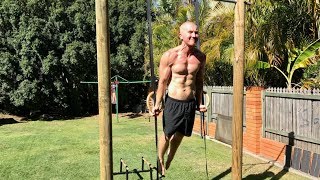
Daniel demonstrates a 30-minute backyard workout with gymnastic rings, a pull-up bar, and a stick. He does 5 sets of ring dips supersetted with bar push-ups, handstand holds, and ring rows with lunges, explaining how rings develop shoulder stabilizers and mobility work improves range of motion.
Chapters
Whoa, never done this before, so hopefully it's working. You probably noticed I've had a shaved head since my last video upload. I think I've shaved off a few seconds off my 100-meter dash time. But what are we doing? What's the purpose of this? Well, I usually livestream on Twitch. I've done some workouts there, but I thought I'd try YouTube, see what it's— I don't know, see how it goes. And I don't know how it'll work, because this is the first time I'm live streaming on YouTube, but we'll see how it, see how it turns out. So what am I doing? I've got the ring set up, I've got the, the bars set up, I've got the speaker kit going. Check it out. I've got the workout written down of what I want to do. We're going to do a backyard workout. So what's that say? It's back to front. We'll check that out in a bit. So we're going to do 30 minutes in the backyard because look at this day, look at it. There's no way I could go inside to a gym on a day like this. There's my crooked pull-up bar, my favorite tool for gymnastic rings. Well, gymnastic rings are my favorite tool. If you've seen my Instagram, you would have, uh, I don't know, seen me raved on about them a few times before. Here's my true supporter, Seven. And I'm not sure what the YouTube deal is with sounds playing in the background, so I've got some no copyright sounds off YouTube. I don't know if I can play actual music. I usually work out to music, but we'll just play this in the background for the time being. So, what's the workout? We're gonna do 30 minutes. We're gonna do 5 minutes of stretching. Got the stopwatch here. Stopwatch here on the iPad. We're gonna use this beautiful tool to stretch. Stick, broomstick you can buy from any hardware store for a few dollars. My favorite tool for upper body stretching at the moment. And so let's look at the workout. What do we have? 5x6 ring dips superseded with 5x10 bar push-ups, and then we have a break, and then 3x10 breath, 10 breath, 10 breath handstand hold. So I'm going to hold a handstand for 10 breaths slow breaths, then 3x10 bodyweight ring pulls superseded with 3x10 side stick lunges. I'll show you what they are in a minute. And then 1 minute rest in between sets, and we'll pay attention to the rest time on this stopwatch. So I'll try to talk in between rest sets and whatnot, but otherwise I'm just gonna— look at that— otherwise I'm just gonna go for it. I didn't put sunscreen on my head because it's so sunny. And I almost— I don't know, I don't want to get sunburnt. I look like a monk slash Avatar. Right, let's get into it. We'll start off with 5 minutes of stretching. Stopwatch. You know, as I said, the stick is my favorite upper body tool for stretching at the moment, along with elastic bands. Like, you can, uh, grab an elastic band, hang off the top, but I don't have one on me at the moment. So what can you do with the stick? And just, just play around with it. Just get the shoulders warmed up, shoulders rotating, because the rings, when you get on the rings, they're going to put a lot of pressure on shoulders. So go up, down. I like to do this, I know, probably at least 20 each side, just back and forth. You know, since I started the gymnastic rings, my shoulders have been incredible. I used to have a lot of shoulder pain when I first started out using, um, using barbells and dumbbells and whatnot. But after getting into the gymnastic rings, of course the start was incredibly hard, uh, but after, after I used them for a while, it it got so much better. Like, everything went up. My bench press went up, my overhead press went up. I could— my shoulder no longer got sore after certain types of workouts just because the rings work on each of the little stabilizer muscles in the shoulders that are, uh, exercises like bench press and overhead press don't, don't really get at as much. So I think if you— if I could choose one tool to use on its own, it would be the rings, but with using the rings alongside things like the bench press and other barbell work, you'll be able to— you'll build a strong, good-looking upper body physique. And even if you don't have rings, you can use stuff like the parallel bars that I've got at the back there, which I'm going to be using for push-ups as well. Or you could even just do push-ups with some weight on your back. Get someone to sit on your back if you're that strong. I can't do that yet. Rotations. Before I started stretching with the stick, I could, I could barely rotate back like that. And as you get closer in, it gets harder and harder. So if I go back like this, I can't go back, but if I go out a few inches, we can go back. So the idea is gradually like it's what they do in gymnastics training. They get closer and closer. You'll see gymnasts, they'll have massively developed upper bodies, but they can still go all the way back with the stick because in gymnastics training, I'm no gymnastics coach, but from what I've heard, they focus on the ball joints, which is your hip and your shoulder, and really work on getting that ball joint strong. For the different gymnastics movements. Obviously you've got the flips and you've got the rings and you've got the, I don't know, the horse and you're doing a lot of rotation stuff. Whereas in what I've done in the past with bodybuilding and whatnot, we sort of focus on, what are they called, the hinge joints, like the elbow and the knee and the up and down with the squat and the up and down with the bench press and the overhead press. Sort of neglect those ball joints and they get incredibly tight. I've got massively tight hips because of it. And by the way, I'm not sure if all this is registering. I'll have to check my mic. I should have tested this stream before I started, but I'm going to keep it going regardless. See how it turns out and possibly do more in the future if it goes well, if it works. Otherwise, I've used Twitch in the past and Twitch works. Relatively simply. Simply? Simply? Is that a word? Is that a word? If you want to check out my Twitch, it's twitch.tv/mrdburke. My Instagram is also @mrdburke. So this is another one I like to do with the stick. So you're going to grab behind the stick— well, behind your back, sorry. With this arm, grab the stick, and with your top arm, you're going to pull up. So see see how I go down and pull up. And when I pull up here, the stretch comes down along the front, front side of the shoulder, front side of the delt. And I always get it mixed up. I'm not sure if it's posterior, anterior, or what you want to call it, delt. I just call it front, side, rear. And that's your shoulder, by the way, made up of 3, 3 major muscle groups as well as a lot of smaller muscle groups. I don't know the anatomy that well, If I was to improve on one thing in terms of my knowledge of the body, it would probably be anatomy. Because when you know something, you can describe it better. Does that make sense? When you know the name of something, you can describe it better. Say, for example, if you went to the physio and you had an injury, you'd go, "Well, it's in my posterior delt something something something," and the physio would understand where you're coming from and they could help you out. So that's been about 5 minutes. That's the stick. Do some warm-up rotations back and forth, each shoulder, left and right. And then stretching out the front delts. Oh, you can even make it— this stretch even better by going forward like this. So after years of bodybuilding, my shoulders, especially my front, front delt, it's extremely tight. So I can't touch my, my hands behind my back properly. I try to do this, but my shoulders hold me out. And I can't do this either, grab back together. But I'm slowly working on it. So now let's get into some workouts. What do we got first? We have 5 times ring dips. So we're going to do 5 sets of ring dips, or 6, 6 reps per set, and supersetting that with 5 times 10 bar push-ups. So we go rings and then straight into the parallel bars, uh, for dips followed by some push-ups. We'll turn the music up, um, while this is going, and I'll, I'll talk to you in the rest. So now we go 1 minute rest time. It's warmer than I thought out here. Already starting to work up a sweat, and I was just in stretching. It's just turned spring here. So we go 1 minute rest. What do we have? A few minutes over the stretching time, but that's alright. So once it's about 8 and a half minutes on my stopwatch, get back in for another set. I'll show you quickly how I grip the rings. So when you grab this ring, I grab from the top, from the upper, lock the hand in there, and then rotate down. So it sort of locks your wrist in there. And then if you imagine, if I did that, I'm holding my phone here so I can't do the other one. If you did that on the other side, lock it in, and then when you get up here, your wrist is in a locked position. I don't know, maybe you could just go straight from here, but I like to, I don't know, I like the rotation. It feels good. So we'll get back into it. This is set number 2. You notice at the top I'm like flaring my arms out like this. That makes it a lot harder. My chest is sore than I thought. That superset with the— with the— whoa! Never done this before, so hopefully it's working. You probably noticed I've had a shaved head since my last video upload. I think I've shaved off a few seconds off my 100-meter dash time. But what are we doing? What's the purpose of this? Well, I usually livestream on Twitch. I've done some workouts there, but I thought I'd try YouTube, see what it's— I don't know, see how it goes. And I don't know how it'll work because this is the first time I'm livestreaming on YouTube, but we'll see how it turns out. So what am I doing? I've got the ring set up, I've got the, the bars set up, I've got the speaker kit going. Check it out. I've got the workout written down of what I want to do. We're going to do a backyard workout. So what's that say? It's back to front. We'll check that out in a bit. So we're going to do 30 minutes in the backyard because look at this, look at it. There's no way I could go inside to a gym. On a day like this. There's my crooked pull-up bar, my favorite tool for gymnastic rings. Well, rings are my favorite tool. If you've seen my Instagram, you would have, uh, I don't know, seen me raved on about them a few times before. Here's my, my true supporter, Seven. And I'm not sure what the YouTube, uh, deal is with, uh, sounds playing in the background, so I've got some no copyright sounds. Whoa, never done this before, so hopefully it's working. You probably noticed I've had a shaved head since my last video upload. I think I've shaved off a few seconds off my 100-meter dash time. But what are we doing? What's the purpose of this? Well, I usually livestream on Twitch. I've done some workouts there, but I thought I'd try YouTube, see what it's— I don't know, see how it goes. And I don't know how it'll work because this is the first time I'm livestreaming on YouTube. But we'll see how it turns out. So what am I doing? I've got the ring set up, I've got the bars set up, I've got the speaker kit going. Check it out. I've got the workout written down of what I want to do. We're going to do a backyard workout. So what's that say? It's back to front. We'll check that out in a bit. So we're going to do 30 minutes in the backyard because look at this day, look at it. There's no way I could go inside to a gym on a day like this. There's my crooked pull-up bar, my favorite tool for the gymnastic rings. Well, gymnastic rings are my favorite tool. If you've seen my Instagram, you would have, uh, I don't know, seen me raved on about them a few times before. Here's my true supporter, Seven. And I'm not sure what the YouTube deal is with, uh, sounds playing in the background, so I've got some no copyright sounds off off YouTube. I don't know if I can play actual music. I usually work out to music, but we'll just play this in the background for the time being. So what's the workout? We're gonna do 30 minutes. We're gonna do 5 minutes of stretching. Got the stopwatch here, stopwatch here on the iPad. We're going to use this beautiful tool to stretch, stick, broomstick. You can buy from any hardware store for a few dollars. My favorite tool for upper body stretching at the moment. And so let's look at the workout. What do we have? 5x6 ring dips superseded with 5x10 bar push-ups, and then we have a break, and then 3x10 breath, 10 breath, 10 breath handstand hold. So I'm going to hold a handstand for 10 breaths, slow breaths. Then 3x10 bodyweight ring pulls superseded with 3x10 side stick lunges. I'll show you what they are in a minute. And then 1 minute rest in between sets. And we'll pay attention to the rest time on this stopwatch. So I'll try talk in between rest sets and whatnot, but otherwise I'm just gonna— look at that— otherwise I'm just gonna go for it. I had to put sunscreen on my head because it's so sunny and I almost— I don't know, I don't want to get sunburnt. I look like a monk/Avatar. Right, let's get into it. We'll start off with 5 minutes of stretching. Stopwatch. You know, as I said, the stick is my favorite upper body tool for stretching at the moment, along with elastic bands. Like, you can grab an elastic band, hang off the top, but I don't have one on me at the moment. So what can you do with the stick? Just, just play around with it, just get the shoulders warmed up, shoulders rotating, because the rings, when you get on the rings, they're going to put a lot of pressure on shoulders. So go up, down. I like to do this, I know, probably at least 20 each side, just back and forth. You know, since I started the gymnastic rings, my shoulders have been incredible. I used to have a lot of shoulder pain when I first started out using, um, using barbells and dumbbells and whatnot. But after getting into the gymnastic rings, of course the start was incredibly hard, uh, but after, after I used them for a while, it, it got so much better. Like, everything went up. My bench press went up, my overhead press went up. I could— my shoulder no longer got sore after certain types of workouts just because the rings work on each of the little stabilizer muscles in the shoulders. That are exercises like bench press and overhead press don't really get out as much. So I think if I could choose one tool to use on its own, it would be the rings. But with using the rings alongside things like the bench press and other barbell work, you'll build a strong, good-looking upper body physique. And even if you don't have rings, you can use stuff like the parallel bars that I've got at the back there, which I'm going to be using for push-ups as well. Or you could even just do— 6. Done! 5 sets. All right, so we can mark this off. We've done 5 sets, 5 sets of ring dips, tick. Supersetted with bar push-ups. We did fail on this last one, we only got 5 reps instead of 6, but that's okay. We're gonna go into— have a 1-minute rest. What do we got? We'll say we'll go at about 17:30. We're trying to get this all done in half an hour, remember. So, 1-minute rest. I've got 3 times 10 breath handstand holds. Now, I'm not sure where the angle would be best for this, to film this, but I'll do my best. Um, maybe I'll put it against the fence and that'll be able to see it. But essentially what I'm going to do is— see this pole? I'm going to do a handstand here, lean my body against the pole, and just hold it for 10 breaths. Now this will count— 2 breaths, alright? So 1 cycle, but count that as 2 breaths. So essentially 5 cycles. We're going to do 3 sets of that with about a minute in between. So let's see how this setup goes. If I could get up. You got to get up first. My whole upper body is fatigued. We'll get there. So for this one, I like to remind myself to suck my belly button into my lower back. That's 6. 8, 10. Been trying to work on my handstand, so I figured at least— oh, you get the blood rush when you stand back up. You get the blood rush back to your head. So I figured if I can practice just holding it for 10 seconds at a time, that will eventually lead to me being able to hold a handstand without the support of one of these here poles all the time. So about another 30 seconds or so rest, I'll get in and do set 2 of the handstand hold. There's another thing I need to work on as well, is handstand push-ups. I like to be able to do My goal, muscle-ups on the rings and handstand push-ups, uh, not against anything, so just in free zone, free roam, free roam handstand, because that's cool. Being able to walk on your hands, that's some monkey see monkey do stuff right there, baby. What am I saying? All this blood's rushing to my head. All right, we're getting to set 2. Hopefully I can get up a bit better this time. 2. 4, 6, 8. Woo! Getting a bit shaky on that one. That's good, that's what we want, that means you're growing. Once you get sore, that's the growth, that's where the growth happens. So that's the idea. What you want to do in workouts is break down the muscle in such a way that, not to destroy it, but to just tear it down. Because essentially What muscle is, is just a combination of a whole bunch of little strings that make muscle fibers. That's why you see people get really lean, they get all stringy and look grainy, that's the effect. So when you're working out muscles, when you're putting them under tension, you're essentially breaking each of these little strings. Imagine it like a piano, and you're going through and you're cutting, cutting each of those strings. And what the recovery process does is when you're resting, when you're sleeping, when you're eating, when you're doing anything but working out, your body is working on repairing those little cuts and scratches that it makes in the muscles. So essentially, all the muscle tissue you build, or you're working on, you build all the stuff that's more than what you, I don't know, would naturally have if you didn't work out, is essentially could be considered as scar tissue because it's just the body repairing itself. So we'll get into set 3. This will be the final one for handstands, and then we'll get in the final superset, and then we'll be done. That's good. 3 handstand holds for 10 breaths. 1, 2, 5 breath cycles. We'll cross that off. We got bodyweight ring pulls superseded with side stick lunges, so I'll show you what these are with the stick. Another great reason to get a stick. But we've got to lower the rings to do these bodyweight ring pulls. So we're going to lower the rings down to about here so that I can hold off them and do like essentially, essentially a bodyweight row. Oh, sorry, I bent— I bent over row. Oh, it's just my body weight. Get them down nice and low. So this is the beauty of the rings. Not only are they good for shoulder, chest, tricep development. They're really adjustable. It can be used for whole body except for maybe legs, right? You don't want to— I know you don't want to be getting your legs involved in these too much. So we'll go— what are we going to do? Going to superset, superset the bodyweight ring pulls. I'll show you what they are. And follow them up with some, some sidestep lunges with the stick, and that'll be it. 3 sets of this. So essentially, with the side step lunges with the stick, I'm going to just be dropping the stick to each side and going to be lunging down to pick it up. Okay. 5 reps each leg, total of 10 reps. So that's really good. Side step lunges. We'll give that a minute rest or so. Side step lunges. I've need something I also need to work on alongside with the rings. It's only the last, I don't know, I would say 6 months or so that I've really focused on the ball joints of my body. Shoulders being with the rings, uh, with the rotation with the stick, and hips being with the things like sidestep lunges, um, stretching. I can't think of other things on the fly at the moment, but essentially what years of squatting up and down did for me was it did, it built some great legs. I built some big legs, some big strong legs. But when it comes to sort of movements that involve any kind of sidewards movement or any kind of, I don't know, deep, deep lunge, it's, I would say a combination of the excess muscle mass and a combination of tight hips and a combination of me not doing the right form. Has led to, I don't know, me being lacking in those sort of range of movements. So when I went and tried jiu-jitsu or dancing or something like that, I'd find I'd be let down by my lack of ankle mobility and lack of hip mobility. So that's been something I've been trying to focus on by doing things like sidestep lunges and other various stretches. I'll show you some in a second, actually. So I'm going to try a different angle this time for the rows. Let's see how this goes. I think that'll be better. Get the lunges here as well. So essentially just grabbing the stick, letting it fall— well, letting it fall side to side and then lunging down to pick it up as it falls down. Trust me, this doesn't seem like that much of a hard drill, but you add the reps up over time and it gets harder. I lost count paying too much attention to myself on camera, not being in the workout. We'll go 3 more. A lot of this stuff is from Ido Portal. If you've never seen him before, check him out on YouTube. His Instagram is also really cool, you can check him out. I think it's— if you go Go IDO Portal, P-O-R-T-A-L. And my stream's letting me know I've got a very bad connection, probably because I'm outside and Wi-Fi doesn't reach very far out here. Um, but we've got one more set left. The time is going just a bit over 30 minutes. Well, going to go over 30 minutes, probably because I've been talking too much. But we'll finish this off and that'll be it for the backyard workout. So let's go, we'll see what the angle is like from here. Oh, that's not bad. Watch out, 7, watch out. So we're letting the, letting the stick fall, lunge side to side, last set. And that is it. 30 minutes of fun in the sun. Get the body moving, get a chest pump while you're at it, get a shoulder pump, get a tricep pump. Whole body pump pretty much, this one, with the— between the, the parallel bars, the ring dips and the ring pulls. Could have even done some pull-ups as well. And of course, the $3 stick, invaluable. So that's it, guys. First time livestream on YouTube. Tell me what you think in the comments. Tell me what you think, if I can improve, I don't know, my form or technique or something like that. If you ever do, I don't know, some sort of backyard workout, link it in the comments. I'd love to check it out. I like to do backyard workouts every now and then because being in the gym in the aircon and people with their headphones on, there's no way I was time. And plus, getting some vitamin D, getting some sun into you, getting some time in nature, spending some time around some beautiful animals like this, it's good for the soul. So I'm gonna go eat and then take a nap and then get back into coding. Oh, by the way, I should have mentioned this whole thing was a break from coding. So if you haven't seen my channel before, I post videos on technology, fitness, and nutrition, and that's about it, and my adventures and whatnot. But otherwise, Thank you so much for tuning in. You can find everything else out at mrdburke.com, or my Instagram is @mrdburke, M-R-D-B-O-U-R-K-E. Love you all. Stay strong.
More from Daniel

Small Language Models (SLMs) Are the Future: Fine-Tuning AI That Runs on Your iPhone

Introducing Sunny - A MedGemma-Powered Skin Health Tracking App (Kaggle Competition Entry)


Benchmarking: NVIDIA DGX Spark & NVIDIA RTX 4090 | Part 4 - Comparing the results

Benchmarking: NVIDIA DGX Spark & NVIDIA RTX 4090 | Part 3 - Running LLMs on the RTX 4090

Benchmarking: NVIDIA DGX Spark & NVIDIA RTX 4090 | Part 2 - Formalizing the tests

Benchmarking: NVIDIA DGX Spark & NVIDIA RTX 4090 | Part 1 - Creating a series of tests


Local Multimodal RAG on the NVIDIA DGX Spark | Part 4 - Publishing our demo to Hugging Face


Local Multimodal RAG on the NVIDIA DGX Spark | Part 3 - Putting it all together