BJJ White Belt Competition - How I won my first competition (with commentary)
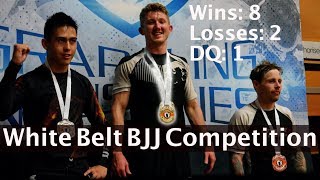
In this 20‑minute YouTube commentary, Daniel Bourke and his training partner Dave Liefeld watch and dissect the 11 matches they fought at the Grappling Industries white‑belt tournament on the Gold Coast in October 2019. They begin by recounting how they started training at Infinity BJJ Sandgate in 2018, their rapid progress, and the decision to film the competition. The video walks through each gi and no‑gi roll, explaining the tournament’s format (single‑round 5‑minute matches for white belts, point scoring for dominant positions, submissions, and reset rules). For each roll they identify key techniques—single‑leg takedowns, foot locks, arm‑bars, guillotines, kimuras, triangles, and baseball‑chokes—describe the positions, point outcomes, and why certain actions earned or lost points. They also discuss the impact of fitness, grip fighting, and the slippery nature of no‑gi. Throughout they share tactical takeaways (prioritising takedowns, managing energy, using the white‑belt mindset to stay calm) and broader life lessons such as staying calm under pressure, learning from failure, and treating every day as a “white‑belt” learning opportunity. The commentary ends with reflections on their medals (silver in gi, gold in no‑gi), future training plans (Iron‑man rolls, upcoming Halloween event), and the belief that BJJ is a lifelong practice.
Chapters
Sorry, man, I just couldn't hear you.
All right, hello everyone, Daniel Bourke here. I've got my arch nemesis and best friend here.
Hi guys, I'm Dave Liefeld.
Drop! And so what we're going to do today is, well, okay, long story short, we've been doing jiu-jitsu and I'm probably going to take these off because because that's gonna get very annoying very quickly. But we've been doing jiu-jitsu for the past year or so. It was actually earlier this month in 2018, it's 2019 now, that we signed up to our local jiu-jitsu gym that opened up down the street, Infinity BJJ Sandgate, with Coach Robbie. We had our first session and since then we've been basically addicted.
Yeah, it's been a, uh, it's been a totally new learning curve and I think we're both addicted to the the new challenge, something shiny comes up and we're like, boom, let's get into it. And surprisingly for me, I've actually stuck to it for the past year instead of being distracted by something else that's new. So I think that speaks volumes for how much more I've enjoyed it. I'm sure you as well.
Yeah, I wrote an article the other day saying some of the life lessons I've learned from it.
A lot of—
I know, I think you can get it from almost any difficult physical exercise, but there's— for some reason, jiu-jitsu has just really spoken to us. We've worked out together for, for years beforehand And now doing jiu-jitsu for the past year, it's just totally changed our perspective on, on what we want to do going forward in terms of being physically active, mentally active, because that's all a part of it, right? It's like you're doing— there's a saying, it's like jiu-jitsu is high-level problem solving with dire consequences. And one of the beautiful things is it's, it's hard to really worry about small things when you're trying to prevent someone from choking you out.
Definitely. So over the past year, between all the guys who we sort of started training with, we've done a couple of competitions. And pretty much in recent times— yeah, clackety clack— in recent times, we've decided to start filming a little bit more of it and probably start sort of documenting a little bit more is probably the right word for it. So over the last competition that we did, which was the Grappling Industries Grappling Industries.
Yep.
Uh, at the Gold Coast in— well, it's pretty much just over a year of all we've been training. So in October 2019, we all filmed all of our fights, and what we wanted to do today is film a bit of a video where we sort of watch the fights and just analyze it, have a bit of a yarn over the top of it.
Yeah.
So that's what we're going to do. That's pretty much it.
Yeah. Well, important thing to note is I think the progress has been phenomenal. Like, these— look, at the end of the day, these are, these are nice to haves, not need to have. Like, the progress is more fun just, just This competition that we're about to show was just one day. Like, the whole year was, was more fun, the training leading up to it, etc., etc. But it's kind of cool to see, see the progress of what, how much can change in a year. Our first competition was 6 weeks after we started up, and we lost all our fights. Oh, I won one, you lost.
Yeah.
And then since then, you've done what, 2 or 3 more? One place on the podium. I remember I After my first competition, I looked at the podium like, wow, that would be hard. And lo and behold, after this one, I made it there. So exciting. Yeah, that's enough blathering from us. Um, we're going to go through the gi rolls first. I was in the 66 to 70 kilo division, and then we'll go through no gi.
How many fights were there in total?
I had, I had 11 rolls in total, but we've only recorded 10, so I think 4 gi and 6 no gi. Sweet, let's jump in, get into it. And some of them, some of them aren't from the very start, like they just start sporadically because my brother was trying to film like 4 of us competing at the same time.
Shout out to you, Wham, that was awesome, mate.
Thanks, Wham. So this first one is no gi. I mean, sorry, maybe I'm still recovering. Or maybe we should, maybe we should explain how it starts. Yeah, let's do that. So before we get into a fight, here's how it starts.
All right, so you both basically, uh, you're waiting for your name to come up on a TV screen, and the mats— the— let's backtrack a bit. So all the fights, they're only one round and they go for 5 minutes for anyone, uh, brown belt and below. The black belt matches go for 15.
Yeah, it increases as your belt goes up. So we all start— you'll start at white belt. As your belt goes up, the time your match goes up as well.
So, basically, the way that you win a roll is you win on points, so for having a dominant position, or you win by submission, which is where you get the opponent to tap because they're in a compromised position where your arm's going to get snapped off, or you get choked and you can't breathe, something like that.
Like a joint lock, or, yeah, or a choke.
Yeah. So, basically, you'll start the roll. The referee will call you both forward. You sort of come onto the mat, shake hands with everyone, you know, your sort of etiquette. And then the ref will shout— well, shout—
yeah, "Kombate!" 5, 4, 3, 2, 1. Okay, and we're back. All right, so we had to fix up some audio here. We just left off saying the ref is, uh, just said "Kombate!" And so what we've done is we started standing, we've walked into each other, and now because jiu-jitsu is a ground-based martial art, We're trying to take each other to the ground. So this little process here where we're like grabbing each other's collars is called rip fighting. See, we just went off the mat there. The fight area is like that little gray part, that little gray square. So if we go outside of that little arena, the ref's going to stop it, pull us back into the middle of the mat.
Something else you guys will see is you can kind of tell the rank of your opponent even within— so you've got just— you can tell the rank of your opponent by the color of their belts. Obviously, this is a white belt only competition so that you're all of sort of similar, uh, skill level. But within a belt, you've also got rankings and you've got stripes on your belt, uh, and the more stripes you have, the closer you are to the next rank, if your gym gives out stripes. Not all gyms do. But, uh, I think your opponent has 4 stripes here. So is it 4 is the max before you go?
Yeah, 4 dead. So you'll have a white belt with then a stripe. Once you get to 4, after you get your next stripe, you go blue belt. So what we're doing here is he's got top position at the moment, I'm on the bottom, and there we go. So I'm trying to roll onto the top of him. Let's see here, we went out of bounds. I just got the good position, but because the ref saw we went out of bounds, we got reset.
And I think because you didn't hold it for a certain amount of time, he'll reset you— does he reset you standing?
Yeah, yeah. Some—
I'm still trying to get my head around some of the reset rules. I think if you haven't, um—
oh, we got the legs! Beautiful.
Haven't kept it for a, uh, a long enough period of time, you go out of bounds, they just reset you standing again, or the previous position.
So I think I took him down here again. So basically the point system, it works off two, two kind of ways to win a match. Is the point system or the submission system. Here I was going for the armbar, but he defended that. Well done. And now I was getting him in guard. In guard means that I've got him wrapped around, as you can see. So I'm using my legs to block him from getting to me.
The idea there is pretty much— it's— it is a very defensive position because it stops the opponent from being able to pass and get up and get on top of you. But it also gives you heaps of opportunities for, uh, attacks as well, which is what I'm about to go for here.
I remember trying to get this and I'm like, how's his arm— how's he not tapping?
Massive.
So I didn't have a good enough grip here, I think. What I'm trying to do is essentially bend his elbow, bend his arm or shoulder to a point that it hurts, and so he taps for submission.
I think what you had to do there was get your right arm through his arm and grab your wrist.
Yeah, watching this back, that's probably why. Yeah, yeah, I need to try it.
You were— you should have been pushing. If you're going to hold those weird sort of grips, you should have been pushing on his elbow.
Yeah, yeah, because that would have been— I needed to figure four my own arms here. And so we're back, back to like two ways to win. One is submission or through points. Points get given basically whoever has the most control. So control would be he's on top of me, I'm on top of him, I've got his back, or he's got my back, or something like that.
Or you've got your knee into their belly and you've sort of got them pinned there.
Now here I'm trying to get a baseball choke on, so that means I'm grabbing the collar, twisting around.
It's kind of hard to see in the video, but it looks like he's almost lying on top of Dan, but actually, um, underneath.
I had my hands around his neck and was trying to choke him out. But then once I had it on, we get reset again, we get taken back to the middle.
Having a breather, mate?
No, no, this is pretty good actually. I think he was having a breather because I just, uh, look, put it this way, he was struggling to breathe until the ref had to reset us.
I thought you were going to get him there.
I did too.
We're all watching off to the side.
Yeah, the crew are all on the left. See, this is the fun thing about it, right? It's like your friends going to battle. It's like old times, Roman Colosseum. You're watching your friend go to war and you're watching on the sideline. There you are, mate.
Good work, Bruce.
So now we're back standing again, trying to get each other to the ground. I remember I could feel him tiring out. See, I'm pretty fit. So that's kind of like one of my strengths, is that, uh, once people get tired, I can take advantage of that. And so I'm like, good, I'm just going to go harder. And this is where I was reaching in for the grip again. I knew, like, getting him to the ground, it was being a bit of a pain in the ass. So what I was trying to do here was reach inside the collar and get another baseball grip choke. So essentially just grab my arms around his neck And then I was like, that was awesome, take him down. Nice. So this is, he's on top of me, but I landed with my hands around his neck. Yeah.
And I'm trying to pull down, but he's trying to stay back to stop Dan from pulling him over his body, because if he does that, he's got full, um, full leverage.
So you can't— I don't know if you can hear this, but from where I was, he's breathing like this. So I was cutting the air off But it didn't get fully on because my hands were too far apart, so he survived it. There we go. And now he's in side control, which means he's to my side and on top of me. So he's got a better position than me at the moment. So now it's my goal— I think the fight's almost over here— it's my goal to try and get out, but it's in his best interest to, uh, to stay on top of me, stay in control. He's holding on for dear life here. Yeah, I should be used to getting out of this position by now with you, mate.
We're looking for a triangle here.
Yeah, yeah, but he was just holding on for dear life. And so what, what— and this is the end of the fight. Oh, you're just like, no, I nearly walked off.
The rush is insane, so your brain doesn't function properly.
And you can't see the scoreboard here, but this fight finished off 3-2. Um, so I'll be honest, like, with myself, like, I, I think I fought the more entertaining fight because I was trying to put on more submissions, but end of the day, I didn't get them, so he won.
Rulebook's there for a reason, hey? It is a sport. So in real life, you know, if it was a fight you probably would have come out, you would have kept attacking him and come out on top because eventually you would have got one.
Yeah. And so now that was, uh, that was roll 1, roll 1 out of 11 or something for the day. Let's get into roll 2. Say that again. So we're starting here again, going to the same place.
Down we go.
I took him down with a single leg takedown, so at the moment I just got points there for taking him to the ground. So what's going through my head right now is he's trying to get— he's trying to pull me down and get guard, but I'm letting him move his foot around my waist. See, I'm fishing in there. I got his foot, right foot with his— no, his left foot with my right arm. So I'm holding it in. Now we've rolled to the ground. You can't really see this, but I've got his leg secured under my right arm, trying to put the foot lock on, and he's trying to defend. His defense here is to stay close to me. So I've got his right foot. I'm about to— I'm trying to straighten his heel, or he's shaking a lot. And so there, he submitted. So that's what I was— this was actually a pretty quick one. This was what, 40-odd seconds? So if we go back, I'll show you the point. We'll just freeze frame it there. So as you can see, yeah, I wanted him— I was— this is the thought process going through my head, is I took him to the ground, and because I like to do foot locks, my thought process is, okay, I'm gonna let him think that he's getting an advantage here by placing his feet on my hips and keeping the distance. But then I let that foot, which is his left foot— it's kind of hard to, to Daniel, go through so my right arm could secure it. So now I'm holding my right arm like this, holding on to my gi. And so when I take him down, I've got that right— left foot, sorry, very well secured. And then when we hit the ground is where I'm leaning back, is where that submission comes in, is where he's trying to defend. You can't really see it, but long story short, where do we go? Probably from here. Long story short is I've got his foot in here and what I'm doing is just straightening it.
So you can imagine the top of the foot is being expanded, just gets pulled back.
Yeah, so that's it, your bit of your signature movement, especially through this competition. So that's, yeah, fight 2. So now I'm 1-1, 1 loss, 1 win. Okay, so this one you'll see right from the start Shake hands, fist bump at the start.
Mr. Elusive left-hander up there. Yeah, pulls guard.
I haven't watched any of these back.
That's good.
So here I'm going for the same lock again, the foot lock, but, uh, this guy's managed to get out of it. I didn't get on as tight.
He's a lot faster on his feet than the, um, the other two fellas.
So right now I've got it. What's that? That's half guard. No, I've got him in full guard actually. So I've got him in full guard. What I'm doing is I'm just taking it easy at the moment now because we're kind of in a, in a stalemate position. So what I was doing here is I'm remembering like thought pattern now is I'm just like, I'm gonna hold him here until he makes a move, hopefully grab one of these arms and put him in some kind of arm lock. So there you see on the left side I'm trying to block his right arm with my left leg. Oh, this is where I was attempting to do an armbar, didn't get it on fully because his elbow wasn't deep enough. So I'm kind of trying to hold on here, but then I realized, no, I don't have it, I'm going to give up and take top position.
So basically now Dan's trying to get past his knees. Because if you've still got a leg in, it's hard to really have control and you don't get any points for it.
Yeah, that's what I needed to do, is clear that leg. But again, here you can see me, I'm trying to get my right arm— oh, I was trying to go for the foot lock there. That's all right. I fell over. I was trying to do a spinning armbar.
That's all right, working, working.
Look at that sick mobile. Right now you've got a good chance to isolate the arm, but my kimura isn't good. So yeah, what Dave's saying is that arm that you can see closest to us of his, I can potentially isolate that, but I'm not very good at that type of submission. That was a knee ride. I put my knee in his chest. So now—
oh, oh, you were saying you were trying to take his back then.
Another one. So right now I'm just trying to throw on arm bars left, right, and center here.
Man, you do a heap of, um, like, submission attempts.
Yeah, so that's my style, is, uh, just my technique's not good, but I have— well, not— it's better than when I started, put it that way. But, um, I do have a high level of fitness and speed, so a lot of my technique style is just attacking. Here I'm trying to get the triangle, but he's doing a good job at posturing. So if I got my feet tight there, he was gone. What I needed to do was move my shin onto— oh, I was actually close to a triangle here. You can hear his ref coaching him out of it. And then I realize—
then you went for the chok nose.
I could not— another triangle here. Wow. Nah, not really, just some sort of head grip. Now we're in north-south.
To a lot of people, mate, who have never watched this before, it looks like just a lot of lying around. And lying on top of each other, but I promise you, if you've never tried it, there's— it's a totally new type of fitness.
Yeah, it's crazy.
Even being on the bottom is insane. Yeah, it's draining.
So here we go. I'm doing a similar move to what I was trying to do before, is isolate a foot and get it stuck under my right arm again. So now he's trying to block it with his legs, which he does a good job of.
So now Dan's got to get past— see how his leg's trapped between the two fellas? The fellas' two legs. Got to push that foot down, straight over to the side.
Yeah, that's what I'm just like, I don't know, it felt weird from the angle that I was looking at.
It just looked like it was about to snap it off, but you did fucking well.
So now we're kind of in a stalemate. We're just trying to fight the position, but I'm probably in the better one because I'm on top. There we go, get out.
Very good.
He's, uh, very technical though. He's strong.
He holds his strength from everywhere.
Yeah, very aggressive. That's his class. Coach William. So here we go, I've isolated the right leg. This is exactly what I want. You can see my right hand, I'm trying to grab my gi to strengthen my grip. And here we go, this is— I remember— there we go. So now I've got his foot stuck Yeah, once it basically— once it gets to that position, it's very hard for them to get their foot out. And this was, yeah, end of fight 3.
Well done, mate.
I think this is the one at the end when I come walking over to you.
Yeah, because I see you throw up the shuckers because I'm laughing over on the side. I've been tapped so many times by Berkey doing that bloody foot lock. Should get a tattoo on my ankle that has his name written on it.
Yeah, yeah, I think I—
I—
here we go, here's you.
Hey, just finished it off having a giggle.
So that was 3— what am I now? 2 and 1. 2 wins, 1 loss. Now we've got roll 4. Now this was, I think, um, my one before this. This is the final, so So I'd actually had a roll after that one you just saw, and this one is for the gold medal. And because at the— by this stage I'd won the other one, and so now I was 3-1. Yeah. And so I'm about to roll Tom, who I met on the day actually, real good guy. So shout out to Tom for, for the gold medal. So we actually missed footage of one roll. So you can just imagine the one before this. I won that one by guillotine submission.
That was a good one.
There we go, right from the start, tap hands, quick grips there.
Nice, getting back on top. This guy's pretty sturdy on his feet.
So I kind of overheard this, um, him with his team, like I think he'd seen all my rolls before, which means like he was watching me fight, so maybe kind of knew my stuff. All knew that I was going for foot locks, but it didn't really matter, um, because I— the way I sort of think about going into these things is, um, it's just another roll. Like, it's just— this is how we train. Dave and I train about this intensity at gym as often as we can, so when we go to competitions, it's no different.
Yeah, you guys get reset there. Did you feel strong?
Yeah, no stronger than other people in the division.
Yeah, yeah. Was there any highlights? Anyone who was super difficult?
To be honest, the whole time, I'll be like brutally honest, I never felt like in danger of anyone. Um, I think that's a testament to, to yourself, mate. I've been, uh, well, I hope so, man.
I've got about 20 kilos.
So yeah, right now I remember pulling his— the gi over his head, and then I'm like, yes, I'll get a leg. But then I think he— oh, there we go. So I would have got 2 points for that because I took him down. Thank you, ref. I remember pulling his gi over his head, and now he's trying to go for the kimura. But I remember just being strong enough to defend it with a single arm. There we go. And I was, I was planning on reversing the kimura here, actually, like getting on top of him. And if you've never heard of what a kimura is, it's basically just bend the shoulder in a way it's not supposed to. Yeah, bend it up like that. Eventually they tap. So now he's trying to pass me, and I remember distinctly he was going to get side control here, but I remember moving into the into the, the banner on purpose. Race the rule book. Yeah, cuz I knew we'd get reset. So I remember that was like a sneaky, uh, a trick from me. So the belt I've got on is just to differentiate us, uh, from each other so we know who's like, is It's like blue and red corner.
I need to work on what you just did then, like reaching out with your leg. You're too off balance. Not you in general, but just in general. Yeah, I always give him my leg. It reminded me.
So here we— I remember this one, we were spending a longer amount of time with this, like, it's grip fighting and wrestling, than I wanted to. Like, I wanted it to go to the ground. Because I knew I could, I could do well there.
But I think the good thing about that as well though is because you are so fit, you can afford to keep, keep grip fighting because it's very tiring. Yeah, trying to wrestle all the time because you— it's like when guys play footy, they go 100% all the time. With this, it feels very much the same. So if you can tie the opponent out, keep the fitness up, you're good. He's coming around. Oh, nice!
So I was trying to spin around. Oh, then he gets me inside control.
You were close.
So now he— yeah, now he has the dominant position, like he's lying on top of me, so he gets points here, I believe. Yeah, he'll definitely— he definitely got points for that.
And his goal here, unless he's super comfortable, is— there we go— coming across into what you call mount.
But—
and then weight was off.
I've got my leg, so my right leg, you can see there, I'm blocking him from getting on top of me. And now if he passes that leg, he gets more points. So I'm trying to prevent that at all costs. So that leg that I've got between mine, I don't want to let him get that control of that. So I'm holding on to his knee with my two legs. There we go, I lock my feet over. I'm not in a very good position right now, so like he has He has a lot more control, but that being said, I wasn't in, uh, like a threatening, like in terms of potential for submission position.
Yeah, he really has to pass that leg before he can be in complete control at the moment.
Oh, there we go. Oh, I don't think he actually gets— maybe he does. Oh yeah, there he gets some points. So because he's in mount— or maybe he didn't, did the ref—
you moved fast enough.
No, there we go. Okay, so he would have got 4 points, I think, for that, for mount. And so then we roll over, he's in back take, he's trying to choke me out here. But this is where I was trying to wrap his foot around. See, with my bottom leg, I'm trying to wrap it around that foot to hip out. There we go. And that's when I break his feet to get out. But then he gets into the mount, or almost doesn't get into mount. And again, I think I was trying to push us over to the side of the mat. Like, this is kind kind of where you have to play, uh, play with the rules like a bit, because I was trying to push him over the side of the mat so we'd have to get reset again because I didn't want to get letting him get that dominant position. I think this screen is getting extremely dark, so we'll fix that for the next one. Come on! So yeah, we're getting reset a few times here. Look at that six-pack though, I was pretty shredded for this.
What did you weigh?
I weighed in on the day at 68 kilos. I took him to the ground. I took each other to the ground, and that was it. End of the fight. And so I— you don't see it, but I lost this one. That was, uh, I need to fix this brightness, but, uh, long story short, I lost this 8-2. That was the points. And that was when I got the silver medal for the gi. Now we'll get into the no-gi, which is, if I'm honest, I prefer no-gi because it's easy. It's, you don't wear the big, big clothes thing with the extra grips.
What do you prefer? I think I actually really like gi because the choking aspect of it. Yeah, it's, um, it's something that you can only do if you know how to use the gi. Yeah, yeah, I think I enjoy that.
Beautiful. All right, no-gi time. We should be a bit more brighter now. Yeah, we're back. Ready for the no gi?
Lots more of them.
Yeah, I had 6 no gi rolls. Let's go into number 1. And yeah, really the only difference between this is the same rule set. It's just you wear, you don't wear a gi or a belt.
You basically just wear like compression gear. So like, yeah, you could do it in shorts.
You could do it in any clothes, but you want to keep it like loose. So you could even do no shirt if you want. Yeah.
There's nothing to grip onto.
So this one starts and we're already on the ground, so it's just because my brother was jumping between different fights. So we've done the whole kombatsch. I remember with this one I was dancing around trying to get— yeah, here we go— I was trying to get a foot lock. So that's that right arm— oh no, left arm.
I remember standing on the side here and listening to all the, um, Like the other guys who are in your division. Yeah, rolling off. He likes the feet.
I do, I'm a foot lock fiend. See, yeah, I was trying to set it up here. Here we go, I think. Oh no, he gets out. Something that's—
yeah, you're right, something that's really different about no-gi is it's super, super slippery, especially if you guys— oh, he already tapped once. Yeah, it's that twice. Super slippery because your sweat just like sticks on you, and, uh, it's very hard to hold like any grip even on the body, whereas with the gi it sort of absorbs it. So you just hold on to it.
So he definitely tapped twice. You can see that he tapped, go back. So now I've got his foot.
Watch the first one, and then you fall and roll over again.
I've had it on pretty tight here. He's in pain.
So tap, tap, tap.
It's easy, easy to miss though. But I remember too, I remember overhearing the people on the sideline. I think they'd watched some of my other fights. I think because he was part of a team, the guy I lost in the final to last time, um, he was part of his team. And I think they were watching that I got on, I think, 3 or 4 foot locks by this stage.
Yeah.
So that was match— no gi match 1. That was good because, yeah, that was my 5th roll of the day. So let me just— a little breakdown of what happens is, so I had the gi rolls and then there was about an hour and a half break. So we're just kind of walking around and watching other people fight. So we had a little bit of a rest. Um, but don't get me wrong, it's still like— you're still pretty tired by this stage.
Well, these— look at the timestamps, it's filmed between 2:30 PM and 6:20 PM.
Yeah, so like 4 hours, massive gaps. Yeah, yeah. Um, and in between rolls is where doing warm-ups, stretches, having food. You didn't even have much food. No. Um, so we've got nogi roll 2. So again, we've already done like the starting thing. This is right at the start, we're playing. Oh, you can see the outfit here is that, uh, we've got no gi on, no belt either. It's a lot more faster style. So basically I'm trying to get the foot here again.
I'm pretty sure this guy is the brother of the guy that, um, was in my comp. Oh really? Yeah, I think so.
So remember, just playing it safe here. I'm just stopping him from getting any kind of— or trying to stop him from getting any kind of advantage over me or getting points. So here we're just chilling out in guard.
It's actually really difficult to get out of someone's guard. So Dan has the guard, uh, his competitor is sitting inside his legs. It's actually really difficult to do that because you can't grip onto anything. It's like you can either sort of try and hold someone's hips or or like the tops of their arms, or you can pick them up and try and let them fall off because their core strength can't hold them. But, uh, I think your core strength is definitely up to the job.
I'm trying to get the armbar here, but I didn't have the elbow deep enough. No, you're right, man. If I get— if I get stuck in Dave's guard, which is like basically they have your legs wrapped around you and crossed over at the back, I have to wait till he makes a move, man.
He's attacking, trying to get a head and arm I remember being really calm during this one.
I think that's a big difference. How did you feel compared to like your first competition to this one?
Oh man, the first one felt like I was— it was kill or be killed, like, and really kill or be killed. You can still sort of emulate that feeling a bit, but yeah, it's like, you know, that you know, sort of— it's probably because you know what you're doing.
Yeah.
How many rolls do you reckon we've had, even just you and I, in the last year?
Probably 100 plus.
Oh yeah, at least probably once, 4 days a week.
Yeah, times a year.
Yeah, you definitely, uh, you find yourself pretty familiar with being in a position like this pretty quickly.
Yeah, so he's got his hand around my head and Maybe if you've never experienced that before, that'd probably be an uncomfortable position. But here I'm completely calm right now. So like I've got space, there's no chance he's going to get me. He could get me in a choke if he puts— oh, like there, but I got out.
So if he had his arm the other way— oh nice!
I tried to really lock that foot lock on quickly there. See a little bit of action.
He knows, he knows. He's trying to—
so we're off the mat here, we'll get reset, come back on. What's it like from a spectator point of view, man? What are you seeing when, uh, when you're watching your rolls?
Yeah, I think I'm probably more relating it to— I know exactly how— what the other guy's dealing with right now. As in, I know your speed. That's the big thing, speed and the feet.
Here, here I would have got some points, sorry to interrupt you, but as you can see, because I'm on top and past his legs, that means I'm in top mount. I get 4 points. He's— he did a good sweep just there. That's what I'm pretty bad at, because when I get on top, I'm, I'm not great at holding it.
And the reason why you're given points for, for being on the top position is because if you're in a fight, then you're in the prime position to be laying into someone. So you get points for being in that. Oh, you going to peel it?
No, I didn't go too far. That's all right, we came back. Come back up.
You guys are both pretty good at the scramble.
Yeah. So again, if you want, like, what, what that— what I'm doing with my head is I'm putting my head against his, so that's like kind of creating a certain amount of minimal space between us so that if he tries to do what I'm doing and reach the leg, he can't really do that. So I— the head is like gauging how much space we have between each other. There we go, shoot for the leg, then take it down.
Good takedown. And land straight in the—
no, well, I'm on the wrong side now. I was passing it.
Yeah, thank you.
I don't know if you can see on the back, but there's a scoreboard on I'm up here, 8-0. So I was just like, is that—
I, I looked at the scoreboard then. Was that the thumbs up? Yeah, go back. Let me go back.
And so he's got me, he's got his arm around my head, but I'm in a safe position.
I'm pretty sure I'm sitting where the camera is and I'm looking at you and I'm like, 5 seconds. Yeah, I'm just like, keep it there, mate, you're safe. Yeah, I think I'm pretty sure I'm actually shouting out, you're safe, you're safe, don't worry about it. Yeah.
So at that point I knew that I was up on points, so I was just like, I'm gonna ride this out and just, just, uh, win by points. Ideally I'm a submission dude, so I like to win by submission rather than just points. But, uh, when you get to that stage, yeah, 6 seconds left or something.
Did you hear my stomach just then?
No, was that your stomach? You are hungry, mate. You gotta Okay, so now we're up to Nogi Roll 3. Oh, this is interesting.
This was a good roll.
No, this is— this is the big one. I haven't seen this one.
The second one was great.
So this one, again, the start is a little bit shaky, but that's all right. Let's go. So I think the cameraman was just adjusting here.
He seems quite calm because the ref is getting in the way.
Yeah, here we go. I got the leg again, take him down. Oh, cameraman's changing angle, but essentially I landed with his arm around my neck, which is a similar position to what I was in before but probably a little bit worse. There, he thought I tapped. That's why he gave up. Well, I didn't tap. And then I go to reach the foot lock on again, except my top leg goes too far over, which I don't know—
go back, I want to see that again.
Yeah, let's read.
I haven't seen this.
And so he wasn't happy at the end of that match. So let's go back just to about here.
This is where—
so I've taken him down and my head is under his arm at the moment. It was tight, so you can see my arm come up there. He thought I tapped, but I didn't. I was like adjusting position, and so that's why he let go of everything.
Yeah, he's always—
so I dive on the foot block, but my leg, this top leg, up on his chest apparently passed the halfway mark. So that's when I get— I get disqualified here. And he wasn't happy. He thought I tapped.
Well, you know what the good thing about this is, mate? You got a second chance.
Yeah. Um, so that was my third match. I got disqualified. And then I had one literally right after this because my matches were scheduled for 4:52 PM and 4:57 PM. And so they were like, do you want to go again? Regulation says that you can like have a few minutes break, and I'm like, nah, that minute was— that match was only like a minute, so I'll just go straight into it. So this one was literally straight after.
Mate, I just saw as well, your bloody rash used to be tight on your arms. You've lost so much weight. I'm skinny. You're wearing a blanket. Yeah.
Okay, so this is the— I'm versing the same guy in the first in the first gi match in no-gi. So I, I got a few submission attempts on him in that first gi match, like the chokes. He won that, didn't he? Yeah, he won that.
Yeah, he won.
So I'd lost against this guy. Amen.
Amen.
So he's putting on this sweatband so they can tell us apart again, so that like the ref like scores sweatband. You can see the ref has a sweatband on his hand. Again, we're starting to wrestle, fight. I'd already gone against this guy, so I kind of knew what his style was.
Try and pull him down.
Yeah, basically that was my style. I was just like, I'm gonna go as hard as I can. What? Anytime I do need some dry— is it? Yeah, that's you in the background, mate, with the medal on. Oh, there's your two medals.
Look at it click.
Now we're just rolling around, and I'll be honest with you, once it gets to this stage, I'm getting pretty sick of being in this wrestle match. So I want to start diving for his feet or start taking him down, but this guy wouldn't put a leg forward, and I was looking for the single legs the whole time. So I'm starting to think maybe I just pull guard, which I did. Yes, Daniel!
Well, that's where we train from the most, is, you know, we're on the ground working moves.
Yeah.
But we have been doing more takedowns and stuff, and it's important. That's actually something— the biggest thing I took away from this competition was all the— a lot of the work is done when you're on your feet and taking them down. So if you can add that into your game, you'll get so much more.
So he got side control here. He would have got some points for that. So see how he's past my legs but on the side, but I'm not— again, I'm not in any compromised position. It's just him lying on top of me, and I'm used to being in this kind of position. So start to roll. Oh, I didn't know how close I was.
If you didn't let go of that, but that's all right.
I think I So now I'm— I've got one of his arms in between my legs and one of them outside. So my move here is to get the triangle tighter, which I do.
The legs closing.
There we go. Once that's on, now I'm pulling his head down to choke him out.
You can see the hand is fluttering.
Yeah, nice, nice. This is So what happened there was he— I had him locked up and basically his throat was being pushed against his own shoulder. I pulled his head in to make that close up the air gap so he couldn't breathe. So it was a rematch. Got, uh, got my revenge. There's the coach. Shout out to Coach Robbie. All right, let's go to roll 4. No, 5. So that was 4. So I'd won 2, I've been disqualified in 1, and I just won another. And so now this I think was for, um, the semi-final because yeah, you have 4 matches before you go on to the semi-final. I'm going against the guy I got disqualified against, so this was like our rematch. He thought he tapped me, but I got disqualified. I didn't realize— I thought I wasn't moving very fast in no-gi, but this is— I'm moving pretty quick. Like, we're dancing around a fair bit. As you can see, some of the mats in the background are being cleaned up. Oh, got a takedown. Looking for it. I was looking for his foot here. Yeah, you're right, but I didn't get inside control.
A bit premature.
That's all right. Oh yeah, see, nogi is very slippery.
You're racking up points here. Well, at least I haven't watched to see how long you really have. 2.
Yep. So every time you take someone down, you'll get points. So I just got 2 lots of points there, and I'm— my— in my head I'm thinking I'm just going to keep him on the ground.
You're very persistent.
So I'm, I'm holding his feet, so there's no chance he's going to be able to get up if I'm holding his feet. And what I'm searching for here is a foot lock, but here he's got—
oh, oh, oh, if he knew how to do it, that was his chance.
So he just got 2 points for that because he took me down. So now we're at 4-2. And he's trying to pass around my leg, but I'm keeping that far leg, my right leg, in against his hip so he can't get his legs around. Mate, I was even contemplating trying to bring this leg up for a rubber guard choke. Yeah, like bring that leg all the way up to his neck.
I'm just watching your knee thinking, yeah, he's almost asleep.
From me, take him to the left. See, look at this, I was trying to bring my leg up under his throat. That would have been a sick tap. He's working his way. So if he gets past that right leg of mine, which is— he's got his arm around, he's going to get points.
But he can't— the thing he's got to be careful of is his left arm. See how it's hanging behind? If he puts that through your legs then you've, um, got a triangle. Yeah, so it's a really— you gotta be picky.
I take him to deep half.
Look at his arm just begging to be Kimori.
I love this. We practice deep half and now I'm in deep half and I think I shoot out the back.
If you'd played a bit more with the, um, the weight.
Yeah, there we go. I shoot him out. Boom.
Would have been so sick if you kept your legs in and then took it back. Yeah, did the big push.
That's what I was hoping to do. So now again, I knew I was up on points because I had people on the sideline saying, hey, Dane, you're up on points, even though it's only 6-2. Oh, there we go.
Yeah, I think he got something to say.
Um, so my game plan here was to either get him by submission or keep him on the ground, because I knew I had another match after this if I won. So I didn't want to expend extreme amounts of energy, uh, only if it's completely necessary. What would you do here, mate? You're up on points, you got a minute left.
I think I had one roll that was very similar to this.
Yeah, yeah.
And again, it's not out of, um, the way I like to roll. It's because you've got rolls ahead of you, you can't be— you can't be gassed. Your forearms especially, I find. Yeah, especially in gi, because you're working all these grips, they just tire out. So quickly. It's like having a pump. It is like a pump.
Yeah, so what I'm doing here, I'm keeping my head against his to keep space, and I'm keeping my legs away so he can't grab my legs.
Just for him right now, for him to win, he has to either get 5 points at least. Yeah, or submit you. He's probably got what, 30 seconds left?
Yeah, so if he—
first, his first battle is to get you to the ground. I would have chopped my knee Yeah, well, I was contemplating that.
I'm like, how do I get to his back? I remember this, I'm like dancing with him, like, how do I get around to his back? See, he's throwing up some good— he's like being aggressive here. I'm like, oh, there we go, we can get a guillotine maybe.
Nothing. Sit back down.
Stay up, Daniel, stay up, stay up, stay up!
He had a few opportunities. This guy should learn leg locks.
So here I'm taking side control, or trying to. He's trying to get a guillotine there, and that's the game over. He wasn't happy.
Either not happy or extremely gassed.
One of the two.
Yeah, probably both.
Doesn't matter. One on points there. So I went to shake his hand. I don't know what happened after that. Maybe he wasn't— he was upset or something. That was the rematch. I think he might have still been upset from when he thought I tapped, but I didn't. So now we're up to the final, mate. No-gi final. This is 6 rolls straight of no-gi. So this is the same guy I versed in the gi final, so Tom.
Oh, I didn't realize it was you guys again.
Yeah. Boom, right from the start. Come on, come on! I was really excited for this one because I'm like, yes, get to do the rematch.
Well, they'd all gone pretty well so far.
Yeah, so again we're fighting for grips. I really don't like this. Oh, oh, oh, he would have got points there, but then I got him in guillotine.
That could have been a lot worse.
I had him I had him pretty damn tight in this. Look at that. Yeah, except he got to the side. Oh, actually, wow, still on. Oh, I was hoping to flatten him out. And he asked for that.
Yeah, but I think there was meant to be another—
I didn't get points for that.
No, you didn't get points for the mount. And then we were shouting at ref like, where's the points for the mount? And then he looks down and you're out of mount by the time he looks down and back up, and he's like, 'Oh, what are you talking about?' So now I dive over the top.
Yeah, I'm trying to stay on top here. I've got my arm around his neck. I'm trying to, trying to choke him out there, or at least distract him so he moves his legs and so I can get top as position.
He's doing— he can almost grab that arm.
Yeah, so he's going for kimura here, trying to bend my shoulder, and I remember defending it, thinking I'm going to reverse it as well. So I remember being strong enough to kind of defend this with one arm.
What's the reversal? That you flip over the top?
Yeah, so I take his arm and just sort of like that. So now I'm— yeah, there we go. If I held it onto there, maybe I could have got the reversal. Did I get points there?
No. I think something you could do differently there, instead of reaching over, is go for a crossface. Yeah, spread them out instead of— because he's on his side, his strong side, he's got your arm right there.
Yep. So now he's trying to get me in guillotine. I remember that being pretty tight actually, but Coach and I have been practicing in that one through the week, so I knew how to get out of that. Back on the feet, back on the headbutt.
Do your ears get sore after this?
Yeah, yeah, mine are still sore. Mine were tender. I don't want to get cauliflower ears.
Touch wood, it's the moneymaker, mate.
I'm too pretty for jiu-jitsu. So again here, same position as before, but I've got my left leg, the far leg, blocking his legs from getting around mine. And I'm trying to— I'm trying to isolate his arm and bring my leg up because I'm thinking maybe potential triangle here. But I remember he did well at getting past. Yeah, there we go. He almost— I think he almost gets me here, like in terms of passing my legs. Oh, there we go. I remember shoving my arm to his face so he didn't, uh, so he let go. Here I'm again trying to just isolate the arm, waiting for him to make a movement. I want to get one arm, so when they have two inside, it's hard to attack. Do it again. Dress is on the floor. Mora, you need to do that.
He's almost out.
Oh, there we go. That was a good pass from him. So here's the scramble. So basically I'm trying to stop him from getting control.
Oh, you're lucky he didn't catch your arm there.
I remember just, just saying to myself, keep moving, keep moving, man.
If you weren't so fast, you would have got your back there. Yeah, this guy knows where he's going.
It's good. I was literally saying in my head, keep moving, keep moving, keep moving. I was like, good, take me down. Oh, you got him.
Just got to get that arm, but I think he's hard enough.
Yeah, so now I've got one arm isolated. Coach yelling out from the side, lift your hips up and get that arm across. So there, so it's going to be his right arm, the one that's in between my legs. I need to get it to the other side of my body, which is what I'm trying to do here. I think I start swimming backwards. Oh no, I land on top. So now he is, he's really wrapped up here. There's almost no escaping this if I'm doing the right thing.
And there we go, that's just the best finish ever. A mounted triangle.
That's sick. And that was for gold.
Yeah, that's like, that's just like, who's your daddy? And then I took the gold. I love that.
So same thing again happened there, is that his shoulder ended up— my legs are wrapped around this area, and so his own shoulder ended up choking him out. And that one was for the gold medal, but that's all right because Tommy beat me in the previous one. I got silver.
Ah, that was a good one. Yeah, it almost went the distance too.
Yeah, well, that was, that was like nearly 5 minutes, wasn't it? 4:52.
Wow, you would have like the better part of what, maybe 10 seconds?
I'm more proud of that than it going the distance. Yeah, I wanted to get the top mount submission.
Yeah, that's a cool sub. Yeah, that's my favorite.
So that was a, that was a massive day on tour. Ended up being, what was that, 11 rolls or something like that, competition level. So Adrenaline's a bit higher. Used to rolling pretty intense like that when we trained together, um, but never like 11 in one day. Usually we average like 3 to 4 per training session.
Yeah, 11, that was a, that was a stretch.
Like, yeah, I'm half fit. Yeah.
And usually like I can sort of deal with rolling. And like we do the Ironman rolls where we put an hour of straight rolling, and Dan and I usually do it together.
Yeah, we got one coming up Halloween.
Yeah, isn't it?
2 hours.
2 hours of rolling.
Yeah, Ultimate Ironman.
Yeah. Yeah, that'll be—
that'd be like watching a movie.
I don't know if you guys—
this video is already long enough. I don't know if you want to listen to my voice for 2 hours. Let's just commentate this. Uh, we're sitting here lying for 10 minutes. Um, but yeah, biggest takeaway I think for me was I wrote an article, I'll link that in the description, um, on some of the things, life lessons that jiu-jitsu has taught me. I think some of the biggest ones are being able to stay calm under pressure. I think that translates to, to just general life, like, as well. Like, in the gym, uh, when you're rolling with someone, you might look at these positions and think, wow, someone's on top of me, they're trying to attack me. Uh, when you first start out, it's a big shock to the system, and you're like, wow, this is, uh— I felt sick after my first couple of sessions. But now, after doing it for a while, you kind of get used to being in uncomfortable positions.
Yeah, yeah. Coach Robbie always says, knowing the difference between a bad position and a threatening position. So if you get used to being in the bad position, then you work your way out of it, you do it calmly, you can sort of save yourself. But you gotta know when you're about to be choked, you gotta get out ASAP. And that's where the energy comes from.
It's a beautiful, beautiful sport. We're definitely addicted. I think you've gotta roll on this afternoon.
In about an hour. Yeah.
Yeah. Exciting, exciting. But, um, no, a lot can change in a year. In our first tournament, lost. Now this tournament, we're starting to place on the podium. And again, medals are just something nice to have, not a need to have. What's more important I like to do is just making progress, getting good at something. It could be jiu-jitsu, it could be anything, but jiu-jitsu is what we're focused on at the moment. It's a great way to stay fit.
A lot of hard work, bit of heart and soul.
Bit of heart and soul. Heart and soul, baby. Um, but yeah, that's it for the— for this, um, commentary over the rolls. We'll probably do a few more in the future at some point, maybe on Dave's channel, maybe on my channel. We'll still work it out. Um, but we don't plan on stopping training jiu-jitsu anytime soon.
No, it's more of a lifestyle. I see it being a really a lifelong sort of thing. Yeah, yeah, for sure.
Exactly. Yeah, there's always more to learn every day, day one. It's that white belt mentality, man. White belt mentality. I've just started to wear all white. Does he just want to remind us? Be a white belt.
Every day.
All the time. No matter what.
Non-stop.
Look at everything in new.
Always white.
Alright, that's it. Keep moving, keep learning. We'll see you in the next video. Oss.
More from Daniel

Small Language Models (SLMs) Are the Future: Fine-Tuning AI That Runs on Your iPhone

Introducing Sunny - A MedGemma-Powered Skin Health Tracking App (Kaggle Competition Entry)


Benchmarking: NVIDIA DGX Spark & NVIDIA RTX 4090 | Part 4 - Comparing the results

Benchmarking: NVIDIA DGX Spark & NVIDIA RTX 4090 | Part 3 - Running LLMs on the RTX 4090

Benchmarking: NVIDIA DGX Spark & NVIDIA RTX 4090 | Part 2 - Formalizing the tests

Benchmarking: NVIDIA DGX Spark & NVIDIA RTX 4090 | Part 1 - Creating a series of tests


Local Multimodal RAG on the NVIDIA DGX Spark | Part 4 - Publishing our demo to Hugging Face


Local Multimodal RAG on the NVIDIA DGX Spark | Part 3 - Putting it all together