Building a business from a bedroom | Ask me anything! (live)
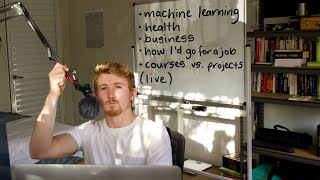
In this hour‑long live stream, machine‑learning educator Daniel Bourke answers a rapid‑fire mix of audience questions about his personal routine, the technical setup for streaming, and, most importantly, how he built a multi‑income business operating from his bedroom in Brisbane. He shares candid reflections on the uncertainty of the job market, the value of first‑principles thinking, and practical advice for aspiring ML engineers and entrepreneurs: prioritize side projects over certificates, use foundational courses to learn core concepts, showcase work directly to potential employers or partners, and treat a business as a low‑overhead, self‑employed venture. He also discusses his stance on YouTube ad revenue, the importance of health and fitness, and offers concrete steps for choosing side‑project topics, finding collaborators, and navigating freelancing. Throughout the stream he engages with viewers from around the world, reads chat messages, and emphasizes a philosophy of continuous learning, creation over consumption, and asking for opportunities.
Chapters
Ready to go, let's test it out. Boom! We're going live. We're going live! Oh, how exciting. Here we are. Are we on? We're fish on? Give me some, uh, give me some information in the chat if we are live, because I would love to know. Um, it's a Saturday morning, very excited. We have to start off these streams as always, remember last time we got cut off. YouTube kicked us off. I'm not sure why, but, um, oh, by the way, if you can hear me or see me, put a thumb up in the chat so I know that everything's going. But what we're going to do is I'm going to be here answering your questions. I've got a whole bunch backed up, ready to go. I'm going to answer the questions that I have backed up. I'm also going to answer the questions that you ask live. So, let's see if this chat comes up. Are we live? I've got a little loading bar here. Excellent connection. How do I get my feed into— hmm. Yes, we're live. We're on. It's coming in. B-E-A-utiful. Show us your abs, please. Oh Christ, no. I've got plenty of videos that you can see there. How we going, everyone? Where are you from in the world? I am from— I'm coming at you live from Brisbane, Australia. So, it's very nice to see you all. I really appreciate you showing up. If you have any questions about anything, about machine learning, about life, about health, about business, that's where most of my time goes at the moment. Leave them in the chat and I will get to as many as I can. And don't worry if you If you can't make it to the livestream, the video is going to live live on this channel. My dog's just decided— there must be someone walking past. My dog's just decided to go crazy. Mateo says, "Hello, how are you?" Mateo, nice to— mate, I'm amazing. Actually, Mateo, I've spoken with you before. Good to see you here, man. Ashan says, "Hello." Woo says, "Nice." Giro says, "Cheers from Brazil." From Brazil, that's so amazing! Ashan says, "You're fine, that's great." From Venezuela. So great to see you all. If you're new to the channel, we have so many— it's gone crazy over the last couple of weeks. So, first of all, welcome if you're new, and if you've been here before, welcome back. You know the drill of what we do. We have fun in these live streams, right? First things first, I need to make sure I put this water over here, so when I get really outlandish with the hand gestures, I'm not knocking it over. But what I've been— what I've been up to. Well, this morning I went for a little workout. It was a sunrise session. The sun— it's getting close to winter where I live, so the sun is coming up at about 6:30 in the morning. So, I get up around— I've been getting up pretty early lately because I go to bed early. And we'll get more into this in the stream of someone asked what my daily routine is. I don't really have one, but I did a little workout, went for a little swim, so I'm feeling good. I'm feeling pumped up. Are you pumped up? I am. So, what are we going to do? Shayik's here. Shayik, what's happening, brother? Anubrata says from the Netherlands. Italy, Mexico. Here we go. A Lamo says, what's my current business? Well, we can talk about that through the stream. Anyway, let's get started. And I'm going to make sure— can you see this? I want to make sure you can see my stream, my screen. Um, so if I put the Notion up here Just wait, just give me a second. I'm getting this set up. If I change this to be over here— no, over here— and then I want to put this bad boy, the stream, over there. I'm reorganizing my screen. I probably should have had this organized before I started the livestream. That would have been smart, wouldn't it, Daniel Bourke? And then I'm going to change it to screen and G85. Will this work? Prepare for breakdown. Oh, can you see that? Yes, but I want to change the display to be display 1. Boom! Little meta here, but that's alright. That is alright. Can you see me? If I put this like this, can you see me? I'm gonna watch myself over here on the live thing because what I want— there we go, I think that's working. Okay, beautiful. So what am I using to stream? I'm using Streamlabs, as you can probably see here. So what we're going to do is I've got these questions here, and so what I'm going to do, I'm going to go through these questions as many as I can, and I'm also going to try and answer as many as I can in the chat. So, that's probably how we're going to go. Maybe we'll go one question on the Notion and then one question on the live chat. Alrighty, so let's get started. Jay, Good to see you. Ashik says he's present. Good to see you too. Alright, let's get started. First question. Nasrullah from YouTube says, what will the coming changes in the next 6 months from now with regards to opportunity in data science? How do you see money and its impact in the world? I've thought this before. If we move money from one month, means no money, how's a human being will function? My grandparents, even my parents, Oh my goodness. Always told me that real asset is earth and what you grow in it. That's so true. Yes. None of what we can do would exist without the earth. With so much job getting fired, do you see job versus self-employed? You know, Daniel Bourke, I'm starting my job along with my friends. We all used to think high to achieve something. Now almost all my friends are in fear of losing job. Oh yes, that is, a lot of that is happening. We are, we are taking automation Is it towards human slavery where instead of thinking of growing, people are scared, think fear and surviving, in fear of surviving? Whoa, that is a very heavy-hitting question. So let me go back to the full screen. Now, I'm going to be straight up with you. With all of these questions in the livestream, what you have to understand is all the answers I give are going to be biased by my experience of the world. And if I don't know something, I will tell you. So that's a very— I respect anyone who has the guts to tell someone that they don't know something. That's a very important point. If you don't know something, just say it, right? Because then you can learn it. Now, Nasrullah hit on a fair few points there. Will there be coming changes in the next 6 months? Well, one thing's for certain in life is that there will always be changes. And now, how do you see money and its impact on the world? Well, for my case, it's going to be It's going to be an individual case-by-case basis. For my case, I have— my major needs for money are shelter, bills, and food, and having enough to create the things I want to create. So, that is my responsibility to somehow generate that amount of money. And you know what? I just noticed that the microphone I'm using is on my camera. Let me try and plug this bad boy in. This might upgrade the audio. If I put that in, can you still hear me? Oh, we've got a little camera array now. Let me know. If you can still hear me, put a thumb up in the chat. That'd be really helpful. And so, now I'm not entirely sure. Of what the specific question is here, but one thing's for sure, what you can put going forward, yes, the world is going through a lot of changes, but truth be told, no one really knows what is going to happen. So that means whenever you're in times of uncertainty, you have to go back to first principles. And what is that? Well, what is society going to need going forward? They are always going to need people with certain skills. Now, it is up to you to figure out where your skills align with the needs of society. Now, whether that be in the field of data science, whether that be in the field of software engineering, whether that be in the field of teaching, right? Sort of what's happened in the last couple of months is that the world has separated themselves from being essential workers and non-essential workers. But in my eyes, Everyone is an essential worker, right? It's just everyone, it's just whatever happens during certain times, it's like the tide, right? The people at the moment in a time of a health crisis, of course people in the health field are needed with a greater necessity than people in other fields, but then it's also going to change, right? These things of separating, I think it's actually a very, not a very good idea to separate people into essential and non-essential because when you tell someone that they're non-essential, whatever they do, that's, that's a very degrading term. You should never tell anyone that they're non-essential. You should instead give them the, give them the encouragement and give them the purpose to either, if their, if their opinion of themselves is that they're non-essential, you should give them the energy to become to become aware that they have the ability to become essential and that they, they always are because at the end of the day, whenever you, whenever you sort of degrade someone, you're really degrading yourself. So, back to the point, if you're in fear of losing your job, well, it's up to you. It's your responsibility. It's your responsibility to take on the opportunity to figure out what skills you will need going forward to not lose your job or to potentially get another job. So, that's a bit of an answer to Nasrullah's question. Let's go back to the live stream. Hello all, it's so good to see you. Abhay says, "Hello Daniel." The audio is clear. Beautiful. Excellent. Sean says hello. Hey Sean. Once again, thank you all for coming here. I really, really appreciate it. We'll probably go for at least an hour or so, as long as I can do it. And all right, Faraz says— this is a question from YouTube. Faraz says, hey Daniel, I'd love to learn ML and AI for robotics, but I've only just learned linear algebra, statistics, Calculus 2, and CAD. How would you suggest me to start learning ML? Should I learn whilst doing a side project on robotics? Yes. For me to apply new lessons, or should I focus from learning from a specific curriculum first? And so what, what the real question here is from, for us is, He wants to get into ML, it's robotics, machine learning and AI for robotics. Should I learn first while doing a side project or should I focus on learning from a curriculum? Now I'm going to say this to you as someone who makes an income from selling a machine learning curriculum. Side projects are better. So of course use courses. To build the foundational skills. Now, I will never encourage you to, to take a course over going over your own side project if you've got some foundational skills. Now, this is the, the mistake that I made. I'm thinking of making a, um, a video of how I would go about relearning machine learning and coding techniques if I had to start again. So, let me know if you'd like to see that. But what I've been thinking more and more is that I I should have started my own project sooner. And that is regardless of whatever, it could be machine learning, it could be learning any new concept. Of course, use books as the foundation or courses as the foundation of your knowledge, because if you have zero understanding of something, well then it's hard to make something with that knowledge. This is a great book, by the way, highly recommend. But then, instead of collecting certificates, like, I mean, I've got certificates of courses coming out my ass. I don't need more certificates. I need more skills. And the— what courses do is they help you build foundational skills, right? You need those skills. But then what working on your own side projects do is that you— they help you build specific knowledge. So, in the case of machine learning and robotics, I mean, that's a very physical thing. So, you can imagine how many books you could read on machine learning for robotics, but none of what you read will hold just— well, some of it might, but none of it will compare to actually building a physical robot and seeing what happens. It's the same if you wanted to learn to swim. Imagine reading 100 books or doing 100 courses on how to swim, and maybe you learn that that you do freestyle arms and then you go, "Breathe in after every 3 arms, you kick your feet," et cetera, et cetera. But then, once you get in the water, do you think if you don't know how to swim, you're gonna be really quickly remembering what you read in the books? No, you're gonna figure out how to swim while you're in the water. You're gonna figure out how to move your arms, how to stay afloat, or you might drown. So, I will always encourage you, yes, if you're on the borderline between doing more courses Or doing your own side projects. Start on your own side projects, but you can always do both, remember? But favor the side projects. Build toys and see if they work. Okay, so that is a beautiful question from For Us. Thank you so much. We are going to tick that off. Come in here. Boom! We'll come back to the chat, see how we're going. Now what we have here is Ashik says, Daniel, I read a few articles a day ago that software engineers taking up the role of machine learning in the coming days. What's your opinion on this? Toby says hello. Toby, good to see you, my friend. So I'm going to put this, I'm going to copy this from the chat into the Notion. So that way, that way we have a source of truth of all the questions that are answered in here. And if you're coming back to this video at a later date, you can check them out. So, live on YouTube. And as a bonus, we haven't been kicked off YouTube yet. I've been kicked off a few times lately. I don't know why. We keep this stream PG and nice and fun, don't we? Alright, alright, let me show you the question. So Ashik says, Daniel Bourke, I read a few days ago that software engineers taking up the role of machine learning in coming days. What is your opinion on this? So I, the way I look at this is that, and again, this is probably going to be in a future video, I'll expand on a bit more, but let me just give you my raw thought. Is that machine learning is a tool. And what's the number one rule of machine learning? This is a quiz for all of you. I'll give you a second to put it in the chat. Number one rule of machine learning: don't use it if you don't need to. All right, if you've got a few simple rules that you could craft with a few lines of code, like if then do this, else, etc., maybe you don't need machine learning. But if you don't have a few set of simple rules, then machine learning is probably something that you can incorporate into your software. Now, Ashiq says software engineers are taking up the role of machine learning. Well, you need to think about the second word in that title, software engineer. They're an engineer. So, what does an engineer do? I'm an engineer. You're an engineer. What does an engineer do? They look for different tools. If they're trying to solve a certain problem, right, if they need a certain tool, maybe they're screwing a pull-up bar into a piece of wood, because that's what I need to do this weekend. Maybe they need a drill to screw the— to drill the holes. Maybe they need a wrench to tighten the bolts, and then that's all good. But if they went to go gardening, maybe they need a shovel and the drill wouldn't really help. So the same thing with software engineers. If they need machine learning for the application that they're trying to build, well, maybe they're going to incorporate it. Now, I really think— I wrote an article like a year ago called "The 12 Things I Learned After My First" my first year as a machine learning engineer. I wrote it back then saying that software engineering and machine learning is— machine learning is just basically becoming part of the software stack. So with frameworks like TensorFlow and PyTorch and all the development stuff and all the deployment stuff, things like TensorFlow Serving, PyTorch has its own version now as well. It's becoming— you can upload a model to Google's AI platform and then just have that queried as a JSON API. If you're not sure what that means, just basically Think of it as your model is hosted on a computer and then you can just write a line of code to go, hey, I'm going to— or maybe 2 or 3, maybe a few lines, depends on how much you need to process. And you're just going to go in your web application or something like that. You're just going to go, hey, say you wanted to build an application to classify dog photos, right? The classic example, Dog Vision. You build that in the machine learning course that I teach, by the way. There's a plug. Yeah, but say you wanted to deploy that, you can upload the trained model to Google's AI platform and then it'll just, you can just query that through a line of code and go, hey, here's a photo of a dog, make a prediction on that, send it back to my app, and then I can display that to the customer. So in saying that, for me personally going forward, I'm, I'm learning software engineering. Because at the end of the day, it's, it's kind of sad when a model ends its life in a Jupyter Notebook. And too many of my models have perished, have gone to their funeral in a Jupyter Notebook, and no one else has used them except me. I find that sad. So me personally, I'm learning software engineering because I need to build things that can use machine learning. Like, it's pretty hard. Like, this is a horse without the cart problem, a horse before the cart problem, or cart before the horse, right? Cart before the horse. To me, a lot of— if you're a solo machine learning engineer or solo data scientist, something like that, and I don't particularly want to work for any, any company other than my own. And so, unless there's one that really suits my needs, but at the moment I'm having fun on my own. And so If you're— if I've just got skills, here's how I think of it. I'll just tell you how I think of it in my terms because that's the easiest to understand for me. I have machine learning skills, I have data skills, but if I want to build an application, well, if I want to use those skills in, in some form of product or service for someone, it's very hard to build machine learning algorithms or do data science when I don't have any data, right? So this is the cart before the horse problem. And what I mean by that is that if you've got a horse pulling a cart, you need the horse to pull the cart. There's no point just having a cart on its own. And so that's why I personally am learning things like software engineering so that I can build full-stack web applications and then integrate, or mobile applications, and then integrate collect samples of data in some fashion, whatever service I decide to build, and then integrate my machine learning skills if it is required. So there's a— I'll probably make a video on that. Let me know if you'd like to see it. Machine learning versus software engineering. It's probably one of the things I would do differently if I was to start learning machine learning again is to learn from a building point of view rather than just building— like a building, something that can get into a user's hands point of view, rather than just building a model with greater, greater accuracy. Because I mean, that's fun, but at the end of the day, it's not really helpful if it's not bringing value to someone. Okay, so that is from Ashik, thank you for the question. I'm going to tick that one off. Now, here we go. What do we got here? We'll go back to the— we'll go back to Notion and then we'll come back to the chat. So Ishan says, a medium-sized business versus 2 to 3 small businesses. Now I copied, I just copied and pasted all of these. So I don't really, I'll be straight up. I don't really know the context to that, but then, so he's got 2 questions. A medium-sized business versus 2 to 3 small businesses. What the companies looks for in a junior ML engineer. I'm a web developer, wants to go into machine learning and AI. What part should I be focused more on? Projects or experience, et cetera. Answer this with reference to your first ML job. Job. Okay, so we'll start with the first one. So Ishan says a medium-sized business versus 2 to 3 small businesses. Well, this is going to be case-by-case scenario. What you could think is that I personally, where I'm at in my stages, I'm a company of one. I have a business partner, Andre, that the entire team of of Zero to Mastery, that, that is one source of income. So, that is, you could say that that's one medium-sized business, but then I have a couple of other smaller businesses that I run, say for example, the YouTube channel. I'm partnered with Coursera and DataCamp with affiliate links, Medium, I write articles on there. So, what you could say is, I'm a company of one on my own, But I'm also partnered in my largest source of income is from my Udemy course. And then I have a few other smaller sources of income. So, if you treat each of them as their own individual business, I'm part of several, 2 to 3, well, you said 2 to 3 small businesses, so I'm probably part of 4 or 5. Small businesses. And so, is that the most ideal situation? Well, at the moment it's working for me. So, where do I want to go longer term? Truth be told, I'm not entirely sure, but I do know that I have a lot of interests in just a whole bunch of different things. So, at the moment, things are probably going to stay quite similar for the next couple of years. But again, my track record of prediction is probably as good as yours. I need to train myself. I need to backpropagate through all of the errors I've made. But yeah, the world, the internet has given you and me opportunities to create businesses that weren't there before. But the key point here is, in whatever business you're in, whether it's brick and mortar, or whether it's online, it's bring, create something of value that people are willing to pay for. That is the simplest thing. And you might be saying, well, Daniel, how do I create something of value? Well, you need to build skill, skill in something. This is going to lead into the second course. I mean, second question from Ishan. What companies looks for a junior ML engineer? I'm a web developer who wants to go into machine learning and AI. "Which part I should focus more on projects?" Yes, always focus on projects. "Or experience, etc. Answer this with reference to your first ML job." So my story with my first ML job is I got pretty lucky. Well, I'm not gonna— no, not pretty lucky. I got lucky, right? Because I was relentlessly sharing my work online, just saying, "Hey, I'm learning machine learning." And at the time when I was doing it, Machine learning was kind of this, or artificial intelligence was, Australia didn't really know much about it and they kind of, they still don't, to be honest, because we go to, I worked for a technology company in Brisbane, which would partner with other larger companies and say, "Hey, you guys have a lot of data. We have machine learning skills. Would you like us to build you a proof of concept to try and help out with some kind of service that you offer?" And so, that's what we would build. We would build projects in different industries health, commerce, you name it. And so what, what does a company look for in a junior machine learning engineer? That's going to be different from role to role to role. Now, whatever that's going to be, what I would do, or how I got hired with my first ML job, was that I was posting continually on LinkedIn, like, what I was learning. It's like, hey, I just learned this in machine learning, here's what I built with it, etc., etc., posting it. Eventually, some Someone sent me a message and said, "Hey, Daniel, there's a company— no, there's a person you should meet." It turned out I met that person. That person knew another person at a company, and that was the company I ended up working for. And I spoke with them, told them, "Hey, I'm doing this thing. I'm learning it in my bedroom. Here's what I've done." That's the most important point. A lot of— well, in my opinion, right? What you have to understand, all my opinion. But they could see what I had done. So this is why if you don't have experience in machine learning or some sort of role, you have to create it yourself through projects. Now what I would do, I'm not looking for a job at the moment, but what I would do if I was would be I would find an ideal company or an ideal role that I would like. And then I would look at that role and, okay, I'd read the skills and you're going to see, trust me, you're going to see these things. Experience, 3 to 4 years needed. Bachelor's degree, master's degree, PhD, 3 of them, yes. 7 more years of experience and then you get a junior role, right? And you're going to read that and you're going to start crying because, well, not really because you're probably tougher than me. You're going to start crying and you're going to think, I'm not— I don't have 7 years of experience. Screw that. All job postings are basically just generic crap that someone has copied and pasted from another one and just said, "Yep, that'll do." But read the actual skills, find out what the role requires, what will you be doing there day to day. You're smart enough to do this research. Find people who work for the company, actual engineers, and say, "What do you do day to day?" Ask them. You never know, you might, you probably, you might not, you might ask 100 people and you might get 100 nos of someone not even replying to you, but you might get one and they might tell you what they want to do, what they do. You could ask recruiters, you could ask engineers, I probably prefer engineers, ask them what they do day to day. A lot of engineers are probably happy to go, "You know what, I don't really talk about this, I'd love to share my advice for someone who's trying to get in this role." And so, once you figure out what they do day to day, start the job before you have it. And what I mean by that is set up, design your own project. This is why projects are so valuable. Design your own project based on what they've said that they do day to day. And so then when you apply, when you reach out, if you send your resume in through a job portal, it's probably going to get filtered out anyway. So when you apply, by sharing your work, by directly contacting people at that company, you can go, "Hey, I talked to XYZ and I spent the last 6 weeks," and yes, I'm being serious when I say 6 weeks because that is a great amount of time to, it's short enough that you're not over-investing time, but it's also long enough to do something amazing. It's why I built the Airbnb project series on my YouTube channel. If I was going for a job at Airbnb, I can go, hey, I built this, look at it. That's— there you go. There's— you want the product history? I designed this project myself. I took everything. Here's, here's how I got the data. Here's how I modeled it. Here's how I deployed it. All ready to go. And so that's what I would do if I was applying for a job. Now, what does a company look for in a junior ML engineer? It's going to be different from company to company. Maybe they want AWS skills, maybe they want Google Cloud skills. But that's what you have to figure out, and you can incorporate all of those into your tailored specific project for that company. Now, to me, that's a lot better than just clicking apply on some website. Build something. Okay, we go here. We are back to— so, Ishan, I hope that answers your questions. Thank you very much. Let's go to the chat. Merlin, my boy Merl, what's happening, brother? My son, how are you doing? Good to see you, man. So we see, what have we got? Hi from Indonesia, good to see you. All right, what do we got over here? Let me— how do you choose? Well, we've got a lot of questions here. And okay, I think I'm gonna— I'd love to get to all of these, but in reality I can only get to a certain amount, so If I miss your question, it's not because I don't want to answer it for you, it's just because there's a lot. Feel free to email me at any time, daniel@mrbourke.com. I'll get back to your question in text format. And I've just realized this little camera thing is just showing a microphone level constantly. How professional! Alright, we got one here. Beautiful. From— I'll just show you it. So Gokulnath says, to do— well, I'd really like if that just turned that into to-do list. There we go. And Gokulnath, how do you choose a great side project? What factors do you consider? I always end up doing some side projects that end up being too trivial. Hmm, what factors do I consider in doing a side project? Number 1, curiosity. If I'm not interested in something, it's going to be very hard for me to sink my teeth into it, and it won't set my heart on fire, and so I won't be able to put as much energy into it as I'd like. So my last one, that Airbnb project that I built that little documentary series on, that was just a fun little toy project that I decided to do. I wanted to— I had a few tools that I wanted to learn, like Detectron 2 and Weights and Biases. And this is a great way to learn tools, right? It's like you choose a side project and then just go, you know what, I'm gonna see how these tools over here, these things I want to learn, marry up with this problem I want to solve. And just go, maybe they fit, maybe they don't. But that's the fun about it. And so Going back to the last question that I answered, if you want to— maybe you're going for a job. So, a great side project would be some side project that's going to be specifically related to that job. Right, for example, I— what I should have done when I— the last job I got denied for was about 2 months after I quit my last job. I wanted to start my own business, but I saw this role that was going. It was for a machine learning engineer position. I think I wrote a blog post about it, but it was for a machine learning engineer position at a company called Zoe, or Zoe, Z-O-E, who are working on building a personalised nutrition system. And that's, that's somewhere where I'd like to go. Like, for example, I want to look at a plate of food and know how it's going to influence my body. Is that possible? Maybe, maybe not. But yeah, it excites me. And so, I applied through their job portal. I also reached out via email directly to one of the people that I found worked there and just said, "Hey, here's my stuff. Here's what I built. Here's my experience," etc., etc. Long story short, I got denied for a lack of experience. Now, what I should have done was I should have built an interesting side project, something that interests me around what I'd be specifically doing at that company. When that was— I would read the role and go, you know what, okay, they're just designing a personalized nutrition system that someone can track what they eat through an app interface. Okay, so maybe I should replicate that. And then that app breaks down what's in that food. So, okay, it's got image recognition on that food. Okay, so that's one part of the pipeline that I could build. All right, so maybe I should have gone through those, and that would have really interested me. And so, that is how I would choose an interesting side project. It has to, first of all, drive my curiosity. Will it help me learn something? And then, 3, will I have a story to tell afterwards? And I mean, you're going to have a story to tell regardless of your side project. And also, another one is, if you think it's going to be too trivial to begin with, you're probably thinking too large. Now, the reason why I created the 42-day— I stole actually, I stole this from Basecamp. I stole their 42 or their 6-week project cycle. And what I mean by that is you can look it up on my website, Daniel Bourke 42 days, danielbourke.com. No, I really wish I had my own name as my domain, but I don't. MrDBourke.com/42days or just search Daniel Bourke 42 days. But anyway, it's really simple. It's just you, you set out on a new project that's something that interests you, but you set the time frame to be 6 weeks. You go, "I'm only going to work on this thing for 6 weeks." And what you do at the end of the 6 weeks is you decide whether it's worth pursuing, because again, 6 weeks is a lot of time to, to figure something out or to, to realize, "Oh, okay, maybe this wasn't worth pursuing." And then after that next 6 weeks, you go, "Oh, am I going to keep pursuing this?" Yes. Then you might get to a point your side project suddenly turns into your main project. But worst case scenario, if you try something for 6 weeks, it doesn't really spark your curiosity as much as you thought, you can just push it to the side. Well, that's done. You've got a story to share. You're like, "Hey, I worked through this." And it turns out people also like to hear what things that didn't work. In fact, it's, it's more robust in life to know what doesn't work. For example, if you knew something that was going to harm your health, one way to be healthier is to avoid what's going to harm you. So, that's how I choose a great side project. Curiosity. Can I learn something from it? And will I have a story to tell after it? So let's go back to the Notion and we're going to tick this off. Gokul Nath says, um, how do I choose an interesting side project? Thank you for that. Alrighty, now we're going to go back to the Notion and then we're going to— oh, Walter says greetings from Peru. Good to see you, Walter. Thank you for joining in. And what do we have here? Hi from Indonesia. Yes, we've taken that. Nawal says, what are my configurations of my MacBook? It's a 16-inch MacBook Pro, so the almost the top of the line. That was my present to myself after having a good year in business. But I sold my laptop for it. I only need one laptop, and really this is probably overkill. I probably I probably— see, it really pisses me off that Apple— it's hard to run NVIDIA-style deep learning libraries like TensorFlow and PyTorch on Apple's GPUs. So this bad boy has an 8GB GPU, real fast, great for editing videos, but for deep learning? Nah. So what I might have to do is get like a NVIDIA GPU card or build a deep learning computer of my own or just continue using cloud instances. But anyway, so Emil says greetings from the Netherlands. Great to see you. And we have Nigeria, so Quadri, great to see you as well. Merlin, I'm going to get to your question because it's, uh, it's nice and simple. What do we got here, Merlin? My boy, you know, Merlin and I once, uh, once traveled the entire width of New Zealand in a van. It's freaking great. We met my boy Richard in the lifeboat. So Richard owns a small business in Greymouth, which is a tiny town in New Zealand. Serving coffee and stroopwafels, which are like a little beautiful delicious cookie, out of a small wooden boat on the end of a rock pier with waves and wind howling like you wouldn't believe. So, shout out to Richard and Monique. Now, Merlin says, viewpoint on fitness gurus. There we go here. Hey, viewpoint on fitness guru. Daniel Bourke. Is that a question at me? Like me being a fitness guru? If it is, up yours, Merlin. Nah, I'm kidding. Love you, brother. But fitness gurus in general, what the— See, I nearly got into that world, right? The fitness guru and like posting photos on Instagram of being shredded and all that sort of stuff. And don't get me wrong, I'm still shredded. I like being fit and healthy. It gives me energy. To do other things. See, that's the first principles approach to life, is take care of your spirit, take care of your health, take care of your wealth, take care of your relationships. I got a video coming out on that, probably tomorrow. But if you're going to health, right, what do you need? You reduce stress, move every day, eat well, avoid processed crap, don't eat so often, sleep. Simple. That's like health in a nutshell. Whereas if people are trying to like— health improves via negativa, by removing things. Whereas a lot of health marketing these days is like, take this supplement. Oh, if you're at your desk, take this pill. If you're trying to sleep, take this. If you're whatever— what is this crap? Right? It's like, no, just keep moving. Eat well. Gets— if you need to sleep, sleep. That's it, right? Like, that's fitness. See, I find great pleasure in challenging my body and challenging my mind. And so, they're two non-negotiables for me every day is movement, some sort of movement, whether it's a walk in the morning with my dad and puppies or whether it's a creative or a full-blown session like I did this morning with gymnastic rings, hill sprints, etc., etc. I went for a little swim after, did some animal crawl, get close to the ground, get dirty. So, yeah, fitness gurus, they have a place. They can live in that world. I've even been in that— I've been in the world. I got tanned, took my shirt off, got up on stage, did the poses. Still got some pretty nice guns, but come on. If you're coding Python, you need to be rocking Pythons. Number one rule when it comes to code. But fitness gurus, if they're preaching movement, they're preaching health, I support them. Put it that way. But do you need all the crap? No, not really. Alright, so that was view on fitness guru Daniel Bourke. But as fitness guru Daniel Bourke, probably the most shredded machine learning engineer on YouTube. That's, that's number one rule for me is coding Python, rocking Pythons. Number one rule. We'll tick that one off the list. Okay, so I do have a few questions here. Look at this one. This is a, this is a big dog, big dog question. What I might do is bust through these because they did send me emails directly and I promised I'd answer on stream. Then we'll jump back in the chat. So, I'm going to do like a little speed round. We'll mix it up. We are 45 minutes deep into this. So, let me know in the chat, is it going alright? Like, this is always kind of just a figuring it out thing. That's what a lot of life is, right? It's just figuring these things out. So, we have here. From Muhammad. My name is Muhammad, like you, I'm a machine learning engineer. LinkedIn profile— I removed that out of there, but there was a link there. I'm impressed by what you did, your business and everything, it's very inspiring. I'm working on an online course which I will upload to Udemy. Before that, I invest a lot in myself learning, making multiple online courses. So I would like to know, do you use any paid ads to promote your course on Udemy? If you don't, do you have any marketing advices? So, keep going. I will not be in your live stream because of the time difference. Living in France. Oh, that's amazing. I'd love to visit France one day. I've got a friend in France called Ludo. We also met in New Zealand. Actually, he gave me a gift. Where is it? My boy Ludo gave me this gift. This is a stone. And I don't know if you can see it. Well, this is a necklace that says the cheeky— you can't see it. I'm just going to read it. Friendship. The cheeky little bugger put it in my jumper pocket as he left because he had a flight out at 4:30 in the morning and there was no chance I was waiting. I'm like, dude, I'll say goodnight to you. I'll say lovely to meet you and safe travels tonight because I'm going to be asleep at that time tomorrow. And he snuck this into my jacket pocket while I was asleep, and I woke up the next morning, I'm like, what is this? Oh, you cheeky bugger. Anyway, Muhammad says, do I use any paid ads for my Udemy course? No, I don't. Andre might, but I don't think so. My— so do I have any marketing advice? So I don't use any paid ads for anything. That's not to say that paid ads are something negative. I might try it, who knows? I don't know. But what are my marketing advices? And my marketing advice is always going to be— I could improve at this, right? I've never really— I don't like the whole idea of like having an ad and shoving something down someone's throat and just being like, you need this, or like an ad popping up for me in someone's feed and it being like, "Oh, here you go, here you go, you might want this." I mean, people have got enough stuff in their lives, right? Including online resources and whatever. My approach to business and getting things out there is to make it as good as possible so that it markets itself. And what I do on YouTube and what I do on Medium and all that sort of stuff, is that a form of marketing? You could say that, but in reality, I am seriously just putting out things that I myself would have liked to have seen in the world, or things that people like yourself, like customers and fans, ask for. And when they collide over, something that interests me and the people that I make things for, my customers, my fans, when they collide over, it's a beautiful moment. It almost works for itself. And so, the best thing that happened with my course and why I think it's been— the uptake has been so, so large is because Andre, I partnered with Andre, who'd already made some Udemy courses and he'd made them exceptionally well. And so, he already had an existing base of students. And so, when we— a lot of them were asking for a machine learning course. And so the way Andrej and I partnered up was I wrote an article, again that one I mentioned earlier in the stream, the 12 things I learned as a machine learning engineer during my first year. And he read it and liked the article, so there's it, and then emailed me and said, hey, my students are wanting a machine learning course, you've got machine learning skills, do you want to partner up? I'll bring the, I'll bring the students and you bring the machine learning course, machine learning skills, And boom! And then we launched it and I made the course that I would have liked to have had when I first started learning. And it turns out that I poured my soul into it. I got real, like, I try to pour my soul into everything. And it turned out that it's gone pretty well, but at the same time I always know that it could, it could it could be better. And that's the beautiful thing now, is that the students are, when they go through it, you might have gone through it if you're watching this, you offer feedback and say, oh, this could be improved, or this teaching aspect, I got quite confused there. And I go, oh, look back, like, you know what, in future iterations, that is something I could work on explaining clearly. So what do I need? Discord's going off, I actually need to close that. Boom, boom. And so, what are my marketing advices? Well, I would say first and foremost, put out something that— this is before marketing happens— is put out something great. You want the product to— marketing is like a nice-to-have. This is the same thing with machine learning almost. It's like if you're building an app, machine learning is a nice-to-have if you require it. Now, if you're building a product, marketing is also a nice-to-have if your product doesn't sell itself. Like, the product has to be that good that it sells itself. So, for example, you want it to be that good that someone gets it, and the marketing, the best marketing ever, tell me if I'm wrong, is when someone goes, "Hey, I tried this thing." and I know that you also like this thing, so I think you should, you should try the thing that I tried because it was really good. That's the best marketing ever, but that comes from, like, better than any ad I could write, better than any video I could make. It's when someone tries something and goes, or someone tries my machine learning course and goes, hey, this course by this dude is pretty good, you should try it. And then someone else looks at it and goes, wow, that is pretty good too. And then they tell tell their friends, and etc., etc. That's the best marketing you want. So, build something that, first of all, you'd like to see in the world, and second of all, is that good that people want to tell other people about it. So, that's my marketing advices. But, of course, the next thing you could do is to create things around that. Take all the questions— one of the things I do is when I get a question, like what I'm doing now, is when I get a question, I make a specific resource tailored to that question. So one of the main questions I used to get, or I still get actually, sorry, was, "I want to learn machine learning, how do I start?" I wrote an article, poured my soul into it, answering that one specific question for that one specific person. And it turned out a lot of people had that question. And so a lot of people looked at that article. So, that's another piece of marking advice there. Alright, so, thank you for the question, Muhammad. I'll send you, because you're not here, you're in France, so I hope you're having a great time there. I will send you the timestamp of this video when it's on YouTube. So, Amal says, I said I was going to go through these fast, but that was a lie. Amal says, "In this time, I'm thinking about studying to take master's degree, one of the CS specialties. So I would like to consult you and know about helpful recommendations from your background so that may help me to choose one of these fields: data science, web science, artificial intelligence, and cybersecurity." Whoa, that is a lot of fields there. Look, I'm going to be truth be told, it's— I can't make a decision for you. So my best advice with these things is to dabble. Is to go through them with trial and error. Is to— if you want to look at data science, try it out. If you want to go into web development, try it out. Artificial intelligence, cybersecurity, try it out. Like, there's— what's the— you don't need to necessarily learn all of these things at one time. You can just see how it goes, of course, and remind yourself, building skill in any of those fields will take time. There's no, there's no like, you see these things like learn programming in 3 months and all that sort of stuff. No, that's not how it works. Is that you try these things out, you see if it sparks your curiosity. If it sparks your curiosity, you keep going for a little bit more and then you start to build skill. And then once you have skill, that's when passion starts to come. A lot of people think it's like, oh, passion, I don't have a passion, what am I gonna do? What's my passion? Is my passion data science? Is my passion web development? Is my passion artificial intelligence? Is my passion cybersecurity? It may be any one of those things, but usually what happens is if you're not sure, try to build skill in at least one of them, because then it kind of, it helps itself. The passion, the skill triggers the passion, and then the passion helps you to get better at the skill. And so it becomes a circle. So when I, when I couldn't decide on something I'd like to do, it was usually because I didn't have much skill in any of them. See, people generally like to do what they're good at. So that's my advice for that one. Or if you want CS, I found a great resource the other day. Where can I— how can I get this up? Maybe I— boom, here. I'll get up here. Teach Yourself CS. This just got updated. Look at this. If you have the dedication, you can potentially go through this. And I say potentially because, of course, if you have an opportunity in life, it requires you to take on the responsibility of fulfilling that opportunity. Look at this. Teach Yourself Computer Science. Boom, full screen. So this guide was extensively updated in May 2020. That's this month. This is going to take a lot of effort. TL;DR: Study all 9 subjects below if you want to learn computer science in roughly the presented order using either suggested textbook or video lecture series, but ideally both. Aim for 100 to 200 hours of study on each topic. Now if you were doing Let's go 3 hours a day, 5 days a week, so 3 times 5, and actually we want— so let's go 150 hours per topic. There's 9 topics, so 150 times 9, that's 1,350 hours to get through this, times an average of 3 hours per week is— oh, sorry, 3 hours per day is 450 days. Now take out weekends, you might as well say that's 2 years, right? 2 years to go through all of this stuff. So don't be thinking, oh, and that's 3 hours per day at 5 days a week. Now I say 3 hours, some days you might do less, some days you might do more, but 3 hours is generally a good amount of time to, if you're focused, to get something worthwhile done. But look at this, programming, computer science, algorithms and data structures, math for CS, operating systems, computer networking, databases, languages and compilers. Who knows, I might even go through this. I haven't done a CS degree. Or I might just pick and choose the things I want to go through. Still too much? Like, this is phenomenal. If you have the dedication to set this up, share your work as you go, right? If you're like, wow, I want to try this out, get a study group. Maybe you probably won't convince your friends because, I mean, your friends are probably interested in other things, but put your stuff out online and then other people who want to do this will probably find you if you're putting yourself, if you're putting your stuff out there. That's, that's why I did it, so that I could find people like you guys who are interested in things that I'm interested in. Teach Yourself CS, I'm going to put that link in, uh, in the description later on, but boom. I'll create a bookmark for that. So, thank you, Amal. Now, John Smith has a series of questions. I'm going to pump through them because he actually said he wanted his name changed and that's fair enough. Maybe I should have changed the other names of people. Alright, let's do a speed round. I know I said that about 10 minutes ago, but this will be a real speed round. What is your daily schedule? Like, how many hours do you work per day? I don't really have a schedule. I try to avoid any event, as much planning as possible, if it's not like a, just a short-term thing. Now, the reason being is because that's kind of the reason I started my own business, was because I wanted to be in control of my time. But what I've been doing lately is I get up quite early in the morning. I work on a longer-term project that I spend about an hour working every day on a longer-term project that's important to me, but non-urgent. There's no rush with this. I'm taking my time and enjoying it. It's actually, it's sitting over there. You can't see it, but that's on purpose. So, that's what I do. I get up in the morning. Lately, it's been about 5:00 or 4:30 AM. It's still dark, but I light a candle over there because it brings up the tranquility of things. And then, what I do, I go for a walk. Me and Dad go for a walk at sunrise, about 6 AM, and then I come home. I do— I'm in study mode for May. I've been off social media, doing an experiment of no consumption of social media whatsoever, only just sharing things. You should try it. It's really good, 30 days. I might do that every 6 months. And so I spend 3 to 4 hours once I get home from the walk. It's about 7:30, and so I spend about 3 to 4 hours of either studying or creating. At the moment I'm in study mode, so it was, it was just all, all, all studying, all reading this book end to end. Really great book, Hands-On Machine Learning. And then after that, I usually finish— oh, after I'm finished studying, I answer all the questions from my students in the Discord channel and reply to— or check emails and reply to the things that I need to reply to. I'm pretty terrible with emails, but that— you've got to be terrible at something, right? Not really. I've been trying, I've been trying to improve. But then I have something to eat. So, food is my reward for doing something challenging. So, whether that be— I like to do something challenging every morning before I eat. That is probably my one routine, is do something challenging every morning before I eat. I feel good when I do that. After the afternoon, I'll probably do a little bit more study and work on something that that sparks my interest, try to learn something new, go for a walk again or do a workout, and then by about 5 PM, I've been really trying, I'm writing down on my thing to like finish at 5 and then do nothing after that and then just read and whatever. It's kind of hard like because I have my bed right there and my computer right here, so it's hard to like fully disconnect, but that's a challenge I signed up for. And so, by— I have dinner with the family like 6 to 6:30, 7:30 maybe, depends, really depends. And then, I'm in bed usually by 8 or before 9 and I'm reading, reading a book of some sort. So, yeah, that is what my day looks like. Work, I would say, and truth be told, I don't see any of it as work because I have fun doing it. So, it's like In reality, it's probably 4 to 5 hours of solid work on average a day, sometimes less, sometimes more. So yeah, I'm not, I prefer rather than longer hours, just make sure the hours that you're putting in are quality hours. Don't be distracted. Like you can get, I had a conversation with a colleague at my previous machine learning job that, like we believe that you could shorten the week to 4 days and 6 hours a day and we'd get the same amount done. Because most days are just filled with 2 to 3 hours of crap. So, take that out and just do what needs to be done and just trust that each other's gonna do what they're gonna do. That's a really important point. And things will get done. Yeah, so, some days I need to do more work, some days I don't. But I don't put pressure on myself to do more hours. I think I put pressure on myself to do quality hours. Alright. "Since you have multiple income streams, did you make a corporation, LLC, for each income source or just one corporation? Also, what corporation did you make? I'm just wondering because of the tax deductions. And what income did you start the corporation?" Whoa, that's a lot of lawyer speak. I don't really know. But the way it works is— well, truth be told, I did do some research because that's important. If you're going to start a business, you need to know things. I think that's more targeted towards the US. In Australia, we have, we have this thing called self-employed. And so I am, I'm a sole trader. That is what I am in Australia. So I'm a self-employed business of one, so to speak, even though I work with, with other people. So that, yeah, that's the setup scheme there. And so, I am taxed at the same rate, my tax rate is the same as an individual. So, someone who was working for a company, but I have the ability to say buy, invest in something. So, this is, I bought a MacBook Pro to run my business. I sold my old laptop because I needed a more powerful machine to edit videos and et cetera, et cetera. And so that I can, I can write off on tax because it's purely for my business. I basically don't do anything on, and this is, this is where you got to think about what you want to design the life for yourself. So I basically don't do anything on, on my laptop which isn't like related to my business, whether because my business, I've created it around the things that I enjoy doing most, which is coding, Write, or basically writing. My favourite things to do in life are create and learn. So, writing. I love nothing more than writing. Writing code, writing words. Code because it's deterministic. Words because there's a beautiful array of— there's limitless possibilities of what you can create with language, right? Code is like, you write code and it works or it doesn't. You write an article or a story and people can take what they want from it. So they kind of— I like that. That's living at both extremes of creation. So that, yeah, I said this is going to be a speed round. Another lie. 3. How much do you pay yourself? I am assuming the $98,000 you made in your business's income, not yours, even though you run the business. Out of the $98,000, How much would you give yourself as an income? Okay, so yeah, great question. So when I posted, I posted an article recently, which is running a business from a bedroom. It's on my website. I'm not going to put it on this. Running a business from, oh, running a business from my bedroom. And I said I earned so far, it was 11 months in, I earned $98,130. You could probably take about $20,000 off of that for expenses. So things like bills around the house, just general operating costs, electricity, food. Oh no, food's not incorporated in business. So that's about $78,000. All of that gets paid to me. But my— the thing is, the most important thing is is that my expenses are low. I don't spend money on anything other than what I enjoy, and what I enjoy happens to turn out to be things that are relatively cheap, right? This is like— people overestimate how much you, you need to earn as a, as a business. My goal— no one ever asks, is like, why do you need to grow a bigger business? People always say, oh yeah, you need to grow your business. It's like, I've hit the point. I've hit the point. I've hit the point where where if I buy more shit, it doesn't mean anything to me. It's like I've, I've earned enough. I earn enough now to be able to pay for bills, right? It wasn't always like this, but I kind of already learned this lesson. I earned enough to pay for bills, pay for food, pay for the things I want to work on, pay for rent, etc. So that's it. I don't need anything else. I got to create. This is my tool. Boom! I got a keyboard. I can, I can make, make things now. So that's, that's what I wanted to set up. Um, so yeah, and, and also my overheads are very small because I create digital things. I create things that can scale. Code and media can scale. I had no, no, I didn't have much money to start. I think I left my job, my machine learning job, with about $7,000 in savings. So I knew I had to make something that could generate me income with a very low overhead cost. That comes in the form of code and media. So that's what I do. Okay, here we go, we're back to the questions. Number 4: How do I find people to work with my startup business? I'm just wondering because I'm trying to find people I can work with who live pretty close to where I am. Also, I'm having a hard time finding a tech person who is willing to take to take a leap of faith. I asked about 30+ people and these are some of the replies I got back. I got a job offer. I don't think I'm qualified. I'm too busy with school. I don't know this type of technology, but if you're trying to find somebody doing NLP analytics, contact me. The list goes on. As of right now, I am the person doing the tech work, which I don't mind. If I found a tech person who I can trust and work with, it would be more efficient to launch the business and the products. Also, I did find one person I found who lives right across the street from me and recently got laid off. This person has a lot of knowledge in industry my business is trying to get into, has good work ethics, and wants to start a business too. However, this person's tech skills are questionable. Like, what if this person does not have the necessary tech skills for what I'm looking for? Should I tell the person to learn and come back once the person has the skills, or should I just tell the person to join and learn the skills on the way? I'm wondering because this person would be really good at marketing the business. I'm just wondering, how do I convince people in the B group to join later on. Just want to know your input on this because you partnered up with somebody in your Udemy course. Whoa, okay, I need to be straight up with this. I don't have enough experience to answer this question fully, like in terms of hiring people. So what I say here is just kind of how I would go about thinking the problem or what happened. How did I partner up with, with Andrej to launch the machine learning course? I wrote an article, Andrej emailed me, we got in contact, he showed me what he'd worked on in the past, I showed him what I worked on in the past, and we said, you know what, we're probably pretty good to partner up and put this thing out in the world. Now, the important point is that I had to— when we first contacted each other, I had 2 and a half years of material online that I had put out there myself with no prompting from anyone else. So this is why it's so important, so important to have your work somewhere where someone else can see. So if you have this situation, if you have someone who's looking to hire someone and they're not sure like who to hire, and so maybe they're searching for people and somehow your name stumbles into the mix, it's like, when they look at your name, what do they see? Because this is the world we live in. Now, this gentleman, John Smith, talked about he wanted someone in close vicinity. Now, again, I can't really comment on this because the people I'm partnered with, we all work remotely. Shabam is my teaching assistant, or is our teaching assistant, who's an absolute and complete living legend, and we've never met in person. The way he sort of came onto the team was that we had question and answering on Udemy for people who need to answer questions. And the trial was, go and answer some questions. And he did an amazing job and said, well, you want to keep going? Yeah? Okay. Well, that's how it worked. That's how we hired him. If I was looking to hire someone, I would— if you're asking them to take a leap of faith, you have to also take a leap of faith. So, I would say, come in for a few days, paid, yes, paid, because people have lives, they can't just do free work. And this is the risk that you have to take if you're hiring someone. Of course, you do a little bit of vetting first, you make sure that they're not just someone walking down the street. But if you've got a small group, you go, well, come in. Spend a, spend a day or two working on this and we'll, we'll see how you go. That's, that's how I got hired for my machine learning job. I went in and they said, come in for a day a week for the next couple of weeks and, uh, work on these problems. Here's, here's the problems we're working on, see what you can do. And I did a whole bunch of data analysis with Pandas. Didn't know a lot of it, but I knew I had the foundational skills. I could, uh, I could figure it out, like as I was going along, and I showed them my work, said, "Hey, here's what I've done. I figured this out." And they said, "You know what? You want to be hired?" And I said, "Yep." So, that's what I think. It also, it like, as I said, I don't have, I don't have much experience in this, but that's what I do. If you, if you're expecting someone to take a leap of faith and work with you, you have to take the leap of faith first to give them an opportunity. Like, at the end of the day, if they're going to dedicate their time helping you to build something, it's like you need to, you need to make the first move, man. You need to make the first move, John Smith. Okay, what do we got here? How come you don't claim your ad revenue from YouTube? Hoo-hoo. I don't need it. I didn't want it. Well, I could use it. But, so, the thing is, the story here is I've never claimed, I've never made a cent directly from YouTube. So, every video that I've made, every video of mine that you've watched, I've never seen a dollar from that. The reason, well, I have in other aspects. So, for example, affiliate links or people, customers buying my course, students buying my course through, they found me through my videos and seen my website and then bought the course from there, etc. So, that's how I've made money indirectly from YouTube. But the reason I started on YouTube was not necessarily to make money from it, it was to just make sure that I was— I made a video about this 2 weeks ago, it was the creation versus consumption. I'd reached a point in my life where I realized I was consuming too much. I wasn't creating things that I would like to see in the world. I knew deep down that I had things that I wanted to put out into the world. So, I wanted to, to do that, to create, to make videos, to put things out into the world. And I didn't want, and I'm not saying that money is a bad thing, right? I didn't want it to be just shooting for the money. Because first and foremost, I knew that that wouldn't happen for a long time. I think it was like a year. On YouTube before I made a single cent from ad revenue. But then Google sent me a letter in the mail. I've still got it in my drawer, which is like this code to activate your ad revenue. And I just kept it in the drawer because I'm like, well, I'm not— I don't need to make money from YouTube. I'm, uh, I've got an income elsewhere. I'm just making these videos to first and foremost follow my own curiosity and to secondly potentially bring value to others because Money stands in the shadow of the best currency in the world. The value you bring to others or the feeling you, you spark in someone else. That's, that's what I'm going for. And whatever I make, that is what I'm going for. Of course, money is nice. I'm not stupid. I know I need money for food and, and bills and, and tech and whatnot. But if I've got that covered, well then, Why do I need more? So yeah, that's why I don't claim YouTube ad revenue. Maybe I will one day, but at the moment it's just sitting there in Google's bank account doing nothing. Maybe it's probably smarter to invest that in something else. Hmm, I don't know. But yeah, I'm not claiming it for the foreseeable future. Okay, boom. That was a 10-minute speech Speed round, 5 questions. Okay, we've done enough in the Notion. Let's go back to the chat. I'm so sorry for ignoring what was going on here. Boom, boom, boom. I know you enjoy girl on girl from your web history, Daniel Bourke. Jesus Christ, what was happening in the chat here? Talk dirty to me. How do I— wow, Redheaded Camgirl. How do I kick this person? Sorry guys that you had to see that. Uh, hide user. Boom. Wow, my bad, should have moderated that better. I should have set someone here as a moderator. And what questions do we have? And Ashik says, how AI will impact on blockchain field? Because after this coronavirus, many countries getting their hands into blockchains, like India right now. Views on blockchain with collab of AI. Blockchain, I don't know enough about blockchain to comment on this, so I'm gonna stay out of it. But I, look, the technology to me, it makes sense, put it that way. It makes sense. Things like Bitcoin make sense. But when you have a whole societal shift, which is what blockchain and things like Bitcoin kind of require, they take a lot, they take, they take a fairly long time to fully manifest. So yeah, I think— will privacy, like AI and data privacy, be a thing? Yeah, that'll probably be a thing. I think privacy is kind of overrated at the moment, but going forward, I think it'll just be like the default. It'll be everything's private, the AI learns on private data, no one can be traced, it's all tracked on the blockchain. It makes sense, put it that way. But as for actual things, I don't know enough about the space. My bad, my bad, team. That redhead chick was going crazy. Far out, redhead cam girl. Just, I'm getting cam girls in the chat. Got fans everywhere. I finished the deep learning specialization, gotten familiar. Oh, this is from Ali, by the way. I'm gonna put this in here. Oh, I forgot to put in Ashik's question. We got here, Ashik, thank you very much. Alright, what we might do is tackle, because this is going on, I'm, I'm, maybe 10 more minutes, maybe 2 or 3 more questions. Are you guys having fun? Let me know in the chat. Yeah, how we going so far? So, Ashik, I'm going to turn that into a to-do. Done. Alright, next question from the chat. Let's do it. Um, Ali says— I'll copy this. Ali says, I finished the deep learning specialization, gotten familiar with the TensorFlow to build NLP. Time time series and CNN models, but some models on Kaggle datasets. Now I'm looking for internship and work. Well, where would you recommend I go next? Start your own projects, Ali. If you've got a foundation, start your own projects. Find the job you'd like to work at, figure out what they work on day to day, and start that. Start doing that. Reach out to them directly. Job portals are basically null and void. Well, that's my opinion. But that's how I would apply for a job. Seriously, if I found a technology company right now, I would figure out what they do. I would replicate that myself, show them that I can replicate it myself, and then be like, boom, here. Because any roles, as I said, a lot of machine learning engineering roles, the things that I would go for, would like, they love that. They love to just drop in 4+ years of experience. One way that you can do that is to just Skip that and then just go, you know what, screw these requirements. I'm just going to work on what needs to be, what needs to be done and then show them that. Will it work? I don't know, but that's, that's seriously the approach I would take. But yeah, so take what you've learned in those deep learning specializations, the TensorFlow, NLP, and if you're looking for an internship, build some things with it. Apply directly to the people who work at that company, message the engineers, message the recruiters. That's— this is— so this is the second part of getting a job. So, the first part is, of course, always building skills. That is regardless of what you do in life. Build skills to connect what's in your head with the material world. The second part is showcasing those skills directly. It's hard for someone getting a resume of yours through with 100 other people's resumes through a job portal website and then going, "Hmm, which one should I pick?" So get rid of that. Straight to the target. Great question. Great question. Here we go. Ken, my boy Ken. Ken G says, Daniel Bourke, would you like to have a data scientist vs. MLE jiu-jitsu spar? Done, my friend. We're on. This is, uh, this is peak, peak tech YouTube. This is the real conflict here, man. It's on, man. Let me turn this into a bloody to-do. There should be a shortcut for this in Notion. Look at that, my boy Kenji. Would you like to have a data scientist vs. MLE jiu-jitsu spa? Now if you aren't aware, I've been doing jiu-jitsu for like the last year and it's great fun. It's a great challenge. It's like a It's like coding but for the body. So, you have to figure out different patterns and different ways to do things. And man, I'm addicted to it. I'm addicted to it. So, Ken, I accept your challenge, man. I've seen your work. I really enjoy it. I'm going to have to figure out where you live because I don't actually know. And I'm going to be a little bit rusty for a while because my jiu-jitsu gym is closed. I think it opens back up on June 15th or something. But, have a look at this. Mate, just before I left, got upgraded to a 4-stripe white belt. Just want to show you that. So, I'm not actually sure what belt you are, but that's me, white belt. Mentality, I actually don't really want to upgrade because I like the white belt mentality. But it's inevitable that you're going to improve. And I just want to show you something else that will probably scare you off. Just to show you, mate, if you want to— see, this is a silver. That's second in the gi, and the no-gi, well, your boy took gold here. So, just a little taunting there if you want to make sure that you're ready for this, my friend. Yeah, we're talking to a gold medalist here in jiu-jitsu. So, long story short, challenge accepted, my friend. Let's do this. That would be great. 2 nerds wrestling it out. I'd watch that. Alright, so Ken, tick, done. Jiu-Jitsu spa, we're on. What do we got here? Alright, one more question. One more question. Ken, I need to— yeah, I need to— we do need to collaborate, my friend. We'll get in contact somehow. I'm pretty sure we got each other's email or something like that. If not, you can find mine. Where we go here? One more question. What do we got? This is pretty long. I think we've answered this question from Gupta. Can you tell us how a newbie can break into any type of ML role? Um, Gupta, keep going, my friend. It is a tough thing to do, but focus on building your own projects, building skill, circumventing the job portal of death, and just go straight to the people who are hiring, the engineers who are on that team. Show them what you're capable of. Um, What else do we have here? Um, Will Be Punished Discord says— oh, that's a very— Will Be Punished, that's an interesting name. Can you please tell me, will the complete learning— complete machine learning and data science zero to mastery course be okay for freelancing? I have some interest in that direction, so definitely going to try it out. I understand it's definitely not enough. I'm also looking to learn more deeply HTML, CSS, and JS. But even so, more specifically about the course, is that what I need? I just want to know in advance, will this course help me get the knowledge I need for freelancing? What else must I be looking for? Well, this is a very important one. I'm going to tell you straight away, even though I made this course, even though I made it like as a source of income, even though I made it to teach you The foundational skills of machine learning, that is, you got to remember, that is specifically what it is. It teaches the foundational skills. What I've stressed, I'll say it till I go hoarse in this video, is that foundational skills like are becoming commodities. Like you can learn all this stuff. Like you don't even have to buy my course. Like it's, you can learn this stuff for free. I will never, never, ever not recommend you just creating your own path and learning it. Mine is just one of the many resources that you have out there. So, if you are interested in freelancing and you do my course, will you have foundational skills once you finish the course? Yes. Will you be ready for freelancing? It depends. It depends on what the freelancing requires. But what I always, as I said, again, I said it through this, through the, a lot of times, and this is what I stress for myself, I tell myself this. The reason why I have to say this over and over again is because no matter how many books I read, specific skills are more important. Treat your books nicer than that. So yes, if you are doing my course on the complete learning zero— what is it? Complete Machine Learning and Data Science: Zero to Mastery. Yes, you will have foundational skills. Will you be ready for freelancing? I, truth be told, I don't know. I've never, I've never gone for freelancing roles. As I said, I will always tell you if I haven't done something personally. And but check out what the freelancing roles require. What, what are the consistencies in there in the freelancing roles? How can you build upon, how can you take the foundational skills that you've learned through either my course or through any other resource and take the freelancing gig that you're after or the type that you're after, because they may not last for very long. Take the type that you're after and then work backwards from there. So you're like, oh, maybe I'm seeing a lot of, a lot of these freelancing gigs who want someone to do a proof of concept on a dataset, etc., etc. Well, maybe what I'm going to do is find a similar, find a similar dataset, do up a project end to end of working through a dataset like that. And you know what? I'm going to reach out to this person who posted this freelancing gig and I'm going to go, hey, here's what I did. Here's what I worked for. Even though the gig is not available anymore, if you have any future work, I'd love to, I'd love to know. I just wanted to let you know that I worked through this. Here's what I've done. That is seriously what I would do. That is my approach for If you have a target, go straight to the target. That is what I would do. So that's my advice. Courses build foundational skills, your own projects build specific skills. Don't do what I do and just collect courses and certificates out your ass. Work on your own projects. I personally need to do that more. So this is why I stress it so much, because I'm giving myself feedback here. Now, history will show whether I listen to that or not. Alright, but I think that is well and truly, well and truly a great session. Far out, Notion just loves to— Did you all have fun? Because I had a great time. We've gone for about an hour and a half. That is probably as long as this session needs to go for. As always, if you have any questions, if it didn't get answered in this video, Leave a comment below or send me an email. That's usually the best way to get to me because I try not to spend too much time on social media. I do check emails usually once a day, never on Sundays. If I take too long to respond, follow up with me. Seriously, you'll be very surprised. The takeaway from this week, I said I was on a podcast interview the other day actually. If you've got a podcast, yeah. Yeah, let me know. I'll come on, have a chat. I love, as you can see, I love having a yarn. The takeaway was just ask. You never know what's gonna happen. If you got something you're after, just ask the universe for it, whether it be machine learning skills or a job or something like that. You never know what's gonna happen. So just ask, that's the trick. But as always, keep learning, keep creating. Thank you, thank you, thank you to everyone who joined in the livestream. If you're watching this at a later date, thank you for watching as well. You can find my email on my website. But that is it. It is Saturday, and you know what that means. It's pancake day. I'm going to go down to the shops, get some eggs, and cook up a beautiful pancake with some nice berries and almond butter, my favourite food in the world. So, yeah. I'll see you next time.
More from Daniel

Small Language Models (SLMs) Are the Future: Fine-Tuning AI That Runs on Your iPhone

Introducing Sunny - A MedGemma-Powered Skin Health Tracking App (Kaggle Competition Entry)


Benchmarking: NVIDIA DGX Spark & NVIDIA RTX 4090 | Part 4 - Comparing the results

Benchmarking: NVIDIA DGX Spark & NVIDIA RTX 4090 | Part 3 - Running LLMs on the RTX 4090

Benchmarking: NVIDIA DGX Spark & NVIDIA RTX 4090 | Part 2 - Formalizing the tests

Benchmarking: NVIDIA DGX Spark & NVIDIA RTX 4090 | Part 1 - Creating a series of tests


Local Multimodal RAG on the NVIDIA DGX Spark | Part 4 - Publishing our demo to Hugging Face


Local Multimodal RAG on the NVIDIA DGX Spark | Part 3 - Putting it all together