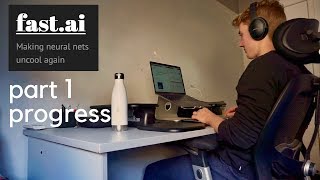
The creator finishes fast.ai Part 1 and documents his setup: one monitor, Jupyter notebook, and a Trello board for tracking tasks. Next he'll take Rachel Thomas's linear algebra course and Jeremy Howard's machine learning course before Part 2, while maintaining his routine of intermittent fasting, 10 PM bedtime, and daily bike rides.
Chapters
Let's take a 5-minute break. We'll come back at 7:45 and we're going to go back to computer vision. Halfway through the final lecture of the fast.ai part 1 and it is, it's incredible. My neural networks training, it's, it's part of the Jupyter notebook. I'm going to let that train. It's time for me to get some breakfast because what is it? It's about 1 PM. I haven't eaten yet. I've been fasting, but look where we go. We've got a few more epochs left. I think that's going to go till 'til about 63. And look at this setup. I'm using one monitor at the moment 'cause I'm in my brother's room. Got the video of the lecture here, Jupyter Notebook here, and all the notes I've been taking down here. This course has been amazing. I'm excited. I've got a whole bunch of, I've got a list of things that I'm gonna go over after. The way I've been, let's step back. The way I've been approaching it is essentially just going through the lectures, zooming through them, writing down little bits and pieces and taking notes on what I need to improve on. Because what the Fast.ai stuff goes through is essentially implementing state-of-the-art models in NLP and computer vision and everything like that. So what I've been doing is taking note, and I've got it— they've got it on my task list today on my, my famous sheet of yellow paper of what I need to go back on. And once I've collated that list, I'll be sure to share it with you. But check it, look at this. I've got a mess. Cups everywhere, scraps of paper everywhere. This is, this is not the ideal study environment. Shoes on the ground. I'm going to clean this up, I'm going to eat, and then I'm going to come back and finish off this lecture. Oh boy, am I excited for this. It's one of my favorite meals. So simple. Just a bunch of eggs, bunch of greens, little bit of vegetables. Top it off with some salt and pepper. Oh, one more thing. Drizzle of olive oil. And voilà, we are finished. We are ready to eat. Look at that. That's a work of art right there. I haven't eaten since, what have I eaten? When did I last eat? A proper meal was dinner. I've been fasting a bit lately, last week or so. I usually don't eat outside of 12 PM till 8 PM, so my first meal will usually be around 12 PM and then my final meal will be around 8 PM. Just because I find in the mornings, if I'm tied to food, it slows me down and I wanna, I do my best study in the morning. And after 8 PM, if I eat too late, it affects my sleep and I'm real, really rigorous on my sleep. I like to get in bed by 10 PM and then be out for the next 7, 8, 9 hours depending on how much I need. But I'm going to get into this and then I need to make a— actually need to make a sauce because we've got some something exciting going on in the backyard. We bought a smoker, so we're cooking some ribs. I don't know if you can see the smoke, but that thing there is packed with ribs. Let's do that and then I'll finish off Fast.ai. Final lecture. Part 1. All right, I cleaned up this room a little, breakfast is done, it's time to get back into some study. Okay Google, stop the timer. Just going back over my notes of the Fast.ai Part 1. I just finished the last lecture and I updated my Trello board. I think it's, it's pretty dark in here. I didn't realize what time. I still had my headphones on. I was in the zone. Check this out. I just updated my Trello board. Actually, let's get some light on. So Trello, if you're unaware, is what I use to track my AI master's degree, or essentially now it's just a bunch of courses that I really enjoy doing and I'm tracking my progress in them. And so I just finished this one. It goes into the done column, right? Fast.ai Part 1, all the video lectures are done. 7 of them, 2 hours each. And now I've just added these 3 bad boys. So they're all the next steps I want to take before going on to part 2 of the fast.ai curriculum. So what's, what's there? We've got a course on computational linear algebra by Rachel Thomas, who's one of the, uh, one of the co-founders of fast.ai, I believe. And we've got a machine learning course by, by Jeremy Howard, which, which he's the main instructor of fast.ai, so it's by him as well. And we've got a few extras that I want to go over in Part 1 that Jeremy mentioned would be good to have before starting Part 2, aka being able to reproduce the notebooks from scratch without watching the videos. So, I'll probably at least be going over the Part 1 videos another 1 to 2 times each just to fully understand it. That's how I, I find I remember things really well when I go back over them. But as always, there'll be links to everything I've just mentioned, the computational linear algebra course, fast.ai, and my Trello board in the description if you want to check them out. And I think it's— the sun's still up. I'm gonna go for a bike ride and then, uh, and then have dinner. It's been a good day of study so far. Safety first, right? I really like the first part of the Fast Today course. Jeremy's a real practitioner, and what I mean by that is, is the stuff he went through was— he's like, I've done this, I've practiced this empirically and learnt over time that this is really good, and here's what I've learned from the papers. And I really like those sort of courses. So if you haven't already checked it out, where should we go, bro? Waterfront it is. That got dark real quick. It's a beautiful sunset, but I like to spend a little bit of time in nature each day without technology, so that's why I didn't bring the camera with me. But next time I'll bring you along. And it's cold. I'm much more of a heat creature. It's time for dinner. We got some ribs cooking. Look at that. They've been on there since this morning. The payoff. I got the head torch on too. I don't know if you can see the screen. And look, look in this. Look at that. That's some heat right there. I'll take the light off. How cool does that look? You got it. We're gonna let them sit for 30 minutes and then we dig in. I'm gonna keep looking at this fire and probably just standing next to it for a while because I love fires. You're nice and warm. Oh, what do we have here, Wham? We got some, I think, 8-hour cooked ribs. Let's unveil. Oh my goodness, look at them bad boys. You keen, Josh? How about you, Slick? Very keen. Hahaha. What about you, Jimmy? Oh, you're dancing for them. It's dinner time. Time to wrap up this episode of the vlog. It's been a good day. Lots of learning, bit of mental exercise with the learning, and a bit of physical exercise with the bike ride. I think it's research day tomorrow at Max Kelsen. I think we're gonna dive into some reinforcement learning. But I'll share with you what I learn. What's my catchphrase, man? Catch you later. Oh, that's one of them, but this one, it's keep learning. Keep learning. All right, keep learning, team. We'll see you soon.