Graduating from the deeplearning.ai Coursera Specialization | Learning Intelligence 22
Daniel Bourke completes weeks 2 and 3 of deeplearning.ai's Sequence Models course, covering word embeddings, Word2Vec, GloVe, and building an Emojify classifier and trigger-word detector. He reflects on MIT AGI lectures by Ray Kurzweil and Josh Tenenbaum, and explores whether AGI is feasible by 2045.
Chapters
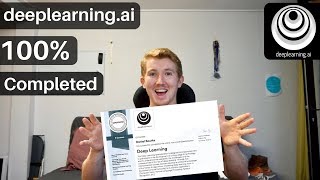
It's quarter past 8 at night and I just finished week 2 of the sequence models course. I'm gonna— I did the whole entire week in one day. So if we go through, we start out, this was Latridge Language, Natridge, Natural Language Processing and Word Embeddings. We go down, I went through these classes, induction, intro— wow, Introduction to Word Embeddings. Can you tell I've been studying all day? Learning Word Embeddings. So what's a word embedding? Imagine like always when a computer wants to understand some data, it can't understand a raw image or it can't understand a raw word. What it has to do is convert that word into a list of numbers. And that's what essentially a word embedding is. Now, if you imagine a dictionary, for example, but if you go through the dictionary and you number the words from whatever it starts at, A to zebra, it's not zebra, but something close to zebra, you'd label it with numbers. That's essentially a the basis of word embeddings. It goes a bit deeper onto that, but that's how, that's how I understand it at the moment. And then what did we do? We looked at word embeddings using Word2Vec and GloVe. They're two algorithms for word embeddings. And then we looked at some applications for word embeddings, so sentiment classification and debiasing word embeddings. Sentiment classification is, for example, if you imagine a movie review, right? And the movie comment, there's thousands and thousands and hundreds of thousands, millions of comments online about different movies. And if you wanted to understand what the movie review was about, humans can't always rate it a certain good or bad percentage. I think this, this may be how Rotten Tomatoes works or something like that. They analyze all the comments and generate a rating. So sentiment classification goes through a comment of something or a bit of text and analyzes, puts out an output whether or not the sentiment was good, bad, indifferent, maybe 1 star, maybe 5 stars, maybe 4 stars. So that's sentiment classification. And debiasing word embeddings is, say for example, you're looking looking at the relationship between a bunch of different words, and the computer thinks that male is more related to computer scientist, whereas female is more related to nurse. Now, of course, that, that has some gender stereotype there. So what debiasing word embeddings does is it removes that gender stereotype and puts them at an equal weighting. So man and woman are equally weighted towards computer scientist and nurse. There's some really fun things there in natural language processing. And then two programming assignments. I'll go over these quickly. Operations on word vectors, so debiasing, we practice what I just talked about, the debiasing. And Emojify, which is really fun, I just finished that one. Let's have a look here. We'll go down. Essentially what this does is, like in, in you type on the iOS keyboard, it brings up emojis. This one assigns an emoji to whatever sentence you type in. So I put in, "I love artificial intelligence," and it put a little happy face there. Maybe it should have been a love heart, but I'm not entirely sure. My model was only about 85% accuracy. And of course, You all know I love working out, so working out is fun. That's the right emoji to put there. And one last thing, I found this awesome— well, this was linked in the bottom of the assignment, Woebot. Now, this is the chatbot to help with mental health, and it was built out of Stanford's research lab, so it's all backed by science. I think this is amazing. So, humans really seem to like me. It's called woebot.io. I'll put the link in the description for you so you can check it out. It's created by scientists. And it's essentially to help mental health. And the beauty, beautiful thing is, because it's a chatbot, it remembers your history. So no longer do you have to go to a doctor or a psychologist or a psychiatrist. It, well, of course they're going to remember it if they're a good one, but you can talk to Woebot 24/7. I was just practicing chatting to him. It's incredible how human-like it responds. And I think that's something that we may be looking into the future in terms of interaction with computers and machines. It may move something more towards this. And certainly that's, That's where I'm looking to go in terms of the AI and health space. More so health and fitness rather than mental health. But these things can definitely help us out because there's definitely a shortage of doctors, there's definitely a shortage of nurses, and you can't always get to these people on time or not even on time, but just our lives are busy, right? And so having these things on hand is really gonna be beneficial for society. I just finished going for a morning walk. I like starting my day off like that. And man, it's hot outside. I've been listening to this really cool audiobook. I don't know if you can see it. 12 Rules for Life by Jordan Peterson. I'll link it in the description. If you haven't seen Jordan Peterson before, check out his stuff on YouTube. He's an amazing psychologist. I'm gonna have a quick shower and then get into the code for today. You know what the orange screen means? Means I've been staying up late, and it is probably the latest I've stayed up coding in a while. What's the time here? 11:30. But it is with all good cause because I set myself a goal today. I wanted to finish week 3. I think I saw you this morning, and I wanted to finish week 3 of the Coursera, the final course of the sequence models course. I'll show you, I'll show you where I'm up to. So this is the final assignment. So trigger word detection. Welcome to the final programming assignment of this specialization. What's trigger word detection? Well, you ever seen Google Home? Okay Google. Or Alexa? Alexa. Or Siri? Hey Siri. That's all trigger words, and that's what sequence models can be used for. If you train a dataset or train a deep learning model on heaps of different audio, on certain words and when whatnot, you can create a microphone that listens to, or sorry, a program that uses a microphone to listen in the air, all those little noises coming through the air and picks out the exact sound waves it wants. If you imagine that as a sound wave and we want this one, that means the microphone is listening for this one so it can activate and listen to what you're saying here. We built our own trigger word detection. So the trigger word was activate. We play a little audio here. Oh, is this gonna work? Activate. There we go. Activate. So that's a positive example. And then we'll give you a negative— referee. That's a negative example. And then some background noise. So it's just some ambient white noise. And then we go right down here at the bottom. I'll show you what the goal was. The goal was to output a little model here that has a chime whenever someone says activate. And this is the start of where models like Siri and OK Google, this is how it all starts off. And then you can use instead of the chime, It'll be listening for your voice of what to tell it to do and then reply with a certain action. So, let's look here. Activate innocent. Activate baby. And a really cool thing, I made my own. So, check it out. Let's activate this little charm. Activate. Kind of sounds like that chime that comes on on the seatbelt sign, like on an airline. Well, that's what I think it sounds like anyway. Last night I broke the door on our oven upstairs, shattered the glass completely. So I was trying to source somewhere to fix that for us, for the family, so, so we can eat food. I'm kidding. Well, we can still eat, but we just can't use the oven. I was also helping out my brother with his AI assignment. He's doing a course from MIT actually that's using AI in the business world. So he's going into an accounting role. So that was really fun to look at what the perspective was of using AI in the business world. Of course, I'm excited about AI in any aspect, but my, my passion and foundation lies in AI and health. Anything to do with AI excites me. And I tell you what, I'm also really excited because check this out. So the Coursera deep learning specialization, we can officially mark it off. Look, this is a trolley board and my screen's orange because it is, it is again well past sunset, but we're going to take this off here and we're going to take this off. Course 5, sequence models, is officially done. And then we can drag this over into the done in the February column. Little day, little few days overdue, but that's all right. We still got it done. Congratulations. You have successfully completed sequence models and the deep learning specialization. I have no idea why I'm talking like that. My final grade for this course was probably the highest one I got actually. 97.2, 97.8, 99.5 for the final course, deep learning. I finished the entire thing. Look at this beautiful certificate that you get at the end. deeplearning.ai, Daniel Bourke, sequence models, signed by the man himself, the legendary Adjunct Professor Andrew Ng, Computer Science. What an amazing course, guys. On top of that, it's now on my LinkedIn. If you guys want to add me on LinkedIn, I'll put the, put the link in the description so you can. We've got 9 certifications now. Sequence Models, Convolutional Neural Nets, Improving Deep Neural Networks, etc., etc. And of course, we're still going with the Udacity Artificial Intelligence Nanodegree. There is no shortage of work to do here, guys. As I said, uh, well, as As my philosophy goes, I'm not entirely interested— certificates are great, don't get me wrong, I really love it, but the skills is what I'm looking for. That's, that's really important. The certificates are just something that you can, you can sort of prove to someone else. Like, if I was to go for a job, I would look, I've got this certificate, rather than just saying, hey, look, I know about sequence models. But I'm a big advocate of letting your work prove that you've got the skills. So, that's where these videos come in, that's where these blog posts that I like to do come in, and that's where Contributing to open source, that's really important. So if you're going for a job, it's showing the employer what you can do, oh sorry, what you've done, sorry, yeah, that's right, what you've done rather than what you can do. Because anyone can string together a sentence and say, oh yeah, I can build an AI model that can decrypt the human genome and decipher what you need to eat every day, every hour of the day. But it's another thing to have actually built something that can do that. That's a really cool point. I just finished watching two lectures of the MIT AGI course. The first one was on future of intelligence by Ray Kurzweil. And the second one was, on Building Machines That See, Learn, and Think Like People with Josh Tenenbaum. And there's a photo of Ray, Ray Kurzweil, and Josh Tenenbaum, I believe, is there. And those, both of those lectures, it wasn't even, they excited me. I didn't even feel like it was that stressful. I mean, they're explaining some hard concepts, but it wasn't, I was having fun. I mean, that's a really good place to be in when you're learning something that you're actually really enjoying. And so that's where I was with these two lectures. These two courses offered by MIT for free are incredible. I'll leave a link in the description for both of them so you can check them out. Self-Driving Cars course and this one is Artificial General Intelligence. But I had one major takeaway from both, both videos. So, the first one was from Josh Tenenbaum's video and the idea was using, modelling the, how children learn or how babies discover physics in the world to reproduce general intelligence systems or intelligent systems that can progressively learn on their own. Because that's where we're going to end up, right? If we, well, if we want to build systems that can, or robots or something like that, that can help us in the physical world, I mean, now AI is great at doing things in terms of data processing on a computer, parallel, using heaps and heaps and heaps of CPUs across major massive cloud computes for things like image recognition or speech detection or natural language processing. But if you want to have an actual physical robot in the world, like something, something here, That could help me out, my little power robot here. Doesn't exist quite yet, but maybe, maybe future Dan knows one. We have to model how children think or how babies learn and how they come into the world. And the concept, or the concept to take away from that is how do you develop the game engine of intelligence or the game engine of your own mind? Now, I thought that was really cool. So, if you imagine like video games, they have a game engine so they don't have to hard code every single piece of graphics into the game. They have the game engine which generates it on the fly. And that's a really similar analogy you could use. How do we develop our own game engine for the mind so that rather than an intelligent system reproduce every single scenario it's ever been through, how do we create one so it's got some principles that it can adhere to and make something on the fly? That was really cool. And the second one was right up my alley in the healthcare space from the Ray Kurzweil lecture. And if you've never heard, he's, he's got a really good book called The Singularity. He's got a few books actually. He works for Google. They bought his company after it was only started 5 weeks or so. He's a really, really smart guy in terms of the technology field. His books are all about predicting the future or not in terms of predicting the future, but just using mental models of today to try and understand what's coming next. And he's got some very good, very good predictions, very good track record. But his was on escape velocity in life expectancy. And what does that mean? Well, at the moment, life expectancy is a measure of how long statistically you will live once you're born, right? But it's It's sort of flawed in the way that the number itself is based on the fact that there'll be no scientific progress in your life, but that's completely wrong, right? Every other week we're hearing of an AI breakthrough or a biotechnology breakthrough. And so, Ray said the life— the explosion or the escape velocity of life expectancy is about 10 years or so away. So, if you're diligent and you can— you take care of yourself and you make it through the next 10 years or so, life expectancy or your life expectancy, my life expectancy, kid who's born tomorrow, their life expectancy will increase faster than time itself. What does that mean? So, say, say for example, my life expectancy is 80 years old or something like that. Now, within 10 years, based on Ray's prediction and the advancements in technology and biotechnology and AI, every year my life expectancy will increase more than my age. I find that mind-blowing. And because I'm sort of interested in the AI and health space, that is my— why those two things, or well, that thing from Ray's talk is my favourite takeaway. What's for next week? Well, I just checked over the NLP, Natural Language Processing section in the Artificial Intelligence Nanodegree. Here's the classroom here. I updated the Trello board to have some of the, some of the tasks I need to do. There's the lesson plan if you want to check that out, Natural Language Processing lesson plan, and there the classes are part of it. Of course, this link will be in the description. Now that was a lot of rambling on, but it's time for some shoutouts of the week. I think I'm getting better at that. And now these people reached out to me via YouTube comment, via email, via Twitter. You can contact me anywhere if you like. All my links are in the description below, of course. Otherwise, my email is daniel@mrdbourke.com and my Twitter is @MrDBourke. First of all, Akash from the email space, thank you so much and well done, my friend, on learning for free. That is amazing. That is one of the best things you can do in this world. And that is why we are so privileged to have access to the resources we do. I have paid for some of the courses I've done, but I do not regret that because they have been high-quality courses. But that being said, you can certainly learn a lot of whatever you need to know. Almost, actually, let's just say with the internet, you can probably learn exactly what you need to know without paying a cent because it is that great of a resource. Guys, we are so lucky. I thank her. I, I, can you imagine 30 years ago trying to learn something without the internet? I don't even know where I would start, right? I talked to my mum about my assignments and whatnot in high school. She's like, I had to go to the library and handwrite things and look for books and stuff like that. I didn't have the power of being able to search through Google. I digress. Thank you so much, Akash. From the YouTube Space, we have Dimitrios. Yes, I totally agree. Do I ever feel if I'm learning something but not actually learning it, do I not get the concepts? And I think as humans, we are very visual, right? So, if we take in something on a screen, whatever it may be, I tried to pick up an example I don't have one close. But if we take something on a screen and we visually see it, we can see it. We see lots of things, right? But then if we see it again, because we've seen it in the past, it can be sort of a trick that we understand it, but really we don't. We just recognize it visually. We don't understand underlying concepts behind it. And I think this is where compound learning comes in, for me at least. It's where I learn something. I like to— yeah. It's like learning something for the first time, you know, you sort of, you get the visual picture of it. And then learning something for the second time, you sort of start to understand like the wheels behind it, the wheels that are actually making that beautiful car move. And learning from different sources, this really helps with compound learning. And I think that's where myself, in my case, combining the Deep Learning Nanodegree with the Deep Learning Specialization on Coursera, it's two different approaches to a similar topic. And I, like, that has cemented my knowledge. I've, I've, I'm so thankful that I've gone through both of those courses and I really recommend that to you if you want to. If you're doing the Nanodegree, if you're doing the Coursera, try to learn from different sources. It doesn't have to be the exact same ones I've done, but try to find different sources. So, someone else's point of view and then, most importantly, create your own point of view on it. And so, that's, that's the idea of compound learning. Well, that's what I like to think of it as. Dimitrios Yes, I definitely get that thing of learning something but not actually learning it. But the way I get around that is just keep going with it, keep revising it, teach it to someone else. It's kind of the reason I like to make these videos as well. Although I haven't made really in-depth educational ones, just talking about it helps me to learn more. And finally, uh, Sarah Vannan, thank you so much. And the computer I use is a MacBook Pro. It has the Touch Bar, the Touch ID, probably the best feature on it. I actually I really love it. 13-inch MacBook Pro, 512GB solid-state storage, i5 core processor, I'm pretty sure. However, all the major deep learning models that I run on it are through the cloud. So through AWS, through Google Cloud, through FloydHub. A lot of deep learning models are far too complex to run on my local machine. And that's what I think you'll find with any laptop almost. It's— unless you have an external GPU, it's going to be very hard for you to run deep learning models at speed, or at least big deep learning models on your computer, until we work out a way to make simpler models or faster computing in a smaller space. So thank you to all of those who have reached out to me. And of course, guys, feel free, as I said before, you've got my contact details. Reach out, ask me any question, I'll do my best to answer it. We have one last thing, which is the question of the week. I'm starting this and trying to remember to do it every video. Question of the week this week, the best comment, leave a comment, I'll I'll shout you out in the next video when we can talk about it more. What are your thoughts on AGI? Does it exist or can it ever exist? AGI is artificial general intelligence, right? Can we solve it by 2045? Why 2045? Well, that's the date when Ray, in one of the videos I, I watched this week, Ray Kurzweil predicts the intelligent singularity. If you've never heard of that, Google it because this video is far too long already, so I'm not going to explain it. What are your thoughts on AGI and can we reach the singularity by 2045? Leave a comment below. I'll talk about the next or the best comment in next week's video. Well, thank you so much for watching. As always, keep learning.
More from Daniel

Small Language Models (SLMs) Are the Future: Fine-Tuning AI That Runs on Your iPhone

Introducing Sunny - A MedGemma-Powered Skin Health Tracking App (Kaggle Competition Entry)


Benchmarking: NVIDIA DGX Spark & NVIDIA RTX 4090 | Part 4 - Comparing the results

Benchmarking: NVIDIA DGX Spark & NVIDIA RTX 4090 | Part 3 - Running LLMs on the RTX 4090

Benchmarking: NVIDIA DGX Spark & NVIDIA RTX 4090 | Part 2 - Formalizing the tests

Benchmarking: NVIDIA DGX Spark & NVIDIA RTX 4090 | Part 1 - Creating a series of tests


Local Multimodal RAG on the NVIDIA DGX Spark | Part 4 - Publishing our demo to Hugging Face


Local Multimodal RAG on the NVIDIA DGX Spark | Part 3 - Putting it all together