How I made my first $1500 online: The 2-Year Self Apprenticeship
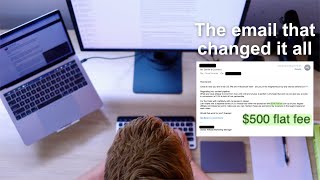
Daniel Bourke got his first $1,500 online from a Coursera sponsorship in 2018, after spending two years teaching himself coding and machine learning while living in his parents' garage and driving Uber. He made daily videos, articles, and a podcast to build an audience, proving that consistent creation eventually attracts paid opportunities.
Chapters
5, 4, 3, 2, 1. September 29th, 2018. I got an email that changed my life forever. And actually we got, well, a follow-up email to that was on the 3rd of October, 2018, because we went back and forth a little bit discussing it. But the real one was the 29th of September, 2018. And now, where did this email come from? It was from an online learning platform called Coursera, and if you haven't heard of Coursera, you can go to coursera.org and check it out. It's, it's basically like an online university for different skills. And now you might be thinking, why would Coursera, this online learning platform, reach out to me? Well, this video is about how I earned my first $1,500 online. And why $1,500? It sounds like a really specific amount? Well, first of all, it's because it is, but second of all, because it's $1,500 to— if you're making zero online, which is what I was before, this is a lot of money. And it's, it's not too large of an amount that if you're not making money online at the moment— because that's what kind of this, this video is about, how to make money online— if you're not making money at the moment, you could watch someone else's video and see that they're making thousands, if not millions of dollars online, and you think, wow, how do I go from zero to that? Well, going from zero to $1,500 is a lot easier to start off with than going from zero to a million. That's what I'm working towards at the moment, but this is how I went from zero to $1,500. And so Coursera sent me this email saying, hey, do you want to partner up, uh, make some videos on your channel, and we'd like to sponsor them? Why $1,500? Because it was $500 US each video. So I live in Australia, so that converted to more, more than $2,000. So prior to this, I'd earned no money making things online. And now you might be wondering, why is Coursera sending me an email? If I— if you've never heard of Coursera, you could be thinking, well, that's strange that an online education platform reached out to, to little old me. And I thought of it too because— actually, we might get rid of this. We'll use the whiteboard in a second. But the point here is that in 2017, so a year before I got this email, I'd started on what I like to call a 2-year self-apprenticeship. Let's write that down. This was the first thing. Now, 2 things you have to know about me before we get into the rest of this video is I— well, 3 things actually. I now make money online. I employ myself. That was my goal the whole time of doing this 2-year self-apprenticeship. And the second one is that I'm an idiot. Why? Well, because I should have started something like this, what I do now, a lot longer ago. Earlier than 2017, earlier than 2018, that's for sure. I already knew that I wanted to do this thing. I just took so long to do it. And number 2 is that I'm not special at all. My only talent is showing up and— actually, I got 2 talents— showing up and being insanely curious. Now, if you're in high school or just out of high school, someone might tell you, don't be curious, don't be ADD, don't be, don't dig into things, don't dive into things. But really, it's kind of the, the internet allows you to kind of do the opposite. If you're interested in something, you can get after it. And what was I interested in? I was interested in learning to code, right? So, I worked at Apple for a little bit and I decided, you know what, instead of selling these devices, I worked at the retail store as a genius. Instead of selling these devices, I'd like to make things that would live on these devices. So, I'd like to build things rather than just service them and help customers, of course. And so, I'd already been to university by this stage. It took me 5 years to do a 3-year university degree because I failed the first 2 years. So, I was already in a large amount of student debt and I decided, well, rather than go back to university and teach myself or learn how to code, I'm gonna go online and teach myself. I'm going to, to do a 2-year self-apprenticeship. Now, the reason this came about was because I went to university some sort of open day and inquired about doing a computer science degree because I thought that's what you do to learn how to code, to learn how to build things. And it is, that is definitely one viable option, but when the lady told me that it was $42,000 per year, I was like, you know what, I've already spent enough time in university and I've already know kind of exactly what I want to do. I'm reading this curriculum and it's not, it's not exactly what I want to do. So, I'm just going to go online and do it myself. And that was 2017, right? I made my own self-created artificial intelligence master's degree. And now I put it in inverted commas, right, because it's, it's not official. It's just a blog post that I put together myself and created it and went through it. I went through my own curriculum to teach me how to code, to teach me about machine learning, learnt it all using the computer that sits behind where the camera is at my desk. And I made a whole series of learning online, and that's the key point there. Was part of my 2-year self-apprenticeship And we're going to loop this back to where the email came from. Just give me a second. Part of my 2-year self-apprenticeship, my end goal was to learn how to code, learn how to build things, eventually employ myself. Now, you might be wondering, if I'm learning how to code, why not go work for a big technology company? I thought I wanted to do that. I thought I wanted to do that. But truthfully, if I was being really honest with myself, and this is what's important for you as well, is that was, that was a good goal to have. That looks good on paper. If I got a technology job at a company such as Google, such as Facebook, or whatever, that looks good on paper. But when I really dug deep inside myself, I asked, am I trying to, to build a life or build a resume? So working at Google, working at Facebook looks great on paper. but I was more interested in building a life rather than a resume. So, that's another one that's worth writing down. So, this is what you have to ask yourself, and for me, I was choosing life. Design your ideal life and work backwards from there. So, that's what I did. That's what was it. The 2-year self-apprenticeship, I was studying in my room, learning exactly what I wanted to learn online, but the crucial point here was that as I learned things, Because I was learning in my room, I was pretty lonely. As I learned things, I was sharing them online relentlessly. And this room I live— I still— this is my old parents' garage. And so, the way I employed myself was I kept my expenses ridiculously low, living in parents' garage. I drove Uber on the weekends to pay for the courses I was doing online, and I made videos and articles almost every day posting about what I was doing, how I was learning it, and what I'd learned that day. And so, this was hands-on, 2-year self-apprenticeship, not only learning the skills but learning how to communicate those skills. And so, this is where the email come from, because Coursera was one of the platforms that I was using to learn, they reached out to me and go, "Hey, we saw your video on learning something about machine learning and we'd like to sponsor some videos coming up in the future if you're gonna, if you're gonna make them and mention Coursera. So that's where that initial funding came from, but that would have never have happened if I didn't start creating, if I didn't start choosing myself, choosing to rather than Rather than spending $42,000 at university, I was— my mindset was I'm going to invest that same amount of money, and really learning online was not even a tenth of what that cost. You could always do it for free, whatever skill you want. That's the beautiful thing about the internet, is that with the internet now, you don't have to wait to be picked. If you decide that you want to create something, you know exactly where you want to go, and it's okay. You might not know. The really important thing is to, first of all, you've got to think about, am I trying to build a resume or am I trying to build a life? For me, it was, it was building a life, and I did that through a 2-year self-apprenticeship. And so once I realized I could start to make money online with my creations, in the beginning I was actually a little bit hesitant. I knew deep down I had this poke in my side that I was going to employ myself eventually. I just had this feeling. Of all the jobs I've had, they've been amazing. Working at Apple, working at a technology company in my own city, but I always had this little itch in my side to finally go, okay, I'm going to employ myself. And so that's why I was creating Relentlessly. So that's, I think there's two points there. If you want to start making money online, keep your expenses low. And if you do want to invest in something, invest in yourself. And number 2 is create relentlessly. This whiteboard is wobbling tremendously. And now, that's how business works. If you create something of value and you put it out to the world, eventually people are going to want to pay you for it. So, if you were coming— I have to apologize as well— if you were coming to this video for an exact answer of what you should be doing, my answer is pretty vague. But the 2-year self-apprenticeship, I can tell you, I'm biased because it worked for me. But if you have— and I learned code, I learned all these things that are pretty— like, you can learn them online relatively easily. Of course, it takes effort to learn. But if you have something you're interested in, say for example, my little brother's getting into photography. He's learning by taking photos and posting his photos online. And sharing them relentlessly. He's creating relentlessly while keeping his expenses low. He's not going for a certificate to put on the resume. He's going for a life that where he can wake up, choose what he wants to do that day, take photos, post them online, bring people value. That's what business is. It is, are you bringing people value and enough value that they want to pay you for? And if you're stuck not knowing what to make, if you're wondering what people are after, start with yourself. What do you want to see in the world? So, let's put down here, that'll probably be the last one. That's a tough question to ask, a tough question to answer. It takes bravery to be specific. And when you do eventually take some time to ask yourself, what do you want to see in the world? You might start on something like a 2-year self-apprenticeship. I'm going to teach myself online. And at the same time I'm going to create relentlessly and my creations are going to improve over time and then eventually someone might reach out to me like Coursera and offer to pay me for future creations. When you first start out, your actions will be going like this. Maybe we should have drawn this graph, but you can imagine this one. Your actions will be going up and up and up and up because you'll be making things, you'll be learning things, you'll be putting your work out there. You'll be sharing with the world, but your results won't match your actions to begin with. So before I got that email from Coursera, the $1,500, I'd made videos for a year not making any money. My first 30 videos, you can look them up, they're still on my channel, are me sitting in my car talking. I started a podcast, a podcast a day for 100 days. Why? Because I just wanted to get better at talking in front of a camera, better at speaking, better at making things online. So I just said one a day for 100 days. And that's probably what we can sign off with. So the results won't always match, match your actions in the beginning. It's going to take time for, first of all, the way business works online is that if you're— or business works is people usually pay for quality. So in the beginning, if you're terrible like I was, people won't necessarily want to pay for that. But as you improve, then you've got something to offer other people. So, ask yourself, what do you want to see in the world? Can you start a 2-year self-apprenticeship? I'll leave an article below which has a bit more detail about that that I wrote on my blog. Are you trying to build a life or a resume? That's a really hard question, right? I chose, I'm trying to build a life, right? I'm not, I didn't need a very high-paying job. I keep my expenses low. And I prefer to create relentlessly whatever I want and not be held back by the name of some corporation. I like to put my name on what I create. But that's it, how I earned my first $1,500 online. $1,500 is life-changing. That email changed my life. It turned what I thought was just me rambling on and posting videos into, okay, this is actually something I can do for a living. And really deep down, I knew that the whole time. But leave a comment below if you have any questions. I'm happy to answer it as best I can, or I'll also leave my links in the description. You can reach out to me. But thank you so much for watching. And whatever you're interested in learning, keep learning, keep creating. I believe in you.
More from Daniel

Small Language Models (SLMs) Are the Future: Fine-Tuning AI That Runs on Your iPhone

Introducing Sunny - A MedGemma-Powered Skin Health Tracking App (Kaggle Competition Entry)


Benchmarking: NVIDIA DGX Spark & NVIDIA RTX 4090 | Part 4 - Comparing the results

Benchmarking: NVIDIA DGX Spark & NVIDIA RTX 4090 | Part 3 - Running LLMs on the RTX 4090

Benchmarking: NVIDIA DGX Spark & NVIDIA RTX 4090 | Part 2 - Formalizing the tests

Benchmarking: NVIDIA DGX Spark & NVIDIA RTX 4090 | Part 1 - Creating a series of tests


Local Multimodal RAG on the NVIDIA DGX Spark | Part 4 - Publishing our demo to Hugging Face


Local Multimodal RAG on the NVIDIA DGX Spark | Part 3 - Putting it all together