How to be more self-reliant: The Jester Physicist Approach
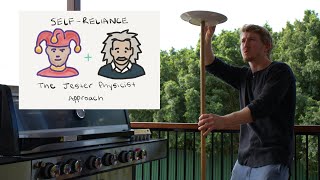
Daniel Bourke presents the "Jester Physicist" approach to self-reliance: combine playful curiosity with analytical rigor across four areas—spirit, health, wealth, and relationships. He emphasizes removing excess rather than adding more, treating movement as play, and keeping all four spinning in balance.
Chapters
Now, the Jester Physicist, I came up with the term this morning actually. Well, probably not, it's probably not that original. But, oh, listen to that sizzle. That's how you know, that's how you know you're on the right path there. Now it's important that these, these onions and mushrooms won't, will take a little bit longer. Than the steak we're going to cook. So we're going to put them on first. But where does it come from? The jester physicist. Well, what does a jester do? They play around, they jump, they jive, they dance, they have a little fun. The jester is seen by a fool by many, but not by the people who know, and most importantly, not by himself. And now where, where does this physicist come in? Why, why is that helpful? Well, what does a physicist do? They experiment. They try things. They think of the world in first principles. They take things seriously. They have fun. Once again, we find balance at the extremes. Now let me tell you who my favourite physicist was, or who my favourite jester— jester physicist was. Richard Feynman.
Now I'm going to discuss how we would look for a new law. In general, we look for a new law by the following process. First, we guess it. Then we compu— well, don't laugh, that's really true. Then we compute the consequences of the guess to see what, if this is right, if this law that we guessed is right, we see what it would imply. And then we compare those computation results to nature, or we say compare to experiment or experience, compare it directly with observation to see if it If it works.
You might be wondering, why, why, why, Daniel, why is Richard Feynman a Chester physicist? Well, if you don't know, he discovered the theory of— what's it called? Quantum electrodynamics. Just a small little thing, you know, just how light interacts with matter. So pretty full on in that case. But also he liked to play jokes on people, practical jokes, like nothing malice, like just a little bit of fun. He liked to crack safes. I think that's why a lot of people, including myself, look up to him because he had the balance from both extremes. He had the gesture, the jester. It's a funny word. I'm trying to practice saying that. I should have practiced saying that a bit more before this video. Oh well. He looked at life through the lens of a physicist, through first principles, getting as low as you can go basically with quantum mechanics, and then through the eyes of a jester. Like just understanding that everything around us is just fun and a chance to dance. That's what every day is, right? And so where does this, where does this tie back into self-reliance? Well, I've got a prop for that. So this is where we're going to tie it in, the Jester Physicist approach to self-reliance. If you imagine life as you've got 4 sticks. And now on each of those sticks, another tool. See, this is the beautiful thing about cooking is that you've got so many tools you can use them for analogies. On each of those sticks, we've got 4 of them, remember? 1, 2, 3, 4. Pretend I'm spinning this plate, and I'm not going to pretend to do that because I'm going to drop that plate, but let's pretend we've got a plate up here. And the 4 sticks, each of them is analogous to: 1. The spirit. 2. Health. 3. Wealth.
4.
Relationships. And now, you might have heard this before about the 4 pillars. You can really customize them to whatever suits your needs. Let's get these steaks on and we'll elaborate on this theory of the Jester Physicist. Look at this. See, that's a beautiful steak from a local butcher. Shout out to Tim. I like buying small, supporting small businesses. Beautiful. Now, come on, back to me. Steaks are important, but the chat's more important. A good cook always cleans up as he goes. Put this in the bin. You might be thinking, okay, wash your hands. Where does this all tie in? Right, where are these? Why? As I said, you might have— where's the tea towel? Here we go. Boom. Now, as I said, I'm going to turn these down to low. You might have heard that the story we just talked about, the spirit, the health, wealth, relationships, as the four pillars. Now, I like that analogy of them being the four pillars of life. Because a lot of things in life you can sort of just deduce down into those 4 categories. But my idea, I prefer it as a spinning plate because if they're just pillars, a pillar usually stands up on its own. But if you have to spin plates, if you have to spin the plate of the spirit, you have to spin the plate of the health, you have to spin the plate of wealth, spin the plate of relationships, that implies that it requires consistent effort, which is true. And if we're moving towards self-reliance, if we're thinking of things in first principles, if we're thinking of things, we're looking at the world through the eyes of the jester, through the eyes of play, through the eyes of fun, through the eyes of dance. All right, we're coming back to these 4 pillars, these 4 spinning plates, and we're bringing things back to first principles because within each of them Right, you've got the spirit. What would be— how would a physicist approach the spirit? They break it down into first principles. So, are you spending time getting in touch with your God, whatever that is? It could be God if you're from the Christian religion, it could be nothing, it could be your ethics if you don't believe in a higher power, it could be the universe, or if you're a technology freak like I am, it could be artificial intelligence, maybe that's your goal. But whatever the case, usually the trends along all of them, whatever belief you have in terms of the spirit, there is some part of connecting heaven and earth. And by that, of course, I mean metaphorically. Heaven can be whatever you want, but it's connecting some sort of energy that you can't describe into the material world. That's what the first principles of the spirit would be. Now, whether you do that through some form of art, And if you don't have some form of art, you definitely should. And whether you do that by sitting around doing nothing— man, this barbecue is rip-roaring hot! But that's how the physicist would look at the spirit. Now, how would the jester look at the spirit? Well, same thing, right? It would still— this is why it's called the Jester Physicist Approach. You will look at the first principles and just realize, wow, each of these The connecting to heaven and earth, say for example, if I, I might, one of my crafts that I enjoy doing is writing. And so for me, that is channeling the muse wherever it is. I have to show up and I have to play. I have to tap dance between different words. Or if you're a programmer, you might want to think is like, how do I program this computer to do the thing I want? How do I get this computer to dance for me? We're going to get some eggs on. And then we'll go to the next spinning plate. Oh, look at that! You know what? These steaks are gonna be ready sooner than I thought. We need to get 2 eggs. You want an egg? Yeah? Alright, now the health. Health from First Principles. I'm gonna quiz you while you're watching this video and watching me crack these eggs. What is Health from first principles. Now, this one's quite simple. Things get complicated when you start to add more to the system. See, that's a— oh, that's a tip for you. Health improves via negativa. What I mean by that is actually a lot of things improve via negativa. The spirit improves via negativa. And what I mean by that is by removal of excess. The same with health. Now, if we go to health by first principles, what is it? Food, movement, sleep. They're the foundations. That's the physicist approach to it. Now, what about the jester approach? Well, the jester, well, the jester likes to dance. That's a form of movement, but it also is a stress relief, and that is the big, the big, big detrimental part of your health. So, the jester looks at the world, I said again, I'll say it till I go hoarse, in a playful manner. Understands that waking up in the morning is a chance to dance. And so if we're going back, we're approaching, we're becoming self-reliant— by self-reliant, I mean taking care of ourselves so that we can contribute back to the rest of society in whatever way that may be. We're taking care of our health through the eyes of the Jester physicist. Now, for food, and there's many different doctrines, as many different doctrines of eating as there are of religions. I mean, this kind of meal you'd probably classify as keto, but I don't really follow any sort of one specific doctrine of eating. And now the most important point about all of the spinning plates is that the beautiful thing, and the most beautiful thing, the most important, most beautiful thing— that's another one for the spirit, by the way. Look at things of beauty, create things of beauty. Like, there's a girl with blonde hair I see every morning when we go for morning walks. She's got a smile that'll light up a thousand night skies, and it warms my heart. So that's one way to get in touch with your spirit— look at beautiful things. These steaks are actually nearly done. The most important point of the spinning plates philosophy— we'll turn those right down to low, actually. Is that you can start wherever you are. So wherever you are in terms of your spirit, your health, your wealth, your relationships, you can start there. So what were we going back to? Food. If you want to approach health from first principles, of course, food, what you put into your body. Now the simplest one, the simplest two things that I can give you for that that, even after studying nutrition and doing a whole bunch of experiments on myself of best ways to eat, is avoid things which take multiple steps to get to you. So, for example, things that are in a packet. You might say, "Oh, well, Daniel, that— the eggs you got, the eggs come in a packet." Yes, but they have one step. They're made from a chicken. It's simple, one-ingredient foods. We've got 4 ingredients on this on this plate. Now, if you eat foods that are ultra-processed and have more and more ingredients, what did I say right at the start? Health improves via negativa. So, you remove them. So, that's it. Avoid processed foods. Done. That's tick number 1 for food. And number 2 is eat less often. So, what time is it? Sam?
Yeah? 12 o'clock.
12 o'clock, yeah, midday. I haven't eaten yet, so food is my reward for doing things. And what are those things? Whatever needs to get done, right? And the same goes for sleep and movement. Movement can be whatever you want. It could be a dance. Remember, we're Jester physicists now, so we get up every morning and we're jumping and we're jiving. It's also a proven fact that whatever you're cooking taste better when you're dancing. That's movement. Just get a little active each day.
Go for a walk.
It's a basic human necessity, going for a walk. And then sleep. It's like, go to sleep when you need. Don't sit on your smartphone while you're in bed. And just make sure your room is as dark as possible. And so those things— oh, and the biggest one, remember, Stress. Again, through the eyes of a Jester, a physicist would look at health and break it down into food, sleep, movement. But the Jester remembers, "Oh, stress, the thing you can't really measure." That is a big one. So, we're spinning plates. What have we taken care of? We've taken care of the spirit, we've taken care of health, and of course, What I've just said requires to be put into practice to be actually taken care of. And now wealth. We'll take care of wealth or relationships. And now why do I stress the spinning plates is kind of a— it's an engaged movement. Well, the thing is, you're never really going to know in life is when one of those plates is going to take a fall. I just want to remind you to have a little thought experiment of how good your track record is with predicting things that are going to happen. If you can predict something, it's already the past. The most denture— the most significant events in our lives are the things we can't predict. These steaks are done, look at that. That's beautiful. Oh, another one for food is learn to cook. One of the, one of the best feelings in life is being able to cook a meal for yourself or cook a meal for yourself and others and then share it. So if you don't know how to cook, learn how to cook. I'm going to go get a spatula and then we're up to the third plate, which is wealth. Spatula. Now, wealth. How much do you need? Well, basic necessities. The beautiful thing about life is that nature, nature gave us most of the things that we need, are quite accessible now. You see, the curse of modernity is being told that we need far more than what we actually do. And so I'm not gonna pretend that I'm sort of some philosophical robot here and say that I don't indulge myself in the materialistic world. I bought a jet ski when I was 22 or 23 or something like that. It cost $22,000, very expensive for me at the time, basically all of my savings, because I thought I wanted it. I thought if I have this jet ski, it's going to make me happy, it's going to fulfill my hopes and dreams. And everything will be great, everything will be complete. And you see, I was very quickly shown the right answer after owning it. It's funny how— look, come on, sit. You chilling out. You don't need it. You just need food and play.
Yeah.
It's very funny how it works like that. You think you need something and then eventually you get it and you realize, oh wow, I didn't actually need that thing. And so that was the best financial decision I ever made. Was in investing in that because it taught me that, you know what, no matter what, no matter what the material good is, I don't need it. I derive pleasure from other things. I derive pleasure from creating. I derive pleasure from, as I said, from the other pillars, from connecting heaven and earth. But that doesn't mean that I'm not taking the spinning plate, the spinning plate of wealth. Seriously, if I want to be self-reliant, I need to take care of myself financially. I need to— if I take pride in the fact that I can support my family financially, I need to take care of my wealth. And so what does that mean for me? It means having enough to be able to buy food. It means having enough to be able to pay bills. It means having enough to keep working on the things I want to work on. Now, again, your spinning plate may be higher or lower than mine. Now, the trap is, is when one of them gets too high. So, for example, a really easy one to understand is when someone like me, for example, when I bought the jet ski, is when my wealth, my material wealth plate was getting really high and I'm trying to spin it up here. And so what happened to all the other plates? They all fell off. And so what you'll see sometimes, or fairly often actually, is when someone is dedicating, for example, they're trying to earn too much money and they're going up here, the wealth's going up here. Oh yeah. What happens? The spiritual plate, whoops, the health plate falls off. The relationship plate falls off. And see, that's why I like the analogy of the spinning plates instead of the pillars, because a pillar, one gets higher, it doesn't usually mean that the others fall over. But if you're a Jester physicist trying to maintain spinning 4 different plates, if you focus too much on one, pshh, the other ones go down. And so finally, relationships. Now here's a great one to reflect on. Or to remember why it's always a work in progress, the spinning plates, and why self-reliance is always, always something you have to— it's an engaged activity. It's not just a passive activity. It's— let's finish this off.
We've got—
we've taken care of the first 3. The final one is relationships. They're all— all of these are as important as each other, right? And depending on where you are in life, one may be more important than the other. So for example, at the moment, my most important are spirit, health, wealth. I've been focused on them a lot. Relationships, of course, but the relationships with my family, with myself are, are pretty sound at the moment. Who knows? That may change in the future. Um, but in the past, I'll give you an example of a track record. So about 5 years ago, I had a girlfriend, significant other. So that's part of relationships. We're looking at relationships from first principles. Do you have a significant other? How are your relationships with your friends and family? How are your relationships with yourself? That would be how the physicist breaks it down into first principles. And so 5 years ago, I had a girlfriend, and we moved into her apartment. It's really hot, we just moved furniture, so it's like, no, we're not gonna unpack, we're just gonna lie on the ground. Lay on the ground. And we're like, had one of those moments. You know those moments? If you've ever been in love, you probably understand this. It's when you're so in love, you don't know what to do with yourself. That's the stage we were at, the honeymoon stage. And looking into each other's eyes on the floor of this new apartment, sweaty and just like, where do you see yourself in 5 years? And I said, with full certainty, with you. And look at it now, 5 years later, we broke up and life goes on. So that— I believe we are finished here, but that is a perfect example of why if you want to become more self-reliant, if you want to take care of your spirit, your health, your wealth, and your relationships, that it's an engaged process and it requires you to sign up. Right? So that is a challenge. But the beautiful thing is, as I said, man doesn't need to wait to improve himself. So if one of your spinning plates is teetering, it's losing balance, you can always work on that. You can always bring it up to meet the others. Look at this meal. I'm so excited for this meal. Are you excited? But yeah, that's, uh, that's my tip for the day. If you want to become more self-reliant, if you want to have a good time approaching life, approach it from both extremes. Pretend that you're a physicist. Look at things in terms of first principles. Break it down. Simple steps. But at the same time, don't get so serious, right? It's never— the people who get too serious are the ones whose plates, one of their plates, one of their spinning plates goes way too high and it forgets about all the rest. So that's where the jester comes in and realizes that, "Oh, I was getting a bit foolish there, raising that plate a bit too high. I lost control of all the other ones. Now, it's no fun playing with broken toys." So yeah, keep dancing, keep cooking your own food if you're not, and keep looking at the world from first principles. See you next time.
Theory is that the best way to teach is to have no philosophy, is to be chaotic and confused in the sense that you use every possible way of doing it. That's the only way I can see to answer it.
More from Daniel

Small Language Models (SLMs) Are the Future: Fine-Tuning AI That Runs on Your iPhone

Introducing Sunny - A MedGemma-Powered Skin Health Tracking App (Kaggle Competition Entry)


Benchmarking: NVIDIA DGX Spark & NVIDIA RTX 4090 | Part 4 - Comparing the results

Benchmarking: NVIDIA DGX Spark & NVIDIA RTX 4090 | Part 3 - Running LLMs on the RTX 4090

Benchmarking: NVIDIA DGX Spark & NVIDIA RTX 4090 | Part 2 - Formalizing the tests

Benchmarking: NVIDIA DGX Spark & NVIDIA RTX 4090 | Part 1 - Creating a series of tests


Local Multimodal RAG on the NVIDIA DGX Spark | Part 4 - Publishing our demo to Hugging Face


Local Multimodal RAG on the NVIDIA DGX Spark | Part 3 - Putting it all together