I left my machine learning job - Ask Me Anything (live)
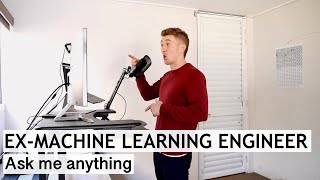
Daniel Bourke left his machine learning job to start his own business. He walks through his path from food science to self-taught ML, recommends learning resources like DataCamp and Hugging Face, and answers questions about career moves, frameworks, and building income from ML skills.
Chapters
A bit of milk. Hopefully I'm live. There's a little button here to go live. All right, 3, 2, 1. I think we're going live now. Are we going live? Are we going live? Yes, we're live. Boom, there we go. Okay, where are we gonna start? Let me just fix this up. I'll put the camera back on. What's happening, y'all? Happy Sunday wherever you are in the world. It is Sunday, the 30th of June. So we're officially basically halfway through the year and I'm trying this new like standing up desk like type of deal. I don't know if you can see it, but, but I'm, I'm standing up here. There we go. Because I don't know, it gives me a bit more freedom, gives me a bit more freedom to move around. How we doing, Yash? How we doing, John? So, purpose of this stream is to first of all, hang out with you all. Second of all, answer your questions as best as I can about whatever you want to talk about. I left my job about, not last week, the week before to, to go full time on my own business, not start my own business because it's already kind of started. I just wanted to spend more time. And P.S., I forgot to check, is the audio all good? I'm getting a, getting a green tick on my end. Can you all hear me? Can you all see me? How we doing? Thank you all for joining in. We'll probably wait for a little while, a little, a little, a few minutes before everyone joins in. We'll start jumping into your questions. If you do have any questions, leave them in the chat and I will get to them. Can be about machine learning, can be about health, can be about life, can be about business, can be about what do I like to eat. But yeah, what are you up to? All right. Before we get into question and answers, I have a few shoutouts to give. First of all is to Kamsky, who got it recently, got a data science internship. So, congratulations to Kamsky. YouTube is not receiving enough video to maintain smooth streaming. As such, Buffers. Viewers will experience buffering. Am I lagging? Hmm, good question, guys. Thank you all for the heads up that it's lagging. I'm going to check this and fix it out. More info. Is it still lagging? Thank you, Pradosh. I appreciate it for, for letting me know. I think I've got a few too many things open on my computer. It shouldn't be lagging, but hold on. I'm, I'm clearing as much as I can to get this lag, lag issue fixed. Thank you all for your patience. Classic machine learning engineer. As soon as I stop being a machine learning engineer, we get lag. Okay, so what is it? What is it like at the moment? What are we getting? We're getting still lagging. Hmm. All right, let me, uh, We still lagging? Thank you all for letting me know in the chat. My internet connection should be good. Uh, one second. I think there's a setting I can change. No, still lagging. Stream output video bitrate. Am I still lagging? Thank you all, Joshua and Rutik, for the updates. Priful, how are we? Everyone, it's so good to see you. I'm sorry for the technical issues. I might have to cancel this and come back. We should be— thank you, Josh. All right, I'm gonna change the bitrate. Josh, what should I change the bitrate to? Audio is pitch perfect, but the video is lagging. Alright, one second. I'll start lowering my bitrate. Audio is great. Beautiful. Beautiful. I love this. We're all working this out together. Apply. I've just lowered my bitrate by about half. Actually, you know what it could be? I'm recording this at the same time. I'm going to stop recording. Maybe, maybe the stream will improve if I stop recording. How's that? How's the video now? I've stopped recording. All I'm doing is now streaming. YouTube is still getting— still giving me an error. Thank you all for being so patient, by the way. We will get this working. If not, I'll just can this one and come back. Better? We good? We good? Should I keep going? Perfect. We're good. Much better. Okay, I'm gonna keep going. All right, so we've got a couple of shoutouts to give now that the video's good or semi-good. Make sure— thank you all for updating. If it does lag again, let me know in the in the chat. Thank you all for your help. To Pradosh, Yash, Jusu, Tech Dots, Praful, I really appreciate it. Josh, shout out. That's my brother. He's upstairs. Um, so first of all, shout out to Kamsky who got a data science internship. Massive effort there, Kamsky. And then Vitaly who's left his job of 4 years to get after a data engineering/new job which starts next month. Massive effort, Vitaly. Round of applause for those two. And of course everyone else that's, that's here. Again, thank you all for 10K. I don't think I've said thank you the first time, so I'm not entirely sure why I said again, but we did hit 10,000 subscribers. Really, really psyched about that. Numbers aren't that big of a thing to me. Like, okay, I say this, I'm a data scientist, I love numbers, but in terms of status of number of subscribers or anything like that, I don't really have a goal in terms of what I want to do. I just love making videos. I love creating. I love hearing your stories. I love sharing my story. So that's what we're here for. That's what we're here to do today. Um, and we do have one question that we can start everything off with and then we can start getting into the chat. Thank you for the updates on the stream. Beautiful. All right, let's do it. We've got the first question is from Gao Xiaoliu, who is studying, did I study machine learning on my own and did I have any prior background? Well, thank you, Gao Xiaoliu, for the question. But the answer to that is I don't think anyone has a background when they start studying something. Right. So, it's like important to remember that even though you see people who have progressed in something or have achieved really great things is that again, they had to start from somewhere. Not everyone starts as an expert on something. So whenever you start something new, of course you're not going to have a background on it. And when I started studying machine learning, I didn't have a background in it. I studied food science and nutrition at university as a part of a Bachelor of Science. And then I was trying to build a startup on the web and found out that I didn't really like web development as much as I liked machine learning, which is this thing that I kept hearing about while I was trying to learn web development. And so I'm like, I'm going to start learning machine learning. Where do I do that? Well, I started Googling around different places and I found some awesome resources to sort of follow along. And I followed them along, did that for about 9 months, got a job as a machine learning engineer. And I'm still learning, right? I'm 2 years or so into it and I'm still learning every day. That's kind of my catchphrase is keep learning. And then, so to answer that, does anyone have any background when they start something? Of course not, right? And I think that's what you got to allow yourself to remember is that if you're starting something new, you won't have a background in it. And of course, at the start of doing anything new, you're not going to be the best at it. So You have to be willing to suck for a little while, be bad at something. You'll see people that are better than you and then slowly practice, learn, practice, learn, reflect on what you can improve on and then keep going. Right. That's how you improve at anything. Same goes for machine learning. And then he asked, best course for a beginner. Now this is really hard, right? Hard to get my pen off the ground. Now, the best course for a beginner, there really is no such thing. There is no such thing as a best course. There's no such thing as the best pathway to anything. Everyone's going to have a unique thing. But in terms of how I would recommend, how I'm recommending my brother who wants to learn machine learning or data science, I'm kind of pushing people towards DataCamp. Why? Because it kind of has everything built into one place. Now, DataCamp is a paid resource if you do the free trials, but I'm a big fan of paid education because you can, because I find if you pay— sorry, I'm getting warnings on the screen and is it still good? Is it still good? Ah, all this lag. No, I'm a big fan of paying for things if you can, right? Because if you think about all the free stuff out there, because there's an abundance, right? And there's a lot of free stuff. You can access it if you find it. However, If you pay for something, you're more likely to take it seriously. Now, that's not to say you have to do it. That's just one example, right? If you pay for something, you're more likely to take it seriously. Otherwise, if you can't afford it, you can't pay for it, that's fine. Find something free. Do your research. Study hard. Practice. You can get the same sort of skills. I just recommend DataCamp because it kind of has everything in one place. All right. Let's get to the chat. Let's get to the chat. Here we go. Lumina says, hey, I'm interested in doing a data project. I have 3 months of free time. Do you recommend doing 1-month projects or 3-month projects? Hmm. All right. 3-month or 1-month project. Well, it really depends. I was recommending to my other brother, Josh, who I think is watching this stream, to build an app a month to practice being an iOS developer. You could spend one month— what? No, sorry, one month, one week planning, two weeks building, one week iterating on, on what you build. All right. So that's maybe how you could structure it. You could build three projects. You do one week of planning and research, two weeks of building it, one week of sharing it in a blog post or making a tutorial on it or, or reiterating what you've already done. And then at the end of the first month, worst case scenario, you can think about, okay, can I make this better or is this something that now I can share? Right. So I really think I really appreciate that kind of outlook. Right. You have 3 months of free time. Should I do 3 one-month or one 3-month? I would say start with the outlook of doing one one-month. No, sorry, 3 one-months. but after the end of your first 1-month project, decide whether you want to keep that one going or do 2 more. All right. So great question, Lumina. Gang, Gangotri, I applied for image processing job. Massive effort, my friend. Let me know how it goes. Wolf Rage, as a machine learning engineer, what responsibility you had or what kind of tasks you had to accomplish? So, I had a fair few responsibilities. It ranged, right? Let me walk you through what kind of day I might look like. So, the morning I would get in 9 AM, 9 till 10 AM would be kind of organising the day ahead, right? So, you're sort of putting things into place where they were from yesterday, catching up on the messages in the Slack channel and all that sort of stuff. And then figuring out what next steps you have to take for the rest of the day. So that's how I would spend my 9 to 10 AM. 10 AM to about 4 PM, right, with lunch in between, was basically working on whatever project I was working on. And now that may be full-blown coding, building models, doing data engineering, or it may also just be researching new ways to do something that I didn't really understand. So there's a lot of a lot of iterative practice in terms of being a machine learning engineer. You're either preparing a dataset to build a model or you're improving the existing model you have, or you're taking that model, packaging it up into a way that the customer or the client can use. Now, because we were a rather small company and a rather small team, I could work on multiple projects throughout a single week. So there could be text processing, there could be image processing. A lot of what I would work on was short-term projects, as in 6 to 12 week proof of concept. What that means is that our business partnered with a larger business and then they, they said, hey, we've got this data here, what can you do with it? And then we would spend 6 to 12 weeks going through it and exemplifying what we could do with the data. Because at the moment, a lot of big enterprises in Australia have heard of machine learning, have heard of data science, but haven't really yet put it into business. So what our business was, was trying to do was offer our services in machine learning and data science to, to help them get into the world of machine learning and data science with their existing data or set up a data pipeline, right? So they could ingest data, use it, store it somewhere, then gain insights off it later. So we work from the full spectrum, right from data collection to deploying state-of-the-art machine learning models. Now I'm getting a warning here from YouTube saying the stream's current bitrate is lower than the recommended bitrate. Is the video okay quality? Let me know if it's not. And here we go, we got another question. So I hope "Or what kind of tasks you had to accomplish?" I hope that answers your question, Wolf Rain. So we were doing a lot of projects that were, well, I personally was doing a lot of projects of right from the start of ingesting data, transforming it, building a model on it, deploying that model. So that was kind of the full spectrum. Praful, "Did you work on computer vision during your time at Max Kelsen? If yes, how was your experience?" Praful, yes, we did a lot of computer vision problems at Max Kelsen. Much of them were image classification. Right. So, so you all, if you, if you've heard of computer vision, I'm sure you've heard of image classification. It's essentially taking an image of something, classifying it with a label and sorting it somewhere else. So one example was it partnered with a council. So say there was some sort of issue in a park and someone took a photo of it and submitted it to the council. Could we use that image to figure out what was the issue within that person was submitting? Right. So that was, that was one example project that we tried to work on. Long story short, it didn't work out to be very successful. And again, this is important to remember. Not all the projects you'll work on will turn out successful. All right. So this is, this is something that I really try to drive home with people is to— it's okay to do things that might not work. And so we found if we had all these images that people were submitting because they were so different and because the council had so many different labels, we couldn't classify the images well enough to their likings. Right. So we'd get an image. The model worked very well, but because the image could have multiple labels, if the model picked one of the labels and it wasn't the one label the council was looking for, then it was deemed as wrong. So it was kind of a labeling issue rather than sort of a machine learning problem. If it was a multi-label problem rather than a single label, then our model probably would have performed better. And here we go. Apropos, how should I start with my machine learning engineer? Hmm. There's too many ways to answer that. So if guys, if the question is, is how do I, how do I start? I would say Google my name, Daniel Bourke, how do I start? And that'll give you an idea of, of how I got started because that, that sort of how do I start question could be, could be answered anyway. And I'm, I'm just one example, right? So my path will definitely be different to your path. I mean, you can do similar things to what I did, but ultimately we'll end up, likely end up on different directions. So how to start is kind of like a— if you want to ask a question, the best ones I can answer are sort of specific questions. I'm happy to answer as specific as you want. Video is okay. Yo, Shaikh, what's happening, bro? All right, here we go. Michael says, as a machine learning engineer, how much software engineering did you need to know? Michael, amazing question. So that, that is kind of where I think machine learning engineering is is heading now. It's merging with software engineering. And now I don't know enough about software engineering to be able to tell you the specifics of how, but some of the things that I'm noticing are services like AutoML. That is where machine learning is kind of becoming like a, like an application almost. Like you have your data here and you just pass it to the AutoML service and then the AutoML service— oh, hitting the microphone— AutoML service will automatically build a machine learning model of it. And I think even like Google's AutoML system is absolutely incredible to build like an image classification, text classification, object detection, that sort of stuff. I think that's where the future will sort of start to push forward. I mean, definitely within the next 2 years or so, Building your own models from scratch, kind of— this is how I think the field will play out. Because software engineering and machine learning engineering is merging, building your models from scratch will kind of be almost a thing of the past. I don't want to say it's, it's going to be totally obliterated, but because it's going to be so structured like software engineering is and because machine learning is going to be offered basically as an application, you'll see these things like AutoML from Google. Microsoft also have a similar service. They, they will get better and better, right? And once there's— the problems I worked on at Max Kelsen, there was only like a sort of a select few that are really big problems in terms of what— what a lot of companies have very similar problems in terms of classification. Classification was actually the big one, right? And then other, other things is like regression. So picking, picking the amount of items a company sort of needed to order, that kind of thing. And now this is where my, my lack of knowledge in software engineering prevents me from answering, answering the question fully. However, that's kind of where I'm going at the moment as well. I plan on spending the next few months upskilling myself with software engineering skills so I can combine my machine learning knowledge, right, with software engineering knowledge and put those two together and build products that are driven by machine learning. That's essentially why I left my role so I could dedicate all my time to learning those two skills and how to combine them. So, stay tuned for that journey. But very good question, Michael. I think the two are merging, right? Again, I don't have enough knowledge as a software engineer. I haven't been trained in software engineering before to be able to speak to that properly. But machine learning engineering, software engineering are coming together. And you can see these things with like things like Kubernetes and Kubeflow and all that sort of stuff. We're trying to structure machine learning so it's not just like, okay, here's some data, build a model, model it. What do we do now? More of a systemized manner like software engineering does. Pradosh says, for a machine learning intern interview in FAANG company, do basic DS, algo should be focused on the machine learning algorithms? I'm not the best person to answer that one, Pradosh. And this is what I'll say, guys, like honestly, like if I get a question that I'm not entirely sure of, I'll, I'll let you know, right? I'm not going to sit here and try to tell you the wrong thing. I can only speak to things that I know or that I have experience with. So, in terms of interviewing for a FAANG company, I'm assuming that means Facebook, Apple, Netflix, Google, that type of jazz. I don't have any experience with any of those companies. I worked for a machine learning team in Brisbane. We had 35 people. There was about 5 machine learning engineers on the consulting team and then about another 5 on the research team and then about 10 in the software engineering team. So, that's kind of my experience, right? I've never worked at a big startup— I'm sorry, startup— big company in Silicon Valley and all that sort of stuff. And frankly, I'm not interested in working at a big company. I much prefer smaller environments where you know everyone and, and yeah, or working on my own. That's, that's my preference, right? I'm not aiming to work at like Facebook, Apple, or Google or that sort of stuff. I'll happily collaborate with them at some point. But in terms of being an employee there, it's not something I'm striving after. What I'm striving after is building my own company or working by myself. That's, that's kind of how I operate best. All right, Tech Docs. Look at Linux Academy, they have a free trial. That's amazing. We have Mahendran, who has a display picture of an Indian cricket team player. I like cricket too, but I think Australia beat India in the World Cup recently, so yeah, go Aussies. It's turning out to be a good Cricket World Cup. Mahendran says TensorFlow or PyTorch, which one should I learn? Now, this is the same thing with like Python or R. The important thing is to know that they're both great, TensorFlow or PyTorch. Some may have some slight advantages over each other, but pick one. Try it for a while. See if you can build your own projects using it. If it doesn't really work, if you run into some limitations, which will probably be unlikely unless you're building some really, really specific stuff for your own problem. But they're both very capable, right? We used both recently. We've been switching between— swaying between PyTorch. I personally have been swaying towards PyTorch. That may change. Because of TensorFlow 2.0 and Swift for TensorFlow, which is like— Swift is a— there's a new pro— well, Swift is not a new programming language. It's kind of new, new compared to Python. But if you Google Swift for TensorFlow, Google are adopting Swift to be used with TensorFlow to basically fix all the errors and issues that come with using Python. All right. Because there's a few things that Python sort of isn't too great at. And then Swift sort of makes up for all those things that Python isn't too good at. And Lumina Pursuit, in a project, would people like to see you focus on data wrangling, data pipelining, or focus on modern ML algorithms? So Lumina, great, great question. The main, the main thing with, with a project and you're partnering with another business, the main thing is to remember is that the other business that you're partnering with doesn't necessarily know a thing about machine learning. So even if you say, "We're using the state-of-the-art algorithms. This paper came out 2 weeks ago. We're using those to solve your problem." That, to be honest, that won't mean much to them because what they are most concerned about is how machine learning can bring the most value to their business. So, if they have a problem, right, they don't care if you're using 20-year-old machine learning algorithms or 2-week-old machine learning algorithms, right? All they are after is if what your work can do will bring value to them. So, that's really important to communicate from the start, right, is to, to go, okay, look at the data. What do you think is possible at it? So, it really depends. So, some projects will want just a whole bunch of data cleaning to get their data prepared. And then the model will work really well after that. Some people will want state of the art because they're already using existing machine learning algorithms and they're coming to you because they want to see if you can, can try something new and fix their problem. Now, again, this is a communication piece. It's not necessarily a technology piece. It's a communication piece. So if you're building machine learning models or working on machine learning projects for a client or for a business, remember to get the communication down. What skills do you have and what problem do they have and how do they match up? Right. What is their end goal? Do they want you to use the latest and greatest machine learning algorithms? Do they care about that? What do they care about? That's your job, right? As a, as a person who's offering a professional service, Your job is to find out what the customer or client cares about most. So when people— this is what I ran into a lot, right? When I'm working with engineers, a lot of the time people can get lost, especially engineers, lost in using state of the art or making something that's perfect at the expense of making something that works and delivers value to the customer. Right? So that is your one goal. Deliver value to the client so that they will either continue being your client or recommend you to someone else. That is your goal. And that all comes down to communication. So as much as you're, you're practicing the code, you're practicing implementing state-of-the-art algorithms. Remember, if you're partnering with someone else, your biggest issue will likely not be the technology. It will be the communication between you and them. PJ says, I'm seriously confused between web.js and data science. Both appeal to me. Please have an insight. Thanks. PJ, you're like me. I get excited about everything too, right? That's my problem. I, I have shiny object syndrome, which means I look at things and something new, something fun, something tech— technology, something technology, technology. Daniel can't even speak today. And I get excited. I want to learn all about it. So the way I think about these things is you only have a limited amount of energy per day. You have 100 energy points in the morning. You wake up, 100 energy points. How are you going to spend those energy points? Right? And that's not to say you shouldn't learn WebJS or data science. That is to say that here's how your day would look. Let's say you decided you wake up, you're going to spend your 100 energy points learning WebJS. You're probably going to be pretty good at WebJS in a couple of months. Or let's say you wake up, you spend 50, 50 of your energy points on WebJS, 50 of your energy points on learning data science. Now it's going to take you a little while to get to get better at both. And what you'll probably find, because you're only spending 50% of your energy on both of them, and what you'll probably find is one will take away from the other. That is why I had to leave my job to work on my own thing, because they started taking away from each other. I've only got 100 energy points. So if I wanted to spend 100 energy points getting better in my machine learning engineer role, right, I'd have to neglect the fact that I wanted to do my own thing. And if I wanted to spend 100% doing my own thing, I had to remove my machine learning engineer role. And now I'm not going to tell you which one you should, you should focus on. But what I would say is choose one, stick with it for a given period of time. Could be 6 weeks, could be 6 months. All right. But stick with one. Stay with your decision. You can— the other one's probably not going to go away. Right? So you can always learn the other one at another time. That's, that's kind of how I live my life and make decisions now is I choose one, follow it for a bit. If it doesn't work, I reflect and iterate. If it works, I keep going with that and then I forget the other things. Very hard to do. I totally know how you feel. All right, so next question, and thank you all for joining in. I really appreciate it, guys. This is— I have fun, so much fun doing these things. But I'm going to stick around for the next, let's say, 20-25 minutes, because I'm going to go for a walk with my dad and puppies. It's a beautiful Sunday afternoon. Important to get outside every day. Take that from me. That's a quote from Daniel Bourke. Get outside every day. Okay. So, Shubanshu Mishra says, would you recommend Udacity ML Engineer Nanodegree? Yes. Udacity offer some of the best classes in the world. I've done 2 nanodegrees now. They, they built essentially the foundation that I've used to gain all my skills in machine learning and artificial intelligence and whatnot like that. But remember, with any course, right, with any course, they will only get you to a certain point. They're there to build the foundations. Then it's upon you to build the buildings upon those foundations. So courses will get you, right, a broad set of knowledge, will get you to the ground floor. The really good ones might get you to level 1, right? But then it's up to you to challenge yourself and go above and beyond that. And now that is really hard because, and it's also impossible to teach, right? I was saying to my little brother, you can't exactly teach programming. You can teach the foundations of it. You can teach some syntax, but until you start to practise it yourself, right, that is where the real learning happens. So, remember, I recommend all of Udacity's Nanodegrees. I recommend all of the courses that you've seen me do, right, because I pick the best ones, to be honest. But they only build the foundation. It's upon you to go above and beyond that. And that is very challenging, right? But the challenge is worth it. Cena says, "Hi mate, I'm 45 years old and good to see you live." Thanks Cena, thanks for showing up. "Can I start to learn data science and get a job? Am I too old?" I think you definitely can, Cena. Like, it's like these things— I started 2 years ago, all right, and so I got a job in 9 months. I'm not saying— I'm just— remember, when I use numbers to describe how long I do things, it doesn't mean that that you, you should do things in my time. And I'm not saying that my time is the best. I'm just using me as an example. And I had no background in data science or machine learning or coding really. I started learning to code 9 months into it from doing online courses and sharing my work online. I got offered a machine learning engineer role. Is that going to happen for everyone? No, right? Everyone's going to have a different journey, but that's just an example of how you can make a decision one day and go, I'm going to learn this thing. It's going to— I'm going to be bad at it for the next year, but then the second year I'm going to be a little bit better than I was the first year. And then the third year I'm going to be a little bit better than I was the second year. As long as you're continually improving, right? Reflecting on what you could be better at. And so Data science and machine learning, these things aren't going away. The world is slowly moving towards a data-centric model of— now, I don't have the language again to describe this, but data is, is basically everywhere. All right. So, the demand for people who are literate in understanding what data means, understanding how it can be used, understanding just data itself can is going up. So, well, will be steady for years to come. So I think you're 45 years old, you can definitely get into it. All it's going to take is some effort on your behalf. And I say all it's going to take, but it, yeah, it's quite difficult, but I think you can do it. I'm proof, right? I was 23 starting getting into it. Age is just a number, right? But yeah, hit me up if you have any questions. I'm happy. If your question doesn't get answered on the stream, guys, by the way, Hit me up anytime. I'll do my best to help you out. Shiva says, how to 2x live video, please tell. 2x live video. I'm not entirely sure what 2x live video means. JT says, how do I make sure I get an ML engineer job and not a data science job? I feel like many companies get mixed up between the two positions. You're right, JT. The difference between machine learning engineering and data scientist. I think I get mixed up between the two. There's a lot of things like in terms of different things to do with data engineering and data science that kind of overlap, kind of don't. So I myself get mixed up between those two at times. What I would say is, again, it comes down to a communication piece. If you're applying for a job, right, and you have skills in data engineering, you want to make that known to the person who's hiring you or the job that you're applying for, right? You want to be sure that they know that you're after a data engineering job rather than a data science job. So that's, that's on your behalf to communicate that. If the, if the role title that you're applying for says data scientist, that's probably something that you don't want to adhere to. Or if it says data scientist but lists some responsibilities that you think are more, more suited towards your data engineering skills, you might want to get in contact with whoever's offering that role and just go, hey, I've got some experience in data engineering. I think the person you're looking for is more likely a data engineer rather than a data scientist. So again, it all comes— this is what I'm noticing, right, is it all comes back to, to data engineer. I mean, sorry, data engineer. All comes back to communication. All right. Is does your point of view agree with the other person's point of view? And now this is a really— communication is an incredibly tough problem. But it's a skill that everyone needs to practice, right? Because you could be the best data scientist in the world, the best coder in the world, the best programmer in the world. But if you can't communicate your skills or your talent to someone else, it doesn't have any value to anyone apart from yourself. Okay. So, John Cena asks, hey John, good to see you. I saw you earlier in the stream before. When I was setting it up and you said hi. I didn't say hi properly, but hey, John, thanks for tuning in. John Cena. Daniel, do I do freelancing? Yes, I do. That's kind of how I'm getting my income at the moment. So my, my role at the moment sort of is kind of a bunch of everything. I make videos, I write articles, and I'm partnered with people like Coursera, Cloud Guru, and DataCamp. And so that is kind of how I make income right now is doing freelance work for people like DataCamp, Coursera, A Cloud Guru. John Cena also asks, are you a front-end or back-end developer? I'm neither. I have— if you were to say where my skill set best fits in, I would say it would be data scientist with a little bit of little bit of data engineering sprinkled on that. So you could say machine learning engineer to kind of combine all that. That's the, that's the fancy term for it. Okay, thank you everyone for saying the video is perfect. I've kind of, uh, uh, let the chat drag on a little bit here because I take so long to answer one question. Let's keep going though. I'm having fun here. Let me know if you're having fun. Let me know if you're, if my answers are giving you help. If not, I'll try and improve them as best I can. And where were we up to? SajTech says, "Desk setup tour." Oh, I could do one of those in the future in a video. I like my, I like my desk to be pretty plain. All I need is a keyboard and a screen, and that's about it. And some notepads. I need notepads to write down what I need to do during the day. Okay, so Don Dong Mo asks, most used algorithms in machine learning, can you also jumpstart, jumpstart, or do you need a background to learn? Most used algorithms in machine learning, I don't think— don't worry about paying attention to the most used, right? Use the best one that is required for your problem. How do you do that? You try a bunch of different ones, and then once you start to build an intuition about which algorithms work best for which kind of problem, then maybe you can start to, to when you start a new problem, you can go, okay, there's 10 algorithms that are really good, but I'm only going to try these 3 to begin with because I know in the past that these 3 have worked well on this sort of problem. So don't worry about those top 10 algorithms that you see and all that sort of stuff. Know the gist of them. Don't really, rather than knowing them off by heart, know what they can be applied for, right? Know what they can be applied to. That is more important because then really know what problem you're trying to solve, because then you can research machine learning for X problem. Okay, so define the problem space that you're trying to solve and then think about the algorithm that you can apply to. Can you jumpstart or do you need a background to learn? As I said before, you can definitely jump in from whatever learning level you're at. Just remember, learning something new is hard. That's the definition of learning, is being bad at something, then improving at it. All right. Okay. Superfox. Hi. What do I think of Amazon Web Services machine learning programming language? Superfox, I think you're talking about Gluon. In that case, I've never used it, but I think it looks similar to PyTorch. It's in Python. So if you know Python code, this is why I recommend everyone just if you want to get into machine learning or data science, learn Python code to begin with if you're a complete beginner, because all of the, all of the, the top languages, all of machine learning basically in production is Python or C++ or Java. But use Python, choose Python to start with and then change it if you need to. But Python will get you 99% of the way with whatever problems you need to go. But yeah, what do I think of AWS machine learning programming language? Can't really answer that. There is a book though. Google, hold on. I think it's called Deep Learning: The Straight Dope. I think this is by some people at Amazon. Deep Learning: The Straight Dope. This is actually a really good book, even though it's in Gluon. The way they describe different things like linear regression from scratch, Multiclass logistic regression from scratch. It's all in Gluon, which you can use on, on a bunch of different— I think you might be only able to use it on AWS, but you can definitely— well, you can definitely use it on AWS. Maybe you can use it on GCP or something like that. It uses MXNet, so maybe you want to read into it. But anyway, long story short, Google Deep Learning: The Straight Dope. This book, it describes some of the principles of deep learning. Really well. I've read that and it turns out to be really valuable. Okay, well, back to the cam full screen. Lumina Pursuit. Learning SWE on your own sounds amazing. What approaches are you taking? Self-teaching yourself like that, open source projects, etc.? I'm talking too fast. My mouth is getting dry. I'll slow it down a bit. Lumina, um, hold on. Did my Screen stop. Oh no, it's just delayed. All right. Software engineering on my own. Sounds amazing. What approaches are you thinking? So I haven't quite figured that out yet. I'm looking— so I want to build some things on mobile devices. So I'm looking into like Swift probably. And I think there's a book by Apple themselves on how to use Swift. Reason being, why am I choosing Swift? Because I want to make some things on mobile devices, right? Because they're kind of always on you. I've thought about the web before. I've tried the web before. Maybe I'll be down that path one other time. But for now, I'm going to stick with mobile. I'll release more content around this once, once I've figured it out more and, and actually made some progress in it. But Swift, why? Because one, twofold. Mobile devices. Two, it's very fast, right? So if you Google Swift for TensorFlow, that's a kind of— so learning Swift is kind of like a two-edged sword because then I'll not only be able to build things for mobile devices, but I'll also be learning Swift for TensorFlow, which is going to be amazing because Swift for TensorFlow kind of fixes all the, the downfalls that Python has for numerical computing. But yeah, that, that is the short, short of it. As for more details, stay tuned. All right, Jachendra, I'll have a drink. Any thoughts on marrying quantum computing with data science? Oh yeah. Oh boy. Awesome thing. If you Google Max Kelsen quantum computing, I worked across the well, I worked with a couple of boys from university in— we called them the Quantum Boys, right? And now I don't know enough about quantum computing except that it's really fast, so I think that would help a lot with data science. But they were called the Quantum Boys because they're all physicists and they're all working on quantum computing, and, and now they're working at Max Kelsen. So really smart. So if you Google Max Kelsen quantum computing. Maybe it'll come up here. Maybe we can do that together. Let me, let me change my screen. Max Kelsen quantum computing. All right, so a very brief— yes, there we go. So if we look in here, there we go. So if you go to the Max Kelsen Medium account, there's some articles here on quantum computing. And they're really good. So this is the kind of stuff that we're— we were getting into. Well, not, not me personally. So yeah, go to medium.com/maxkelsen. This is the company I used to work with, and that is what they're trying to do— use reinforcement learning for quantum computing. As for that, as for quantum computing for data science, I'm not entirely sure, but I think it will be— it will be something we can look forward to in the future. But at the moment, I don't think it's ready. To be honest. Superfox, dude, I met a guy who works at Google DeepMind. Google DeepMind, that's awesome. The competition for the PhD is fierce. They want guys doing mid-PhD, which I can imagine is quite hard to achieve. Yeah, well, Google DeepMind, they're probably one of the— they're probably the leading artificial intelligence sort of organisation in the world. So, of course, they're after the best talent. That's what it becomes at the end of the day when you get to such a large company, right? When you're such a big company, all your time is basically dedicated to finding the best people, right? Because if you have talent, that's, that's— So, okay, how do I explain this? So, 50 years ago, it used to be a resource battle, right? So, if a country had all the resources, a.k.a. oil, a.k.a. steel, right? You had the most, you had the most power, essentially. That's how America sort of rose to the, rose to the top of power. I don't know the exact history, but just think of it as this way. But now we're shifting, switching from a resources-based economy, right? Because of shipping. Now every country has access to similar resources because of trade, because of international, international, how do we say, globalization. Because I can access, I can go and eat food in the grocery store, that's come from America, that's come from Africa, right? So, we all just trade our resources. Now, the battle is for knowledge, right? If a company, if a country has the best intelligence, has the best knowledge, they have the most power because they'll think of the new things, they'll think of the new technology, etc., etc. Same thing happens with big companies, especially tech companies, because technology, hardware, once you have the hardware, Right? What you have to be able to use that hardware. And so you have to build things using the existing hardware. And so this is what Google is, what DeepMind is, what Facebook, they're all after now is the best of the best people, the smartest people, people way smarter than me. That was a little rant on history and what companies are looking for. Smartest, smartest people. Baba Rohit says, do you suggest any course or GitHub projects for machine learning? I suggest a lot of courses and open source. So if you go to bit.ly/aimlresources, I, I recommend all of these. I'll link it in the chat. I don't think it'll actually work. There's a link in the description. Sorry. They're all the resources I recommend. As for interesting GitHub projects, there's a bunch of them. So I I can't really remember them off the top of my head. Actually, the Hugging Face PyTorch BERT implementation, that library is— oh, sorry, that repo is amazing. So look up Hugging Face PyTorch BERT. That is an amazing repo. Okay. Productive Channel, what is the use of algorithms and DS in ML? Is it worth studying CLRS book? I'm not entirely sure what the CLRS book is. What is the use of algorithms and DS in ML? So algorithms and DS kind of make up what ML is. I'm not sure what that question means. Production channel, productive channel. Here we go. We're scrolling down. Where am I in the chat? Productive Channel, thank you for subscribing to my channel twice. One with your fun channel, one with your productive channel. I appreciate it. And so Luminous Pursuit asks, where could you find a community of people willing to code review your work? Oh, that's very challenging. GitHub. That's what kind of what GitHub is for. If you put your project open source, you can have people look at it. You can share it online. That's, that's the value. That's the value in sharing your work, right? Is that you have the public to critique it. And you— so can be hard, right, to see people go look at your work, look at your effort and go Hey, this could be better, but that's valuable, right? Because now your work can improve the next time you do it. You can make it better. Will it always work right? Do you want it to be public all the time? No. Well, that's the value in meeting great people. And so communication. Oh my gosh. Just scroll to the bottom of the chat and I'm, I see I'm missing out on a bunch of questions here, right? Because I'm still like a third of the way through the chat, not even anywhere near the bottom. But that's all right. We'll stick around for another 10 minutes or so. Let me know if the— if this is all right and I'm bringing value to you guys, because that's, that's kind of what I do. I just love being here. I love hanging out, love making videos. I saw someone asked, why did I leave my machine learning job? Here we go. ABD Kumar, why did you leave your ML job? Well, I kind of— I made a video about it, but the long story short is I wanted to try and build my own business. I wanted to go out on my own. I'd studied on my own to become a machine learning engineer. Now I wanted to use what I'd learned in an actual machine learning business to build my own. That is essentially what I'm doing now, is how can I best dedicate my effort to building myself as a business, right? Treating myself like as a solo entrepreneur or by creating a startup and making that larger, potentially hiring people. I'm not sure how that looks like in the future, but for the rest of the year, I'm kind of setting myself up with cash flow so that I can have flexibility to sort of work on longer term projects. So the important thing is to remember, you don't have a business until you have a paying customer. And I've already— I've— that's where I'm at at the moment. I have some paying customers, some clients who pay for my work, and I'm trying to increase that, right? So that it's at a level that it can, that it's sustainable for a longer term, right? Because at the moment it's kind of, it's at a good level. It's replaced my salary that I was getting at Max Kelson, but I'd like to bring it up a bit more, right? Because when you have a large amount of wealth, then you have a real flexibility of how you want to spend your time. Of course, you don't require a large amount of wealth to think about how you'd spend your time, but things I want to do, things I want to build cost money. So I need to earn money to pay for the things that I want to build, right? Compute power isn't free. So that's essentially what I'm doing. And don't worry, there'll be videos. I'll share with you how I'm doing it, what I'm doing day to day. That's how I think I'm going to do videos in the future is make tutorials as well as like kind of like a vlog series of week to week building a business, building a startup. What does it actually take? Like what does it look like from day zero, right? What does it look like from day zero of being a business on your own, right? So that's the kind of content I'm gonna be making in the future. So stay tuned, let me know if you wanna see that sort of stuff. Let me know if you wanna see anything, right? I'm always open to suggestions. But that's the long story short. Now we go. And Bilat says, what do you suggest is a very first ML project that would be representing portfolio? Bilat, I would take something that you're interested in, see if machine learning can be applied to it, put those two together and then share that with the world. Right. It could be anything you want. If there's anything that excites you, maybe you get really excited about international travel. So how can you use international travel, marry that with machine learning. I don't know that. I don't know. Maybe that's something you have to research. But again, this is where the value comes in your project development is doing the research, then building the project and then sharing that project with other people. That's what it's all about. And you can't teach those things. There's no course that will teach you that. Here we go. Superfox, how do you learn a side hustle while you are doing a normal job? E.g., how do you learn machine learning while doing your normal computing job? Um, well, I'll tell you how I built my side hustle. Side hustle, which is kind of like what I'm doing now, like making things online and sharing them with the world while working at— while working full-time as a machine learning engineer, I ruthlessly had to get rid of everything else apart from being a machine learning engineer and working on my, my side business. So I spend a lot of time in this room, right? There's my bed. You've probably seen it in a video. Hold on. There's my bed. That's my desk. This is my desk. And so Friday nights, people, friends going out. I'm not saying you have to do this. I'm just telling you what I did Friday nights. Friends going out weekends, friends going out. I was at this computer being a loner, being a nerd, working on my business, which is kind of why I was able to leave my machine learning job and go with it full time. Do you have to do that? No, you don't have to do that. But that is just how I did it and how I'm doing it. And Shayik, I see you're answering questions. Thank you so much, brother. I appreciate, I appreciate it. All right. Cozy Gran, Kessie Gran, Kessie Gran asked, hi Daniel, what would be the hottest topic of ML to learn right now? And hottest topic of ML to learn right now. Hmm, I don't even think it's ML itself. I still think there's lots of value in applying machine learning to existing problems and deploying— no, scalability. That if you can scale machine learning, right, you will get a job at any big tech company. Now that's really hard to do, right? That's why tech companies, right, that's why big tech companies are the only ones that can do it because it's really hard. You need lots of smart people, you need lots of hardware, you need lots of engineering. But if you want to practice scaling machine learning, figure out how to do it. Look up what Kubernetes is, look up what Kubeflow is, all right? Look at how you deploy a machine learning model, all right? Those sort of things. If you can do that at scale and look up the retraining cycle, that is really hard. I'm not— I'm— I don't even know how to do it, right? That's something I would— I need to look into how to learn. But that's what I'm starting to notice is that scalability issue of machine learning, right? Because it's well and good to be able to train a machine learning model in your Jupyter Notebook. Then how do you take that to 100 million people? How do you take that to a billion people? Right. You don't start trying to take it to 100 million people, but start with training machine learning model in your Jupyter Notebook. And then how does someone access that? How would someone retrain your model and and use it for their service or their problem. So that's something to think about. Real Bhat, Real Bhat says, can we look at your resume? You can. My resume is on LinkedIn. My resume is LinkedIn. If you Google my name, that is my resume. I don't really like A4 sheets of paper as resumes. So that's just how I operate. If I was gonna hire someone in the future, I'm gonna Google your name and I wanna see what you've been doing. So that's a heads up. If you want to work for me in the future, I'm going to Google your name. Um, all right. Shayik, legend, linking. Shayik, thank you so much, brother. Okay. All right. We're going to do 2 more questions because it's 4:00 PM here and I'm going to go for a walk with my dads and my dads, my dad and my puppies. I'm really excited. So Amit says, hey Daniel, I've completed MOOCs, courses from DataCamp. I've done a few projects on DataCamp. Now what should I do to bring professionalism in my machine learning projects? That's a, that's a really great question, Amit. Right. So you've already put in some effort on DataCamp. You've done a few projects on DataCamp. What should you do now? I would say this is, this is a hardcore part, right? Because You cannot teach this. No course will teach this. Take what you've learned from DataCamp and apply it to your own project and then share that project, right? And share why you did it, what you, what you learned, what you would do differently. You could build it on GitHub as a repo. You could post the results on LinkedIn. And now, important thing to remember, I can't stress this enough. It doesn't have to lead to anything amazing or great. The important thing is is that you started something of your own. You tried it, you learned something new, and you shared it with others, right? That is actually how the biggest things start. There's a lot of things holding people back, including myself, of not trying to start something because you, you, you think it won't turn out to be amazing or great, right? I can assure you that nothing, nothing that you see is amazing or great started with someone thinking it like that, right? Or if it did, it was kind of lucky that it turned out to be that way. You have to be willing to be bad, to try something that won't work. So that's how you can improve, bring professionalism in your machine learning projects. Use the knowledge. It'll be fresh. It'll be raw. Try and connect it in your own project. That is where the best learning will come from. And then again, Amit, if you want, if you want another point, build it in a weekend, right? The best and greatest projects, if you can't build it within a weekend, like I'm talking, don't think it's going to be the end product, but just just basically like a proof of concept. Build the proof of concept in a weekend, because if you can't build it in a weekend, it's probably too complicated. And then run from there. Start with a weekend project. Could be, could be next weekend. Say, hey, I'm going to do— tell your family, tell your wife, or if you don't have them, doesn't matter. You can just do it. I'm going to work on this project. I'm not going to be available this weekend because I need to work on something. All right. Jana Kay says, is there opening for ML for those who start now? Yes, machine learning coding skills aren't going away, guys, right? So the way that use— you can use the internet to share your— to both one, gain skills and share, share your skills. And then you can either create your own role, which I'm kind of doing now, right? I make videos online about machine learning and health and, and people watch those. So you can, you can do that or you can gain your skills and show an employer what you're capable of and then they will potentially hire you. Again, no guarantees for these things. All right. So what do I mean by scalability? I, I kind of answered that. So if you can, if you can build your machine learning model in a Jupyter Notebook, how do you scale that to be used 100 million times, right, online by other people? That's what I mean by scalability. Back to the Janaki. Janaki, is there openings? Yes, there's openings. If you want to get after something, get after it, right? Challenge yourself. That's what I try to do every day. That's what you guys encourage me to do. Right? Because I love, I love sharing knowledge with you all. I love learning from you all and I'm very thankful for 10,000. I'm very, very proud of Kamsky, Vitaly, proud of you all. Thank you all for being here. That's going to wrap up this Q&A. If you have any more questions, you can find me online basically anywhere. If you Google my name, you can email me daniel@mrdbourke.com. I'll get to your question as soon as possible. Otherwise, hit me up wherever you want. Um, but yeah, we're going to wrap that up. Thank you all once again. And again, I'm terrible at goodbyes, but, uh, we'll see you next month. I'm going to be posting more videos on the channel, so stay tuned for that. Peace. Oh wait, keep learning, keep getting after it. Love you all.
More from Daniel

Small Language Models (SLMs) Are the Future: Fine-Tuning AI That Runs on Your iPhone

Introducing Sunny - A MedGemma-Powered Skin Health Tracking App (Kaggle Competition Entry)


Benchmarking: NVIDIA DGX Spark & NVIDIA RTX 4090 | Part 4 - Comparing the results

Benchmarking: NVIDIA DGX Spark & NVIDIA RTX 4090 | Part 3 - Running LLMs on the RTX 4090

Benchmarking: NVIDIA DGX Spark & NVIDIA RTX 4090 | Part 2 - Formalizing the tests

Benchmarking: NVIDIA DGX Spark & NVIDIA RTX 4090 | Part 1 - Creating a series of tests


Local Multimodal RAG on the NVIDIA DGX Spark | Part 4 - Publishing our demo to Hugging Face


Local Multimodal RAG on the NVIDIA DGX Spark | Part 3 - Putting it all together