Is 13 too young to start learning machine learning? | 97,777 Subscriber Livestream Q&A
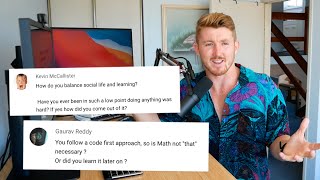
Daniel Bourke answers questions from his community about learning machine learning at 13, choosing projects, and balancing curiosity with practical skills. He draws on his varied work history—Uber driver, Apple Genius, fitness coach—to explain how real experience shapes how you learn.
Chapters
We're on, we're on, we're on. No, 1 minute late. Oh, we've joined in. Hello, hello, hello. If you're joining in, please let me know if you can hear me, if you can see me. Those 2 things are important for a livestream. And then we've got the screen there. Beautiful. I wonder if I can pop this out. Pop out chat. There we go. Keep that over here. Now we're just going to let people join in. If everything's all good, please, uh, put the flag of where you're listening from in the chat. I'm coming to you live from Brisbane, Australia. It is quite windy today. It's beautiful and sunny though. You can see the light from outside. I'm watching the trees and the breeze. I can see the water. We're going to— Ashik, what's going on? Alex. Hello, good to see you all. So what we're going to do is have ourselves a good old-fashioned livestream, and I'm going to maybe put this here, and then— or I need the chat window. I'm still working out the ideal setup for livestream windows. That can stay there in case I need to swap things. I'll keep that over there. And we're good. We got the chat. Can I zoom in on the chat? Yes, I can. Yousef, hello. Breeze, hello. Hello from Egypt. Pie Pony, what's good? Okay, we're going to give it another minute or so to let people join in. I might share this link. Just give me one second. I'm gonna share the link in the ZTM Discord. That way everyone knows that we're live. Is there so many snakes and spiders in Australia? Yes, I'm sure there is, but I hardly see any of them where I live. Going live on YouTube. To celebrate 9,777 subscribers. My favorite number is 7. That's why we're here, answering all of your questions. Come and say hi and then wave. Hello, hello, hello. Thank you all so much for joining in. We're gonna have a good old party. Yo team, going live on YouTube. I just need to— I use the everyone tag. I don't use it very often, but when we have special events like this, I use it. So let's put it in. We're going to send that message that's in the Zero to Mastery, our machine learning data science Discord. I'm going to get out of that. I'm going to come back to the Q&A. Let's, let's dive right into it. So Lakshan, actually, let me just give a preface. I want to thank you all for being here. We are celebrating 9,777 subscribers. We're gonna do a Q&A. You can ask me anything you want. This is a preface to all of my answers. I don't know anything. I don't really don't know what I'm doing here, but I will try to answer questions. If I don't know something or if I don't have a viewpoint, I will tell you. And always be wary that whatever I tell you is biased from my own experience. So keep that in mind. Okay, but let's jump into it. I'm gonna put my phone on do not disturb and put that in a drawer. Let's jump. Let me get some questions up. Boom, here we go. Can you all see that? You can see my face. You can see everything ready to go. So, Pony says— what I'm going to do is I'm going to go between these questions that I've got bookmarked here and also go between the chat. So, Pie Pony, and then I'll put these in a blog post or something when we're finished. Pie Pony asks, hey, what's up? I wanted to learn deep learning for a long time to train images of human structure, but I understood it takes a lot of time, so I'm kind of nah. Well, and actually I'm going to preface this as well with how to ask a good question. So if you ask thoughts or advice on something, it's not really a great question. If you can be as specific as possible, that is how to ask a good question. Like whatever, just be as specific as possible. No, like thoughts on this, right? Because most things I don't really have thoughts about. So be as specific as possible with your questions. Pony says, hi, what's up? Hey Pony, what's good? What's going on? I wanted to learn deep learning for a long time to train images on human structure, but I understood it takes a lot of time. Well, see, that's not very a great question, is it? Because it doesn't really ask anything. It's basically saying I'm interested in something, but I'm not sure. Well, you can either go and try it out, see how you go, or you could not do it, but really you could really do anything you want. So in that case, I would, for anything, right? Don't just think about it, try it out. You're far smarter doing something than you are thinking. So keep that in mind. I'm going to keep coming back to that often, more often, but good questions are specific. Keep that in mind. Good morning from the Philippines, Martin. Hello. Hello from Saudi Arabia. Hello from Brazil. Hello from Israel. Hello. I am from Australia. Um, here we go. Lakshan asked a great question. We're going to go one for one, Lakshan. And if you— if I don't answer your question, just keep posting it in the chat. I can't promise I can get to everything, but I will get to as many as I can. So my former job before machine learning, I'll show you on my website. I've had a few. I've had probably 10 different actual jobs. So if we go to about, here's what I've been. This is my website, MrDeBurke.com. I've been a machine learning engineer, so that's before machine learning though. I've been an Uber driver before that. I was a genius at Apple. So genius at Apple. I was one of these persons that would help you with your technology. I loved helping people with their technology. I still have always been a tech nerd. And then before that, I was a fitness coach. So teaching people how to get ripped and muscly and strong. I've also competed in men's physique competitions. I'm not sure that you could find any of that online anymore, but I'd get fake tanned up and go on, go on stage and show off my body and whatever. I've also worked at Subway making sandwiches. I've also worked in an office at an accounting firm or no, a building firm, just doing paperwork, which was very boring to me. I just used to watch YouTube videos while I was working there and I've been a laborer, so I've helped with construction work and, and wheeling wheelbarrows full of concrete and whatnot. Lots of things. It's been good fun actually. So I've had a fair few jobs and that's, I believe actually that's, that's made me sort of the person who I am. Of course. No duh, Daniel, of course it has. Just having different experience of like many different things has allowed me to sort of, whenever I do something now, I can draw from the experience of so many different jobs and interacting with so many different people. Like driving Uber, you meet a new person every 10 minutes. Same with working in retail, you meet a new person every 10 minutes and you have to talk to them. You have to meet them where they are. So I'd highly recommend that any job that you can, especially for tech nerds, Any job that we have to interact with a lot of people, it will make you a better engineer. Okay, so now we're going to go to the preloaded questions. That's what we're going to do. We're going to bounce between chat and preloaded questions. Do I have a date for the release of the hardcover of my book? No date yet, but it's coming soon. Okay, I'll jump back to the chat after we answer Ashik's question. So Ashik, thank you so much for the questions. Number 1 is how to adapt a Lindy life. I'm a beginner, just know the concept of Lindy, but how to incorporate it into one's life. So first of all, we have to define what Lindy is. What is Lindy? Lindy effect. Here we go. The Lindy Effect, also known as Lindy's Law, is a theorized phenomenon by which the future life expectancy of some non-perishable things like a technology or an idea is proportional to their current age. That means if something's been around for a long time, the Lindy Effect is a theory that says it will probably stay around for a long time. So if you want to adhere to a Lindy, Lifestyle, uh, it would be just questioning. There's no rigid guidelines for this, of course, but it would be just to question what are things that have been around for a long time? Why have they been around for a long time? And will they continue to be around for a long time? And if you adhere to the Lindy Effect, if they have been around for a long time, chances are they will stay around. So for example, the technology of a book has been around for, When was it? When was the printing press invented? Like 1400 or something? But even before then, like, they'd create books and whatnot. So, books have been around for, let's say, over 1,000 years. So, if it's been around for 1,000 years, chances are it's going to stay around for 1,000 years. Do you remember when ebooks and digital books and Kindles came out and people were like, "Oh, the bookstores are dead. No one's ever going to read physical books again." That never really happened. People love physical books. In fact, even more like it's just different. It feels good when you hold a physical book in your hand. That's a great example of the Lindy Effect. And the same thing goes for— you can apply it to anything, right? Apply it to food, apply it to lifestyles. Like a lot of the, um, a lot of what's going on in society today is just complete and utter bullshit. So the Lindy Effect is using time as a filter. What trends have stood the test of time? And will likely stand the test of time going forward. That's, that's the main way to adapt to a Lindy lifestyle is to just to think about it. And of course, you don't necessarily have to. A lot of new things are really cool. Like I like my iPhone, I like going on YouTube and whatever, but are these things Lindy? It's, well, it's up to you to define what Lindy is. So there's no set way to do it. I in fact am not the expert on this. If you want to learn more about Lindy, I'd look up the Lindy newsletter by Paul Scalas. Um, one of my favorite emails and things to read online. So here you go. Check this out. One of my favorite, uh, ways to read Lindy, about Lindy. And Ashik also asked, number 2, how to overcome the laziness before a workout or exercise or even a walk? Why it's hard to trick my mind into doing something physical at times. So Okay, I'm a big fan of having discipline, of just doing shit when you need to do it, but also like, make it— you're thinking, you're overthinking it. This is what a lot of people do with anything, right? Is they just overthink it. They're like, oh, I need to, I need to do this or whatever. I need to have discipline and all that sort of stuff. But it's like when you try to have discipline, you split your body into two personalities. It's like you have one personality that doesn't want to do anything. And you have another one that's telling you, you have to do this, but in reality you're always the same person. So the person telling the— being disciplined, you need to be more disciplined, is the same person as the person who isn't disciplined. So that's— people are overthinking it. When you split yourself into multiple personalities, it's hard to do anything. So the way I work out or even go for a walk is I don't even think about it. I just do it. If I need to go for a walk, I just go for a walk. Don't even think about not doing it. Just start moving. Again, you're far smarter doing than you are thinking. Your brain will trip you up far more than your body will. So if you want to work out or if you want to walk, just start to move. Give— don't even give your brain a chance to think about it. Just begin moving. Same with studying, same with doing whatever you need to do. Just start doing it. Don't even give your brain a chance to second-guess it. Yourself. These brains are cool, but they, they sometimes trip themselves up because there's just too many thoughts going on. We get too smart for ourselves. So that's my advice there. Or if you're lazy and whatnot, just do the walk or the workout when you're feeling high energy. Figure out when you feel the most energetic during the day and do the walk or workout then. And in fact, for me, you should feel better after a walk or exercising. I exercise and walk to feel better after. Right? So that's why I move and walk and dance so much is because you feel better after you move, right? Okay. And then finally is 3, a few tidbits on food. So food is, use the Lindy Effect for food. It's probably the easiest one. Has this been around? Has this food been around for over 1,000 years? If not, like supermarkets, most of the shit you get in there is full of crap. Seed oils, canola oil, sunflower oil, rapeseed oil, all of those seed oils, bullshit. Cut them out of your diet. Um, try to only adhere to having sugars from natural sources, fruit and fruit juices and whatever. And if it comes in a packet, you don't need it. If it's got an ingredient list, you don't necessarily need it either. Stick to whole foods. Learn how to cook from scratch with 4 or 5 ingredients. Make food yourself. That is all you really need for food. Think about what your great-great-grandparents would have eaten. Anything that's been productionized is, is just, they're just making it for profit, right? So that's a few, few tidbits on food. I'll write more about food and whatnot in, in the future. That was my first love before machine learning. Let's jump into back to the chat. Thank you all so much for joining in. Um, hello there says, why did I get into programming? Great question. Actually, this is probably a short answer. It's just because I'm curious about it. I'm a tech nerd. So why did I get into programming? Because I was— I've been around technology my whole life and I was selling things at the Apple Store and I thought, how cool would it be instead of just selling these products at the Apple Store that I was writing code that people would use these products and use the programs that I created. So that's still why I learned it. I want to create applications and build things that people enjoy using. And most of all, I enjoy using. So pretty selfish in that regard. But I believe you got to follow your curiosity. So, so Zalen says, we'll go to from the chat because I missed, I answered 3 of Ashik's calls and questions. So we'll go couple from the chat here. Turn into to-do list. Oh, come on. I want bold. I want to— we're going to make things look nice, people. Any advice, videos or code on the best way to iterate on a time series model for prediction? Specifically looking for SARIMAX model for stock price prediction. Stock price prediction is bullshit. Don't— any forecasting in any sort of open market is a load of crap. Don't, don't even bother. It's like basically just palm reading. It's like guessing, shooting into the wind because anytime you deal in an open system, there are too many variables. And often, often the biggest and most important events in any open system are completely unpredictable. So stock market price prediction, read the book The Black Swan by Nassim Taleb, The Black Swan. This is what I mean by Black Swan. The Black Swan. I advise against any form of stock market prediction. There we go. The Black Swan: The Impact of the Highly Improbable. And also look up the turkey problem. Daniel Bourke, the turkey problem. So Models that try and predict in an open system will probably eventually send you broke. Think about your own life. I'll give you a quick analogy. Um, think about the most impactful and important events in your life, such as meeting a significant other or being born where you were born. Could you predict those events? No, right? Completely random. Well, you probably could compute some of it, but most likely, probably not. The same with the stock market. You might be able to predict small little things, but even then it's like guessing. It's like flipping a coin up or down, up or down, whatever day. And then you'll have events like the global financial crisis and you'll just come crashing to a stop. So that's the turkey problem. The turkey problem. Images. So a turkey, a turkey lives 1,000 good days and then Thanksgiving comes along and it gets killed. Did it ever predict Thanksgiving? Probably not. So all of its historical data never would have thought that. Never. The turkey would have never thought that on its thousandth day it wasn't going to have a very good day. But you also asked time series prediction. There are some time series that you can predict. Pretty well. That's in a closed system such as in manufacturing, or if you have— if you know all of the inputs to the system, you can probably build some models to predict pretty well. In that case, I would look up models like Facebook Time Series Prediction. They have a library. Facebook, if you imagine, are probably profit. There's another two. Hold on. LinkedIn also have one. If you imagine all of these social media companies, they have to predict pretty well to know what they can send you at their top on their timelines. So just go, go use some of their libraries for building time series forecasting models and then iterate from there. I can't even remember what they're called. Time series. Extensions. Yeah, Facebook Cats Library. Here's one for time series, and then there's also LinkedIn Graykite Library. So check out both of these if you're looking for time series predictions. Um, there's also extra resources in the Learn TensorFlow.io book. If you go to Learn TensorFlow.io Time Series. This will, this will teach you a lot about time series predictions, um, in using Bitcoin as an example. You'll find that it didn't do too well. Again, we're forecasting in an open system here. So we'll get out of some of these tabs and we'll come back to the chat. Thank you for the questions. Oh no, we just did the chat. So thank you, Zaylan, for the question. Yogesh has a question. What points are to be considered and research work need to be done for building a full-stack machine learning application? So I'm going to outsource this answer as well to, um, Made with ML. This is what I'm using to learn how to build full-stack machine learning applications. MLOps, I'd highly recommend this. I'm going to just link this here. Made with MLOps, I'd go through this and just read through what's going on there, right? So all of these things, of course, you might not need to take all of them into account. Just read this to get a little bit of knowledge on what you're, what you're doing, a little bit of foundational knowledge, but you're always going to learn far more when you start to actually do the project. You could, you could read all this, know it inside and out, and then when it comes to actually doing the thing, it's completely different. So just, yes, read through this while you're building some kind of full-stack machine learning application. Start small and then just add complexity as you go. Engineers' disease is we typically like to just add as many things to systems as possible. No, build the smallest thing you can and then iterate. You'll be— it'll be a lot better if you do it in small, manageable steps, especially if you're working on something on your own. And oftentimes that's how the most significant things start. You start to build something because you're curious and then other people see that and then they join in and decide to build along with you. So there we go. Made with ML. Thank you Yogesh for the ongoing support, by the way. Yogesh, I see you all the time in the comments and watching the videos. So thank you so much. I really appreciate it. Let's go back to the chat. MD Hidyat, beautiful Saturday morning. Great to see you. Fares Messaoud says, I should start a podcast about self-development and programming. I could do one about programming. Self-development, I don't really know much about, right? Self-development is different for everyone. Self-development itself is like an oxymoron because it's like every time you talk about self-development, it implies that you're two selves, one self that you have to improve and one self that wants to do do the improving when really it's just yourself the whole time. It also, self-development takes you away from the present moment, which is perfect in itself. And this sounds a bit woo-woo, but think about it, right? So the self-development is just ignore, like dwelling on the part, on your past version of yourself to improve a future version when like you could just consider being right in the moment wherever you are, be present and treat that moment as perfect in and of itself. Rather than dwelling on the past and having anxiety about the future. But programming, yes, because that's tangible and you can write code on a screen and it works or it doesn't. Um, D Selling says, advice for a computer science student. D Selling, that's a poor question. Advice for anyone or a computer science student is very, very vague. Get as specific as you can if you'd like me to answer your question. Because I mean, advice on what? There is so much out there, but my general advice always in life is keep learning, keep creating, keep loving, keep dancing, keep moving, keep eating well, take care of yourself. So Lakshan says, we're going to answer this question and then go to Back to the Notion. Lakshan says, I always wonder why there are so many machine learning courses and articles on internet, but people don't talk about artificial intelligence even though machine learning is part of AI. Hmm, to me it's like just a wording thing. Like, yeah, machine learning is part of AI. I typically say that I do machine learning. It's also like it's, it's kind of a hype term as well. And it's a fun term. I like the term machine learning because you were like, what's that? Artificial intelligence. Like, what is intelligence? What is real intelligence? What's artificial about it? Who knows? Like, you could argue that a book is artificial intelligence because someone has taken their intelligence, put it in the pages here, and now we've got a condensed form of whatever was going on in someone's head and you can pass this around. So Is this a form of intelligence? For me, machine learning is getting a bit more specific in saying that if I do machine learning, I am writing— for me, machine learning is writing algorithms that allows a computer to learn patterns in data. So that would be why I would use machine learning rather than artificial intelligence. But good little tidbit there. And a lot of these things, a lot of these, like in the, in the field, there's a lot of semantics, right? There's a lot of different ways to describe the same thing. AI, machine learning, data science, computer programming. Okay, they are slightly different, but they're all— for me, they're all like those diagrams. What are they called? Venn diagrams. It's all just a circle that overlaps. Venn diagram. There we go. It's all one of these. It's just a big one of these. You've got machine learning and artificial intelligence and data science and math and code and hardware, and it's just all overlaps. It's a lot of fun. Let's get back to the notion. Hasma says, how to start a job before you have it? For example, getting a job at Google as a data scientist, how to do it? Well, Hasma is probably referring to my article, How Does a Beginner Like Me, a Beginner Data Scientist 'Like me, get experience.' Is this going to come up with me? Yes. Here we go. Oh, I've got a video on it as well. So how can a beginner data scientist like me gain experience? The main point of this entire article is start the job before you have it. So if you want this article, you can go here. Paul, hello, hello. Harpreet, hello, hello. Thank you for joining in. Congratulations on the 9,777. I really appreciate that. So to start the job before you have it, Hazma asked how to start the job before you have it. So if you can learn to research different topics of data science and machine learning, you can learn to research and figure out what an actual data scientist and machine learning engineer does. And then to start the job before you have it is a way to sort of say, hey, You've done some courses, you've got some foundational knowledge. Now it's time to test that and apply that knowledge. Start applying your knowledge. You can get specific and be a data scientist at Google. Actually, that's probably not too specific because Google probably have thousands of data scientists, maybe 10,000. I don't know. Their whole business is data science. But I would start as small as possible. Find something you're curious in, figure out what would that person do day to day. And if you're not sure, just start to try and figure it out yourself. That's— so courses offer foundational knowledge, whereas starting the job before you have it, working on your own projects are for specific knowledge, means knowledge that cannot be taught, knowledge that you would only figure out if you tried to do the thing, which is why before I release any sort of more advanced course on MLOps or whatever, I've had a few questions about that, is I have to do that myself. I can never teach anything that I haven't practiced thoroughly myself or done myself. So that's, that's my rule. But how to start the job before you have it? Follow your curiosity, research the things that you're into and just start going, share, share your work, build things around things that you'll, that spark joy in you. Spark joy. Spark joy. I don't know where I got that from. I think that's the cleaning up. Thing. If something sparks joy in you, don't throw it away. There you go. Referencing cleaning up. Okay, let's go to the chat. YouTube chat. Alex says, do you think you will do a State of AI video this year? Alex, stay tuned. If you're wondering what the State of AI is, It's a great article. Let's go to stateof.ai. It's a great report, actually, of what artificial intelligence is doing in 2021. So if you want the state of AI, check that out. I've had a few videos where I go through all of this and just explain it. I think this video, this year's video, might be a little bit different. So, but let's keep that on the DL. And we'll keep some surprises, hey? So thank you, Alex, for the continued support, by the way. I've seen your name in the chat and comments fairly often as well. It's good to see you here. Are you the Alex from Twitch as well, by the way? I mean, just with a different username? I get confused between YouTube and Twitch now that I'm streaming on both platforms. Lekith asks, if integrated into the system of bureaucracy from some form, Does ML and AI have the potential to reform the bureaucracy and increase transparency? Okay, look, I have no idea. It depends what you mean by bureaucracy, but politics is not my— I don't play with politics. I don't know enough about it. I really think a lot of it doesn't matter. If you are worried too much about who's in government, who's not in government, you need to sort of reevaluate what your values are. Because you can— who's, who's holding you back from living the kind of life that you want to live? You gotta remember that politics themselves are downstream from culture. So if culture is moving one way, politics follows that. People think it's the other way, that politics influence culture. No, culture influences politics. So if you want to change politics, change the culture. And how do you change the culture? You start living the life that you would like to live. Right? And whether that's that, you can create that in your own moral value and whatever you think is the right way to live. And start from the smallest unit possible. Start with yourself, then your family, then keep going from there, or your closest group. People always think it's like, yeah, the government, they're going to tell us, like, they're going to use AI and ML to tell us how to live. And it's like, really? There's a lot of variables there. And as a machine learning engineer and an AI scientist and whatever, you know that when there's a lot of variables, chances are if you can use— can you really harness all of them to predict the right thing? So we've got a little bit of a little bit off track there, but politics isn't my game. I don't know enough about it. But can AI and ML help bureaucracy, reform the bureaucracy, and increase transparency? I have no idea. Let's go back to the chat. Oh, French Toast Mafia 97, what's going on? Alex from Twitch, thank you. Nadika says a question here. I am 13 years old. Am I too young to learn machine learning? Absolutely not. In fact, we need more younger people in the field, right? Don't let us old people. So what's the— what's this saying? Science improves the death one death at a time. So absolutely not. Please keep learning. Alright, we want the young minds to come to the field so that they can bring new ideas. So the science improves one death at a time is because there'll be an old scientist, an old professor who's kind of set in their ways, his or her ways, and They don't let the young people advance with their ideas because they shut the ideas down because the old person wants to— I want to keep my spot on the top of the hill. So yes, if you're young, please get into the field. We want the more energy that goes into something and the more fresh ideas. Imagine that the prosperity of any field, machine learning, energy, food, whatever. Youth are required to sort of push it forward. So please, you're never too young to get into machine learning. In fact, you're never too old to get into machine learning or get into whatever you want, because older people have different perspectives too. And especially, that's where the value comes in any field, is when someone from outside of it steps in and goes, hey, I've got all this experience in XYZ, I'm gonna bring it to this field now. I really like those kind of people. So Nadika, welcome to the field of machine learning. It's great to have you here. So let's jump here. Charles Whale. Charles, thank you for the kind words. Let's do this. Charles, to do. Hey Daniel, love the channel. I'm a machine learning engineer, ex-Google. Wow. That's amazing. Who wants to make YouTube videos about ML similar to your channel? Any tips on how to get started? So if you go back, you can see. So this is how to get started on a YouTube channel. First of all, thank you, Charles, for the kind words. But honestly, if you go back to my first videos, you'll see that I was just— I had no idea what I was doing. And honestly, I still have no— I really no idea what I'm doing except I make videos that I would like to watch. And it so happens that sometimes they cross over with what other people would like to watch too, because I figured if you get in touch with yourself and go, hey, what would I like to know? When you've been really honest, chances are if you're interested in something and you portray that to other people, they will get interested too. Curiosity is contagious. So that is my only advice for a YouTube channel. And sure, there's ways to game the algorithm. Well, actually, I don't know. Maybe you do. You're, ex-machine learning engineer at Google. The algorithm, schmalgorithm, for me, it's like, if the video hits, it hits, and if it doesn't, it doesn't. Well, that's good. I like the up and down. I like the volatility. But no, if you'd like to make things, make the things that you'd like to watch. My first 30-something videos on YouTube were all shit, and they were just me talking in a car to myself. And in fact, it kind of feels like I'm talking to myself now, even though it's like I'm watching, well, I know that Some people are watching somewhere. But yeah, it's a, it's a, it's a fun game. Just get started, put some videos out there, see what happens, see what works, see what doesn't. Keep creating. That's my best advice. But I would like it from a— I'd like to watch— what's it from a— from the Google perspective. You don't even have to say Google, just say the things I learned in my first year as a machine learning engineer somewhere, right? As a— at a big tech company, you could say Google. I think a lot of people have built YouTube channels off saying they worked at Google, but it's up to you what you can share. I don't know what you can and can't share. Kenji, what's happening, my man? Early congrats on 100K. We're getting there very soon. We're going to have a big party for 100K. And big, big party. I'm planning a few different things, uh, for the 100K. We've got a few options, few options, but it's going to be fun. Thank you, thank you. Um, Gary H says, have I worked on distributed apps and what's your perspective on AI's role in a distributed marketplace based around the blockchain? SingularityNet. Okay, this is out of my wheelhouse as well. I'm going to tell you just straight up, I don't know enough about this. Have you worked with distributed apps? So I think it may be— do you mean decentralized apps? What's your perspective on AI's role in a distributed marketplace based around the blockchain? SingularityNET, to me, look, conceptually distributed computing makes sense, or decentralized computing, it makes sense conceptually. However, there's a big difference between what makes a sense and a university perspective, uh, like an academic perspective and what works in practice. So, um, I'm not sure, like, was Satoshi Nakamoto the original one who introduced the blockchain? It would be interesting to see where that original idea came from because right now I think we've had, what, when did Bitcoin come out, like 10 years ago, something like that? We haven't really seen Uh, when did Bitcoin come out? 2009. So it's been nearly 12 years of Bitcoin and decentralized stuff and blockchain. And again, I don't know enough about this, so take this with a grain of salt, but have we really seen any like actual application of this stuff? Like really? For me, like the whole world of cryptocurrency is— the motto is you buy crypto and it goes up. What, like, that's, that's what the model of crypto is. Buy crypto and it goes up. But what, like, what, where, where is that going? Where, like, what is happening? I can't go down to the coffee shop and buy with Bitcoin. Maybe in the future I can, but it's, to me, it's like, what is all of this doing? What is all of this extra compute and where is it going? Conceptually, again, it makes sense, but it's really hard for me to sort of think about in practice what, like, the use cases are of these things are, you know, like if it's for health and whatnot and you want to like make things anonymous and train AI anonymously. Yeah, sure. But I think most like this is a lot of technology nerds trying to shove a solution down people's throats that maybe they don't really care about. Like, I have a feeling that if you like in terms of health, whatnot, and there's a lot of privacy around this and look, I'm going on a bit of a tangent here, but I think a lot of people wouldn't really care. Like if they're— like, how much privacy do you give up just browsing Facebook and Instagram and Google and whatnot? Do people really care? Like, do people really care about their privacy? This is a question that I'm asking. I don't know the answer to. I don't know enough about SingularityNET. I don't know enough about decentralized apps, but I struggle to always see these, like, where are the use cases for these things? So, but again, I don't know enough and I have not worked with distributed apps, so maybe I'm just talking shit. But thank you, Gary H. Um, Lakshan, it would be great if you create another course with PyTorch or Keras. I have a whole course on TensorFlow and Keras. Go to learntensorflow.io. Learn TensorFlow. Oh, back to the crypto thing, and I'm seeing NFTs. I have no idea what NFTs are. Of course I've looked into like what they are. I know like the, the synopsis of an NFT. But it's like, what are people— people are actually buying these things? It perplexes me. I would not be surprised if like the entire crypto game is like a massive rug pull, massive rug pull. I don't know. Again, I don't know. But this is just— I'm skeptic. I'm a skeptic. Um, I have a whole course on TensorFlow and Keras at learntensorflow.io. Stay tuned for, uh, Rohan says, as Jeremy Howard says, anyone can take Fast.ai course without prior knowledge of machine learning. But would you recommend anybody to directly take Fast.ai deep learning course without any learning any machine learning? Give it a shot. If you've got 6 months of Python or 6 to 12 months, I think is the actual requirement of Python, try out Fast.ai's course. I'll give you a warning, though. Jeremy is an outstanding programmer, and that is reflected in the fast.ai course curriculum materials. So it can be kind of like a drinking from the fire hose experience. fast.ai is probably in the top 3 best AI courses online. But if you haven't sort of got a fair bit of time to sort of learn the things that are being taught, you might find it a bit difficult to keep up. But if you're interested, go check it out. Try it out. I can't, I can't. Nothing I can say will give you like proper preparation other than just trying it out. Another question. Before starting with machine learning, I want to improve my coding skills. What do you think can help me the most? Building a big project? Yes. Yes. That's it. Right. If you've done some courses, you've got foundational skills, do that. Fuck off all of the other little tutorials and programs and challenges and things that make numbers on a screen go up because you're completing all these little exercises. Fuck that off. Build a project, share it on GitHub, write about it. If it doesn't work, it doesn't work. Move on to the next thing and figure it out. Courses are good for foundational knowledge. Projects on your own will build specific knowledge, will improve your programming skills. Right? Courses are just compressed knowledge of what someone else has already learned, including my own courses. Your own projects, you don't know what to do. I don't know what to do in my machine learning project that I'm working on, but I'm figuring it out. I'm learning a lot and it's a lot of fun. It's hard sometimes, but it's fun. Another, do you think contributing to open source can improve my coding skills? Of course. Whenever I find a beautiful coding— a coded repo in Python, whatnot, I like to just read it. Just read it. Like, you know how if you read a book, It improves your writing. Well, a lot of people don't read these days. I hope you read. That's how you find out that people don't read, is you write a book and then you say, "My book is published," and they go, "Wow, I haven't read a book." This is what I found out. I wrote a book, I said, "My book is out," and a lot of people told me that they never read, which is kind of sad because I'm a big advocate for reading. Obviously, I'm biased, I wrote a book. But contributing to open source is like reading books to improve your writing. If you read good code, well, hopefully it improves your own code. I like to rewrite entire classes or functions from good coding repos like Facebook's GitHub, Scikit-Learn's GitHub, all of those. It's a bit verbose sometimes, but I feel like it improves my own code. So yes, give a go at contributing to open source, even to documentation. It doesn't have to be just code. Learn to write about code will actually improve your code. Like, why does Why do the parameters that you set for this function, why do they exist? What does the function do? How can you explain that in 2 to 3 lines so if someone reading the docstring could understand that? So that's another big thing about open source is it doesn't have to necessarily be code. It can be documentation. Virgil asks, chuck this VOD up on the channel. Yes, this will live on the channel, this stream. Where are we at? So Martin has a question here from— we're going back to the chat and then we're going to back to the Notion. Oh, Ken's been training BJJ. Hey, nice, my friend. I just crossed 3 years on October 8th, 3 years of Brazilian jiu-jitsu. I love it, love it. Trained it last night. I'm a little sore. But that's all right. We're here. We're here to party. We're here to dance. Martin says, in what field discipline are you applying ML and how important is domain-specific knowledge in picking the right models, a and n's? E.g., Dr. Ernest Chan recommended random forest types for financial ML. For me, I'm most interested in health. That's my background, especially food, any kind of food. So that's going to be my, my current machine learning project is Nutrify. If you go to my GitHub, you'll find Daniel Bourke GitHub, you'll find it there. It's a work in progress. I've had to do a few things over the last 2 weeks, so it's on pause. I'll be working on it next week, and from there on after, Nutrify is live. All the code will be public. I'm going to make videos about it, so just keep that in mind. But essentially, I want to build a data flywheel for food vision, so check that out. I'm most interested in that. Of course, other fields excite me, but they're not sort of where I'm going to go. How important is domain-specific knowledge in picking the right models or RNNs? Not really. Like for vision, you use a convolutional neural network or a vision transformer. For natural language processing, you use a transformer. And in fact, transformer is starting to be the general purpose algorithm. So yeah, you do need a little finesse, but just start to practice. There is no domain-specific knowledge that's going to help you know which algorithm to apply to which problem. Machine learning is very experimental. What you do one day might be completely different the next month because some new research came out. Ernest Chan recommended random forest types for financial ML. Yeah, typically if you have structured data like rows and columns in an Excel spreadsheet, you'll want to use ensembles of decision trees like a random forest or a gradient boosted algorithm like XGBoost. But if you have unstructured data like images or videos, like data that just has a lot going on, natural language text that doesn't have rows and columns, any data that isn't rows and columns, you typically want to use deep learning algorithms. So neural networks. But thank you for the question, Martin. Great specific question there. Vic, Vic UPB says, man, you are an inspiration for self-learning ML. I'm halfway through already. Keep learning, legend. How often will you update your machine learning roadmap? I think every 2 hours should be fine. Sorry, every 2 hours. Wow, that would be far too often. 2 years probably. So maybe start of 2022 I'll make a new roadmap video. Um, Gary H— oh no, we need to go back to Notion. MD says discuss all about the ML lifecycle including data collection to deployment. Well, stay tuned for future videos on my YouTube channel. I'm not going to talk about all of that now. If you want that, I would go to Full Stack Machine Learning. Or deep learning, sorry, fullstackdeeplearning.com. This or, um, Goku Mahandas's MLOps. I've also got a page on my blog now which is resources. So if we go here, ML resources, this is my courses and resources I recommend. So Level 3 Deep Learning will be where all the stuff that you need to know about full, full stack stuff. So Full Stack Deep Learning Made with ML Ops, Chip Ewing's Machine Learning System Design course. That's level 3 deep learning for me. So there we go. Go to that ML Resources, check out Full Stack Deep Learning for all of the, uh, data collection, full ML lifecycle stuff. So thank you, MD. I promise it's not the, you know, what's going on right now in the world. That cough is just because I've been talking too fast. Leo, thank you for the kind words. Congratulations, Daniel Bourke, on 97K subscribers. Thank you, Miguel. Thank you so much. And I'm glad you're enjoying the ML Monthly. I appreciate it. So Gary H, is NLP a good starter project? So this is the thing, guys, I can't, I can't choose your projects for you. I can't choose what you learn for you either. If something sparks your curiosity, that is enough to go, I'm going to try that out. So let's turn this into a to-do. Is an NLP project a good starter project or you just something that may be better? So NLP is great. Anything that interests you is fantastic, right? Because if you have that energy to get going, inspiration is fleeting. Use it while you have it. There is no better, worse project that you could work on. Small, big, whatever. I like to do a 42-day project. So Daniel Bourke, 42-day project, 42 days, a cure for Work on one thing for 42 days and see where it gets you. Check that out. 42 days. If you work on one thing for 42 days, you'll probably get further than you, you think. And even if you don't, you will learn a whole bunch because you're just trying to work on one thing for 42 days. And worst case, it's 42 days. Right? It's 42 days and that's only 6 weeks. Well, you just continue living your life if it didn't work. But if, if you enjoy it, do it for another 42 days. We'll get one more question from the chat. So I'm going to pronounce this wrong, but Kishayan Raj, Kishayan Raj. We have a question there. I'll just spell it out. K-H, Kishai, I'm just going to call, call it that. Apologies for pronouncing it wrong if I am. Kishai says, will data scientists code less than software developers? Um, what is your perspective on that? I have no idea. So this is another one of those questions I had no idea. Will data scientists code less than software developers? I think people overestimate how much code people actually write. Of course, you're going to write a lot of code as a software developer, but a lot of coding and programming, as you start to learn more, a lot of it is just thinking and designing something. So you can write as— I would, I would say actually the best software engineers try to write as little code as possible. Why? Because any code that you write has to be maintained and you're going to maintain code far longer than you are going to write it. So if you write— I write— if you write one piece of code, I'm sure there's some code in Google's tech stack that has been around for 10 years. And so maybe someone took 6 months to write it, but it's been in production for 10 years now. Of course, it might have been updated, but that just goes to show that you may— the better you get at programming, the less code you'll write. And of course, I'm still a novice in this field. Well and truly a novice, but that is what I've experienced. You tend to write less code because you're thinking about what you should write, because you know, hey, anything that I put down here, I'm going to have to come back to later. So I want to build this thing as simple as— of course, as well-performing as possible, but as simple as possible at the same time. Because oftentimes you're the one reading your own code in like a year. So if you've written all this spaghetti code and you have to come back to it, well, not a great time, is it? But otherwise, will data scientists code less than software developers? Who knows? Maybe there's going to be more tools that allow— that abstract the actual code writing away. We're seeing a lot of that now. I mean, Google Sheets, like, and Excel, like, those are programmers— programs that you can do a lot of data analysis and data science just from in a visual aspect. Okay, we'll go to Bahadir. Hi, Daniel. First of all, thanks for the excellent YouTube videos and courses. It helps a lot. My question is, will there be an object detection series in the future? No comment. The other question is, do you plan to publish an advanced machine learning course in the future? Also no comment. For example, end-to-end ML production cycle. So I've linked a few examples here of— here we go— of this is level 3 deep learning for me, full stack deep learning made with ML Ops and Chip Thewin. So these are the full stack machine learning stuff you need. You don't need any more than that. Go through some of these and then use what you've learned in your own projects. That's what I'm doing at the moment. Building Nutrify. I'm not in a rush to build it. It's something that I'd like to see in the world. So as I learn more, there'll be videos about it. But object detection, maybe, who knows. For advanced machine learning course. So my, my market is not advanced or intermediate users. I am still, I still think of myself as a beginner in machine learning. So the people I make stuff for is from people who know nothing about machine learning to go to learning something about it. Or the people who are just beginning and would like to learn more. For the intermediate and advanced, they've got— you've got the skills to learn on your own. So, once you get to a certain stage in programming and computer science and whatnot, you start to work out that, "Okay, I've got the skills to figure these out, figure stuff out myself." Right? In the first year, of course, do courses, get taught by someone else, but then as you go on, figure stuff out by yourself. Don't get me wrong, there's always times to learn from someone more advanced than you, but a lot of the times it will be just researching documentation, trying things out, writing code, figuring out what the inputs and outputs are of your program, and then just filling in the steps from there. So for me, advanced courses are unlikely because my best target market is beginners to level 0 to level 1. I'll let other people take care of the, the higher levels. And Grav says, you follow a code-first approach, so is math not that necessary, or did you learn it later on? I'll be straight up, Grav, math is 100% necessary to, to machine learning. Like, that's what it's based on. I'm no stranger to that, that the Python code that you write triggers math directly. However, 99% of my time is spent writing Python code, not digging into the math of machine learning algorithms. So think about— I write mostly neural networks. So for me, I think of neural networks not as math but as layers. So I program in layers. Let's look at— what is it? The Great Stagnation, Mark Soulfam. Machine learning, the great stagnation. So 99% of my time I'm not thinking about the math. I am just writing pure TensorFlow or PyTorch code. So I need this on Substack. This is a great article, by the way. Substack, here we go. Read this article. So that's why my courses are like just pure code, because that's how I spend most of my time, writing code. So Working Class Deep Learner, another great article. Read all of Mark's articles, by the way. Look at this. This is how I think of neural networks. It's basically just a stack, especially like this is an LSTM, but transformers are the same. Transformers are like literally like a a big dictionary. They create an embedding and you do matrix multiplication on that embedding, and there's your transformer model. But this is how I think of coding neural networks. I never think about the math behind it. I just stack the things on top. Of course, I've looked into the formulas of sigmoid and matrix multiplication, all that stuff, and linear layers, but I write neural networks like this. So yes, math is fundamentally important to it all. But for me, I prefer to write code and learn about deep learning like this. Uh, how to get started with object detection? I would just say this is how I get started. Object detection, uh, because it's computer vision, I'd go to PyImageSearch. PyImageSearch object detection archives. I just replicate 2 or 3 articles from here and start going from there. Look at that, PyTorch object detection with pre-trained networks. Perfect. So PyImageSearch is my favorite blog for deep learning computer vision. Um, go check that out and then start to work on your own projects after you've done that. So we'll go back to Notion. You mentioned when you're starting 2 projects, um I finished one of them. That was the TensorFlow course and my book. Actually, that was two. So the main three projects I've worked on this year are my book, the TensorFlow course, and Nutrify. So that's— yeah, they're the three. That's what I'm working on right now. If you want to see what I'm working on at any given time, you can just go to my website, DanielBourke.mrdbourke.com/now. That will tell you a brief synopsis of what I've got going on. Organizing hard copies of my book, Charlie Walks. Go and read the digital copy if you want. I've got plenty of free articles online about that. My friends got married. That's so exciting. Oh, so emotional. I cried so much. I cried both times when the brides— I've known these people for over— see, that's, that's beauty, right? That's beauty. Of course we can make things on computers and write beautiful articles and books, but when you, you can't describe the feeling like, yeah, we can make technology and all that sort of stuff, but let's, let's reemphasize family values and love between people because that is the, that's what society comes down to. It comes down to having loving parents raising loving children. If we have no, no children coming up, humanity doesn't exist. That's what Elon Musk said in one of his recent talks is that probably one of the biggest threats to humanity as a whole is the declining birth rate. So what does that say? We've put too much, emphasis on careerism. It's like, yeah, get this great job and get lots of money and go work and be a big CEO and build a big company and all that sort of stuff. But what I think a lot of people are finding is that that shit is unfulfilling. What's the most fulfilling thing in life is giving your all, giving your gifts, right? It might not be necessarily sitting in a cubicle writing some bullshit, reading, replying to emails of people you don't really like to talk to. It might actually be creating the thing you want to create, the thing that's deep in your soul and raising a beautiful family. Now, if that's not for you, well, that's perfectly fine. But I think a lot of people are starting to realize this, myself included. I bought into that big Silicon Valley dream, build a big billion-dollar company and let's fucking take over the world and disrupt everyone and whatever. But then I realized, holy shit, there's always more. There's always more. You can do money, you can raise more, you can get more users, you can all that sort of stuff. But then you realize it's like, oh, Maybe feeling that thing inside me doesn't necessarily happen with more numbers on a page. It happens by creating something tangible, having beautiful relationships with those close to you, raising children. I'll do that eventually. That's probably my most important role in life despite the fact that I make videos and teach people around the world. Of course, I take that very seriously and not seriously at the same time, but my most important role in life is being an older brother until I am a father. So family, relationships, take care of yourself. Health is my most important value and then relationships and then creating the art that you would like to see in the world. So that was a bit of a tangent. So two of my friends got married, but this is, yeah, what I'm up to now. Back in the game, working on a machine learning project. The project code is on GitHub and I've finished the TensorFlow course. So I'm going to use the funds from the course to fund this machine learning project. What did Gaurav ask? Oh yeah, so that's my projects. If you go to my now page, I'm on there. This is what I'm up to now. Livon Trong says, here we go, I'm going to copy this in. What book do I choose for CNN? I probably wouldn't use a book for CNN. I just look up a good blog post on it. And we're going to turn this into a to-do. Cough away from the microphone. I completed your TensorFlow certificate. Should I interview for position ML intern? Yeah, of course. There's no right or wrong time to start like applying for jobs. Like, this is a crazy thing about society as well, is that applying for jobs is like a skill in itself that you have to learn. And then once you like get the job, you find out that you actually don't do anything that you trained for to apply for it, which is kind of disjointed. But I guess that's like how the systems evolved. So, I haven't worked a job in 2 years. I don't plan on going back to a job at all either. So, I'm not the best person to talk to, to talk to about giving advice for applying for jobs. I've never, I never applied for a job in a tech position. I prefer the— my style is to just put things out there in the world and then make things come to me. So yeah, but if you'd like to apply for an intern, give it a shot. I will always advise start the job before you have it. You can read my article on that. I've linked that earlier. BA says, how to enter bioinformatics for non-biology students? There's no secret. To this. If you want to learn something, just try and learn it. If you're not good at it, move on to the next thing. I entered machine learning with no background in computer science or whatever. I just started studying online and it interests me enough to keep going. And now I'm here, still not— still don't really know what's going on, but I'm figuring things out slowly but surely. Rafael says, firstly, thanks for the content. My question is, do you have any more advanced TensorFlow course with custom layers, loss function, custom optimizer, etc.? No, I don't. Well, thank you for the kind words, but no, I don't. I don't plan on any advanced courses of this, of such. My market is beginners, so 0 to 1. Once you've done that, you don't need me anymore. Move on. In fact, you never need me, but I'm more of the beginner stuff. Kevin says, how do you balance social life and learning? Well, for me, I learn better when I'm happy and having fun. Like, of course I'm a tech nerd. I like spending time in front of a screen, but I will go crazy, as you can probably see, I'm getting a little bit crazy, um, if I don't get outside and talk to people. So I am probably extroverted. Well, not probably, but I am extroverted by nature. Uh, I like being in front of a crowd more than I like being part of a crowd. That's just how I am. So for me, it's back to the family unit. We discussed this a little bit earlier. Is that family is very important to me. And so I consider friends family. Of course, they're not blood family, but they might as well be family. So I find if I feel a little bit off because I'm sitting in front of a screen too much, I need to go out and talk to people. Like, I go to cafes and restaurants sometimes, not even just to eat, but just to talk and interact with the people that are there, say hi. I go for walks. Good morning. Hello. Good afternoon. Good to see you. Like, just small little interactions like that to get energy. That's what we are as a species, right? We're a social species. You can't just spend all of your time like sucked into a void, sucked into a screen. As much of a nerd as I am, and as much as I like making videos and writing articles and watching cool things, is that we are deep down, we do yearn for the connection with other people. And so yes, uh, I do spend a lot of time inside, but I balance that with getting outside and interacting with others. However big, however small. Um, have you ever been such a low point doing anything was hard? If yes, how did you come out of it? Uh, yes, in the past, but it's hard for me to recall on that now because I'm here. So time, I think this is another, uh, kind of a misguidance from society at large is that it teaches you like never to like feel down or never to sort of avoid pain, like avoid pain at all costs and all that sort of stuff. And yeah, all right. I get the logic behind that, but again, a lot of arguments can't be won with just pure logic. It's— when it's important to realize if you are on a low point is to reflect on why you might be there and just embrace it while you're there. Don't change it. Just, just see it through. They— these moments in life, you'll look back on them in a few years and be like, wow, I'm grateful for going through that. Of course, you might not want to go through it again, but you'll be like, the low points in life give meaning to the high points. So they're required. It's the coincidence of opposites. If you didn't have a low point, if you didn't go through pain, would the pleasures that you experience in life be as valuable as they are? So that's, that's a big lesson that I had to learn was that when you're in the low point, you can be like, "Get me out of here. Get me out of here." Or you can just go, This is what it is. I'm experiencing this and I'm going to just embrace the moment and keep walking on. And so the same thing goes and— oh, what did I— I've just missed this. I've missed it. Must've not mattered enough. There we go. We're going to keep moving on. We're going to embrace it. There's an article on my website which talks a lot about this. Oh, depression. Yeah, there we go. I've never been actually diagnosed with depression. I've been sad and whatnot. I'm sure a lot of people out there actually have the medical diagnosis of depression, so I'm not taking away from this. What book is it called? What, what's the article? Daniel Bourke. This is why I love Google. Love yourself like your life depends on it. Depression to me is— oh, the one book that saved my life. So read this article. This was after I broke up with one of my girlfriends and I really loved her and it hurt after a while and yeah, so I was sad for a while and it was a low point, but that's all right. That's— these things are necessary in life. What have we got here? I should take her name out of this. Oh, well. So yeah, depression is a combination for me is if I hear that, it is a combination of deep rest. So depression is like depressed, depressed, I'm depressed. For me, it's saying that something in your life is going. And again, I don't know anything. I am a mostly a joker, like 95% a clown. So take this with a grain of salt. Is there something going on in your life that you need a deep rest from? You need to take a step back and just chill out. That is depressed to me. So think about if you're at a low point, if you're depressed. Again, not a doctor. I'm 95% a clown. Um, think about what you need to take a step back from and just chill out and go, this isn't working. I need to embrace it. I need to keep walking on, but maybe not in that direction that I was going. So that's my advice there. Sue Hale says, can you please help in choosing the final year project as Android app? I cannot. I can never help you choose your own projects. I can only give you advice. And my advice is very general but very specific. Follow your curiosity. If you find something, pick one thing, try it out. Do it. You're far smarter doing than you are thinking. Uh, Nico says, what are your plans in the mid-long run? I don't really have plans in the mid-long run. I try to be as now-focused as possible, but the future of course for me is going to be raising a family. Uh, it's going to be owning a big piece of land. It's going to be creating something very tangible like growing food and feeding those closest to me. Uh, I think there should be far more of an emphasis on family values in modern society than sort of work values and career values. Again, we've discussed this earlier in the stream, but a lot of like the narrative that the Western world has been brought up on is that career and work and jobs and everything will give you meaning. And of course they do to a point, but, um, have you ever had a loving family like that? And again, people are different from all of their circumstances, but for me, I believe like if we want to change society, if we want to change culture, we want to use culture to influence politics. You have to go to the smallest possible unit. Smallest possible unit is the individual. Is that individual taking care of their, their health? Are they creating the life that they'd like to live? The individual then leads on to the person, people closest to them, the family unit. That's why I put so much emphasis and value on the family unit. If the family is disrupted, the individual is going to be disrupted. The society at large will eventually be in turmoil. So bring it back to the smallest unit possible rather than trying to fix things top down, do it from both ways, bottom up and top down. So mid to long run, have a loving family, have a loving partner, raise kids in a world that teaches them to, to see the beauty in life. So that's my plans for the mid to long run. But again, who knows? You can never predict the future with precision. If you did, I'd— if I could predict my future with such precision, I'd feel a little dead inside. So we'll see what happens. I plan on having a lot of fun over the next year and 2 and 3 and 4 and 5 and 50 and 60. Do you plan on staying at your current job for a while or maybe taking new opportunities? I don't plan. I wrote an article the other day called Betting on Yourself. I got offered 2 jobs in the last month or so that were very, they would pay a lot of money and they'd probably be a lot of fun. Fun, but they weren't for me. I knew deep down that they weren't for me. So, I don't have a job at the moment other than working for myself, and I plan on keeping it that way. And it's not even— it sounds like it's for myself, but really it's just because that's how I work best. And it's selfish in a way, but it will allow me to give, to give what I can give best back to the world. So, I don't plan on getting another job. And I don't really have a current job. Like, of course I do. I'm a machine learning instructor online. I'm an older brother. So, I'm going to stay here for a while, but I'm going to just keep following my curiosity. That's why I give that advice so much, because I'm trying to get it into my head that I want to do it as well. Maybe even moving to a different country. Well, we'll see what There's an airborne disease wreaking havoc on the world right now that kind of prevents me from doing that. But Australia, I'm very lucky to live in Australia. We have a wonderful climate. I'm very biased, but I love this country. Once the airborne disease moves on that's wreaking havoc around the world, then I will probably explore. I did plan on going on a huge endless travel something to just explore. But that's on hold for now. I'm going to just embrace what I've got here for the time being. And thanks for the awesome content. I'm currently finishing my master's degree in data science and your videos have helped a lot. I really appreciate that. Thank you so much, Nico. Whoa, I'm talking too much. I think we're, uh, I think we've got, uh, UCR. Will you be doing a State of AI video for the new 2021 pack? Stay tuned. Um, Akash says, let's finish off on this one. If I haven't got to your question, well, I'll do more live streams in the future. But thank you all so much for joining in today. Hi Daniel, just wanted to say that I've been loving your and Kenji's ML content and it's pushed me to officially start my master's in AI and hopefully PhD soon. Wow, that is amazing, Akash. Thank you so much for letting me know. And I'm sure Kenji really appreciates that as well. There is going to be plenty more videos to come. Let's see what the stream is. How long we've been going for? Just over an hour. I think that is about the limit of my voice box. So even though I could probably talk the wings off a bird, but thank you so much everyone for joining in. I really appreciate it. Thank you so much for the great questions. And if you have anything else, shoot me an email or tweet me or something like that. Eventually I'll get back. If I don't get back to you, just follow me up. I've got a blog post coming out on that soon, but I really appreciate it. 9,777,777. Is there enough 7s there? 7 is my favorite number, so that's why we're doing 97,777,000 subscribers. It's a crazy amount to even think about. I've never had a numerical goal for the channel except for 1,000. We did a livestream way back then, but let's just say there's going to be plenty more videos to come. And, um, yeah, I trust you'll enjoy them. And if not, you can just go to another channel. That's the beauty of the internet. So see you all. Keep learning, keep creating, and I'll see you next time.
More from Daniel

Small Language Models (SLMs) Are the Future: Fine-Tuning AI That Runs on Your iPhone

Introducing Sunny - A MedGemma-Powered Skin Health Tracking App (Kaggle Competition Entry)


Benchmarking: NVIDIA DGX Spark & NVIDIA RTX 4090 | Part 4 - Comparing the results

Benchmarking: NVIDIA DGX Spark & NVIDIA RTX 4090 | Part 3 - Running LLMs on the RTX 4090

Benchmarking: NVIDIA DGX Spark & NVIDIA RTX 4090 | Part 2 - Formalizing the tests

Benchmarking: NVIDIA DGX Spark & NVIDIA RTX 4090 | Part 1 - Creating a series of tests


Local Multimodal RAG on the NVIDIA DGX Spark | Part 4 - Publishing our demo to Hugging Face


Local Multimodal RAG on the NVIDIA DGX Spark | Part 3 - Putting it all together