Learning Data Science with My Brother! | Learning Intelligence 37
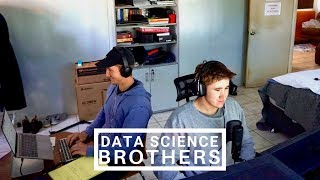
Daniel Bourke and his brother work through University of Michigan's Python Fundamentals course on Coursera, tackling week 1 quizzes on list operations and string slicing. Daniel emphasizes that learning is hard and you'll suck at first, but you have to keep going anyway.
Chapters
It's pretty loud out here. Can you hear me? Morning team! Today we're on the iPhone camera and have a look, I think it looks pretty good. My other camera's on charge, but I'm not going to let that deter me from making a video. Today my brother and I, he wants to get into data science, so we found a course on Coursera that we're going to be jumping into. Why do you want to get into data science, bro? You put me on the spot here, mate.
I'm not ready for this question. Okay, well, no, I'm just interested to learn how to code, and, uh, mainly because of the scalability of coding and whatnot, that, um, you write it once and it can literally be played like millions and millions of times. Like, that code sticks forever. Yeah, so also interested in AI and whatnot. In the application of business.
But this is the course, Coursera, University of Michigan Python Fundamentals. You've been through a few videos here, just the introduction stuff.
Now it's starting to actually get into the fundamentals. But, um, yeah, got my tutor here. My coding experience is pretty limited. It's mainly the markup, so CSS and HTML and a small amount of JavaScript in there. So seen how Python goes.
And hey, puppy! Morgan in the background. So are we gonna set up a desk in here for me? What we're gonna do, we're gonna go through this course together over the next few weeks. It's an introduction to applied data science with Python. So I'm actually really excited to jump back into some fundamentals and see what it's like from, from the beginning. I've done a lot of deep learning, machine— deep learning and machine learning, so it'd be great to see what some fundamental data science principles are, which I think I need to work on. So we're going to jump into this, do Module 1. I think that's our goal for today, finish Module 1, and we'll hit you up with what we learn, eh, bro?
Yep.
Could probably do multiple weeks.
Little makeshift desk for some Okay, we're ready.
We keep going, keep going, finish week 1. We'll, uh, have a debrief at week— end of week 1. Sound like a plan?
Well, when are you getting up to the quiz?
Well, I'm gonna keep going until I'm at the end of week 1, and then we'll have a debrief.
Yeah?
Yep.
You're not really supposed to help each other with the quiz, but we're helping each other anyway.
I don't even know if this is gonna work.
What are you trying to do? Add two lists together. Remember?
Oh, sorry.
Just adding two lists together.
Oh.
What do you think it'll be? Yeah, you gotta risk it for the biscuit. Hold on. What is the result of the following code? One way to do it is to just try typing out that bad boy.
I was just typing.
Or you just go with it.
I think it's either It's one of these lists, right?
Yeah, why?
I'm just taking a stab in the dark because it's got multiplication in it. No, no, comprehension. Yeah, I knew it, I knew it was a list, I just didn't know, I forgot what the square brackets—
you could think of the square looks like an L, so square bracket kind of looks like an L, so that's a list. Yeah, look, I don't think we are. We obeyed by this, but that's all right. We can help each other out a little bit. Let's submit it, bro. This is your first Python quiz. How's it feel?
Oh man, I can't say I, uh, did that easy.
Hey, it's pretty hard. I found it pretty hard too. Submit. What'd you get? Oh, you got one wrong. Which one was it? String. A string is string slicing. Oh no, it's a way to make a substring of a string in Python. So that'll be number C there. All right, week 1 done. All right, I think, I think week 2 goes into some, some pandas, which, which I'm really excited for. How'd you find week 1, bro?
Um, to be honest with you, I didn't really, uh, understand a whole lot of it.
Like, it was—
I had to watch the videos like twice to get, to get around, to like start getting around it. I think it's just like, because obviously it's a new language and I have no Python experience whatsoever, like just trying to understand it. And I think that obviously this is probably more complex than what you would normally start off learning in Python. Like, yeah, well, you're diving straight into data science stuff because what it says on the course is that it's, uh, for experience to experience to what?
Um, no, intermediate.
Intermediate, yeah, experience level. So like they expect that you already have programming knowledge where I don't. So, oh, look what I got!
Hey, little delivery! Let me set this stuff down. I think you already know what this is. Get it open. Yes, Python for Data Analysis! By Wes McKinney. This is the book I've been talking about the last few videos, the livestream earlier in this one, I believe. I'm excited to learn some pandas. Going over that, that introductory data science course with my brother was a real— it got me pumped. Some of it was hard, but it's, it's, it's good when you're learning new things and progressing and looking at something you thought you knew from a different angle. It just, it just feels like it's unlocking a different part of your brain. But now I'm going to get into a deep reinforcement learning lecture, kind of switch gears a little bit from, from just straight up Python data analysis into some, yeah, some deep reinforcement learning because that's what we're learning about. I said in the last video at Max Kelsen we're working on some— we've chosen to take on a deep reinforcement learning problem. So there's a deep reinforcement learning boot camp— saying so many Words on YouTube, which you can check out. There'll be a link in the description. But it's time to get in. I'm up to the second lecture. I said I'd do three before we got back next Monday. So, I'm going to get into the second one now. Whoa, deep reinforcement learning is blowing my mind. I just finished the second lecture of the Deep RL Bootcamp. They're nice and short, they're about, they're about an hour long, but I watch them on 1.5x speed. So maybe it takes, takes half an hour or so. But I've got some notes here. Essentially, there's a lot of math to go through. A lot of it was theory so far. And I'll be honest with you guys, those equations, they scare me. Well, not scare me, but just because I don't fully understand them. But that, that doesn't mean I can't. So I'm going to, I'm going to practice some of this stuff with actual code in the very near future, like PyTorch or something. And here's Here's one of the slides that stood out to me. This is the final one. Deep reinforcement learning from pixels to actions. That's what I'm really, really fascinated about. So how do you, how do you take something from, from just like a game, for example, like DeepMind did with Atari or did with Go and turn it into pixels? Because my dogs are, oh, this is a good example. My dogs are seeing some light particles from, from a stranger or someone walking along the street. Ah, there we go. Someone skateboarding. Perfect example. So, my dogs are seeing the light reflect, reflect or reflect from her as she's skateboarding. They're hitting their brain and they've learnt from previous experience of dealing with us, my family, that that girl is not a part of our family and so she might be a stranger and their instinct is telling them to bark. Now, how does that relate to deep reinforcement learning? Well, how do you get an agent to look at a game or to, for example, a self-driving car to look at the world, turn it into a pixel space, and then learn actions from that pixel space? Such a beautiful problem. Such a— I don't know, that's the problem of life, right? Is how do you act in the world? We get deep on this channel. Deep. Learning. I need to go work out. Wanna see something funny? Check out that hat hair. All sweaty and I've been wearing that hat all day. I definitely need a shower. You know, I've been thinking. I get a lot of questions. Where do I start? Where's the right place to to begin? What course should I do first? And I've always had a little bit of trouble answering that. My bad, fogged up there. That shower was nice and warm. My face is probably all red because— ah, it was so hot. I love jumping on beds.
How fun is it?
Remember when you were a kid and you just bounce up and down on the bed? But where is the best place to start? Truth is, I'm not entirely sure. In fact, I don't know. How I got started and the reason why I document and share so much of my journey is because I'm really figuring it out myself, right? I'm trying a bunch of different things and just exploring the world, trying to, trying to be like a little kid, right? We have so much to learn from, from kids, right? Just exploring the world, trying things out, seeing what works, seeing what doesn't. And I mean, is there a best course you could do? And this goes for learning anything, not just data science and machine learning. Is there a best course you could do? Probably. But is there likelihood that you'll find it based on everything that's on the internet, based on all the different universities out there? It's unlikely, right? So, that's why the beautiful thing about the internet is, is you can jump on, jump on anywhere and try something. You can check it out for yourself. And the worst thing that's going to happen is if you don't complete it. Well, then you You learn that you didn't like that and you move on to the next thing. Let's go check in with my bro and see if he wants to keep learning tomorrow. He better, right? Wait, hang on to it.
Let's get back up to the teleporters.
Let's go in anyway. What am I thinking?
There's one guy left.
He's streaming Fortnite. Bro, are we on for tomorrow?
Yes.
Yes. What's your advice to people who want to jump in and learn data science?
Just get amongst it.
You heard it first, guys. And look— 2 beds, 1 video. My brother just got a new bed. It's a little bit comfier than mine. I'm a tiny bit jealous, but if you want to stop—
Wait, come back!
Let me in!
And check out my brother on Facebook. He streams Fortnite if you're into that. I've never played Fortnite. I don't know what it is, but as always, keep learning. Oh, it does do damage.
Dude, the thing's nearly dead. Fuchs, what are you talking about? Unless that's you crashing or something.
See you tomorrow. Or next week, or whenever the next video comes out. Something just come to me. I'm editing this video that you're watching right now. And I realized I didn't quite say enough towards the end, right? I said, "Just jump in and try something." I think that the other caveat to that is whenever you're trying something new, something you've never done before, you're going to suck. And sucking is hard, right? When you're bad at something, it's hard to keep going. What do you do when it's hard to keep going? What other option do you have? You can give up or you can keep going, right? Just keep going. Remember those 3 words? Life goes on. Just keep going. You're gonna die. 3 words, whichever 3 you want to pick to be your motivation, right? But that's— or here's my favourite one, actually. Embrace the suck, right? When you try something new, you're going to be bad at it for a little while. I'm bad at most of the things I do, but I know I can continually improve. Step by step, I keep putting in the work. So, if you're trying something new, if you're just jumping in, realize it'll be hard, there'll be times it'll suck, but just keep going. Keep learning. And this is definitely the final clip, alright? We'll see you next week.
You and me, everything that we've been through has made us strong. You won't believe we've had our break.
More from Daniel

Small Language Models (SLMs) Are the Future: Fine-Tuning AI That Runs on Your iPhone

Introducing Sunny - A MedGemma-Powered Skin Health Tracking App (Kaggle Competition Entry)


Benchmarking: NVIDIA DGX Spark & NVIDIA RTX 4090 | Part 4 - Comparing the results

Benchmarking: NVIDIA DGX Spark & NVIDIA RTX 4090 | Part 3 - Running LLMs on the RTX 4090

Benchmarking: NVIDIA DGX Spark & NVIDIA RTX 4090 | Part 2 - Formalizing the tests

Benchmarking: NVIDIA DGX Spark & NVIDIA RTX 4090 | Part 1 - Creating a series of tests


Local Multimodal RAG on the NVIDIA DGX Spark | Part 4 - Publishing our demo to Hugging Face


Local Multimodal RAG on the NVIDIA DGX Spark | Part 3 - Putting it all together