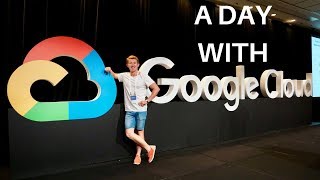
Daniel Bourke attends Google Cloud Onboard in Brisbane and walks through sessions on storage, Kubernetes, and CDN. His main takeaway: Google's machine learning APIs for speech-to-text, image recognition, and video transcription that developers can build on top of.
Chapters
Something I'm really excited for is tomorrow, the event I mentioned last week is tomorrow. Wait, I just said tomorrow like 3 times, but anyway, Google Cloud Onboard Brisbane. Let me show you what's it gonna be. So 8:30 AM, we have registration, welcome and building what's next with the Google platform, introduction to the Google Cloud platform, whole bunch of stuff with the Google Cloud platform, storage, everything to do with Google Cloud platform, and it goes till 5:30. And my favorite thing is the first 50 attendees will receive an exclusive Google Cloud gift. What do you think it'll be? Google Cloud credits, Google hat, Google shirt? That'd be really cool. I think I'd like a Google hat or maybe a Google shirt. That'd be awesome. Anyway, it's not about the free gifts, it's about the knowledge that I'm excited for. I will try to be one of the first 50 people there. I'll bring you guys with me, of course. Let's check it out. So we're heading into the Google Cloud event. My mom just dropped me off at the train station, so thanks, Mom. Little tip for going into these things is if you're nervous, just think about what other people would think. We're all on the same page, right? So I think about what I would talk about If I was— or I think about what I— If you're a little bit nervous going to these events, which I am, I'm sort of talking myself through it at the moment. I just think about what would other people think of me attending this stuff. I'm thinking, what would I think of them? Sorry. And I think we're all on the same page here. We're all friends. We all love Google Cloud. We all love AI. So why would we— why would I be nervous? Enjoy that. Good morning. I'm Daniel Bourke. I think it's just at the bottom there. Yes. Thank you so much. I got a name badge. It's official. Alright, so you know how I said the first 50 people in get a sort of little gift? Well, check it out. Let's do a quick unboxing before we go in. I got here super early, so it's still about half an hour before we go in. But look at it, it's a shiny little water bottle. You'll be seeing this in videos to come. It's so cold in here. We just finished the first session, or the first two sessions actually, and that was sort of like a getting started with Google Cloud and then a little bit of a tour of how to, uh, of what Google Cloud services offer. The next stage is virtual machines, and then eventually I think the last session is on machine learning APIs, which is what I'm most interested in. And it's supposed to be lunchtime now, but I'm going for a walk, and plus the line for lunch is, is way too big. I don't know if you can see it. I just walked away from it all the way down there. All these people here are waiting for lunch, so I'm going to walk around this building for a bit and check it out, and then, uh, Yeah, I'll show you what's on offer for lunch. I forgot to mention, my favorite takeaway from the first session so far is of course the scalability and the services that the Google Cloud Platform offer. But not only that, is that the whole platform is powered by renewable energy. That's a major, major, major up in my books. I think that's the only way we're gonna move forward going forward in the future. But Google know how to put on a spread. Look at this food. We've got about 3 different types of sandwiches, pasta, salad, tuna, fish, sweet potato. My favorite vegetable there. Just gonna eat this lunch. I've sort of ducked away from the group for the time being. Gonna eat this food and then go back and mingle and talk to some people, meet some people, find out what they're excited about, and we're back into classes. Okay, so session 3, 4, 5 were about Kubernetes, which is like TensorFlow but for developing web applications, so you can transfer them easily between— you can transport them easily between— how do I explain this? Kubernetes, which is like TensorFlow but for web applications, so you can use it across different platforms, much like TensorFlow is like a universal universal language for deep learning. Kubernetes is like a universal language for shifting applications across different platforms. And also the Goode— Google CDN, which is Cloud Delivery Network, utilizes Google's cloud network and a whole bunch of their infrastructure, which is plenty of cables underground. They even had a video of a shark eating one of the Google cables, which was kind of funny, the one that runs from the US to Australia. We've got lots of sharks in Australia. That was blazingly fast. Apparently it's 25% or maybe a bit more faster than AWS, so that was really cool. The last session is what I'm most excited about, which is about machine learning and AI. About to jump into that. I didn't get too much footage of the last session of the Google Cloud Platform. You probably see on screen at the moment that there was, it wasn't the greatest environment to film in. Like I could get some of the screen, but not all of it. So I thought rather than, rather than showing you exactly what I saw, I just tell you it back in my own words. So my favorite parts of the, of the last session were the fact that you have access, or we all have access to the AI and machine learning APIs on the Google Cloud Platform. So which means all you need to do is make use of the already available APIs to build your applications and your job gets done at a faster rate. They range from something like speech-to-text, natural language processing, even can even scan your videos and embed like subtitles along them. So that's really cool. I might have to try that. That's in beta at the moment. I might have to try that. On one of my videos in the future. I think that'd be a pretty fun project. And there's also image recognition. So, essentially, what does this mean? Well, it means that you and I, if we wanted to start like an AI startup, we could take the best, the best AI company in the world, we could use their platform to build the base layer, the foundation of our product, and then build on top of that. So, build our layer on top of it, like say, for example, you use a speech-to-text API then you build an app on top of that, and then you package that up and you can put that on the App Store. Thanks to things like Cloud ML, I think it's Core ML, I'm not entirely sure, I might be wrong. Core ML, I think that's the Apple one, I'm not entirely sure, but the way how you can run machine learning algorithms directly from the phone or directly from the cloud. So essentially, massive takeaway from the Google Cloud Platform event was Google Cloud is expanding rapidly. Rapidly. Like the fact that they laid a cable from the US to Australia just shows how keen they are just to build this infrastructure out so people like you and I and even Google themselves can provide the best cloud service in the world. And I've used AWS in the past and I was talking to some people there about AWS and they said it's the best at the moment, but what they heard of the Google Cloud Platform is said that it's just blowing it out of the water. It's getting better and better and better. At the end, I met up with a lovely gentleman. He was originally from India, moved to Australia, started his own business. So Kiran, it was very nice to meet you. So shout out to Kiran. It's awesome what you're doing in the education space. I really— you've really inspired me. Two more things about the Google Cloud Platform. I finished off with a little certificate here, which I think is pretty cool. I like the fact that it's got like the div tags here on my name. So, you'll see that on my LinkedIn or something like that, and I'll put it on the wall maybe. But yeah, that's a nice gift. And one more thing I'll show you. Check this out. Stop that. What? The whole pinging and the binging and the shirt changing. Oh, hey future Dan. Just tell the people what you're up to. Yeah, I know, but it just makes for effect. It's cool. I think it's cinematic. You don't agree? Okay, okay. For the rest of today, I'm working through the artificial intelligence Nanodegree. Almost onto the machine translation project. So, I'm working through the NLP pipeline classes at the moment, which is text processing, feature extraction, and then modelling. More to come with that. How come you've got the same t-shirt on as me? I can wear whatever I want. I'm from the future. I want to change my clothes and just generate something new. I don't have to pick out my wardrobe because I can just change it whenever I want. Future's really cool, trust me, I've told you this. Oh, now that's cool. Now, Future Dan, does all this stuff work out in the future? I know you're from like 2048 or something, you never really tell me where you're from, but this whole AI and, and, uh, stuff, does it, does it, does the world a better place in the future? Oh, I can't tell you that, that's future code. All I can say is that it's really cool and keep doing what you're doing. Yeah, that's true. Keep it up. Alright. Simple but true. Thanks, future Dan. You never know when he's gonna show up.