My First Time Speaking In Public - TDBS 20 April 2017
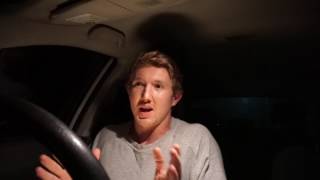
Daniel Bourke shares how he went from terrified at public speaking to confident through practice. He gives concrete tips: make eye contact with individuals, ditch the palm cards, talk about things that excite you. Fear doesn't go away, he says, you just reshape that energy into fuel.
Chapters
What is going on everyone? It is day 79 of the Daniel Bourke Show. It is April 20th as well, 2017, aka 420 Day. Blaze it, you know the drill. Hope you're all having an awesome day. Um, yeah, it's gonna be an awesome show. I'm excited. We're gonna run this one for about 10 minutes or so. You know, every time I start making one of these, I do it off the cuff sort of thing. I have a few dot points, but I always feel as if I'm never going to make the 10 minutes. I remember when I first did my first podcast, I was in the car, I was driving in the car as well, cruising along, and I just started talking. I can't even remember what it was about, to be honest. I think I was explaining what I wanted to do for the 100 days of podcasting or what I wanted to get out of it. We're up to day 79 already. If you had told me at the start of the year or the end of the year or any time in the past 2 years, let's just say that, that I would have 79 episodes of podcast. And I say this every time I make an episode almost, but it's true, right? I look back at the 79 episodes and I think, wow, I've actually made 79. And this is going to be number 7, I think, of recording it on video. I should have started recording it on video from the start so you could have seen how sweaty I was under the armpit when I started. How I started recording with my Beats headphones in my car, just driving around. The first ever episode of the podcast I did, I was that nervous, I got in my car and I drove, just, I just kept driving, just kept talking because, I don't know, I don't know why. If you listen to day 1 of the 100-day experiment, you can do that on any of your podcast outlets, you'll see why. But it's taught me a lot. I've learnt a lot doing it. And what did I even start on? Oh yeah, 10 Minutes. I didn't think I could talk for 10 minutes and I ended up going on it for 10 minutes, I think. I think the first episode was about 10 minutes or maybe 20 minutes. I can't remember exactly how long it went for. And I never thought I'd be able to just keep talking for something. When I did debating in high school, I would always meticulously write out my speeches. And I was the third speaker of the debating team. And so, the third speaker usually doesn't have a script, right? They write down rebuttal points to rebut the other team's arguments. So, as a third speaker, your job is to rebut the first two speakers of the other team's argument and say why their points are invalid and why you're correct. And essentially, you write your speech while they're writing their speech. And because when you're a third speaker, you don't start the debate with points to rebut. You have to wait to see what they say. And I think back then, learning— I learnt a lot from doing that. I didn't have my full speech prepared, but I would still meticulously write out everything I wanted to say. But I never really looked at what my palm cards would say. I would read them sometimes, but to project a point and to get the most points for your team from the adjudicators, you would have to not use your palm cards as much. And plus, if you're constantly looking down at something while you're speaking, you're not really projecting your voice. You're not buying in with the audience. You're not getting their attention. You're not making eye contact with individual people, which is, I don't know, a tip I've picked up from speaking. Make eye contact with individual people rather than sort of looking at the crowd. The crowd, or fixate on something behind the crowd. Say you've got a window there, fixate your eyes on the latch every time you move to a different part of the room. Say you're looking at the clock over there at the back of the room, then you look at the latch over in the middle of the room, and then on the right you look at the vase, something like that. And that way your sort of eye contact is sweeping the room and you're not— you don't seem as if you're looking into space. Another way is to make eye contact with individuals. And yeah, if I had it written out, I would always find myself looking at the palm cards. The speech didn't go as well. The timing would all be stuffed up. But when you're sort of speaking, this is what I found. When you're speaking about something you're passionate about, you don't need— not necessarily passionate about, or something that you know, or something that gets you excited, right? This podcast gets me excited. Time I do it. And same with filming it. I get excited now to do this. Before, I was procrastinating a bit. I was watching some YouTube videos of Elon Musk on his hiring philosophies for his companies because I was getting distracted. I should have been making this, and it's, it's getting towards my bedtime. It's, what is it, 9:39 at night right now. I'm going to go to bed within the next hour, and so my mind's a little hazy. I spent the day studying. That's what I was gonna, gonna talk about, actually. But yeah, if I'm reading this book called Dale Carnegie, the something to do with effective speaking by Dale Carnegie. I think it's Effective Speaking. And one of the major points he talks about is to be an effective speaker, talk about something you know, talk about your experiences, talk about something that gets you excited. And that's one of the reasons I've been doing this podcast and why I've been doing this, this YouTube video is to improve my skills as a speaker. I love speaking and I think it's a valuable skill. Like, my intuition tells me that it's a valuable skill, and I've heard from other people, mentors that I look up to through various outlets such as books and other podcasts, and they think it's a valuable skill too. So, I've done plenty of speaking in the past through high school. I remember in Year 6, I did my first speech. I was shaking everywhere. It was about a watch, a Wacko watch. You could effectively call it the Apple Watch. Maybe I was ahead of my time. It was 2004, maybe? Yeah, I was in Year 6, 2004, and I wrote a speech called the Wacko Watch, and it could do some amazing things. And maybe I was way before my time. Maybe I predicted the Apple Watch back in 2004. You know what? I'm going to try to dig up that speech. If I can find that speech, I'll be so stoked because that was the first ever public speaking speech that I did. And I remember distinctly, I heard it from some other kid, the concept from some other kid, and I went home that night and I made it my own. And I think that won me a whole bunch of prizes in— when I was in year 5, 6, and 7. I started in year 6. 6, 7, 8. Yeah, I think I won a prize, like the public speaking prize for my grade with that speech. And yeah, it was copied. All the best stuff's copied, right? But that's what really got me started. So if I can find that, I'll definitely Definitely post it on my blog or something like that. But yeah, that's my tip with public speaking. That's what I've gathered as well over sort of years of knowledge. And you'll notice when I speak on these podcasts, if it's— or some of these videos, if you look back at older episodes of the podcast, maybe some episodes I don't clearly articulate— I can't even say the word— articulate myself. And most likely, I think those topics are because I wasn't excited about them or maybe I didn't know too much about them. But I find when you're telling a story about something you're excited about or something that you're knowledgeable about, for example, fitness and nutrition, I talk a lot about that because that's a large part of my life and that gets me excited and that's something I know about. So, I can talk at length on that. But something else like how a car engine works, probably can't talk too much about that. I mean, it's a bit fascinating to me, but it's not something that really excites me. So, what have I been up to today? I got up this morning, did some study as usual, did some writing, answered some questions on Quora. I'm learning about deep neural networks at the moment. I did a section on Udacity. About derivatives and convolutional neural networks, and I don't really understand it that well at the moment. It's very complicated for me. I know some people are incredibly smart at these things, but I'm fascinated by the area and I want to keep learning more. But I don't understand it, but it's also exciting me at the same time. So, I'm going to keep digging, keep learning. I've been using Khan Academy to learn some some fundamental calculus and things like partial derivatives, multivariable derivatives, gradient descent and whatnot. But it's like anything, right? You gotta struggle in the beginning. If you're learning something, a skill of value, you're gonna struggle in the beginning. Much like I struggled with public speaking at the start. I remember being in Year 6, I was 11 years old, nervous as I was shaking. I remember getting up and in front of this crowd of parents and I was shaking. I had my palm cards in my hands and I'm sure they were— now that I look back, it's— I was making the situation a lot worse than what it was because if I was a parent looking at a kid doing that, I would be in awe, right? I would be like, good on him for getting up and doing that. Just like when I started fitness, I was scared to come into the gym at some point. When I was at school, in high school, In my senior year, I was scared of going to the gym because I was afraid of what other people would think of me. I wasn't the fittest kid. I was a chubby kid, and they'll be like, what's this chubby kid doing in the gym? And now I absolutely love it. If you look at my Instagram today, I posted a story. It's @MrDBurke if you want to check it out. I posted a story of me working out with my friend and A few people responded to that and said, "Hey, I'd like to work out with you one time." Or one person did. "I would like to work out with you one time." And I'll happily do that. But at the start, like years ago, I would have been scared to do that. Same with public speaking. I would have been scared to do these things. I would have been scared to make these podcasts and YouTube videos. I mean, don't get me wrong, the butterflies never go away. When I speak in front of a crowd, I still get the butterflies. And when I speak in front of this YouTube video, there's still a little bit of me that's a bit nervous. Being in front of the camera. I've spoken about it before, but over time I think you'll learn to remould that energy. The butterflies will always be there. You can learn to remould that energy and use it for excitement, use it for making the speech awesome, use it for making the workout awesome. There's so many ways to do it, but I think the only real way to learn how to remould that, at least in my experience, is, and I'm not saying I'm right, this is just what I've found, it's just to keep doing it. That's it. There's no secret to it. It's just keep doing it and keep trying to make yourself better. So, with the podcast, I try to make myself better by making it a visual, a video aspect now. And if you're listening to the podcast, you can check it out on YouTube, or if you're watching this on YouTube and you want an audio format of my last 70 79+ episodes or 78 now. You can check out my podcast. They're both available at mrdeburgh.com/videos or podcast, whichever one you want. But guys, whatever you're doing, thank you so much for tuning in today. I really value your time and attention. Hopefully I'm bringing you some sort of value. If not, let me know and I'll try work on it, you know. But I'm just trying to be the truest version of myself this year. That was one of my goals. And I appreciate you all following along. But, tell someone you love them. And, oh, what's today's daily challenge? Daily challenge. Could be, think about a time in the past when you were nervous, and why aren't you nervous anymore about that thing? If you've done something for a number of years and you were when you first started, think about what made you nervous at the start and why you got better at it. And how can you apply that process to something else? So just think about that. Say you've been working in a job for 4 years now and you thoroughly enjoy it, or even if you don't enjoy it, if you were excited at the start, why were you excited? If you were nervous at the start, why were you nervous? And how can you apply that framework to something else in your life? So reflection piece for today's challenge. Nonetheless, I love you all and tomorrow's day 80. We're going to wrap 80% of the way through after tomorrow. That's massive. Anyway, happy 420 day. I'll catch you later.
More from Daniel

Small Language Models (SLMs) Are the Future: Fine-Tuning AI That Runs on Your iPhone

Introducing Sunny - A MedGemma-Powered Skin Health Tracking App (Kaggle Competition Entry)


Benchmarking: NVIDIA DGX Spark & NVIDIA RTX 4090 | Part 4 - Comparing the results

Benchmarking: NVIDIA DGX Spark & NVIDIA RTX 4090 | Part 3 - Running LLMs on the RTX 4090

Benchmarking: NVIDIA DGX Spark & NVIDIA RTX 4090 | Part 2 - Formalizing the tests

Benchmarking: NVIDIA DGX Spark & NVIDIA RTX 4090 | Part 1 - Creating a series of tests


Local Multimodal RAG on the NVIDIA DGX Spark | Part 4 - Publishing our demo to Hugging Face


Local Multimodal RAG on the NVIDIA DGX Spark | Part 3 - Putting it all together