NEW TensorFlow Deep Learning Course Release Celebration/QA
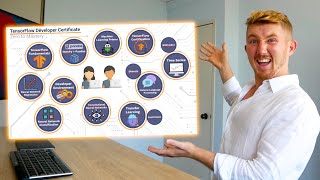
Daniel Bourke launches his TensorFlow Deep Learning course with 150+ video lessons covering fundamentals through NLP and time-series. The course costs $29/month with a 20% affiliate discount, requires six months of Python experience, and emphasizes code-first projects over certification prep. He answers audience questions about prerequisites, platform rollout, and planned updates on transformers and hyperparameter tuning.
Chapters
Here we are, we're on. Fish on. Looks like you can start streaming. Going live. Boom. Hello everyone. If you're joining the chat, please tell me how the sound, how the microphone looks, how the video looks, sorry, in the chat. Let me know if you can hear me, if everything sounds okay, and then we will keep going. We're going to answer a bunch of questions about the new TensorFlow course. I'm going to start sharing out the link. If everything is all good, please let me know in the chat. That way we can keep going. Hello, Rohan. Hello, Pi Master. Hello, Yashin. So glad to see you anymore live. All right, I just need to share this out. You look good as always. Oh, thank you, Piemaster, I appreciate it. It's very kind of you. And we're going here. I've got a placeholder link. I just need to post this link at here. Going live on YouTube. To celebrate the new TensorFlow course. Rocket. And answer any questions you may have. So if you have questions, please leave them in the chat. I will get to as many as I can over the next hour or so. Send now. Boom. All right, fish on, fish on. How are we, everyone? Steve, thank you so much. Elias B, thank you for everything. Thank you for everything. Now we are here. I will show you what's going on. Now that I've shared it, let me, uh, how can we work this? I'm going to open up a Chrome tab, new window. Can you see my screen? You can't yet. That is okay. Go on here. Can you still hear me? Oh, look at this. Good morning, Daniel. I love this extension. Today, my one goal for today is release an absolute beast of a TensorFlow course. And we have done that. By the way, you should be able to find all the links you need in the description if I've done them correctly. But let's go to the course GitHub because this is where everything is going to live. Right. And this has been out for a while. But so what's the story for this actually? We need a story because this is— we can— you can go through this yourself, right? There's a whole bunch of materials here. This is of course GitHub. But what's the story of this? So if we look up Daniel Bourke TensorFlow Developer Certified. So I wrote an article during COVID I passed the TensorFlow Developer Certification exam. There's me with a scraggly beard and a mullet. Writing some code in Colab, yada yada yada yada. And it was just a guide to how I prepared to pass the TensorFlow Developer Certification, which is, if we go here, TensorFlow Developer Certification. Now I want to put a big caveat on this. You actually— this is completely optional to do this, differentiate yourself with the TensorFlow Developer Certificate. In fact, all certificates are completely optional. However, after writing this article, and I made a video on it too, if we go here, how I passed the TensorFlow Developer Certification, right? So there's that video on my channel and you can see that if you just search Daniel Bourke TensorFlow Developer Certification. I had a lot and a lot of people asking, how do I do this myself? And of course I had a little bit of a guide here on how you can do it. But I felt like just when I made my first machine learning course, I felt like I wasn't giving my point of view. So that's why I made this course, because I had a lot of people asking, how do I start learning TensorFlow? And what I found is that, of course, you can learn all of this. Let's be real. Let's be straight up and real. You can learn all of the stuff that I've included here on your own. You don't need me to teach it to you. You don't need to pay for courses. You don't need to even pay for my course. You can learn all of this stuff on your own. The value of any course is curation and community. So when you sign up to a course of some sort, you've got someone like me who's done something, who may be a couple of steps ahead of you and put it into a nice little package so that you can learn it all too. And so that's what I've done. I've put in— this course will basically go through the fundamentals of TensorFlow, which is a deep learning machine learning framework. It will then teach you different concepts and information about deep learning, such as how to build neural networks for regression problems, neural networks for classification problems. We then go into computer vision. We then go into transfer learning and still to come, I've actually got the code ready for these 3, 07, 08, 09, but they haven't been released yet. I need to make videos for those. So the course is releasing with about 150 or so videos. Then we go through NLP with TensorFlow. So working with text data, and then we go through time series. So a whole bunch of stuff in this, whole bunch of projects. It's taught code first. If we go here, this is how we teach. We write code and then we talk about the concepts. So that's probably enough for me for now. You can go through all this stuff yourself, but let's jump into the chat and see what's going on. Gustavo asks, the ML course is a prerequisite for this new course? Yeah. So this is quite an advanced course. This is not like a complete beginner. My machine learning course is for complete beginners. You don't know code, you can do my machine learning course. This one, you need some prerequisites. So let me show you prerequisites. What do I need to know to go through this course? You need 6+ months writing Python code because we focus on what? Writing code first. Can you write a Python function which accepts and uses parameters? If you don't know what that means, go learn some more Python. But if you can, that's good enough. If you can't, go learn some Python code, come back here. You need to also have done at least one beginner machine learning course. So I might teach also a machine learning course. So you might have done that. Are you familiar with the idea of training, validation, and test sets? Do you know what supervised learning is? Have you used Pandas, NumPy, or Matplotlib before? If no to any of these, I'd go through at least one machine learning course which teaches these first and come back. And you must be comfortable using Google Colab or Jupyter Notebooks because our course, we teach Google, we use Google Colab throughout the whole thing. Why? Because we need a GPU. Why? Because as we reveal in the course, deep learning finds a lot of patterns in numbers and GPUs are very fast at computing. So we've got a main question here. Should you do this course? Do you have 1+ years experience with deep learning and writing TensorFlow code? 'If yes, no, you shouldn't.' This is for people who have never— this course is for people who have never experienced deep learning or TensorFlow before. So if you have experience doing that, you should use your skills to build something. But if you don't have 1 year's experience with TensorFlow and deep learning, on to the next question. 'Have you done at least 1 beginner machine learning course and would like to learn about deep learning/pass the TensorFlow Developer Certification?' Remember, That certification is completely optional. You do not have to do it. If yes, this course is for you. If not, go do a beginner machine learning course. And if you decide to learn TensorFlow, this page will still be here. I'm so excited. Who wants to see my recording studio? This is where I record videos. I've spent a lot of time in my closet recording videos. Have a look at this. I need to zoom out. Click download. This is my recording studio. I have a laptop here. There's a bench. This is a bookshelf. This is toilet paper to dampen the sound because why am I recording in here? Because recording studio, if I recorded it here, there'd be too much echo. So if I record in there, it's not, it's not as loud. So the audio sounds better. And you let me know how it sounds because I think it sounds pretty good. But what do we got in the chat here? Get dark mode. Um, Vasya asks, will the course be available on Udemy? Yes, it will be in about 1 month from now. I don't know the exact date for Udemy, but it'll be about 1 month from now. So I'm going to start writing down some questions here that people want. Um, be, Command B. Will the course be available on Udemy? Yes, in about 1 month from— what's the date today? Today is the 26th of February. Well, in Australia it is. I'm going to zoom in on there. So if we come back to the GitHub as well, this is— I'm really excited to do this because I've also got a new tab on GitHub, which is the discussions tab. So if you have any questions, you can add them here. So new discussion. So someone asked here, Trav Haran asked, availability of course on Udemy. And hey, I'm about to finish up the machine learning and data science bootcamp. And it's by far the best ML course I've ever taken. Thank you so much, Trav. I really appreciate that. Of course, out of curiosity, this deep learning course is going to be available on Udemy. So there's a question for the course. This course will be available on Udemy and ZTM. However, I think it'll be a ZTM exclusive first for a month or so. I'll share as much as I can closer to launch. So I answered that about a month ago. So if you have any questions of the course, go to the GitHub and go to discussions and click New Discussion and I will personally answer them or someone else might if you ended up taking the course. So this is what I'm really excited about. I'm keeping— this is something we didn't do for the machine learning course. We didn't have GitHub as like the central resource for everything. But this is a new experiment, right? I'm trying it out to see what it's like having GitHub as the central resource for everything. That way all the questions are open, everyone can see them. All the materials are open source. You can see it. You can decide whether you want to do it or not. Here we go. Um, Ahmad, how much is the course? So right now, Ahmad, you can have access to it if you go to zerotomastery.io and boom, brand new course, TensorFlow Developer Certificate in 2021, Zero to Mastery. If we click on that, if you use the code TF20, you get 20% off. So start learning now. So right now you can sign up for monthly membership at $29 per month. But if you use the code TF20, you get 20% off for life. So this is accessing the TensorFlow Developer Course on zerotomastery.io. It's not available on Udemy yet. It will be on Udemy in about a month or so from now. But if you get $29 a month, you get access to all of the ZTM courses. So not only the TensorFlow course, but Complete Web Developer, Mastering Coding JavaScript. If you want to learn some web development, if you want to learn Python, Learning How to Learn. Where's my course? Here we go. TensorFlow Developer Certificate in 2021. Boom. Look at that. 229 lessons. That's what's up. And so And the machine learning one is— where is it? There. So that's 43 hours. So $29 a month, 20% off. You can do the machine learning one and you can do the TensorFlow Developer Certificate in 2021 after the machine learning one. So what else do we have? Hello, everyone. Hey, Henry. Good to see you. Thank you for the kind words. I really appreciate it. Rishung says, how much experience we need with Python to clear TensorFlow Developer Certification? So to begin this course, you need minimum 6 months Python code. The TensorFlow Developer, this one, TensorFlow Deep Learning. To pass the developer certification, I would say you would need to go through at least all of these notebooks. So you need at least 6 months experience with TensorFlow for the TensorFlow Developer Certification. And that's what this will give you. There's going to be a lot of material. There's like 25 hours worth of TensorFlow code in the course so far. And Ilya says, Ilya says greetings from Colombia. Ilya, so nice to meet you. Hello from whatchamacallit, Australia. I just forgot where I was for a second. I'm trying to read the chat and answer. How many projects would you recommend to do first? There are so many machine learning algorithms. Should one make projects for each before they move on? So Hashit, that's a great question. I would say what you want to do is just don't overwhelm yourself. There is a lot in machine learning and deep learning. So just pick one small thing and do that at a time. Small thing, do that. Small thing, do that. Maybe you're really interested in the random forest algorithm for classification. So practice that on a few problems and see what happens from there. And then the same goes for anything else. Maybe you decide, I want to learn more about k-means clustering, and then you find an unsupervised dataset, use k-means clustering on that, and start to figure it out from there. So what else do we have here? Harry asks, why TensorFlow? TensorFlow is amazing. Have you not seen it? If we go here, TensorFlow is used by some of the world's biggest companies. It's used by Google. TensorFlow. Boom. An end-to-end open-source machine learning platform. It goes through everywhere. You've got— if you want to do it in the web browser, you've got JavaScript. We don't teach that. We teach Python TensorFlow. For mobile and IoT. So if you want to deploy your TensorFlow models to your mobile application, you can do that. For production, If you want to serve your models in production, such as on Google Cloud or AWS, TensorFlow helps you to do that. So, it's an amazing resource. Robust ML production everywhere. Powerful experimentation for research. It's basically— you've got— for deep learning, you've got basically two options. You've got TensorFlow or PyTorch. They're both great. I have more experience with TensorFlow. I love PyTorch as well. But the reason why TensorFlow is— I can only teach what I have the most experience with. And so that's why TensorFlow. It's where we go. I'll go back to the full screen. And Hassan, who teaches you these courses? I teach myself. I read books, I do projects, and I do other courses online, and I work on different machine learning problems. The Only Pack, have you completed the certification? How hard, easy to do the estimate is? I haven't completed this course. If you complete this course and you know it throughout, you'll have no troubles passing the certification. That's why I made it. I made it exactly, exactly how I made it with. So I completed certification and then started working on this course straight away. So I made it exactly how, um, with what the information I'd like to know. Not, not only just about the certification though. Okay. The certification is optional. I can't stress that enough. I wanted to make this— if you do the course, you'll know the foundations of deep learning and you'll be able to work on multiple different problems. And if you decided to do the certification, you would be prepared. So that's the three, three pillars there. Foundation of deep learning, write a bunch of TensorFlow code. And if you wanted to do the certification to sort of show your TensorFlow skills, I'm a big advocate for you can just show your skills by having a nice GitHub repo with a bunch of projects you've worked on with TensorFlow. But if you did want to do the certification, you'll have the skills to do it. Um, yeah, as Hassan said, certifications "It doesn't worth any shit. Your knowledge and process, your knowledge and projects is important, not the piece of paper. Sorry, man. Just honestly, everyone can get a certificate." Hassan is 100% correct. Yes. So certification, he said, is not worth shit. However, I would argue that it's just another tool in your toolbox. So say you were going for a role. If I was personally hiring, I actually wouldn't care about what certificates you have. I would go to your GitHub repo and see what you've worked on. However, some other people who are hiring, because I'm an engineer, I know what code looks like. However, some people who are hiring and they don't necessarily know what should be in a GitHub repo may go, okay, this person's got a GitHub repo, but have they passed? Are they able to certify themselves in any way, shape, or form? So that is the like certification is just one piece of the puzzle. I'm more of a big advocate for projects, but that's what I'm saying. Completely optional. I cannot stress this enough. Um, hello everyone. By the way, Henry asked, what's next for you in terms of projects? Oh, this is a great one. So I, um, I've been in teacher mode for like the last year, so I've been making this course and doing the other ML course, and I feel like I need a big project. So once I've finished up finishing the rest of this material, it's a beginner TensorFlow course. I cannot stress that enough. If you have already experience with TensorFlow, you probably don't need to do this. It's for beginners. But after I finished it, I'm going to be working on my own project for like a year. And see what happens, see what I can build. I'm thinking of doing a YouTube series. This is, this is in the idea space. Let me know if you think it's a good idea. It's going to be called something like Making Money with ML, and I'm just going to make videos of, of me using machine learning to make money. So apart from selling courses, so working on projects, selling those projects, etc., etc. So let me know if you'd like to see that. My YouTube videos have waned recently because I've been putting all my effort into this course. Making a course is a lot of effort. You need to do things 4 times. You need to read and learn the materials. You need to work on projects to practice the materials. You need to create materials, and then you need to teach materials. So 4 times: learn it yourself, use them, get experienced on working with it yourself, then create materials to teach others that. And then, um, yeah, once you've created the materials, you actually have to teach them, record videos. You do everything 4 times minimum. So I hope that answers your question, Henry. Why Python? Why not Python? Why do we need the course if we have the GitHub resource? So the GitHub resource only contains code. So if we go back, I need to change the screen. So the GitHub resource only contains code and slides, so it's all text-based. So you can 100% use this. I've made the notebooks. Let's have a look at one. Here's one of the most recent ones. This is Transfer Learning in TensorFlow Part 3, Scaling Up. We work on a project called Food Vision. So let's load this up. These are pretty big notebooks, so that's why it's probably taking so long to load. This would be great if it doesn't load. Oh, here we go. Boom. So Transfer Learning with TensorFlow Scaling Up. We work on a project called Food Vision, which is identifying different types of food and images. So we want to try and beat the original Food101 paper with only 10% of their data. This is the type of experimentation that we do. What we're going to cover. So this is the type of materials that you'll find. Right. This teaches a whole bunch of different stuff about building a feature extraction model. Then we make predictions, we plot loss curves. If you already know how to do this stuff, you don't have to do the course. You can just go through the GitHub repo. It's all free. There's fine-tuning. If you want to fine-tune a model, you can go down like that, teaches you that. And then yeah, then this is a really fun one. I'm actually recording the videos for this now. We make a huge confusion matrix because we're working on 101 different classes. And then of course you could go through all of this, but I find some people learn, learn good when they watch videos. So that's what you're paying for when you sign up to the course. Is you get the video version of this. So we go through and we code all of this step by step. But these notebooks in the GitHub repo, see, there's F1 scores for— this should be actually 101 different classes. I'll change that. I found an error. How good is that? If you find any errors, let me know because there are probably plenty through here. Loading, preparing images, making predictions. Boom. So, we cover a whole bunch. That's just one notebook, right? And so, all of the other notebooks are very similar to that. They have a lot of code, a lot of text explaining different things. But if you'd like to go through them step by step, that's what happens in the videos. And there's probably going to be a YouTube video in probably maybe a week or so that I release that will give you a very big insight into how I teach different things. So, stay tuned for that. That'll be on the channel within a week or so. Uh, Manoj asks, hey Daniel, what hyper parameter tuner are you going to use in the course? Uh, we don't actually use any for now. We more focus— that's more of an advanced topic. So that will be likely an extension, hyper parameter tuner. Minaj, if you have any suggestions on what hyperparameter tuner I should use, please let me know. Sendhu asks, is this course coming to Udemy? Yes, it is. Will this be available on Udemy? It'll be about 1 month from February 26th. So it's releasing right now. Right now, um, there's about 150, 50, 100 videos. In 1 month, there will be 200+. So I'm going to put a little date today. Well, actually, how do I get today's date in Notion? Today. That'll do. I'll put it— yeah, that'll just do today. Wonderful. So Dax says, oh, this is a great question. Why do you need— why would you need a certificate? Why would you need a certificate? I'm going to correct your spelling, Dax. Can't, can't you just show your skill by projects? Here we go, we're going to answer this once and for all. You don't need a certificate, it's 100% optional. You can showcase your skills through projects, have an awesome GitHub repo with things you've built. Boom. There's a conclusive answer for that. Why would you need a certificate? Can't you just show your work? There we go. We've completed those typos. So what do we have here? I want to understand the math behind it, how it works. Samantha, this course is not for you. This course teaches code. There are a bunch of extensions that I've included. In the external resources that go through the math. So extracurriculum. So this is what we have with every notebook, right? We have exercises that you go through. Then you have TensorFlow Fundamentals Extracurriculum. Then we have Neural Network Regression with TensorFlow. We have exercises for you to try yourself. Then you have extracurriculum if you want to go through and start learning the math behind this stuff. We focus specifically on writing lots and lots of TensorFlow code. Because in my experience with machine learning, you write a whole bunch of code. Come down here, external resources, etc., etc. That's where all the information will be for tracking. I mean, practicing the math behind the scenes. So where we at? So Vile says, I like watching videos more. Yeah, you're like me. I like learning in a whole bunch of different ways. I like reading. I like listening to audio on YouTube videos. I like watching YouTube videos. I like watching course videos. I learn in a myriad of different ways. So that's why there's all the resources that are text-based are free on GitHub, will be free forever. And then the videos to fund future projects that I want to work on, I'm selling them in a course. Oh, 2021. Thank you very much for Supernova, for that Supernova. Will this course be relevant in 3 years? Will this course be relevant in 3 years? Probably not. The field of deep learning moves fast. However, it will teach you the foundations of deep learning, slash, writing TensorFlow code, which you will be able to adapt to field changes, right? So will, will any tech, current tech course be relevant in 3 years? I don't know. I can't predict that. I'm going to put that here, but I can't predict that, right? So ideally, this is what I learned 3 years ago has changed. So that's a field of machine learning, right? That's a field of technology in general, is that it updates, it changes. You need to learn different things. But that's what I tried to incorporate in this, was also not only teaching you stuff about TensorFlow, it makes you— it gives you a curiosity to learn. That is what's most important. That is the most important thing that I can sort of impart on anyone. It's not any skill in general. It's just a curiosity to learn and to create. That is what I'm trying to, to get across. That is the fundamental thing. And it just, it just happens that it's It's in the form of a machine learning course. And John says, thank you, this format is awesome. Thank you, John. I really appreciate it. A legend. Osama, how are you, brother? Good to see you, man. Which books you have referred to while making this course? Hands-On Machine Learning. So that's probably the You don't even have to do this course. Just buy this book and read it end to end. If you want, if you want a single book, if you can read books and learn, read this book and you'll, you'll know everything in the course. Read that end to end. The value of this course is that it's code first and there's video explanations of all the code. But if you prefer to read, get this book and don't even worry about the course. Ibrahim, do you need any prerequisite skills for the TensorFlow course? Yes, you do. So if we come to GitHub, all of the information is in GitHub. So course materials, course structure, should you do this course, prerequisites. So let's go to prerequisites. Is that going to take me there? Oh no, there's a spelling mistake in the link. I need to fix that. So here we go. Here's the prerequisites. Prerequisites. What do I need to know to go through this course? So I'm going to link that prerequisites. I'll write this here. What are the prerequisites? See, did I spell prerequisites right? So basically you need 6 months writing Python code, at least one beginner machine learning course, and you need to be comfortable using Google Colab, Jupyter Notebooks. Actually, the most important thing, you need a willingness to learn. If you're coming for this and you've never learned deep learning, you've never learned TensorFlow, there's probably going to be a lot of hard, hard stuff in this course. I was about to say shit, but I withheld my emotions. So you need a willingness to learn. You need a willingness to be wrong, to get things wrong, to bang your head up against a wall, because that's what I do. I'm— I learn this stuff in this room and I create with it. So you need that energy as well. And I try to convey that throughout the course. Do I have to learn PyTorch if I learn TensorFlow? No, I would say learn one or the other. You should know a little bit of both, actually, but they're very similar. All right. So if you can, if you can write models in TensorFlow, you can start to learn PyTorch. It's the same, same paradigm. I'm more proficient in TensorFlow, hence why I'm teaching this course. But I also know some PyTorch. Samantha says, can you tell me to learn the math behind it? I would go to deeplearning.ai or Deep Learning AI YouTube. Here we go. This will teach you basically all of the math behind deep learning videos. YouTube's busted on me. Oh no, Deep Learning AI. Here we go. I'm pretty sure— do they have videos on deep learning? YouTube's wigging out on me. So go to deeplearning.ai. You can learn a lot of the math behind it from here. And then there's also a book, Math for Machine Learning. If you want to read this book, this will teach you all of the math for machine learning. The book's available on GitHub as well for free. Look at that. There's all the math for machine learning. If you just go through, if you read this book end to end, you will be in the top, I don't know, X percentage of the machine learning field in terms of the math. So this is a great book. I'll put this in the chat. Boom. Oss. JK says oss, my legend, my brother. Do you do jiu-jitsu? So much fun. So much fun. Good to see you everyone here. Will this be available through Udemy Business? Yes. Will this course be available on Udemy? Yes. In about Oh, in, in about 1 month from February 26th. So today, 1 month from today, it should be on Udemy, maybe a few days either side. Who knows if we can get everything together. Marios, so excited. That is amazing that you're building milestone projects and help you finish your machine learning thesis. That's amazing. Would you have some material on model validation and data quality related topics to verify the outcome is good? We do a lot of model evaluation, but we don't do— it depends on what you mean by data quality. Can you expand on that, Gian? We do a lot of model validation to see what its results are. So we evaluate our models. Substantially. Is TensorFlow probability tested as well? No, it's not. What other questions do we have? Hamad says, does the course follow the structure of the exam like the course on Coursera does? Yes, it goes very, very similarly to the, to the structure of the exam. However, I've kind of built it with my own flavor. So it's, it's very similar to the structure of the exam, but I've also included a lot of cool projects in there. So this teaches you actually more than you know, than you need to know for the exam. Far more. As I said, the exam certification is optional. Look at this. The TensorFlow Developer Certification exam, optional. The main focus of this course is to teach you the foundations of deep learning and write lots of TensorFlow code. That's what we do. Can you do a video on how to install advanced Python frameworks in PyCharm on a Mac? I don't use PyCharm, so I can't. I'm not going to make a video on that for now. What's the title of the first book you mentioned by O'Reilly? It's Hands-On Machine Learning. Hands-on Machine Learning with Scikit-Learn and TensorFlow, Second Edition. So actually, we go here. All right. What? I don't want to do the course. Where can I find similar materials? Read this book and you'll know you'll have a great foundation of machine learning and deep learning with TensorFlow. So this is my 100% book recommendation for learning the foundations of deep learning and machine learning is Hands-On Machine Learning with TensorFlow. And what's it called? Hands-on Machine Learning with Scikit-Learn, Keras, and TensorFlow. But I'm so excited. This is— I've been working on this for so long. Let's have a look at the course page. Where we go here? TensorFlow Developer Certificate in 2021, Zero to Mastery. Look at this. There's my head. I don't have a mohawk in that photo, but doesn't matter. Why Zero to Mastery is right for you. This is a great sales page, by the way. Introduction. Look at that, you can see what you want to look. You can preview all of Part 1. So this is what we cover. Look how many videos there are. Introduction. This is about joining the course. Discord, which is— I'm in there every day answering questions. That's one of the values. Deep learning and TensorFlow fundamentals. What is deep learning? Why is deep learning? What are neural networks? What is deep learning already being used for? Why use TensorFlow? What is a tensor? What we're going to cover throughout the course. Yada yada ya. And then we go into section 2, neural network regression with TensorFlow. Anatomy of an architecture of neural network regression model. The major steps in modeling with TensorFlow. We keep going down here. Boom. Neural network classification in TensorFlow. This is amazing. Who did all of this? Oh, I had a lot of help with the ZTM team. So thank you very much, ZTM team. Very, very— Andre, MacKenzie, very, very, very excited to release this neural network classification in TensorFlow. We got 35 videos or something in that section. Whole bunch of every section comes with a challenge, exercises, and extracurriculum. Computer vision and convolutional neural networks in TensorFlow. All of these videos, there's only 1 or 2 videos at the start where we go through a keynote and we talk about concepts, but all of these are just videos of me writing code with you alongside me. And then at the end, another exercise and extracurriculum. Then we have Transfer Learning in TensorFlow Part 1. This is— and then Part 2. And then we have Part 3, Scaling Up. So, and then Food Vision, NLP Fundamentals. These are all coming soon. Skim Lit, Time Series, Milestone Project 3, BitPredict. Oh, right. And then, and then optional. I might, I might make this section optional. Passing the TensorFlow Developer Certification exam. My goodness. There is a lot, a lot, a lot of cool stuff in this. I'm so proud of this. So proud of this. I'm going to use the funds from selling this course to drive and build future projects, make videos on the channel. So if you'd like to see those, you can support me by buying the course. Hey Andre, what's happening? Marius, thank you so much. Don't forget to include your deep learning course in the machine learning roadmap you already started. Yes, you're so right. I need to do that. Obviously it was all Andre. Kenneth, you're exactly right. Andre is incredible. I recorded the videos. Andre did all the behind the scenes work, so he needs a lot more credit than what he's going to get. But, um, thank you Andre. I really appreciate it. Um, Ibrahim says, amazing dude. Thank you so much. Venkat says, thank you for doing this. Your course is awesome. John Zucca, totally worth it. Awesome content. Yeah, there's actually so much there. There's like 30+ hours of pure TensorFlow coding videos. Like I'm talking, we are coding together projects. We code all of these projects. There's still— there's 7 notebooks here so far because zero indexed, but there's still 4 more or so to come of like end-to-end projects. Naveen says, do I participate on Kaggle? No, I don't. I have too many things on to— I would like to, but it's just one of those things where I've got too many things on and I have to say no to some things. Uh, The Baller says, have I tried TensorFlow.js? Should JS devs learn TensorFlow, and would learning TensorFlow.js help towards this certificate? Whoa, I'm having trouble saying certificate. Uh, so I personally haven't had much experience with TensorFlow.js. I'm a Pythonista with TensorFlow, so I write TensorFlow and Python code. However, if you would like to include TensorFlow models in your browser, I'll give you an example. We go here. What are you going to do for $100K? Oh, we'll get to that. We'll get to that in a second. So here we go. And you asked TensorFlow.js. Let me give you an example. CNN Explainer. This is a phenomenal website built with TensorFlow.js. So CNN Explainer, I actually use this resource a lot in the course to explain what convolutional networks are. Neural networks. So boom, we have— so this is a neural network running live in your browser. You can pick an image here, and this is what's going to happen in a convolutional neural network. We actually code these networks from scratch in TensorFlow in the course. So if we look up here, it breaks an image into red, green, and blue channels. It passes a filter over there. The filter is— another word for filter is kernel. Depending on the size of the filter will depend on the output of output shape of the tensor here. This is a bias neuron. Then we go into another layer, which is a ReLU, which that'll— that's a nonlinear activation. If you're not sure what that is, we talk about it in the course. Another convolutional layer. And these are going to learn different features of what's in the image. What's a feature? Well, a feature could be something like the line of the, of the, the bell pepper or the flower on the top. Now, the important thing is with convolutional neural networks, if you've had experience with them, We don't define the features, do we? The convolutional layer learns that itself. And then we come here, we have the output, predicted bell pepper. So this is running with TensorFlow.js, a neural network. Is it here? TensorFlow, TensorFlow.js. How is CNN explainer implemented? Uses TensorFlow.js. So if we go to TensorFlow.js, this is not taught in the course, by the way. TensorFlow.js is not taught in the course. It's TensorFlow Python. So develop ML models in JavaScript and use ML directly in the browser. How amazing is that? So I would say if you knew the fundamentals of TensorFlow and you knew the fundamentals of JavaScript, you could probably bridge these two fairly easily. And another cool one is TensorFlow Playground. TensorFlow Playground. This is a neural network running in your browser. Boom! We actually use this in the course too to explain different things. We rebuild all of these networks using pure TensorFlow, so we can change the learning rate, 0.1, increase the number of layers, and we'll run that. Look at that, the loss. Is it going to model it? No, it needs some ReLU. And I'll increase this to 4 neurons. Huh. Learning rate. Oh, maybe the learning rate's too high. We need to up this. This is fun. So you can go and play, play around with this. Look, there we go. Output. See, that's the kind of model that we build. We actually rebuild basically this exact model in pure TensorFlow, but I believe this is running TensorFlow.js as well. Hmm. Oh no, it's actually using ConvNet.js. But amazing resource. I'm going to get out of this because that's taking up a lot of browser stuff. Oh, was I not showing my screen that whole time? Far out. What a rookie. My bad. But anyway, I was showing you this CNN explainer. Why didn't someone tell me? Why didn't someone tell me you're not showing my screen? Far out, guys. Supernova, thank you. So this is, okay, scrap the last 5 minutes. This is what I was talking about. This is CNN explainer, this is running TensorFlow.js, and this is TensorFlow Playground. Why didn't someone tell me? This is also TensorFlow Playground running a neural network in the browser. This is where TensorFlow.js can be used. All right. Oh, someone was saying we can't see the screen. And thank you so much for everyone who did that. And I— it was my bad for not showing you my screen. I should have showed you my screen. So CNN explainer, it goes through a convolutional neural network. We actually rebuild this in TensorFlow. I'll just repeat what I just said. It learns the features. We come down. If we look, TensorFlow.js, boom. I'll just keep showing you my screen. What's wrong with my Discord theme, Sean? I use the default theme for basically everything. Jawad, any recommendations on credit card fraud detection? Build a classification model to detect fraud and non-fraud transactions and see how that goes. Can you please create like a mock exam for the TensorFlow Developer Certification exam? No, um, it's much better to learn the fundamental skills that you can apply to almost any TensorFlow problem than to practice mock exams. The Only Pack says, thanks for your honest answers, but anyone who is not willing to pay while able for a great dirt cheap course to learn ML is not worth a $100K salary. Thank you. Thank you. Sean says, oh, what am I going to do for $100K? You mean $100K subscribers? So I mean, who knows whenever that happens. I've slowed down on making YouTube videos because I've been working on this course, but it'll be fun. We'll have another party like this. I might have some candles, I might have a cake, who knows. We'll do another. This is what I do whenever we do, um, every, whenever the channel gets some sort of milestream, milestone, we do a livestream. I was combining milestone and livestream just then. And we have a party and we dance. So this is what you also have to do while you're running your machine learning models, is you have to dance because a lot of time when you sit down and you're writing too much code, you get hunched over. So you need to get up and you need to move your hips around and you need to dance and you go, yeah! You've got to watch your loss curve. You've got to dance like a loss curve. So move your body and ideally it's going down. Make it like the limbo. You could walk under your standing desk. You have to make it fun. Make deep learning fun. All right. So how long have we been going for? 48 minutes. We might go for another 5, 10 minutes. If you have any questions specifically about the course, all of the links, by the way, will be in the description. So here's all of the materials. You can sign up on the Zero to Mastery Academy. If you use my link in the description, I will get a kickback. So that would be very appreciated from that. It's an affiliate link. Don't forget you can use code TF20 to get 20% off on ZTM. And for those wondering, is this going to be on Udemy? Will the course be available on Udemy? Yes, in about 1 month or so from now. That's as much as I know. So yeah, what other questions do you have? Do you go over transformers in the course? No. So I'm actually— I've got something in the works for transformers, not in this course, but it will be an extension and it probably— I'm going to not say anything because I want to actually just build it and then you'll see. Stay tuned on transformers. So if we go here, it's actually— I actually included this in the repo. What this course is missing. I will update this to, to show you what it's missing and then also link to resources where you can learn more on what the course is missing. But that's what I've also tried to do with the extracurriculum because you can't cover everything in a single course, otherwise it would be hundreds of hours. So I've curated and tried to link extra resources for some cool stuff. And of course I'm going to cover more stuff in upcoming YouTube videos. But yeah, where we at? I'll just stay here on the GitHub repo. So Rohan says, hey Dan, you can tell— you tell that certificate skills. So why did this TensorFlow course based on the certificate? This course only contains the syllabus of TensorFlow Developer Certificate, nothing extra. GANs. So it's— Rohan, this teaches the fundamentals of TensorFlow. I stress that the certificate is optional. That's kind of like a marketing thing, right? Because it kind of works for some reason. But me personally, I did the TensorFlow Developer Certificate because I wanted something to work towards. I wanted to— I spent a month during COVID just studying like 6 to 8 hours a day because I wanted to polish up my TensorFlow skills and get better. So if you want something to work towards, you might want to go, okay, I'm going to spend a month preparing for the TensorFlow Developer Certificate. I'm going to take it because that'll give you a goal to work towards. So if you read this article, that will explain why I went for it and it worked, right? Because I spent a month practicing my skills because I knew at the end of the month I would have this exam and if I failed it, well then I wouldn't be happy with myself. Any recommendations on how to get ripped like you? Diet and lifting schedule. Oh, I could do a lot more. I want to do a lot more fitness videos. Do you want to see that? Do you want to see how to get shredded or how I get shredded or how I stay shredded? Because if you're coding Python, you've got to be rocking pythons. Number one rule. Alright, so as the internet's machine— as the internet's most shredded machine learning engineer with a mohawk, with a mohawk, that is my niche. The most shredded machine learning engineer on the internet with a mohawk. I feel it's my duty to teach you machine learning as well as how to get shredded. In short, I don't overeat too much and I train very hard almost every day and I go for long walks. Simple. That's it. And I get lots of sleep. So that's, that's, that's simple. I don't eat crap very often. Sometimes I eat crap. I train very hard. I get sweaty, raise my heart rate, and I go for long walks and I get good sleep. 3 points, 4 points, how to get shredded and do that for 10 years. Which was the most enjoyable project for you while building this course? Food Vision and Skim Lit. It's not out yet, but food, the NLP, and I haven't got it here. So Milestone Project 1 is Food Vision. So I'm really interested in food. I actually want to do a large project to do with that. I'll expand on that later on. You'll see that on the channel probably. And then Skim Lit is actually really cool. We replicate a paper. So I'm now, I'll save this surprise for later when it's out. I'm not going to reveal it now. I want this to be some surprise for the course. Cheers from Zimbabwe. Hey Francis, good to see you. Cheers from Australia. How do you practice your ML skills? I write lots of machine learning code and I work on projects. How do you know that you're confident? Um, I think just with experience. So I'm no, I will never tell you that I'm an expert. Some videos may claim that I am an expert or something, but I am, a perpetual student, right? Perpetual student. Am I confident in some things? Yes, of course. I'm far confident than I was a couple of years ago because I've worked on my skills. But don't get me wrong, just because I can talk in front of a camera doesn't mean I'm extremely good. So I'm always in the process of refining and improving my skills. I'm my own harshest critic and also my own biggest fan. You gotta be both at the same time, right? It's— people are too hard on themselves. So you gotta be hard on yourself because then you gotta improve. But you also gotta say, hey, you know what? You've come a long way. So give yourself a pat on the back, but not too much because then you get full of yourself and then push forward. You've got to learn a bit more. So I'm as much a student as everyone who would do this beginner course. How to get shredded using machine learning. Am I a fan of Peloton? Nah, I like working out outside. Not with screens and stuff. Is that what Peloton is? Peloton? Peloton? Workouts streamed live and on demand. Yeah, I don't mind streaming workouts. I've watched some, I've watched plenty of workouts. I have plenty of workout videos on my channel, but I prefer lifting weights and fighting. So, treadmill, just go for a walk outside, dude. And bikes, I mean, cycling's like a crap sport for if you wanna develop an aesthetic physique. Cycling gives you massive legs and a small upper body. So, that to me is not very aesthetic. I prefer Greek statue physiques. Greek statue. Look at this. This will be a course, ZTM course, how to become a Greek statue. Where is, uh, Greek statue head of Medusa? Upcoming ZTM course, how to become Perseus. Yes. Look at this. Perseus. All right. Perseus certification guide coming up. All right, this will be the next course. How to become Perseus. Look at that. Rah! How to write Python code and how to slay Medusa. How cool is that? You can look at those skills. You can write Python code and you can slay whatever Medusa was with snakes in her hair. That's the power of learning Python code. If you can write Python code, you can slay monsters with pythons for heads. Greeks have the best aesthetics. So we're going to— how long are we going for? About 56 minutes. We'll probably answer 2 or so more questions. So that would be a cool pickup line. If you're coding Python, you need to have pythons. Yeah, I totally agree. Will it be on special price when it's finally released on Udemy like the machine learning course? Yes. Udemy. So that's why we did it on Zero to Mastery, right? Because Udemy, Udemy controls the pricing, right? So if you're trying to run a business and you're trying to like sort of go, you know what, I want to try and control the pricing of the things that we're selling. You can't really do that on Udemy. Udemy just blasts it out to everyone. And decide what prices they want. So that's why we're going to ZTM first because we can control the pricing on Zero to Mastery. Right? Udemy controls the pricing. And if you're on one of those platforms that control— what if Udemy shut down tomorrow? Right? Then we wouldn't have anything. So that's why we're going to our own website first. That's a little tidbit for running a business, right? Behind the scenes is I'm not gonna— this is Straight up. This is— we're selling courses. That's our business. We teach online. That's our business. So we, yes, we're in it to make money, but that helps us drive for future projects. Do I do calisthenics? Yes, I do. I do. This is how I train. I lift weights. I do hill sprints. I fight Brazilian jiu-jitsu. And I do long walks and that's about it. And then calisthenics, of course, like pushups and gymnastic rings and stuff like that. Josh Cummins. Hey, how are you? Excited to try this out. Thank you very much. I hope you enjoy it, but I believe we're going to wrap up unless anyone has another question. I'm so excited about this. This has been so many months in the works. Zero to Mastery: Deep Learning with TensorFlow is released. If you have any questions, go to the GitHub repo and click Ask a Question, add a discussion, or you can just go to the Discussions tab, click Discussions. Will you keep the course updated? Oh, this is great. Will you keep the course updated considering how fast machine learning moves forward? Will you try to make sure this course stays the best resource for learning DL? Let's answer this live. How about we do that? So as of now, 26 Feb 21, the course is still not 100% finished. For the next month or so, the course, the focus, the focus, that's a great word in corporate America. The focus will be to finish it. After that, I will, um, attach and offer different resources when requested for students who'd like to learn more. Boom. Right, so after that, and as I learn more, I will attach an offer, different resources. All right, answer the question. Let's mark that. So this is what's going to happen. If you have questions, ask it on discussions tab, and then I can come and answer them about once per day. Otherwise, I hope to see you in the TensorFlow Deep Learning course. If not, thank you so much for tuning into the live stream. I really, really appreciate it. If you want to sign up, there's a link in the description with my affiliate code. To sign up. I'm an affiliate of my own course. Go figure. That means that if you do sign up and pay monthly fee, I will get some funds, funds I will use to make more YouTube videos and more course materials to answer things like this, having updated resources and creating more YouTube series, et cetera, et cetera. So unless there's another question, I'm going to rock and roll. Hey Dan, when will I be sure I'm ready to dive into deep learning? I'm passing machine learning course now and struggle a lot. Deep learning seems more complicated and seems scary. Ameer, take your time. There is no rush, right? So go through machine learning, learn what you need to learn. I've specifically made this course for beginners of deep learning. So if you can write Python code and you can write some machine learning code, you can do this course. If you can read, you can learn all of this stuff. So that's, that's my tip to you. Take it slow. All right, beautiful. The Ralu says, hello ladies and gents and Mr. Daniel. Hello. And Abhishek says, hi, love from India. Well, Abhishek, hi and love from Brisbane, Australia, but this is going to be the end of the livestream. Thank you so much for everyone for tuning in. Go check out the TensorFlow Deep Learning course. Tell me what you like, tell me what you don't like. I'd really appreciate it. Leave a comment on this video if you have any questions or add a discussion on the GitHub page. This is where I'll be answering a whole bunch of different questions and that way everyone can see them in one place. So as always, happy machine learning and keep creating, keep moving, keep rocking those pythons if you're writing Python. I will see you next time.
More from Daniel

Small Language Models (SLMs) Are the Future: Fine-Tuning AI That Runs on Your iPhone

Introducing Sunny - A MedGemma-Powered Skin Health Tracking App (Kaggle Competition Entry)


Benchmarking: NVIDIA DGX Spark & NVIDIA RTX 4090 | Part 4 - Comparing the results

Benchmarking: NVIDIA DGX Spark & NVIDIA RTX 4090 | Part 3 - Running LLMs on the RTX 4090

Benchmarking: NVIDIA DGX Spark & NVIDIA RTX 4090 | Part 2 - Formalizing the tests

Benchmarking: NVIDIA DGX Spark & NVIDIA RTX 4090 | Part 1 - Creating a series of tests


Local Multimodal RAG on the NVIDIA DGX Spark | Part 4 - Publishing our demo to Hugging Face


Local Multimodal RAG on the NVIDIA DGX Spark | Part 3 - Putting it all together