Physique Update and 6 Things I Wish I Knew Before Starting Gym
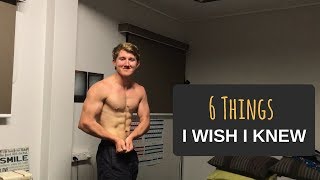
A gym-goer at 75.5 kg shares six lessons from his training: prioritize sleep and nutrition over volume, keep workouts to 45 minutes to an hour, make mobility half your routine, train with a partner, spend time with people better and worse than you, and stop chasing a finish line.
Chapters
What's going on, y'all? So the other day I answered a question on Quora that was, what should I know before going to the gym? And I kind of answered it as if, like, what I've learned, I sort of put in my own perspective, like what I'd like to— if I was just going back and starting now after sort of 6 or 7 years of training on and off, well, at least 5 years of solid training, what would I have liked to know before I got into the gym? So, I answered it with a few points, and I thought I'd turn this, like that answer, it got, turned out to be pretty popular. So, at the moment it's got about 40,000 views. I'll put it in the link in the description as well. So, I thought I'd turn this video into a sort of a physique update, as well as a video version of the points I gave. And so, there's some pretty, I just finished gym, and there's some pretty good downlight here. I haven't actually had a calorie in about 24 hours, so it's around, 7 PM, 7 PM where I am right now. I haven't eaten since last night dinner, which was around 8 PM. So, I'm doing about a 24-hour fast, so I'll probably going to look a little bit flat, but that's alright. Not really trying to work on, I don't know, having the best physique anymore. That was a previous goal, but not so much anymore. So, we'll just do an update. This is what I look like untensed in relatively good downlight. Like, it's not the best, but it's also not the worst. So this is front, side, back. Do a few poses. So this sort of stuff I used to live for. I haven't posed in a long time. Don't get me wrong, every time I hit a mirror, I still managed to bust one of these out. So what am I weighing right now? I'm about, I weighed in this morning about 75.5 kilos. I don't know what that is in pounds, maybe 170 pounds, I'm guessing. 102.2 kilos times 2.2. Calorie intake, not tracking. Current diet protocol, or, I don't know, food consumption protocol, I stop eating generally around 8:00 PM and don't eat until after 12:00 PM. Usually, most days. But within those sort of that 8-hour window, I'm going to be consuming, I'm guessing, around 2,000 to 3,000 calories, and that will vary on days. So I'm not, I've changed my training philosophy from like building muscle and being as shredded as possible. I'm pretty lean at the moment, but not as lean as I have been, to more of a functional type. Like if you look up Ido Portal, any kind of gymnastics types workouts, like that's what I've been moving towards, like gymnastic rings, animal flow, not so much, uh, like bench press, overhead press, squat, deadlift. I still do them, but they're not, they're not my primary focus. So without further ado, that's enough for the physique. Let's get on to the— I think it's 6, 6 things I wish I knew before I went to the gym. So number 1, food is more important than working out. And I'd probably go back on this, maybe update my answer, uh, because I would say rest is more important than work than food, and then food is second, and then exercise third. Reason being, I've done a few, a bit of research on sleep lately, and I worked out, like, I started to realize, sorry, how important that is, like, to get proper sleep, proper rest. So, I would say sleep and food actually on par, and then working out is sort of an addition to that. So, sleep and food are the force multipliers of everything you do. If you're not sleeping right and if you're not eating right, well then you're not going to get the results you get in the gym. I'll link my video on sleep in the description as well, but just essentially think of sleep as your body's— we all know it's time to repair. And the same thing is with food. Like, when you're in the gym, sort of a lot of people put too much focus on the workout. They really kill themselves in the gym and sort of train all out for hours on end, and then all of a sudden they're not getting results. Well, I used to be like that, alright, and that'll be another point in the future. 0.3 or something like that. But since focusing on my food intake and my rest, I've got the best results of my life and I'm sort of, I'm in the best condition I've ever been in right now. Certainly not as lean, but just amazing physical condition. No injuries. But yeah, focus on your food. If you're not tracking your calories, I suggest trying it out just so you understand how much you're intaking. as well as your micronutrient and macronutrient goals and whatnot. And then sleep, you may be getting 7 to 9 hours, but how's the quality of sleep? Again, I'll put the sleep video in the description. There's a whole bunch of things you can do to improve your quality of sleep, because most of the time you may be getting enough quantity of sleep, but you might not be getting quality sleep, which is fundamentally important. So that's number 1, food and rest. Are more important than working out. Number 2, you're supposed to feel better after a training session. So, in my opinion, that's, that's what training is meant to be for, right? To make you feel better. Like, your body's going to be in a worse condition after training because you're breaking down muscle tissue, you're breaking down connective tissue, you're breaking down, you're just breaking your body down, right? And the way you get better is from the body healing itself after the training session. So, If you're going too hard, like I used to, like training for hours and hours on end, okay, maybe you might be a professional athlete, but for 99% of the population, you're probably not a professional athlete, including myself. But if you're busting yourself, like let's go, anything over 2 to 3, or in the realm of 2 to 3 hours, right? If you're not getting at least 24 hours rest before your next session, then you're not gonna feel too great. And that is if you're a natural athlete getting optimal food intake as well as optimal sleep. So, I used to bash myself up in the gym, being there for hours on end, and I wouldn't get results that I wanted. And then, when I cut it back and sort of tracked my training and was focused, I could get in and out in 45 minutes to an hour. Look at, look at Dorian Yates. He was Mr. Olympia. I used to sort of have a goal of being massive and building lots of muscle. Don't get me wrong, I have built muscle, like, over the past 5 or so years. Nowhere near as much as some of the big guys like Dorian Yates used to. But he used to train 4 times a week and 45 minutes to an hour sessions. It's— if you're putting in the work in that time, you can get enough results, or you can stress your body enough to make it adapt to change. There's no need to go to those 2 to 3 hour long sessions, really depending on what your goal is. But if you're not walking out of the gym feeling like a better person, you're feeling like worse, well, then you're probably overtraining a bit too much. So number 2, don't worry too much about the longer sessions. Keep it short and concise. Number 3, don't forget about mobility. Yes, 100%. So in the last, I would say, 18 months to 2 years, 50% of my training has been dedicated towards mobility. And why is that? Well, I got to a point where I was, I had a sore knee constantly, like even walking up and down stairs. I had like back spasms in my back. I was stuck hunched like this for one side for weeks at a time because my back was just so tight and I would still lift heavy deadlifts, do heavy squats, and I was putting too much pressure on my back. My hips weren't really firing, my glutes weren't firing, and this is all due to my own fault, not doing proper technique with certain lifts like deadlift and squat and whatnot. And I really could have educated myself to do them better in the first place. But once I started focusing more on mobility, and by mobility I mean active stretching. So if you follow Mobility WOD on Instagram, Mobility WOD, they're a great sort of starting point to learning about how to move properly. I also bought the book Becoming a Supple Leopard by Kelly Starrett. That's an amazing book. I actually fixed my knee problem with that after going to many physios and even chiropractors and couldn't We couldn't solve it. I ended up fixing it on my own, and it was a whole— like, I tie it back to a lack of hip and a lack of ankle mobility, so it was too much pressure on my knee. And so since getting back into mobility, all of my workouts, all of my physical exercise in general, even— I play dodgeball once a week, I play touch football, I play— I could go to almost any sport and be very adaptable to that. So that's one of my goals at the moment, is just be an adaptable athlete. So, sort of like CrossFit, like you can go to any type of sport and perform well. So, mobility is now 50% at least of my training. I'll spend 15-20 minutes before each session doing active stretching or some form of yoga. Actually, that's practically every day. 10-20 minutes of active stretching or yoga just to ensure my mobility. And it's not good— that's I don't see a point where I'll stop that. Like, I can keep doing that sort of stuff for the rest of my life. Mobility, fundamental. If you're lifting the heavy weights, I try to treat it as an accordion. I think of the body as an accordion, right? If you're squatting under a heavy weight, think of an accordion getting crushed. An accordion doesn't work well when it's just stable like that, when it's tight, like tight together. It has to be pulled back out to work fully, right? That's what I feel like with the body as well. This is just my thoughts, right? I'm not sort of trained in physiotherapy or whatnot. It's just my logic running through the body. It's not going to perform well if it's constantly tight. You have to also expand it as well. That's when you get the best performance. And that's just what I've noticed over the past 18 months to 2 years, focusing on that mobility training. So that's number 3, don't forget about mobility. Number 4, Get a training partner. All of my best friendships are forged through iron, forged through the gym, forged through some sort of physical activity. And you know who you are if you're watching this. And so the reason why I say this is because oftentimes we'll let ourselves down, like we'll more easily let ourselves down than we will let others down. And that's, I don't know what that's from. I think that's maybe just wanting to fit in in society. But we'll also more easily say no, like if we're just going to train by ourselves, than if we've got a friend expecting us to come there. So, you have to, like Greg Plitt says, you have to be pretty, a pretty low-down person to let your friend down constantly. So, you're not going to do that. That's why having a training partner is good, because not only will you have that sort of pressure to go there and not let them down, but you'll also have that person who will be able to motivate you through your workout. Like if you're if you're struggling on some sort of weight, or I don't know, if you just want to talk with someone during it, because gyms these days, I see a lot of people with headphones in, and I don't know, training, I've trained in silence plenty of times, but it's still a good social thing to chat with someone, lift some heavy weights, and test your body. And don't get me wrong, like when you're on endorphins, like that's the greatest high there ever is. It's free as well. And by endorphins, I mean the feeling you get when you get the pump. Like when your muscles are full of blood and when you're sweating and when you're, you just got whole, some great things flowing through your body. You have some pretty epic conversations as my training partners will attest to. So, number 4, get a training partner. Number 5, plus minus equal. So, what does that mean? I think this, This can be related to almost anything in life as well, not just the gym. And what I mean by plus minus equal is, so, spend 30% of your time with someone who's better than you. That way you can learn from them and improve yourself. Spend 30% of your time, or 33%, you break it into a third each. So, a third of your time with a plus, a third of your time with someone who's equal to you, and a third of the time with someone who's less than you. And so, a third of the time with someone who's equal to you, like on equal playing field, with just as good as you in terms of weight, in terms of performance, in terms of times, etc. That'll give you someone to compete against. So, spending all of your time with someone who's better than you may sort of, I don't know, discourage you to keep going because you're constantly getting beaten. And then, spend 33% of your time, or a third of your time, with someone who's a little worse than you. That way, you can use or cement the knowledge you've learnt from someone who's better than you, as well as with competing with others. And teach them. And I believe that philosophy can be used in any aspect of life. So, whatever you want to learn, think of plus minus equal. How can you learn from someone better than you? How can you compete against someone on the same level as you? And how can you use that knowledge you've learned from those two experiences to help someone else? Because that's what it's all about, right? Giving back. So, number 5, plus minus equal. And finally, number 6, There is no finish line. So, in the past, I've competed in men's physique competitions, competed in men's bodybuilding competitions, probably too early for, if I look back and I'm honest, because I should have let, I'm only 23 years old, 24 in actually 2 weeks. I should have let my body grow, and I was kind of looking at these competitions as like the end point. Like, once I get there, yeah, I'll reach my goal and I'll be, I'll have the body I always wanted and I'll look awesome and I'll have this fake tan and I'll be on stage in front of everyone and everything will be great. Well, that's not true. Like, you get there, it's a great feeling, don't get me wrong. You do have to dedicate, you have to pretty much have tunnel vision while you're preparing for the show. You're putting your body to an absolute extreme level of whatever, of performance or something like that. Realistically, looking back, getting on stage is just the icing on the cake. The rest of the cake is the journey. And that's another philosophy you could almost put on anything in life. So you may have these goals of like, you look in the mirror, okay, I've got a poster of Arnold Schwarzenegger on my roof above my bed here. I look at him and you may have a poster like that in your room and you look at that body of whoever it is and you're like, I want to achieve that. You see someone do a dance move or a backflip or some sort of physical maneuver and you're like, "I want to achieve that." Okay, yeah, you may reach there one day and of course that's great achievement, but in my experience, the journey is so much— like, you look back and you're like, "Wow, I can't believe I've come this far." Like, looking back and seeing the progress shots and seeing where you were, remembering how much you used to lift, remembering what you used to look like, remembering what you used to weigh, remembering how you couldn't do a certain movement before, that, that is like, that's the best part, the journey. And that's, that's with anything, like you, because if you tie too much happiness to the goal, if you don't achieve that goal, it won't be, I don't know, you'll sort of become unhappy. And that's, that's not the point, right? If you have, if you set it up so that your goal is to just keep doing the things you enjoy, which is maybe working out, building muscle, then you can't lose, right? So, just remember that there is no finish line. Don't think that getting a six-pack is the be-all and end-all. I've been on both sides. I was overweight as a teenager and now I'm relatively lean. Trust me, it is good. I do prefer being lean, but it wasn't like it was an absolutely life-changing moment once once I achieved it. You sort of get there and you realise, "Okay, what's the next goal? What's the next goal?" They say this— there's a saying in the lifting and the bodybuilding community, "The day you start lifting is the day you become forever small." And I agree to that. My goal isn't to build as much muscle anymore, but I still look in the mirror sometimes and think, "Hey, my body could always be better." So, that's number 6, wrapping up. There is no finish line. That was about half a dozen things I wish I knew before going to gym. And of course, there's probably a few more out there. If you have any you'd like to add, I'd love to hear it in the comments. And as well, at the start of the video, that was a bit of a physique update. As I said, my goal at the moment is not to sort of have the best looking physique. I'm more enjoying being functional, being able to do some things like dancing and going on gymnastic rings and doing flips. A whole bunch of movement. That's what I'm about now, movement. But yeah, thank you so much for watching. Leave a like, comment, subscribe. I'd love to put more videos out for you guys and those things really help. But we'll see you next week and I've got to go eat some food because I've spent 24 hours almost without a calorie. See you later.
More from Daniel

Small Language Models (SLMs) Are the Future: Fine-Tuning AI That Runs on Your iPhone

Introducing Sunny - A MedGemma-Powered Skin Health Tracking App (Kaggle Competition Entry)


Benchmarking: NVIDIA DGX Spark & NVIDIA RTX 4090 | Part 4 - Comparing the results

Benchmarking: NVIDIA DGX Spark & NVIDIA RTX 4090 | Part 3 - Running LLMs on the RTX 4090

Benchmarking: NVIDIA DGX Spark & NVIDIA RTX 4090 | Part 2 - Formalizing the tests

Benchmarking: NVIDIA DGX Spark & NVIDIA RTX 4090 | Part 1 - Creating a series of tests


Local Multimodal RAG on the NVIDIA DGX Spark | Part 4 - Publishing our demo to Hugging Face


Local Multimodal RAG on the NVIDIA DGX Spark | Part 3 - Putting it all together