Ranking the Best Open Source AI Companies for 2025 + Open Source Model of the Year
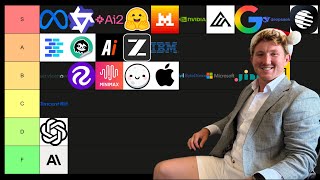
Daniel Bourke ranks 26 open source AI companies and models for 2025, assigning tier ratings from S to F. He names Qwen 3 VL 8B and MOLMO 2 as tied for Open Source Model of the Year, with special mentions for Hugging Face contributors, MLX, and OpenCLIP.
Chapters
Hello everyone, first and foremost, Merry Christmas. Secondly, if you're like me and a small-time AI developer/tinkerer, 2025 has been an amazing year. I mean, I go to huggingface.co/models basically every single day. I think there's 2 million or so models on there now, open source, and many of them come with Apache 2.0 licenses. So we have definitely been blessed with open-source models, open-source AI models. So Big shout out to all the companies for your amazing work over the past 12 months. And so now we are going to rank open source AI companies and models for 2025. This is purely subjective. It's basically the models that I like and the companies that I think are doing outstanding work. I have a list of 26 different companies. I've got a template here on one of these ranking websites, and I'll leave a link below so you can create your own list as well. So without any further ado, let's get into it. Now, when I first interacted with one of these websites or saw one of these ranking things, I had no idea what S means. I still don't. So if you know what S means, please leave a comment below. I believe it means super. Maybe. I don't know. But S is the best, F is the worst. And spoiler alert, I'm probably going to give none of these companies an F. Okay, let's get into it. We have Meta. Now, this, of course, you could argue that there'd be a C because of Llama 4 or Llama 5 didn't come out. They could be a B, but they're definitely not a B. They are definitely an A or an S from my point of view. And I'm actually going to give them an S. Now there is argument you could say that they're an A because of Llama 4, but in the non-LLM world, if you ignore Llama 4, Meta would get an S anyway because they have models like Dyno V3, Sam 3, Sam Audio, which just got released the other day. And plenty more perception encoders. And they are just incredible models for— they're really the workhorses for some of these larger models. So Llama 4 was a good model. Was it the best open source? No, we all know that. But based on just Meta's sheer amount of open source models outside of that— oh, and then the, um, what's the model called, the one that does the audio? That just got released as well. So that's 1600 languages or something like that. So based on just that, Meta's had an outstanding year and I use several of their models almost every day. Next we have OpenBMB. Now, of course, all of these people are available on Hugging Face. So if we go Hugging Face, here we go. They have models like VoxCPM, which is text-to-speech, and MiniCPM, So all of their profiles are available on Hugging Face. I'm going to give them an A because the models that they've put out, they were probably one of the first companies I saw to run a VLM natively on an iPad. That is really cool. Unsloth. So Unsloth, basically every new model that comes out, they make it better, more efficient. So they're going to get an A. Don't necessarily make their own models, but all of their code, all their documentation, tutorials are fantastic. If a new model comes out like Gemma, there's an UnSloth version basically within 24 hours and it just makes it better. I believe the founders are based in Australia too, which is where I'm from. ServiceNow. So they've had two recent really good models. I'm gonna give them a B because if we go to, I believe they've got one in the top here potentially now. Here we go, April 1.6 15B Thinker. This is a model by ServiceNow AI they just released. It is on par with Gemini 2.5 Flash and it's open source. So that is a very cool model. So they're going to get— they're getting a B because that's— they've sort of just come to the open source space at the back end of 2025. But the models they're releasing are outstanding. And now here we have RoboFlow. So RoboFlow are a computer vision platform. I'm going to give them a B as well. They released the recent RF-Detta, which is Apache 2.0, and it is state-of-the-art performance in object detection. And they also have RF-Detta-Seg, which is segmentation, which is also state-of-the-art there. So RoboFlow, not only do they put out outstanding computer vision tutorials, they're also starting to open source their own models now as well. And Quen, whoo-hoo, here we go. Okay, Quen, Right up in S tier. I think we're, we're no strangers to that. Not only do they put out state-of-the-art LLMs, but also VLMs. Uh, I think Qwen models are probably my most used in the past 12 months. So big shout out to the Qwen team. The image model as well is fantastic. When that came out, that was definitely possibly better than all the other image models. Of course, now there's a few newer ones, but Qwen, thank you so much to the Qwen team for all the work you've done. Minimax. So Minimax are going to get, I would say, a B. They're putting out sensational models. They're basically up there with state-of-the-art on the usability front. So this is a big ranking criteria for me as well, is the usability front. So how, as me as a small-time developer, can I run something on a small GPU? Yes, you're putting out 400B+ parameter models. But how usable are they for the average everyday developer? That's my main criteria. So Minimax, outstanding models, but getting a B because of just usability. AI2, Allen Institute for AI. They are also getting an S tier. A recent release with MOLMO2, which is state-of-the-art VLM, vision language model, competitive with Gemini 3 Pro. At 8 billion parameters, 8B parameters. Also Olmo 2, uh, almost 3 as well. And so the thing I love about AI2 is that almost everything they publish is open source. It's beautifully created. The models are performant. You don't only get the model weights, you get a paper, you get data. Um, the datasets on Hugging Face are so rich, and they actually started a trend in VLMs being able to link to things and images with their first release of Pixmo Count. So big shout out to everyone at AI2. 100% an S tier there. Hugging Face up next. They're going to get an S tier as well. I mean, most of this, this video wouldn't be possible. What I do day to day almost wouldn't be possible without the Hugging Face platform. As I said, I go to huggingface.co/models basically every morning. I really, really am thankful for all the efforts Hugging Face have been putting in over the past couple of years. Apple, we're going to give Apple, uh, probably a C or maybe a B. See, I'm biased, right? Because I, I'm, I'm benefiting so much from all these models. I'm gonna go a B. You know why they get a B? Because they had MobileClip 2, and I really like MobileClip 2. But I think MLX is the dark horse here for Apple. MLX, uh, I haven't got too much hands-on experience with MLX, but this is a— I guess I don't have it included here, MLX, but this is a dark horse, I think, because it's slowly activating all of the base Apple hardware out there and making it available for AI. So, um, special mention to the MLX team. The work here is absolutely outstanding. Apple also had FastVLM. So I guess those two, FastVLM, ML Mobile Clip, and a lot of other things that they put out brought their ranking up from a C to a B. And if you'd like a video on MLX, please let me know because, yeah, it'll give me an excuse to dive deeper into that. So we have AIDC next. AIDC, let's go here. Now if you're not sure, these— this team builds the OVIS, OVIS VLM GitHub. Let's have a look at that. So these models are again kind of a dark horse. OVIS 2.5, OVIS 2. I know when OVIS 2 came out it was the best VLM in class. It was better than Quen 2.5 7B on basically every benchmark. And then even when I tried it, it was really good, but it just hasn't they haven't yet gained the exact traction as the Qwen sort of models. And OVUS 2.5 are arguably on par with Qwen 3 8B VL as well. So big shout out to the OVUS team. That is AIDC AI, so Alibaba International Digital Commerce Group. They also put out a recent one which was OVUS U1, but just, yeah, the work— I always like to look at the updates from AIDC AI. Up next, we have Mistral, which is of course S-tier. They were the original company to publish LLMs, highly performant LLMs, and with an Apache 2.0 license. And in the last month or so, they've really come back strong to finish off 2025 with— they've definitely blessed us with their releases at the back end of 2025. We got Mistral Large, the Ministral variants, which are highly performant multimodal models. So big shout out to the Mistral team. Thank you so much for your efforts across the year. And thank you for paving the way for being one of the first companies to go, you know what, AI deserves to be open, and powerful AI at that, and under Apache 2.0. So really, really cool work over the past 12 months from the Mistral team. Up next, we have Zed.ai. And they would be based on their last— if we were ranking this over the last 2 months, they would get an S. But I'm going to say they're at an A for the whole of 2025. So the last 2 months though, they are at an S. If you go to models on Hugging Face, we've got zai.org, zai, zai, zai, zai. Out of about 20 or so, they've got 6 6 of the top 20 models there. So we've got GLM 4.6v Flash, a phone use model here, image text-to-text, a VLM text-to-speech. There was an audio model here. There we go. Automatic speech recognition. So basically every modality. Incredible models there from the Zed.ai team. So very, very big thank you to the Zed.ai team for all of your work and outstanding past 2 months. Thank you so much. Up next, we have NVIDIA. And of course, they're going to get an S tier. Basically, every month NVIDIA release something like, look here, um, NeMoTron 3 Nano. So this is state of the art at the moment for its weight class, and it's also fast on throughput. But if we just go to the NVIDIA Hugging Face page, all of these collections when they got released are basically the best in the class. NeMoTron V2, there's the parakeet models and the Canary models, which are outstanding for— they're somewhere down here. Look at this, look how many open source models NVIDIA have. Now they did have a period of time, I'm not gonna lie, NVIDIA with— yeah, Parakeet models, there we go, for speech recognition. These are incredible. Mamba Vision, Minitron, Radio. Radio are also very good models. They're kind of like the SigLIP models. Or CLIP models. But NVIDIA did have a period of time where the licenses were always confusing for me. So anytime I went to an NVIDIA model, they've sort of fixed that with the recent releases such as this one here, which is NVIDIA Open Model License. I went there and it was open source but then non-commercial. So it's kind of like a catch-22 as an open source developer. If it's non-commercial, okay, I'll use it on my own data Anyway, just, just a pain in the ass. But now their recent releases are using the NVIDIA Open Model License, which makes it a lot easier to do. So big shout out to the NVIDIA team, definitely S-tier, uh, releases there. Tencent. So Tencent in 2025 have really been upscaling their, uh, AI open source outputs. I'm gonna say they're probably at a C-level. They're catching up to people like Quen and whatnot. But some recent releases from the Tencent team have, have been very good. And the usability though is not quite there. I— when I've tried to run a fair few of their models from Hugging Face, uh, the benchmarks are definitely there, but the, uh, yeah, the usability not quite there just yet. Like, a Quen model generally within a day of release is runnable on about 10 different platforms, so Big shout out to Tencent. Come a long way. I don't think I really even noticed anything before 2025 from you guys. So thank you so much for your efforts. And that would be my tip to you. If you want to be more prominent in the open source community, definitely go for usability. That's probably advice all around, right? It's one thing to release a performant model. It's another art form to make that model usable. Up next, we have Moondream, who released Moondream V3. Which was a substantial improvement on Moondream 2. But again, as I'm going to give them a B, usability again was a bit— wasn't quite there for me when I compare it to equivalent models such as a Qwen 3 or Qwen, even Qwen 2.5 VL7B. The Moondream model, yes, on paper, on benchmarks was better performing at 9 billion parameters, I believe Moondream 3 is. but then in practice it didn't quite line up with those benchmarks. So always remember, I— yes, benchmarks are great to glance at, but until you test a model on your own problems, then it's not really benchmarks. Benchmarks, right? Up next, we have ByteDance. And ByteDance have basically— again, this is another company that almost every month— I'm going to give them a B as well. Almost every month there has been something new on the front page of Hugging Face from ByteDance. My favorite models from ByteDance was SA2-VA, um, VL GitHub, which was marrying up— this is one of the first models I saw to combine SAM-2, which is Segment Anything 2, with an open source language model so you could just segment via text. And I found it to work incredibly well straight out of the box on many different types of data source. And they've, they've been upgrading this repo slowly Uh, when their first release came out, I think it was using Qwen2 as the backbone, and they've been uploading, uh, every time a new backbone comes out, they add it to the, add it to the list here. So Qwen3VL, um, Intern3VL, etc., etc. So go and check out that model if you want to try it. Uh, ByteDance, fantastic results. Give them a B. They have a strong potential for an A or even an S in 2026. So Microsoft, I'm going to give Microsoft— I don't know what's happened there over the past 12 months. Maybe a B. They had the Phi series, the Phi series over the past few releases from Phi 1, 2, 3, 4. 4 was really good, but I, truth be told, I haven't seen much from them over the back end of 2025. Maybe there was some stuff at the start, it just When I think of Microsoft and I go, I mean, I'm being legit when I go to the Hugging Face website basically every morning there. So my pattern recognition of seeing Microsoft in that top list is not as much as it was. Of course, they've been publishing a lot of open source stuff, but it's— I'm going to give them a B for 2025. Up next, we have Gina. Now, Gina also are going to get a B. They're another company who often publishes things that are incredibly useful in performance. So they're basically the layer— I find Gina is a company that is becoming the semantic database layer. And what I mean by that is you— they are building utility tools for enabling such as embedding search or visual language search, semantic search over your existing database. The problem with me for Gina as an open source developer is I know it's very tough as a company to publish something like this. Is that, uh, almost every model I see from them is a non-commercial license. So me as a developer, when I partner with companies or build stuff for myself, if I see that, I'm basically like, well, I'd like to use this model, but if I run into something down the track and a client asks what model did I use and I use this and they're like, well, we're using that for our business, we can't do that, I tend to steer away from that. And I understand that it's kind of a hard thing to, um, publish something under an open source license. I guess Chinese companies tend to just publish everything under Apache 2.0. Is that, is that a thing? Like, I've noticed Western companies are generally— like Meta, for example, published some recent, um, vision models, but they're non-commercial. And so is that because they're kind of saving their ass, or— and Chinese companies don't really care? I don't know, maybe. But then you've got people like Mistral who just publish things as Apache 2.0 as well. And surely we're all using the same data somewhere, right? Like everyone's scraping the same internet, aren't we? I don't know. Anyway, who we got next? Now this logo is a little bit blacked out. Oh, okay. OpenAI. I should have, I should have put a white background there. Maybe that was for a reason. You know, I'm going to give OpenAI a C because it's in the name. And prior to GPT-SS, they would be getting a hard F. And because, yeah, uh, if you've been— yes, OpenAI, the, the face of modern-day AI. But if you've been around since 2017 and remember the paper The Sentiment Neuron, which is basically one of the first AI papers I ever read, um, OpenAI have kind of been a little bit of a letdown the past few years in terms of the open source world. Remember, this is strictly focused on open source. If it was for commercial products, they'd be S-tier. Um, but we're going to put them at a C because they kind of gave out the GPT-OSS 20B and 120B models as kind of a, oh, we kind of have to do this, don't we? That's how it kind of felt to me. Those models are very performant though. Objectively, they are good. I like them. But the sentiment around it, I don't know, I guess it was kind of like, I guess we have to. And but objectively, the models from my experience are quite good. And they were some of the first models that I saw that were natively, uh, the MX4P or MX4FP4 or something like that to use floating point 4 precision or int4 precision. And so it tripped me up a little bit as someone who's experienced to running in float16 precision. The 20B model, I'm like, wow, this 20B model is not even usable on an RTX 4090 which has 24GB of VRAM. But then it could work on that because they've used int4 precision. Or actually, no, it couldn't because RTX 4090 can't run in 4-precision, so you need a 5090 or an H100. Okay, anyway, I'm getting ahead of myself here. OpenAI get a C. They've passed the bar for open source models. They can definitely, uh, improve upon this rating, even up to an A or an S. I could see them being an S if they were like, you know what, we're going to upgrade GPT-OSS to have variants from 3B parameters to 120B. You don't need to go higher than 120B and then make it multimodal. I mean, they'd probably be S tier, wouldn't they? But let's give them C. They passed the bar this year. OpenAI, love to see your open source work. And up next we have Metwan. I believe this is how you pronounce it. And they're going to get a B because their recent models on, again, my basically homepage, huggingface.com or.co/models, I've seen them over the past few months have a model. Yeah, there we go. Metwan Longcat in the top page of Hugging Face for probably the last 6 months. So if we go to their page, they're still relatively new of releasing open source, but basically everything they've published has been excellent. There we go. A 562B parameter model that came out September. Oh my gosh, it's 4 months ago already. That performs on par with things like Deepseek V 3.1 and Kimi K2, which were also outstanding open source models. So, Metwan, I believe I'm saying that correct. If I'm not, please correct me in the comments. A B. Thank you for all your efforts. And up next, we're going to have IBM, which are going to get an A. The IBM Granite series has been outstanding to watch from the first release of Granite 1, which was kind of like, okay, we've got our own LLM or SLM, small language model, which I'm kind of tending towards, uh, using at the moment and really liking the ability to just fine-tune small language models to do certain tasks, all the way up to the 4.0 series, which was— now we're getting into the realm of, okay, this is a really usable model in a commercial setting. And I think that's, that's kind of the benchmark of, or the ballpark of where things take, is GPT didn't really become usable until version 4. So we need kind of the 4th version or the 4th iteration of things, and that's kind of a trend, uh, amongst many of the model makers. The 3rd or 4th iteration of an open source variant of something is genuinely quite, quite good, quite darn good. So for example, Ministrul 3, they are outstanding models. But IBM A for, uh, your efforts this year. Thank you so much. Next we have Black Forest Labs, and they're gonna get an S here. Black Forest Labs basically took over from Stable Diffusion. So when Stable Diffusion released their model open source, that was groundbreaking, right? Image generation was this thing that didn't work, and then they made it work. So that's probably someone I forgot from this list, Stable Diffusion, but I haven't really seen what Stability AI have been doing in terms of the open source work this year. If I'm missing something, please leave a comment below. Big shout out to the people at Stability.ai, friend of the show. We have Black Forest Labs at an S though, um, let's not skip them. The FLUX models, when they came out, they are still often the front page. The FLUX-1 models, front page of Hugging Face models page. But now that the 2 models have come out and the 2 open source version is I believe on par with Nanobanana, not quite Nanobanana Pro. That might be the Flux 2 Max version that just got dropped, but that's a paid API. Black Forest Labs doing outstanding work in the image generation space where a lot of these companies are working on the LLMs. And this is probably my favorite one for image generation. Next up, we have Google. Google are going to get, oh, A or S. I mean, if Meta gets an S, Google kind of have to get an S. Because no, Google get an S. I mean, again, every time Google drop a model on the huggingface.co/models page over the last 12 months, it has been probably the best in class for what, what it is. We've got SigLIP2, we've got Gemma 3, we've got Embedding Gemma, we've got Gemma 3 270 mil, which is actually a model that I've been using personally for a project of using a small large language model there's Time Series FM, there's the smaller Gemma models that can run on mobile devices, Med Gemma. Basically every time Google releases something open source over the last 12 months, it's been outstanding. I can't wait to see what Gemma 4 has in store for it. So Google, thank you. And also even on the non-open source side, Google has been absolutely crushing 2025. Again, every release has basically been, yep, We're the gold standard now. So huge comeback from Google in 2025. Up next, we have Deepseek, which of course has to get an S tier as well. They basically— I remember this time last year it was— was it this time last year when Deepseek 3 came out or Deepseek R1? And it felt like it was like code red for all of the large American AI companies. They're like, Deepseek's going to take over. And no, what they did was they basically gave a kick in the butt to everyone of like, hey, we can publish outstanding models and hey, American companies, we're a Chinese company putting out stuff that's just as good as you and we're going to put it on Hugging Face so everyone can just download it and start using it. And then what happened? It caused an avalanche of the American companies to release open source models as well. And so as a consumer of this, I'm just sitting there licking my lips because I'm like, this is incredible. It's just raining models for 2025. That's literally how I could describe it. It's raining models. When they say, oh, the race for AI play the race for all this. I always like give my— like have a little giggle because to me the race for AI is just me watching the models on Hugging Face tick up and get more likes and whatnot. And it's just a really good blessing as a consumer. Um, so that to me, I don't think there's, there's ever going to be one single winner. It's like, look at this, at, at any stage any one of these companies has had the crown in terms of it. And so that's— it's to me, it's, it's healthy competition. The— yes, there is a race, but it's, it's fun. It's not, it's not out of malice, and that's how I view it anyway. So Deepseek, S tier. And also their research, all the research papers that they publish. There's like been a dozen or so research papers that you could take something from and go, wow. Um, I— for the Deepseek OCR paper, they were looking at image compression. And so to store large amounts of context in an LLM context window, you could compress it into the image space rather than the token space, because images could store— the, the way that they compress could store more information. So I found that really fascinating. And that's, that's the kind of research I wish OpenAI would publish as well. That's the kind of research I remember they used to publish was like, here's this really cool thing that we found and we're going to put it in a, in a paper that everyone could read. I think Deepseek have basically taken the role of OpenAI lately. Finally, last but not least, definitely not least, is again a toss between S tier and A tier. KIMI, KIMI K2 from Moonshot AI. I'm going to give— I guess if you've had, you kind of need to be S tier. This is my reasoning. If you've had a state-of-the-art model, open-source model, which KIMI K2, I believe, was state-of-the-art when it came out for its, its size and usability and probably still is across several benchmarks and open-source model. If you've had an open-source model that needs— that's been state of the art and best in its class, you kind of need to be on the S tier. So there we go. Probably missing a few here. Maybe. I think I've just remembered InternVL. So I definitely give them— I think that's— who's that? OpenGL or something like that. I'll Photoshop them into here. They can— they're definitely going to get an A because they've got the InternVL series. But this is my tiers for 2025 for best open source model companies of 2025. And of course, it's purely subjective out of my own, just what I've seen, what I've used, what I like to do, what I build day to day. And so now we have the coveted award. Now, I should have had a little trophy for this, for Model of the Year, Open Source Model of the Year. And now this is incredibly biased. Again, it's, it's from models that I personally like to use and have used almost day to day. So we'll get a little drum roll. The model of the year is a tie. I know, sitting on the fence between Quen 3 VL 8B, my favorite model, and we also have MOLMO 2 from Allen AI, a late entrant, very late entrant to the race. As I think that only got released like 3 days ago. Why? Because Momo 2 8B is just, from what I've used over the last couple of days, incredible. And not only, it's introducing a new, entire new problem set. It doesn't only come with the weights, it comes with dataset as well. But it's incredibly good at pointing, which is a totally new thing in terms of, well, not totally new, but it's very new over the past sort of year. Pointing in images and pointing in video. If we're gonna be building open source AI models which are going to interact with the world. Think about it as a human, right? Like being able to visually pinpoint something in a, in a field of view is an incredibly useful task. So a big shout out to Allen AI for their efforts there in creating that as a benchmark and a task. And then of course that model is built off Qwen-3 LLM, not VLM-8B, and my favorite non-LLM model of the year, is another drum roll. Siglip 2. Because even before I used Siglip 2, Siglip 1 was probably my favorite model before that. And then of course we've got Sam 3, Sam Audio. The list goes on. Too many things. So finally, we have some special mentions I'd like to, these aren't on the tier list, but these are just special mentions I'd like to thank people for their work and efforts over 2025. They haven't gone unseen, and that is Merve Noyan, uh, I hope I'm saying the name right, which is the open sourceress at Hugging Face. If you've been on Hugging Face at all, you've probably seen Merve's face on LinkedIn. She does an incredible job at sharing the amazing work of the open source AI community. So big shout out to Merve. Thank you so much. We have the MLX team, already kind of shouted out them. They're making incredible waves on just making all of your Apple devices much better at running AI locally. And why not, right? Because not everyone can get a dedicated NVIDIA GPU. So if we can make devices that already exist better at running AI, that's an incredible thing. We also have the OpenCLIP library, which basically integrates any new, uh, CLIP-style model, whether it's SigLIP or Perception Encoder, within a couple of days, and then it makes it very easy to use. And finally, we also have the TIM library, which is Torch Image Models. So There is over 1,000 image model backbones in that library. I believe every time a new backbone comes out or I need to create a small image model, I'm basically using Timm now. So there's some special mentions. Leave a comment below if there's— I think my Christmas baubles are falling over. Leave a comment below if there's any model or company that I've missed out. What was your favorite model and company of the year? And big shout out to everyone that's been mentioned here. It's been an incredible year as an open source AI developer or someone who uses open source AI models. And so I'm very excited for 2026. Merry Christmas, Happy New Year, and I'll see you soon.
More from Daniel

Small Language Models (SLMs) Are the Future: Fine-Tuning AI That Runs on Your iPhone

Introducing Sunny - A MedGemma-Powered Skin Health Tracking App (Kaggle Competition Entry)


Benchmarking: NVIDIA DGX Spark & NVIDIA RTX 4090 | Part 4 - Comparing the results

Benchmarking: NVIDIA DGX Spark & NVIDIA RTX 4090 | Part 3 - Running LLMs on the RTX 4090

Benchmarking: NVIDIA DGX Spark & NVIDIA RTX 4090 | Part 2 - Formalizing the tests

Benchmarking: NVIDIA DGX Spark & NVIDIA RTX 4090 | Part 1 - Creating a series of tests


Local Multimodal RAG on the NVIDIA DGX Spark | Part 4 - Publishing our demo to Hugging Face


Local Multimodal RAG on the NVIDIA DGX Spark | Part 3 - Putting it all together