Running a business from a bedroom - Ask me anything! (live)
Daniel Bourke runs a solo tech business from his bedroom and answers questions about learning programming, staying motivated, and making money through content and freelance work. He structures his day around four pillars: eat, move, learn, make. He dropped out of Y Combinator's Startup School to focus on high-impact personal projects instead.
Chapters
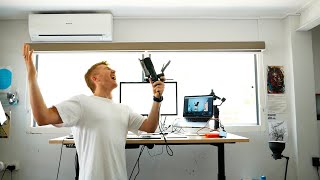
Oh, live. Now I need to get the chat window on the right. You're live. Oh, what's happening everyone? You know, I was at the Apple Store the other day because my Mac is getting clogged up. So what is this, a couple of days? And I'm like, you know what, uh, just erase everything. And they did. So they erased everything, installed the new software, macOS Catalina. And I broke everything. So we are half an hour late. I said I was going to be here at 10:00 AM, but we are here 10:30, ready to answer whatever questions you may have. I've been collecting a few over the past couple of weeks. I've got them documented. I've got a little, little setup here. There's your boy. That's a bit delayed. We'll let this stream maybe run for a minute or so before we jump into these. But essentially what we're going to do today, is have a little bit of fun. We're going to hang out. We're going to dance around because I like dancing and I'm really stoked with this. I actually got it. You can't see it, but I got a standing desk and maybe you can. Let me get this out here. This might turn out extremely bad, but standing desk. Might have to do a room tour eventually, show you guys what's going on. If you want to see that, let me know. But we are here to answer your questions, whatever you may have, whether it's code, whether it's machine learning, whether it's running a business, whether it's life, whether it's health, all these things that I'm into, whether it's creating. I'm pretty open to anything, you know. I'm happy to converse and chat about whatever, whatever you like to chat about. I don't know it all, but I can spin a pretty good yarn. And if you're not sure what that saying is, that's an Australian saying for talk about something. Now, if you're in here and you're seeing things going on, please let me know if the video or the audio is working. I know we're about 2 minutes in, but I've just had to re-download all this software to get it set up. And hopefully it's working well. Hi, Ivan from Taiwan, how are you? Hello from Brisbane, Australia, the Northern Beaches. That's where I live. I live in Northern Beaches of Brisbane. The water is about a 5-minute walk down that way. It's amazing. I love spending time near the water. Sabarish says, how to start with a machine learning project? We'll get into that in a second, probably in about another minute or so. Please check the current Please check the video resolution. The current resolution is 860 times 538, which is not optimal. Look at this, getting a warning from YouTube. I don't even know how to fix that, to be honest. Is that in OBS? Maybe, maybe I can't fix that on the fly. Output video. Look how hopeless I am. Output scaled resolution. Anyway, let me know in— if you're watching, let me know in the comments if this is, if this is okay. Is the stream quality good? Because if it is, we'll keep going. If it's not, we'll, uh, we might reset this. Hello everyone. Oh, I'm excited. Medium. Audio and video is fine. Beautiful. Thank you, Jervais. Hey, how does your workdays look like? Hello everyone for joining in. I'm going to keep just reiterating what we're doing so that way if people come in any time, we'll let them know what's happening. And by the way, if you're joining at some point, I'll put a timestamp whenever we actually start getting in. We might— might in 4 minutes 30 in, we will get started on questions. That's about 20 seconds from now. What I'm going to do is I've got a few bookmarked. I'll show you. I've got a few of these bookmarked here. This is Notion, by the way, if you're wondering what this app is. Maybe I, I should keep this on the left. There we go. So I got the stream chat as well as this question and answer, and you can't really see that. Well, maybe you can see the chat where you can, uh, let's, let's bring this here. There we go. So I can see both things at the same time. That's good. Okay. So I'm going to, what I'm going to do, I'm going to go start off one for one. So we'll go one here, one in the chat. So if you have any questions on anything you want to talk about, leave it in the chat. I'll get to it as quickly as I can. Um, and yeah, if you can't hang around for the whole stream, we'll go for about maybe 45 minutes, an hour or so. This video will be on my channel once it's finished, if the internet decides to work and save everything to my channel. So number 1, Abhishek asks, hi Daniel, what are the resources that you use to learn programming and related stuff and stay updated with it? And also, how do you decide which resource is better for learning something than the other so that you don't waste your time on a resource that is not Good, okay. So what can you do for that? Well, the main question here is what resources can you learn, use to learn programming and stay updated with programming? And how do you decide which resource is better than the other? Well, this is the sort of paradox of the internet, right? Is that there's, right now there's so many different ways to learn programming, so many different ways to learn everything actually. So you'll have YouTube, you'll have platforms like Coursera, you'll have Treehouse, you'll have Codecademy, you'll have edX. All of these resources, right, teach much of the same thing. They teach some sort of fundamental concepts of programming. Some will be more updated than the other. How do you decide which one is better? The truth is they're all pretty good. These days, internet courses— I mean, actually, I forgot, you actually have the documentation of the programming language itself, which is probably probably the number one place to go because that will be updated as the new versions keep getting updated. So that's a tough thing, right? You decide which resource is better and so you're not going to waste your time. What I had to remind myself was, rather than spending so much time trying to decide, "Which one should I choose? Should I go something like Coursera or something like edX or whatever?" I just I had to just pick one, stick with it, use it for fundamental knowledge because they're all going to teach you basically the same thing just in a different format depending on who you learn from. So, choose one. It almost doesn't matter which one you choose, but stick with that for a little bit. If it doesn't suit your needs, you can change to something else. So, try one. If it doesn't work, change to something else. That's the beauty of having so many resources available for you. And how do you stay up to date with it? Well, that's kind of a challenge that you're going to have to figure out for yourself because there's no real way to do that. I mean, there's so many things getting released and you're going to have to draw it upon yourself to figure out, okay, which way am I going? What am I going to be learning? And following, following your own, your own curiosity in that direction, right? And so, will you waste your time? Who knows? I have to remind myself most, 99% of effort is actually just wasted. So, maybe I study for 10 hours and I remember 1% of what I learned. Or maybe I work on a project and at the end of the project it doesn't really work out, but I learned some key takeaways from that project I can apply in the next one. So, that's a kind of long-winded answer on Which learning resource to use? They're all pretty great. Choose one, try it out. It doesn't work, go to the other. Repeat that process. And how do you stay up to date? Keep practicing what you learn. Put it into an application, put it into a project. Do your own research. Follow your curiosity. I'm sure you'll be satiated with the endless amount of information on the internet. And of course, don't be afraid to reject some things. You can say no. That's the key point there. So thank you, Abhishek. We're going to tick this off. Look at this. I got this so organized except for the stream being half an hour late. Okay. Now let's go to the webcam and we're going to do one from the chat. So we want right at the top here. Hello everyone for joining, by the way. If you're coming in, we're doing a Q&A on whatever you want to talk about. I'll get to as many questions as I can. Sabarish R says, how to start with a machine learning project? So let's— we are on the webcam. I need to turn my camera off because it's beeping. Okay, how to start with a machine learning project? Well, again, there is no right or exact path to do this. This is why it's hard. See, Let's draw this back. What happens in a school system? A school system, you go there, you're in a classroom, and there's a criteria sheet of what you have to do. It goes, "Okay, if you want to pass this assignment, you have to do this, this, this, this." And then, "Okay, that's your project." And so you do that project and you hand your project into your teacher. And your teacher goes, "Okay, well, you did this step 1, you did step 2, He did step 3, and it was all pretty good, so you're going to get a good mark. But what happens when you get into working on your actual projects? You don't have this. You don't start off with a criteria sheet, and so that— you don't start off with a step-by-step analysis of things to do. So what the problem with the school education system is is that all it does is kind of optimizes your learning to follow instructions. And this is why people, including myself, including myself, right, find it so hard to start on their own project. You spend a lot of time searching for a step-by-step way to do something, when in reality, the best projects don't start like that. Including your own projects. So that's why you see these default ones that if you search online, maybe 100 different people have done the same thing, right? Including myself, right? I'm no stranger to this. I know what you're thinking. And so, how do you start your own project? Well, you have to start with a willingness to be wrong. You have to start out by going, okay, I'm not entirely sure of the steps to get where I want to go. but I'm going to figure it out. And as you go through, realize, okay, maybe this won't work out. Because an existing project, you know how that's going to end. You've seen them, you've seen like Kaggle competitions, you've seen people go through the same thing, you've seen people go through this, you know how that's going to end. But the most interesting ones, right, are when someone like yourself has gone out of their way to create their own path. That's what people are most interested in. If you've seen the same thing redone 100 different times, someone else's project, that's— that's okay, that's been done before. Where the best learning will happen is when you say to yourself, "Well, I kind of want to work on this, but I haven't seen anyone else do it, so I'm going to try and figure it out." And then you go through that process. So the way you sort of start on your own project is you have to tell yourself, "This might not work." So that, that is a key point right there. You have to go, "Okay, I'm going to work on this. I'm going to learn, try and figure it out, and it might not work." So that's the number 1 thing for working on your own projects. Remind yourself, "This might not work." And if I sound like a broken record, it is, as in I'm saying the same thing over and over. It's because I'm trying to remind myself for the same thing, right? I'm no expert at this. I'm still learning myself. So thank you for the question, Sabarish. We're going to go back to the Notion. We're going to jump in here. Ashish asks, how to crack any data scientist/ML interview? I have been interviewing for the last few months, managed to crack only 3 where interviewers know less DS than me. DS lesson me. I want to crack DS in big project products-based company. I'm working data science for last 2 years. Okay, I'm going to be upfront with the questions. I'm going to be upfront with the questions that I don't know, right? So I'm not going to pretend that I know all everything because with the one that's how do I crack a data scientist/ML interview, I've never had a data science or ML interview. So when I got my machine learning role at Max Kelsen, which is a tech company in Brisbane, how did it work? Well, we were in a— I got a message on LinkedIn because I was making things and sharing them on LinkedIn. Someone said, do you want to meet up? And I met up with that person and they said, do you want to meet up with someone from another place, which ended up being Max Kelsen? And I met with him and I spoke with him and I told him what I was interested in. And there was no coding involved or no talk of data science. We were just getting to know each other. This is kind of how it works in Australia sometimes. It's kind of you get to know each other first before there's any formalities. I don't know if it's the same elsewhere. So this is only where my experience has come from. And then he's like, well, do you want to come in on Thursday? And this was on a Monday and I went in on Thursday and I did some code hands-on working on some Pandas data frames, just some data manipulation. And a couple of Thursdays later, like I went in one day a week, I was asked by the CEO, do I want to start a role? And I said, yes. So that's kind of how my journey went. I've only had one role, formal role in machine learning, plus a few freelance jobs online creating content. So when it comes to interviews, I'm— I don't know. I honestly don't know. So I would, I would keep doing what you're doing and asking questions. But I'm not the right person to help out with data science or machine learning interviews because I've never had, I've never really had a formal one. But I will, what I might do is I might ask one of my friends who is a lead data scientist, lead machine learning engineer, and ask him in a future resource or a blog post that I might do what they look for. So because they all know a bit more than me. Okay, so we're going to tick off, we're going to tick off Ashish and we're going to come back to the chat. Welcome everyone if you're joining in. So we have here, are you taking a new course about AI online from Ivan? And Ivan, no, I'm not taking, I'm not taking any courses currently. I'm working on a few projects which take up all my time. I think for the time being, I've got to a point— now, this is not to say I can't learn anymore because I always can. I've got to a point where I need to start applying my knowledge rather than just continually taking courses. So, I want to start building my own things. Well, I am building my own things. And so, at the moment, I'm kind of just— if I get to a roadblock in that, I research what to build next and it's not really in a formal course. So, I'm just kind of learning things as I need them. So I've kind of got a foundation knowledge of code and machine learning, data science now. Well, I do, and I'm building on top of that by trying to build my own things. It's a great question, Ivan, but I do want to keep doing basically just all the fast.ai courses because they're my favorite ones. Now we're going to go back to Notion. This is what we're going to do, back and forth, Notion, chat, Notion, chat. Anuj asks, hold on, sip of coffee first. Oh, iced coffee, iced coffee, because it is getting hot where I live, but I love the heat. Do we need to be good at math and stats to become a data scientist? I often hear people saying this. Please help, Daniel. Okay, maths and stats. So this is another hard one, right? It's like how much, how much, let me bring this down a little. It doesn't really matter. How much maths and stats? This is another question I'm probably not the best at answering because all the machine learning stuff I've worked on was with Python code. So it was just making sure the code was running. All the math and statistics behind it was kind of concealed by things like TensorFlow and PyTorch and sklearn and all that sort of stuff. So I was just writing code and to execute different things in data pipelines for machine learning. So I would say the last time I did a proper mathematics course was when I was in high school, which was about 10 years ago now. But for the maths for machine learning and for data science, I've kind of learned on the fly as I was learning to code, right? So I was practicing coding, machine learning, and data science, whatever, on projects and doing courses. And the maths and stats that I needed as a bare minimum was kind of within the learning the concepts, right? So I never had to write Greek symbols in my role, as in like formal math equations. The most of the stuff that I had to do, like, that was mathy was figuring out how convolutional neural networks shapes line up. And that was only a once-off, right? Now, how much stats and maths do you need to know? I'll give this to you. When I was in university, I failed my first statistics course. It took me 2 goes to pass it. So that's— that kind of gives you an idea of my statistics knowledge. But from that, I was just reading books on statistics, I was reading books on math, and my approach to all of learning anything is practical, right? So I had to build things, learn the concepts as I need it. So if you try to learn all of math, all of stats before becoming a data scientist, before writing any code, it's like trying to boil the ocean. And this is my style, right? You might have a different style, but I was code first. So I would apply the code and if it had some maths or stats behind it that I didn't really understand, then I would go and research it. So how much of that do you need to know? Well, it's kind of a case-by-case basis, and I think that's my way of approaching it. It works for me, might work for you. So if you're learning code, keep going with the code. If it comes up to some kind of stats thing that you need to know, start researching it. Alright, so thank you, Anuj. We're going to tick that off the Notion, and we're going to come back to the YouTube chat. Boom. Hello everyone, thank you for joining in. Hope you're having an amazing day. And we have Bernardo says, I lose my motivation always at the end of some project. You have any recommendation for this? Oh, Bernardo, me and you both, brother. We are— I actually, I was writing this in my journal the other day. It was a concept of finish strong. Now I, losing motivation at the end of a project, I'm no stranger to that either. Like, I've had projects in the past that have kind of got to that point. When you get to like— it's funny, you get to 90% of something being done and you actually have another 90% to go. So the way I think of this is just you have to— there's no easy way about this. So at the start of a project, it might be all new and everything's amazing and you're starting with enthusiasm. So what I sort of told myself is I want to just trick myself into being that enthusiastic at every stage of a project. And how do I trick myself? I just tell myself that. Like, I'm getting close to the end, I'm going to finish as strong as I start. So that's the concept. Finish— start strong, finish strong. Finish strong. Because what the amateur does, the amateur starts a whole bunch of projects. So they might have 100 projects but never finished any of them. The professional starts same amount of projects, cuts off the ones that don't work, but this is what makes the difference between an amateur and a professional. A professional delivers on 3 out of 100 projects. Projects. Now, of course, you can make the numbers up, but that's just easy to understand, right? If those 3 projects out of 100, 97 he cuts them off, she cuts them off because they're not what they were after in the beginning. But on the 3 projects that do get delivered, they're of world-class quality. So that's the difference between a professional and an amateur. If you want to be a professional, you must deliver on projects. If you don't deliver on projects or deliver on work or put work out there, you forever remain an amateur. That's what I have to tell myself, so maybe that'll help you. And how did I do this? Well, with that concept we talked about before. Start as strong or finish as strong as you start. And it's hard. It's hard, right? You get to a point you lose motivation because it's like it gets hard and it gets dark, but that's what makes the difference between an amateur and a professional. Professional. Great question, Bernardo. I actually face some of that all the time, so don't feel like it's only you. It's me as well. Okay, who we got here? We got back to the Notion chat, back to the Notion chat. Filmstube, how to control yourself and avoid distractions in order to achieve your goals? Whoo, laying it on me this morning. Laying it on me. So how do I avoid distraction? I got distracted right there, right? Coffee right in front of me. That's a good one. I wrote an article about this actually the other day. Maybe I can get that up. Search it. 6 study tips that help me learn machine learning every day. And one of the main ones is controlling your environment. So, I'm not doing a good example of that now. I have my phone here. So what I usually do— main distractions come from information being injected. So what— how does that happen? That's from notifications, that's from— I'm on my Mac right now, notifications on here, that's from my phone messages going off, that's from something like coffee sitting in front of me, which is not a bad thing actually, but if something's sitting in front of you, you're more likely to be distracted. If you have applications like Slack open and it's just messages coming in nonstop, these things are all going to distract you, right? So what you have to do is reduce your search space, reduce the number of inputs of information that you have coming in. And how do I do that? I'll put my phone in another room. I'll turn off all notifications on my Mac. I'll close all applications except the one that I'm working on. And so you have to remove— multitasking to me is like a myth. If you want to do good work, you need that long stretch of uninterrupted time so you can focus and work on a single project. I got a distraction here, so the car's starting up, so you lose your train of thought. So number 1 is control your environment. Or create a little bit of a game plan. You can do this. These are two things, probably the best. Two things: control your environment, so remove all of the distractions you have. And that's why I don't have social media, right? I just— there was— I didn't need it, so I just cut it all out. Cut, cut, cut. That's what I'm getting in the habit of, is just removing things like a boss. Number two is I write down a lot, like write down a lot of things because You get lost in thought but found in the words, right? So I've got here, this is my daily list. Livestream at 10, write 750 words because I write every day, bread-making class. I've got a bread-making class today, how fun is that? Davo's birthday, plan week, read Matplotlib, blog post, workout. So that's my list. Now, how this works for me is I don't do anything that's not on the list. And again, that sounds a bit robotic, but it works for me. Some days I throw the list out the window and mix things up, but that's how I avoid distraction. I control my environment, remove distractions, and come to each day knowing what I want to work on by writing it down. Alright, great question, Filmstube. Thank you very much. We're going to come back to the chat. Hello everyone for for joining in. Thank you for coming along. We have a lot of questions. I'm going to start quick firing. Maybe we'll do a— we're about 25 minutes in, 26 minutes in. We'll do a quick fire. We got one from Mo. Mo says, hey. Hey Mo, how are you? What does your work days look like now? Mo, right now I will wake up Oh, let me run you through a typical day that I did in the last week. Wake up, I go for a walk with my dad or the dogs, or go for a bike ride or do some yoga. So, that's kind of how I start mornings is with some movement. I'll wash my face, drink a lot of water, so like a litre and a half of water, and then I'll go to the café, I'll sit down, have coffee, do some reading, do some writing, come home, and sit at this desk, do about 3 to 4 hours of work on the computer, and then by that stage it's lunch. I have lunch around midday or 1 PM, around then. After that, maybe I'll do another hour or two of work if I'm lucky. And then from there it's kind of just filling in the gaps with different logistics and whatnot. In the late afternoon I'll do some training. So, that might be jiu-jitsu or weightlifting or running or riding. Something like that, some sort of movement, and then I'll have dinner with the family. So, that's kind of a typical day for me, working day. If I get 2 to 3 hours of solid work time on a day, that's a really good day. If I write 1,000 words, that's a good day. So, yeah, I'm not in the mindset of, ah, some days you do more, some days you do less, right? That's just how it is. I'm pretty privileged at how I can live at the moment, as I can decide how I want to spend my time. That's really important to me. So, we'll have another one. Hey, Juan, he says hi. This is all— we're getting a lot of questions. I'm a little bit behind, but that's alright. I always lose motivation at the end of a big project. Do you have any recommendations for this? We tackled that one. Beautiful. Do I use any nootropics? If so, do you have any recommendations? I don't use any nootropics except for coffee. So that's my recommendation for that. Oh, and also sleep. Get a heap of sleep. Move every day. Doesn't have to be exercise, just movement. And what's the other one? Remove— cut out the number of things that you're working on. So that's, they're the best nootropics, right? It's just keep it simple. Go back to nature. That's a simple way to do nootropics. Then we got here, "How do you find people to answer a research form?" I've never done that, so I can't answer that question, Patrick, sorry. Abel says, "Can you give us a tip how to read research paper and implement it?" I have no great tips for reading research papers other than I read— what I'll do is I'll try to read a blog post version of it first, so I get kind of like the concept, and then I'll read the formal paper, and then I'll read it again, and then I'll go back to another example if I can find it, or I'll just start to hack away at it and just see where I get to. So, my approach is kind of just keep going until I understand it, or if I get to a point where I'm like, ah, maybe this isn't worth learning, I'll just throw it away. So that's, uh, that's, that's my style. Might not work for you, but it's, uh, um, it's how it works for me. James Rawr— Roo— James Roo says, hey man, what's going on, James? Thanks for the Coursera recommendation. I'm currently on the second course with you, U of Michigan's Python specialization. Awesome to hear, James. Keep getting after it, my friend. Adam Smith, when interviewing for a machine learning engineer job, what do they care most that you know? How to train models on giant datasets, the latest state-of-the-art architecture for some tasks, or what? Again, Adam, I've kind of answered this before in early in the stream, but I'll just quickly go up, glaze over it again. I'm not the best for machine learning interviews because I never really had one. But what do they Look, here's what I would look for. Of course, the skills are non-negotiable, right? So that's— you need skills. But what is someone looking for best? That's going to change from role to role. I'm never after— my goal was never to work at a big company. I thought it was, but then I realized it's not. So I never practiced for the interview process. I prefer to create my own path. That's just how my brain works. But yeah, how it works for a bigger company, it's going to differ for each one. So there's no— I can't really answer that. So we're here. Okay, we're going to go back to the Notion board. Boom. Ishan. "When can we say that we are capable, our skills are enough for companies like FAANG?" Facebook, Apple, Netflix, Google. "These days I'm very confused about whether my skills are relevant for the company or not. I've been rejected by some major companies. They don't even consider interviewing me." Well, again, I kind of touched on this one before. I've never— I thought I was interested in getting a job at Facebook, Apple, Netflix, Google, Amazon, list off a big tech company there. But I'm not really. I thought I was, but I was kind of caught up in the hype of seeing these big companies and going, yeah, that would be cool to work for. But then when I really figured it out, that's not what I was after. I thought it was— the idea of it was better than the actual reality, even though I never actually worked there. So I'm not— again, I'm not the best person to answer questions for big tech companies because I'm not interested in working at big tech companies. But how do you know when your skills are ready or not? You'll never know, right? So it's always this question of when am I going to be ready? When am I good enough? The trick answer to that is right now, right? But it may not line up with what other people are looking for. So I think you're doing the right thing with reaching out and asking people like me. I'm not the best, but keep doing what you're doing. Ask people who are— I would say go on LinkedIn and start messaging people like who are working there and go, hey, how can I know when I'm ready? What are the tips you used, etc., etc.? So I'm not an expert in applying for big tech companies. So that's a great question from Ishan. I couldn't really give a great answer. Now we're going back to the chat. So we want— let's go here, webcam. Adam Smith says, that job process is not how it works in Silicon Valley at all. It's like 6 hours of interviewing just for software engineers at big tech companies. Yeah, see, that's— I'm not interested in that. I don't like that, um, the 6 hours of grilling just for software engineers. It big tech companies. That's fair enough. That's, I, that's probably a tried and tested process, but it doesn't interest me at all. Um, so we want to hear Ahmad. Ahmad says, do you recommend studying AI and computer science BSc then master's in AI or software engineering BSc then master's in AI and applications for a career in artificial intelligence researcher? That was a mouthful. Um, To be honest, I don't think the order really matters. They're all going to be valuable whichever way you do it. So I would say have a think about it yourself. I've never formally studied artificial intelligence or computer science at university. I'm, I'm, I've used the university of the internet. So I'm not after an artificial intelligence researcher position. So again, I'm not the best, the best to answer these questions, but I think either of those would be great. If you do a Bachelor of Science, a Bachelor of Computer Science, or Bachelor of Software Engineering and then AI, or the reverse, either way you're going to come out with some great skills, right? It's up to you then to apply them in whichever direction you want to go. So we're here. If you're about to start a PhD in machine learning, which would you choose? PhD in machine learning, that would depend. I don't think I would do it in pure machine learning, like figuring out different algorithms and applying different mathematical concepts to improve baseline machine learning models and all that sort of stuff. I would, I would, my PhD would be figuring, like, trying to line up, and I mean, you don't have to do a PhD to do this, but figuring out different machine learning applications or getting into machine learning hardware. I think I'm really interested by hardware because at the end of the day, like, progress is limited by the hardware that you can produce. I mean, software is eating the world, right? Machine learning eating software. But if you don't have the hardware to begin with, it doesn't matter what software you have because it won't run on anything. So I would look into— if I was doing a PhD in machine learning, I'd first of all figure out how it can be applied to something like machine learning in the gut microbiome, because that's, that's just what I love. And like health-wise, or some sort of hardware-related machine learning thing. So as in like bio-tracking, that sort of stuff. How can I create hardware that is specific for bio-tracking and using machine learning? And maybe I don't have to do a PhD to do that. Maybe I can just figure out how to do that online. Who knows? Hey Daniel, what about machine learning with C#? From, from Nealon. Thanks for the question. Actually, thank you for the question, Carolos. What would you do a PhD in machine learning? What about C# with ML? You can definitely, you can definitely, you can do machine learning code in any numeric coding language. I don't have any experience with any other language than Python. So C#, yeah, you can, but I can't really, again, I can't really comment on it. Most of the time when you write Python anyway, it's, it's going to be executed in C. So because Python is slow. So yeah, what about ML in C#? Not as popular as Python, but definitely doable. So let's go back to the, um, to the Notion. Esteban says, bro, talk about your Y Combinator project. You have some progress? Well, with Y Combinator, I signed up to the startup school and then I realized that's not what I wanted to work on. So I was building— actually, I was working on too many things, put it that way. I had, I had the channel and I had writing and I had this startup and I had to earn money in the short term, as in like working on client projects. And so it all just became too much, let's be real. So we talked about this before, I started cutting things out. So I cut out the Y Combinator Startup School because I kind of I knew, I knew what I wanted to build. And so every time I was talking to people and whatnot, it was like, how can you make this bigger? How can you scale this? How can you, you get hundreds of millions of users? How can you get funding? That's not what I wanted. I just wanted to work on my projects, build it for myself, and then open it out to the world. And so I started building a prototype, and actually the prototype was nice and simple. It was in Airtable. Like just a spreadsheet, and I was like tracking my biometrics. And then I got to a point where I realized like, hold on, it's a lot of work. Maybe I don't actually want this thing. So this is, this is kind of that 99% of effort is wasted, right? So I actually tried to build the thing that I wanted to, thought I wanted to use. And when I started using it, I'm like, wow, that's a lot of effort for not much return. I did find out some great things about different foods that spike my blood glucose and all that sort of stuff. So actually, I might revisit that, but at the moment I've kind of reduced my workload to working on two bigger projects, which I'm going to finish roughly by the end of the year or start of next year. I haven't told anyone really what they are. So I'm really excited about that. This is part of the Finish Strong. And then after I've built those, they'll kind of create a little foundation that I can go and work on the next thing. At least that's how I'm kind of planning things out. So we'll see how that goes. But as for Y Combinator, I didn't finish the startup school. I signed up, I did a couple of weeks and then realized, you know what, I thought I wanted to do this, but I don't really. So cut it out. And that's, that's just being honest with yourself, right? You have to— don't be afraid. Like, you can work on things and then if you realize, okay, this isn't exactly what I wanted, cut it out and just start to pursue the things that you are obsessed with, that you are wanting to pursue relentlessly. You don't have to explain those to anyone. You can just do those. So great question from Esteban. We want here. Oh no, we don't. We want back to the webcam. We're going back to the chat and Fabian, thank you for the donation. That's awesome. I didn't know you could even do that. Haha. Fabian, how to deal with annoying clients who who pay well. This is a tough challenge. So you have a client and they pay well, but they're annoying. Well, my perspective with these things is I always go long term, right? So I'm biased. I love— I have fun in the short term, right? I have fun just being here, like right here and now. But when I make decisions on like someone to partner with or someone to work with, that is long-term because I only really want to work with— if I do want to work with someone, I want to work with them for the longer term because that's where the best value comes from. And so if someone's annoying me but they pay well, all my— I learned a couple of years ago that money is obviously important to me to an extent, but not to an extent that I have to continually be unhappy to get it. So put it this way, I do my best work when I'm excited, when I'm happy, when I'm— I, I, if I had a client that I love to work with that was paying $1,000 versus a client that I hated working with that was paying $2,000, I'll let you think about which one I would choose, right? Because at the end of the day, my best work is going to come from work that I'm enjoying. And of course you're never going to enjoy everything. But if this client is continually annoying over the long term, I'd start to look into ways at how you can fire said client. Now maybe you need the money, maybe that's good, or maybe you can step back, take a few steps back, right? So rather than just thinking— this is what I was trying to talk to my brothers about the other day, is the first order versus second order process. Rather than just basing your decisions on a first order process, like how much money you'll get from a client. Start to take a few steps back. So go, what's the second order process? Okay, if I work with this client, I'll get $1,000 for this project, whatever the number can be, the number's arbitrary. $1,000 for this project, but I'll be out of whack and I have to deal with this person for the next couple of months. Is it worth it? Is it really worth it? Or the third order process. So now you've said yes to that project and you have to deal with this annoying person. And now, because you've said yes to that project, you can't work on the other project that you really want to work on. So this comes back to being very careful with the things you choose to work on, right? So that's my way of dealing with it. Maybe it'll be different for you. At the moment, I'm pretty lucky I don't depend on any single— Hey, hey, hey. Puppy, there's no one there. I'm pretty lucky at the moment. I don't have— my dogs are just going wild. I don't have any single client that I'm dependent on, so I've kind of diversified that and I can be kind of strict about who I choose to partner with. So that's kind of a long-winded answer to how to deal with annoying clients. I would just say work with them as best you can. Kill them with kindness, and when they go to sign up for another project, maybe it's time to move on. So let's, uh, let's go back to the Notion board. Ashad, how to freelance machine learning and get projects so we can make some money? Okay, so I can only really tell you how to freelance the projects that I've worked on. So my skill set is I'm definitely not the best engineer or the best data scientist. But I am good at writing and I am good at making videos, or fairly good, right? I can always improve. So the way I freelance, or the way I've got money, is I partnered with places like DataCamp, with Cloud Guru, with Coursera, with— there was another one there, forgotten that. And I've created educational content for them as well as Medium. So these are, these are my sources of income. I actually wrote, I actually wrote an article about this the other day. Let me, let me search it up for you. Daniel Bourke, how I made $10,000 online. Maybe this will show up. There we go. You search for that that details how I make money online. I just earned $10,000 online. This will tell you how exactly how I make money online. If you want to ask me any questions about it, feel free to send me an email or something like that. But that's— personally, I made that article not to like brag and show, show off like making money. There's people making a lot more money than me, whatever, but mainly just to show my brothers and show people around me like how how you can kind of create your own path, and there's no real set way of doing it. So the internet has kind of made it so that if you do find something that you're interested in learning and creating with, you can do that without barriers. And now, how do you get a client? That is a hard problem. But again, I had someone message me this the other day, how do you get someone who's willing to pay for your work? Now, the first customer you get is your hardest customer. Once you get a customer, you kind of go— you kind of get some experience with going, okay, now that I've had some customers and this is some clients, these are the things I can work on now. How did I get my first one? Well, I relentlessly created and put things online for free. Like, I've got 170-odd videos or something like that, close to 500 articles, all online that can be read for free. All my premium articles on Medium can be read for free on my blog. And so I was just really interested in creating things. That was my fundamental thing, whether it be data science or machine learning. That's kind of where I stumbled in. And so someone from Coursera— Coursera were my first customer or first client that I partnered with— reached out to me after seeing my 3 videos on my channel of me doing Coursera courses and going, hey, we'd like to pay you for some more videos. And then they did, and then it kind of went on from there. And then now I can work for myself and get more clients like this. Now, that is my niche, creating educational and media content around machine learning and data scientists. So in terms of working on a, like, an actual data freelance project, that might be a bit different. But the premise still remains is that if you want someone to find your work, it has to be out there. So applying— if you imagine this, you've got a job page for a remote data science job or a freelance contract. How many people are going to be applying for that? Hundreds, right? Because everyone wants to Everyone wants to work like that. Well, not everyone obviously, but a lot of people want to work for that. So a lot of people are going to do that. So how can you differentiate yourself? Well, the trick is with inbound work. So rather than you going for it all the time, which is, which is not a problem, start to make things and put things out there of projects that you'd like to work on and start sharing them out. Someone may stumble across it, right? There's no guarantees for this. But if someone does see your work, like someone who wants a freelance data scientist or freelance machine learning engineer, and you can go, hey, here are the things that I've done of your project, that's much better than just applying through like a job web portal or something like that. Does that make sense? So having an existing amount of projects and things that you worked on, things that people can find is much better than just going, typing your name and attaching your resume to a job portal for some freelance work. So that's kind of the backstory of how I did it. I just put work out there relentlessly and something eventually came from it. That might not be an option for you, but that's just the path that I followed. So if you look up that article, it details a few more things. But hopefully that helps. So great question, Asad, Ashad. So we got here, hi from Germany. I'm also much addicted to your daily 1-minute reads. My question is, how do you manage so many things simultaneously? How do I manage so many things simultaneously? Um, I am actually doing too many things. Let's be real. Uh, if I wanted to, to do things better, I should cut things out, but one of the things I'm never going to cut out is writing because I just love writing. So, a daily article, I've kind of been thinking about it. Maybe— maybe— that's actually really good to hear that you're enjoying that because I don't have any tracking metrics or anything on my website, so I never know how many people are reading it, but I would— writing is kind of my art that I would make no matter what the views are. So I don't really care about views or numbers or any of those statistics. I just like making for the sake of making. But, um, how do I manage so many things simultaneously? I've actually been practicing in the last couple of weeks relentlessly cutting out things. So going no, no, no. That's why my videos have dropped off, right? And you'll see, like, you— this is— I don't like these games where it's like You have to continually look at these statistics on YouTube, right? This is right in front of you. So this is— oh wait. So this is right in front of you all the time, but I don't like playing along with these kind of— look at that, down. Summary, last 28 days. So this is what happens. Down 68%. Like, I don't care about these, obviously, but they're kind of first and foremost, and I don't like playing those games where you, you kind of just have to keep putting out stuff to drive the graph up and to the right. So I'm not interested in getting more views or getting more watch time or more revenue. Of course, I'm not stupid, right? I know, like, revenue, like, helps me buy food food and that sort of thing. But if I'm continually making just for the sake of doing things, just for the sake of watching numbers go up on a page, that's not what I'm after. I'm after things that set me on fire, that set my whole soul on fire, that when I create something, that someone else watches it or someone else reads it and they go, wow. That gave me a feeling. And again, at the same time, I'm not stupid. I know I need to earn money from my work to pay for food, to pay for rent, to pay for bills. That's life. But yeah, that's— so this is kind of a long-winded answer, as always, to managing so many things simultaneously. I've practiced getting rid of so many things, so it kind of appears that I might be doing a lot of things, but really it's only I'm writing every day, I'm studying and working on a few projects, and I'm maintaining my health and relationships with others. So, they're the things that I work on most. So, those— what are that, 4 things? So, that's why my website, if you go to my website, it's— this is it. This is the banner. I made this on purpose. These are the 4 things I like doing most. And you could put in there time with loved ones. Eat, move, learn, make. So that's basically all I do. Eat, move, learn, make. I like the way that sounds. And then you throw in there the relationships, taking care of the relationships with yourself, taking care of the relationships with your family, because that's what's important to me. So now we might go Back to the chat. So thank you for reading my posts. I'm glad you enjoyed them. Kevin asked, what's your opinion on the whole Siraj debacle? To be honest, I don't know enough about it to comment on it. So yeah, I'm going to stay out of that. I'm not interested in drama. So Abel says, what part of machine learning are you interested in right now, like computer vision or NLP? By the way, great videos from Ethiopia. Wow, that's amazing. Thank you so much for watching my videos. That's— let's see, that's why I make things. I like making things online. They can go all over the world. Thank you for tuning in. So we have computer vision or NLP. I might say they're both great, to be honest. Like, I'm interested in— I'm fascinated by all of them. I was at the back end of— at the start of the year was probably NLP. I think 2019, some pretty big things have happened in NLP. Computer vision is just getting crazy, like these phones, they're just getting amazing. They're basically different, they're another set of eyes. So my favorite would probably be NLP. Nah, I can't decide. I like them both. I like a lot of things. What is my Rot Myers Briggs score? I think it's ENFP. ENFP. That's my Myers-Briggs score, ENFP. Hi Daniel, just wanted to know how you get started with freelancing. I've been learning for 6 months and still am. I think it's time to apply it and get some money, but I don't know how. Nicholas, I kind of touched on this before, but I would say start applying your knowledge, build your own projects, have a portfolio of projects, and start sending them to people who are looking for things similar to the projects that you've worked on. And they can be whatever style of project that you like. So we've tackled most of the questions in the chat. We might do one or two more in the, um, in the Notion. We'll go here. So what do we got here? This is a pretty big one. Maybe I'd, I'd save this for another one. Um, we'll tackle both of these, these two, and then we'll, uh, Or maybe these 3. So let's get, let's do these 3. We'll do a rapid fire, finish up the stream. 5 minutes. Hopefully you've had some fun because I definitely have. Thank you all for tuning in. So Hachimi says, "What's the essentials and most important skills an ML company or startup's looking for?" Again, that's going to differ per company, per startup, etc. I think the, my most important skill is a willingness to learn. A willingness to be wrong, and a willingness to give things a try. So they're 3 skills that are my favorite. And of course, you can fill in the blanks where, where the other machine learning skills are required. What do I think about DataCamp machine learning career full online course? Machine learning career full online course. Do they have one of them? Machine learning career DataCamp tracks, career tracks on DataCamp. Do they have a machine learning career track? Look how slow my internet is going. In Python, or maybe I just want all machine learning. Oh, that's cool. I think it's great. I've made a DataCamp course. I think DataCamp's a great place to learn. So yeah, if you want to check that out, check check it out. Let's have a look. What's it got? Supervised learning, scikit-learn, great. Unsupervised learning, linear classifiers. To be honest, I think if you go through this, you'll get some great foundational skills. Then it's up to you to start applying them in your own projects. So let's go back to the question. So thank you, Hachimi, for that question. Shaville, this is a long, long-winded one, but I'm gonna I'll show you it so you can read it with me. I'd love to hear about your general perspective on day-to-day life and your focus long-term, 5 to 10 years. What inspires you to get up and do what you do? If you're following daily tasks with a conscious future plan in mind, or if you're just doing what you enjoy or both, would be cool to get a glimpse of profound thoughts such as that. Also, I think it'd be cool, could outline your path from where you were following your breakup. That was the catalyst, if I'm not mistaken, to where you are today. Did you just randomly drop in at a BJJ school? Did you randomly choose to start posting YouTube videos or did you plan it out, etc.? 21, blue belt BJJ. Ooh, nice, brother. Developer at Verizon. I've been in rehab for my knee for a few weeks, but I'm hoping to get back into it next month and competing at Europeans in January. That's awesome, my friend. As for the coding, apart from a week, a meek associate's degree, I'm also self-taught, 100% self-taught JS. Amazing. Congratulations. Came across your channel before you knew you trained, but I got a glimpse of that couple of days ago. Interested me even more. I dig what you're doing and would like to follow a similar path myself. We're quite similar in our interests. Well, that's amazing. That's the beautiful thing about creating online. I'd also like to say keep doing what you're doing, man. Thank you very much. I appreciate it. Outside all the benefits it's probably bringing you, it's also definitely inspiring others as it's inspiring me. "We'll definitely check your stream." Well, Shaville, thank you very much for that, to that comment and those questions and that story. I really, really do appreciate the kind words. Let's kind of break this down a little bit and we'll do a bit of a quickfire. Maybe this is a longer-winded answer I can, you can bring out in a future stream because this one's kind of borderlining to its limits. But what inspires you? What is my general perspective on day-to-day life? Man, my general perspective on day-to-day life is I'm just happy to be here. Like, I get up out of bed and it's whatever it is. It's like I'm very heavily skewed optimistic, right? And so, but again, if you wanted to put a quote on it, I'm an optimistic realist, or at least I try to be. My head is in the clouds a lot of the time. I just love love experiencing things. Um, the Stoics had a saying, amor fati, a love of fate. So that's, that's me. Um, of course some things are shit and some things are better than others and all this sort of stuff, but at the end of the day, it's, it's all it is what it is. What else do we have? We have right here, we have right now, we have, we have this day, we have how we experience it. And life is, is, uh It's basically what you make of it. And so I just like, well, that's a simple, simple fix. I can just make it amazing. So that's my general perspective on day-to-day life. And my focus long-term, 5 to 10 years, I don't really have focus long-term for 10 years, 5 to 10 years. I have an idea, right? But if I know how quickly things can change, like a lot can change in a year. A year ago I was working at a small tech company. A year before that I was driving Uber. A year before that I was working at Apple. A year before that I was— so I'm kind of like an 80%er. I get 80% good at something and then I look into the next thing and I like to— I got shiny object syndrome. You can probably tell by the amount I bounce around. So, and also focus for long term, right? Think about this. The amount of things I've learned in the last 5 years So I was 21, 5 years ago. So I was where you are 5 years ago. I wouldn't want my 21-year-old self making decisions for me now because of all the things that I've learned over the last 5 years. So my timeframe is more like day to day, like what, what do I want to do today? What do I have to work on today? Um, where, where do I want to be in 1 to 3 years? Or do I want to keep heading this direction? Am I sticking true to myself? Am I creating things that are fun? That's basically the main one I'm trying to optimize for, is just doing things that are fun. Of course, things get hard sometimes, but you can flip it. Work is play, play is work. That's how I get through things. Or 5 to 10 years. Imagine me 10 years ago, I was 16 in high school. I'm not letting that dude make decisions for me now. And I know in 10 years' time when I'm 36, if I'm still here, who knows, like that's just how things go. I know I'll have learned a lot. Every year I'm kind of like, I have to remind myself every time I think, you know what, Daniel, you're getting older now and you kind of know some things more. No, don't be silly. Don't be silly. You know nothing. Everything's— it's all— I'm a perpetual student of life. So that is my If I can learn and I can create, that's a good life for me. So that's what I try to optimize for. Fun, learn, create, day to day. That's what I, that's, that's, that's my general perspective of day to day and what gets me up in the morning. Um, also I could think you could outline your path where you're following your breakup. That was a catalyst, not mistaken, to where you are today. Yeah. So I had a, I had a girlfriend from 2014. I asked her out. August 8th, 2014, and we broke up July 9th, 2016. So almost 2 years. Um, I'm a funny, I'm weird with numbers, right? I'm a, I like, I like numbers. So I remember these things. Um, and that, that, like I was sad for a long time, right? Because, um, I obviously loved her immensely. It was like the thing I, I, thing I've loved the most in my entire life. But it was kind of like, and this is me being optimistic, right? It was kind of good that it happened. Like, I, I, uh, well, it was good. It was good. Um, it taught me a valuable lesson. I had invested all of my self-worth in someone else. And so that was kind of a hard thing to learn. But again, the best lessons come out of suffering, right? So I was heartbroken, like sad, whatever. Still out, like to other people, like I was how I am now, like fun, having fun. But on the inside, it was pretty, pretty tough. So how did I figure this out? I was journaling. I was writing about how I feel, felt, and I'm like, ah, why am I feeling this way? And I worked it out. I wasn't loving myself. So that was a really, really fundamental lesson. And then I worked it out. That's kind of a superpower. Once you, once you love yourself, look in the mirror, make eye contact with yourself, say, I love you. Takes some practice if you've never done it. It sounds weird if you've never done it, but you, I mean, at the end of the day, the most important relationship you have is the one with yourself. And so learned that lesson, started loving myself, and then I realized, holy crap, this is a superpower. I can use this. Energy that I'm getting from loving myself to create the things I want to create, to learn the things I want to create, pursue my interests relentlessly because I'm— I love myself. So whatever I do, I'm going to give myself energy with, with love. And I mean, you might hear that and sound, oh wow, that's Daniel's going crazy or whatever, but I encourage you to try it, right? How's your relationship with yourself? So me, for me, I practice it by journaling. I look in the mirror, I tell myself I love you. There's a great book called Let me get up for you. This is, this is actually really— this is beside like data science and machine learning, but it's life, man. This is the things that are really important. Love Yourself Like Your Life Depends on It. This is a great book. It's only about 8,000 words. So yeah, I'll let you Google that. There you go, this one. Love Yourself Like Your Life Depends on It. This book really changed my life. I try to read it once a year, all that sort of stuff, just a reminder. It only takes about half an hour to read, but it's a great story, right? This is what you want to— this is what makes— this is what sets me on fire, is hearing stories from other people of what they've gone through in life and how they've dealt with it. And that's kind of what I like to do, is I like to learn things and share them with the world. So we come back. This is a great way to finish off. You're 21 and blue belt? Did I just randomly drop into a BJJ school and start randomly posting YouTube videos? Yeah, I seriously did. The BJJ school, I was in America and I said to my brother, I'm like, when I get back, let's sign up to a martial art. And he sent me back a photo of a BJJ school opening the day I got back. So I got off the plane, got in the car, and we drove to the class. We were the first ever class at jiu-jitsu, and I've been doing it since, and I'm in love with it. And as for YouTube and making things online, I did. I did. I wanted to be a creative, right? I like to make things. I just wanted to make things that I wanted to see in the world. That's my formula. That's my secret sauce. I make things that I would like to watch, or I write articles that I would like to read. That is my whatever you— there's a fancy word for it, but I can't think of it. That's my style. Make things that you would like to see in the world. That's an easy way of putting it. And yeah, so if you want to follow a similar path, man, that's, that's what I do. Love yourself. Whatever, whatever comes your way, love yourself first. Use that as energy to create the things you want to see in the world. That are my two big ones. And Abhishek, we'll finish off on this one because this is a great one. Hey Daniel, what is the most important thing you are working on right now? So first of all, that's a secret. I could never tell you that. Nah, I kind of just did. The most important thing I'm working on right now is the relationship with myself, like to keep loving myself because that fuels everything else that I do. And so, if you wanted to get formal about it, so, most important project is kind of a secret at the moment. I'm practicing not telling people what I'm working on and just working on it and going, "Hey!" once it's finished. "Here's this big thing that I was working on." So, yeah, that's number 1. That's always number 1, is to love yourself first. And then, fill in the blanks from there. So, of course, it's number 1 is relationship with myself. Number 2 is relationship with my family and those that I love. Number 3 is health. Well, that's kind of all bundled together, right? And then number 4 is, of course, the projects that I'm working on. So the creating, the being an artist, the running a business, that's— they come after the priorities. So I would never trade the relationship with myself or family or health for things like earning more money or working on projects or something like that, you know. So that's what's most important to me. But I think that is enough to wrap this up. Maybe we have a little thing here. Hey Daniel, what's up? Love from India. Thank you very much. Aloha, aloha, what's going on? Oh, we got a few questions here. Santosh says, I know you checked out health and fitness. Have you checked out Netflix doc on Game Changers? Plant-based diet? I have tried 100% percent-based plant-based diet and it didn't work for me. Best diet is the one that works for you. Mo Shin, walk us through your ML data science journey. Um, I've got a fair bit of content on that. I'm sure if you looked up my Medium account, you'll have, um, you'll have a bunch of things to read there, or Quora. Love yourself. What is your— wow, that's great that, uh, love yourself has appeared and I've just been talking about that. "What is your day? You're a very enthusiastic, driven, and self-motivation individual. What gets you up in the morning?" That was what I talked about before, so I've got that in the stream somewhere. But otherwise, Rahul says, "You're very eloquent. Great to hear your wisdom." Thank you very much, Rahul, but again, I'm still figuring these things out, right? We're all on this floating rock through space figuring out what to do every day. Hoping that the sun will come up. And that's why it's fun. That's why it's fun. But we have gone over the hour mark. We've gone an hour and 10. Thank you everyone for joining in. If you have not had your question answered, feel free to message me on Telegram. I'm going to put it in the chat. Maybe the link won't appear. Maybe I can't put it in the chat. So we got to go here. This is where you can contact me, t.me/ /mrdburke. This is probably the best way to get at me because I hate checking emails, but I do them because it's, it's what, what I need to do. So look at that, I look like a monkey. So go to, go to t.me/mrdburke if you want to send me a message directly. I can text you back there. Or my email is— almost forgot my email. Daniel@mrdbourke.com. So that's, that's my email there. I would probably prefer Telegram. I'll probably get back to you quicker there because I try to avoid checking emails because there's just so much going on there and I, I'm not optimizing for checking email, you know, but check out this book, download a free sample on Kindle and tell your people you love them and have an amazing day. But, uh, this is going to be wrapping up. I'll see you in the next stream. Love you all. Thank you for joining and peace.
More from Daniel

Small Language Models (SLMs) Are the Future: Fine-Tuning AI That Runs on Your iPhone

Introducing Sunny - A MedGemma-Powered Skin Health Tracking App (Kaggle Competition Entry)


Benchmarking: NVIDIA DGX Spark & NVIDIA RTX 4090 | Part 4 - Comparing the results

Benchmarking: NVIDIA DGX Spark & NVIDIA RTX 4090 | Part 3 - Running LLMs on the RTX 4090

Benchmarking: NVIDIA DGX Spark & NVIDIA RTX 4090 | Part 2 - Formalizing the tests

Benchmarking: NVIDIA DGX Spark & NVIDIA RTX 4090 | Part 1 - Creating a series of tests


Local Multimodal RAG on the NVIDIA DGX Spark | Part 4 - Publishing our demo to Hugging Face


Local Multimodal RAG on the NVIDIA DGX Spark | Part 3 - Putting it all together